Category: NRI Tax in India

  • India-USA DTAA: How NRIs in the US Avoid Double Tax on Rent, Interest and Capital Gains in 2026

    Quick answer: The India-USA DTAA caps or allocates tax on each type of income. India can tax your Indian rent and capital gains in full, and interest at up to 15 percent. The US taxes your worldwide income but gives a foreign tax credit on Form 1116 for the Indian tax you actually paid. You need a Tax Residency Certificate and Form 10F or Form 41 to claim treaty rates in India.

    Key takeaways

    • Capital gains are taxable in both countries under Article 13, with credit in the US
    • US citizens and green card holders are covered by the saving clause, so the US taxes them as if the treaty did not exist
    • Claim US credit only for final Indian tax, not TDS you will get back as a refund
    • US Social Security is taxable only in the US under Article 20(2)

    If you live in the US and still earn in India, two tax systems see the same income. The US taxes its residents and citizens on worldwide income. India taxes Indian-source income of non-residents. Without the India-USA Double Taxation Avoidance Agreement, rent from your Pune flat or interest on your NRO deposit could be fully taxed twice.

    The treaty, signed on 12 September 1989 and in force since 18 December 1990, does not make Indian income tax-free. It decides which country taxes first, how much the source country can take, and how the other country gives credit. Understanding it, income by income, is what stops NRIs in the US from overpaying.

    How the India-USA DTAA Avoids Double Taxation

    The treaty uses the credit method under Article 25:

    • India taxes first on Indian-source income, within treaty limits
    • The US then taxes the same income as part of your worldwide income
    • The US gives a foreign tax credit for the Indian tax, claimed on Form 1116
    • If you later become an Indian resident, India gives credit for US tax through Form 67, or Form 44 from tax year 2026-27

    The Saving Clause for US Citizens and Green Card Holders

    Article 1(3) lets the US tax its citizens and residents as if the treaty did not exist. In practice:

    • US citizens and green card holders cannot use the treaty to reduce US tax on most Indian income
    • The foreign tax credit under Article 25 is preserved, so double tax is still avoided through credit
    • A few articles, such as those for students and government employees, are protected for people who are neither citizens nor green card holders

    India-USA DTAA Rates by Income Type

    IncomeTreaty ArticleWho Can TaxIndian Rate Under the Treaty
    Rent from Indian propertyArticle 6India first, US with creditNo cap. Normal Indian rates apply
    NRO interestArticle 11India first, US with creditUp to 15 percent (10 percent for banks)
    DividendsArticle 10India first, US with credit25 percent, or 15 percent for companies owning 10 percent or more
    Capital gains on property, shares, mutual fundsArticle 13Both, under domestic lawNormal Indian rates
    Salary for work done in IndiaArticle 16India, with a short-stay exceptionNormal Indian rates
    Private pensionsArticle 20(1)Country of residenceNot taxed in India if you live in the US and are not covered by the saving clause
    US Social SecurityArticle 20(2)US onlyNot taxed in India

    Always check the treaty text for your exact situation.

    Rent From Indian Property

    India has the first right to tax rent under Article 6. Your tenant deducts TDS at around 31.2 percent on rent paid to an NRI, and you file an ITR in India to settle the real tax after the 30 percent standard deduction and home loan interest.

    The US also taxes the rent as worldwide income, after depreciation and expenses under US rules. You then claim a foreign tax credit for the Indian tax.

    Interest on NRO Accounts

    Under Article 11, India can tax NRO interest paid to a US resident at up to 15 percent, compared with 31.2 percent TDS under Indian law. To get the treaty rate:

    • Get a US Tax Residency Certificate, which is IRS Form 6166, by applying on Form 8802
    • File Form 10F online for income up to FY 2025-26, or Form 41 from tax year 2026-27
    • Give both to your bank, or claim the treaty rate in your ITR

    NRE interest is tax-free in India but taxable in the US. Since no Indian tax is paid, there is no credit to claim.

    Capital Gains on Indian Property and Mutual Funds

    This is where the US treaty differs from others. Article 13 lets each country tax capital gains under its own law. Unlike the India-Singapore treaty, there is no rule giving the residence country the sole right.

    • India taxes the gain at its normal rates, such as 12.5 percent on long-term gains
    • The US taxes the same gain as part of worldwide income
    • The US gives credit for Indian tax, limited to the US tax on that income

    Indian mutual funds also raise PFIC issues for US persons, which can make US tax on them far higher than the Indian tax.

    Worked Example: Rent and NRO Interest for a US-Based NRI

    Anita lives in Texas on an H-1B and is a US tax resident but not a US citizen. In FY 2025-26 she earns in India:

    • Rent: Rs 6,00,000, so taxable rent after the 30 percent standard deduction is Rs 4,20,000
    • NRO interest: Rs 2,00,000

    Indian tax under the new regime

    • Total income: Rs 6,20,000
    • Tax at 5 percent on Rs 2,20,000 above Rs 4 lakh: Rs 11,000, plus cess = Rs 11,440

    TDS deducted

    • On rent at 31.2 percent: Rs 1,87,200
    • On NRO interest at 31.2 percent: Rs 62,400
    • Total TDS: Rs 2,49,600

    What she should do

    • File an Indian ITR and claim a refund of about Rs 2,38,160
    • Claim a US foreign tax credit only for the Rs 11,440 of final Indian tax

    This is the most common US-India mistake. The IRS does not allow credit for tax you can get refunded. File in India first, then claim credit in the US.

    How to Claim India-USA DTAA Benefits
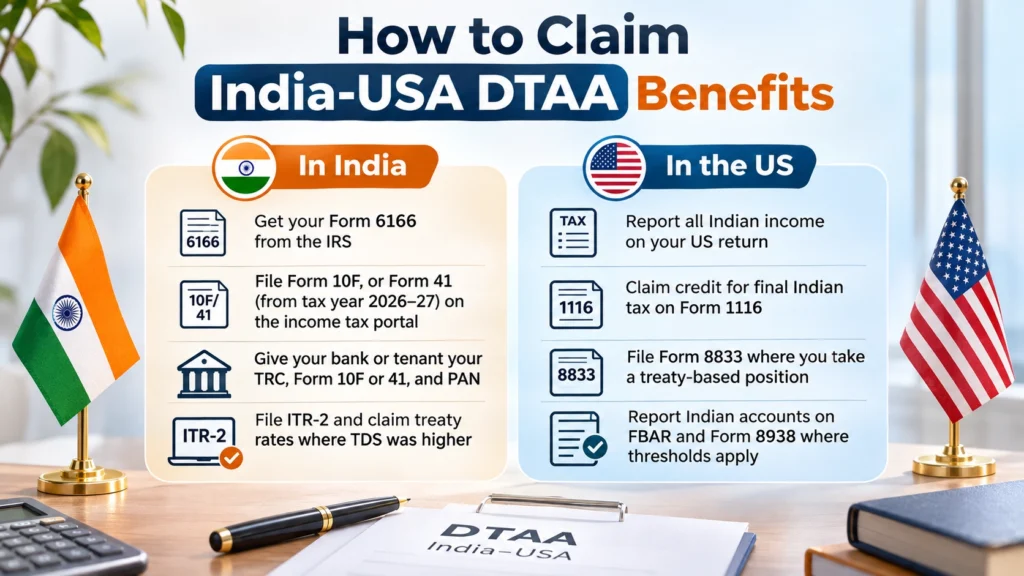
    In India

    • Get your Form 6166 from the IRS
    • File Form 10F, or Form 41 from tax year 2026-27 on the income tax portal
    • Give your bank or tenant your TRC, Form 10F or 41, and PAN
    • File ITR-2 and claim treaty rates where TDS was higher

    In the US

    • Report all Indian income on your US return
    • Claim credit for final Indian tax on Form 1116
    • File Form 8833 where you take a treaty-based position
    • Report Indian accounts on FBAR and Form 8938 where thresholds apply

    MostlyNRI handles NRI income tax return filing on the Indian side and coordinates with your US preparer.

    Common Mistakes

    • Claiming US credit for refundable TDS
    • Assuming capital gains are taxed only in the US
    • Not getting Form 6166, so the 15 percent interest rate is never applied
    • Forgetting that NRE interest is taxable in the US
    • US citizens assuming the treaty cuts US tax despite the saving clause

    Conclusion

    For NRIs in the US, our desk handles TRC and Form 10F or Form 41 filings, treaty rate claims with banks and tenants, Indian ITR filing with refunds, capital gains computation, and the Indian figures your US preparer needs for Form 1116. MostlyNRI works with NRIs across 33 countries, including thousands of families in the US.

    Earning in India while living in the US? Book a consultation with our specialists at beige-spoonbill-433256.hostingersite.com/ for US-India NRI tax filing that keeps you from paying twice.

    FAQs

    What is the India-USA DTAA?

    It is the tax treaty between India and the US, in force since 1990. It decides which country taxes each type of income, caps Indian tax on interest and dividends, and lets each country give credit for tax paid in the other.

    Does the India-USA DTAA make Indian income tax-free in the US?

    No. The US taxes residents and citizens on worldwide income. The treaty lets you claim a foreign tax credit on Form 1116 for Indian tax paid, so the same income is not fully taxed twice.

    What is the DTAA rate on NRO interest for US residents?

    Under Article 11, India can tax NRO interest paid to a US resident at up to 15 percent, instead of 31.2 percent TDS. You need a US Tax Residency Certificate (Form 6166) and Form 10F or Form 41.

    Are capital gains in India taxed in the US for NRIs?

    Yes. Article 13 lets each country tax capital gains under its own law. India taxes the gain first, and the US taxes it as worldwide income, with a foreign tax credit for the Indian tax.

    Can US citizens use the India-USA DTAA?

    Partly. The saving clause in Article 1(3) lets the US tax its citizens as if the treaty did not exist. The foreign tax credit is preserved, so US citizens still avoid double tax through credit.

    How do US residents get a Tax Residency Certificate for India?

    Apply to the IRS on Form 8802 for Form 6166, the US certificate of residency. Then file Form 10F, or Form 41, for tax year 2026-27, on the Indian income tax portal.

    Is NRE interest taxable in the US?

    Yes. NRE interest is tax-free in India but taxable in the US for US tax residents and citizens. Since no Indian tax is paid on it, there is no foreign tax credit to claim.

    Can I claim US foreign tax credit for TDS deducted in India?

    Only for the final Indian tax. TDS that you can recover as an Indian refund does not qualify. File your Indian ITR first, then claim credit for the tax actually payable.

    Is US Social Security taxable in India?

    No. Under Article 20(2) of the India-USA DTAA, US Social Security benefits are taxable only in the US, even if you return and live in India as a resident. Report them in your ITR as exempt income where required.

    How can MostlyNRI help NRIs in the US with DTAA claims?

    MostlyNRI files your TRC and Form 10F or Form 41, applies treaty rates with banks and tenants, files your Indian ITR to recover excess TDS, and gives your US preparer the Indian tax figures for Form 1116.


  • GST 2.0 Rules for NRI Freelancers Exporting IT, Design, and Consulting Services: LUT, Zero-Rated Export, and OIDAR Classification

    GST 2.0 Rules for NRI Freelancers Exporting IT, Design, and Consulting Services: LUT, Zero-Rated Export, and OIDAR Classification

    GST 2.0 went live on 22 September 2025, and it reshaped how India taxes goods and services. Most of the attention went to the new two-slab structure of 5 percent and 18 percent, with a separate 40 percent rate for luxury and sin goods. For freelancers selling IT development, UI and graphic design, content, marketing, and consulting services to clients abroad, the rate itself matters less than three older ideas that GST 2.0 has now made easier to use: zero-rated exports, the Letter of Undertaking (LUT), and OIDAR classification.

    For Non-Resident Indians, there is a more basic question first. Does Indian GST apply to you at all? An NRI coder in Toronto billing a Canadian startup sits outside Indian GST entirely. The same coder working from Pune after moving back sits squarely inside it.

    This guide explains who is covered, what GST 2.0 changed, how to file an LUT, and when OIDAR rules pull NRIs selling digital products to Indian buyers into the GST net.

    Does GST Apply to NRI Freelancers at All?

    Indian GST on services turns on the location of the supplier and the place of supply. For most professional services, the place of supply is the location of the recipient under Section 13(2) of the IGST Act. That gives five common NRI scenarios.

    Your SituationGST Position
    NRI living abroad, working abroad, foreign clientsOutside Indian GST. No registration needed
    NRI living abroad, Indian business clientsImport of services. Your registered Indian client pays GST under reverse charge
    NRI abroad selling online courses, e-books, templates, or software to Indian individualsOIDAR supply. You must register and pay 18 percent IGST
    Returned NRI, RNOR, or NRI freelancing from India for a long stay, foreign clientsExport of services. Zero-rated if all conditions are met
    NRI owning an Indian LLP or company that bills foreign clientsThe entity is a supplier in India. Export rules apply to the entity

    The fourth row catches people. Returning NRIs often keep overseas clients after moving home. Once you deliver work from India, you are a supplier located in India, and registration, LUT filing, and returns follow once you cross the threshold.

    Residency for GST is separate from residency for income tax. Your NRI tax residency status under the Income Tax Act decides how your freelance income is taxed, while GST asks only where the service is supplied from.

    What GST 2.0 Changed for Service Exporters

    The 56th GST Council meeting on 3 September 2025 approved the GST 2.0 package. For freelancers and consultants exporting services, the useful changes are:

    • Rate rationalisation from 22 September 2025: most IT, design, and consulting services stay at 18 percent, which only matters when you supply to Indian clients
    • Provisional refund of 90 percent for zero-rated supplies from 1 November 2025, through an amendment to Rule 91(2) of the CGST Rules, based on system-driven risk evaluation
    • Simplified registration from 1 November 2025 for small, low-risk applicants, with registration granted within three working days
    • Removal of the refund threshold for exports made with payment of tax, through a proposed amendment to Section 54(14) of the CGST Act
    • Intermediary services: the Council recommended omitting Section 13(8)(b) of the IGST Act, so intermediaries serving foreign clients could qualify as exporters (this needs a legislative amendment, so confirm its status before relying on it)

    The practical win is cash flow. Refund claims on IGST paid, or on input tax credit for laptops, software, and coworking rent, now get 90 percent provisionally instead of waiting months.

    When is a Service an Export? The Five Conditions

    Under Section 2(6) of the IGST Act, a supply counts as an export of services only when all five conditions are met at the same time:

    1. The supplier is located in India
    2. The recipient is located outside India
    3. The place of supply is outside India
    4. Payment is received in convertible foreign exchange, or in Indian rupees where RBI permits
    5. The supplier and recipient are not merely establishments of the same person

    Miss any one, and the supply becomes domestic at 18 percent. Keep the FIRC or FIRA from your bank or payment platform for every invoice as proof of foreign exchange receipt. The fifth condition means a service from an Indian branch to its own foreign head office is not an export.

    Registration Threshold: When Freelancers Must Register

    GST registration for service providers becomes mandatory once aggregate turnover crosses Rs 20 lakh in a financial year (Rs 10 lakh in special category states). Export turnover counts toward aggregate turnover.

    • Crossing Rs 20 lakh triggers registration within 30 days
    • Voluntary registration below the threshold lets you claim refunds of GST paid on business expenses
    • OIDAR suppliers located abroad must register regardless of turnover

    Freelancers planning to scale can set up the right structure early. Our Business and Startup Support for NRIs desk helps you choose between sole proprietorship, LLP, and private limited before registration locks you in.

    The Letter of Undertaking (LUT): Export Without Paying IGST

    An exporter has two options under Section 16 of the IGST Act:

    • Export under LUT without paying IGST, then claim a refund of accumulated input tax credit
    • Export with payment of IGST at 18 percent, then claim a refund of the IGST paid

    For freelancers, the LUT route is almost always better because no cash leaves your account at the time of invoicing.

    How to File an LUT

    1. Log in to gst.gov.in
    2. Go to Services, then User Services, then Furnish Letter of Undertaking (LUT)
    3. Select the financial year
    4. Enter details of two independent witnesses
    5. Sign with DSC or EVC and submit Form GST RFD-11
    6. Download the ARN acknowledgement, which is usually auto-accepted

    The LUT is valid for one financial year and must be renewed every April. File it before the first export invoice of the year, otherwise that invoice is treated as an export with payment of tax.

    Invoice and Return Requirements

    • Mark each export invoice with “Supply meant for export under LUT without payment of IGST”
    • Show IGST at 0 percent and the foreign currency value
    • Report the invoice in Table 6A of GSTR-1
    • Report the value in Table 3.1(b) of GSTR-3B as zero-rated supply

    OIDAR: The Rule That Reaches NRIs Living Abroad

    OIDAR stands for Online Information Database Access and Retrieval services. It is the one GST category that can apply to an NRI who has never worked a single day from India.

    The Finance Act 2023 widened the OIDAR definition from 1 October 2023. The old condition that services must involve minimal human intervention was removed, so the definition now covers services delivered over the internet more broadly. The definition of non-taxable online recipient was also expanded to include unregistered persons in India.

    Typical OIDAR supplies by NRI creators include online courses, e-books, templates, stock images, SaaS tools, plugins, apps, and paid memberships.

    If you live abroad and sell these to Indian individuals or unregistered buyers, you are supplying OIDAR services into India. You must take simplified registration through Form GST REG-10, file GSTR-5A returns, and pay 18 percent IGST. If your buyer is a GST-registered Indian business, that business pays tax under reverse charge instead.

    Custom one-to-one work, such as building a website for a client in Mumbai, is generally a professional service rather than OIDAR. The line is about how the service is delivered and whether it is a standard digital product.

    The Intermediary Trap

    Some freelancers act as agents, such as sourcing Indian vendors for a foreign brand, recruiting for an overseas employer, or arranging sales for a foreign SaaS company. Under Section 13(8)(b) of the IGST Act, the place of supply for intermediary services is the location of the supplier. If you are in India, the supply is domestic, so you charge 18 percent GST even though your client is abroad. The 56th GST Council recommended removing this clause. Until the change is notified, structure your contracts carefully and price GST into intermediary engagements.

    How GST Fits With Your Income Tax Return

    GST and income tax are separate, but they must agree. Turnover in GSTR-1 should match gross receipts in your ITR, since AIS captures both. You can use the Section 44ADA presumptive scheme and still be GST-registered, and returned NRIs in their RNOR window still owe GST compliance on services exported from India.

    Our guide to ITR filing for NRI freelancers and F&O traders explains the ITR-3 and ITR-4 choice, and our Income Tax Returns Filing team reconciles GST turnover with your return before submission.

    Common GST Mistakes NRI Freelancers Make

    • Registering while still living and working abroad with only foreign clients
    • Ignoring OIDAR registration when selling courses or templates to Indian buyers
    • Issuing the first export invoice before filing the LUT
    • Losing FIRC or FIRA records for platform payouts
    • Treating intermediary commissions as exports
    • Letting GST turnover and ITR receipts drift apart

    If a mismatch has already produced a notice, our NRI Income Tax Notice Solutions team handles the response.

    How MostlyNRI Helps NRI and Returning Freelancers

    At MostlyNRI, we help NRIs and returning professionals across the USA, UAE, UK, Canada, Singapore, and Australia with:

    • Residency analysis to confirm whether GST and Indian income tax apply
    • ITR filing with Section 44ADA and GST turnover reconciliation
    • Returnee planning so overseas clients move with you cleanly, through our Returnee NRI Transition Services
    • Bank set-up for foreign inward remittances using our NRI Bank Account Type Advisor

    Our team serves clients from over 33 countries across 13 Indian cities.

    Freelancing for overseas clients from India, or selling digital products to Indian buyers? Book a consultation with our specialists at beige-spoonbill-433256.hostingersite.com/ to map your GST, LUT, and income tax obligations before your next invoice.

    Frequently Asked Questions (FAQs)

    Does GST apply to an NRI freelancer living abroad with foreign clients?

    No. If you live and work abroad and your clients are outside India, you are not a supplier located in India, so Indian GST does not apply. GST becomes relevant only when you supply from India or sell OIDAR services to Indian consumers.

    What is GST 2.0 and when did it start?

    GST 2.0 is the rate and compliance overhaul approved by the 56th GST Council. New rates took effect on 22 September 2025, with 5 percent and 18 percent as the main slabs. Provisional refund and simplified registration changes followed from 1 November 2025.

    Is GST payable on export of IT and design services?

    No, if all five export conditions are met. Exports of services are zero-rated under Section 16 of the IGST Act. You either export under an LUT without paying IGST, or pay 18 percent IGST and claim a refund.

    What is an LUT and how often must freelancers file it?

    An LUT is a Letter of Undertaking filed on Form GST RFD-11 that lets you export without paying IGST. It is valid for one financial year and must be filed before the first export invoice of each year, usually in April.

    What is an LUT and how often must freelancers file it?

    An LUT is a Letter of Undertaking filed on Form GST RFD-11 that lets you export without paying IGST. It is valid for one financial year and must be filed before the first export invoice of each year, usually in April.

    When must a returned NRI freelancer register for GST?

    Registration becomes mandatory when aggregate turnover, including exports, crosses Rs 20 lakh in a financial year, or Rs 10 lakh in special category states. You can register voluntarily below this limit to claim refunds of GST paid on business expenses.

    What is OIDAR and how does it affect NRI creators?

    OIDAR covers digital services delivered online, such as courses, e-books, and SaaS. NRIs abroad selling these to Indian individuals must register through Form GST REG-10, file GSTR-5A, and pay 18 percent IGST on those sales.

    Do NRIs need GST registration to work for Indian companies from abroad?

    Usually no. When an NRI abroad provides services to a GST-registered Indian business, the Indian business pays GST under reverse charge as an import of services. The NRI does not need to register, though the client may ask for a tax residency certificate.

    What proof of foreign payment do service exporters need?

    Keep the FIRC or FIRA from your bank or payment provider for every export invoice. It proves payment arrived in convertible foreign exchange, which is one of the five conditions for zero-rated export treatment under Section 2(6) of the IGST Act.

    Are commission and agency services treated as exports?

    Not under current law. Under Section 13(8)(b) of the IGST Act, intermediary services take the supplier’s location as place of supply, so they attract 18 percent GST. The GST Council recommended changing this, so check notification status before invoicing.

    How can MostlyNRI help freelancers with GST and income tax?

    MostlyNRI confirms whether GST applies to you, supports business set-up, reconciles GST turnover with your ITR, files returns under the Income Tax Act 2025, and handles notices, so returning NRIs and freelancers stay compliant on both fronts.

  • Union Budget 2026 for NRIs: Seven Structural Changes That Rewire Your Tax, Property, and Remittance Playbook

    Union Budget 2026 for NRIs: Seven Structural Changes That Rewire Your Tax, Property, and Remittance Playbook

    The Union Budget 2026-27, presented by Finance Minister Nirmala Sitharaman on 1 February 2026, was not headline-grabbing on income tax slabs. Rates stayed where the 2024 Budget left them. But look past the slab table and Budget 2026 quietly delivers seven structural changes that touch almost every decision an NRI has to make: the new Income Tax Act 2025 takes over from 1 April 2026, the OCI listed-company holding cap has been raised for the first time in years, NRI property paperwork has been simplified, a six-month foreign asset disclosure window has opened, TCS on outward remittances has been cut, the Baggage Rules 2026 kicked in for NRI travellers, and ITR filing deadlines have been staggered.

    For NRIs in the USA, UAE, UK, Canada, Singapore, and Australia, these changes shift both the numbers and the compliance calendar for 2026-27. Missing the six-month disclosure window can expose you to the Black Money Act. Waiting for 1 October 2026 can save your buyer weeks of TAN paperwork. Restructuring your Indian equity portfolio can double your per-company exposure without breaking FEMA limits.

    Change 1: New Income Tax Act 2025 Takes Over from 1 April 2026

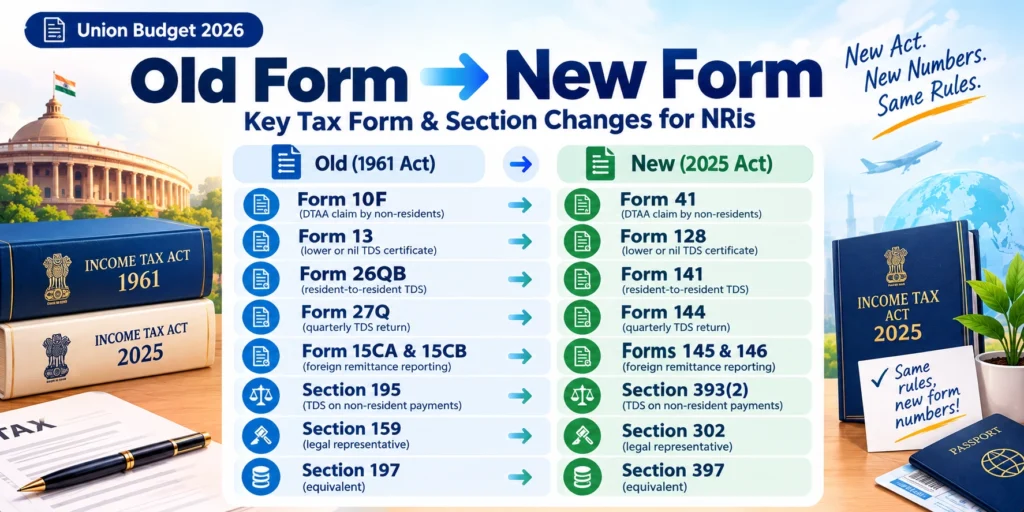
    The most consequential change is not a rate cut but a full statutory replacement. The Income Tax Act 2025 replaces the Income Tax Act 1961 from 1 April 2026. Every section number, form number, and procedural reference NRIs have used for decades now has a new label.

    Key form renumbering NRIs should note:

    • Form 10F replaced by Form 41 (DTAA claim by non-residents)
    • Form 13 replaced by Form 128 (lower or nil TDS certificate)
    • Form 26QB replaced by Form 141 (challan-cum-statement for resident-to-resident TDS)
    • Form 27Q replaced by Form 144 (quarterly TDS return for non-resident payments)
    • Form 15CA and 15CB replaced by Forms 145 and 146 (foreign remittance reporting)
    • Section 195 replaced by Section 393(2) (TDS on non-resident payments)
    • Section 159 replaced by Section 302 (legal representative)
    • Section 197 equivalent under Section 397

    The substantive law on residency, capital gains, DTAA relief, and Schedule FA disclosures continues in largely the same shape, but every filing reference must now cite the new numbers. Our NRI Taxation and Compliance team files all NRI returns under the new Act with correct form references.

    Change 2: OCI and NRI Listed Company Holding Cap Raised

    Budget 2026 delivered one of the longest-pending NRI investor asks. Under the FEMA Non-Debt Instruments Rules, individual NRIs and OCIs were previously restricted to holding 5 percent of the paid-up equity capital of a single listed Indian company, with the aggregate NRI-OCI cap at 10 percent (raisable to 24 percent by company special resolution).

    The new limits:

    • Individual NRI or OCI cap: raised from 5 percent to 10 percent of paid-up capital in a single listed company
    • Aggregate NRI-OCI cap: raised to 24 percent (with special resolution flexibility retained)
    • Applies to Portfolio Investment Scheme (PIS) holdings routed through designated banks

    For high-net-worth NRIs building concentrated positions in Indian midcap or largecap names, this doubles the per-company exposure ceiling. If you are also considering diversified vehicles, our Invest in Mutual Funds and PMS for NRI services align portfolio construction with the new headroom.

    Change 3: NRI Property Paperwork Simplified from 1 October 2026

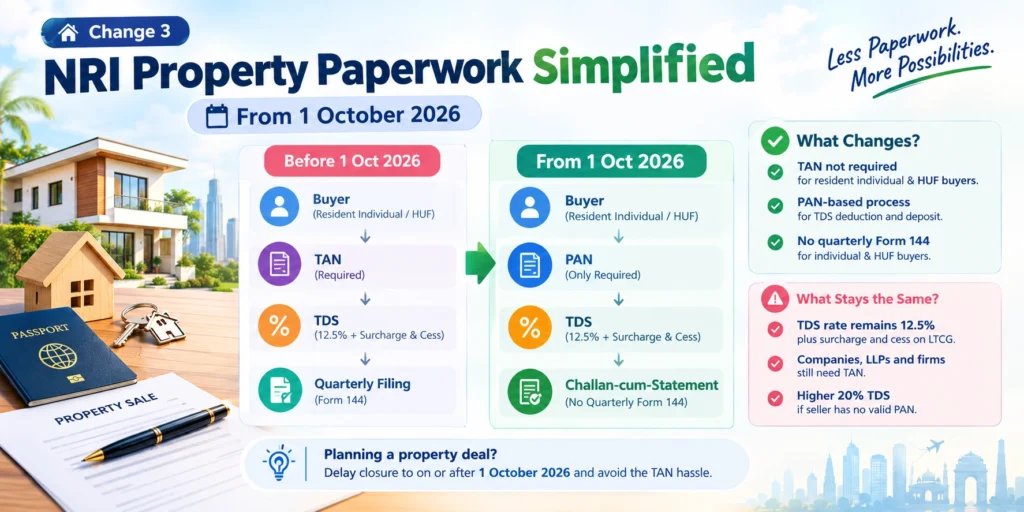
    Under the amended Section 397(1)(c) of the Income Tax Act 2025, resident individual and HUF buyers purchasing property from an NRI will no longer need a TAN from 1 October 2026. TDS will be deducted and deposited using the buyer’s PAN via a challan-cum-statement mechanism.

    What changes and what does not:

    • Change: Resident individual and HUF buyers can transact with just a PAN
    • Change: No quarterly Form 144 return burden for individual and HUF buyers
    • Not changed: TDS rate remains 12.5 percent plus surcharge and cess on LTCG
    • Not changed: Companies, LLPs, and firms still need TAN
    • Not changed: Higher 20 percent TDS if seller has no valid PAN

    For NRIs currently in a property sale negotiation, delaying closure to on or after 1 October 2026 can eliminate the entire TAN pain point for individual buyers. Our Capital Gain Tax team models both timing options, and the NRI TDS Refund Calculator estimates any refund exposure.

    Change 4: Six-Month Foreign Asset Disclosure Scheme (FAST-DS 2026)

    The Foreign Assets of Small Taxpayers Disclosure Scheme 2026, or FAST-DS 2026, is the single most important compliance opportunity Budget 2026 opened for NRIs and returning residents.

    Who it targets:

    • Returning NRIs who forgot to disclose foreign bank accounts, brokerage, or IRAs in past Schedule FA filings
    • Students and technology professionals with dormant overseas accounts
    • Former deputees with legacy foreign employer holdings (RSUs, ESOPs, pension plans)
    • Individuals who had a period of Indian tax residency during COVID or relocation and missed disclosures then

    Category A: Undisclosed foreign income up to Rs 1 crore Category B: Undeclared foreign assets up to Rs 5 crore

    In return for disclosure within the six-month window, participants receive immunity from penalties and prosecution under the Black Money (Undisclosed Foreign Income and Assets) Act. This is a rare reset opportunity because the Black Money Act allows a 10-year look-back and imposes penalties up to 300 percent of tax due, with prosecution risk.

    Our Returnee NRI Transition Services framework audits your foreign asset position to determine whether you qualify for FAST-DS 2026 before the window closes.

    Change 5: TCS on Outward Remittances Cut to Flat 2 Percent

    Budget 2026 rationalised Tax Collected at Source (TCS) under the Liberalised Remittance Scheme (LRS) and overseas tour programme packages under Section 206C(1G).

    PurposeOld TCS RateNew TCS Rate
    Overseas tour packages (up to Rs 10 lakh)5%2% flat, no threshold
    Overseas tour packages (above Rs 10 lakh)20%2% flat
    LRS education (above threshold, own funds)5%2%
    LRS education (loan-funded, Section 80E)0.5%0.5% unchanged
    LRS medical (above threshold)5%2%
    LRS general purpose20%20% unchanged

    For NRI families whose India-based parents or siblings fund tours, education, or medical treatment abroad, this saves thousands of rupees per remittance. On a Rs 15 lakh European tour package that previously carried Rs 1.5 lakh TCS, the new outgo is just Rs 30,000.

    The NRI TDS Refund Calculator helps estimate any recoverable TCS from past filings.

    Change 6: Baggage Rules 2026 for NRI Travellers

    The Baggage Rules 2026, which came into effect on 2 February 2026, provide two direct benefits for NRIs travelling to India:

    • Higher duty-free allowance on personal effects and gifts
    • Cleaner rule on gold jewellery brought by returning residents
    • Simpler declarations at the customs desk on arrival

    For NRIs returning permanently, the updated allowance eases the transition. For NRIs visiting India for weddings or family occasions, gift and jewellery limits have been rationalised to reduce customs friction. Combined with the Returnee NRI Transition Services framework, the rules cut the paperwork on a physical move meaningfully.

    Change 7: Staggered ITR Filing Deadlines

    Budget 2026 introduced staggered filing deadlines to reduce end-of-July congestion on the e-filing portal.

    • ITR-1 and ITR-2 (individuals, capital gains, salary): 31 July
    • Non-audit business cases and trusts: 31 August
    • Audit cases (business, F&O traders, professionals with high receipts): 31 October
    • Transfer pricing (international transactions): 30 November

    For NRIs filing ITR-2 (which covers most residents-abroad with capital gains, rent, and other income), the 31 July deadline continues. For NRIs with freelance or F&O business income requiring audit under Section 44AB, the 31 October window applies. Our Income Tax Returns Filing team maps your correct due date based on the income profile.

    The Broader Signal: Budget 2026 Rewards Compliance and Participation

    Look at all seven changes together and a policy direction emerges. Budget 2026:

    • Eases entry into Indian equity markets (raised OCI caps)
    • Reduces friction on cross-border remittances (TCS cut)
    • Simplifies property transactions (PAN-based TDS for individual buyers)
    • Rewards voluntary disclosure (FAST-DS 2026 with immunity)
    • Lowers physical-move barriers (Baggage Rules 2026)
    • Modernises the statute (new Income Tax Act 2025)
    • Rationalises compliance calendar (staggered ITR deadlines)

    The subtext is that India wants NRI capital and participation, but on audited, disclosed, compliant terms. NRIs who use 2026 to clean up legacy Schedule FA gaps, rebalance under new equity caps, and time property sales around 1 October are set up for years of smoother filings.

    Immediate Action Checklist for NRIs in 2026

    Concrete steps to take before the windows close:

    • Audit your Schedule FA history for any unreported foreign bank accounts, RSUs, IRAs, or pensions
    • Evaluate FAST-DS 2026 eligibility if legacy assets are under Rs 5 crore
    • Delay property sale closure to on or after 1 October 2026 if buyer is an individual or HUF
    • Restructure Indian equity portfolio to use the new 10 percent per-company cap
    • Refile Form 41 with correct TRC under the new Income Tax Act 2025 if needed
    • Update your ITR filing calendar based on the staggered deadlines
    • Time large LRS remittances to fall in FY 2026-27 for the 2 percent TCS benefit
    • Consult on GIFT City options where dollar-denominated exposure is preferred

    Our GIFT City Funds service maps the dollar-denominated NRI options for portfolio integration.

    How MostlyNRI Helps You Execute the Budget 2026 Opportunities

    Budget 2026 is a compliance and planning window, not just a set of announcements. Capturing the benefits requires residency analysis, portfolio restructuring, disclosure scheme evaluation, DTAA planning, property timing, and forms transition under the new Act.

    At MostlyNRI, we help NRIs across the USA, UAE, UK, Canada, Singapore, and Australia with:

    • FAST-DS 2026 evaluation and disclosure execution
    • Property sale timing around the 1 October 2026 PAN-based TDS window
    • Portfolio restructuring under the new 10 percent OCI equity cap
    • ITR filing under the Income Tax Act 2025 with correct form references
    • Form 41 filings and TRC applications
    • Schedule FA and FSI disclosures with DTAA credit optimisation
    • NRE, NRO, FCNR account structuring for remittance planning
    • Baggage and returnee planning for NRIs relocating in 2026-27

    Our team serves NRIs from over 33 countries across 13 Indian cities.

    Ready to act on the Budget 2026 windows before they close? Book a consultation with our specialists at beige-spoonbill-433256.hostingersite.com/ to build your 2026-27 tax, property, and remittance playbook under the new Income Tax Act.

    Frequently Asked Questions (FAQs)

    What are the seven structural changes for NRIs in Budget 2026?

    Budget 2026 introduced the new Income Tax Act 2025, raised OCI equity limits, simplified NRI property TDS from 1 October 2026, launched FAST-DS 2026 foreign asset disclosure, cut TCS to 2 percent, updated Baggage Rules 2026, and staggered ITR deadlines.

    When does the new Income Tax Act 2025 take effect for NRIs?

    The Income Tax Act 2025 takes effect from 1 April 2026 and applies to FY 2026-27 (AY 2027-28) onwards. It replaces the 1961 Act with new section numbers and forms while keeping most substantive rules on residency, capital gains, and DTAA relief unchanged.

    What is the new OCI listed company holding cap under Budget 2026?

    Budget 2026 doubled the individual NRI or OCI cap in a single listed Indian company from 5 percent to 10 percent of paid-up equity. The aggregate NRI-OCI cap has been raised to 24 percent, giving high-net-worth NRIs materially more headroom in concentrated positions.

    What is FAST-DS 2026 and who qualifies?

    FAST-DS 2026 is a six-month Foreign Assets of Small Taxpayers Disclosure Scheme offering immunity from Black Money Act penalties. It covers returning NRIs, students, and professionals with undisclosed income up to Rs 1 crore (Category A) or foreign assets up to Rs 5 crore (Category B).

    How does the 1 October 2026 property TDS change help NRI sellers?

    From 1 October 2026, resident individual and HUF buyers purchasing property from an NRI can deduct TDS using their PAN without obtaining a TAN. This removes weeks of paperwork and quarterly Form 144 filings, though the 12.5 percent LTCG rate remains unchanged.

    What is the new TCS rate on outward remittances under Budget 2026?

    TCS on overseas tour packages is now a flat 2 percent with no threshold. TCS on LRS education and medical remittances above the applicable threshold has been reduced from 5 percent to 2 percent. General LRS purposes continue at 20 percent above Rs 10 lakh.

    What are the new ITR filing deadlines for NRIs in 2026?

    ITR-1 and ITR-2 filers, including most NRIs with capital gains and passive income, continue with a 31 July deadline. Non-audit business filers get 31 August, and audit cases get 31 October. Transfer pricing cases have a 30 November deadline.

    Do the Baggage Rules 2026 benefit returning NRIs?

    Yes. The Baggage Rules 2026, effective 2 February 2026, provide a higher duty-free allowance and a cleaner rule on gold jewellery brought by returning residents. This eases the customs experience for NRIs relocating to India or bringing gifts during family visits.

    Should NRIs disclose foreign assets under FAST-DS 2026?

    Yes, if your Schedule FA history is incomplete and your undisclosed foreign assets fall within the scheme’s thresholds. The cost of the scheme is far lower than the Black Money Act penalty of up to 300 percent with 10-year look-back and prosecution risk on future detection.

    How can MostlyNRI help me execute Budget 2026 opportunities?

    MostlyNRI evaluates FAST-DS 2026 eligibility, times property sales around 1 October 2026, restructures portfolios under new OCI caps, files ITRs under the Income Tax Act 2025, and handles Form 41, TRC, and Schedule FA disclosures for NRIs across 30+ countries.

  • TCS on International Tour Packages Cut to 2 Percent: What NRI Families Save on India Visits and Return Trips in 2026

    TCS on International Tour Packages Cut to 2 Percent: What NRI Families Save on India Visits and Return Trips in 2026

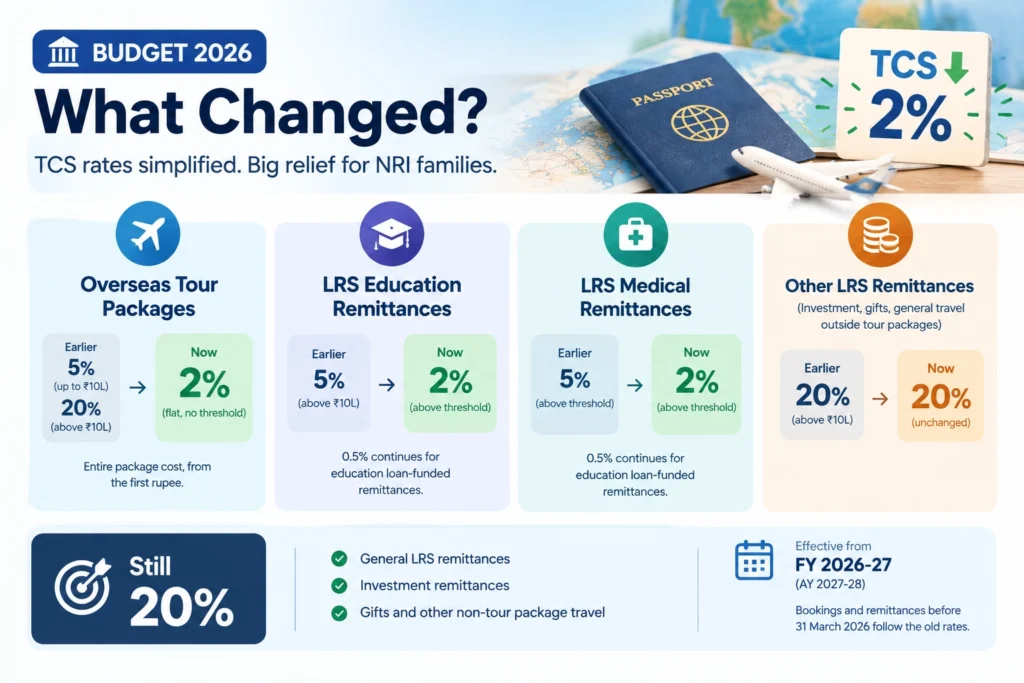
    Budget 2026 delivered one of the most direct cost cuts NRI families have seen in years. On 1 February 2026, Finance Minister Nirmala Sitharaman announced a flat 2 percent Tax Collected at Source (TCS) on overseas tour packages, replacing the earlier dual rate of 5 percent up to Rs 10 lakh and 20 percent above Rs 10 lakh. The Rs 10 lakh threshold for tour packages has been removed entirely. In parallel, TCS on education and medical remittances under the Liberalised Remittance Scheme (LRS) has also been cut from 5 percent to 2 percent.

    For NRI families whose parents fund a US or Canada visit, whose siblings book tour packages for family reunions, whose spouses study in an American or UK university, or whose relatives need overseas medical treatment, the change is a direct cash-flow win. On a Rs 15 lakh European tour that previously carried Rs 1.5 lakh TCS at the higher slab, the new outgo is just Rs 30,000. A parent funding a Rs 40 lakh medical treatment abroad saves close to Rs 1.2 lakh in blocked cash upfront.

    This guide breaks down exactly what changed under Section 206C(1G), how much NRI families save on India visits and return trips, who qualifies, when the old rates still apply, and how to claim a TCS refund if the tax cannot be adjusted.

    What Changed on 1 February 2026: The Budget 2026 TCS Reset

    The Finance Bill 2026 rationalised TCS rates across the three main LRS categories that touch NRI families most often.

    • Overseas tour programme packages: flat 2 percent, no threshold
    • LRS education remittances: 2 percent on amounts exceeding the threshold
    • LRS medical treatment remittances: 2 percent on amounts exceeding the threshold
    • Education loan-funded remittances: continue at 0.5 percent under Section 80E-linked concession
    • Other LRS remittances (investment, gifts, general travel outside tour packages): unchanged at 20 percent above Rs 10 lakh

    The changes are effective from FY 2026-27 (AY 2027-28). Bookings made and remittances sent before 31 March 2026 follow the older rate structure.

    For an NRI family based in the US, UAE, UK, Canada, Singapore, or Australia planning a large India visit or return trip, this is a clean savings window. Our NRI Tax Residency Calculator confirms your residency classification before you plan any large remittance.

    TCS on International Tour Packages: The Flat 2 Percent Rate

    This is the headline change. Under Section 206C(1G), an overseas tour programme package includes travel, hotel stay, boarding, lodging, and any similar related expenditure sold as a single package.

    Before Budget 2026:

    • 5 percent TCS on aggregate package cost up to Rs 10 lakh
    • 20 percent TCS on the portion exceeding Rs 10 lakh

    After Budget 2026:

    • Flat 2 percent on the entire package cost
    • No minimum threshold
    • Applies from the first rupee of the tour package

    The tour operator collects the TCS at the time of booking and deposits it against your PAN. It is not an additional tax; it is a prepaid credit that can be adjusted against your final tax liability in India or claimed as a refund in your ITR.

    TCS on Education Remittances Under LRS: 2 Percent Relief

    For NRI-linked families paying overseas tuition and living expenses from India, the education TCS cut is a major cash-flow relief.

    Before Budget 2026:

    • 5 percent TCS on amounts exceeding Rs 10 lakh
    • 0.5 percent TCS if remittance was funded by a recognised education loan under Section 80E

    After Budget 2026:

    • 2 percent on amounts exceeding the applicable threshold
    • 0.5 percent rate for education loan-funded remittances continues
    • Bank, forex dealer, or authorised remitter collects the TCS at the time of transfer

    For NRI parents in India sending children to the US, UK, Canada, or Australia for education, the effective upfront tax on a Rs 40 lakh annual fee remittance drops from Rs 1.5 lakh to Rs 60,000. That is Rs 90,000 back in the family’s cash flow at the exact moment tuition and rent are due.

    TCS on Medical Remittances: The Critical Cash-Flow Fix

    The 2 percent rate on medical LRS remittances is the most humane change in the package. Overseas medical treatment often runs into tens of lakhs, and previously families were forced to send 5 percent extra upfront at the worst possible moment.

    Before Budget 2026: 5 percent above the applicable threshold.

    After Budget 2026: 2 percent above the applicable threshold.

    For a Rs 50 lakh cancer treatment package overseas, the upfront TCS falls from Rs 2 lakh to Rs 80,000. That difference sits in the family’s account when medical bills are being paid, not with the tax department awaiting refund.

    If your relative is receiving treatment abroad and TCS has already been blocked, the NRI TDS Refund Calculator helps estimate how much can be recovered through an ITR filing.

    Old vs New TCS Rates: The Complete Budget 2026 Comparison

    PurposeOld TCS RateNew TCS Rate (Budget 2026)
    Overseas tour package (up to Rs 10 lakh)5%2%
    Overseas tour package (above Rs 10 lakh)20%2%
    LRS education (above Rs 10 lakh, own funds)5%2%
    LRS education (loan-funded, Section 80E)0.5%0.5% (unchanged)
    LRS medical (above Rs 10 lakh)5%2%
    LRS general purpose (above Rs 10 lakh)20%20% (unchanged)
    LRS investment abroad (above Rs 10 lakh)20%20% (unchanged)

    The pattern is clear: essential and family-linked remittances (tour, education, medical) benefit; discretionary remittances (investment, general transfers) remain at the higher slab.

    How the New Rules Benefit NRI Families

    NRI families interact with LRS and tour package TCS in more scenarios than most realise. Consider how the flat 2 percent rate flows through common situations.

    • Parents in India booking a package tour to visit an NRI son or daughter in the US or Canada
    • Siblings arranging a family reunion tour in Europe or Southeast Asia
    • NRI’s Indian family funding a child’s overseas education
    • Elderly parents seeking medical treatment abroad, funded from India by the NRI’s siblings
    • Return trips for the NRI’s family through Indian tour operators
    • India-outbound honeymoons and destination weddings with global family members

    In each case, the cash outgo at the point of booking or remittance drops materially, freeing up funds for the actual purpose rather than a refundable tax deposit.

    NRI-Specific Scenarios: Who Saves and How Much

    Scenario 1: Parents visiting an NRI child in the US on a Rs 12 lakh tour package

    • Old TCS: Rs 50,000 (5% on Rs 10 lakh) plus Rs 40,000 (20% on Rs 2 lakh) = Rs 90,000
    • New TCS: Rs 24,000 (flat 2% on Rs 12 lakh)
    • Savings: Rs 66,000

    Scenario 2: NRI’s sister in India funding overseas medical treatment of Rs 25 lakh

    • Old TCS: 5% on Rs 15 lakh (above threshold) = Rs 75,000
    • New TCS: 2% on Rs 15 lakh = Rs 30,000
    • Savings: Rs 45,000

    Scenario 3: Indian grandparents paying US university fees of Rs 35 lakh (own funds)

    • Old TCS: 5% on Rs 25 lakh (above threshold) = Rs 1,25,000
    • New TCS: 2% on Rs 25 lakh = Rs 50,000
    • Savings: Rs 75,000

    Scenario 4: Family destination wedding in Bali costing Rs 30 lakh as one package

    • Old TCS: Rs 50,000 (5% on Rs 10 lakh) plus Rs 4 lakh (20% on Rs 20 lakh) = Rs 4,50,000
    • New TCS: 2% flat on Rs 30 lakh = Rs 60,000
    • Savings: Rs 3,90,000

    The high-ticket, single-package trips see the biggest gains because the punitive 20 percent slab is fully replaced by 2 percent.

    The Rs 10 Lakh Threshold and How to Plan Around It

    The Rs 10 lakh annual threshold applies per PAN, per financial year, per category. This means:

    • Amounts below Rs 10 lakh for LRS education and medical remittances continue to attract zero TCS
    • Amounts above Rs 10 lakh attract the 2 percent rate on the excess portion
    • For tour packages, no threshold applies; 2 percent kicks in from the first rupee

    If your family is planning multiple remittances during one FY, TCS is calculated on the cumulative annual total per PAN. Splitting between two PANs (say father and son) can help stay under thresholds where feasible.

    For a personalised remittance and TCS plan, our NRI Taxation and Compliance team maps the annual outgo to the right PAN.

    LRS: What NRIs Should Know About Who Qualifies

    The Liberalised Remittance Scheme is fundamentally a resident individual scheme. NRIs themselves cannot use LRS from outside India, but the rules matter because:

    • Resident Indian family members using LRS to fund NRI-linked expenses are subject to TCS
    • Resident Indian parents sending money to NRI children are governed by LRS
    • The USD 250,000 annual cap per resident individual applies across all LRS purposes
    • Once the NRI moves back to India, LRS applies to them as well
    • HUFs with resident status can also use LRS

    For NRIs planning a return to India, our Returnee NRI Transition Services framework flags LRS obligations that kick in from the day of return.

    How to Claim TCS Refund When You Cannot Adjust It

    TCS is not an additional tax; it is a prepaid credit. If your final Indian tax liability is lower than the TCS collected, or if you have no taxable Indian income, you can claim the balance as a refund.

    Steps to claim TCS refund:

    • Check Form 26AS and AIS for the TCS credit posted against your PAN
    • File ITR-2 if you have capital gains, foreign income, or non-business income
    • File ITR-3 if you also have business or professional income
    • Report the TCS in the taxes paid section along with your PAN details
    • Reconcile with the challan reference from the tour operator or bank
    • File within the due date to avoid interest calculation reversals

    Refund processing typically takes 4 to 12 weeks after e-verification. Our Income Tax Returns Filing team handles NRI-linked TCS refunds end to end.

    Common Mistakes NRI Families Make on TCS Planning

    The most avoidable errors:

    • Booking tour packages before 31 March 2026 at old rates when the trip could wait
    • Splitting a package into flight and hotel separately, treating it as general LRS and triggering 20 percent
    • Ignoring Section 80E education loan benefits that give a 0.5 percent rate
    • Missing Form 26AS reconciliation and losing the refund window
    • Using a non-resident’s PAN for tour bookings (LRS is for residents only)
    • Assuming TCS is a tax cost instead of a prepaid credit
    • Failing to file the Indian ITR to claim the refund
    • Overlooking Rs 10 lakh threshold planning across the financial year

    If TCS refund claims have triggered mismatch notices in past filings, our NRI Income Tax Notice Solutions team closes the file efficiently.

    How MostlyNRI Helps You Maximise the Budget 2026 TCS Savings

    The Budget 2026 TCS cut is real cash back in NRI family pockets, but it needs correct planning to capture. At MostlyNRI, we help NRIs and their India-based families with:

    • Annual LRS remittance planning for education, medical, and tour expenses
    • Section 80E and 0.5 percent rate structuring for education loans
    • TCS refund claims through correct ITR filing
    • Form 26AS and AIS reconciliation before filing
    • Return migration planning for NRIs who will move to LRS status themselves
    • Cross-border DTAA analysis for related payments
    • Response to tax notices on TCS mismatch or refund delays

    Our team serves NRIs across the USA, UAE, UK, Canada, Singapore, and Australia, with client footprint spanning 33 countries and 13 Indian cities.

    Planning a tour, education transfer, or medical remittance under the new Budget 2026 rules? Book a consultation with our specialists at beige-spoonbill-433256.hostingersite.com/ to structure your annual remittance calendar, TCS planning, and refund route for maximum cash retention.

    Frequently Asked Questions (FAQs)

    What is the new TCS rate on international tour packages under Budget 2026?

    The TCS rate on overseas tour programme packages has been cut to a flat 2 percent with no threshold, effective FY 2026-27. This replaces the earlier dual structure of 5 percent up to Rs 10 lakh and 20 percent above Rs 10 lakh.

    What is the new TCS rate on LRS education remittances in 2026?

    TCS on LRS education remittances has been reduced from 5 percent to 2 percent on amounts above the applicable threshold. Remittances funded by a recognised education loan under Section 80E continue at the concessional rate of 0.5 percent.

    What is the new TCS rate on LRS medical remittances?

    For medical treatment abroad under LRS, TCS has been cut from 5 percent to 2 percent on amounts above the applicable threshold. This eases upfront cash flow for families managing overseas medical treatments where costs often run into tens of lakhs of rupees.

    Does the Rs 10 lakh threshold apply to tour packages after Budget 2026?

    No. The Rs 10 lakh threshold has been removed for tour packages. The flat 2 percent TCS now applies from the first rupee of any overseas tour package, making bundling a full package more tax-efficient than booking flights and hotels separately.

    Are NRIs subject to LRS TCS on their own remittances abroad?

    No. The Liberalised Remittance Scheme applies to resident individuals, not NRIs. However, NRIs indirectly benefit because their resident Indian family members who fund tours, education, or medical treatment for NRI-linked purposes now pay lower TCS.

    Can NRI families claim a refund of TCS collected on tour packages?

    Yes. TCS is a prepaid tax credit, not an additional cost. Any excess TCS over the final Indian tax liability can be claimed as a refund by filing ITR-2 or ITR-3 with proper Form 26AS reconciliation and PAN entries in the taxes paid section.

    When do the new TCS rates come into effect?

    The new flat 2 percent rates apply from FY 2026-27 (AY 2027-28), effective 1 April 2026. Bookings made and remittances sent before that date follow the older rate structure of 5 percent and 20 percent depending on category and amount.

    Which LRS purposes still attract the higher 20 percent TCS?

    General purpose remittances and investment-related LRS transfers above Rs 10 lakh continue to attract the unchanged 20 percent TCS. Only education, medical, and overseas tour packages received the 2 percent concession under Budget 2026 reforms.

    What is the difference between booking a tour package vs separate flights and hotels?

    A bundled tour package attracts a flat 2 percent TCS from the first rupee. Separately booked flights and hotels may be treated as general LRS remittance, attracting the 20 percent rate above Rs 10 lakh. Bundling is now significantly more tax-efficient for large trips.

    How can MostlyNRI help me plan TCS savings under Budget 2026?

    MostlyNRI structures annual LRS remittance plans, applies Section 80E and 0.5 percent education loan benefits, files ITRs to claim TCS refunds, reconciles Form 26AS and AIS, and responds to any mismatch notices. Our team supports NRI families across 30+ countries.

  • Are NRI Gifts to an HUF Taxable in India in 2026? Section 56, Clubbing Rules and Form 41 Refile Explained

    Are NRI Gifts to an HUF Taxable in India in 2026? Section 56, Clubbing Rules and Form 41 Refile Explained

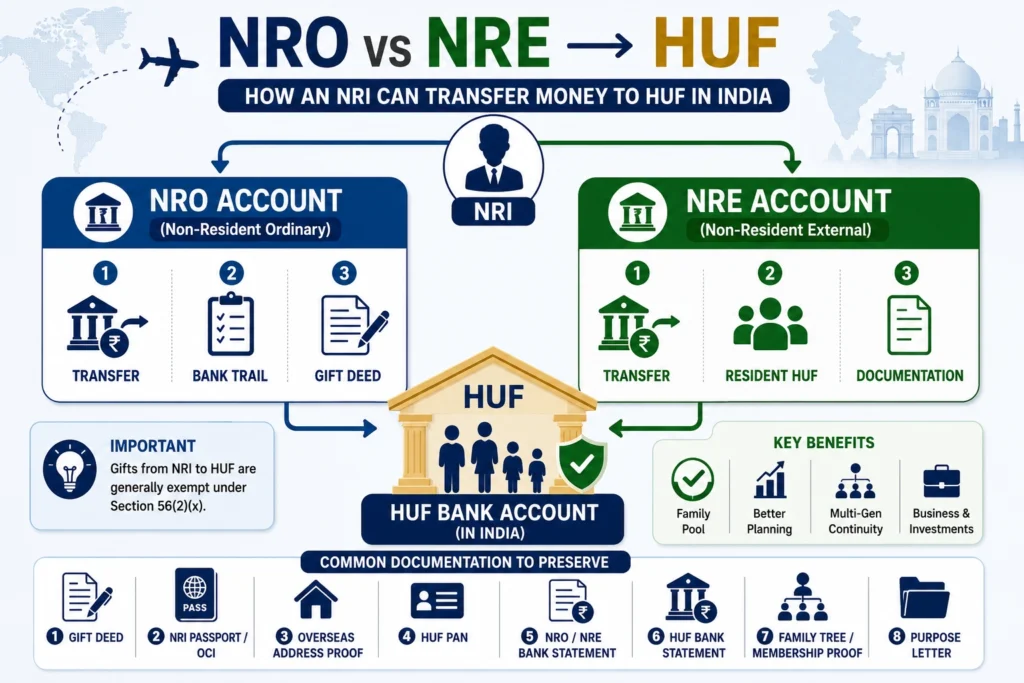
    Gifting money to a Hindu Undivided Family (HUF) is one of the most common ways Non-Resident Indians pass funds back home to a family pool. Yet the tax treatment is one of the most misunderstood. If you are a UK, US, UAE, or Singapore-based NRI planning to transfer savings from your NRO account to your father’s HUF, three separate tax questions have to be answered: Is the gift itself taxable? Is the income earned by the HUF from investing that gift taxable? Is it clubbed back with your income?

    The short answer under the Income Tax Act 2025 (effective 1 April 2026) is that the gift itself is generally not taxable in the HUF’s hands if you are a member of the family. But under Section 64(2), the income earned by the HUF from investing that money is clubbed back in your hands as an NRI member. Get this wrong and you could face a decade of Section 148 reassessment notices.

    This guide breaks down everything an NRI should know about gifting to an HUF in 2026, the relative exemption, the clubbing trap, FEMA position, documentation, and the new Form 41 refile process if your Tax Residency Certificate needs to be updated.

    Are NRI Gifts to HUF Taxable in India?

    The taxability of a gift is always assessed in the hands of the receiver, not the giver. The person making the gift never faces a tax liability just for making the gift. So if you, as an NRI, transfer Rs 25 lakh from your NRO account to your father’s HUF, you owe no Indian income tax on that transfer.

    The question therefore shifts to the HUF as the recipient. Under Section 56(2)(x) of the Income Tax Act, any sum of money received by a person (including an HUF) without consideration exceeding Rs 50,000 in a financial year is taxable as Income from Other Sources.

    However, this rule has a crucial exception for gifts received from relatives. In the case of an HUF, its members are treated as its relatives. That means a gift from an NRI member to the HUF is fully exempt from Section 56 taxability.

    For a personalised NRI residency and taxation review before making a large transfer, start with our NRI Tax Residency Calculator.

    The Two-Sided Analysis: Giver vs Receiver

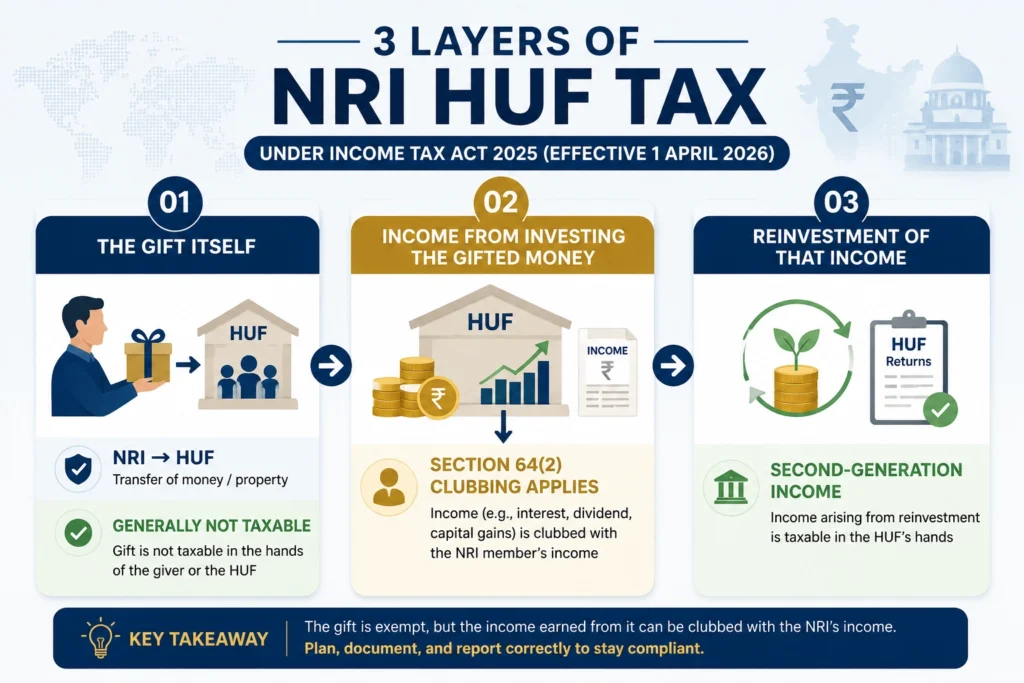
    Understanding NRI gifts to an HUF requires separating three distinct tax layers.

    LayerWho Is AssessedTaxable?
    The gift itself (transfer of money)NRI giverNot taxable
    Gift receipt in HUF’s handsHUFNot taxable if giver is a member (relative)
    Income from investing the gifted moneyHUF and NRI memberClubbed with NRI’s income under Section 64(2)
    Reinvestment of that incomeHUFTaxable in HUF’s hands (second-generation income)

    Missing any of these layers is how NRIs walk into unnecessary tax notices. Handled correctly, the structure is fully compliant and often preferred over gifting to individual family members.

    Section 56(2)(x): The HUF Exception Explained

    Under the Income Tax Act, any sum of money, immovable property, or specified movable property received without adequate consideration above Rs 50,000 in aggregate during a financial year is taxable in the recipient’s hands as Income from Other Sources.

    The Act carves out a list of specified relatives whose gifts are outside this rule. For an HUF, the following are considered relatives:

    • Any member of the HUF (including the karta and coparceners)
    • Spouse of the karta
    • Brothers and sisters of the karta
    • Any lineal ascendant or descendant of the karta
    • Spouse of any of the above

    Since you as an NRI son or daughter are a member of your father’s HUF, any gift from you is exempt. The exemption is not capped; you can gift Rs 5,000 or Rs 5 crore without triggering Section 56 in the HUF’s hands.

    The Clubbing Provision Trap: Section 64(2)

    This is the point most NRIs miss. Section 64(2) of the Income Tax Act contains a specific anti-avoidance rule for HUFs. It says that when an individual member transfers their own property (including money) to the HUF without adequate consideration, the income arising from that transferred property is clubbed with the transferor member’s income for tax purposes.

    In plain terms:

    • You gift Rs 25 lakh from your NRO account to your father’s HUF (Year 1)
    • The HUF invests it in an Indian mutual fund
    • Year 2 dividends and capital gains of, say, Rs 1.75 lakh arise
    • This Rs 1.75 lakh is added back to your total income, not the HUF’s
    • You pay tax on it as if it were your income

    The clubbing continues as long as the original gifted property (or its identifiable form) remains with the HUF. If the HUF reinvests the clubbed income into further assets, the second-generation income is generally taxable in the HUF’s hands, not the member’s. This nuance is why professional structuring matters.

    Read our detailed Capital Gain Tax advisory for structuring HUF investments.

    FEMA Position on NRI Gifts to an Indian HUF

    Beyond the Income Tax Act, FEMA (Foreign Exchange Management Act) is the other regulator NRIs must satisfy. The good news: FEMA does not restrict an NRI from gifting money to an Indian HUF where the NRI is a member.

    Key FEMA points:

    • Gifts from NRO to a resident HUF account are freely permitted
    • Gifts from NRE to a resident HUF account are permitted; funds change character to resident
    • No prior approval or LRS ceiling applies to gifts to a family HUF
    • Documentation should be maintained to show the gift was made from legitimately sourced foreign or Indian earnings
    • A signed gift deed is strongly recommended

    For clarity on which account structure best fits your goals, use our NRI Bank Account Type Advisor.

    Practical Structure: How NRIs Should Gift to an HUF

    Follow this sequence to keep the gift clean, tax-efficient, and audit-ready.

    1. Confirm your HUF membership through the family tree and HUF PAN records
    2. Draft a gift deed clearly identifying the giver, recipient HUF, amount, and purpose
    3. Transfer funds from NRO or NRE to the HUF’s Indian bank account by NEFT or RTGS
    4. Preserve bank statements showing the source of funds in the NRO or NRE account
    5. Report the gift in the HUF’s books of account and ITR
    6. Track clubbing on any income the HUF earns from that specific pool
    7. Include the clubbed income in your own ITR (as an NRI, use ITR-2 or ITR-3)
    8. Retain the gift deed for at least 8 years, ideally longer, for reassessment protection

    Documentation Every NRI Should Preserve

    Documentation is what separates a compliant gift from a tax notice. Keep the following for every HUF gift:

    • Signed and dated gift deed on stamp paper of appropriate value
    • Photocopy of NRI passport, visa or OCI card
    • Overseas address proof of the NRI giver
    • PAN card of the HUF and karta
    • Bank statements of NRO or NRE account showing debit
    • Bank statements of HUF account showing credit
    • Purpose letter if the gift is for a specific investment or purchase
    • Family tree showing your relationship to the karta

    For gifts above Rs 10 lakh, register the deed at your sub-registrar office. It is not mandatory for cash gifts, but it strengthens your defence in any future scrutiny.

    Form 41 Refile Under the Income Tax Act 2025

    If you are an NRI providing services to Indian clients (like consultancy from Singapore, UAE, UK, or US), you file Form 41 online along with your Tax Residency Certificate (TRC) to claim treaty benefits under the DTAA.

    Under the Income Tax Act 2025, the department clarified through FAQs that Form 41 cannot be revised or edited once filed. However, the e-filing portal currently allows Form 41 to be filed again with corrections.

    If you make a mistake, such as attaching an old-year TRC instead of the current year:

    • The earlier Form 41 becomes non-actionable
    • The newly filed Form 41 is treated as the valid form from the date of re-filing
    • All treaty benefits from that point forward are governed by the new filing

    This means if you accidentally attached your 2025 TRC when your consultancy income arose in 2026, you can refile Form 41 with the correct 2026 TRC. The refiled form supersedes the earlier one for future tax deduction and DTAA claim purposes.

    Explore our NRI Taxation and Compliance service for Form 41, TRC, and DTAA claim handling.

    Why NRIs Prefer Gifting to an HUF Over Direct Individual Gifts

    For high-net-worth NRIs supporting family in India, gifting to an HUF instead of an individual family member offers several advantages:

    • Consolidated family pool for investments, real estate, and business capital
    • Independent PAN and ITR allowing separate tax slab benefits (subject to clubbing)
    • Multi-generational continuity without repeated gift deeds
    • Simpler estate planning compared to individual gifts
    • Business capital for family-run ventures under a single legal entity

    However, the clubbing rule under Section 64(2) limits the tax arbitrage on income from directly gifted funds. The second-generation income planning is where a professional structure adds real value.

    Common Mistakes NRIs Make on HUF Gifts

    The most costly slip-ups are avoidable. Watch out for:

    • Skipping the gift deed on the assumption that family transfers do not need paperwork
    • Missing the clubbing disclosure in the NRI’s Indian ITR
    • Assuming the exemption under Section 56 applies to all HUF gifts (it does not; only member gifts qualify)
    • Gifting from NRE and expecting the HUF income to be tax-free (it is not; clubbing still applies)
    • Ignoring the second-generation income distinction from clubbed income
    • Not maintaining a separate ledger for the gifted corpus vs HUF’s own funds
    • Missing the Form 41 refile deadline when TRC is corrected
    • Filing the wrong ITR form (NRIs with HUF-linked clubbed income use ITR-2 or ITR-3)

    If you have already received a notice, our NRI Income Tax Notice Solutions team helps close the file with correct disclosures.

    How MostlyNRI Helps You Structure HUF Gifts Correctly

    Gifting to an HUF is not a one-signature task. It involves income tax classification, clubbing analysis, FEMA compliance, DTAA optimisation, and long-term investment planning.

    At MostlyNRI, we help NRIs from the USA, UAE, UK, Canada, Singapore, and Australia with:

    • HUF gift structuring with Section 56 and Section 64(2) analysis
    • Clubbing computation for the NRI member’s Indian ITR
    • Gift deed drafting and documentation review
    • Form 41 and TRC filing under the Income Tax Act 2025
    • DTAA benefit claims on Indian source consultancy income
    • NRO and NRE account structuring for gifting flows
    • ITR filing with correct schedules including Schedule FA and FSI
    • Notice response for reassessment on gift and clubbing issues

    Our team has served NRIs from over 33 countries across 13 Indian cities.

    Planning to gift savings to your family HUF in India? Book a consultation with our specialists at beige-spoonbill-433256.hostingersite.com/ and structure the transfer with the right documentation, clubbing analysis, and DTAA cover.

    Frequently Asked Questions (FAQs)

    Are NRI gifts to a father’s HUF taxable in India in 2026?

    No. Under Section 56(2)(x), gifts from HUF members (including NRI sons and daughters) are exempt from taxation in the HUF’s hands. The giver also does not pay tax simply for making the gift. Only Section 64(2) clubbing applies to future income.

    What is Section 64(2) of the Income Tax Act and how does it affect NRI gifts?

    Section 64(2) clubs any income earned by the HUF from a member’s gifted property back with the member’s income. So if an NRI gifts Rs 25 lakh to their HUF, the HUF’s dividends, interest, or capital gains on that pool are taxed in the NRI’s hands.

    Can NRIs gift money from an NRO account to an HUF without any FEMA issue?

    Yes. FEMA does not restrict NRI gifts to an Indian HUF where the NRI is a member. Transfers from NRO or NRE accounts to the HUF’s resident account are freely permitted. A signed gift deed and clean bank trail are recommended for documentation.

    Is there any upper limit on the amount an NRI can gift to an HUF?

    No. There is no monetary ceiling on the amount an NRI can gift to their father’s or family HUF. The Rs 50,000 Section 56 threshold does not apply because the exemption for gifts from members overrides it entirely, regardless of amount.

    Do NRIs need to file a gift deed for transferring money to an HUF?

    Yes, strongly recommended. A signed gift deed on appropriate stamp paper, listing the giver, recipient HUF, amount, and purpose, is the primary document that proves the transaction is a gift and not a loan, salary, or income. Register deeds above Rs 10 lakh.

    Is the income earned by an HUF on gifted money taxable in the HUF’s hands?

    Not directly. Under Section 64(2), the income arising from the gifted property is clubbed with the NRI member’s income and taxed in the NRI’s hands. Only the second-generation income (from reinvested clubbed amounts) is taxable to the HUF.

    Can NRIs claim DTAA relief on income clubbed under Section 64(2)?

    Possibly. Since the clubbed income is added to the NRI’s total income, DTAA relief may be claimed for any tax paid in the country of residence on the same income. However, DTAA application depends on the nature of income and treaty article involved.

    Can NRIs refile Form 41 with a corrected Tax Residency Certificate?

    Yes. Under the Income Tax Act 2025, once filed, Form 41 cannot be edited, but a fresh Form 41 can be filed on the e-filing portal. The earlier form becomes non-actionable, and the new form applies from the date of re-filing for all DTAA purposes.

    Which ITR form should NRIs use to report income clubbed from an HUF gift?

    Use ITR-2 if you have salary, capital gains, and other income. Use ITR-3 if you also have business or professional income. Both forms permit clubbed income disclosure and Schedule FA foreign asset reporting for NRI residents abroad.

    How can MostlyNRI help with NRI gifts to an HUF?

    MostlyNRI structures HUF gifts with Section 56 and Section 64(2) analysis, drafts gift deeds, computes clubbing for the NRI’s ITR, handles Form 41 and TRC filings, and responds to tax notices. Our team supports NRIs across 30+ countries end to end.

    1. Are NRI gifts to a father’s HUF taxable in India in 2026?

    No. Under Section 56(2)(x), gifts from HUF members (including NRI sons and daughters) are exempt from taxation in the HUF’s hands. The giver also does not pay tax simply for making the gift. Only Section 64(2) clubbing applies to future income.

    2. What is Section 64(2) of the Income Tax Act and how does it affect NRI gifts?

    Section 64(2) clubs any income earned by the HUF from a member’s gifted property back with the member’s income. So if an NRI gifts Rs 25 lakh to their HUF, the HUF’s dividends, interest, or capital gains on that pool are taxed in the NRI’s hands.

    3. Can NRIs gift money from an NRO account to an HUF without any FEMA issue?

    Yes. FEMA does not restrict NRI gifts to an Indian HUF where the NRI is a member. Transfers from NRO or NRE accounts to the HUF’s resident account are freely permitted. A signed gift deed and clean bank trail are recommended for documentation.

    4. Is there any upper limit on the amount an NRI can gift to an HUF?

    No. There is no monetary ceiling on the amount an NRI can gift to their father’s or family HUF. The Rs 50,000 Section 56 threshold does not apply because the exemption for gifts from members overrides it entirely, regardless of amount.

    5. Do NRIs need to file a gift deed for transferring money to an HUF?

    Yes, strongly recommended. A signed gift deed on appropriate stamp paper, listing the giver, recipient HUF, amount, and purpose, is the primary document that proves the transaction is a gift and not a loan, salary, or income. Register deeds above Rs 10 lakh.

    6. Is the income earned by an HUF on gifted money taxable in the HUF’s hands?

    Not directly. Under Section 64(2), the income arising from the gifted property is clubbed with the NRI member’s income and taxed in the NRI’s hands. Only the second-generation income (from reinvested clubbed amounts) is taxable to the HUF.

    7. Can NRIs claim DTAA relief on income clubbed under Section 64(2)?

    Possibly. Since the clubbed income is added to the NRI’s total income, DTAA relief may be claimed for any tax paid in the country of residence on the same income. However, DTAA application depends on the nature of income and treaty article involved.

    8. Can NRIs refile Form 41 with a corrected Tax Residency Certificate?

    Yes. Under the Income Tax Act 2025, once filed, Form 41 cannot be edited, but a fresh Form 41 can be filed on the e-filing portal. The earlier form becomes non-actionable, and the new form applies from the date of re-filing for all DTAA purposes.

    9. Which ITR form should NRIs use to report income clubbed from an HUF gift?

    Use ITR-2 if you have salary, capital gains, and other income. Use ITR-3 if you also have business or professional income. Both forms permit clubbed income disclosure and Schedule FA foreign asset reporting for NRI residents abroad.

    10. How can MostlyNRI help with NRI gifts to an HUF?

    MostlyNRI structures HUF gifts with Section 56 and Section 64(2) analysis, drafts gift deeds, computes clubbing for the NRI’s ITR, handles Form 41 and TRC filings, and responds to tax notices. Our team supports NRIs across 30+ countries end to end.

  • How Should NRI Freelancers and F&O Traders File ITR in India for 2025-26? ITR-3, ITR-4, Schedule FA and Presumptive Taxation Rules Explained

    How Should NRI Freelancers and F&O Traders File ITR in India for 2025-26? ITR-3, ITR-4, Schedule FA and Presumptive Taxation Rules Explained

    The 31 July 2026 deadline for filing ITR for AY 2025-26 has passed for salaried taxpayers, but freelancers, F&O traders, consultants, and business-income earners still have time. If your books require an audit, you have until 31 October 2026 to file. That extra window is not a break; it is a compliance minefield.

    For NRIs earning consulting fees from Indian clients, running online businesses, trading Indian stock F&O, or supplementing their salary with side hustles from India, the filing exercise involves multiple ITR schedules, careful loss classification, AIS reconciliation, and Schedule FA disclosures. Choosing between ITR-3 and ITR-4, between speculative and non-speculative F&O treatment, or between standard and presumptive taxation decides your final tax bill and future carry-forward rights.

    This guide breaks down exactly how NRI freelancers and F&O traders should file their ITR for AY 2025-26, what schedules to fill, when presumptive taxation works, and the common traps that trigger notices.

    The Extended Deadline: When NRI Freelancers and Traders Must File

    Your due date depends on whether your books require an audit under Section 44AB.

    CategoryDue Date
    Salaried NRIs without business31 July 2026 (passed)
    NRI freelancers / F&O traders without audit31 July 2026 (passed)
    NRIs with audit requirement31 October 2026
    NRIs with transfer pricing (international transactions)30 November 2026

    An audit is required if:

    • Business turnover exceeds Rs 1 crore (Rs 10 crore if 95% of transactions are digital), or
    • Professional receipts exceed Rs 50 lakh, or
    • You are opting out of a presumptive scheme where profits are below the deemed rate

    Missing the correct deadline attracts late fees under Section 234F, interest under 234A, and loss of certain carry-forward rights.

    For accurate ITR preparation, use our Income Tax Returns Filing service built for NRI freelancers, consultants, and traders.

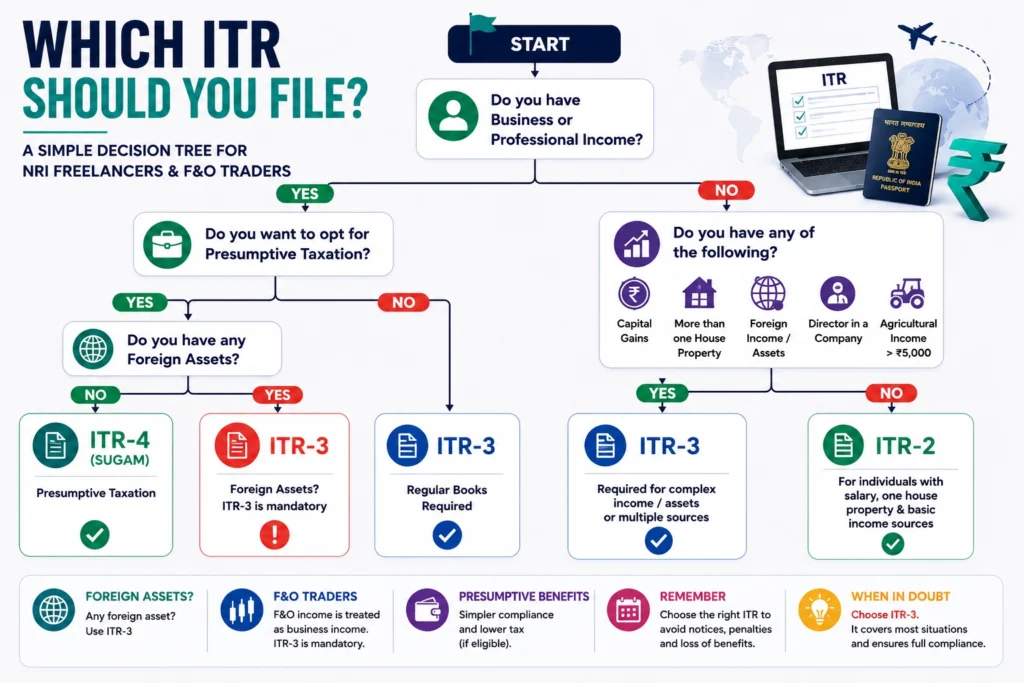
    ITR-3 or ITR-4: Which Form Should an NRI Actually Use?

    The choice depends on the nature of income and whether you elect presumptive taxation.

    ITR-3

    • For individuals with business or professional income
    • Mandatory for F&O traders, since F&O is treated as non-speculative business income under Section 43(5)
    • Required if you have capital gains, foreign income, or foreign assets along with business income
    • Allows full schedule-wise disclosure and detailed loss adjustment

    ITR-4 (Sugam)

    • For individuals opting for presumptive taxation
    • Available under Section 44AD (business) with turnover up to Rs 2 crore (or Rs 3 crore if 95% digital)
    • Available under Section 44ADA (specified professionals) with receipts up to Rs 50 lakh (or Rs 75 lakh if 95% digital)
    • Not available if you have capital gains, foreign assets, or more than one house property

    Important for NRIs: The presumptive scheme is available, but if you hold foreign bank accounts, foreign investments, or need to disclose Schedule FA, you cannot use ITR-4. Most NRIs default to ITR-3 for this reason.

    The Presumptive Taxation Question for NRIs

    Presumptive schemes were designed to simplify tax for small businesses and professionals. They can work for NRIs in narrow cases.

    Section 44AD (business):

    • Presumes 8% of turnover as taxable income (6% for digital receipts)
    • Available for turnover up to Rs 2 crore (or Rs 3 crore with 95% digital)
    • No detailed books required
    • Cannot switch back to normal accounting for 5 years once opted

    Section 44ADA (specified professions):

    • Presumes 50% of gross receipts as taxable income
    • Available for professionals in listed categories (legal, medical, engineering, architecture, accountancy, technical consultancy, interior decoration, IT professionals)
    • Receipt cap: Rs 50 lakh (Rs 75 lakh if 95% digital)
    • Ideal for NRI consultants, doctors, and IT professionals with Indian-source receipts

    NRI-specific caveats:

    • Presumptive can be claimed only if you file ITR-4
    • ITR-4 does not allow Schedule FA, so if you have any foreign asset, you must use ITR-3 with regular books
    • Payment must be received in India or in a mode traceable to your NRE or NRO account

    F&O Trading Classification: Speculative vs Non-Speculative

    This is where most F&O traders and NRIs slip up.

    • F&O trades in listed derivatives are treated as non-speculative business income under Section 43(5)
    • Intraday equity trading (buying and selling the same day without delivery) is speculative business income
    • Delivery-based equity trading is capital gains (short or long term depending on holding period)

    Why does the classification matter? Because losses have different set-off rules.

    TypeSet-Off AgainstCarry Forward
    F&O (non-speculative) lossesAny income except salary8 years
    Intraday (speculative) lossesOnly speculative gains4 years
    Short-term capital lossesAny capital gains8 years
    Long-term capital lossesOnly long-term capital gains8 years

    An NRI doing F&O plus intraday trading must maintain separate books for each stream. Clubbing them incorrectly changes the loss adjustment picture entirely.

    Explore our Capital Gain Tax advisory for structuring your equity and F&O disclosures correctly.

    Freelance Income for NRIs: How India Taxes It

    If you are an NRI providing freelance services to Indian or global clients, the taxability depends on where the service is rendered and where payment is received.

    When Indian tax applies:

    • Service is rendered from India during your visit
    • Payment is received in an Indian bank account (NRE or NRO)
    • Client is Indian, and TDS is deducted under Section 194J or 194C
    • Business is effectively controlled from India

    When Indian tax does not apply (for genuine non-residents):

    • Service is rendered entirely outside India
    • Payment is received in an overseas bank account
    • No permanent establishment or business connection in India

    For freelance work with US, UK, or UAE clients billed from India, the income is fully taxable here. TDS at 10% under Section 194J is typical for professional fees. Excess TDS is claimable as a refund through your ITR.

    Use our NRI TDS Refund Calculator to estimate your refund before filing.

    The ITR Schedules NRI Freelancers and Traders Must Complete

    An NRI running a freelance practice or trading F&O in India may need to fill up to 10 or more schedules.

    ScheduleApplicability for NRIs
    Schedule SSalary income, if any
    Schedule BPBusiness or profession income (freelancers, consultants, F&O traders)
    Trading P&L and Balance SheetWhere books are maintained
    Schedule CYLACurrent year loss adjustment
    Schedule BFLABrought forward loss adjustment
    Schedule CFLCarry forward eligible losses
    Schedule OSInterest, dividends, other sources
    Schedule CGCapital gains on Indian and foreign assets
    Schedule FSIForeign source income (for RNOR or ROR)
    Schedule FAForeign bank accounts, brokerage, IRA, 401(k), etc.
    Schedule TRTax relief claimed under DTAA
    Schedule ALAssets and liabilities if income exceeds Rs 50 lakh

    Filing even one of these incorrectly can trigger a mismatch notice.

    AIS Reconciliation: The Data-Matching Trap

    The Annual Information Statement (AIS) now captures a vast range of NRI transactions:

    • Broker turnover and F&O contract data
    • Dividends and interest from Indian institutions
    • Rental credits in NRO accounts
    • TDS deducted by all payers
    • Property sale entries from registrars
    • Mutual fund purchases and redemptions

    Before filing, reconcile:

    • AIS against your broker P&L, bank statements, and Form 26AS
    • TDS entries against your consulting invoices
    • Contract-level F&O turnover against your trading books
    • Speculative and non-speculative buckets separately

    Any mismatch, especially in F&O turnover (which can run into crores), is a top trigger for Section 148 reassessment notices. Our NRI Income Tax Notice Solutions team handles these cases regularly.

    Loss Adjustment and Carry Forward Rules for NRIs

    Losses are as important to report as income. Missing this in your ITR forfeits your right to carry them forward.

    Business losses (including F&O):

    • Can be carried forward for 8 years
    • Can be set off against any income except salary in subsequent years
    • Must file ITR before the due date to carry forward

    Speculative losses (intraday):

    • Can be carried forward for 4 years
    • Can be set off only against speculative gains

    Capital losses:

    • Carried forward for 8 years
    • STCL sets off both STCG and LTCG
    • LTCL sets off only LTCG

    NRI-specific point: For business losses to be carried forward, your ITR must reach the department before the due date. Missing the audit-linked October deadline forfeits carry-forward rights entirely.

    Beware of Common Tax Traps for NRI Freelancers and Traders

    Errors that regularly trigger notices for NRIs:

    • Misclassifying F&O as speculative or as capital gains
    • Claiming presumptive taxation on ITR-4 while holding foreign assets
    • Ignoring AIS mismatches on broker turnover
    • Reporting only net gain on F&O instead of turnover-based figures
    • Missing TDS entries in Form 26AS reconciliation
    • Skipping Schedule FA despite holding US, UK, or UAE bank accounts
    • Missing advance tax on freelance receipts
    • Claiming losses without filing by the due date
    • Not maintaining separate books for speculative and non-speculative streams
    • Choosing the wrong ITR form and later filing revised returns

    How MostlyNRI Helps Freelancers and F&O Traders File Correctly

    Filing an NRI ITR with freelance or trading income is not a simple exercise. It requires classification of every income stream, reconciliation of AIS with hundreds of transactions, loss allocation, and DTAA planning.

    At MostlyNRI, we help NRI freelancers, consultants, and traders with:

    • ITR-3 filing with correct schedules for business, profession, and trading
    • Section 44AD and 44ADA presumptive scheme evaluation
    • F&O turnover and P&L computation aligned to Guidance Note standards
    • AIS reconciliation across brokers, banks, and clients
    • TDS refund optimisation on Section 194J and 194C deductions
    • Schedule FA and FSI disclosures for foreign holdings
    • DTAA credit claims on cross-border consulting income
    • Audit coordination with chartered accountants for Section 44AB cases
    • Notice response for AIS mismatches and reassessment

    Our team has served NRIs from over 33 countries across 13 Indian cities.

    Are you an NRI freelancer or F&O trader filing your Indian ITR? Book a consultation with our specialists at beige-spoonbill-433256.hostingersite.com/ before the 31 October 2026 audit deadline to file with full loss carry-forward and DTAA benefit.

    Frequently Asked Questions (FAQs)

    Which ITR form should NRI freelancers and F&O traders file for AY 2025-26?

    Most NRI freelancers and F&O traders should file ITR-3, since it accommodates business or professional income, capital gains, and Schedule FA disclosures for foreign assets. ITR-4 is only for those opting for presumptive taxation without foreign assets.

    Is F&O trading treated as speculative or non-speculative income in India?

    F&O trading in listed derivatives is classified as non-speculative business income under Section 43(5). Intraday equity trading (same-day buy and sell without delivery) is treated as speculative business income, with stricter loss set-off and carry-forward rules.

    Can NRIs use Section 44ADA presumptive taxation?

    Yes, provided the NRI is a specified professional (IT, legal, medical, technical consultancy, etc.), gross receipts are up to Rs 50 lakh (Rs 75 lakh if 95% digital), and they do not hold foreign assets, since ITR-4 does not allow Schedule FA disclosure.

    What is the ITR deadline for NRIs whose books require audit?

    The audit-linked ITR deadline is 31 October 2026. Books require audit if business turnover exceeds Rs 1 crore, professional receipts exceed Rs 50 lakh, or you opt out of a presumptive scheme with declared profits below deemed rates.

    How are F&O losses set off against other income for NRIs?

    F&O losses (non-speculative business) can be set off against any income except salary in the same year, and carried forward for 8 years. Intraday speculative losses can only be set off against speculative gains and carried forward for 4 years.

    Do NRI freelancers need to disclose foreign bank accounts in ITR?

    Yes, if they qualify as ROR during any part of the year. Schedule FA requires disclosure of all foreign bank accounts, brokerage, IRAs, 401(k)s, and beneficial ownership. Non-disclosure invites Black Money Act penalties up to 300% of tax due.

    Is TDS deducted on freelance income paid to NRIs by Indian clients?

    Yes. Indian clients typically deduct 10% TDS under Section 194J for professional fees, or higher rates under Section 195 for non-residents. Any excess deduction is claimable as a refund through the ITR-3 with proper Schedule TR entries.

    Can NRIs carry forward F&O losses without filing on time?

    No. To carry forward F&O business losses for 8 years, the ITR must be filed by the applicable due date (usually 31 October 2026 for audit cases). Missing this deadline forfeits the carry-forward right permanently, even if losses are correctly reported.

    How should NRIs reconcile AIS with their broker P&L?

    Match your broker contract-level P&L, bank credits, and Form 26AS entries against the AIS turnover, dividend, interest, and TDS figures. Reconciliation should happen before filing. Any mismatch is a top reason for AIS-triggered reassessment notices under Section 148.

    How can MostlyNRI help NRI freelancers and F&O traders file ITR correctly?

    MostlyNRI classifies each income stream (freelance, F&O, intraday, capital gains), reconciles AIS, prepares Schedule BP with proper books, files Schedule FA and FSI, and coordinates audit where required. Our team supports NRI professionals from 30+ countries end to end.

  • ITR Refund 2026 for NRIs: When Will You Get Your Income Tax Refund After the 31 July Deadline?

    ITR Refund 2026 for NRIs: When Will You Get Your Income Tax Refund After the 31 July Deadline?

    If you are a Non-Resident Indian who filed your Income Tax Return (ITR) for AY 2026-27 before the 31 July 2026 deadline, you are almost certainly checking your bank account daily for the refund. You are not alone. More than 5.9 crore ITRs were filed by the due date this year, and NRIs form a significant share of the refund pipeline because of high TDS deducted on Indian property sales, NRO account interest, and mutual fund redemptions.

    The Income Tax Department has stated that a standard refund takes 4 to 5 weeks to reach the taxpayer’s bank account after the ITR is e-verified. But for NRIs, the timeline is often longer, and a small mistake on Schedule FA, bank pre-validation, or PAN status can push the refund into a review cycle that lasts months.

    This guide breaks down the exact NRI ITR Refund timeline, e-verification rules, common NRI-specific delays, how to track your refund, and what to do when it does not arrive on time.

    The Standard ITR Refund Timeline for AY 2026-27

    The Income Tax Department begins processing your return only after it is e-verified. Once e-verified, the typical journey looks like this:

    StageStandard Timeline
    ITR filedDay 0
    ITR e-verifiedWithin 30 days of filing
    Return processed under Section 143(1)2 to 5 weeks post e-verification
    Intimation received by emailSame day as processing
    Refund credited to the bank4 to 5 weeks from e-verification
    Delayed cases (scrutiny or mismatch)8 to 24 weeks or more

    For NRIs, the average has stretched slightly longer in recent cycles because of enhanced scrutiny on foreign asset disclosures, DTAA credit claims, and high-value TDS refund claims on property and NRO interest.

    The Income Tax Department has also reported that about 60% of returns filed by 31 July 2026 have already been processed. If your refund has not been credited yet, it is not necessarily bad news, but there are steps you can take to check its status.

    Why NRI Refunds Are Bigger Than Resident Refunds

    Most resident taxpayers file for salary or interest refunds of modest sizes. NRIs, however, typically file to reclaim excess TDS deducted at higher rates:

    • Property sale TDS: often deducted on the full sale value instead of the net gain
    • NRO interest TDS: deducted at 30% plus surcharge and cess
    • Mutual fund redemption TDS: withheld at higher rates for NRIs
    • Rental income TDS on Indian property
    • Section 195 TDS on any other India-sourced payments

    A single NRI property sale can produce a refund claim of several lakhs of rupees. That size alone triggers additional verification by the department, extending the timeline.

    Estimate your recoverable TDS with our NRI TDS Refund Calculator before you follow up with the department.

    E-Verification: The Step That Actually Starts the Clock

    Filing your ITR is not enough. The refund clock only starts once your return is e-verified. You have 30 days from the date of filing to complete this. Missing this window renders your ITR invalid.

    E-verification options available to NRIs:

    • Aadhaar OTP: if your Aadhaar is linked to an Indian mobile number
    • Digital Signature Certificate (DSC): mandatory for taxpayers under audit
    • Bank account EVC: via a pre-validated Indian bank account
    • Demat account EVC: via NSDL or CDSL
    • Net banking: for banks integrated with the e-filing portal
    • Physical ITR-V: signed and posted to CPC Bengaluru (avoid if possible; slow and prone to loss)

    NRIs living abroad often struggle with Aadhaar OTP because their Indian mobile number may not be active. In that case, DSC or net banking EVC through NRE or NRO account is the most reliable path.

    For guidance on which account to use for e-verification, see our NRI Bank Account Type Advisor.

    Bank Pre-Validation: The Silent Refund Blocker

    Even after your return is processed, the refund can fail to credit if your bank account is not pre-validated on the e-filing portal. This is the single most common cause of refund delays for NRIs.

    To pre-validate, you must:

    • Log in to the e-filing portal
    • Go to Profile and then My Bank Account
    • Add your NRE or NRO account with the correct IFSC, name match, and PAN link
    • Wait for the Validated status
    • Set it as the primary bank account for refund credit

    The refund can only be issued to an Indian bank account in your own name. Refunds cannot be sent to a foreign bank. If your KYC on the bank account is outdated, pre-validation will fail silently, and the refund will bounce back to the department.

    How to Check Your ITR Refund Status Online

    The Income Tax Department provides two ways to check refund status:

    1. Through the e-Filing Portal

    • Log in at incometax.gov.in
    • Go to e-File > Income Tax Returns > View Filed Returns
    • Click View Details for your AY 2026-27 return
    • Refund status appears here

    2. Through the NSDL Portal

    • Visit the NSDL refund tracking page
    • Enter your PAN and select AY 2026-27
    • Enter the CAPTCHA and submit
    • Status updates every 10 days

    Common status messages and what they mean:

    • Refund Paid: credited to your bank; check the account
    • Refund Failure: credit failed; usually a bank pre-validation issue
    • Refund Determined and Sent Out: on the way, wait 3 to 5 working days
    • Under Processing: return not yet fully reviewed
    • No Refund Determined: possibly a tax demand raised instead

    Common Reasons NRI Refunds Get Delayed

    NRIs experience delays for reasons that rarely affect residents. Watch out for these:

    • Bank account not pre-validated or KYC out of date
    • PAN not linked with Aadhaar (where applicable) or PAN inoperative
    • Mismatch with AIS or Form 26AS on TDS entries
    • Schedule FA disclosures flagged for review
    • DTAA credit claim without Form 67 or TRC
    • High-value property TDS refund flagged for verification
    • Section 197 lower TDS certificate not properly linked to the transaction
    • ITR filed in the wrong form (ITR-1 or ITR-4 not allowed for NRIs)
    • Bank name or IFSC mismatch in pre-validation
    • Refund routed to a closed NRO or NRE account

    If your refund is stuck for any of these reasons, our NRI Income Tax Notice Solutions team resolves it end-to-end.

    What to Do When Your Refund Does Not Arrive

    If 5 to 6 weeks have passed since e-verification and there is still no refund, follow this sequence:

    1. Check the refund status on both the e-filing and NSDL portals
    2. Read the Section 143(1) intimation in your email carefully; the amount and reason are clearly stated
    3. Verify bank account pre-validation and correct any failures
    4. Reconcile AIS, Form 26AS, and Schedule VDA/CG entries with your ITR
    5. Raise a grievance on the e-filing portal under Refund reissue
    6. File a rectification request under Section 154 if there is a mismatch
    7. Respond to the intimation if a discrepancy notice is issued

    Do not respond to an intimation without professional review. Our Income Tax Returns Filing team handles rectifications, refund reissues, and grievance replies for NRIs across 33 countries.

    Special Case: NRI Property TDS Refunds

    The largest refund claims for NRIs typically come from property sales. When an NRI sells Indian property, the buyer is required to deduct TDS at rates as high as:

    • 12.5% LTCG plus surcharge and cess (property sold after 23 July 2024)
    • 20% plus surcharge and cess if the seller opted for the old regime with indexation
    • 30% slab-linked rate for short-term gains

    Often, the buyer deducts TDS on the entire sale consideration instead of the actual gain. The excess must be reclaimed by filing ITR-2, correctly reporting the capital gain in Schedule CG, and matching Form 26AS entries.

    These refund claims commonly run into lakhs of rupees, so processing time can extend to 10 to 16 weeks. In some cases, a Section 197 certificate obtained before the sale would have prevented the excess deduction entirely.

    Read our detailed Capital Gain Tax advisory to plan property sale TDS efficiently.

    The Interest Component: What the Department Owes You

    If your refund is delayed beyond a reasonable period, the Income Tax Department is required to pay interest under Section 244A:

    • 0.5% per month on the refund amount from 1 April of the assessment year to the date of the refund credit
    • Interest is automatically calculated and paid; you do not need to claim it separately
    • The interest amount is taxable in the year it is credited

    For large NRI refunds, this interest can be significant. Keep the intimation for your records and disclose the interest income in the following year’s ITR.

    How MostlyNRI Helps You Get Your Refund Faster

    Filing the ITR is only half the job. Getting the refund credited in your NRE or NRO account requires bank pre-validation, TDS reconciliation, Schedule FA accuracy, DTAA credit paperwork, and, if needed, rectification and grievance follow-through.

    At MostlyNRI, we support NRIs across the USA, UAE, UK, Canada, Singapore, and Australia with:

    • NRI ITR filing with correct form selection and refund optimisation
    • Bank pre-validation guidance on NRE and NRO accounts
    • TDS reconciliation across property, mutual funds, and NRO interest
    • Section 197 lower TDS certificate applications before property sale
    • DTAA credit filing with Form 67 and TRC support
    • Refund reissue and rectification requests
    • Notice and intimation replies for delayed or reduced refunds

    Frequently Asked Questions (FAQs)

    When will I get my ITR refund for AY 2026-27?

    The Income Tax Department typically credits refunds within 4 to 5 weeks after successful e-verification. For NRIs with property TDS or DTAA claims, the timeline can stretch to 10 to 16 weeks because of additional verification of Schedule CG and Schedule FA entries.

    Do NRIs receive ITR refunds in NRE or NRO accounts?

    Refunds are credited only to Indian bank accounts in the NRI’s own name. Both NRE and NRO accounts are eligible, provided the account is pre-validated on the e-filing portal, and the KYC is current and active with the bank.

    Can ITR refunds be credited to a foreign bank account?

    No. The Income Tax Department does not credit refunds to foreign or offshore bank accounts. You must use an Indian NRE, NRO, or resident savings account in your own name, pre-validated on the e-filing portal, to receive the refund.

    What happens if I do not e-verify my ITR within 30 days?

    If your ITR is not e-verified within 30 days of filing, it is treated as invalid. You will need to file a belated return with applicable late fees under Section 234F and may lose your right to carry forward certain losses.

    Why is my ITR refund taking longer than 5 weeks?

    Common reasons include bank pre-validation failure, PAN-Aadhaar mismatch, AIS or Form 26AS mismatch, DTAA credit claims without Form 67, Schedule FA scrutiny, and high-value property TDS refund verification, especially where TDS was deducted on the sale value.

    How can NRIs check their ITR refund status online?

    Log in at incometax.gov.in to view your filed returns and refund status, or use the NSDL refund tracking portal by entering your PAN and AY 2026-27. Status updates typically appear within 10 days of any change in the processing stage.

    Do NRIs receive interest on delayed ITR refunds?

    Yes. Under Section 244A, the Income Tax Department pays interest at 0.5% per month from 1 April of the assessment year until the refund is credited. This interest is automatically calculated but is taxable in the next financial year.

    Can NRIs claim a refund of property sale TDS after filing ITR?

    Yes. NRIs can reclaim excess property sale TDS by filing ITR-2, disclosing the capital gain correctly in Schedule CG, and matching Form 26AS entries. Processing typically takes 10 to 16 weeks due to enhanced verification of large refund claims.

    Which ITR form should NRIs use to claim refunds in 2026?

    NRIs use ITR-2 for capital gains and other income, or ITR-3 if they have business or professional income. ITR-1 and ITR-4 cannot be used by NRIs. Only ITR-2 and ITR-3 allow full Schedule FA, FSI, and CG disclosures.

    How can MostlyNRI help me claim my ITR refund faster?

    MostlyNRI files your ITR with the correct form selection, pre-validates your NRE or NRO account, reconciles TDS, prepares DTAA credit paperwork, and handles refund reissue and grievance requests. Our team assists NRIs from 30+ countries end-to-end.

  • What is the New LTCG Tax Rate for NRIs in ITR 2025-26? 12.5% Capital Gains, Section 112A and Schedule CG Rules Explained

    What is the New LTCG Tax Rate for NRIs in ITR 2025-26? 12.5% Capital Gains, Section 112A and Schedule CG Rules Explained

    The new NRI LTCG Tax Rate in India stands at 12.5%, effective for all transfers made on or after 23 July 2024. This flat rate, introduced through the Finance Act 2024, has replaced the earlier 10% and 20% structures across most asset classes. For NRIs filing their ITR 2025-26, this single change reshapes how equity, property, mutual funds, gold, and unlisted shares are taxed and reported.

    If you are a Non-Resident Indian selling Indian assets during FY 2025-26, understanding the revised Section 112A exemption, the correct use of Schedule CG, and the new holding period rules is critical. Errors here trigger mismatch notices, refund delays, and reassessment scrutiny.

    This guide breaks down everything an NRI needs to know before filing their return this year.

    What Changed in the LTCG Regime from July 2024

    The Finance Act 2024 introduced the most significant overhaul of India’s capital gains structure in decades. For NRIs, the key shifts are:

    • A single, uniform LTCG rate of 12.5% across all asset classes
    • The STCG rate on listed equity shares, equity mutual funds, and Gold ETFs has risen to 20%
    • The LTCG exemption under Section 112A has been raised from Rs. 1 lakh to Rs. 1.25 lakh
    • Indexation benefit removed for most assets sold on or after 23 July 2024
    • Uniform holding period: 12 months for listed securities, 24 months for other assets
    • Debt mutual funds acquired on or after 1 April 2023 continue to be taxed at slab rates regardless of holding period

    For NRIs, the change is even more impactful because TDS is deducted at source on Indian capital gains, and any excess must be claimed back through the ITR. A single filing error can trap thousands of dollars in refund limbo.

    For a personalised residency and capital gains assessment, start with our NRI Tax Residency Calculator.

    The New LTCG and STCG Tax Rates for NRIs in ITR 2025-26

    Here is the updated capital gains structure applicable to NRIs for AY 2025-26 and AY 2026-27.

    Asset TypeSTCG RateLTCG RateHolding Period for LTCG
    Listed equity shares (STT paid)20%12.5%12 months
    Equity mutual funds20%12.5%12 months
    Property (land or building)Slab rate12.5%24 months
    Physical goldSlab rate12.5%24 months
    Gold ETFs20%12.5%12 months
    Debt mutual funds (post 1 Apr 2023)Slab rateSlab rateAny period
    Unlisted sharesSlab rate12.5%24 months
    Foreign shares held by NRISlab rate12.5%24 months

    The 12.5% LTCG rate applies without indexation for transfers on or after 23 July 2024. For property acquired before that date, taxpayers may opt for the older regime of 20% with indexation if it produces a lower tax outgo.

    Section 112A: The Rs. 1.25 Lakh Exemption Explained

    Under Section 112A of the Income Tax Act, LTCG on listed equity shares and equity-oriented mutual funds enjoys an exemption of Rs. 1.25 lakh per financial year. Only gains above this threshold are taxed at 12.5%.

    Important points for NRIs:

    • The exemption is applied automatically by the system
    • Gains must still be reported in Schedule CG even if below Rs. 1.25 lakh
    • Leaving the field blank because no tax is owed is treated as non-disclosure
    • Grandfathering applies to shares purchased before 1 February 2018: cost is the higher of actual cost or the lower of the 31 January 2018 fair market value and the sale price

    Many NRIs assume that because their gains are below Rs. 1.25 lakh, no reporting is needed. This is one of the most common causes of tax notices. The AIS (Annual Information Statement) already reflects your equity gains from broker data.

    Which ITR Form Should an NRI Use for Capital Gains

    NRIs cannot file ITR-1 or ITR-4. The correct choice depends on the nature of income:

    • ITR-2: If you have capital gains, salary, house property, or other income, but no business or professional income
    • ITR-3: If you also earn business income (including F&O trading, which is treated as business)

    Schedule CG is available in both forms and is mandatory for all capital gains disclosures.

    If you sold Indian mutual funds, listed shares, property, or gold during FY 2025-26, you must use ITR-2 at a minimum. NRIs with F&O activity in Indian markets must move to ITR-3.

    For hassle-free NRI filings, explore our Income Tax Returns Filing Service built specifically for global Indians.

    How to Report Capital Gains in Schedule CG

    Schedule CG in the ITR contains separate sections for each type of gain. Filing under the wrong section is a frequent trigger for reassessment.

    Report your gains under the correct section:

    • Section 112A: Listed equity shares and equity mutual funds
    • Section 111A: Short-term gains on listed equity and equity mutual funds
    • Section 112: Property, physical gold, unlisted shares
    • Section 50AA: Specified debt mutual funds, market-linked debentures
    • Section 115AD: FII/FPI gains (rarely applicable to individual NRIs)

    For each transaction, disclose:

    • Date of acquisition and date of sale
    • Purchase cost, sale consideration, and net gain
    • Grandfathered cost (for equity bought before 1 Feb 2018)
    • Indexed cost (only where the old regime is opted for on pre-July 2024 property)

    Do not club short-term and long-term gains. Each stands independently and is taxed at different rates.

    Section 54, 54F and 54EC: LTCG Exemptions NRIs Can Still Use

    Even with the flat 12.5% regime, NRIs can reduce their LTCG liability through statutory exemptions:

    Section 54: Sale of Residential Property

    If you sell a residential house and reinvest the LTCG in another residential property in India within the stipulated period, the gain is exempt. NRIs can hold only up to two residential properties in India for this exemption.

    Section 54F: Sale of Any Long-Term Asset

    If you sell a long-term asset other than a residential house (for example, listed shares, land, or unlisted equity) and reinvest the net sale consideration into a residential property in India, the gain is exempt.

    Section 54EC: Investment in Specified Bonds

    You may invest up to Rs. 50 lakh of your LTCG (from land or building) in bonds of NHAI, REC, or PFC within six months of sale. The bonds have a five-year lock-in.

    Claiming these exemptions requires:

    • Detailed disclosure in Schedule CG
    • Correct linking of reinvested amounts
    • Proof of purchase or bond investment before filing

    Merely reducing the capital gain figure without completing these fields invites a notice. Our Capital Gain Tax service helps NRIs claim these exemptions with airtight documentation.

    Property Sales by NRIs: The Special Considerations

    When an NRI sells Indian property, TDS is deducted by the buyer at higher rates:

    • 12.5% on LTCG (plus applicable surcharge and cess)
    • 30% slab-linked rate on STCG

    The buyer needs a TAN to deduct and deposit this TDS. If TDS is deducted on the sale consideration instead of the net gain, the excess must be claimed back through your ITR refund process.

    Grandfathering for pre-2024 property:

    • Property acquired before 23 July 2024 can opt for 20% with indexation if that results in a lower tax
    • Property acquired on or after 23 July 2024 is taxed at a flat 12.5% without indexation

    This choice is exercised at the time of filing and cannot be revised later. NRIs selling ancestral property or long-held family real estate should compare both options carefully.

    Use our NRI TDS Refund Calculator to estimate the excess TDS deducted on your property sale.

    Debt Funds, Gold, and Gold ETFs: New Reclassification Rules

    Post July 2024, several asset categories have moved to flat 12.5% LTCG with revised holding periods:

    • Debt mutual funds acquired on or after 1 April 2023: slab rate, no LTCG benefit at all
    • Debt mutual funds acquired before 1 April 2023: LTCG at 12.5% after 24 months
    • Gold ETFs, Silver ETFs, Overseas Fund of Funds: from 1 April 2025, taxed at 12.5% LTCG with 12-month holding (24 months for Overseas FoFs); no longer slab-rate assets

    NRIs holding these should reconcile their broker or AMC statement carefully before filing. Reporting an old-regime treatment on a post-reform sale is a common Schedule CG error.

    Reporting Capital Losses: File on Time to Carry Forward

    Losses are as important to report as gains. Under the Income Tax Act, capital losses can be:

    • Set off against capital gains of the same nature in the same year
    • Carried forward for up to 8 assessment years
    • STCL can offset both short-term and long-term gains
    • LTCL can offset only long-term gains

    To carry losses forward, you must file your ITR before the due date, which is generally 31 July 2026 for individual NRIs without an audit requirement.

    Missing this deadline means your capital losses are lost forever. This is one of the costliest mistakes NRIs make, especially those with unrealised equity losses.

    Common Reasons NRIs Receive Capital Gains Tax Notices

    The department now cross-checks your ITR against AIS, Form 26AS, broker statements, and registrar data. NRIs commonly receive notices when:

    • Exempt gains under Section 112A are not disclosed
    • Grandfathering benefit is claimed incorrectly on pre-2018 shares
    • STCG and LTCG are clubbed under the same section
    • Property sale value differs between AIS and ITR
    • Reinvestment exemptions are claimed without proper disclosure
    • Foreign asset gains are missing from Schedule FA (for RNOR taxpayers)
    • TDS credit does not match Form 26AS

    If you receive such a notice, do not respond without professional review. Our NRI Income Tax Notice Solution helps you draft a compliant reply and close the file.

    How MostlyNRI Helps You File Capital Gains Correctly

    Filing NRI capital gains is more than plugging numbers into Schedule CG. It involves residency verification, TDS reconciliation, exemption planning, DTAA evaluation, and defensive documentation.

    At MostlyNRI, we offer:

    • NRI ITR Filing with correct Schedule CG entries
    • Capital Gains advisory on Section 54, 54F, and 54EC exemptions
    • Property TDS refund claims for NRIs
    • DTAA benefit claims where applicable
    • Handling of capital gains notices and mismatch queries
    • Portfolio review for future tax-efficient exits

    Frequently Asked Questions (FAQs)

    What is the new LTCG tax rate for NRIs in ITR 2025-26?

    The new Long Term Capital Gains rate for NRIs is 12.5% without indexation, applicable on transfers from 23 July 2024. It covers listed equity, mutual funds, property, unlisted shares, and gold under a single unified regime.

    What is the Section 112A exemption limit for NRIs?

    Section 112A allows an exemption of Rs. 1.25 lakh per financial year on LTCG from listed equity shares and equity-oriented mutual funds. Only gains above this threshold are taxed at 12.5%. NRIs must still report gains below this limit.

    Do NRIs pay STCG on Indian equity at 20% or 15%?

    The short-term capital gains rate on listed equity shares and equity mutual funds has been raised from 15% to 20% for transfers on or after 23 July 2024. This rate applies uniformly to NRIs and residents.

    Which ITR form should NRIs file for capital gains in 2025-26?

    NRIs with capital gains must use ITR-2. If they also have business income, including F&O trading, they must file ITR-3. ITR-1 and ITR-4 are not permitted for NRIs, and both forms include Schedule CG.

    Can NRIs still get the indexation benefit on property sale?

    Only for property acquired before 23 July 2024. Such NRIs may opt for the old regime of 20% with indexation if it results in a lower tax. Property acquired on or after 23 July 2024 attracts flat 12.5% LTCG without indexation.

    Do NRIs need to report exempt LTCG under Section 112A?

    Yes. Even when gains are below the Rs. 1.25 lakh exemption threshold, NRIs must disclose them in Schedule CG under Section 112A. Leaving the section blank is treated as non-disclosure and often triggers a notice from the tax department.

    What is the LTCG holding period for equity mutual funds for NRIs?

    For listed equity shares, equity mutual funds, and Gold ETFs, the LTCG holding period is 12 months. For property, physical gold, and unlisted shares, the holding period is 24 months. Overseas Fund of Funds requires 24 months of holding.

    How can NRIs claim TDS refund on property sale?

    If TDS is deducted on the total sale consideration rather than on the actual gain, NRIs can claim the refund by filing ITR-2 with correct Schedule CG entries and matching Form 26AS. Our TDS refund calculator helps estimate the recoverable amount.

    Can NRIs use Section 54, 54F, or 54EC exemptions on capital gains?

    Yes. NRIs can claim Section 54 for reinvestment in Indian residential property, Section 54F for other long-term assets, and Section 54EC for investment in NHAI, REC, or PFC bonds up to Rs. 50 lakh within six months of sale.

    What happens if NRIs do not file capital losses on time?

    Capital losses can be carried forward for eight years only if the ITR is filed by the due date, generally 31 July 2026, for individual NRIs. Missing the deadline forfeits the loss permanently and prevents any future set-off against gains.

  • What is the Crypto Tax Rate for NRIs in India in 2026? 30% Tax, 1% TDS, and ITR Filing Rules Explained

    What is the Crypto Tax Rate for NRIs in India in 2026? 30% Tax, 1% TDS, and ITR Filing Rules Explained

    If you are a Non-Resident Indian holding cryptocurrency, NFTs, or any Virtual Digital Asset (VDA) linked to India, the 2026 filing season demands your full attention. India taxes crypto gains at a flat 30% rate plus surcharge and cess, deducts 1% TDS on most transactions, and disallows nearly every form of loss adjustment. These rules have been in force since 2022 under the Finance Act, but many NRIs still misfile, miss disclosures, or receive tax notices they never expected.

    This guide explains everything an NRI needs to know before filing an Income Tax Return (ITR) for crypto income in India during 2026: the tax rate structure, TDS mechanics, allowable deductions, correct ITR form selection, and overseas disclosure obligations under the Black Money Act.

    Are NRIs Liable to Pay Tax on Crypto in India?

    Yes. If you earn income from a Virtual Digital Asset that is transferred through an Indian exchange, held on an Indian platform, or sourced from India, you are liable to pay tax under Indian law regardless of your residential status.

    The Income Tax Act treats all VDA gains identically. There is no lower slab, no threshold exemption, and no concessional rate for long-term holdings. Whether you sold crypto after one week or five years, the tax remains a flat 30% plus 4% cess and applicable surcharge.

    For NRIs, this income is reported in India through:

    • ITR-2 if crypto is treated as a capital asset
    • ITR-3 if crypto trading qualifies as business income

    You cannot use ITR-1 or ITR-4, since Schedule VDA (mandatory for crypto disclosures) is available only in ITR-2 and ITR-3.

    If you also hold crypto outside India, do not assume that offshore holdings escape scrutiny. India taxes global income only for residents, but NRIs must still be careful with source rules and remittance patterns.

    For a personalised review of your residential status and crypto liability, our team at NRI Taxation and Compliance Services can help you file correctly.

    The Framework: How India Taxes Virtual Digital Assets

    The taxation framework for VDAs is built around three provisions of the Income Tax Act:

    • Section 2(47A) defines what qualifies as a Virtual Digital Asset
    • Section 115BBH taxes income from the transfer of VDAs at 30%
    • Section 194S mandates 1% TDS on specified crypto transfers

    Additional rules include Section 56(2)(x) on gifted crypto and Section 285BAA, which requires exchanges to report every crypto transaction to the tax department.

    The VDA definition is deliberately wide. It covers cryptocurrencies like Bitcoin and Ethereum, stablecoins, non-fungible tokens (NFTs), and anything else the government may notify. Excluded items are Indian and foreign currency, Central Bank Digital Currency (CBDC), gift cards, mileage points, and NFTs whose transfer conveys ownership of an underlying tangible asset.

    The 30% Flat Tax on Crypto Transfers Explained

    Every time you transfer a VDA, the profit is taxed at 30%, plus surcharge and 4% cess. This applies whether you sold Bitcoin for cash, swapped Ethereum for a stablecoin, or exchanged one NFT for another.

    Key points NRIs should note:

    • The concepts of short-term and long-term capital gains do not apply to crypto
    • No indexation benefit is available
    • No concessional rate is available for holdings above 24 months
    • Only the cost of acquisition is deductible

    You cannot claim:

    • Exchange fees or brokerage
    • Wallet or transaction charges
    • Gas fees, blockchain fees, or mining costs
    • Electricity or internet expenses used for mining
    • Any other operational cost

    This makes crypto one of the most heavily taxed asset classes in India today.

    Which Crypto Transactions Are Taxable for NRIs

    The table below summarises the most common transactions and how they are treated.

    TransactionTaxable?How It Is Taxed
    Sell crypto for cash (INR)Yes30% on gains
    Crypto-to-crypto swapYes30% on gains
    Stablecoin tradeYes30% on gains
    NFT saleYes30% on gains
    P2P transactionYes30% on gains
    OTC (over-the-counter) tradeYes30% on gains
    Transfer between own walletsNoNo transfer of ownership
    Airdrops receivedYesTaxed on receipt at Fair Market Value
    Staking rewardsYesTaxed on receipt
    Gifts receivedDependsTaxable above Rs. 50,000 unless exempt
    Mining rewardsYesIncome taxable, practical valuation issues remain

    Wallet-to-wallet transfers between accounts held by the same person are not taxable events, since there is no change in ownership. Everything else, including P2P and OTC deals, is taxed identically at 30%.

    How 1% TDS Works on Crypto for NRIs

    Under Section 194S, a 1% TDS applies on the consideration paid to residents for VDA transfers above certain thresholds. For NRIs, the situation is more complex. Payments to non-residents can attract TDS under Section 195 at higher rates depending on the nature of income and the DTAA relief available in your country of residence.

    Here is how the standard 1% TDS mechanism functions:

    1. You sell your crypto through an Indian exchange
    2. The buyer or the exchange deducts 1% TDS
    3. The tax deducted is deposited with the Income Tax Department
    4. The credit reflects in your Form 26AS and AIS
    5. You claim this credit while filing your ITR

    If the exchange fails to deduct or deposit the TDS, the deductor is treated as an assessee-in-default and can face interest, penalty, and prosecution risk.

    For NRIs using foreign exchanges or P2P routes, the responsibility of reporting the income still lies with the taxpayer. Skipping TDS reconciliation is one of the most common reasons NRIs receive tax notices.

    Our team at NRI ITR Filing Services helps NRIs reconcile 26AS, AIS, and Schedule VDA data before submission.

    The Harsh Loss Rules NRIs Must Understand

    Crypto tax rules are especially unforgiving on the loss side. NRIs must know these restrictions before adjusting any figures in their ITR.

    You cannot:

    • Offset a Bitcoin loss against an Ethereum gain
    • Offset one Bitcoin loss against another Bitcoin gain
    • Offset crypto loss against equity, mutual fund, or property gains
    • Offset crypto loss against salary or business income
    • Carry forward crypto losses to future financial years

    Every crypto asset stands alone. If you made Rs. 1 lakh profit on Ethereum and Rs. 1 lakh loss on Solana, you still pay 30% tax on the Ethereum profit. The Solana loss simply disappears.

    This is why tax-loss harvesting, a common strategy with equities, does not work for crypto. NRIs should plan disposals carefully within a single financial year.

    Which ITR Form Should an NRI File for Crypto Income

    Filing the wrong ITR form is one of the top causes of tax notices. Here is the correct mapping:

    • ITR-2: If you hold crypto as a capital asset (investor)
    • ITR-3: If crypto trading is your business income (frequent trader)

    Schedule VDA is mandatory in both forms. You must report:

    • Date-wise details of each transaction
    • Cost, consideration, and net gain per trade
    • Transaction-wise data, not aggregates

    Netting losses across VDAs or reporting only summary figures is a common mistake that triggers notices under the mismatch category.

    Special Situations Every NRI Should Know

    Some crypto scenarios have distinct treatment. Understanding these can save both tax and stress.

    Airdrops and Staking Rewards

    Both are taxed as income at fair market value on the date of receipt. That same value becomes your cost of acquisition for the eventual sale, which is again taxed at 30%.

    Gifted Crypto

    Gifts of VDAs above Rs. 50,000 in a financial year are taxable in the recipient’s hands, unless received from specified relatives or on occasions such as marriage.

    Worthless Tokens

    If a token collapses to zero value, you cannot claim a loss unless there is an actual sale, transfer, or extinguishment of rights. The tax law does not accept notional write-downs.

    Mining Rewards

    Mining income is taxable, but practical valuation issues remain. NRIs mining crypto through Indian infrastructure should consult professionals to avoid classification errors.

    Overseas Crypto Holdings and Disclosure Rules for NRIs

    If you become a resident under Indian tax law and hold crypto abroad, your entire global income becomes taxable in India. Non-disclosure of foreign VDAs can invite provisions of the Black Money Act, which carries penalties up to 300% of the tax due and prosecution risk.

    For genuine NRIs (non-resident status confirmed under Section 6 of the Income Tax Act), only India-sourced crypto income is taxable. However, if you switch residency during the year or hold RNOR status, the rules change. Read our detailed explainer on NRI Taxation and Compliance to understand your specific liability.

    If you also hold US crypto assets, PFIC concerns and dual-tax risks may apply.

    Common Reasons NRIs Receive Crypto Tax Notices

    The department has become aggressive in matching data across sources. NRIs commonly receive notices for:

    • AIS or Form 26AS mismatch with declared income
    • Exchange data not matching the ITR
    • Netting crypto losses across different VDAs
    • Missing crypto-to-crypto swaps in reporting
    • Wrong Schedule VDA entries
    • Incorrect TDS claims
    • Non-reporting of overseas holdings
    • High trading volume with no crypto income shown

    If you have already received a notice, do not respond without professional review. Our NRI ITR Filing team helps clients respond within statutory deadlines and reduce penalty exposure.

    How MostlyNRI Helps NRIs Stay Compliant on Crypto

    Filing crypto taxes correctly is not a matter of ticking one Schedule VDA row. It involves residential status analysis, TDS reconciliation, DTAA benefit evaluation, foreign asset disclosure, and defensive documentation for future notices.

    At MostlyNRI, we help Non-Resident Indians with:

    • NRI ITR Filing with correct Schedule VDA reporting
    • Crypto TDS Reconciliation across Indian exchanges
    • DTAA benefit claims where applicable
    • Advisory on residential status and RNOR planning
    • Foreign asset disclosure review for Black Money Act compliance
    • NRI Wealth Management for post-tax portfolio structuring

    Our clients across the USA, UAE, UK, Canada, Singapore, and Australia rely on our team for accurate and audit-ready filings.

    Frequently Asked Questions (FAQs)

    What is the crypto tax rate for NRIs in India in 2026?

    NRIs pay a flat 30% tax on all Virtual Digital Asset gains, plus applicable surcharge and 4% cess. The rate is the same as for residents, and no long-term concessional rate or indexation benefit is available for crypto income.

    Do NRIs need to pay 1% TDS on crypto in India?

    Yes. Section 194S imposes 1% TDS on VDA transfers through Indian exchanges. For NRIs, higher TDS under Section 195 may also apply based on transaction type and DTAA relief. The credit appears in Form 26AS.

    Which ITR form should NRIs use to report crypto income?

    NRIs must file ITR-2 if crypto is a capital asset, or ITR-3 if it qualifies as business income. Only these forms include Schedule VDA. ITR-1 and ITR-4 cannot be used to declare any crypto-related gains.

    Can NRIs set off crypto losses against other income in India?

    No. Crypto losses cannot be offset against any other income, including equity, property, salary, or business gains. Even a Bitcoin loss cannot offset an Ethereum gain, and no crypto loss can be carried forward to future years.

    Are crypto airdrops and staking rewards taxable for NRIs?

    Yes. Airdrops and staking rewards are taxed as income at fair market value on the date of receipt. The same value becomes the cost of acquisition for any future sale, which is again taxed at the flat 30% rate under Section 115BBH.

    Do NRIs need to disclose foreign crypto holdings in India?

    Non-Resident Indians are taxed only on India-sourced income, so foreign crypto holdings are generally outside scope. However, if you hold RNOR or resident status, you must disclose global VDAs to avoid Black Money Act penalties and prosecution risk.

    Is a wallet-to-wallet crypto transfer taxable for NRIs?

    No. Transfers between wallets owned by the same person do not attract tax, since there is no change in ownership. However, you must maintain proper records to prove that both wallets belong to you if the department raises questions later.

    Can NRIs claim deductions for exchange fees or gas fees?

    No. The Income Tax Act allows only the cost of acquisition as a deduction on VDA transfers. Exchange fees, brokerage, wallet charges, gas fees, blockchain costs, mining electricity, and internet expenses are all disallowed under Section 115BBH.

    What happens if an NRI does not report crypto income in the ITR?

    Non-reporting can trigger notices, reassessment, interest, penalties under Section 270A, and, in wilful cases, prosecution. The department already matches AIS, Form 26AS, exchange data, and TDS records, so undisclosed crypto gains are quickly detected today.

    How can NRIs file crypto tax returns correctly with MostlyNRI?

    MostlyNRI offers end-to-end NRI ITR filing with correct Schedule VDA reporting, TDS reconciliation, DTAA benefit evaluation, and audit-ready documentation. Our experts help NRIs across the USA, UAE, UK, Canada, Singapore, and Australia file confidently without notices.

  • Old vs New Income Tax Act: The NRI Section-Number Cheat Sheet You Actually Need

    Old vs New Income Tax Act: The NRI Section-Number Cheat Sheet You Actually Need

    If your CA texted you last month saying “Section 195 has moved to 393(2)” and you have been staring at the screen ever since, you are not alone.

    The Income Tax Act 2025 came into force on 1 April 2026 and formally replaced the 65-year-old Income Tax Act 1961. Almost every section number that NRIs have been quoting for years has changed. Here is the calm part: for the ITR you are filing this July, the old section numbers still apply. The new numbering only kicks in for income earned from 1 April 2026 onwards.

    This guide gives you a clean old-to-new mapping table for the sections NRIs actually use, plus a plain-English explanation of what changed, what did not, and when to switch to the new numbers.

    The 30-Second Summary Every NRI Should Read First

    • The Income Tax Act 1961 was repealed on 1 April 2026.
    • The Income Tax Act 2025 replaces it, with 536 sections instead of the old 819.
    • Your AY 2026-27 ITR (for income earned in FY 2025-26), filed by 31 July 2026, still follows the 1961 Act and its old section numbers.
    • The new Act’s numbering only applies to Tax Year 2026-27 onwards, meaning returns filed in July 2027.
    • Rates, slabs, and NRI rules are unchanged. This is a structural cleanup, not a tax hike.
    • The core NRI test under Section 6 kept its number in both Acts.

    Why the Change Happened

    Six decades of amendments left the 1961 Act with roughly 819 sections and over 5,500 sub-sections. Provisions like 80CCD(1B), 194-IA, and 115BAC had made the code painful to read. The 2025 Act was drafted to fix exactly that. It:

    • Cuts down to 536 sections across 23 chapters and 16 schedules.
    • Groups related provisions (like all TDS rules) into a single chapter.
    • Replaces the “Previous Year” and “Assessment Year” concepts with one term: Tax Year.
    • Moves most Section 10 exemptions into Schedule II.
    • Rewrites large sections in plain form, without heavy legalese.

    Policy is essentially unchanged. Sections were renumbered, not rewritten.

    The NRI Cheat Sheet: Old Section vs New Section

    Save this table. These are the sections that come up most in NRI returns.

    What It CoversOld (1961 Act)New (2025 Act)
    Residential status test (182-day and 60+365-day rules)Section 6Section 6 (same number)
    Scope of total income for NRIsSection 5(2)Section 5
    Deemed income arising in IndiaSection 9Section 9 (broadly retained)
    Exemptions (NRE / FCNR interest, tax-free bonds)Section 10 clausesSchedule II of the new Act
    NRI-specific investment income chapterChapter XII-A (Sections 115C to 115I)Renumbered under the special rates chapter
    LTCG rates on listed and unlisted assetsSection 112 / 112ARetained under new numbering
    New tax regime for individualsSection 115BACRenumbered
    Capital gains exemption: sale of residential houseSection 54Section 84
    Capital gains exemption: sale of other long-term assetsSection 54FReinvestment cluster (Sections 84 to 88)
    Capital gain bonds (NHAI, REC, PFC, IRFC)Section 54ECReinvestment cluster
    Deductions like 80C, 80D, 80TTA, 80TTBChapter VI-AChapter VIII, Section 123 onwards
    Home loan interest on self-occupied propertySection 24(b)Retained under the house-property chapter
    Tax audit for business or professionSection 44ABSection 63
    Presumptive tax schemeSection 44AD / 44ADARenumbered under the presumptive chapter
    All TDS provisions consolidatedSections 192 to 196DSection 393 (single TDS chapter)
    TDS on payments to non-residentsSection 195Section 393(2)
    Lower or nil TDS certificate for NRIsSection 197 (Form 13)Section 395 (Form 128)
    ITR filing due date and formsSection 139Renumbered under the returns chapter
    Regular assessmentSection 143Renumbered under the assessment chapter
    Reassessment noticeSection 148Renumbered under the assessment chapter
    Refund of excess taxSection 237Retained under the refund chapter

    Notes on this table:

    • Where an exact number is quoted (Section 84, 123, 393, 393(2), 395, 63), it has been matched against the CBDT concordance table and current market references.
    • Where the mapping reads “renumbered under X chapter,” the provision survives in substance, but the exact new number is best confirmed at incometax.gov.in before quoting in a legal document.
    • Rates, thresholds, and eligibility rules are unchanged unless separately amended by the Finance Act 2026.

    Three Concept Changes NRIs Must Register

    1. “Tax Year” replaces “Previous Year” and “Assessment Year”

    The 1961 Act made you juggle two calendars. Under the 2025 Act, there is one concept: the Tax Year (1 April to 31 March). Income earned in Tax Year 2026-27 is assessed after that Tax Year ends. For NRIs used to translating “AY minus one equals FY,” this simplifies conversations with your CA a lot.

    2. Section 10 exemptions are now in Schedule II

    Almost every NRI has quoted Section 10(4)(ii) for NRE interest exemption or Section 10(15) for tax-free bonds. Under the new Act, these exemptions still exist, but they now sit inside Schedule II. The tax outcome is identical. Only the reference in your bank certificate or CA opinion changes.

    3. Section 195 is folded into Section 393(2)

    The single most quoted section for NRIs, Section 195, no longer stands alone. All TDS provisions from old Sections 192 through 196D now live inside Section 393. Payments to non-residents specifically sit at Section 393(2). If a buyer deducts TDS on your property sale in India from 1 April 2026 onwards, the challan reads Section 393, not Section 195.

    What Stays the Same for NRIs

    Before you panic, this is what does not change:

    • The 182-day rule and the 60+365-day rule under Section 6. The residential status test is identical.
    • DTAA relief and the requirement to file Form 67 to claim foreign tax credit.
    • NRE and FCNR interest exemption for non-residents.
    • NRO interest TDS at 30% by default.
    • Capital gains rates: 12.5% LTCG on most assets, 20% short-term on listed equity with STT, slab rates for other short-term gains.
    • Reinvestment windows under old Sections 54, 54EC, and 54F: 2 years to buy, 3 years to construct, 6 months for capital gain bonds.
    • The Rs 10 crore cap on the reinvestment exemption from residential property sale.
    • Basic exemption limits and slabs as notified by the Finance Act.

    If your investment strategy worked in March 2026, it works in April 2026 too. Just quote the new section.

    When to Use Old vs New Section Numbers

    SituationWhich Act AppliesWhich Section Numbers to Quote
    ITR for FY 2025-26, filed July 20261961 ActOld (195, 80C, 54, etc.)
    ITR for Tax Year 2026-27, filed July 20272025 ActNew (393(2), 123, 84, etc.)
    Notice issued before 1 April 2026 for any past year1961 ActOld
    Notice issued after 1 April 2026 for a pre-April 2026 period1961 Act (saved provisions)Old
    TDS challan for payment made after 1 April 20262025 ActNew
    Lower TDS certificate application after 1 April 20262025 ActForm 128 under Section 395

    Rule of thumb: the Act that was in force when the income was earned governs that income.

    How MostlyNRI Helps You Navigate Both Acts

    At MostlyNRI, we run NRI tax filings across 30+ countries. The section-number switch is a routine adjustment for our team, not a source of confusion. Here is what we cover:

    Conclusion

    The Income Tax Act 2025 is a housekeeping upgrade, not a policy overhaul. Your rates, exemptions, DTAA benefits, and NRI-specific rules are intact. What has changed is the shelf each rule sits on. Old Section 195 became Section 393(2). Old Section 80C became Section 123. Old Section 10 exemptions moved to Schedule II.

    For your July 2026 filing, none of this matters yet. The old 1961 Act still governs. From July 2027 onwards, however, your CA, your bank, and the Income Tax Department will all speak in new section numbers. Being early to the switch avoids embarrassing citations and delayed refunds.

    If you want your next return filed with clean references under the correct Act, or you have received a notice with mixed old-and-new citations, talk to a MostlyNRI expert before things get tangled. We handle both acts fluently, so you never quote the wrong section again.

    FAQs

    Which Act applies to my AY 2026-27 ITR filing this July?

    The Income Tax Act 1961 still applies. Income earned in FY 2025-26 is assessed under the old Act, with old section numbers. The new 2025 Act numbering only starts applying to income earned from 1 April 2026 onwards.

    Did the 182-day residency rule for NRIs change under the 2025 Act?

    No. The 182-day and 60-plus-365-day tests remain in Section 6 of both Acts. The section number was retained. The 120-day rule and deemed residency rule for high earners also continue exactly as before.

    Is Section 195 gone under the new Income Tax Act?

    Section 195 as a standalone provision no longer exists. All TDS provisions from old Sections 192 to 196D are consolidated into Section 393. TDS on payments to non-residents specifically sits at Section 393(2). The tax rules and rates are unchanged.

    What is the new equivalent of Section 80C for NRI deductions?

    Under the 2025 Act, Chapter VI-A becomes Chapter VIII, and Section 80C is renumbered as Section 123. The Rs 1.5 lakh limit and the eligible investments list stay the same. NRIs continue to have the same restrictions as before.

    Where did the Section 10 exemptions, like NRE interest, go?

    They moved into Schedule II of the Income Tax Act 2025. The exemption for NRE interest, FCNR interest, and tax-free bonds is retained in substance. Only the reference has changed. Your bank statements and CA letters will start citing Schedule II.

    What is the new section for capital gains exemption on the sale of a house?

    The old Section 54 exemption is now covered under Section 84 of the 2025 Act. Sections 54F and 54EC are clustered near it under the reinvestment exemptions. Reinvestment timelines and the Rs 10 crore cap continue unchanged.

    Do I need a new PAN or a new TAN under the 2025 Act?

    No. Your existing PAN and TAN continue to work under the Income Tax Act 2025 without any reissue. Form 13 for lower TDS certificate applications is replaced by Form 128, but PAN-based identity remains fully intact for all NRI filings.

    Will notices from the Income Tax Department quote old or new sections after April 2026?

    It depends on the year the notice covers. Notices for periods before 1 April 2026 quote the 1961 Act. Notices for Tax Year 2026-27 onwards cite the 2025 Act. Always check both the date of issue and the Act referenced in the heading.

    Do DTAA benefits work the same under the 2025 Act?

    Yes. DTAA relief between India and countries like the USA, UK, UAE, Canada, Singapore, and Australia continues without change. Form 67 filing for foreign tax credit remains mandatory. Only the internal cross-references have been updated in the new Act.

    Should I refile any old returns under the new section numbers?

    No. Returns filed under the 1961 Act stay under the 1961 Act, even if you file a revised or updated return later. The saved provisions in the 2025 Act preserve continuity for past assessments, appeals, and refund claims.