



You’ve been investing all year. Stocks are up. Dividends keep rolling in. Your mutual funds are doing great. And then… tax season hits. You stare at the ITR form. Questions flood your mind. Where do I report these capital gains? What about my FD interest? Do I really need to mention that tiny dividend?
The pressure is on. Here’s the thing. The Income Tax Department is watching closer than ever. They cross-check everything against Form 26AS and AIS (Annual Information Statement). One wrong entry, or worse, a missing entry, and you get a lovely notice under Section 143(1). Trust me, you don’t want that headache. This guide will walk you through exactly how to report every type of investment income. No confusing jargon. Just simple, clear steps.
Let’s dive in.
Why Reporting Investment Income Actually Matters
I’ll be honest. Many people think they can skip reporting small amounts.
It’s just ₹5,000 in dividends. Who will notice? The department will. They absolutely will. Here’s what happens behind the scenes. Every bank, every broker, every mutual fund company reports your income directly to the tax department. They feed it into AIS and TIS (Tax Information Statement).
When you file your return, the system automatically matches your declared income against this data. Mismatch detected? Notice sent. It’s like trying to hide from someone who’s already watching you on camera. You can’t. The good news? If you report everything correctly, you’re golden. No stress. No surprises.
What Counts as Investment Income for Tax Purposes?
Think of investment income as money you make without actively working for it. Your money works for you instead.
Here are the main types:
Capital Gains happen when you sell something for more than you bought it. Sold shares at a profit? That’s capital gains. Redeemed mutual funds after they grew? Also capital gains. Even selling property counts.
Dividend Income is your share of a company’s profits. When companies you’ve invested in make money, they sometimes distribute it to shareholders. That’s a dividend. This used to be tax-free. Not anymore.
Interest Income comes from fixed deposits, recurring deposits, savings accounts, bonds, and even peer-to-peer lending platforms. Basically, anywhere you park money and earn interest.
Foreign Investment Income includes shares of foreign companies, ETFs listed abroad, or ESOPs from foreign employers. These need special attention.
Let me break this down in a simple table:
| Investment Type | Where to Report in ITR | Tax Rate |
|---|---|---|
| Equity Long Term Capital Gains | Schedule CG | 10% after ₹1 lakh exemption |
| Equity Short Term Capital Gains | Schedule CG | 15% |
| Dividends from any source | Schedule OS | Your tax slab rate |
| FD/Savings Interest | Schedule OS | Your tax slab rate |
| Foreign Assets & Income | Schedule FA & FSI | Depends on type |
Each type goes in a different schedule. Mix them up and you’ll create problems for yourself.
Which ITR Form Do You Need?
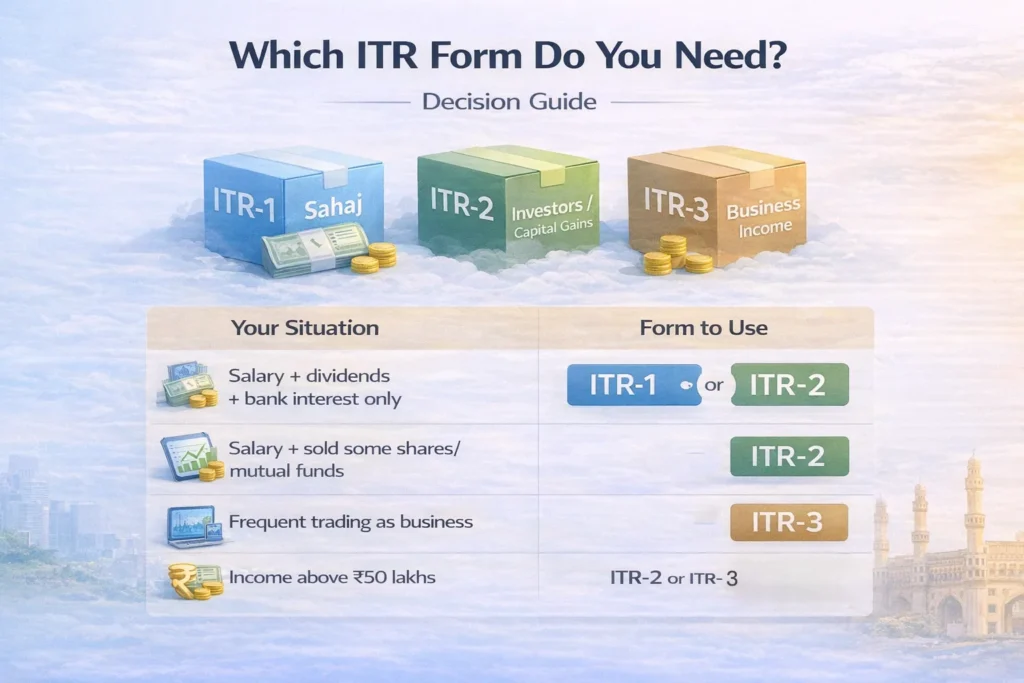
This confuses everyone. But it’s actually pretty straightforward. Think of ITR forms like different sizes of boxes. You need the right box for what you’re packing.
ITR-1 (Sahaj) is the simplest form. You can use this if you only have salary, one house property, and interest income up to ₹10,000. No capital gains allowed here.
ITR-2 is what most investors need. Got capital gains from selling shares? Use ITR-2. Have dividend income along with your salary? ITR-2. Own more than one property? ITR-2 again.
ITR-3 is for business income. If you’re a day trader or treat trading as a business, this is your form.
Here’s a quick decision guide:
| Your Situation | Form to Use |
|---|---|
| Salary + dividends + bank interest only | ITR-1 or ITR-2 |
| Salary + sold some shares/mutual funds | ITR-2 |
| Frequent trading as business | ITR-3 |
| Income above ₹50 lakhs | ITR-2 or ITR-3 |
Most people reading this will land on ITR-2. That’s your safe bet if you have any capital gains.
How to Report Capital Gains (The Tricky Part)
Capital gains reporting scares people. It shouldn’t.
Yes, it requires detail. Yes, you need to fill Schedule CG. But once you understand the logic, it’s like filling out a detailed shopping receipt.
Understanding Short Term vs Long Term
First, know the difference.
Short Term Capital Gains (STCG) happen when you sell equity shares or equity mutual funds within 12 months of buying them. The tax rate is 15%, period. Doesn’t matter what tax slab you’re in.
Long Term Capital Gains (LTCG) kick in when you hold for more than 12 months before selling. Here’s the sweet deal: the first ₹1 lakh of profit is tax-free. Beyond that, 10% tax applies.
For debt mutual funds, the holding period is 36 months to qualify as long term.
What Information You Need
Schedule CG asks for specific details. Gather these before you start:
- ISIN code of each security (your broker statement has this)
- Purchase date and price
- Sale date and price
- STT paid (Securities Transaction Tax)
- Number of shares/units transacted
I recently helped my cousin with his taxes. He had made about 15 different share transactions. He thought he could just enter the net profit.
Wrong.
You need to report each transaction separately. Yes, it’s tedious. Yes, it takes time. But that’s the rule.
SIP Capital Gains Are Special
Here’s where people mess up constantly. Let’s say you started a SIP (Systematic Investment Plan) two years ago. You invest ₹5,000 every month. Now you redeem the entire amount. You can’t just calculate one capital gain figure. Each monthly SIP installment is treated as a separate purchase. Some might be short term gains. Some long term.
It’s like buying apples every month for two years at different prices, then selling them all at once. You need to track which batch you’re selling. Most fund houses provide a capital gains statement. Download it. Use it. Don’t try to calculate manually unless you enjoy punishment.
The Step-by-Step Process
Open Schedule CG in your ITR form. You’ll see sections for different types of gains.
Section 111A is for STCG on equity at 15%.
Section 112A is for LTCG on equity at 10%.
Pick the right section. Enter each transaction’s details.
Calculate the gain: Sale price minus purchase price minus expenses (like brokerage).
The form will auto-calculate your tax liability.
One more thing. If you have losses, report those too. You can carry forward losses for up to 8 years to offset future gains. But only if you report them in the year they occur.
How to Report Dividend Income
Dividends used to be everyone’s favorite. Tax-free money dropping into your account.
Those days are gone since April 2020.
Now, all dividend income is fully taxable at your slab rate. If you’re in the 30% bracket, that’s how much tax you pay on dividends.
Where to Report
Dividends go in Schedule OS (Other Sources).
You’ll find a specific row for dividend income. Enter the total amount received during the financial year.
Here’s something most people don’t know. You can claim a deduction under Section 57 for expenses incurred in earning that dividend. Paid brokerage to buy shares? Demat account charges? These can be deducted.
The catch? You need proof. Keep those receipts.
The AIS Matching Problem
This is where things get messy.
Sometimes your dividend amount doesn’t match what AIS shows. Why? Because AIS might include dividends credited in March but you received in April (different financial year). Or vice versa.
When there’s a mismatch, file a correction in AIS if needed. Or add a note in your ITR explaining the difference.
I’ve seen people get notices simply because they entered ₹12,450 but AIS showed ₹12,500. Fifty rupees difference. The system flags it automatically.
Be precise. Check. Double-check.
How to Report Interest Income
This one’s usually simpler than capital gains. But people still make mistakes.
Types of Interest to Report
Bank savings account interest needs reporting even if it’s just a few hundred rupees. Every penny counts in the system’s eyes.
Fixed deposit interest is big. Banks deduct TDS if your interest exceeds ₹40,000 (₹50,000 for senior citizens). Still, you report the gross amount.
Recurring deposits, post office schemes, NCDs, bonds all generate taxable interest.
P2P lending interest is also taxable. Yes, even from those peer-to-peer platforms. Don’t forget it.
Where to Report
All interest income goes to Schedule OS as well, just in different rows than dividends.
There’s good news if you’re a regular taxpayer. You can claim deduction under Section 80TTA up to ₹10,000 on savings account interest.
Senior citizens get an even better deal. Section 80TTB allows deduction up to ₹50,000 on all bank interest combined.
The Form 26AS Cross-Check
Banks report all TDS deducted to the department. This appears in your Form 26AS and AIS.
Before filing, download Form 26AS. Match every TDS entry with your records.
Missing TDS? Contact the bank immediately.
Wrong PAN linked? Get it corrected before filing.
This matching process saves you from major headaches later.
Reporting Tax-Free Income (Yes, You Still Must)
Here’s a surprise. Even if income is tax-free, you often need to report it.
Why? To show completeness. To avoid questions later.
PPF interest is completely tax-free. But it still goes in Schedule EI (Exempt Income). Just mention the amount. Zero tax. Done.
Tax-free bonds exist, issued by government entities. Interest from these? Also Schedule EI.
ULIP maturity can be tax-free if conditions are met (premium under ₹2.5 lakhs per year, policy held for 5+ years). Report it anyway.
I had a client who didn’t report his ₹3 lakh PPF interest. The department sent a notice asking why such a large amount wasn’t shown anywhere.
He had to explain it was from PPF. Submit proof. The whole nine yards.
Could’ve been avoided by just entering it in Schedule EI from the start.
Reporting Foreign Investment Income
This section trips up many NRIs and Indian residents who dabble in US stocks or foreign ETFs.
The rules here are strict. Very strict.
Two Critical Schedules
Schedule FSI (Foreign Source Income) is where you report income earned from foreign sources. Got dividends from Apple stock? Capital gains from selling Tesla shares? Goes here.
Schedule FA (Foreign Assets) requires you to disclose foreign bank accounts, foreign shares, foreign mutual funds, everything. Even if these assets didn’t generate income. Even if you made a loss.
Yes, that means if you bought foreign stocks and they’re currently underwater, you still disclose them.
Foreign Tax Credit
Many countries deduct tax on dividends paid to foreign investors. The US withholds 25-30% on dividends.
You can claim credit for this tax paid abroad using Form 67. This prevents double taxation (paying tax in both countries).
File Form 67 before filing your ITR. It’s a separate submission. Many people miss this deadline and lose out on claiming the credit.
The Penalty for Non-Disclosure
Not disclosing foreign assets? That’s serious business.
The penalty can go up to ₹10 lakhs. The department views this as potential tax evasion or money laundering.
Even if you hold just $1,000 in a foreign bank account for emergencies, declare it.
Better safe than sorry. Way better.
Documents You Need (The Complete Checklist)
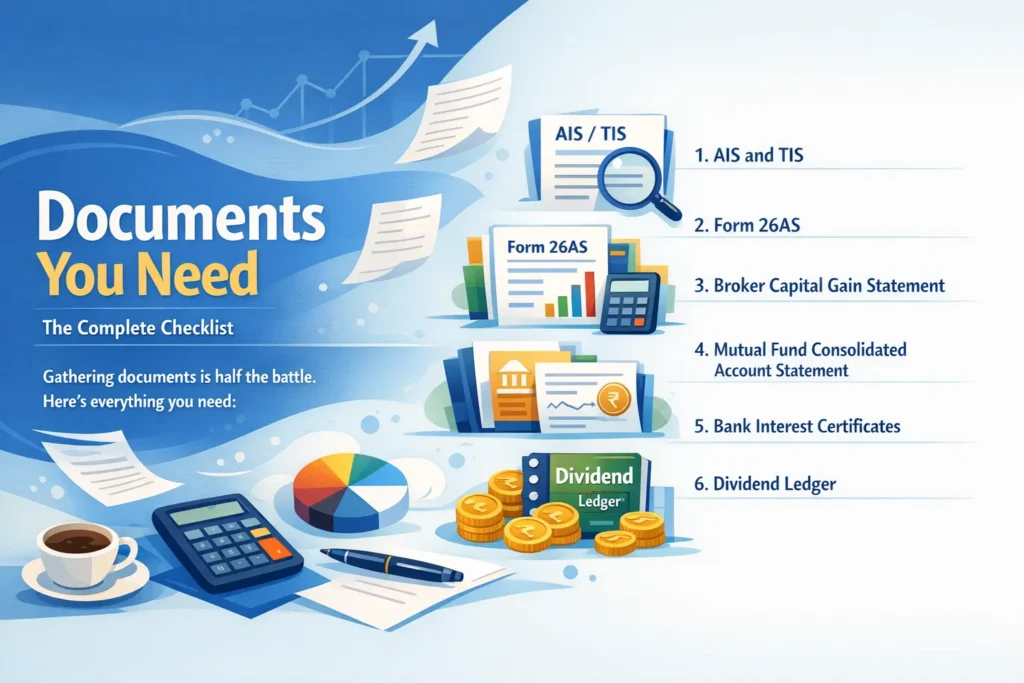
Gathering documents is half the battle. Here’s everything you need:
AIS and TIS: Download these from the income tax portal. They show all income reported by third parties.
Form 26AS: Your tax credit statement. Shows all TDS deducted in your name.
Broker Capital Gain Statement: Every broker provides this. Zerodha, Upstox, ICICI Direct, everyone. Download it before March 31st (some brokers remove old statements).
Mutual Fund Consolidated Account Statement: Get this from CAMS or KFintech. It consolidates holdings across all AMCs.
Bank Interest Certificates: Banks issue Form 16A if TDS was deducted. Even without TDS, get an interest certificate.
Dividend Ledger: Your broker or RTA (Registrar and Transfer Agent) provides this. Lists every dividend received.
Keep digital copies of everything. Store them in Google Drive or similar. You might need them for 7-10 years if there’s ever a scrutiny or audit.
Common Mistakes That Trigger Notices
Let me share the most frequent errors I see:
Not reporting auto-credited dividends: Many companies credit dividends directly to your bank. You might not even notice. But the department knows. They always know.
Ignoring SIP capital gains: As mentioned earlier, each SIP installment needs separate treatment. Bunching them together is wrong.
Entering net gains instead of transaction-wise details: The form wants gross details. Not your calculated summary.
Not reporting foreign assets: This is the costliest mistake. Always disclose foreign holdings.
Using wrong Cost Inflation Index (CII): When calculating LTCG on property or debt funds, you need to apply CII for indexation. Using the wrong year’s index messes up your calculation.
Claiming exemptions you don’t qualify for: Not everyone gets the ₹1 lakh LTCG exemption on every type of asset. Read the conditions carefully.
Forgetting to carry forward losses: Made a loss this year? Report it and file on time. Otherwise, you can’t use it to offset future gains.
Each of these seems small. But they add up. And the system catches them.
Step-by-Step Filing Process
Let’s walk through the actual filing:
Step 1: Collect all documents (use the checklist above). Give yourself at least a week before the deadline to gather everything.
Step 2: Reconcile with AIS and Form 26AS. Check every entry. Note discrepancies. Correct them in AIS if possible.
Step 3: Choose the correct ITR form. Most likely ITR-2 if you have investment income.
Step 4: Fill the schedules methodically. Start with basic details, then move to Schedules CG, OS, EI, and others as needed.
Step 5: Upload proofs if needed. The system might ask for supporting documents. Keep them ready.
Step 6: Pre-validate your bank account. This is crucial for getting refunds. Do it before filing, not after.
Step 7: E-file the return. Review everything one last time. Then submit.
Step 8: E-verify immediately. Don’t wait. Use Aadhaar OTP, net banking, or other methods. Your return isn’t complete until you verify.
I always tell people to file at least two weeks before the deadline. Last-minute filing means if something goes wrong, you’re out of time to fix it.
The portal crashes on July 31st every year. Why fight that traffic?
Frequently Asked Questions
1. What if AIS shows wrong information about my investment income?
You can file feedback in AIS to correct it. Login to the income tax portal, go to AIS, and click on the feedback option next to the incorrect entry. But here’s the reality: corrections take time. If the deadline is near and the correction won’t happen in time, file your return with the correct figures and add a detailed explanation in the “Additional Information” section of your ITR. Keep proof of the correct amount handy.
2. Do I need to report investments where I haven’t made any profit or income?
For domestic investments, generally no. If your shares are just sitting there with no sale and no dividend, you don’t report them. But foreign assets are different. You must disclose all foreign bank accounts, shares, and investments in Schedule FA, even if they’re making losses or generating zero income. That’s the law.
3. How do I report losses and carry them forward?
Use Schedule CFL (Carry Forward of Losses) in your ITR. Enter the loss amount under the appropriate head like capital loss or business loss. But here’s the critical part: you must file your return before the due date to carry forward losses. File even one day late and you lose this benefit forever for that year’s losses. Don’t miss the deadline.
4. Can I report all my SIP transactions as one lump sum capital gain?
No. This is a massive mistake people make. Each SIP installment is treated as a separate purchase with its own buy date and price. When you redeem, each unit’s gain needs separate calculation. Some might be short term, some long term. Your mutual fund house provides a detailed capital gains statement. Use that. Don’t try to create a single lump sum figure.
5. What happens if I forget to report dividend income of ₹2,000? Will I really get a notice for such a small amount?
Yes, you can. The system matches your filing against AIS automatically. It doesn’t care if the mismatch is ₹200 or ₹2 lakhs. A mismatch is a mismatch. You’ll get an intimation under Section 143(1) with a demand for tax, interest, and possibly a penalty. Even small amounts matter. Report everything.
6. Do I need a CA for reporting capital gains or can I do it myself?
It depends on complexity. Simple cases (5-10 equity share transactions, clear broker statement) you can handle yourself. The broker provides a ready capital gains statement. Just enter the details carefully. But if you have: frequent F&O trading, property sales, debt mutual fund indexation calculations, foreign investments, or 50+ transactions, hire a CA. The fee is worth avoiding costly mistakes.
7. I sold shares but reinvested the profit immediately. Do I still need to pay tax and report it?
Yes, absolutely. Capital gains tax triggers the moment you sell, not when you withdraw money. Whether you reinvested, kept it in your trading account, or spent it on vacation doesn’t matter. The sale event creates a taxable capital gain. Report it and pay applicable tax. There’s no exemption for reinvestment in shares (unlike property where 54EC bonds exist).
8. My bank deducted TDS on my FD interest. Do I still need to report this income?
Yes. TDS is just advance tax. It’s not the final settlement. You must report the gross interest (before TDS) in Schedule OS. The TDS deducted will show up in Form 26AS and gets credited against your total tax liability. You might get a refund if TDS was more than your actual tax due. But you must report the income.
9. How long should I keep my investment documents and tax records?
The safe rule: keep everything for at least 6-7 years. The department can reopen cases within 4 years in normal circumstances, up to 6 years if income exceeded ₹50 lakhs, and up to 10 years in serious cases. Digital storage is easy. Keep PDFs of all broker statements, mutual fund statements, bank certificates, and filed ITRs with acknowledgments. Better to have and not need than need and not have.
10. I have both salary income and investment income. Which sections do I fill first in ITR?
Start with the easy parts. Fill your personal details first. Then do salary income (use Form 16). Then tackle house property if applicable. Next comes investment income: Schedule CG for capital gains, Schedule OS for dividends and interest. Then do deductions (80C, 80D, etc.). Finally, fill TDS details from Form 26AS. This sequence keeps you organized and reduces errors. The form auto-calculates tax as you go.
Conclusion
Reporting investment income isn’t as scary as it looks. Yes, it requires attention to detail. Yes, you need to gather documents. Yes, it takes time. But here’s what happens when you do it right. You sleep peacefully. No worry about notices. No stress about scrutiny. The department’s systems are smarter than ever. They match data automatically. Fighting the system or trying to hide things is like playing chess against a computer. You’re going to lose.
Instead, work with the system. Report everything. Be honest. Be thorough. Keep digital records of all investment statements. Maintain a simple spreadsheet tracking your investments and income. Update it monthly. When tax season arrives, you’ll thank yourself. One last thing. Tax laws change. What’s true today might shift tomorrow. Stay updated. Follow reliable sources. Join investor communities. Ask questions. Your financial future depends not just on making smart investments, but on handling the tax side correctly too.
Both matter equally. Start organizing your investment records today. Future you will be grateful.
Also Read: Received an Income Tax Notice in India? Section 142(1) and Other Notices Explained
Also Read: Trump Green Card: Policy Changes, Rules & Latest Updates


0 Comments