



If you're an NRI dealing with US income, taxes, or investments, you've probably hit this wall.
Someone asks for your "tax ID." You stare at the form. You're not sure if they want your SSN, your ITIN, or something else entirely. And the more you Google, the more confused you get.
Here's the thing. SSN, ITIN, and Tax ID are not the same. But they're not completely different either. Think of them like three members of the same family. Related, yes. Interchangeable, no.
This guide breaks it all down. Plain English. No tax jargon.
What is a Taxpayer Identification Number (TIN)?
Start here. Before anything else.
A Taxpayer Identification Number, or TIN, is simply an umbrella term. It's the broad category that covers multiple types of ID numbers the US government uses to track taxpayers.
Think of TIN like the word "vehicle." A car is a vehicle. So is a truck. So is a motorcycle. But you wouldn't call a motorcycle a car.
Same logic applies here.
Under the TIN umbrella, you have three main types:
- SSN (Social Security Number)
- ITIN (Individual Taxpayer Identification Number)
- EIN (Employer Identification Number, used by businesses)
Each one exists for a different reason. Each one goes to a different kind of person or entity. When someone asks for your "Tax ID," they usually mean one of these three. Which one depends entirely on your situation.
Is a Taxpayer Identification Number the Same as an SSN?
No. And this is where most people get tripped up.
Your SSN is a TIN. But not every TIN is an SSN.
It's like saying every square is a rectangle, but not every rectangle is a square. Your SSN is one specific type of taxpayer ID. ITIN is another type. They live in the same family but serve very different purposes.
This distinction matters a lot for NRIs.
What is an SSN (Social Security Number)?
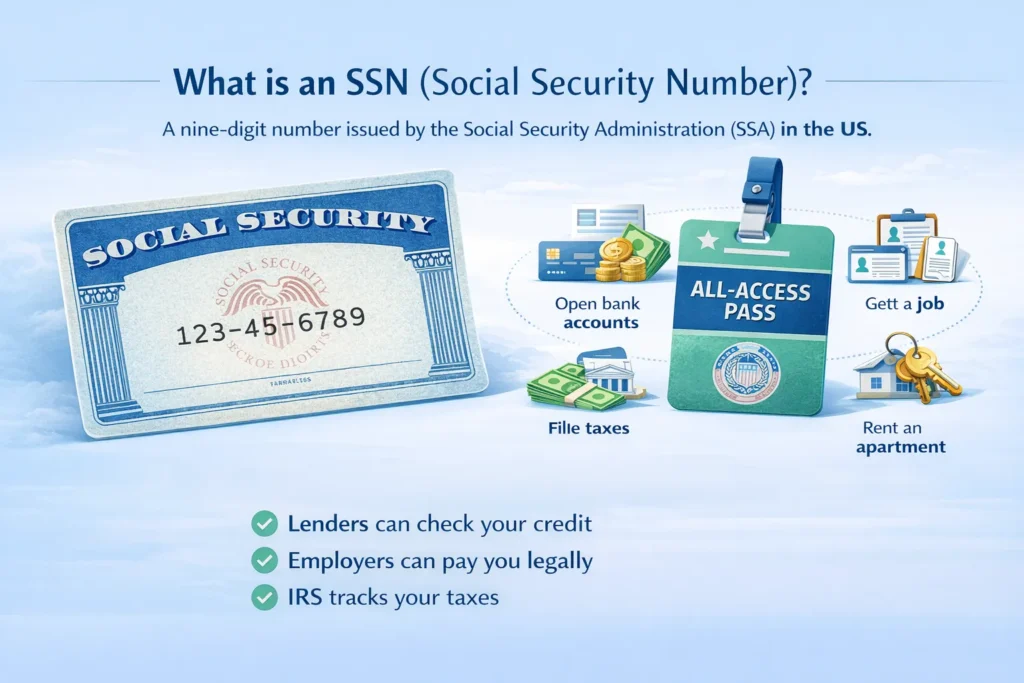
An SSN is a nine-digit number issued by the Social Security Administration (SSA) in the US.
It was originally created to track individual earnings for Social Security benefits. Over time, it became the primary identifier for almost everything in American life. Opening a bank account. Filing taxes. Getting a job. Even renting an apartment.
Think of the SSN as your all-access pass to the American financial system.
Once you have one, doors open. Lenders can check your credit. Employers can pay you legally. The IRS knows exactly who you are come tax season.
Who is Eligible for an SSN?
Not everyone can just apply and get one. The SSA is specific about this.
You're eligible for an SSN if you are:
- A US citizen (born in the US or naturalized)
- A permanent resident (Green Card holder)
- A temporary worker who is authorized to work in the US (on a work visa like H-1B, L-1, O-1, etc.)
That last category is important. "Authorized to work" is the key phrase. You need a visa that explicitly permits employment in the US.
F-1 students on OPT or CPT? Usually eligible. Someone on a B-1 tourist visa? Not eligible. It's that specific.
Can NRIs Get an SSN?
The short answer: sometimes.
If you're working in the US legally on a qualifying visa, yes. You can and should apply for an SSN. Your employer will need it to process payroll and report your income to the IRS.
But if you're an NRI sitting in India, investing in US stocks or collecting rental income from a US property you own? You are not eligible for an SSN. You have no US employment authorization. The SSA has no reason to issue you one.
This is where the ITIN comes in.
What is an ITIN (Individual Taxpayer Identification Number)?
The ITIN is also a nine-digit number. It looks a lot like an SSN. But it starts with the digit 9, which sets it apart.
It's issued by the IRS (Internal Revenue Service), not the SSA. And it was created for one specific reason: to give people without SSN eligibility a way to still file US tax returns and comply with US tax laws.
Here's a good analogy. Think of the ITIN as a guest badge at an office building. It lets you in. It gets you where you need to go. But it doesn't give you the same access as a full employee ID card.
The ITIN gets you into the US tax system. Nothing more, nothing less.
Who Needs an ITIN?
You need an ITIN if you have a US tax obligation but you don't qualify for an SSN.
That includes:
- NRIs earning US income through dividends, interest, rental income, or freelance work
- Foreign investors with stakes in US companies or real estate
- Non-resident taxpayers who need to file US returns
- Spouses or dependents of US citizens or residents who don't qualify for an SSN
For example: say you're an NRI based in Pune, and you invest in US stocks through a brokerage account. You earn dividends. The US government wants a piece of that. To file a return and potentially claim a treaty benefit, you need a tax ID. Since you have no SSN, the IRS issues you an ITIN instead.
What is an ITIN Used For?
The ITIN is only for tax purposes. Full stop.
Specifically, you can use it to:
- File US federal tax returns
- Report US-sourced income to the IRS
- Claim treaty benefits under agreements like the US-India DTAA
- Open certain investment accounts that require a tax ID on file
It does not give you work authorization. It does not give you access to Social Security benefits. It doesn't prove immigration status or anything beyond the fact that you're in the IRS system.
SSN vs ITIN: Key Differences
Here's where it all comes together. Side by side.
| Feature | SSN | ITIN |
|---|---|---|
| Issued by | Social Security Administration | Internal Revenue Service |
| Who gets it | US citizens, residents, authorized workers | Non-residents, foreign nationals, NRIs |
| Main purpose | Work + taxes + benefits | Tax filing only |
| Social Security benefits | Yes | No |
| Valid for employment | Yes | No |
| Starts with | Any digit (except 9) | Always starts with 9 |
The biggest difference? Purpose.
An SSN is your full identity number for life in the US. An ITIN is a limited-use tax number. You use it to talk to the IRS. That's it.
SSN vs Tax ID vs ITIN: Let’s Clear This Up Once and For All
People mix these terms up constantly. Here's the simplest version:
- TIN = the parent category. Any number used to identify a taxpayer in the US.
- SSN = a type of TIN. Used by eligible individuals for work, taxes, and benefits.
- ITIN = another type of TIN. Used by people who can't get an SSN but have US tax obligations.
- EIN = yet another type. Used by businesses, not individuals.
So when someone says "give me your Tax ID," they're asking for your TIN. Which specific TIN depends on which one you have.
If you have an SSN, use that. If you don't have one, your ITIN is your Tax ID.
SSN or ITIN for NRIs: Which One Do You Actually Need?
Let's make this simple. Ask yourself one question:
Are you working in the US with legal work authorization?
If yes, apply for an SSN. Your employer needs it. The SSA processes it. You're in the system.
If no, and you still have US income or tax obligations, you need an ITIN.
Here are some real-world NRI scenarios:
US stock investment from India You buy Apple shares through a US brokerage. You earn dividends. You need to file a US return. You need an ITIN.
Rental income from a US property You own an apartment in New Jersey and rent it out. That rental income is US-sourced. The IRS wants it reported. ITIN required.
Freelancing for a US client You're in India, billing a US company. They issue you a 1099 form. You may need to file a US return. ITIN is the tool for the job.
Working in the US on an H-1B visa You've relocated. Your employer is sponsoring you. You're on payroll. You need an SSN, and you're eligible to get one.
Spouse of a US resident, no work authorization Your spouse is in the US on a work visa. You're filing jointly. You don't work. You still need to be on the return. Apply for an ITIN.
How to Apply for an ITIN: Step-by-Step
The process is straightforward. But it requires patience.
Step 1: Fill out Form W-7
This is the official IRS application form for an ITIN. Download it from the IRS website. Fill it out carefully. The form asks for your name, address, country of citizenship, and the reason you need an ITIN.
Step 2: Gather your identity documents
You need to prove your foreign status and identity. A valid passport is the most accepted document. If you're submitting a certified copy, make sure it's certified by the issuing authority, not just notarized.
Step 3: Attach it to your tax return
Here's the part people miss. The W-7 is not submitted alone. You attach it to your US tax return (Form 1040-NR for non-residents). You're applying for the ITIN while filing your return.
There is an exception: if you qualify for an allowable exception (like a treaty benefit claim), you may be able to apply without a return.
Step 4: Submit to the IRS
You can mail the package to the IRS ITIN Operations center in Texas, take it to an IRS Taxpayer Assistance Center, or use an IRS-authorized Certifying Acceptance Agent (CAA), which is often the easiest route for NRIs outside the US.
Step 5: Wait for processing
The IRS typically takes 6 to 11 weeks to process ITIN applications. During tax season, it can stretch longer. Once issued, the IRS mails you a letter with your ITIN.
How to Apply for an SSN
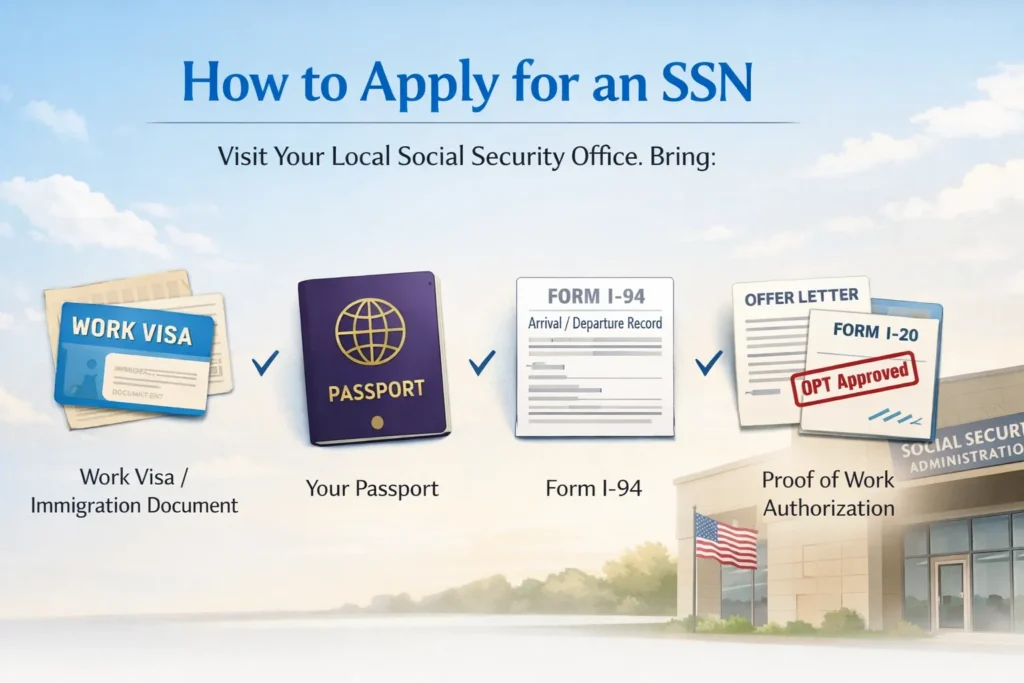
If you are eligible (authorized worker, Green Card holder, citizen), the process is simpler.
Visit your local Social Security Administration office. Bring:
- Your work visa or immigration document
- Your passport
- Form I-94 (arrival/departure record)
- Evidence of your work authorization (like an offer letter or I-20 with OPT approval)
The SSA processes applications and mails your card within a few weeks. Some employers start you on payroll before the card arrives, using a receipt notice in the meantime.
Can You Use an SSN as a Tax ID?
Yes. Absolutely.
Your SSN is your Tax ID if you're an eligible individual. When you file a US tax return and you have an SSN, you use that in the Tax ID field. They are the same thing, in your case.
The confusion arises because non-eligible people need a different tax ID (the ITIN). That difference makes people wonder if there's some separate "Tax ID" separate from their SSN. There isn't. If you have an SSN, it doubles as your Tax ID.
Can You Use an ITIN for Employment?
No. And this is a hard no.
An ITIN does not authorize you to work in the US. It does not substitute for an SSN when an employer runs payroll. It does not give you access to Social Security benefits, Medicare, or any work-related government programs.
If you try to use an ITIN to get a job in the US, that's a problem. The IRS created ITINs specifically for tax compliance, not employment.
ITIN Limitations You Should Know
Beyond the employment restriction, there are a few more limits worth knowing:
- No social security benefits. ITIN holders don't accrue Social Security credits.
- No proof of immigration status. Having an ITIN says nothing about your legal right to be in the US.
- ITINs expire. If you haven't filed a US tax return for three consecutive years, your ITIN becomes inactive. You'll need to renew it.
- Some states won't accept it. Certain state-level forms require an SSN, not an ITIN.
Common Confusions, Answered Directly
Is a Tax ID the same as an SSN? It depends on who you are. If you're a US citizen or eligible resident, your SSN is your Tax ID. For everyone else, the Tax ID is their ITIN (or EIN if it's a business).
Is your SSN your Taxpayer ID? Yes. For anyone who has an SSN, it functions as their taxpayer identification number.
Taxpayer ID vs Social Security Number: what's the difference? A Social Security Number is one type of Taxpayer ID. Not all Taxpayer IDs are SSNs. Taxpayer ID is the broader term.
Conclusion
SSN and ITIN are not the same thing. But they're not at odds with each other either. They simply exist for different people in different situations.
If you're an NRI with any kind of US income, whether that's dividends, rent, freelance fees, or business earnings, there's a good chance you need an ITIN. It's your legal way to stay compliant with US tax rules without being a US resident or worker.
Getting it right from the start saves you headaches. And potentially, penalties.
Before filing your next US return or opening that brokerage account, take five minutes to figure out which ID applies to you. The answer is usually simpler than it seems.
Frequently Asked Questions
What is SSN or ITIN?
Both are US tax identification numbers. An SSN (Social Security Number) is issued by the Social Security Administration to US citizens, residents, and authorized workers. An ITIN (Individual Taxpayer Identification Number) is issued by the IRS to people who have US tax obligations but don't qualify for an SSN. Different purposes, same family.
Is SSN available in India?
No. The SSN is a US government-issued number. It is only available to people who live or work in the US with proper authorization. If you're based in India with no US work authorization, you simply cannot apply for one. NRIs needing a US tax ID should look at ITIN instead.
What is the SSN for NRI?
There is no SSN equivalent specifically for NRIs. If you're an NRI working legally in the US on a qualifying visa, you can get an SSN. If you're earning US income without working there, the ITIN is your equivalent. It's your identity number inside the US tax system.
Can a non-US citizen get an ITIN number?
Yes, absolutely. The ITIN was specifically designed for non-US citizens. If you're a foreign national, NRI, or non-resident with US income or tax filing requirements, you're eligible. Citizenship is not a requirement. Having a US tax obligation is. Fill out Form W-7 and apply directly through the IRS.
How to get ITIN from India?
You apply using IRS Form W-7, attach your valid passport as identity proof, and submit it along with your US tax return. From India, the easiest route is through an IRS-authorized Certifying Acceptance Agent (CAA). They verify your documents locally so you don't mail your original passport to the US.
What if I don't have a US TIN number?
Without a US TIN, you can't file a US tax return, claim treaty benefits, or legally report US income. Withholding tax on your income may also be higher. If you have US tax obligations, apply for an ITIN immediately. Ignoring it doesn't make the obligation disappear. It just adds penalties.
How to get TIN number for NRI?
For most NRIs, the relevant US TIN is an ITIN. Apply by submitting Form W-7 to the IRS with proof of identity and foreign status. A valid passport works best. You can use a Certifying Acceptance Agent in India to simplify the process. Processing typically takes 6 to 11 weeks.
Do we have a TIN in India?
India had a Tax Identification Number (TIN) system used for VAT registration by businesses. For individuals, the closest equivalent is your PAN (Permanent Account Number), issued by the Income Tax Department. PAN serves as your primary tax identity in India, just like an SSN or ITIN does in the US.
Is TIN still used in India?
The old TIN system for VAT has largely been replaced by GSTIN (Goods and Services Tax Identification Number) following the GST rollout in 2017. For individuals, PAN remains the active and valid tax identifier. So while the term TIN is still referenced, GSTIN and PAN are what actually matter today.
Can I use PAN instead of TIN?
Not for US tax purposes. PAN is an Indian tax identifier. The US IRS does not recognize it. For US filings, you need either an SSN or an ITIN. However, under the US-India tax treaty (DTAA), your PAN may be referenced in certain disclosures. But it cannot replace a valid US TIN.
Also read: 7 Steps to Claim a TDS Refund as an NRI in India (Complete Process)
Also read: Income Tax Act 1961 Explained Simply for Indian Taxpayers
Also read: How to Pay Less Taxes on a $150K Salary: Smart Strategies to Reduce Your Tax Bill


0 Comments