



The email arrives on a Thursday afternoon.
Your property in Pune sold last month. The buyer sent the money. But the amount is less than you expected. Much less.
You check the breakdown.
The buyer deducted 20 percent TDS. On the entire sale price. Not just your capital gain. The full amount.
You do the math. They took nearly ₹12 lakh extra. Money that should be in your bank account. Money you planned to reinvest.
Your stomach drops.
Now you need to file a return. Wait for refund. Deal with income tax department. All because someone applied the wrong rule.
I have seen this happen more times than I can count. NRIs losing money to TDS errors. Not because they owe tax. Because buyers, tenants, and banks deduct incorrectly.
Here is the good news.
Most TDS errors are preventable. You just need to know the rules. The rates. The forms. The timing.
Let me walk you through everything.
What Is TDS and Why Should NRIs Care?
TDS means Tax Deducted at Source.
Think of it as pay-as-you-earn. When you earn money in India, the person paying you deducts tax first. Then sends you the balance. The deducted tax goes to the government. You claim credit when filing your return.
For residents, TDS is usually straightforward. For NRIs, it is a minefield.
Why?
Because TDS rates for NRIs are higher. Much higher. And the rules are stricter. One wrong form. One missed document. One incorrect assumption. And you lose thousands.
The income types that trigger TDS for NRIs:
- Selling property in India
- Renting out an Indian property
- Interest from NRO savings accounts
- Interest from fixed deposits
- Capital gains from investments
- Dividends from Indian companies
Each has different rates. Different rules. Different traps.
Common TDS Mistakes NRIs Make
Let me list the errors I see most often.
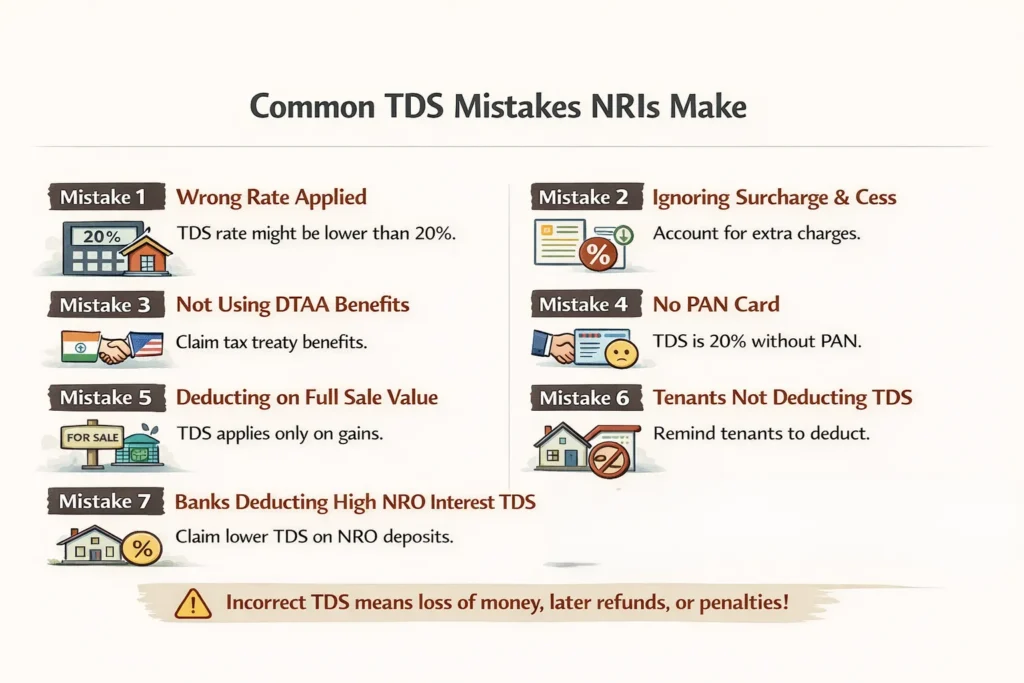
Mistake 1 – Wrong rate applied
The buyer deducts 20 percent on property sale. But your actual tax rate might be lower. Long-term capital gains on property are 20 percent with indexation. But TDS is only on the gain, not the full sale price. Buyers get this wrong constantly.
Mistake 2 – Ignoring surcharge and cess
The basic TDS rate is one number. But add surcharge. Add health and education cess. The actual deduction ends up higher. NRIs forget to account for this.
Mistake 3 – Not using DTAA benefits
India has tax treaties with many countries. These often allow lower TDS rates. But you must apply for them. If you do not, the deductor uses standard rates.
Mistake 4 – No PAN card
Without PAN, TDS is deducted at 20 percent. Mandatory. Even if your actual rate is lower. Even if you are exempt. No PAN means higher deduction.
Mistake 5 – Buyers deducting on full sale value
This is the biggest one. TDS on property applies only to capital gains. Not total sale price. But buyers often deduct on the whole amount. Then you wait months for refund.
Mistake 6 – Tenants not deducting TDS
NRI landlords often do not get TDS deducted on rent. Tenant pays full rent. No tax deducted. Later, income tax notices arrive. Penalties apply.
Mistake 7 – Banks deducting higher NRO interest TDS
NRO interest is taxable. Banks deduct TDS at 30 percent plus cess. But if your total income is below taxable limit, you should not pay this. You need to file forms to prevent it.
TDS Rules for Different Income Types
Let me break down each income type separately.
Property Sale – Section 195
You sell a flat in Bangalore. Buyer pays you ₹1 crore.
The buyer must deduct TDS under Section 195. But here is the key.
TDS is only on your capital gain. Not the full ₹1 crore.
If your capital gain is ₹40 lakh, TDS applies to ₹40 lakh. Not ₹1 crore.
But most buyers do not know your cost of acquisition. They do not know your indexed cost. So they deduct on the full amount. To be safe.
This creates excess TDS. You pay tax on money that is not even income.
Correct rate for long-term capital gains: 20 percent with indexation. Plus surcharge and cess if applicable.
Correct rate for short-term capital gains: Slab rates. Usually higher.
Rental Income from Property
You own a house in Delhi. Tenant pays ₹50,000 per month.
If you are an NRI, the tenant must deduct TDS before paying you.
Rate: 30 percent plus surcharge and cess. Approximately 31.2 percent.
Tenant files Form 15CA and 15CB. Deposits tax. Gives you TDS certificate.
If tenant does not deduct, you are still liable for tax. Plus interest. Plus penalty.
Interest on NRO Accounts
Your NRO savings account earns ₹80,000 interest in a year.
Bank deducts TDS at 30 percent plus cess. Around 31.2 percent.
But what if your total Indian income is below ₹2.5 lakh? You should not pay tax at all. You need to file Form 10F and tax residency certificate. Submit to bank. Ask for no TDS deduction.
Dividends
Companies pay dividends. They deduct TSD before crediting you.
Rate: 20 percent plus surcharge and cess. Unless DTAA applies.
Capital Gains from Shares
You sell Indian shares. Make a profit.
TDS applies only if shares are sold without paying Securities Transaction Tax. For most listed shares, STT is paid. So no TDS.
But for unlisted shares, TDS applies.
How Buyers Make TDS Errors in Property Transactions
This deserves its own section. Property sales cause the most TDS problems.
Error 1 – No TAN registration
Buyers need a Tax Deduction and Collection Account Number. Many do not have one. They deduct tax but cannot deposit it. Penalties follow.
Error 2 – Wrong form filed
Property TDS uses Form 26QB. Some buyers file wrong forms. Tax does not get credited to you.
Error 3 – Deducting on full value
Already explained. Happens constantly.
Error 4 – Late payment
TDS must be deposited within 30 days of month end. Late payment means interest. Buyer may recover this from you.
Error 5 – Not giving TDS certificate
Buyer must give you Form 16B. Without it, you cannot claim credit. Your money sits with government. You cannot prove you paid tax.
If you are selling property, educate your buyer. Send them the rules. Tell them exactly what to deduct. Share your cost details so they compute gain correctly.
How NRIs Can Reduce Excess TDS Deduction
You do not have to accept high TDS. You can reduce it.
Step 1 – Get a PAN Card
This is non-negotiable. Without PAN, TDS is 20 percent minimum. Get one before any transaction.
Step 2 – Submit Tax Residency Certificate
This proves you are resident of another country. Get it from your local tax authority. Shows you qualify for DTAA benefits.
Step 3 – Apply DTAA Benefits
If your country has a tax treaty with India, TDS rates may be lower.
For example, USA treaty allows 15 percent on capital gains in some cases. UK treaty has similar benefits.
You need to submit Form 10F and TRC to the deductor. They apply lower rate.
Step 4 – Apply for Lower TDS Certificate
If your actual tax liability is lower, get a certificate from income tax department. Shows exactly what rate applies. Deductor must follow it.
Step 5 – Inform Deductor Before Payment
Do not wait until after deduction. Talk to buyer or tenant beforehand. Give them all documents. Tell them the correct rate. Show them proof.
Lower or Nil TDS Certificate Under Section 197
This is your strongest tool.
Section 197 allows you to get a certificate for lower or nil TDS deduction.
How it works
You apply to the Assessing Officer. Show your estimated income for the year. Show why your tax liability is low.
The officer issues a certificate. It states: Deduct TDS at X percent. Or deduct nothing.
You give this certificate to the deductor. They follow it. No excess deduction.
When to use
- Your total Indian income is below taxable limit
- You have brought forward losses
- Your income is exempt under DTAA
- You want to avoid locking money in refunds
Processing time: 30 to 60 days. Apply well before your transaction.
Step by Step Process to Apply for Lower TDS (Form 13)
Let me walk you through the application.
Step 1 – Log into Income Tax Portal
Go to incometax.gov.in. Login with your credentials.
Step 2 – Navigate to Form 13
Search for Apply for Lower or Nil Deduction of TDS. Select Form 13.
Step 3 – Choose Assessment Year
Select the year for which you want lower deduction.
Step 4 – Fill Details
Enter your estimated income. Show all sources. Indian income only. Not foreign income.
Step 5 – Upload Documents
- Estimated income statement
- Tax Residency Certificate
- Form 10F (if applicable)
- Previous year returns
- Proof of tax payments
Step 6 – Submit
Officer assigned. They may ask questions. Respond promptly.
Step 7 – Receive Certificate
Download it. Share with all deductors. Banks. Buyers. Tenants. Companies.
Avoid Higher TDS Without PAN – Section 206AA
Section 206AA is harsh.
If you do not have PAN:
- TDS deducted at 20 percent or applicable rate, whichever is higher
- No threshold limit exemption
- No DTAA benefits apply
Even if your income is below taxable limit. Even if DTAA says 10 percent. Without PAN, you pay 20 percent.
Solution: Get PAN. Even if you live abroad. Apply online. Get it in weeks.
If you have applied but not received, give deductor the application acknowledgement. Some accept it. Some do not. Better to have PAN in hand.
DTAA Benefits to Lower TDS
Double Taxation Avoidance Agreements are treaties between India and other countries.
They exist so you do not pay tax twice on same income.
But they also set maximum TDS rates.
For example:
- Interest TDS for US residents: 15 percent under treaty (vs 30 percent normally)
- Capital gains for UK residents: Often exempt if certain conditions met
To claim DTAA benefits:
- Obtain Tax Residency Certificate from your country
- File Form 10F online
- Submit both to deductor before payment
- Ask them to apply treaty rate
Do this every year. Treaties do not automatically apply. You must claim them.
Filing ITR to Claim TDS Refund
Sometimes excess TDS happens despite your best efforts. You paid more than you owed.
Then you must file a return to get it back.
Process
- File Income Tax Return as NRI
- Show all income
- Claim TDS credit using Form 26AS
- Compute actual tax liability
- Refund generated if excess paid
Timeline: Refunds take 3 to 6 months after filing. Sometimes longer.
Documents needed
- Form 16/16A/16B from deductors
- Form 26AS statement
- Bank statements
- Proof of income
Do not skip filing just because TDS was deducted. If you do not file, excess money stays with government forever.
TDS on Rent for NRI Landlords
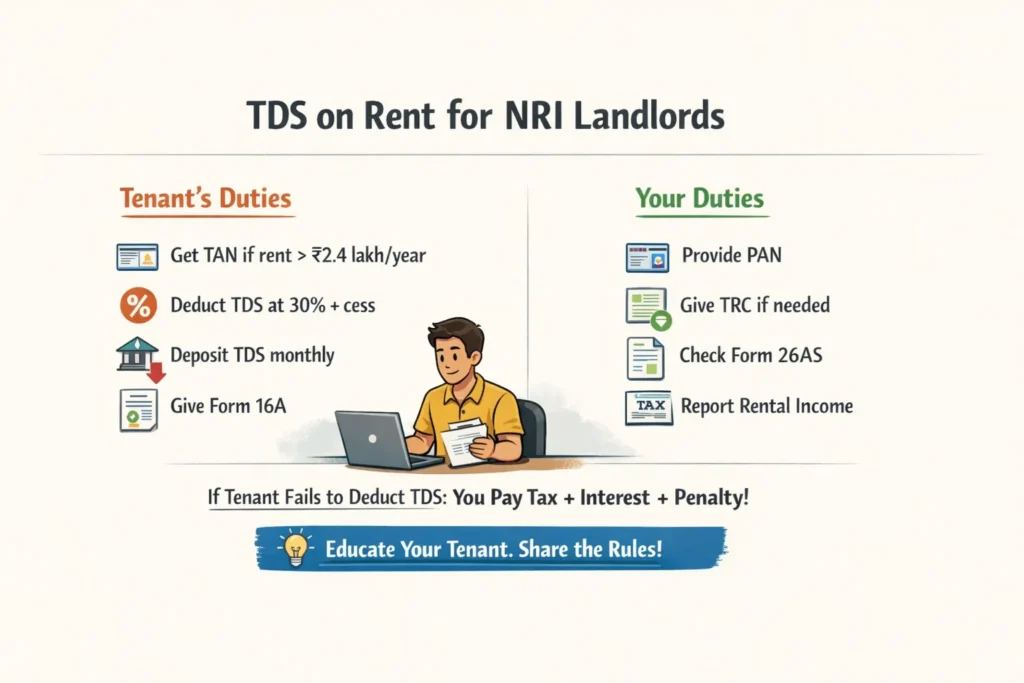
If you rent out property, your tenant has responsibilities.
Tenant must
- Obtain TAN if rent exceeds ₹2.4 lakh per year
- Deduct TDS at 30 percent plus cess
- Deposit tax by 7th of next month
- File TDS return quarterly
- Give you Form 16A
You must
- Provide PAN to tenant
- Provide TRC if claiming lower rate
- Check Form 26AS for credit
- File ITR showing rental income
If tenant does not deduct, you still pay tax. Plus interest. Plus penalty for late payment.
Better to educate your tenant. Send them the rules. Make sure they comply.
Practical Tips to Avoid TDS Non-Compliance Penalties
Penalties hurt. Here is how to avoid them.
Tip 1 – Maintain tax records
Keep everything. Sale deeds. Rent agreements. Bank statements. TDS certificates. For at least six years.
Tip 2 – Inform deductors early
Do not wait until payment day. Talk to buyer or tenant weeks before. Give them documents. Explain rules.
Tip 3 – Check Form 26AS regularly
This shows all TDS credited to you. Log in every quarter. Verify amounts. Discrepancies? Contact deductor immediately.
Tip 4 – File returns on time
NRI return deadline is usually 31 July. Or 31 December if you need audit. File by then. Late filing means interest and penalty.
Tip 5 – Consult a chartered accountant
NRI taxation is complex. One hour with a CA saves lakhs in mistakes. Find one who specialises in NRI work.
Tip 6 – Use online tools
AIS shows all your transactions. TRACES lets you download forms. Income tax portal tracks refunds. Use them.
New TDS Compliance Considerations for 2026
Rules keep changing. Here is what to watch.
Increased scrutiny on NRI transactions
Income tax department now matches property registrations with TDS filings. If buyer did not deduct, you both get notices.
Digital reporting
All high-value transactions reported digitally. Banks. Sub-registrars. Stock exchanges. Data flows to tax department automatically.
AIS reconciliation
Annual Information Statement shows every transaction. Check it matches your records. Discrepancies? File online correction.
Stricter DTAA enforcement
More documentation required for treaty benefits. Form 10F now mandatory. TRC must be current. Old certificates not accepted.
Stay updated. Follow tax news. Or hire someone who does.
Real-Life Scenarios
Let me share three cases.
Scenario 1 – Excess TDS on Property Sale
Mr. Sharma sold his Mumbai flat for ₹2 crore. He bought it for ₹1.2 crore in 2010. Indexed cost was about ₹2.1 crore. Actually, he had a loss, not gain.
But buyer did not ask. Deducted 20 percent on ₹2 crore. Took ₹40 lakh.
Mr. Sharma filed return. Showed loss. Claimed refund. Got money back after eight months. But he lost access to ₹40 lakh for almost a year.
Lesson: Share your cost details. Let buyer compute correctly.
Scenario 2 – Higher TDS Due to No PAN
Mrs. Kapoor lived in Canada. She had NRO fixed deposit maturing. Bank asked for PAN. She did not have one.
Bank deducted 20 percent TDS. On ₹5 lakh interest, they took ₹1 lakh.
Her actual tax rate was zero. Income below limit. But without PAN, she paid ₹1 lakh.
She later got PAN. Filed return. Claimed refund. Got ₹90,000 back after six months. Lost ₹10,000 to processing delays and exchange rate.
Lesson: Get PAN before any transaction.
Scenario 3 – DTAA Not Applied
Mr. Desai sold shares of an unlisted Indian company. Made ₹50 lakh capital gain.
Buyer deducted TDS at 20 percent. Took ₹10 lakh.
But Mr. Desai lived in Singapore. India-Singapore treaty exempts certain capital gains. He should have paid zero tax.
He filed return. Claimed treaty benefit. Got full refund after nine months.
Lesson: Claim DTAA before deduction, not after.
Tools NRIs Should Use
AIS – Annual Information Statement
Shows all your financial transactions. Interest. Dividends. Property sales. Stock trades. Check it quarterly.
Form 26AS
Your tax passbook. Shows all TDS credited to you. Match with your forms. Discrepancies mean someone did not deposit your tax.
TRACES
Download Form 16A and 16B if deductor did not give. Also check TDS statements.
Income Tax Portal
File returns. Track refunds. Apply for lower deduction. Respond to notices. Do everything here.
Conclusion
Here is what I want you to do.
Before any income hits your Indian account, plan.
Property sale? Talk to buyer three months before. Share documents. Explain rules.
Rental income? Educate your tenant. Give them your PAN. Tell them about TDS.
NRO interest? Check if your total income is below limit. File Form 10F. Submit to bank.
Investments? Check DTAA rates. Apply for lower certificate if needed.
TDS errors cost time and money. But they are preventable. One conversation. One form. One certificate. That is all it takes.
Thousands of NRIs lose crores in excess TDS every year. Do not be one of them.
Know the rules. Follow them. Keep what is yours.
Frequently Asked Questions
What is the TDS rate for NRI property sale?
TDS applies only on capital gains. For long-term gains, rate is 20 percent with indexation. For short-term, slab rates apply. Plus surcharge and cess.
How can NRIs avoid excess TDS on property?
Share your cost of acquisition with buyer. Apply for lower TDS certificate under Section 197. Claim DTAA benefits if applicable. Get PAN before sale.
Can NRIs apply for lower TDS deduction?
Yes. File Form 13 online. Show estimated income. Get certificate from Assessing Officer. Give to deductor before payment.
Is PAN mandatory for NRIs to avoid higher TDS?
Yes. Without PAN, TDS is 20 percent minimum under Section 206AA. Even if your actual rate is lower. Get PAN immediately.
How to claim TDS refund as NRI?
File Income Tax Return. Show all income. Claim TDS credit from Form 26AS. Refund processed if excess paid. Takes 3 to 6 months.
What is DTAA and how does it help NRIs?
Double Taxation Avoidance Agreement between India and your country. Allows lower TDS rates. Prevents double taxation. Requires TRC and Form 10F.
Do tenants need to deduct TDS for NRI landlords?
Yes. If rent exceeds ₹2.4 lakh per year, tenant must deduct TDS at 30 percent plus cess. Deposit tax. File returns. Give you Form 16A.
What happens if buyer does not deduct TDS on property?
Buyer faces penalties. Interest on late payment. You still owe tax. File return and pay yourself. Then claim credit later.
Can NRIs use Form 15G or 15H to avoid TDS?
No. Form 15G and 15H are only for residents. NRIs cannot use them. You need Section 197 certificate or DTAA claim.
How to check if TDS was correctly credited?
Log into income tax portal. Check Form 26AS. All TDS deductions appear here. Match with your forms. Discrepancies? Contact deductor.


0 Comments