If you live outside India and still deal with money, property, or investments back home, FEMA matters to you. It matters even if you file your income tax returns correctly. It matters even if you moved abroad years ago. And it matters even if no one ever told you about it.
Many NRIs assume that once tax is taken care of, everything else falls into place. That is not how Indian law works. FEMA rules for NRIs operate in a separate lane. You can be fully tax-compliant and still violate FEMA without realizing it.
FEMA controls how money moves in and out of India. It decides which bank accounts you can hold. It decides how you invest. It decides what kind of property you can buy. Think of FEMA as traffic rules for cross-border money. You may be driving safely. But if you take a one-way road in the wrong direction, it is still a violation.
The good news is this. FEMA is not meant to scare NRIs. It is meant to bring order. Once you understand the logic behind it, compliance becomes simple and practical.
This guide explains FEMA rules for NRIs in simple language, without legal jargon, so you know what to do and what to avoid.
What Is FEMA? Explained in Simple Terms
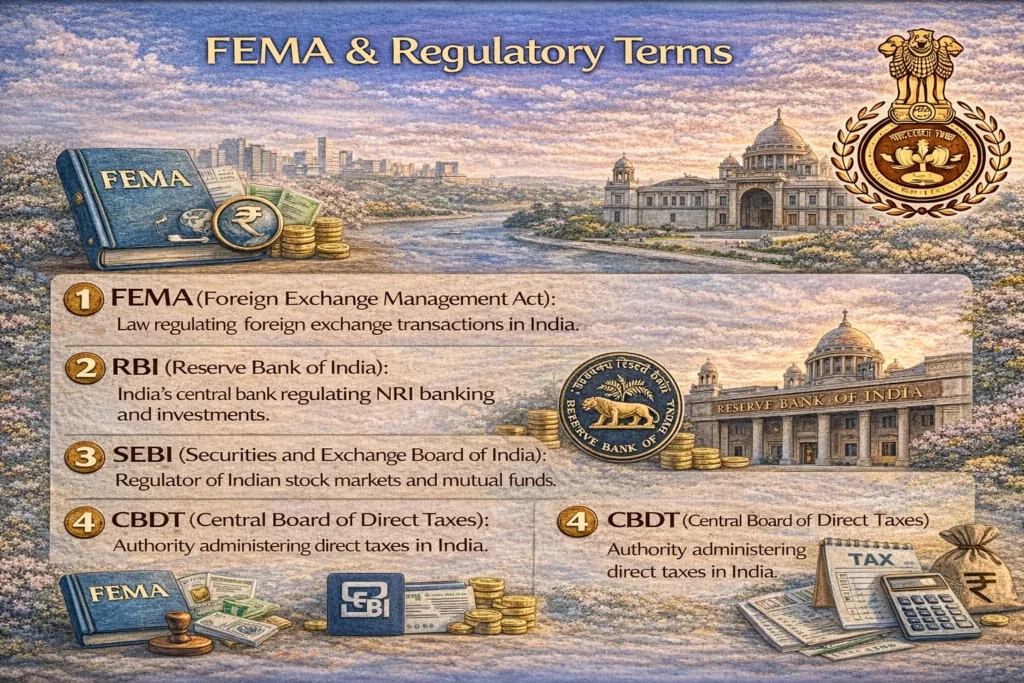
FEMA stands for the Foreign Exchange Management Act, 1999. It is an Indian law that controls foreign exchange and cross-border financial transactions involving India.
In plain words, FEMA answers questions like these.
Can you keep money in an Indian bank account after moving abroad?
Can you send money freely from India to another country?
Can you buy property in India as an NRI?
Can you invest in shares and mutual funds while living overseas?
FEMA is administered by the Reserve Bank of India. Banks act as the front-line enforcers, but the rules come from the RBI.
One important thing to understand is this. FEMA is a civil law, not a criminal law. That means violations usually lead to monetary penalties, not jail. But those penalties can be large. In many cases, they are linked to the amount involved in the violation.
Think of FEMA like airport customs. You are allowed to carry money across borders. But only within limits. And only through the right channels.
FEMA Definition of NRI Status
One of the most confusing parts of FEMA is how it defines who is an NRI.
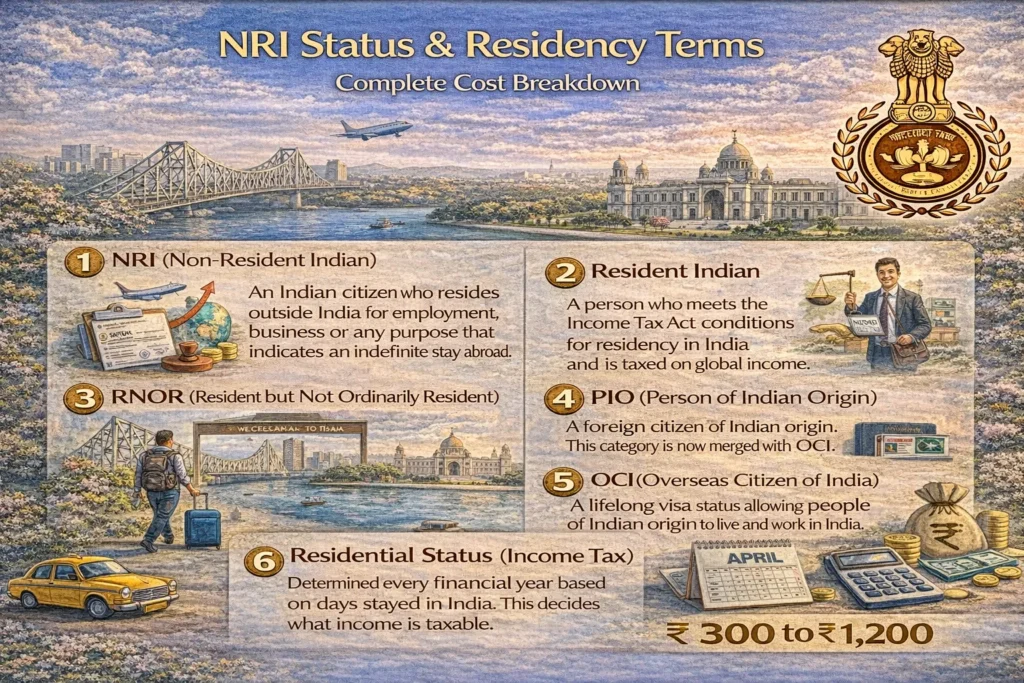
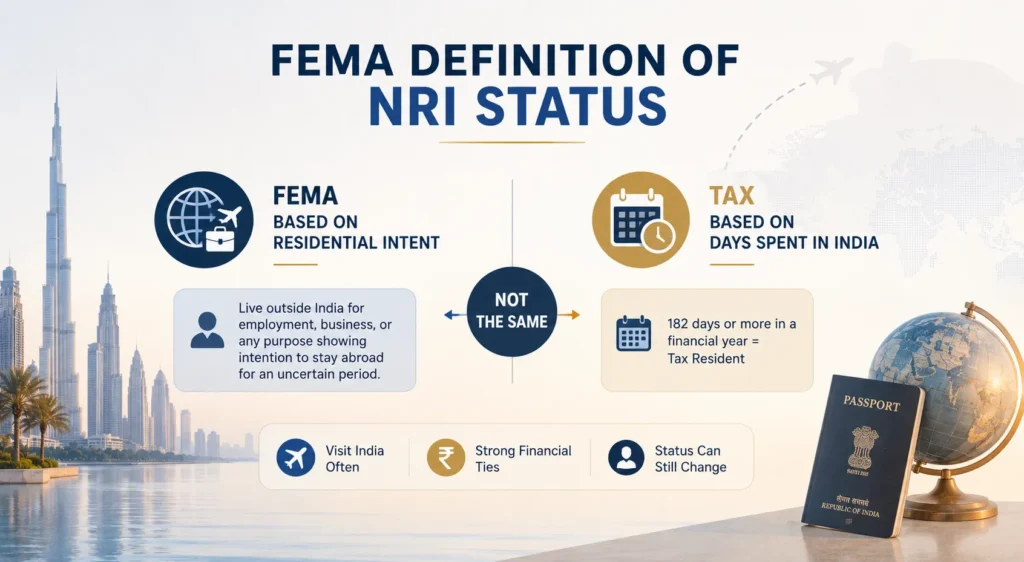
Under FEMA, NRI status is not decided by counting days. It is based on residential intent. If you live outside India for employment, business, or any purpose that shows an intention to stay abroad for an uncertain period, you are treated as a non-resident under FEMA.
This means the moment you move abroad for work or long-term stay, your FEMA status can change. Even if you still visit India often. Even if you still have strong financial ties with India.
This is why people get confused. They follow one rule for tax. Another for FEMA. And they assume both are the same.
They are not.
FEMA vs Income Tax Act: Why NRIs Get Confused
This confusion causes most accidental violations.
The Income Tax Act focuses on taxation of income. FEMA focuses on movement of money and assets across borders. Both laws define residential status differently. Both apply at the same time.
Under the Income Tax Act, residential status depends on how many days you stay in India. Under FEMA, it depends on where your life is centered.
So you can be a resident under tax law and a non-resident under FEMA. Or the other way around.
The key takeaway is simple. You must comply with both laws separately. Filing tax returns does not cancel FEMA obligations.
FEMA Rules for NRI Bank Accounts
Bank accounts are the most common area where NRIs unknowingly violate FEMA.
Once you become an NRI under FEMA, you are not allowed to keep a regular resident savings account. That account must be redesignated as an NRO account.
FEMA allows three main types of accounts for NRIs. Each has a specific purpose.
An NRE account is meant for income earned outside India. Salary abroad. Business income abroad. Pensions received overseas. Money in this account is fully repatriable. You can move it back abroad freely. Interest earned is tax-free in India.
An NRO account is for income earned in India. Rent. Dividends. Pension from India. Interest earned here is taxable. Repatriation is limited and regulated.
An FCNR account is a fixed deposit held in foreign currency. It protects you from exchange rate risk. The money stays in dollars, pounds, euros, or other permitted currencies.
The biggest mistake NRIs make is continuing to use a resident savings account after moving abroad. Under FEMA, that is a violation. It often happens quietly. No alerts. No warnings. Until one day the bank flags it.
FEMA Rules for NRI Investments
FEMA allows NRIs to invest in India. But it defines how and through which route.
NRIs can invest on a repatriation basis or a non-repatriation basis. This simply means whether you plan to take the money back abroad or keep it in India.
Investments are allowed in shares, mutual funds, bonds, and debentures. Listed shares are generally simpler. Unlisted shares may involve additional reporting.
Many equity investments fall under the Portfolio Investment Scheme, commonly called PIS. This requires routing investments through designated bank accounts.
Some investments are automatic. Others require approvals. The difference depends on the sector, instrument, and amount.
A simple rule helps here. Never invest as an NRI using resident accounts. Always route investments through proper NRE or NRO channels.
FEMA Rules for NRI Property Purchase in India
Property is another area where FEMA rules are strict but clear.
NRIs are allowed to buy residential and commercial property in India. This includes apartments, houses, offices, and shops.
However, NRIs are not allowed to buy agricultural land, farmhouses, or plantation property, except in rare cases such as inheritance or special government permission.
Payment for property must be made through banking channels. Cash payments are not allowed. Funds must come from NRE, NRO, or FCNR accounts, or through inward remittance.
NRIs can jointly own property with other NRIs or residents, depending on the case. Inheritance rules are different from purchase rules. Many NRIs inherit agricultural land legally even though they cannot buy it directly.
FEMA Rules for NRI Remittance
Remittance simply means sending money.
Inward remittance refers to money sent to India from abroad. This is generally allowed and encouraged. There is no upper limit in most cases.
Outward remittance means sending money from India to another country. This is where FEMA becomes more restrictive.
Money in NRE and FCNR accounts can be repatriated freely. Money in NRO accounts has limits and conditions.
Purpose matters. Documentation matters. And limits apply.
Think of it like baggage allowance. You can carry things out. But only within rules.
FEMA Limits on Repatriation for NRIs
Repatriation rules depend on the type of account.
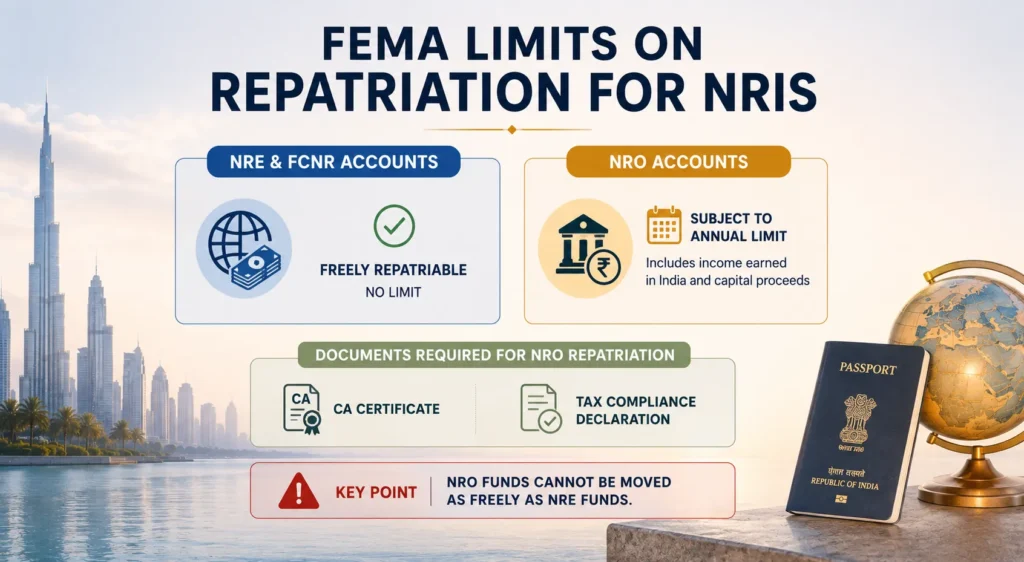
Funds in NRE and FCNR accounts are freely repatriable. There is no cap.
Funds in NRO accounts are subject to an annual limit. This includes income earned in India and capital proceeds.
To repatriate from an NRO account, banks usually require documentation such as a CA certificate and a declaration confirming tax compliance.
Most problems arise when NRIs assume NRO funds can be moved as freely as NRE funds. They cannot.
FEMA-Compliant Gifting by NRIs
NRIs are allowed to gift money and assets, but FEMA sets boundaries.
Money can be gifted to relatives in India through proper banking channels. Property can also be gifted, subject to rules.
Gifting to non-relatives has additional restrictions. FEMA looks at the nature of the transaction. Tax law looks at taxability. Both must be respected.
A gift may be FEMA-compliant but taxable. Or tax-free but FEMA-restricted. Understanding both angles is important.
Common FEMA Violations by NRIs
Most FEMA violations are not intentional. They happen due to lack of awareness.
Common examples include continuing to use resident bank accounts after becoming an NRI, repatriating funds from NRO accounts without following limits, buying restricted property, or investing through incorrect accounts.
Another frequent issue is failing to redesignate accounts and investments after status change.
These mistakes feel small. But FEMA treats them seriously.
Penalties for FEMA Violations
FEMA penalties are monetary. They can be linked to the amount involved in the violation. In some cases, penalties can be several times the amount.
The law also allows compounding, which means settling violations by paying a prescribed sum. This avoids long disputes but still carries a cost.
Beyond penalties, FEMA violations can create long-term compliance issues with banks and regulators.
Practical FEMA Compliance Checklist for NRIs
Staying compliant does not require constant effort. It requires awareness and periodic review.
Update your residential status with banks when you move abroad. Convert accounts correctly. Review investments annually. Track repatriation limits. Maintain documentation. Consult before large transactions.
Think of this like an annual health check. Small checks prevent big problems.
Conclusion
FEMA governs how NRIs interact financially with India. It controls bank accounts. It guides investments. It restricts certain property transactions. Most violations happen not because people break rules deliberately, but because they do not know the rules exist.
Once you understand FEMA, compliance becomes simple. It is not about complexity. It is about clarity and planning.
Understanding FEMA rules is not about fear. It is about staying informed and staying compliant.
FAQs
Is FEMA applicable to all NRIs?
Yes. FEMA applies to every NRI who deals with money, bank accounts, investments, or property in India. Once a person qualifies as a non-resident under FEMA, the law governs how they hold accounts, invest funds, buy or sell property, and move money across borders. Even occasional transactions in India can fall under FEMA if they involve foreign exchange or assets held by an NRI.
Can FEMA rules change?
Yes, FEMA rules can and do change over time. The law itself stays the same, but regulations, limits, and procedures are updated by the Reserve Bank of India through notifications and circulars. This is why NRIs should not rely on old advice and should periodically review current rules, especially before making large financial decisions.
Is FEMA compliance checked automatically?
FEMA compliance is partly monitored by banks and authorised dealers, but it is not fully automatic. Banks may flag certain transactions, account usage, or remittances that appear non-compliant. However, many violations go unnoticed until a review, audit, or specific transaction brings them to light. The responsibility for FEMA compliance ultimately rests with the NRI, not the bank.
Can FEMA violations be regularised?
In many cases, yes. FEMA allows for violations to be regularised through a process called compounding. This involves admitting the violation and paying a prescribed monetary amount to settle the matter. While compounding helps avoid long legal proceedings, it can still be costly. Early disclosure and correction usually result in smoother outcomes.
Do OCIs follow the same FEMA rules?
Largely, yes. Overseas Citizens of India are generally treated at par with NRIs under FEMA for most financial activities, including bank accounts, investments, and property ownership. However, there are a few specific relaxations and exceptions for OCIs in certain areas. It is always advisable for OCIs to check applicable FEMA provisions before entering into major transactions.
Can an NRI be penalised under FEMA even if no tax is due in India?
Yes, this is possible. FEMA and income tax laws work independently. Even if no tax is payable in India, a transaction can still violate FEMA rules. For example, keeping a resident savings account after becoming an NRI may not create a tax liability, but it is still a FEMA violation. This is why NRIs should not assume that tax compliance automatically means FEMA compliance.
Does FEMA apply only when money is transferred across borders?
No. FEMA applies not only when money moves in or out of India, but also when NRIs hold bank accounts, investments, or property in India. Even if the money stays within India, FEMA rules can apply based on your residential status. For instance, using the wrong type of bank account inside India can still lead to a FEMA issue, even without any outward remittance.
What should an NRI do if unsure whether a transaction is FEMA-compliant?
If there is any doubt, the safest approach is to check before acting. NRIs should consult their bank, a qualified chartered accountant, or a cross-border compliance expert before making large transactions. Correcting a mistake after it happens is usually more expensive and stressful than taking advice in advance.