



If you are an NRI thinking about closing your demat account in India, you are not alone. Many non-resident Indians find themselves at this crossroads — perhaps you are returning to India permanently, switching to a more suitable broker, or simply looking to consolidate your investments. Whatever the reason, the NRI demat account closure process in India is more structured than most people expect, and getting it right the first time saves you considerable time, paperwork, and compliance headaches.
This guide walks you through everything you need to know — from the checks you must do before initiating closure, to the step-by-step process of submitting your request from abroad, to understanding whether closing is even the right move for you.
Before You Begin: Should You Close or Convert?
This is perhaps the most important question to answer before doing anything else, and many NRIs skip it entirely.
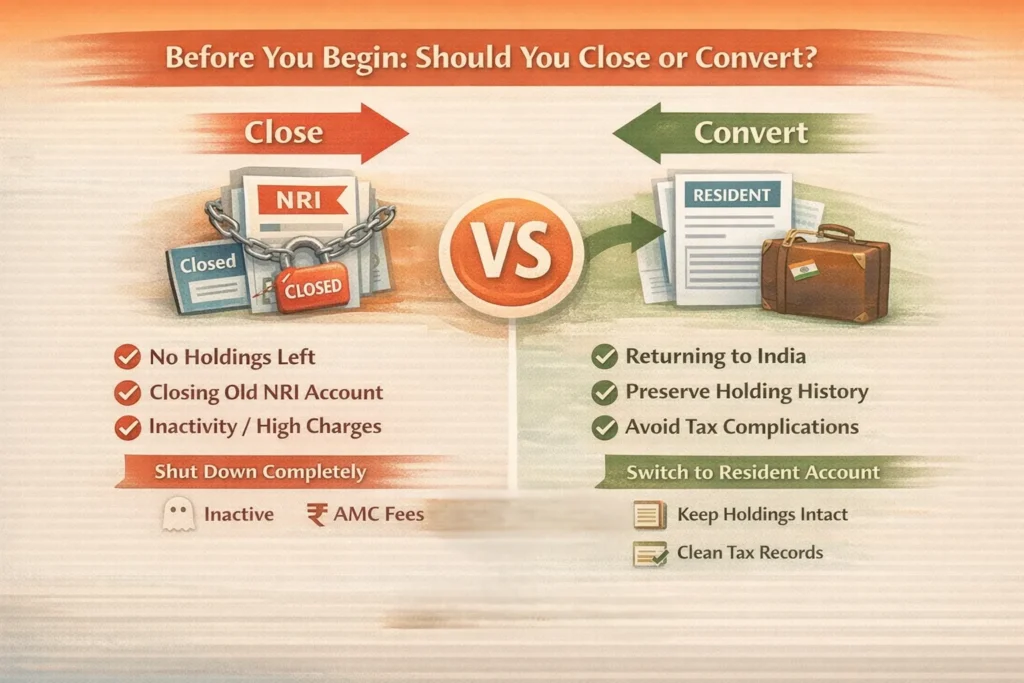
If you are returning to India permanently and changing your residential status, closing your NRI demat account outright may actually be the wrong move. Indian regulations — specifically FEMA guidelines — require NRIs to convert their NRI demat account to a resident demat account upon returning to India, rather than simply closing and reopening a new one. The conversion route preserves your holding history, avoids unnecessary off-market transfers, and keeps your tax records clean.
On the other hand, if you are switching from one broker to another while continuing to reside abroad, the better approach is to transfer your holdings to a new NRI demat account before closing the old one. Closure without first transferring holdings can create serious complications, including frozen securities.
If you genuinely have no investments left in the account and simply want to shut it down — due to inactivity, high AMC charges, or consolidation — then a full closure is entirely appropriate and is a straightforward process.
So before you proceed, ask yourself: Am I returning to India? Am I switching brokers? Or is my portfolio already empty? Your answer determines everything that follows.
Clearing Dues and Linked Accounts – The Pre-Closure Checklist
Think of this stage as settling your tab before leaving a restaurant. Your Depository Participant (DP) — which is the broker or financial institution that holds your demat account — will not process a closure request if there are outstanding dues or unresolved positions attached to your account.
Start by checking for any pending brokerage charges or Annual Maintenance Charges (AMC). These are typically deducted annually, and if your closure request falls mid-cycle, you may owe a pro-rated amount. Some DPs waive this, but do not assume — always confirm in writing.
Next, check whether there are any pending trade settlements. If you have sold shares but the settlement cycle (T+1 in India currently) has not completed, the account cannot be closed until those credits or debits are resolved.
Equally important is your linked bank account — typically either an NRE (Non-Resident External) or NRO (Non-Resident Ordinary) account. Make sure there are no pending dividend credits, corporate action payouts, or rights issue allocations that are still scheduled to come in. Once your demat is closed, any securities credited to it post-closure can become extremely difficult to recover.
Finally, check for any TDS (Tax Deducted at Source) reconciliation that may be pending — especially if you have received dividend income or sold equity shares in the preceding financial year. You want your tax records to be clean and in order before initiating closure.
Step-by-Step: The NRI Demat Account Closure Process
Step 1 – Download the Demat Account Closure Form
Your journey begins with obtaining the correct form from your DP or broker. Most major brokers in India — including Zerodha, HDFC Securities, ICICI Direct, Kotak Securities, and others — have their account closure forms available on their websites, usually under the “Forms & Downloads” or “Service Requests” section.
When downloading, pay close attention to whether the form you are selecting is for closure “With Holdings” or “Without Holdings.” These are different documents with different requirements, and submitting the wrong form will simply delay your request.
Step 2 – Transfer Your Holdings (If Any)
If your demat account still holds securities, you must decide what to do with them before closure can proceed. You have three practical options.
The first option is to sell all your shares through your trading account. Once sold and settled, your demat account will show a zero balance, and closure becomes much simpler. This option also has tax implications — capital gains will be triggered — so factor this in, especially if you are holding long-term positions.
The second option is to transfer your holdings to another NRI demat account, either with a different broker or in the name of a family member who holds an NRI demat. This is done through an off-market transfer using a Delivery Instruction Slip (DIS), which is a physical booklet issued by your DP, or through the Easiest/Speed-e platform of CDSL/NSDL for electronic transfers.
The third option — if you are returning to India — is to convert the existing account to a resident demat account, in which case the holdings transfer automatically and no DIS is required.
Step 3 – Gather the Required Documents
For NRIs, the documentation requirement is more extensive than for resident Indians, largely because your identity and overseas address need to be verified.
You will typically need to submit a duly filled and signed closure form, a self-attested copy of your PAN card, a copy of your passport (especially the pages showing your photograph, address, and visa/residency stamps), and an overseas address proof such as a utility bill, bank statement, or overseas driving license. If you are transferring holdings using a DIS, you will need to submit those slips as well.
Some DPs may also ask for a cancelled cheque from your linked NRE or NRO account, particularly if any refund of AMC or other charges is to be processed back to you.
Step 4 – Courier Documents from Abroad
This is where the process becomes a little more involved for NRIs living overseas. Unlike resident Indians who can walk into a DP branch, you will need to send your documents by international courier — typically services like DHL, FedEx, or Aramex are reliable and provide tracking.
Here is an important detail many people miss: some DPs require your documents to be notarised by a Notary Public in your country of residence, or attested by the Indian Embassy or Consulate. This is especially true for documents like your passport copy and address proof. Always check your specific DP’s requirements before couriering, as sending non-notarised documents can result in rejection and costly re-sending.
The good news is that an increasing number of brokers in India — particularly the newer fintech-driven ones — now accept digital or scanned submissions via email or their online portals, at least for initiating the request. However, even in these cases, physical originals may be needed for final processing. Confirm this with your DP beforehand.
Step 5 – Submit the Trading Account Closure Request Separately
This is a critical point that many account holders overlook: your demat account and your trading account are two legally distinct accounts, even though they are often opened together with the same broker.
Your demat account is held with a Depository Participant and is registered with either NSDL or CDSL (India’s two depositories). Your trading account is held directly with your broker for executing buy and sell orders. Closing one does not automatically close the other.
Make sure you submit a separate closure request for your trading account. Also ensure that all open positions are squared off and there are no pending orders before submitting this request.
Step 6 – DP Verification and Processing
Once your documents reach the DP, they go through an internal verification process. The DP checks that your holdings balance is zero (or that the transfer DIS submitted is valid), that there are no outstanding charges or dues, and that all KYC documents are in order.
This stage typically takes anywhere from 7 to 15 working days for most DPs, though it can take longer if there are discrepancies or if your documents need clarification. Some DPs send an acknowledgement upon receipt of the courier, which is useful for tracking. If your DP does not proactively communicate, it is perfectly reasonable — and advisable — to follow up by email or phone after 10 working days.
Step 7 – Receive Closure Confirmation
Once the DP has processed your request, they will send you a closure confirmation — usually by email. This confirmation will include the date of closure and may be accompanied by a final account statement showing a zero balance. Keep this document safely. It serves as your official record that the account has been closed and can be useful for tax filings or future reference.
If you had a DIS booklet issued to you, you should return any unused DIS slips to the DP before or at the time of closure. Unused DIS slips floating around after account closure can be a compliance risk.
Online Vs. Offline Closure: Which Is Better for NRIs?
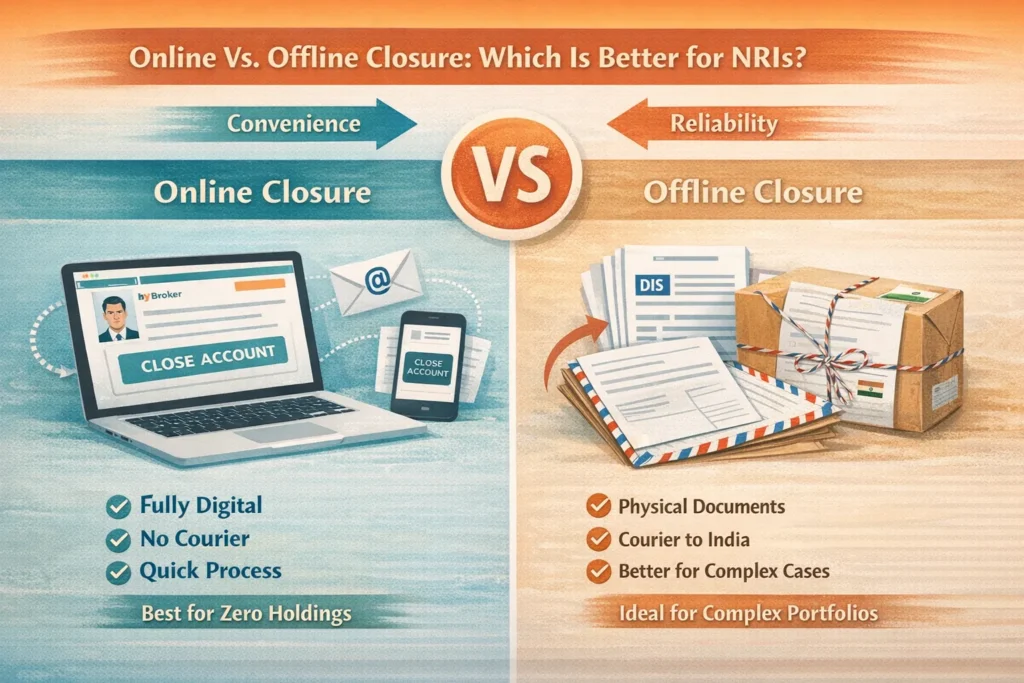
The honest answer is that it depends on your broker. Online closure — where you can initiate and possibly complete the entire process through a portal or email — is significantly more convenient when you are sitting thousands of kilometres away. It eliminates the need for couriering documents and reduces turnaround time.
Offline closure, which requires physical documents to be couriered to India, is more cumbersome but is still the norm with many traditional brokers and banks. The trade-off is that offline processes are often perceived as more reliable for complex cases involving holdings, DIS transfers, or large portfolios.
If convenience is your priority and your account has zero holdings, look for a broker that supports fully digital closure requests. If your portfolio is complex, the added certainty of physical document submission may be worth the extra effort.
Tax and Compliance Points to Keep in Mind
Before you close your account, take a moment to review your capital gains position for the current and previous financial year. If you have sold shares during the year, you may have a tax liability in India — specifically short-term or long-term capital gains tax — and this should be settled or at least documented before you remove yourself from the system.
NRIs are also subject to TDS on capital gains from equity transactions in India, which is deducted at source by the broker. Ensure your Form 26AS (available on the Income Tax portal) reflects all TDS deductions correctly, as discrepancies can create problems when filing your Indian income tax return.
If your account was linked to an NRE account, repatriation of any sale proceeds should have been done in compliance with FEMA regulations. Closing the demat without ensuring this can leave loose ends that are difficult to resolve later.
Conclusion
Closing an NRI demat account in India is not a complicated process, but it does reward those who are thorough and systematic. The most important things to do are to settle your holdings first — whether by selling, transferring, or converting — clear any outstanding dues, gather the correct documents, and follow your DP’s specific procedure for overseas submissions.
And remember: if you are returning to India permanently, closing may not be the right call at all. Converting your NRI demat to a resident demat is usually the cleaner, more compliant path. When in doubt, consult a CA or SEBI-registered investment advisor who specialises in NRI financial matters — a small consultation fee can save you from compliance complications that are far more expensive to resolve later.
Frequently Asked Questions
Can I close my NRI demat account online from abroad?
Some brokers allow online closure through their portal. You upload scanned documents and request closure digitally. Check with your specific broker first. If online facility is not available, you must courier physical notarised documents to their India office for processing.
How long does demat account closure take?
Without holdings, closure takes 5 to 10 working days after documents reach the broker. With holdings, add transfer time. Total process takes 2 to 4 weeks depending on courier speed and broker processing. Track your application using service request number.
What happens if I don’t close an inactive demat account?
Annual Maintenance Charges keep adding every year. These are deducted from your linked bank account automatically. If bank account has no funds, dues pile up. Eventually broker may freeze the account. Credit score not affected but reopening becomes difficult.
Is there any fee for closing demat account?
Many brokers charge closure fee between Rs 500 to Rs 1000. Check your broker’s tariff sheet or client agreement. Some waive fees if no holdings exist. Ask customer support before applying to avoid surprise deductions from your bank account.
Can I convert NRI demat to resident demat instead of closing?
Yes. If you return to India permanently, conversion is better. Submit change of status form with proof of return. Your holdings remain same. No selling or transferring needed. Update bank linkage to resident account. Takes about two weeks.
What documents are needed for demat closure from abroad?
Demat closure form, PAN copy, passport copy, overseas address proof, DIS booklet (if any), photograph. All documents must be notarised before courier. Some brokers also need cancelled cheque or bank statement. Check exact requirements with your DP.
What happens to my shares if I close demat account?
You must transfer or sell all shares before closure. Transfer using DIS to another demat account. Or sell through trading account and repatriate money. Account cannot be closed with holdings inside. Zero balance is mandatory for closure approval.
Do I need to close trading account separately?
Yes. Demat and trading accounts are separate. Submit separate trading account closure form. Clear all open positions and pending orders first. Withdraw any leftover money to bank. Trading account closes faster, usually within 3 to 5 days.
What if I lost my DIS booklet?
Submit a written declaration stating booklet is lost. Some brokers require indemnity bond on stamp paper. Check their specific process. Without returning or accounting for DIS, closure may be delayed. Keep copies of all submitted documents.
Can I reopen same demat account later?
No. Once closed, account cannot be reactivated. You must open fresh demat account if needed later. New KYC, new account number, new paperwork. That is why conversion is better than closure if you might invest again in future.


0 Comments