



The money hit my bank account at 3 am. A client from Australia had paid my invoice. Five hundred dollars. I felt like a real freelancer.
Then April came. And I realised something terrifying.
I had no idea how to file taxes on that money.
The income tax portal looked like it was designed in 1998. The forms had names like ITR-3 and ITR-4. People mentioned Section 44ADA like I should know what that meant. TDS. GST. Advance tax. The alphabet soup was overwhelming.
If you are a freelancer in India, you have been there. The work comes in. The money flows. But tax season feels like walking through a maze blindfolded.
This guide changes that.
I have made every mistake possible. Late fees. Wrong forms. Missed deductions. You name it. Learn from my failures instead of making your own.
Let us break this down step by step.
Understanding Freelance Taxation in India
Who Is Considered a Freelancer for Tax Purposes?
The tax department does not care what you call yourself. Freelancer. Consultant. Gig worker. Solo professional. Independent contractor.
If you provide services to clients without being their employee, you are a professional under tax law.
This includes:
- Writers and content creators – Bloggers, copywriters, journalists
- Designers – Graphic designers, UI/UX designers, illustrators
- Developers – Web developers, app developers, software engineers
- Consultants – Business consultants, marketing experts, HR advisors
- Influencers – Social media influencers, YouTubers, podcasters
- Gig workers – Food delivery, ride sharing, task-based workers
- Creative professionals – Photographers, videographers, editors
- Online tutors – Teaching on platforms, conducting webinars
Basically, if you get paid for work and no one deducts TDS as salary, you are a freelancer for tax purposes.
How Freelancers Are Taxed
Here is the simple version.
Your freelance income falls under “Profits and Gains from Business or Profession.” Not salary. Not capital gains. Not other sources.
The tax department treats you like a small business. You earn income. You incur expenses. Tax applies on the profit, not the total money you received.
If your income crosses certain thresholds, you need to maintain books of accounts. More on that later.
Step-by-Step Income Tax Filing for Freelancers
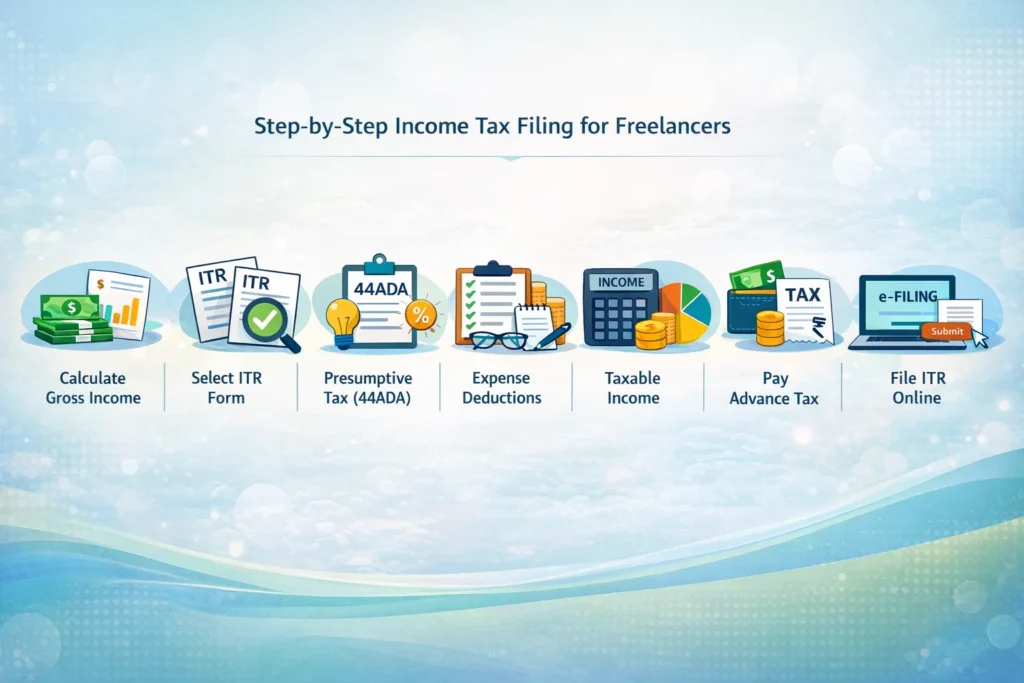
Step 1 – Calculate Your Gross Freelance Income
First, figure out how much money actually came in during the financial year. April 1 to March 31.
Add up everything:
- Payments from Indian clients – Invoice amounts received in your bank account
- Payments from foreign clients – Upwork, Fiverr, Freelancer.com, direct clients abroad
- Platform income – YouTube ad revenue, Medium earnings, affiliate commissions
- Tips and bonuses – Any extra payments clients sent your way
Do not guess. Go through your bank statements. Check your payment gateway records. Look at PayPal, Wise, or whatever you use for international payments.
One freelancer I know forgot about Rs 45,000 sitting in his PayPal account. He thought since it was not in his bank, it was not income. Wrong. Income is income wherever it sits.
Pro tip: Create a simple spreadsheet. Date. Client. Amount. Source. This saves your life during filing season.
Step 2 – Choose the Correct ITR Form
This is where many freelancers mess up.
The income tax department has different forms for different types of taxpayers. Pick the wrong one, and your return gets rejected.
For freelancers, two forms matter:
ITR-3
This is for professionals who maintain regular accounts. You list your income. You list your expenses. You show the profit.
Use ITR-3 if:
- Your income is above Rs 50 lakh
- You want to claim expenses higher than 50% of your income
- You maintain proper books of accounts
- You have multiple income sources
ITR-4
This is the simplified form. It uses the presumptive taxation scheme under Section 44ADA.
Use ITR-4 if:
- Your income is below Rs 50 lakh
- You are okay with 50% of your income being treated as profit
- You do not want to maintain detailed accounts
- You have simple finances
Most freelancers with income under Rs 50 lakh should use ITR-4. It is easier. Less paperwork. Lower chance of mistakes.
Step 3 – Understand Presumptive Taxation (Section 44ADA)
Section 44ADA is a gift to freelancers. Seriously.
Here is how it works.
The tax department says: We know maintaining accounts is hard. We know tracking every expense is tedious. So here is a deal.
If your total professional income is under Rs 50 lakh, you can declare that 50% of it is your profit. You pay tax on that 50%.
Example time.
You earned Rs 10 lakh from freelance work this year.
Under normal rules, you would list every expense. Laptop purchase. Internet bills. Coffee meetings. Software subscriptions. The actual profit might be Rs 6 lakh after expenses.
Under Section 44ADA, you simply say: My income is Rs 10 lakh. My profit is 50% = Rs 5 lakh. You pay tax on Rs 5 lakh.
If your actual profit is higher than 50%, this scheme might not benefit you. But for most freelancers with moderate expenses, it is perfect.
Important: You must declare this in your return. Once you opt for presumptive taxation, you must follow it for five years. You cannot switch back and forth.
Step 4 – Claim Allowable Expense Deductions
If you do not use presumptive taxation, or if your expenses exceed 50% of income, you need to understand deductions.
What can freelancers claim as expenses?
- Laptop and computer equipment – If bought for work, claim depreciation
- Software and tools – Adobe subscription, hosting fees, domain charges, project management tools
- Internet and phone bills – Proportionate to work use
- Home office expenses – If you work from home, claim portion of rent, electricity, maintenance
- Professional development – Courses, books, workshops, conferences
- Travel expenses – Client meetings, coworking space visits, work trips
- Health insurance – Premiums for yourself and family
- Stationery and office supplies – Printers, paper, pens, the boring stuff
Keep proof. Bills. Invoices. Bank statements. If the tax officer asks, you need to show evidence.
One freelancer I know claimed his entire restaurant bill as “client meeting.” He had no client. Just dinner with friends. The tax department noticed. Penalties followed. Do not be that person.
Step 5 – Calculate Your Taxable Income
Now the math.
If using presumptive scheme:
Taxable Income = 50% of Gross Receipts
If using regular scheme:
Taxable Income = Gross Receipts minus Allowable Expenses
Once you have your taxable income, apply the applicable tax slabs.
Old Regime Slabs (FY 2024-25)
- Up to Rs 2.5 lakh – Nil
- Rs 2.5 lakh to Rs 5 lakh – 5%
- Rs 5 lakh to Rs 10 lakh – 20%
- Above Rs 10 lakh – 30%
New Regime Slabs
- Up to Rs 3 lakh – Nil
- Rs 3 lakh to Rs 7 lakh – 5%
- Rs 7 lakh to Rs 10 lakh – 10%
- Rs 10 lakh to Rs 12 lakh – 15%
- Rs 12 lakh to Rs 15 lakh – 20%
- Above Rs 15 lakh – 30%
Plus cess and surcharge where applicable.
Choose whichever regime gives you lower tax. Calculate both. Pick the winner.
Step 6 – Pay Advance Tax
Here is the trap most freelancers fall into.
Salaried employees have tax deducted every month from their salary. They never see the money. So tax payment feels painless.
Freelancers get the full amount. It sits in the bank. Spending it feels easy. Then March comes and you realise you owe tax but the money is gone.
The government knows this. So they created advance tax.
If your total tax liability for the year is Rs 10,000 or more, you must pay tax in installments during the year itself.
Due dates:
- By June 15 – 15% of total tax
- By September 15 – 45% of total tax
- By December 15 – 75% of total tax
- By March 15 – 100% of total tax
If you miss these, interest applies under Sections 234B and 234C. Simple interest. But it adds up.
My first year as freelancer, I ignored advance tax. Paid everything in March. The interest was Rs 4,700. That money could have bought me a nice monitor. Instead, it went to the government as penalty for my laziness.
Pay on time. Set reminders. Treat it like a bill that cannot be ignored.
Step 7 – File Your ITR Online
Finally, filing day.
Go to the income tax e-filing portal. Login with your PAN and password.
- Click on e-File > Income Tax Return
- Select the correct Assessment Year (AY 2025-26 for FY 2024-25)
- Choose your ITR form (ITR-3 or ITR-4)
- Fill in the details
- Personal information
- Income from business/profession
- Deductions under Chapter VI-A
- Tax paid (advance tax, TDS)
- Verify everything
- Submit
- E-verify using Aadhaar OTP, net banking, or bank ATM
Once verified, you are done. The acknowledgement (ITR-V) is your proof of filing.
GST for Freelancers
Do Freelancers Need GST Registration?
GST is not automatic. It depends on your turnover.
Threshold Limit:
If your annual turnover from freelance work exceeds Rs 20 lakh (Rs 10 lakh for some special category states), you must register for GST.
Once registered, you need to:
- Charge GST on your invoices (usually 18% for services)
- File GST returns monthly or quarterly
- Pay collected GST to the government
If your turnover is below the threshold, registration is voluntary. But there is a catch. If you have foreign clients, you might want to register anyway.
GST for Foreign Clients
Services provided to clients outside India are treated as exports. Export of services is zero-rated. That means you charge 0% GST.
But to prove it is an export, you need to either:
- Pay IGST and claim refund (complicated)
- File a LUT (Letter of Undertaking) and export without paying GST (simpler)
Most freelancers with foreign clients file LUT. It is a one-page declaration saying you will only export services. Once filed, you invoice foreign clients with 0% GST.
Without LUT, you must charge 18% GST on foreign clients. They pay it. Then you apply for refund. Refund process takes months. Avoid if possible.
Income Tax Slabs and Deductions
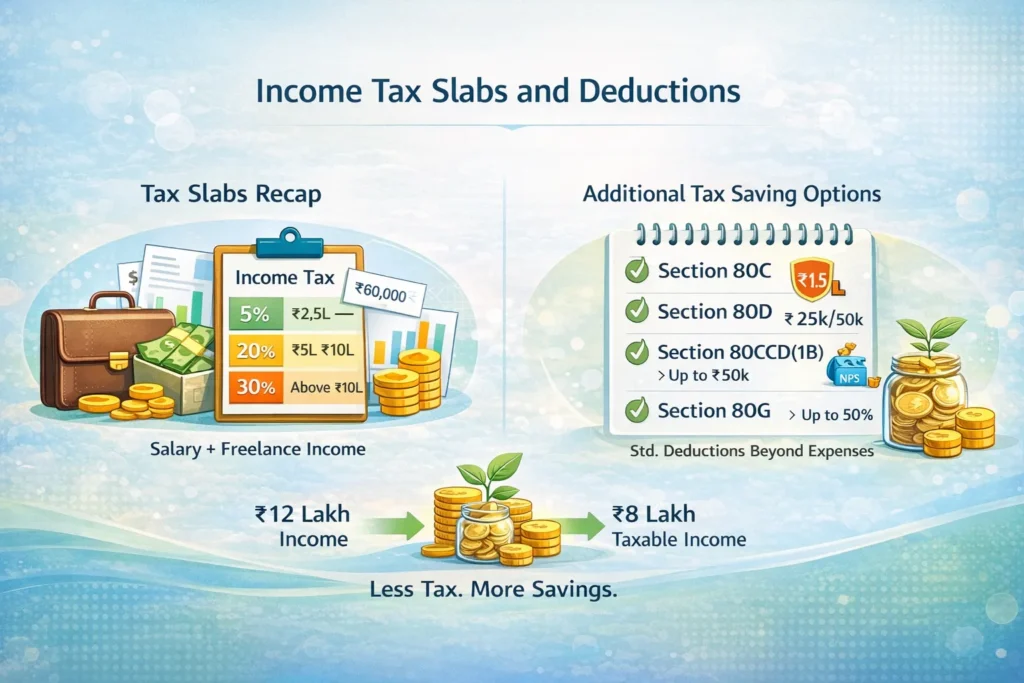
Tax Slabs Recap
I mentioned slabs earlier. But here is the key point.
As a freelancer, your income is added to any other income you have. If you also have salary from a job, both incomes combine. Tax applies on total.
The slabs stay the same. Only the income source changes.
Additional Tax Saving Options
Beyond business expenses, you can save tax using standard deductions:
- Section 80C – Up to Rs 1.5 lakh (PPF, ELSS, life insurance, children’s tuition)
- Section 80D – Health insurance premiums (up to Rs 25,000 for self, Rs 50,000 for parents)
- Section 80CCD(1B) – NPS additional deduction (up to Rs 50,000)
- Section 80G – Donations to specified funds
These apply over and above your business deductions.
A freelancer earning Rs 12 lakh can reduce taxable income to Rs 8 lakh through a combination of business expenses and 80C investments. Less tax. More savings.
TDS and Reconciliation
Checking TDS via Form 26AS and AIS
When clients pay you, some deduct TDS (Tax Deducted at Source). This TDS is already paid to the government on your behalf. You claim credit while filing your return.
But you need to ensure all TDS is correctly reflected.
Form 26AS is your consolidated tax statement. It shows:
- TDS deducted by clients
- Advance tax paid by you
- Self-assessment tax paid
AIS (Annual Information Statement) is more detailed. It shows all financial transactions reported to the tax department.
Before filing, log in to the income tax portal. Download both. Match every TDS entry with your records.
If a client deducted TDS but it is not showing in 26AS, contact them. They may have filed wrong return. Unclaimed TDS means you pay extra tax.
I once had Rs 18,000 of TDS not showing. It took three emails and two calls to the client’s accounts department. They had filed with wrong PAN. Correcting it took two months.
Check early. Fix early.
Freelancers with Salary Plus Side Income
Dual Income Tax Filing
Many people start freelancing while keeping their job. Smart move. Steady income plus extra earnings.
For tax purposes, both incomes combine.
Your salary is reported under “Income from Salary.” Your freelance income goes under “Profits and Gains from Business or Profession.” Two different heads. Same return.
In ITR forms, you fill both sections.
Your employer already deducted TDS on salary. Your freelance clients might have deducted TDS too. All TDS reflects in 26AS. Claim credit for everything.
The tax calculation happens automatically in the ITR software. Total income. Total tax. Subtract TDS already paid. Pay the balance.
One thing to watch. If freelance income pushes you into higher tax slab, your salary TDS might be under-calculated. Your employer deducted based on salary alone. But total income is higher. So you owe extra tax. Plan for this.
Common Mistakes Freelancers Make
Mistake 1 – Not Declaring Foreign Income
Money in PayPal is not invisible. The tax department gets data from foreign banks and payment gateways under information sharing agreements. Hiding foreign income invites notices and penalties.
Mistake 2 – Missing Advance Tax
I already mentioned this. But it deserves repeating. Pay in installments. Set calendar reminders. Interest on late payment is pure waste.
Mistake 3 – Ignoring GST Registration
Cross Rs 20 lakh turnover? Register for GST. If you don’t, you are technically violating the law. Clients may also insist on GST invoices for claiming input credit.
Mistake 4 – Claiming Personal Expenses as Business
That vacation to Goa? Not a business expense even if you answered one client email from the beach. Keep personal and business separate.
Mistake 5 – Wrong ITR Form
Filing ITR-1 when you need ITR-3 leads to defective return notices. The portal will reject it. You have to file again. More stress. More time wasted.
Mistake 6 – Not Keeping Records
Invoices. Bank statements. Expense bills. Keep everything for at least six years. If scrutiny happens, you need proof.
What I Wish Someone Told Me
When I started freelancing, I thought taxes were complicated. They are not. They just require discipline.
Set aside 30% of every payment in a separate bank account. That is your tax money. When advance tax dates come, pay from that account. When filing time comes, the money is ready.
Track everything. Use a simple app. Or a spreadsheet. Just track.
And file on time. Always.
The peace of mind from knowing your taxes are done right is worth more than any client payment.
Conclusion
Freelancing gives you freedom. Freedom to choose clients. Freedom to set rates. Freedom to work in your pyjamas.
But freedom comes with responsibility. Tax responsibility.
The government does not send you a salary slip with deductions. You handle it yourself. That is the deal.
Follow this guide. Pick the right form. Pay advance tax. Claim your deductions. File on time.
Your future self will thank you when there are no notices, no penalties, and no stress.
And that Rs 4,700 I paid as interest? Never again. Now I set calendar reminders. I pay on time. You should too.
Frequently Asked Questions
Which ITR form should freelancers use?
If your income is below Rs 50 lakh and you use presumptive scheme, file ITR-4. If income exceeds Rs 50 lakh or you claim expenses above 50%, file ITR-3. Choose carefully to avoid rejection.
Do freelancers need to pay GST?
GST registration is mandatory if annual turnover exceeds Rs 20 lakh. Below that, registration is voluntary. For foreign clients, register to export services under LUT and charge 0% GST.
Is advance tax mandatory for freelancers?
Yes. If your total tax liability is Rs 10,000 or more, pay advance tax in four installments by June 15, September 15, December 15, and March 15. Late payment attracts interest.
What is Section 44ADA presumptive taxation?
It allows freelancers with income up to Rs 50 lakh to declare only 50% as taxable profit. No need to maintain detailed accounts. Simple and hassle-free for eligible professionals.
What expenses can freelancers claim as deductions?
Claim laptop, software, internet, phone bills, home office portion, professional courses, travel for work, and health insurance. Keep all bills and proofs for at least six years.
How to file tax with foreign client income?
Treat as normal business income. Convert foreign currency to INR on receipt date. If GST registered, file LUT to charge 0% GST. Report gross income in ITR.
Can I have salary and freelance income together?
Yes. Report salary under “Income from Salary” and freelance income under “Business/Profession” in same ITR. TDS from both sources combines. Total income determines tax slab.
What happens if I don’t file ITR?
Penalties up to Rs 10,000 under Section 234F. Interest on unpaid tax under Sections 234A, 234B, 234C. Possible scrutiny notice from department. Always file on time.
How to check TDS deducted by clients?
Log in to income tax portal. Check Form 26AS and Annual Information Statement (AIS). Match every TDS entry with your records. Discrepancies must be corrected with clients.
What records should freelancers maintain?
Keep all invoices issued, bank statements, expense bills, client contracts, GST returns filed, and TDS certificates. Organised records save stress during filing and scrutiny.


0 Comments