



Living in Brazil is an adventure. The vibrant culture, the beautiful landscapes, the rhythm of life. But for an Indian living in São Paulo or Brasília, thoughts often turn back home. Maybe it’s family. Maybe it’s the familiar pulse of the Indian economy you hear about in the news. You start to wonder, “Can I still be part of India’s growth story from here?”
The answer is a confident yes. Investing in India as an NRI from Brazil is not just possible, it’s a smart way to build your future. The process is clear, legal, and mostly digital. You don’t need to be a finance expert. You just need the right map.
This guide is that map. We will walk through every single step together. We will cut through the complex terms like FEMA and PIS. We will explain exactly how to open accounts, choose investments, and follow the rules. Whether you are a software engineer in Rio, a business owner in Salvador, or a student in Campinas, this guide is for you.
Think of it as building a secure financial bridge. Your life and income are in Brazil. Your investment opportunities are in India. This guide will show you how to build that bridge, piece by piece. Let’s get started.
Who Qualifies as an NRI from Brazil?
First, let’s get the label right. Are you an NRI? In India’s rulebook, it’s not about your passport. It’s about where you live.
You are considered a Non-Resident Indian (NRI) if you live outside India for more than 182 days in a single financial year. This is the rule for the Foreign Exchange Management Act (FEMA), which controls investments.
Your Indian passport or OCI card doesn’t change this. Your residency does. This status is your key. It unlocks the special set of banking and investment rules designed just for you. Using your old Indian resident accounts for new investments is a common and costly mistake. Let’s avoid that.
Step-by-Step Overview: How NRIs in Brazil Can Start Investing
The entire process can be broken down into seven clear steps. Don’t let the list overwhelm you. We will explore each one in detail.
- Confirm your NRI status: This is just a calendar check.
- Open NRE and NRO bank accounts: Your new financial home base in India.
- Open an NRI Demat and Trading account: If you want to buy stocks.
- Complete your KYC: A one-time paperwork step.
- Choose your investment products: Mutual funds, stocks, deposits, and more.
- Follow FEMA and RBI rules: The simple guidelines to stay compliant.
- Manage taxes and repatriation: How to keep your profits and bring them back to Brazil.
This is your roadmap. Now, let’s start with the most important step: your bank accounts.
Opening NRE & NRO Bank Accounts from Brazil
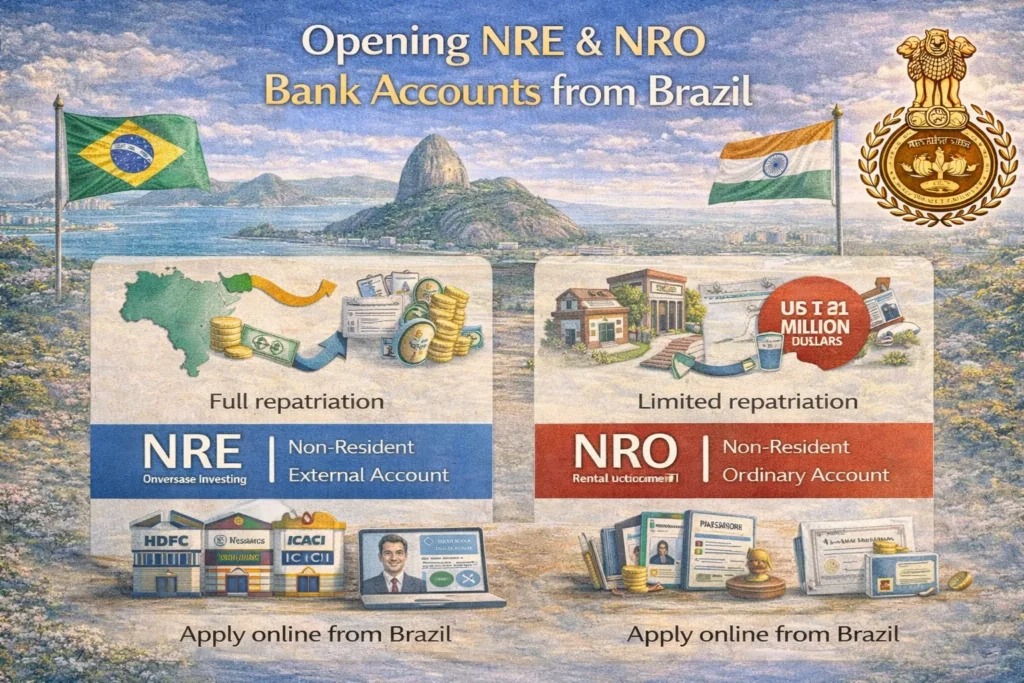
Your old Indian savings account is like a bicycle. It worked for getting around your hometown. But for an international financial journey, you need a car. NRE and NRO accounts are that car.
The NRE (Non-Resident External) Account
This is your primary account. You fund it with money you earn in Brazil. You send Reais, convert them to Rupees, and deposit them. The magic of this account is full repatriability. This means every single rupee you put in, plus any profits you make from investing it, can be converted back and sent to Brazil anytime. No limits. It’s a two-way street for your wealth.
The NRO (Non-Resident Ordinary) Account
This account is for money you earn inside India. Rental income from a family flat. Dividends from old investments. That money flows here. Repatriation from this account is limited. You can send up to one million US dollars per year out of India from all your NRO accounts combined. And you need to show tax documents. Think of it as a parking garage for Indian-sourced income.
How to open them from Brazil: Most major Indian banks like HDFC, ICICI, and SBI allow you to start online. You fill a digital form. You will need to provide scanned copies of your documents. These usually include your passport, Brazilian visa or residence card, proof of address in Brazil, and your PAN card. Many banks now offer video KYC. A representative verifies your identity over a call. You never have to visit a branch in India. The account is opened digitally, and your welcome kit is sent to your Brazilian address.
Opening NRI Demat & Trading Account from Brazil
Want to buy shares of Indian companies like Reliance or TCS? You can’t use a regular trading app. You need a special NRI setup.
This involves opening a Demat (Dematerialized) account to hold your shares electronically. For NRIs, this must be linked to a PIS (Portfolio Investment Scheme). The PIS is not an extra account. It’s a special designation on your NRI demat account that lets the Reserve Bank of India (RBI) monitor your stock trades. It’s a simple compliance layer.
You can open this account with the brokerage arm of your Indian bank or with a registered broker like Zerodha or Upstox for NRIs. The document list is similar: PAN, passport, Brazilian address proof, and details of your NRE/NRO account. The entire process is online. Once approved, you link this trading account to your NRE/NRO bank account. You transfer funds and you are ready to invest.
Investment Options in India for NRIs from Brazil
With your accounts active, let’s explore what you can actually buy. The menu is extensive.
Mutual Funds
This is often the best starting point. A mutual fund pools money from thousands of investors. A professional manager invests it in a diversified basket of stocks or bonds. You own a small piece of that basket.
As an NRI from Brazil, you can invest in almost all Indian mutual funds. You complete a one-time KYC with a KRA (KYC Registration Agency). This is separate from your bank KYC. Once done, you can invest directly on the fund house’s website or through platforms like Coin by Zerodha. Use your NRE account to pay if you want easy repatriation later.
Stocks & ETFs
This is for when you want to pick your own companies. You buy shares through your NRI Demat and PIS account. You can also invest in ETFs (Exchange Traded Funds), which are like mutual funds that trade on the stock exchange.
Fixed Deposits
For stability, Indian banks offer NRE and NRO Fixed Deposits. The interest rates are often attractive. NRE FD interest is tax-free in India. NRO FD interest is taxable. You also have the FCNR (Foreign Currency Non-Resident) FD. Here, you deposit US Dollars or Euros without converting to Rupees. Your deposit and interest are protected from rupee currency fluctuations. It’s a safe harbor for your foreign currency savings.
Real Estate
NRIs can buy residential and commercial property in India. You cannot buy agricultural land or plantation property without special permission. You can pay from your NRE, NRO, or FCNR accounts. You can even take a home loan from an Indian bank. When you sell, you can repatriate the sale proceeds, but there are rules on how much. Generally, you can repatriate up to the amount you originally paid from foreign currency sources. Any profit above that can be repatriated within the NRO limit.
NPS (National Pension System)
The NPS is a long-term retirement-focused investment. It offers tax benefits and is a good way to build a retirement corpus for your future in India.
FEMA & RBI Rules NRIs in Brazil Must Follow
The rules exist to help you, not hinder you. The main law is FEMA (Foreign Exchange Management Act). The RBI (Reserve Bank of India) enforces it.
The key rules for you are simple:
- Use NRE/NRO accounts, not resident accounts.
- Use a PIS-designated demat account for stocks.
- Avoid investing in prohibited sectors like agricultural land or lottery businesses.
- Report large transactions through your bank, which they usually do for you.
It sounds complex, but in practice, using the right accounts ensures you are automatically compliant. Your bank and broker are your guides.
Tax on NRI Investments in India (For Brazil Residents)

India will tax the income you earn from your Indian investments. Understanding this helps you plan better.
- Capital Gains: Selling stocks or equity funds within 1 year attracts a 15% tax. After 1 year, gains over ₹1 lakh per year are taxed at 10%. For debt funds and real estate, the “long-term” period is 3 years, with a 20% tax after indexation.
- Interest: Interest from NRO and FCNR deposits is taxed at your income slab rate (often 30% for NRIs). Interest from NRE deposits is tax-free.
- Dividends: Dividends from stocks or mutual funds are added to your income and taxed.
What about Brazil? This is crucial. Brazil taxes its residents on worldwide income. This means you might have to declare your Indian investment profits in Brazil too. But don’t panic. India and Brazil have a DTAA (Double Taxation Avoidance Agreement). This treaty helps ensure you don’t pay the same tax twice. You can often claim a credit in Brazil for taxes paid in India. It is highly recommended to speak with a cross-border tax advisor who understands both Indian and Brazilian tax laws.
Repatriation of Money Back to Brazil
This is about bringing your profits home. The rule is simple: money in your NRE account is easy to repatriate.
You log into your Indian bank’s online portal. You file a request to transfer funds to your Brazilian bank account. The bank converts rupees to Reais (often via US Dollars) and sends it via SWIFT. The process is smooth and mostly online.
For money in your NRO account, you have the annual limit of one million dollars. You will also need a Chartered Accountant’s certificate stating all taxes have been paid. This is why funding investments through your NRE account from the start is the smartest move.
Common Mistakes NRIs in Brazil Make
Let’s learn from others so you don’t have to.
- Using Old Resident Accounts: Trying to invest with a resident savings or demat account is the biggest error. It can lead to legal and tax complications.
- Ignoring the PIS Requirement: Buying stocks without a PIS-designated NRI demat account is not allowed. Your broker will not allow the trade.
- Tax Misplanning: Not accounting for TDS (Tax Deducted at Source) in India or forgetting to report income in Brazil can lead to penalties.
- Repatriation Confusion: Assuming all money can be freely sent back, especially from NRO accounts, leads to frustration. Plan your account usage from day one.
Practical Checklist for NRIs in Brazil
Before you start, have this ready:
- Valid Indian Passport
- PAN Card
- Brazilian Residence Visa/CPF
- Proof of Address in Brazil (Utility bill or rental contract)
- Email ID and Phone Number (to receive OTPs)
Conclusion
Investing in India from Brazil is a powerful way to connect with your heritage and build wealth. The system is designed for you. It is digital, compliant, and structured.
The journey begins with a single step: opening your NRE account. From there, each step follows logically. Choose investments that match your goals. Respect the simple rules. Plan for taxes.
Your financial future can have strong roots in both Brazil and India. It is not just about money. It is about maintaining a tangible link to home while building a secure life abroad. Start building your bridge today. The process is clearer than you think, and the potential awaits.
FAQs
What is the first thing I need to do to invest in India from Brazil?
The first and most critical step is to open an NRE (Non-Resident External) bank account with an Indian bank. This account is your legal gateway for sending money from Brazil and for easily bringing your investment profits back later. Do not use your old Indian savings account.
Can I use my regular Indian demat account to buy stocks?
No, you cannot. As an NRI, you must open a new NRI Demat and Trading account with a PIS (Portfolio Investment Scheme) designation. Your old resident demat account will be blocked for new investments. Your broker will help you open the correct NRI account online from Brazil.
Are Indian mutual funds open to NRIs in Brazil?
Yes, absolutely. Once you complete a one-time KYC (Know Your Customer) process with a KYC Registration Agency (KRA) in India, you can invest in most Indian mutual funds. You can do this directly on fund house websites or through registered investment platforms.
How do I get my investment money back to my bank in Brazil?
This process is called repatriation. If you used your NRE account to fund the investment, you can repatriate both your original money and your profits freely. You simply log into your Indian bank’s online portal and initiate an international transfer to Brazil. Money in an NRO account has repatriation limits.
Will I be taxed twice—in India and Brazil?
India will tax the income generated from your investments there. As a Brazilian tax resident, you must also report this global income in Brazil. However, the India-Brazil DTAA (Double Tax Avoidance Agreement) helps prevent double taxation. You can usually claim a credit in Brazil for taxes already paid in India. Consulting a cross-border tax advisor is recommended.
What is the difference between an NRE and an NRO Fixed Deposit?
An NRE Fixed Deposit is funded with money you sent from Brazil. The interest you earn is completely tax-free in India. An NRO Fixed Deposit is for rupee income earned in India (like rent). The interest earned on an NRO FD is taxable in India. Both are safe investment options.
Can I buy property in India while living in Brazil?
Yes. NRIs are allowed to buy residential and commercial property in India. You cannot purchase agricultural land, plantation land, or a farmhouse without special permission. You can use funds from your NRE, NRO, or FCNR accounts for the purchase and even take a home loan from an Indian bank.
What is a PIS account, and do I need one?
PIS stands for Portfolio Investment Scheme. It is not a separate account. It is a mandatory designation on your NRI Demat account that allows you to buy and sell shares on Indian stock exchanges. The RBI uses it to monitor NRI investments in stocks. Your broker will set this up for you when you open your NRI demat account.
What are the common mistakes I should avoid?
Using old resident bank or demat accounts for new investments.
Funding investments through an NRO account when you plan to repatriate, instead of using an NRE account.
Not planning for Tax Deducted at Source (TDS) in India or forgetting to report income in Brazil.
Trying to buy stocks without a PIS-designated NRI demat account.
Can I manage everything online without visiting India?
Yes. The entire process—from opening your NRE/NRO accounts and demat account to completing KYC, making investments, and initiating repatriation—can be done digitally from Brazil. Video KYC and online document submission have made physical presence unnecessary.
Also Read: How to Invest in India as an NRI from Mexico
Also Read: How To Renew Indian Passport in Norway


0 Comments