



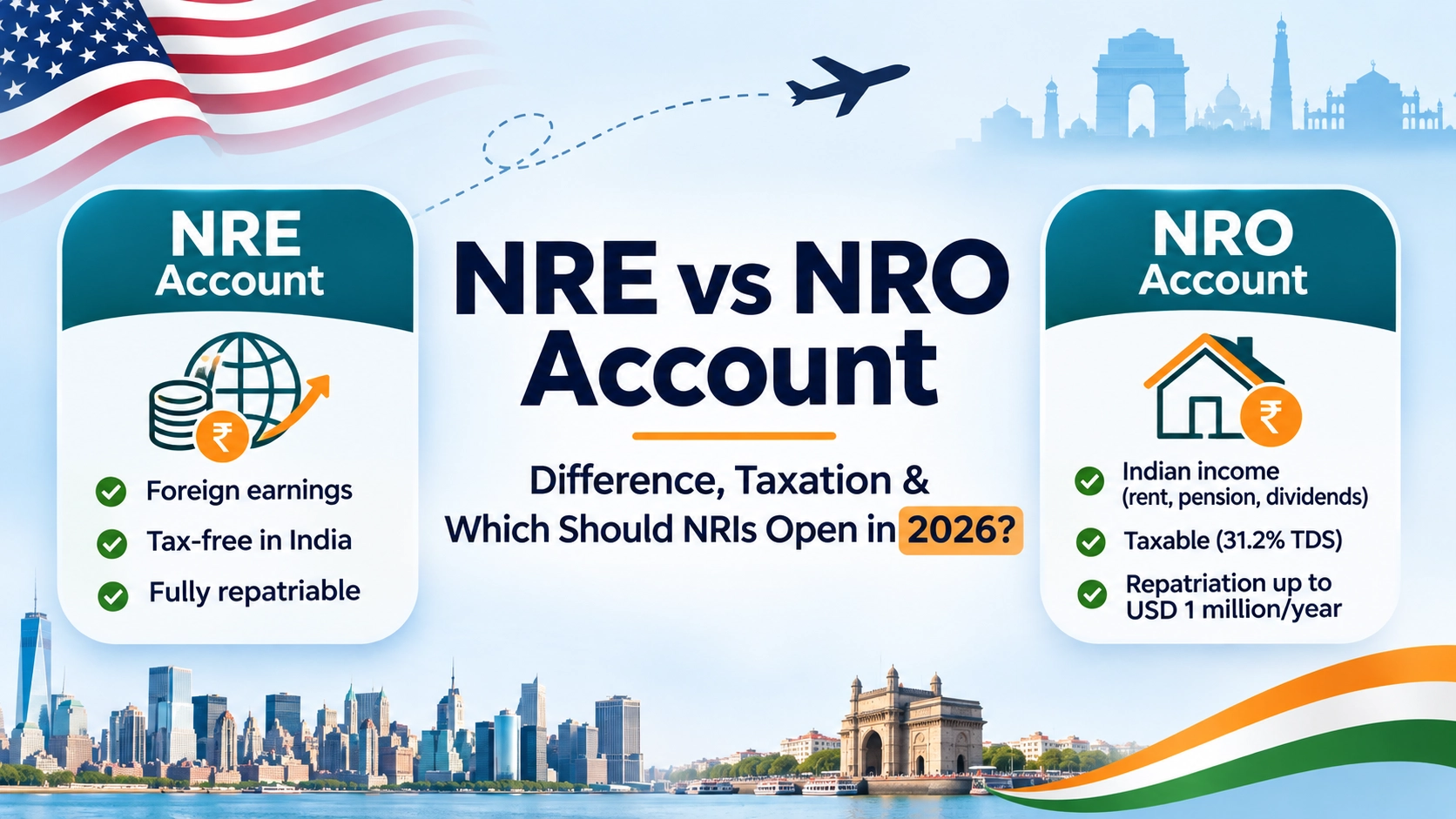
Quick answer: An NRE account holds money you earn abroad: interest is tax-free in India and the money is fully repatriable. An NRO account holds money that arises in India, such as rent, pension, and dividends: interest is taxed with 31.2 percent TDS, and balances can be repatriated up to USD 1 million a year after tax. Most NRIs need both.
Key takeaways
- Open an NRE account for foreign earnings and an NRO account for Indian income
- Rent, pension, and dividends must go into NRO, never NRE
- A resident savings account must be converted to NRO once you become an NRI
- US-based NRIs must report both accounts to the IRS, and NRE interest is taxable in the US
The NRE vs NRO account choice is the first banking decision every Non-Resident Indian makes, and it shapes everything after it: how much tax you pay on interest, whether your money can leave India freely, and whether you stay on the right side of FEMA. Get it right, and your interest is tax-free and transfers are simple. Get it wrong, and you can lose 31.2 percent of your interest to TDS or breach foreign exchange rules without knowing it.
The stakes rose in 2026 as NRI deposit rates climbed. In July 2026, AU Small Finance Bank raised its NRE fixed deposit rate to 7.60 percent for 36 months and one day to 45 months, and its FCNR(B) rate to 7.40 percent on three to four year US dollar deposits. On an NRE deposit, that interest is tax-free in India. On an NRO deposit at a similar rate, nearly a third goes to TDS.
NRE and NRO Account Difference at a Glance
| Feature | NRE Account | NRO Account |
|---|---|---|
| Full form | Non-Resident External | Non-Resident Ordinary |
| What it holds | Money earned outside India | Money earned in India |
| Deposits allowed | Foreign remittances, transfers from NRE or FCNR | Indian income and foreign remittances |
| Currency | Indian rupees | Indian rupees |
| Tax on interest in India | Tax-free | Taxable |
| TDS on interest | None | 30 percent plus surcharge and 4 percent cess |
| Repatriation | Fully repatriable, no limit | Up to USD 1 million per financial year, after tax |
| Joint holding | With another NRI, or a resident relative on a former-or-survivor basis | With NRIs or residents |
| Best for | Savings you may take back abroad | Rent, pension, dividends, sale proceeds |
NRE Account Meaning
An NRE (Non-Resident External) account is a rupee account for money you earn abroad and bring to India. The word external is the clue: the money comes from outside India.
What can go into an NRE account:
- Foreign inward remittances from your overseas bank
- Transfers from another NRE account or an FCNR deposit
- Interest earned on NRE deposits
- Maturity proceeds of investments made from NRE funds
Why NRIs choose it:
- Interest is exempt from Indian income tax while you are a person resident outside India under FEMA
- No TDS on interest
- Principal and interest are fully repatriable
The trade-off is currency risk. Your dollars, pounds, or dirhams are converted into rupees, so a weaker rupee reduces the value when you take money back.
NRO Account Meaning
An NRO (Non-Resident Ordinary) account is a rupee account for money that arises in India. It is also the account your old resident savings account becomes when you move abroad.
What must go into an NRO account:
- Rent from Indian property
- Pension from an Indian employer or government
- Dividends from Indian shares and mutual funds
- Property sale proceeds, after TDS
- Maturity proceeds of investments made from NRO funds
- Balances from your old resident savings account
NRO interest is fully taxable, and banks deduct 31.2 percent TDS with no threshold. Most NRIs owe far less and can recover the excess by filing an ITR, or cut TDS at source with a treaty rate.
Where Does FCNR Fit In?
An FCNR(B) deposit is a third option for money earned abroad. It keeps your money in foreign currency, such as US dollars, for one to five years. Interest is tax-free while you are an NRI, and there is no rupee risk. Choose it over an NRE fixed deposit when your future spending will be outside India.
NRE vs NRO Account: Which Should You Open?
| Your Situation | Open This |
|---|---|
| You send part of your salary to India to save | NRE |
| You own Indian property that earns rent | NRO |
| You receive an Indian pension or dividends | NRO |
| You plan to sell Indian property | NRO, and NRE if it was bought with foreign funds |
| You want dollar savings in India with no currency risk | FCNR(B) |
| You just moved abroad with a resident savings account | Convert it to NRO, and open NRE |
| You plan to invest in Indian mutual funds and take gains abroad | NRE |
For most NRIs, the answer to the NRE vs NRO account question is both: NRE for money coming in from abroad, NRO for money earned in India. Find the right NRI bank account type combination in a few steps.
Can Rental Income Go Into an NRE Account?
No. Rent arises in India, so it must be credited to an NRO account. The same applies to pension, dividends, and property sale proceeds. After paying tax, you can move this money abroad or into your NRE account within the USD 1 million annual limit, using Form 145 and, where required, a CA certificate in Form 146.
How to Open an NRE or NRO Account
Most banks now let you open both accounts from abroad with video KYC. Keep these ready:
- Passport, with visa, work permit, or residence permit
- OCI or PIO card, if you hold a foreign passport
- Overseas address proof, such as a utility bill or bank statement
- PAN card, or Form 60 if you do not have one
- Recent photograph
- Indian address proof, if the bank asks
An NRE account must be funded from abroad or from another NRE or FCNR account. You cannot open it with an Indian rupee deposit. NRIs who still need one can apply for a PAN card from abroad.
NRE and NRO Accounts for US-Based NRIs
If you live in the US, or are a US citizen or green card holder, three extra rules apply:
- NRE interest is taxable in the US, even though it is tax-free in India. Report it on your US return
- FBAR: if your foreign accounts together exceed USD 10,000 at any point in the year, file FinCEN Form 114
- Form 8938: report specified foreign assets above the FATCA threshold, which starts at USD 50,000 at year-end, or USD 75,000 at any time, for a single filer living in the US
NRO interest is taxed in both countries, so claim the foreign tax credit in the US for the Indian TDS. Many Indian banks also ask US persons for extra FATCA declarations when opening accounts.
What Happens When You Return to India?
Once you become a FEMA resident:
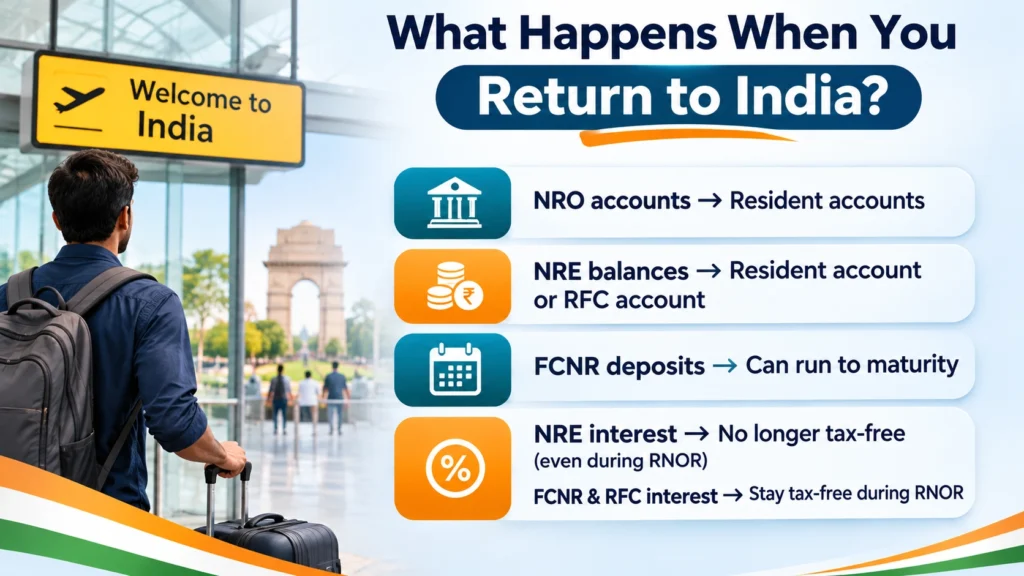
- NRO accounts are redesignated as resident accounts
- NRE balances move to a resident account or a Resident Foreign Currency (RFC) account
- FCNR deposits can usually run to maturity
- NRE interest stops being tax-free, even while you are RNOR, but FCNR and RFC interest stays tax-free during RNOR
The timing depends on your RNOR years, and MostlyNRI's returnee NRI transition services handle the conversion with your bank.
What Mistakes Do NRIs Make With NRE and NRO Accounts?
- Crediting Indian income to an NRE account, which breaches FEMA
- Keeping a resident savings account after moving abroad
- Holding large NRO fixed deposits when NRE or FCNR would be tax-free
- Not filing an ITR to recover excess NRO TDS
- US persons skipping FBAR or not reporting NRE interest to the IRS
How MostlyNRI Helps
MostlyNRI sets up and maintains NRI banking for clients worldwide, covering account selection across NRE, NRO, FCNR, and RFC, repatriation paperwork with Form 145 and Form 146, TDS reduction using DTAA rates, ITR filing to recover NRO TDS, and account conversion when you move back. MostlyNRI supports NRI banking and tax needs across 33 countries.
Not sure which account your money belongs in? Use the NRI Bank Account Type Advisor, or book a consultation with our specialists at MostlyNRI.com to set up your NRI banking and remittances correctly.
Frequently Asked Questions (FAQs)
What is the difference between NRE and NRO accounts?
An NRE account holds money earned abroad, with tax-free interest and full repatriation. An NRO account holds money earned in India, such as rent or pension, with taxable interest and repatriation capped at USD 1 million a year after tax.
What is the meaning of an NRE account?
NRE stands for Non-Resident External. It is a rupee account in India for money an NRI earns abroad. Deposits must come from foreign remittances or other NRE or FCNR accounts, and interest is tax-free in India.
Which is better, NRE or NRO?
Neither is better overall, because they serve different money. Use NRE for foreign earnings you want to keep tax-free and repatriable. Use NRO for income that arises in India, which FEMA does not allow into an NRE account.
Can I open both an NRE and an NRO account?
Yes, and most NRIs should. An NRE account handles money you bring from abroad, while an NRO account receives rent, pension, dividends, and sale proceeds. Keeping them separate avoids FEMA breaches and makes repatriation easier.
Is NRE interest taxable in India?
No, as long as you are a person resident outside India under FEMA. Interest on NRE savings and fixed deposits is exempt and has no TDS. It becomes taxable once you return and become a FEMA resident.
Can rental income go into an NRE account?
No. Rent from Indian property is Indian income and must be credited to an NRO account. After paying tax, you can repatriate it or move it to NRE using Form 145 and, where required, Form 146.
How much money can I take out of an NRO account?
You can repatriate up to USD 1 million per financial year from NRO balances, asset sale proceeds, and inheritances, after tax. Current income such as rent is repatriable after tax. Larger amounts need RBI approval.
Do US-based NRIs need to report NRE and NRO accounts?
Yes. File FBAR if your foreign accounts together exceed USD 10,000 at any time in the year, and Form 8938 above the FATCA threshold. NRE interest is taxable in the US even though India exempts it.
Can an NRI keep a resident savings account?
No. Once you become an NRI under FEMA, your resident savings account must be redesignated as an NRO account. Continuing to operate it as a resident account breaches FEMA and can cause problems with your bank.
How can MostlyNRI help me choose between NRE and NRO accounts?
MostlyNRI recommends the right mix of NRE, NRO, and FCNR accounts, sets up repatriation paperwork, reduces NRO TDS using DTAA rates, files your ITR to recover excess TDS, and converts your accounts when you move back.


0 Comments