Category: NRI Investments & Financial Planning

  • FCNR Deposit Rates and Tax in 2026: Is an FCNR Deposit Better Than an NRE FD?

    Quick answer: An FCNR(B) deposit keeps your money in a foreign currency such as US dollars for 1 to 5 years, with tax-free interest in India and no rupee risk. An NRE FD pays interest in rupees, usually at a higher rate, but your returns fall if the rupee weakens. FCNR is better when your goals are in foreign currency, or when the rate gap is small, as it was in 2026.

    Key takeaways

    • FCNR interest is tax-free for NRIs and stays tax-free while you are RNOR after returning
    • Withdraw before one year and you get no interest
    • In 2026, some banks paid 7.40 percent on USD FCNR against 7.60 percent on NRE FDs
    • US persons must report FCNR interest and balances to the IRS

    For years, NRIs treated FCNR deposits as the safe but boring choice: dollars in, dollars out, lower rates than NRE. 2026 changed that. The RBI opened a special swap window that let banks pay more on FCNR deposits, and from 17 June 2026 it temporarily removed the interest rate ceiling on fresh 3 to 5 year FCNR deposits. By 21 August 2026, banks had raised about USD 65.4 billion through FCNR(B). In July, AU Small Finance Bank offered 7.40 percent on three to four year USD FCNR deposits, barely below its 7.60 percent NRE FD rate.

    When the rate gap shrinks that far, the question changes from “is FCNR worth the lower rate?” to “why take rupee risk at all?”

    What Is an FCNR Deposit?

    FCNR(B) stands for Foreign Currency Non-Resident (Bank) deposit. It is a term deposit in India held in foreign currency.

    • Who can open it: NRIs and persons of Indian origin living abroad
    • Currencies: US dollar, British pound, euro, Japanese yen, Canadian dollar, and Australian dollar at most banks
    • Tenure: 1 to 5 years
    • Funding: foreign remittances, transfers from an NRE account, or another FCNR deposit
    • Account type: term deposits only, with no savings or current option

    You deposit dollars, earn interest in dollars, and take dollars back at maturity.

    How Are FCNR Deposits Taxed?

    In India

    • Interest is exempt from income tax while you are a non-resident
    • It stays exempt while you are RNOR after returning to India, unlike NRE interest
    • No TDS is deducted
    • Principal and interest are fully repatriable

    In your country of residence

    • Most countries tax interest earned abroad
    • US persons must report FCNR interest on their US return and include the deposit in FBAR and Form 8938 where thresholds apply

    Plan your return date with returnee NRI transition services to make the most of the RNOR window.

    FCNR Deposit vs NRE FD: Side by Side

    FeatureFCNR(B) DepositNRE Fixed Deposit
    CurrencyForeign currencyIndian rupees
    Currency riskNone for your chosen currencyYes, rupee depreciation
    Typical ratesLower in normal years, close to NRE in 2026Usually higher
    Tax in IndiaTax-freeTax-free
    Tax after return (RNOR)Still tax-freeTaxable once you are a FEMA resident
    Tenure1 to 5 years1 to 10 years at most banks
    Premature withdrawalNo interest if under 1 yearLower or no interest if under 1 year, per bank terms
    RepatriationFully repatriableFully repatriable
    Best forGoals in foreign currencyGoals in India

    The Real Comparison: Currency Risk

    An NRE FD’s rate is in rupees. If you will eventually spend the money in dollars, the rupee’s movement matters as much as the rate.

    A simple rule of thumb: an NRE FD beats an FCNR deposit in dollar terms only if the rupee weakens by less than the rate gap each year.

    Illustration with 2026 rates

    • NRE FD: 7.60 percent in rupees
    • USD FCNR: 7.40 percent in dollars
    • Rate gap: about 0.2 percent a year

    If the rupee weakens by more than about 0.2 percent a year against the dollar, the FCNR deposit gives the better dollar return. Over the past two decades, the rupee has typically weakened by more than that against the dollar in most years, although past trends do not guarantee future moves.

    Illustration with a wider gap

    • NRE FD at 7.25 percent, USD FCNR at 5.00 percent
    • Breakeven rupee depreciation: about 2.1 percent a year
    • If the rupee falls 3 percent a year, the NRE FD returns roughly 4.1 percent in dollar terms, less than the FCNR’s 5 percent

    Worked Example: USD 50,000 for Three Years

    Kavya, an NRI in New Jersey, has USD 50,000 to park in India for three years. Assume annual compounding and an exchange rate of Rs 88 per dollar today.

    USD FCNR at 7.40%NRE FD at 7.60%
    Amount investedUSD 50,000Rs 44,00,000
    Value after 3 yearsUSD 61,942Rs 54,81,375
    In dollars if the rupee stays at 88USD 61,942USD 62,288
    In dollars if the rupee falls to 93USD 61,942USD 58,940
    In dollars if the rupee falls to 96USD 61,942USD 57,098

    The NRE FD wins only if the rupee stays below about Rs 88.50 at maturity. A move of just half a rupee wipes out the extra interest. If Kavya’s money is meant for her daughter’s US college fees, the FCNR deposit is the safer choice. If it is meant for a flat in Pune, the rupee rate matters less and the NRE FD works well.

    When FCNR Makes Sense

    • Your goals are outside India: a child’s US education, a home abroad, or retirement overseas
    • You want certainty in dollars or pounds
    • You plan to return to India soon and want interest that stays tax-free during RNOR
    • The rate gap between NRE and FCNR is small

    When an NRE FD Makes Sense

    • You will spend the money in India: a home, parents’ care, or retirement in India
    • The rate gap is wide
    • You want tenures longer than five years

    Many NRIs split their savings: FCNR for foreign currency goals, NRE for Indian goals.

    Rules to Know Before You Book

    • Premature withdrawal: no interest if withdrawn before one year. After a year, banks may apply a penalty
    • Loans: most banks lend against FCNR deposits
    • Rate locks: the rate is fixed for the full tenure at booking, so rates offered during the 2026 window stay locked even as market rates change
    • Joint holding: with another NRI, or with a resident relative on a former-or-survivor basis
    • Returning to India: the deposit can generally run to maturity at the contracted rate, then move to a Resident Foreign Currency (RFC) or resident account

    How to Open an FCNR Deposit

    1. Open or use an existing NRE account at a bank that offers FCNR deposits
    2. Complete KYC with your passport, visa or OCI card, overseas address proof, and PAN
    3. Remit foreign currency from abroad, or transfer from your NRE account
    4. Choose the currency and tenure
    5. Keep the deposit confirmation for your records and your home-country tax return

    Decide how much to keep in FCNR, NRE, and NRO by comparing each NRI bank account type.

    How MostlyNRI Helps

    Our banking desk helps NRIs choose between FCNR and NRE deposits, plan maturities around a return to India, keep interest tax-free during RNOR, and report deposits correctly in their home country. MostlyNRI supports NRI banking across 33 countries.

    Deciding where to park your savings in India?

    Use the NRI Bank Account Type Advisor, or book a consultation with our specialists at beige-spoonbill-433256.hostingersite.com/ for NRI banking support.

    FAQs

    What is an FCNR deposit?

    An FCNR(B) deposit is a term deposit in India held in a foreign currency, such as US dollars, for one to five years. NRIs earn interest in that currency, pay no Indian tax on it, and can repatriate it fully.

    Is FCNR interest taxable in India?

    No. FCNR interest is tax-free for NRIs and has no TDS. It also stays tax-free while you are RNOR after returning to India, which is longer than the NRE exemption lasts.

    Is an FCNR deposit better than an NRE FD?

    It depends on where you will spend the money. FCNR removes rupee risk, so it suits foreign currency goals. An NRE FD usually pays more in rupees and suits goals in India. In 2026, the rate gap was unusually small.

    What currencies can I hold in an FCNR deposit?

    Most banks offer FCNR deposits in US dollars, British pounds, euros, Japanese yen, Canadian dollars, and Australian dollars. Some banks offer more. The deposit stays in the currency you choose for its full tenure.

    What happens if I break an FCNR deposit early?

    If you withdraw before one year, no interest is paid. After one year, banks may pay interest with a penalty under their terms. Check the premature withdrawal rules before booking.

    What is the minimum tenure for an FCNR deposit?

    FCNR deposits run for one to five years. There is no option shorter than one year, and no savings or current account version. For shorter needs, NRIs usually use an NRE savings account.

    Why were FCNR rates so high in 2026?

    The RBI opened a special swap window for FCNR deposits and temporarily removed the rate ceiling on fresh 3 to 5 year deposits from 17 June 2026. Banks raised about USD 65.4 billion by 21 August 2026.

    What happens to my FCNR deposit when I return to India?

    It can generally run to maturity at the contracted rate. Interest stays tax-free while you are RNOR. At maturity, the money moves to a Resident Foreign Currency account or a resident rupee account.

    Do US-based NRIs pay US tax on FCNR interest?

    Yes. US tax residents and citizens must report FCNR interest on their US return each year, even though India does not tax it, and include the deposit in FBAR and Form 8938 where the reporting thresholds apply.

    How can MostlyNRI help me choose between FCNR and NRE?

    MostlyNRI compares FCNR and NRE options for your currency goals, plans maturities around a return to India, keeps interest tax-free during RNOR, and makes sure deposits are reported correctly at home.
  • Form 15CA and 15CB for NRIs in 2026: Who Needs It, Step-by-Step Filing

    Quick answer: From 1 April 2026, Form 15CA is Form 145 and Form 15CB is Form 146. NRIs need them when sending taxable money abroad, such as NRO balances or property sale proceeds. Form 145 is a self-declaration filed online. Form 146 is a CA certificate, needed when taxable remittances exceed Rs 5 lakh in a year. CA fees usually run Rs 3,000 to Rs 10,000.

    Key takeaways

    • Banks still say “15CA and 15CB”, but the portal now uses Form 145 and Form 146
    • Form 145 has four parts: A, B, C, and D
    • Form 146 must be filed by the CA before you file Form 145 Part C
    • NRE and FCNR repatriation is generally not taxable, so Part D or no form applies

    Every NRI who moves money out of India runs into the same two forms. The bank asks for “15CA and 15CB”, the CA asks for documents, and the portal has quietly renamed both. Under the Income Tax Act 2025 and the Income-tax Rules 2026, Form 15CA became Form 145 and Form 15CB became Form 146 from 1 April 2026, with the old Rule 37BB now Rule 220. The purpose is unchanged: India wants to confirm that tax on money leaving the country has been paid.

    Get the forms right and the bank processes your transfer quickly. Get them wrong, for example by declaring a taxable payment as non-taxable, and you risk a penalty of up to Rs 1 lakh and a stuck remittance.

    What Are Form 15CA and Form 15CB?

    Old NameNew Name (from 1 April 2026)What It IsWho Files It
    Form 15CAForm 145Online declaration of the remittance and tax paidThe person sending the money (the remitter)
    Form 15CBForm 146Certificate on taxability and tax deductedA Chartered Accountant

    The remittance date decides which form applies. Any transfer on or after 1 April 2026 uses Form 145 and Form 146, even if the underlying income or sale happened earlier.

    Who Needs Form 15CA and 15CB?

    NRIs typically need these forms when they send money abroad that is, or may be, taxable in India:

    • Repatriating NRO balances to a foreign bank account
    • Transferring NRO funds to an NRE account
    • Repatriating property sale proceeds
    • Repatriating inherited money
    • Sending rent, dividends, or pension from NRO abroad

    Residents paying non-residents, such as an Indian company paying a foreign consultant, also file these forms.

    Who Does Not Need Them?

    • NRE and FCNR repatriation: these balances are not taxable in India. Many banks need no form, and some ask for Form 145 Part D
    • Remittances on the specified list: Rule 220 lists 33 categories where neither form is needed, including LRS remittances by residents for travel, education, medical treatment, gifts, and overseas investment. For these, the bank needs only Form A2 and a purpose code

    Which Part of Form 145 Do You Need?

    PartWhen It AppliesForm 146 Needed?
    Part ATaxable remittance, and the total to the recipient in the year is up to Rs 5 lakhNo
    Part BTaxable remittance above Rs 5 lakh, and you hold an Assessing Officer certificate or order on the tax to deductNo, the AO order replaces it
    Part CTaxable remittance above Rs 5 lakh, with no AO certificateYes
    Part DRemittance not taxable in India, under the Act or a tax treatyNo

    Most NRIs repatriating NRO money or sale proceeds above Rs 5 lakh will file Part C with Form 146.

    Step-by-Step: Filing Form 146 and Form 145 Online

    1. Add your CA on the income tax portal under Authorised Partners, then My Chartered Accountant
    2. The CA accepts the request from their login
    3. Share documents with the CA (see the checklist below)
    4. The CA prepares and files Form 146 with a digital signature
    5. Go to e-File, then Income Tax Forms, then File Income Tax Forms, and choose Form 145
    6. Select Part C, enter the Form 146 acknowledgement number, and fill in the remittance details
    7. E-verify using an EVC through net banking, a bank account, a demat account, or Aadhaar OTP, or with a digital signature
    8. Download the acknowledgement from the filed forms tab
    9. Submit to your bank with the bank’s outward remittance form (Form A2) and supporting documents

    For Part A or Part D, skip steps 1 to 4 and file Form 145 directly.

    Documents Your CA Will Ask For

    • PAN of the remitter and beneficiary details including name, address, bank, and SWIFT code
    • NRO account statement showing how the balance built up
    • Source-of-funds proof: sale deed, will or succession certificate, rent agreements, dividend statements
    • TDS certificates for tax deducted on the money
    • Capital gains computation, for property or investment sales
    • ITR acknowledgement for the relevant year
    • Passport, visa, or OCI card as proof of NRI status
    • Tax Residency Certificate, if you claim a treaty rate

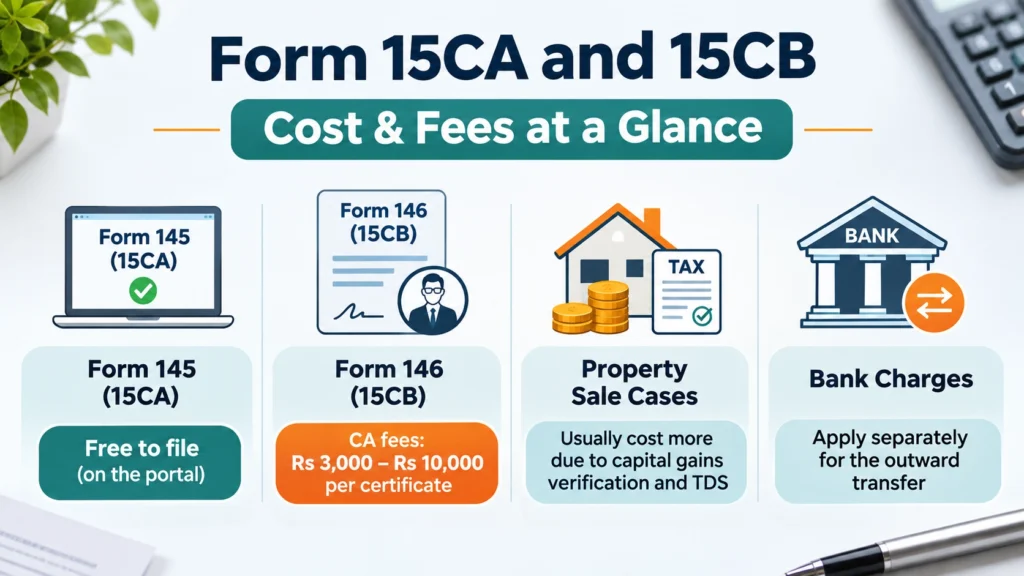
    How Much Do Form 15CA and 15CB Cost?

    • Form 145: free to file on the portal
    • Form 146: CA fees typically range from Rs 3,000 to Rs 10,000 per certificate, depending on complexity and city
    • Property sale cases usually cost more because the CA must verify the capital gains computation and TDS
    • Bank charges for the outward transfer apply separately

    How Long Does the Process Take?

    • Form 146: usually one to three working days once the CA has all documents
    • Form 145: can be filed and e-verified the same day
    • Bank processing: the transfer itself is usually quick once the bank accepts the forms, though some banks take a few working days to verify documents

    The biggest delays come from missing documents and tax not yet paid. File your ITR and settle any tax before you start.

    What Happens If You Get It Wrong?

    • Wrongly declaring a taxable remittance as non-taxable under Part D can attract a penalty of up to Rs 1 lakh per default under Section 462 of the Income Tax Act 2025
    • An incomplete or inconsistent form can lead the bank to reject the transfer
    • Remitting without paying tax can lead to notices and FEMA issues

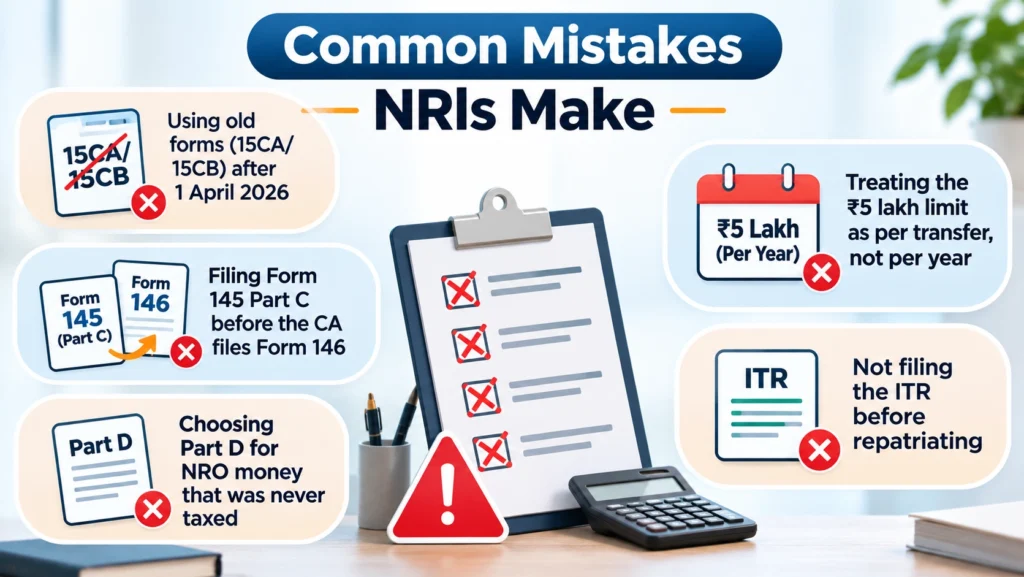
    Common Mistakes NRIs Make

    • Asking the bank for 15CA/15CB and filing old forms after 1 April 2026
    • Filing Form 145 Part C before the CA has filed Form 146
    • Choosing Part D for NRO money that was never taxed
    • Forgetting that the Rs 5 lakh limit is the total for the year, not per transfer
    • Not filing the ITR before repatriating

    Conclusion

    Our tax team prepares the paperwork behind every NRI remittance: settling tax, filing your income tax return, coordinating Form 146 with a CA, and filing Form 145 correctly. For property sale proceeds, the capital gains tax computation is checked first. Founded by Pryank Agrawal (IIT Roorkee), MostlyNRI helps NRIs in more than 33 countries move money home and abroad.

    Sending money out of India? Book a consultation with our specialists at beige-spoonbill-433256.hostingersite.com/ to get Form 145 and Form 146 done right the first time.

    Frequently Asked Questions (FAQs)

    What is Form 15CA and 15CB called now?

    From 1 April 2026, Form 15CA is Form 145 and Form 15CB is Form 146 under the Income-tax Rules 2026. The remittance date decides which applies, so any transfer from that date uses the new forms.

    Who needs Form 15CA and 15CB?

    NRIs sending taxable money abroad need them, such as NRO balances, property sale proceeds, inheritance, rent, or dividends. Residents paying non-residents also file them. Remittances on the specified list of 33 categories need neither form.

    Is Form 15CB needed for every NRI remittance?

    No. Form 146, the CA certificate, is needed only for Part C, when taxable remittances exceed Rs 5 lakh in the year and there is no Assessing Officer certificate. Part A, B, and D filings do not need it.

    Do NRIs need Form 15CA for NRE account repatriation?

    Usually not. NRE balances are not taxable in India, so many banks need no form. Some banks ask for Form 145 Part D as a declaration that the remittance is not taxable.

    How much does a CA charge for Form 15CB?

    CA fees for Form 146 usually range from Rs 3,000 to Rs 10,000 per certificate, depending on the complexity and city. Property sale cases cost more because the CA must verify capital gains and TDS.

    How long does it take to get Form 15CA and 15CB?

    Once documents are ready, a CA usually files Form 146 within one to three working days. Form 145 can be filed and e-verified the same day, and the bank then processes the transfer.

    What are the four parts of Form 15CA?

    Part A covers taxable remittances up to Rs 5 lakh a year. Part B covers those above Rs 5 lakh with an AO certificate. Part C covers those above Rs 5 lakh with Form 146. Part D covers non-taxable remittances.

    What is the penalty for a wrong Form 15CA?

    Wrongly declaring a taxable payment as non-taxable can attract a penalty of up to Rs 1 lakh per default under Section 462 of the Income Tax Act 2025. Banks may also reject the remittance.

    Which documents are needed for Form 15CB?

    Your CA will need your PAN, NRO statement, source-of-funds proof such as a sale deed or will, TDS certificates, capital gains computation, ITR acknowledgement, passport or OCI card, and beneficiary bank details.

    How can MostlyNRI help with Form 15CA and 15CB?

    MostlyNRI settles the tax due, files your ITR, coordinates Form 146 with a Chartered Accountant, files Form 145 in the right part, and prepares the documents your bank needs, so your remittance goes through without delays.

  • OCI and NRI Shareholding Cap in Indian Listed Companies Raised in Budget 2026: New Ceiling, SEBI Filing, and Portfolio Rebalancing

    OCI and NRI Shareholding Cap in Indian Listed Companies Raised in Budget 2026: New Ceiling, SEBI Filing, and Portfolio Rebalancing

    For years, Non-Resident Indians and Overseas Citizens of India who wanted a meaningful stake in a single Indian listed company ran into the same wall: 5 percent per individual, and 10 percent for all NRIs and OCIs combined. Budget 2026 removed that wall. On 1 February 2026, Finance Minister Nirmala Sitharaman announced that the individual cap would double to 10 percent and the aggregate cap would rise to 24 percent. The change was then notified through the Foreign Exchange Management (Non-debt Instruments) (Third Amendment) Rules, 2026, reported as S.O. 3030(E) dated 12 June 2026.

    The headline is simple, but the fine print matters. The new individual ceiling is below 10 percent of fully diluted paid-up equity, not 10 percent itself. Crossing it turns your whole holding into FDI. Holding more than 5 percent also brings SEBI disclosure duties that most retail NRIs have never dealt with. And with more headroom comes a real question: should you actually concentrate more of your wealth in one Indian stock?

    This guide explains the new limits, who is covered, the SEBI filings you must make, the breach rules, the tax position, and how to rebalance your Indian portfolio sensibly.

    What Changed: Old vs New Limits

    LimitBefore Budget 2026After the 2026 Amendment
    Individual cap per listed company5 percentBelow 10 percent of fully diluted paid-up equity
    Aggregate cap for the category10 percent (NRI and OCI)24 percent
    Who is coveredNRIs and OCIsAll individuals resident outside India, including NRIs and OCIs
    RoutePortfolio Investment Scheme through a designated bankRecognised stock exchange through a designated AD bank branch
    BasisRepatriableRepatriable

    Two shifts deserve attention. First, the category is wider. The rules now cover any individual resident outside India, so NRIs and OCIs share the 24 percent aggregate room with other foreign individuals. Second, the individual ceiling sits just under 10 percent, which keeps portfolio holdings clearly separate from foreign direct investment.

    Investments made on a non-repatriation basis under Schedule IV of the NDI Rules continue to be treated like domestic investment and are not counted against these portfolio limits.

    Why the Government Raised the Cap

    The Budget speech and market commentary pointed to three reasons:

    • Foreign institutional flows turned volatile through 2025 and early 2026
    • Diaspora capital tends to be longer-term and less reactive than hot money
    • Higher caps align India with global norms and widen the shareholder base of listed companies

    Market participants welcomed the move. Portfolio managers noted that doubling the per-investor cap creates headroom in sectors where foreign ownership limits had been choking flows.

    The Thresholds That Now Matter

    With room to buy up to just under 10 percent, NRIs and OCIs can now cross several regulatory lines. Here is the ladder.

    Holding LevelWhat Happens
    Below 5 percentStandard portfolio investment, no SEBI disclosure
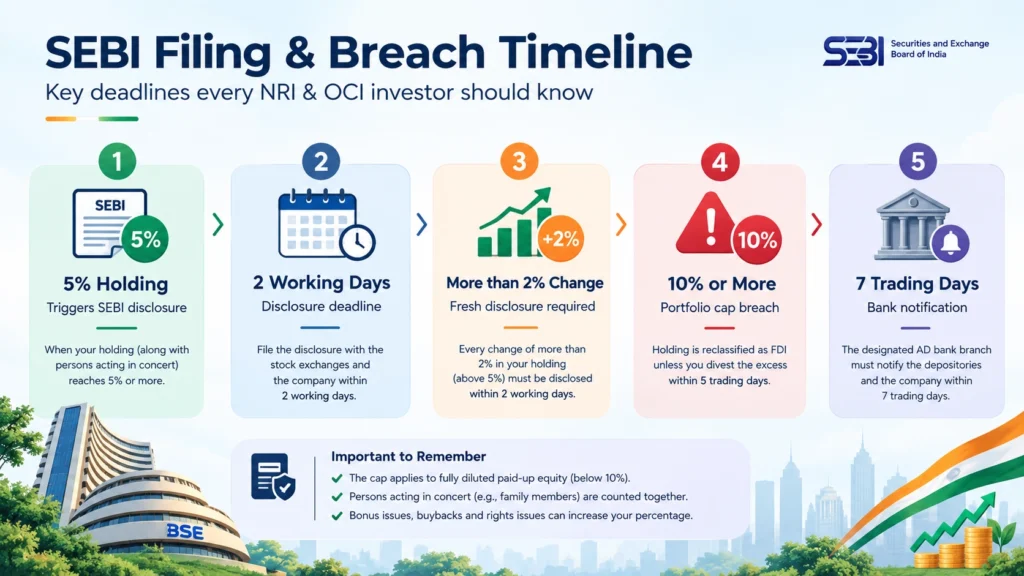
    5 percent or moreSEBI SAST disclosure within two working days
    Each 2 percent change above 5 percentFresh SEBI disclosure within two working days
    10 percent or moreBreach of the portfolio cap. Holding reclassified as FDI unless divested within five trading days
    Aggregate 24 percent for the companyNo further portfolio buying by individuals resident outside India

    SEBI Filing: Disclosures Under the Takeover Regulations

    The SEBI (Substantial Acquisition of Shares and Takeovers) Regulations, 2011 apply to every acquirer, resident or not.

    • Regulation 29(1): when your holding, together with persons acting in concert, reaches 5 percent or more, you must disclose it
    • Regulation 29(2): once you hold 5 percent or more, every change of more than 2 percent must be disclosed
    • Regulation 29(3): disclosures go to the stock exchanges and the company within two working days

    The words persons acting in concert matter for families. If you, your spouse, and your parent all buy the same stock, regulators may treat the holdings together. A family that crosses 5 percent collectively has a disclosure duty even if no single member does.

    Two more points help NRIs plan:

    • Staying below 10 percent also keeps you under the significant beneficial owner threshold in the Companies Act rules
    • If you join the board or receive unpublished price-sensitive information, SEBI insider trading rules apply to your trades

    Breach Rules: What If You Cross the Ceiling?

    The 2026 amendment has a strict breach mechanism:

    • Excess holdings must be sold within five trading days of the settlement date
    • If not sold, the entire holding in that company is treated as FDI
    • The investor is then barred from further portfolio investment in that company
    • The designated AD bank branch must notify the depositories and the company within seven trading days

    Bonus issues, buybacks, and rights issues can push your percentage up without a single purchase, since the cap is measured on fully diluted capital. Track these corporate actions.

    Who Should Use the Extra Headroom

    The higher cap is most useful for a narrow group:

    • High-net-worth NRIs with strong conviction in a mid-cap or small-cap company
    • Founders’ families abroad building a position in a company they understand
    • Former employees who already hold meaningful stakes through ESOPs
    • Long-term investors in stocks where the old 10 percent aggregate cap was full

    For most NRIs, the change matters less directly. A portfolio worth a few crore rupees rarely approaches 5 percent of a listed company. The real benefit is indirect: more room in stocks that were previously on the RBI caution list because NRI and OCI holdings had hit the aggregate cap.

    Portfolio Rebalancing: Headroom Is Not a Strategy

    A higher legal ceiling does not mean higher concentration is wise. Before you build a large single-stock position, run through these checks.

    • Concentration risk: a single-company position above 10 to 15 percent of your total net worth adds risk that diversification cannot offset
    • Liquidity: a large stake in a thinly traded stock is hard to exit within the five-day breach window
    • Currency: your returns depend on the rupee as well as the share price
    • Sector caps: FDI sectoral limits for banking, insurance, and defence still apply
    • Aggregate headroom: popular stocks may already be close to the 24 percent mark

    A balanced approach for most NRIs looks like this:

    • Keep direct stock holdings for high-conviction ideas, sized sensibly
    • Use mutual funds for NRIs for core diversified exposure
    • Consider a PMS for NRIs if you want a managed concentrated portfolio
    • Look at GIFT City funds for USD-denominated access to Indian markets

    Tax Implications for NRIs on Larger Positions

    The cap change does not alter tax rates. For listed shares held by NRIs:

    • Short-term capital gains (held 12 months or less): 20 percent plus surcharge and cess
    • Long-term capital gains (held more than 12 months): 12.5 percent above the Rs 1.25 lakh annual exemption
    • TDS is deducted at source by your broker under Section 393(2) of the Income Tax Act 2025
    • Dividends attract TDS at 20 percent plus surcharge and cess, or the lower DTAA rate if you file Form 41 with a valid Tax Residency Certificate

    Larger positions mean larger gains and larger TDS. Plan exits across financial years where possible. Our Capital Gain Tax team models the tax on a staggered exit, and the NRI TDS Refund Calculator estimates any excess TDS you can recover.

    Banking and Account Set-Up

    Portfolio investment on a repatriation basis runs through a designated Authorised Dealer bank branch. You need:

    • An NRE account linked to a PIS-enabled trading and demat account for repatriable investment
    • An NRO account for non-repatriable investment
    • KYC that matches your passport, OCI, and PAN details

    Our NRI Bank Account Type Advisor helps you set up the right NRE, NRO, and PIS structure before you increase your position.

    Common Mistakes to Avoid

    • Assuming the new cap is exactly 10 percent rather than below 10 percent
    • Ignoring family holdings when checking the 5 percent SEBI disclosure line
    • Missing the two-working-day disclosure deadline
    • Forgetting that bonus and buyback events change your percentage
    • Buying a stock where the 24 percent aggregate cap is nearly full
    • Mixing repatriable and non-repatriable holdings in the same account
    • Concentrating too much net worth in one stock

    How MostlyNRI Helps

    At MostlyNRI, we help NRIs and OCIs across the USA, UAE, UK, Canada, Singapore, and Australia with:

    • Portfolio reviews under the new limits
    • Mutual fund, PMS, and GIFT City allocation
    • NRE, NRO, and PIS account structuring
    • Capital gains and TDS planning on large positions
    • ITR filing under the Income Tax Act 2025 through our Income Tax Returns Filing service
    • DTAA claims with Form 41

    Our team serves clients in 13 Indian cities across 33+ countries.

    Planning to build a bigger position in an Indian listed company? Book a consultation with our specialists at beige-spoonbill-433256.hostingersite.com/ to check headroom, SEBI disclosure triggers, and the tax impact before you buy.

    Frequently Asked Questions (FAQs)

    What is the new shareholding cap for NRIs and OCIs in Indian listed companies?

    Individuals resident outside India, including NRIs and OCIs, can now hold below 10 percent of a listed company’s fully diluted paid-up equity on a repatriation basis, up from 5 percent. The aggregate limit for the category rose from 10 percent to 24 percent.

    When did the new NRI and OCI shareholding limits take effect?

    The change was announced in Budget 2026 on 1 February 2026 and notified through the FEMA (Non-debt Instruments) (Third Amendment) Rules, 2026, reported as S.O. 3030(E) dated 12 June 2026, effective on publication in the Official Gazette.

    Do foreign individuals who are not NRIs or OCIs also benefit?

    Yes. The amendment widened the category to all individuals resident outside India. NRIs and OCIs are now part of this broader group, which means they share the 24 percent aggregate room with other foreign individual investors.

    What SEBI filing is required when an NRI crosses 5 percent?

    Under Regulation 29 of SEBI’s Takeover Regulations, you must disclose a holding of 5 percent or more, and every later change above 2 percent, to the stock exchanges and the company within two working days.

    What happens if an NRI’s holding crosses the 10 percent ceiling?

    The excess must be sold within five trading days of settlement. If not, the entire holding is reclassified as FDI and further portfolio investment in that company is barred. The designated bank informs the depositories and the company.

    Do non-repatriable NRI investments count toward the new caps?

    No. Investments on a non-repatriation basis under Schedule IV of the NDI Rules are treated like domestic investment and do not count toward the individual or aggregate portfolio limits. They are made through an NRO account.

    Has the tax on NRI share gains changed with the new cap?

    No. Short-term gains on listed shares are taxed at 20 percent and long-term gains at 12.5 percent above Rs 1.25 lakh, plus surcharge and cess. Brokers deduct TDS under Section 393(2) of the Income Tax Act 2025.

    Do family members’ holdings count together for SEBI disclosure?

    They can. SEBI rules look at holdings of an acquirer together with persons acting in concert. If spouses or parents buy the same stock with a common objective, their combined holding may trigger the 5 percent disclosure duty.

    Should NRIs increase single-stock positions because the cap is higher?

    Not automatically. The higher cap gives legal room, not investment logic. Concentration, liquidity, currency risk, and sector caps still apply. Most NRIs are better served by diversified mutual funds or PMS, with direct stocks sized carefully.

    How can MostlyNRI help with the new shareholding limits?

    MostlyNRI reviews your portfolio under the new limits, sets up NRE, NRO, and PIS accounts, plans capital gains and TDS on large positions, allocates across mutual funds, PMS, and GIFT City funds, and files your ITR with DTAA claims.

  • What Is Mis-Selling of Mutual Funds, Insurance, and Financial Instruments – And How Can NRIs Avoid It?

    What Is Mis-Selling of Mutual Funds, Insurance, and Financial Instruments – And How Can NRIs Avoid It?

    Mis-selling happens when a financial product is sold to you using misleading information, hidden charges, or incomplete facts. The agent puts their commission first. Your actual needs come second.

    It is more common than you think. And NRIs are particularly exposed to it because they manage Indian investments remotely, rely on a single trusted contact, and rarely get a second opinion.

    In this guide, you will understand what mis-selling actually means, why NRIs are easy targets, the specific products and tactics used against them, how to identify if it has already happened to you, what SEBI and IRDAI rules say about it, and exactly how to file a complaint without being present in India.

    By the end, you will know your rights. And you will know what to do with them.

    What Is Mis-Selling – A Clear Definition

    Let us start with the basics.

    Mis-selling happens when a financial product is sold to you using false or misleading information. It also happens when important facts are hidden from you. When risks or returns are misrepresented. Or when a product is recommended that simply does not match your needs, your risk appetite, or your financial goals.

    Here is the part most people get wrong. Mis-selling is not the same as a product performing poorly.

    Markets go up and down. A mutual fund that underperforms is not automatically a mis-selling case. What matters is the process at the point of sale. Was the product explained honestly? Were the charges disclosed? Did the recommendation actually fit your situation?

    Think of it like buying a car. If a salesperson tells you the car gets 20 kilometres per litre and it actually gets 12… that is mis-selling. If you bought the car knowing everything and just do not like how it drives… that is a different story.

    In India, SEBI regulates mis-selling in mutual funds. IRDAI handles it for insurance. Both have specific codes of conduct that every agent and distributor must follow by law. If those rules were broken when you were sold a product, you have options.

    Why NRIs Are Especially Vulnerable to Mis-Selling

    NRIs are a higher-risk target for mis-selling than most domestic investors. Not because you are less smart. But because of the circumstances you operate in. The distance, the trust, the information gap — all of it creates an opening.

    Here is exactly why:

    Remote Management You cannot walk into a branch. You cannot sit across a table and ask hard questions face to face. Everything happens over calls, emails, and WhatsApp messages. By the time you notice something is wrong, months or years may have already passed.

    Over-Reliance on One Person Many NRIs invest based on a recommendation from a relative, a family friend, or an agent they have known for decades. That trust is completely understandable. But it also means there is rarely a second opinion in the picture. One person. One recommendation. No check.

    Regulatory Knowledge Gap Regulations change. Products evolve. What was true about a policy five years ago may not be true today. Agents know this gap exists. Some take advantage of it.

    Time Zone Barriers Following up from abroad is genuinely inconvenient. The assumption that “someone back home is handling it” means problems stay invisible for longer than they should. An issue a domestic investor catches in three months, you might not catch for three years.

    Targeted Product Pitches ULIPs, endowment plans, and structured insurance products are frequently pitched to NRIs as “safe” or “guaranteed” investments. They are often neither.

    The Most Common Mis-Selling Patterns Targeting NRIs

    These are not hypothetical situations. These patterns show up again and again.

    ULIPs sold as mutual funds

    A ULIP is part insurance, part investment. But many agents present them purely as investment products. “Just like a mutual fund, but with added benefits.” What they do not explain are the very high charges in the first few years, the insurance component that eats into your returns, and the long lock-in period that traps your money. You think you are investing in a growth product. You are actually paying for an insurance policy you may not even need.

    Endowment plans with misrepresented returns

    “This plan gives 6 to 7 percent returns, sir.”

    What the agent does not say is that these are illustrated returns. Non-guaranteed projections. The actual returns in many traditional insurance plans sit closer to 4 percent, sometimes less. Compare that to a simple index fund or even a fixed deposit and the difference becomes very clear, very quickly.

    High-commission products pushed over suitable ones

    Some products pay distributors significantly more commission than others. Regular mutual fund plans over direct plans. Certain insurance categories. Specific fund types. The product may not be outright bad. But the reason it was recommended to you might have nothing to do with your financial goals.

    Charges that were never mentioned

    Mutual fund expense ratios. ULIP allocation charges. Premium deductions in insurance policies. These numbers exist in the documents. But if an agent chooses not to mention them during the sales conversation, most investors never notice. You only discover them years later when you wonder why your corpus looks smaller than expected.

    Unsuitable risk profiling

    Imagine someone with a two-year investment goal and a conservative risk appetite being put into a mid-cap equity fund. That is a mis-selling situation – regardless of how good the fund itself is. If the product does not match your situation, it should not have been recommended to you. Full stop.

    Bundling products without proper consent

    “We have also added a small protection plan as a bonus with your SIP.”

    You did not ask for it. You were not clearly told about it. But there it is – adding charges and commissions to your overall package without your proper informed consent.

    How to Identify If You Have Been Mis-Sold a Financial Product

    Read through this list carefully.

    If any of these describe your experience, it is worth taking a closer look at what you were sold.

    • The product was explained verbally only. No written Key Information Document, benefit illustration, or scheme document was given to you before you invested.
    • Returns were described as “guaranteed” or “assured” for a product that is actually market-linked – like a mutual fund or a ULIP.
    • The agent rushed the signing process. Forms were pre-filled. You were asked to sign quickly. Nobody walked you through the charges or lock-in period.
    • The product does not match your goals. You wanted a short-term liquid investment. You were put into a 15-year endowment plan.
    • No risk profiling form was ever filled. The agent jumped straight to the recommendation without asking about your income, goals, or how much risk you were comfortable taking.
    • Your statement shows deductions or charges you were never told about.
    • The agent is now difficult to reach. Calls go unanswered. Follow-up questions get deflected.

    If two or more of these apply to you… the product may well have been mis-sold.

    What a Mutual Fund Distributor Must Not Do – SEBI Rules You Should Know

    This section matters. Because knowing your rights is the first step to protecting them.

    SEBI has laid out clear conduct requirements for every registered mutual fund distributor in India. These are not guidelines. They are rules.

    A distributor must not recommend a product that is unsuitable for your profile – even if it pays them a higher commission. They must disclose the commission they earn from the product they are recommending. They must complete a risk profiling exercise before making any recommendation at all. They must provide the Key Information Memorandum and Scheme Information Document before you invest. And they must never make exaggerated or false return claims.

    For insurance, IRDAI has equivalent protections.

    Every insurance agent must provide a benefit illustration – a document showing how the policy works under different return scenarios. You must sign this at the time of purchase. The insurer must deliver your full policy document within a specified timeframe. And every insurance policy sold in India comes with a free-look period of 15 to 30 days. During this window, you can return the policy for a full refund. No questions asked.

    Most people have never heard of the free-look period. Agents rarely bring it up. That silence, by itself, tells you something.

    How to Protect Yourself From Mis-Selling – Before You Invest

    A few straightforward steps can dramatically reduce your risk.

    1. Always ask for documents in writing before you sign anything.

    A Key Information Document for mutual funds, a benefit illustration for insurance, and the full scheme or policy document should all be in your hands before you commit a single rupee. If an agent resists or delays providing these… pause. That hesitation is a signal.

    2. Verify the agent’s registration.

    Every mutual fund distributor must be AMFI-registered. Every insurance agent must be IRDAI-registered. Both are publicly searchable online. A legitimate, professional agent will not mind you checking.

    3. Never invest based on verbal promises.

    “It gives 12 percent returns” means very little if it is not in writing. And if it is in writing, check whether those returns are guaranteed or projected. Any market-linked product with a return promise is almost certainly a projection. Not a guarantee.

    4. Consider using a SEBI Registered Investment Adviser.

    An RIA charges you a flat fee for advice. They do not earn commissions from the products they recommend. That removes the single biggest incentive for mis-selling. For NRIs managing serious wealth in India, this is often the cleanest, most conflict-free option available.

    5. Use your free-look period if something feels wrong.

    If you have recently purchased an insurance product and something does not add up – charges are higher than described, the product is not what you thought – you have 15 to 30 days to return it for a full refund. Act quickly if this applies to you.

    6. Always get a second opinion on large commitments.

    Before signing up for any significant or long-term financial product, take the documents to an independent advisor first. One extra opinion can save years of frustration.

    Get Independent, Unbiased NRI Financial Guidance – Talk to MostlyNRI

    What to Do If You Have Already Been Mis-Sold a Product

    If you believe you were mis-sold a product, do not panic. There is a proper process for this. And NRIs can use it entirely online – no need to be physically present in India.

    Step 1: Gather your documentation.

    Pull together everything you have. The policy document or fund statement. Written communication from the agent. The benefit illustration if you received one. Any recorded calls if available. The stronger your paper trail, the stronger your case.

    Step 2: Check if the free-look period still applies.

    If the insurance policy is recent – within the last 15 to 30 days – contact the insurer directly and request free-look cancellation. This is your fastest route to a refund. The insurer is legally required to process it.

    Step 3: File a formal grievance with the AMC or insurer.

    Every Asset Management Company and every insurance company has a registered Grievance Redressal Officer. Submit a written complaint. Be specific. Describe what you were told, what the product turned out to be, and how it was unsuitable for your situation. Keep a copy of everything you send.

    Step 4: Escalate to the regulator if needed.

    If the AMC or insurer does not respond satisfactorily within 30 days, escalate. For mutual fund complaints, file on SEBI SCORES at scores.sebi.gov.in. For insurance complaints, use IRDAI’s Bima Bharosa portal or contact the Insurance Ombudsman for your region. Both platforms are fully online. You do not need to be in India to use them.

    Step 5: Consult a professional for complex cases.

    If the amount is significant or the complaint is complicated, speak to a financial advisor or a legal professional with experience in investor grievances. Having expert support makes a real difference in how these cases are handled.

    Frequently Asked Questions

    What is mis-selling of mutual funds?

    Mis-selling of mutual funds happens when a distributor recommends a fund using false information, hides charges or risks, misrepresents returns, or pushes a product that does not match your risk profile or goals. It is about what happened at the point of sale. Not whether the fund did well or poorly after that.

    What is mis-selling of insurance products?

    It happens when an insurance agent sells you a policy by misrepresenting its features, returns, or suitability for your situation. Presenting a ULIP as a pure investment product, quoting non-guaranteed returns as if they were assured, or not disclosing the lock-in period or charges – all of these are classic mis-selling examples.

    How can NRIs identify if they have been mis-sold a financial product?

    Watch for these signals. Verbal promises that do not match the written policy. Charges you were never told about. Products that do not match your goals or risk tolerance. No risk profiling was done before the recommendation. And an agent who has become difficult to contact or avoids answering your questions.

    What should I do if I have been mis-sold a mutual fund or insurance policy?

    Start by collecting all your documents. If the policy is recent, use the free-look period to return it. Then file a formal complaint with the AMC or insurer. If it is not resolved within 30 days, escalate to SEBI SCORES for mutual funds or the IRDAI Bima Bharosa portal for insurance. Everything can be done online.

    What are the SEBI rules on mis-selling of mutual funds?

    SEBI requires distributors to conduct risk profiling before any recommendation, disclose their commissions, provide the Key Information Memorandum before investment, and never make false return claims. Recommending a product based on commission rather than investor suitability is a direct violation of SEBI’s conduct guidelines.

    What is the free-look period for insurance policies in India?

    It is a 15-day window – 30 days for policies sold through distance marketing, which covers most phone or online sales to NRIs – during which you can return a policy for a full refund. The window starts from the date you receive the policy document. Most agents never mention it.

    How do I file a complaint against mis-selling in India as an NRI?

    For mutual funds, go to SEBI SCORES at scores.sebi.gov.in. For insurance, use the IRDAI Bima Bharosa portal or contact the Insurance Ombudsman for the relevant region. Both are completely online processes. You do not need to be physically present in India to file or follow up on a complaint.

    What is the difference between mis-selling and unsuitable advice?

    Mis-selling typically involves deliberate misrepresentation – false information, hidden charges, or exaggerated returns given at the point of sale. Unsuitable advice is broader – a recommendation that does not fit your needs, even if no outright lie was told. In practice, SEBI and IRDAI treat both as violations of their conduct standards.

    Conclusion

    Mis-selling is not always obvious. It hides behind trust, familiarity, and complicated paperwork.

    But now you know what to look for. You know your rights. And you know exactly what steps to take if something feels wrong.

    The best protection is staying informed. Ask questions. Get everything in writing. And when in doubt, always seek independent advice before committing your money.

  • 10 Financial Advisors for NRIs You Should Know About (2026 Guide)

    10 Financial Advisors for NRIs You Should Know About (2026 Guide)

    Managing money is already complicated. Managing it across countries? That is where things become stressful for many NRIs.

    You may be earning in dollars, pounds, dirhams, or Canadian dollars while still investing, paying taxes, supporting family, or owning property in India. Suddenly, your finances are spread across multiple systems, rules, and tax structures.

    Most NRIs do not just need an investment advisor anymore.

    They need someone who understands:

    • Indian taxation and DTAA rules
    • NRE/NRO banking
    • Repatriation regulations
    • Cross-border investments
    • Retirement planning
    • Estate and succession planning

    The challenge is that many traditional wealth firms are either too expensive, too investment-focused, or simply not built around the real-life needs of NRIs.

    That is why modern NRI-focused financial platforms and specialized advisors have become increasingly important in 2025.

    This guide covers some of the most trusted financial advisors and platforms for NRIs today, from digital-first solutions to full-scale wealth management firms.

    Why Choosing the Right Advisor Matters for NRIs

    Think of your finances like a bridge connecting two countries.

    If one side is weak, the entire structure becomes unstable.

    That is exactly how NRI finances work. A tax mistake in India can affect your finances abroad. A wrong investment structure can create compliance issues later. Even something as simple as moving money from India to your country of residence involves rules many people do not fully understand.

    A good NRI financial advisor helps you avoid these problems before they happen.

    They help with:

    Tax Planning Across Countries

    One of the biggest NRI concerns is double taxation. Without proper planning, you could end up paying tax in both India and your country of residence.

    An experienced advisor understands DTAA agreements and helps structure your finances efficiently.

    Repatriation & Banking Guidance

    Moving money in and out of India is not always straightforward. NRIs often struggle with:

    • NRE/NRO accounts
    • FEMA compliance
    • Repatriation limits
    • Foreign remittance documentation

    A specialized advisor simplifies this process.

    Investment Planning

    Not every investment product in India is available to NRIs. Some mutual funds restrict US and Canadian investors. Certain tax implications also differ based on residency status.

    A good advisor helps you build investments that actually work for your long-term goals.

    Retirement & Return-to-India Planning

    Many NRIs eventually plan to return to India. But very few prepare financially for that transition properly.

    This includes:

    • pension planning
    • healthcare planning
    • taxation changes
    • residency changes
    • estate structuring

    The right advisor helps you prepare early instead of reacting later.

    Selection Criteria: What We Looked For

    We did not just pick big names.

    We focused on firms and platforms that genuinely serve NRI financial needs in a practical way.

    Here is what we considered:

    • NRI-specific expertise
    • Tax planning capabilities
    • Cross-border financial understanding
    • Digital accessibility
    • Transparency in fees
    • Ease of use for overseas clients
    • Banking and repatriation support
    • Investment advisory quality
    • Reputation within NRI communities

    We also prioritized platforms and advisors that understand the day-to-day realities of NRIs instead of simply offering generic wealth management services.

    Top 10 Financial Advisors & Platforms for NRIs

    1. MostlyNRI

    MostlyNRI has quickly become one of the most practical and NRI-focused financial platforms for Indians living abroad.

    Unlike traditional wealth firms that mainly focus on ultra-high-net-worth clients, MostlyNRI is designed around solving the real financial challenges NRIs face every day.

    From investments and taxation to banking and repatriation guidance, the platform takes a complete NRI-first approach.

    What They Offer

    MostlyNRI helps NRIs with:

    • investment planning
    • mutual fund investments
    • NRE/NRO banking guidance
    • tax filing support
    • repatriation assistance
    • cross-border financial planning
    • long-term wealth creation strategies

    They also simplify complex NRI financial topics through educational content and practical guidance.

    What Makes Them Stand Out

    Their biggest strength is simplicity and accessibility.

    Instead of forcing NRIs to deal with multiple advisors, tax consultants, apps, and banks separately, MostlyNRI creates a more unified experience.

    The platform feels modern, practical, and easier to navigate compared to many traditional advisory firms.

    Best For

    NRIs looking for an easy-to-access platform that combines investing, taxation, banking guidance, and financial planning without the complexity of traditional wealth management firms.

    2. Prime Wealth (Prime Wealth Advisors)

    Prime Wealth is a well-known name among NRIs, especially those planning an eventual return to India.

    They focus heavily on India-centric financial planning.

    What They Offer

    Their services include:

    • investment planning
    • retirement planning
    • India-US tax planning
    • estate planning
    • succession planning
    • will creation

    Best For

    US-based NRIs and families planning long-term wealth management and return-to-India strategies.

    3. SBNRI by Mani Karthik

    SBNRI takes a modern, app-first approach for NRIs.

    Founded by Mani Karthik, the platform focuses on simplifying Indian financial management for overseas Indians.

    What They Offer

    • NRE/NRO account assistance
    • mutual fund investing
    • tax filing support
    • banking assistance
    • insurance guidance
    • access to experts

    Best For

    Tech-savvy NRIs who prefer digital-first financial management.

    4. ClearTax NRI Consulting

    ClearTax is already popular for tax filing in India. Their NRI consulting arm focuses strongly on cross-border taxation.

    What They Offer

    • NRI tax filing
    • DTAA guidance
    • capital gains taxation
    • compliance support
    • tax-efficient investment advice

    Best For

    NRIs whose biggest concern is taxation and compliance.

    5. Wise NRI / Ark Advisors – led by Hemant Beniwal

    WiseNRI is led by certified financial planner Hemant Beniwal, who is widely known in NRI financial circles.

    What They Offer

    • retirement planning
    • investment management
    • tax-efficient planning
    • financial planning for US, Canada, and Middle East NRIs

    Best For

    NRIs looking for personalized guidance and relationship-driven advisory.

    6. Kuvera

    Kuvera is one of India’s most popular direct mutual fund investment platforms.

    It also has dedicated NRI investing support.

    What They Offer

    • paperless mutual fund investing
    • direct mutual funds
    • goal-based investing
    • portfolio tracking
    • advisory access

    Best For

    DIY investors who want low-cost investing with digital convenience.

    7. Circle Wealth Advisors (CWA)

    Circle Wealth Advisors is a Mumbai-based advisory firm focused on personalized wealth planning.

    What They Offer

    • investment advisory
    • tax planning
    • retirement planning
    • customized financial roadmaps

    Best For

    NRIs who value relationship-based advisory and personalized planning.

    8. The Wealth Buddy

    The Wealth Buddy is a fee-only financial planning firm.

    That means they do not earn commissions from financial products.

    What They Offer

    • goal-based financial planning
    • retirement planning
    • education planning
    • long-term wealth planning

    Best For

    NRIs seeking unbiased, fee-only financial advice.

    9. WaterField Advisors

    WaterField Advisors is one of the early fee-only wealth management firms in India.

    They serve both NRIs and returning Indians.

    What They Offer

    • integrated wealth management
    • estate planning
    • investment management
    • real estate advisory

    Best For

    NRIs looking for established fee-only wealth advisory services.

    10. ASK Private Wealth (360 ONE WAM)

    360 ONE WAM is one of India’s largest wealth management firms.

    Their services are highly sophisticated and largely designed for ultra-high-net-worth individuals.

    What They Offer

    • bespoke portfolio management
    • estate planning
    • global asset structuring
    • succession planning
    • alternative investments

    Best For

    Ultra-high-net-worth NRIs with complex global financial structures.

    Comparison Table: Features, Fees, Digital Access & Specialties

    Advisor / FirmPrimary ModelKey SpecialtyDigital AccessBest For
    MostlyNRINRI Financial PlatformBanking, Tax, Investments & RepatriationExcellentEveryday NRIs seeking all-in-one guidance
    Prime WealthHolistic PlanningReturn-to-India PlanningGoodUS-based NRIs
    SBNRITech PlatformAll-in-One NRI ServicesExcellentDigital-first users
    ClearTaxTax-Led AdvisoryTax & DTAA ExpertiseExcellentTax-focused planning
    WiseNRIPersonal AdvisoryCross-Border PlanningGoodPersonalized advisory
    KuveraInvestment PlatformDirect Mutual FundsExcellentDIY investors
    Circle WealthRelationship AdvisoryCustomized PlanningGoodPersonalized wealth management
    The Wealth BuddyFee-Only PlanningGoal-Based Financial PlanningGoodTransparent advice seekers
    WaterField AdvisorsFee-Only Wealth MgmtIntegrated Wealth PlanningGoodEstablished fee-only clients
    ASK Private WealthHNI Wealth ManagementGlobal Asset StructuringStrongUltra-HNI NRIs

    How to Pick the Right Advisor for Your NRI Profile

    Not every advisor is right for every NRI.

    The best choice depends on your financial goals, complexity, and how involved you want to be.

    If You Want Simplicity & All-in-One Guidance

    Platforms like MostlyNRI and SBNRI work well because they simplify multiple financial needs together.

    This is ideal for:

    • working professionals
    • first-generation NRIs
    • busy families abroad

    If Your Biggest Concern Is Taxation

    Choose a tax-focused advisor like ClearTax.

    This is especially important if:

    • you earn income in multiple countries
    • you own Indian property
    • you have capital gains
    • you need DTAA guidance

    If You Prefer DIY Investing

    Kuvera is a strong option for investors who are comfortable managing portfolios themselves.

    If You Need Personalized Wealth Management

    Relationship-based firms like WiseNRI or Circle Wealth Advisors may suit you better.

    If You Want Unbiased Fee-Only Advice

    The Wealth Buddy and WaterField Advisors are good choices because they follow a fee-only structure.

    If You Are an Ultra-HNI

    ASK Private Wealth is more suitable for NRIs with large global portfolios and complex international assets.

    FAQs

    Which is the best financial advisor platform for NRIs in India?

    The best platform depends on your goals.

    Some NRIs prefer traditional wealth managers for complex portfolios, while others prefer digital-first platforms like MostlyNRI or SBNRI that simplify taxation, investing, banking, and long-term planning together.

    What is the difference between fee-only and commission-based advisors?

    A fee-only advisor earns directly from the client.

    A commission-based advisor earns from financial products they sell.

    Fee-only models are often preferred because they reduce conflicts of interest.

    Why is NRI tax planning so important?

    Because NRIs may face taxation in both India and their country of residence.

    Without proper planning, you could end up paying unnecessary taxes or facing compliance issues.

    Can NRIs invest in Indian mutual funds?

    Yes, but there are restrictions depending on your country of residence.

    US and Canadian NRIs often face additional compliance limitations with certain AMCs.

    Are these advisors accessible remotely?

    Yes.

    Most modern NRI-focused advisors and platforms offer:

    • video consultations
    • online onboarding
    • digital document handling
    • remote investment management

    Conclusion

    Managing finances as an NRI is no longer just about investing money in India.
    Today, it is about creating a complete financial system that works across countries, tax structures, currencies, and long-term life goals.
    That is why many NRIs are moving toward digital-first platforms and specialized advisors that understand cross-border Indian finances deeply.
    For many overseas Indians today, the ideal solution is not simply a traditional wealth manager.
    It is a platform that can simplify:

    • investments
    • taxation
    • banking
    • repatriation
    • financial planning
    • long-term wealth creation in one connected experience.
      That is exactly why platforms like MostlyNRI are becoming increasingly popular among modern NRIs looking for practical, accessible, and NRI-focused financial guidance.
  • How to Close an NRI Demat Account in India – A Complete Step-by-Step Guide

    How to Close an NRI Demat Account in India – A Complete Step-by-Step Guide

    If you are an NRI thinking about closing your demat account in India, you are not alone. Many non-resident Indians find themselves at this crossroads — perhaps you are returning to India permanently, switching to a more suitable broker, or simply looking to consolidate your investments. Whatever the reason, the NRI demat account closure process in India is more structured than most people expect, and getting it right the first time saves you considerable time, paperwork, and compliance headaches.

    This guide walks you through everything you need to know — from the checks you must do before initiating closure, to the step-by-step process of submitting your request from abroad, to understanding whether closing is even the right move for you.

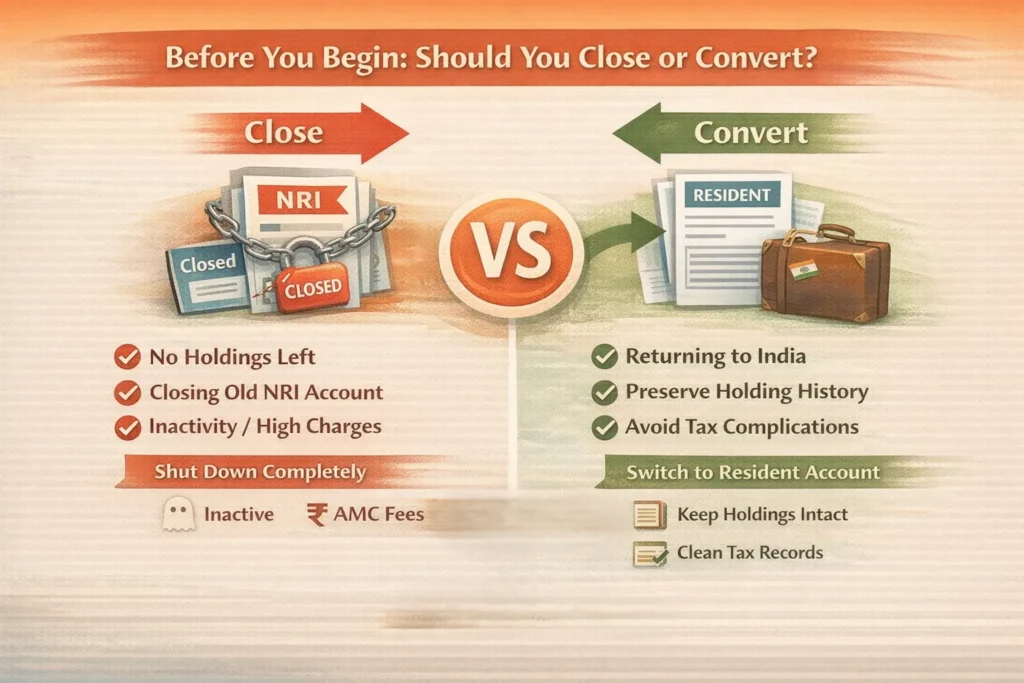
    Before You Begin: Should You Close or Convert?

    This is perhaps the most important question to answer before doing anything else, and many NRIs skip it entirely.

    If you are returning to India permanently and changing your residential status, closing your NRI demat account outright may actually be the wrong move. Indian regulations — specifically FEMA guidelines — require NRIs to convert their NRI demat account to a resident demat account upon returning to India, rather than simply closing and reopening a new one. The conversion route preserves your holding history, avoids unnecessary off-market transfers, and keeps your tax records clean.

    On the other hand, if you are switching from one broker to another while continuing to reside abroad, the better approach is to transfer your holdings to a new NRI demat account before closing the old one. Closure without first transferring holdings can create serious complications, including frozen securities.

    If you genuinely have no investments left in the account and simply want to shut it down — due to inactivity, high AMC charges, or consolidation — then a full closure is entirely appropriate and is a straightforward process.

    So before you proceed, ask yourself: Am I returning to India? Am I switching brokers? Or is my portfolio already empty? Your answer determines everything that follows.

    Clearing Dues and Linked Accounts – The Pre-Closure Checklist

    Think of this stage as settling your tab before leaving a restaurant. Your Depository Participant (DP) — which is the broker or financial institution that holds your demat account — will not process a closure request if there are outstanding dues or unresolved positions attached to your account.

    Start by checking for any pending brokerage charges or Annual Maintenance Charges (AMC). These are typically deducted annually, and if your closure request falls mid-cycle, you may owe a pro-rated amount. Some DPs waive this, but do not assume — always confirm in writing.

    Next, check whether there are any pending trade settlements. If you have sold shares but the settlement cycle (T+1 in India currently) has not completed, the account cannot be closed until those credits or debits are resolved.

    Equally important is your linked bank account — typically either an NRE (Non-Resident External) or NRO (Non-Resident Ordinary) account. Make sure there are no pending dividend credits, corporate action payouts, or rights issue allocations that are still scheduled to come in. Once your demat is closed, any securities credited to it post-closure can become extremely difficult to recover.

    Finally, check for any TDS (Tax Deducted at Source) reconciliation that may be pending — especially if you have received dividend income or sold equity shares in the preceding financial year. You want your tax records to be clean and in order before initiating closure.

    Step-by-Step: The NRI Demat Account Closure Process

    Step 1 – Download the Demat Account Closure Form

    Your journey begins with obtaining the correct form from your DP or broker. Most major brokers in India — including Zerodha, HDFC Securities, ICICI Direct, Kotak Securities, and others — have their account closure forms available on their websites, usually under the “Forms & Downloads” or “Service Requests” section.

    When downloading, pay close attention to whether the form you are selecting is for closure “With Holdings” or “Without Holdings.” These are different documents with different requirements, and submitting the wrong form will simply delay your request.

    Step 2 – Transfer Your Holdings (If Any)

    If your demat account still holds securities, you must decide what to do with them before closure can proceed. You have three practical options.

    The first option is to sell all your shares through your trading account. Once sold and settled, your demat account will show a zero balance, and closure becomes much simpler. This option also has tax implications — capital gains will be triggered — so factor this in, especially if you are holding long-term positions.

    The second option is to transfer your holdings to another NRI demat account, either with a different broker or in the name of a family member who holds an NRI demat. This is done through an off-market transfer using a Delivery Instruction Slip (DIS), which is a physical booklet issued by your DP, or through the Easiest/Speed-e platform of CDSL/NSDL for electronic transfers.

    The third option — if you are returning to India — is to convert the existing account to a resident demat account, in which case the holdings transfer automatically and no DIS is required.

    Step 3 – Gather the Required Documents

    For NRIs, the documentation requirement is more extensive than for resident Indians, largely because your identity and overseas address need to be verified.

    You will typically need to submit a duly filled and signed closure form, a self-attested copy of your PAN card, a copy of your passport (especially the pages showing your photograph, address, and visa/residency stamps), and an overseas address proof such as a utility bill, bank statement, or overseas driving license. If you are transferring holdings using a DIS, you will need to submit those slips as well.

    Some DPs may also ask for a cancelled cheque from your linked NRE or NRO account, particularly if any refund of AMC or other charges is to be processed back to you.

    Step 4 – Courier Documents from Abroad

    This is where the process becomes a little more involved for NRIs living overseas. Unlike resident Indians who can walk into a DP branch, you will need to send your documents by international courier — typically services like DHL, FedEx, or Aramex are reliable and provide tracking.

    Here is an important detail many people miss: some DPs require your documents to be notarised by a Notary Public in your country of residence, or attested by the Indian Embassy or Consulate. This is especially true for documents like your passport copy and address proof. Always check your specific DP’s requirements before couriering, as sending non-notarised documents can result in rejection and costly re-sending.

    The good news is that an increasing number of brokers in India — particularly the newer fintech-driven ones — now accept digital or scanned submissions via email or their online portals, at least for initiating the request. However, even in these cases, physical originals may be needed for final processing. Confirm this with your DP beforehand.

    Step 5 – Submit the Trading Account Closure Request Separately

    This is a critical point that many account holders overlook: your demat account and your trading account are two legally distinct accounts, even though they are often opened together with the same broker.

    Your demat account is held with a Depository Participant and is registered with either NSDL or CDSL (India’s two depositories). Your trading account is held directly with your broker for executing buy and sell orders. Closing one does not automatically close the other.

    Make sure you submit a separate closure request for your trading account. Also ensure that all open positions are squared off and there are no pending orders before submitting this request.

    Step 6 – DP Verification and Processing

    Once your documents reach the DP, they go through an internal verification process. The DP checks that your holdings balance is zero (or that the transfer DIS submitted is valid), that there are no outstanding charges or dues, and that all KYC documents are in order.

    This stage typically takes anywhere from 7 to 15 working days for most DPs, though it can take longer if there are discrepancies or if your documents need clarification. Some DPs send an acknowledgement upon receipt of the courier, which is useful for tracking. If your DP does not proactively communicate, it is perfectly reasonable — and advisable — to follow up by email or phone after 10 working days.

    Step 7 – Receive Closure Confirmation

    Once the DP has processed your request, they will send you a closure confirmation — usually by email. This confirmation will include the date of closure and may be accompanied by a final account statement showing a zero balance. Keep this document safely. It serves as your official record that the account has been closed and can be useful for tax filings or future reference.

    If you had a DIS booklet issued to you, you should return any unused DIS slips to the DP before or at the time of closure. Unused DIS slips floating around after account closure can be a compliance risk.

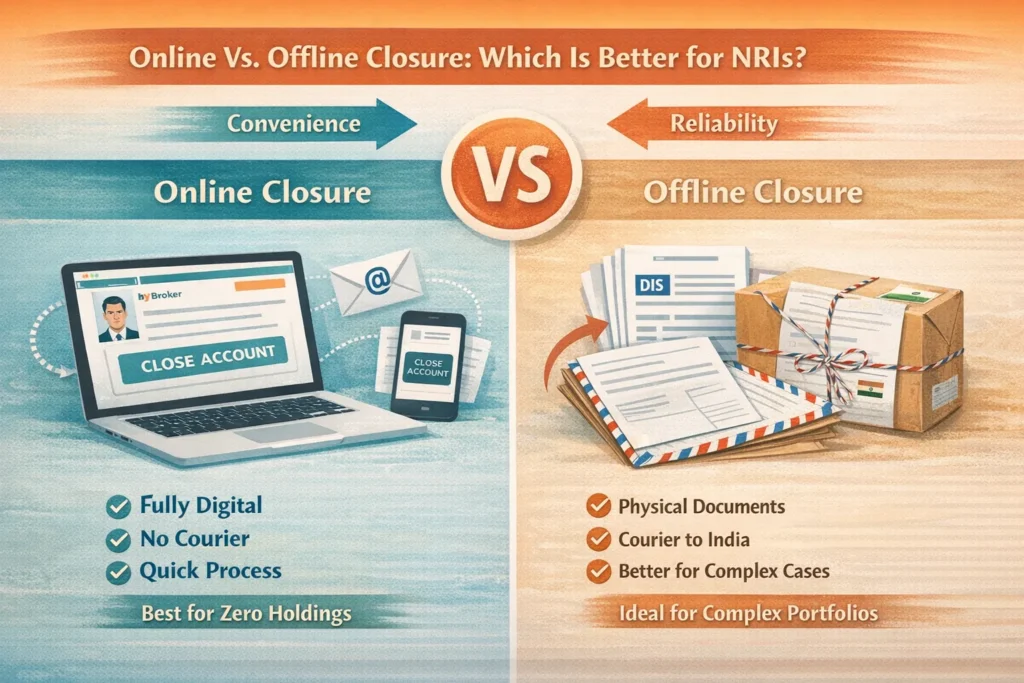
    Online Vs. Offline Closure: Which Is Better for NRIs?

    The honest answer is that it depends on your broker. Online closure — where you can initiate and possibly complete the entire process through a portal or email — is significantly more convenient when you are sitting thousands of kilometres away. It eliminates the need for couriering documents and reduces turnaround time.

    Offline closure, which requires physical documents to be couriered to India, is more cumbersome but is still the norm with many traditional brokers and banks. The trade-off is that offline processes are often perceived as more reliable for complex cases involving holdings, DIS transfers, or large portfolios.

    If convenience is your priority and your account has zero holdings, look for a broker that supports fully digital closure requests. If your portfolio is complex, the added certainty of physical document submission may be worth the extra effort.

    Tax and Compliance Points to Keep in Mind

    Before you close your account, take a moment to review your capital gains position for the current and previous financial year. If you have sold shares during the year, you may have a tax liability in India — specifically short-term or long-term capital gains tax — and this should be settled or at least documented before you remove yourself from the system.

    NRIs are also subject to TDS on capital gains from equity transactions in India, which is deducted at source by the broker. Ensure your Form 26AS (available on the Income Tax portal) reflects all TDS deductions correctly, as discrepancies can create problems when filing your Indian income tax return.

    If your account was linked to an NRE account, repatriation of any sale proceeds should have been done in compliance with FEMA regulations. Closing the demat without ensuring this can leave loose ends that are difficult to resolve later.

    Conclusion

    Closing an NRI demat account in India is not a complicated process, but it does reward those who are thorough and systematic. The most important things to do are to settle your holdings first — whether by selling, transferring, or converting — clear any outstanding dues, gather the correct documents, and follow your DP’s specific procedure for overseas submissions.

    And remember: if you are returning to India permanently, closing may not be the right call at all. Converting your NRI demat to a resident demat is usually the cleaner, more compliant path. When in doubt, consult a CA or SEBI-registered investment advisor who specialises in NRI financial matters — a small consultation fee can save you from compliance complications that are far more expensive to resolve later.

    Frequently Asked Questions

    Can I close my NRI demat account online from abroad?

    Some brokers allow online closure through their portal. You upload scanned documents and request closure digitally. Check with your specific broker first. If online facility is not available, you must courier physical notarised documents to their India office for processing.

    How long does demat account closure take?

    Without holdings, closure takes 5 to 10 working days after documents reach the broker. With holdings, add transfer time. Total process takes 2 to 4 weeks depending on courier speed and broker processing. Track your application using service request number.

    What happens if I don’t close an inactive demat account?

    Annual Maintenance Charges keep adding every year. These are deducted from your linked bank account automatically. If bank account has no funds, dues pile up. Eventually broker may freeze the account. Credit score not affected but reopening becomes difficult.

    Is there any fee for closing demat account?

    Many brokers charge closure fee between Rs 500 to Rs 1000. Check your broker’s tariff sheet or client agreement. Some waive fees if no holdings exist. Ask customer support before applying to avoid surprise deductions from your bank account.

    Can I convert NRI demat to resident demat instead of closing?

    Yes. If you return to India permanently, conversion is better. Submit change of status form with proof of return. Your holdings remain same. No selling or transferring needed. Update bank linkage to resident account. Takes about two weeks.

    What documents are needed for demat closure from abroad?

    Demat closure form, PAN copy, passport copy, overseas address proof, DIS booklet (if any), photograph. All documents must be notarised before courier. Some brokers also need cancelled cheque or bank statement. Check exact requirements with your DP.

    What happens to my shares if I close demat account?

    You must transfer or sell all shares before closure. Transfer using DIS to another demat account. Or sell through trading account and repatriate money. Account cannot be closed with holdings inside. Zero balance is mandatory for closure approval.

    Do I need to close trading account separately?

    Yes. Demat and trading accounts are separate. Submit separate trading account closure form. Clear all open positions and pending orders first. Withdraw any leftover money to bank. Trading account closes faster, usually within 3 to 5 days.

    What if I lost my DIS booklet?

    Submit a written declaration stating booklet is lost. Some brokers require indemnity bond on stamp paper. Check their specific process. Without returning or accounting for DIS, closure may be delayed. Keep copies of all submitted documents.

    Can I reopen same demat account later?

    No. Once closed, account cannot be reactivated. You must open fresh demat account if needed later. New KYC, new account number, new paperwork. That is why conversion is better than closure if you might invest again in future.

  • How to invest as Indian NRI in India from Chile

    How to invest as Indian NRI in India from Chile

    Life in Chile is a beautiful adventure. The stunning mountains, the vibrant cities, the pace of life in Santiago or Valparaíso. But for an Indian building a life here, thoughts often turn to the future. You hear about opportunities back in India. The growing economy, the stock market, the sense of possibility. You want to be part of it, to build something for your family. But how? The rules, the accounts, the taxes—it can feel overwhelming.

    I spoke with a software engineer in Las Condes. He had been wanting to invest for years. He was saving money in Chile but worried about inflation. He knew India had potential, but he thought the process was only for people living in Mumbai or Delhi. He was stuck.

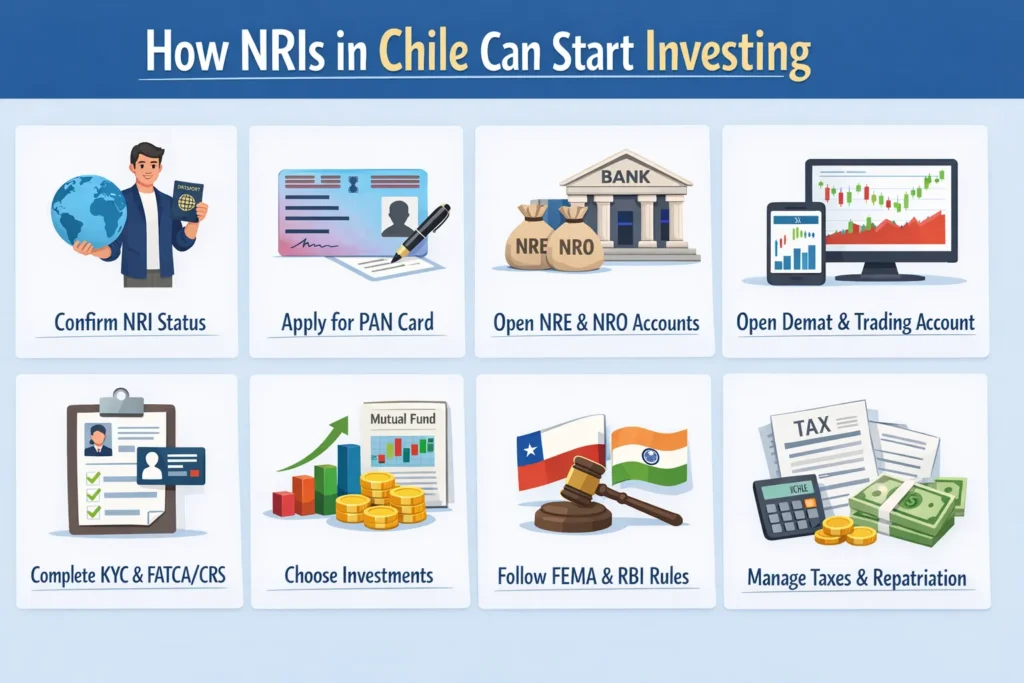
    Let me tell you a secret. The process is for you. Investing in India as an NRI from Chile is a clear, legal, and structured path. It is designed for people exactly like you. This guide will walk with you through every single step. We will demystify the jargon, explain the accounts, and explore your options. From the first click online to seeing your investments grow.

    Think of it as planting a tree in your homeland while you live abroad. You provide the seed capital and care. India provides the fertile ground. This guide is your gardening manual. Let’s start planting.

    Who Is Considered an NRI From Chile?

    First, let’s get the label right. The Indian government has a specific definition for this. It’s not about your passport or where your heart is. It’s about where you live.

    You are considered a Non-Resident Indian (NRI) if you are outside India for more than 182 days in a single financial year. This is the rule under FEMA, the Foreign Exchange Management Act. This law is the rulebook for all cross-border money moves.

    Your Indian passport or OCI card is important. But for finance, your residency is key. Getting this status correct is the first and most important step. Using your old Indian resident accounts for new investments is a serious mistake. It can lead to frozen accounts and penalties. We will start correctly.

    Step-by-Step Overview: How NRIs in Chile Can Start Investing

    Let’s look at the big picture. The entire journey can be broken into eight clear steps.

    1. Confirm your NRI status. This is a simple calendar check.
    2. Apply for a PAN card, if you don’t have one. This is your tax ID in India.
    3. Open NRE and NRO bank accounts. Your new financial foundation.
    4. Open an NRI Demat and Trading account. For buying stocks.
    5. Complete your KYC and FATCA/CRS declarations. Standard paperwork.
    6. Choose your investment products. Mutual funds, stocks, deposits.
    7. Follow FEMA and RBI rules. The simple guidelines to stay compliant.
    8. Manage taxes and repatriation. Plan for profits and bringing money back.

    This is your roadmap. Now, let’s start with the foundation: your bank accounts.

    Opening NRE and NRO Bank Accounts From Chile

    Your old Indian savings account is like a local bicycle. It worked for trips around your hometown. For an international financial journey, you need a reliable car. NRE and NRO accounts are that car.

    The NRE (Non-Resident External) Account

    This is your primary investment account. You fund it with money you earn in Chile. You send Chilean Pesos or US Dollars, convert them to Indian Rupees, and deposit them. The best feature is full repatriability. Every rupee you put in, plus all your investment profits, can be converted back and sent to Chile anytime. No questions asked. The interest you earn on the balance is tax-free in India. It is a true two-way street.

    The NRO (Non-Resident Ordinary) Account

    This account is for money you earn inside India. Rental income from a flat in Bangalore. Dividends from an old investment. That money lands here. Repatriation from this account has limits. You can send up to one million US dollars per year out of India from all your NRO accounts combined. You also need a bank certificate proving all taxes are paid. Think of it as a secure garage for Indian-sourced income.

    How to open them from Chile: Most major Indian banks like HDFC, ICICI, and Axis allow you to start the process online. You fill a digital form. You will need to provide scanned copies of your documents. This includes your Indian passport, Chilean residence visa or ID card, proof of address in Chile (like a utility bill), your PAN card, and photographs. Many banks offer video KYC. A representative will verify your identity over a video call. You can complete everything from your home in Chile. The welcome kit is couriered to your Chilean address.

    NRI Demat & Trading Account for Indians in Chile

    If you want to buy shares of Indian companies, you need a digital vault to hold them. This is a Demat (Dematerialized) account.

    As an NRI, you need a specific NRI Demat and Trading Account. This is different from a resident’s account. You will open this with an Indian brokerage like Zerodha, Upstox, or the brokerage arm of your bank.

    Here’s a key point. There are two main routes:

    1. PIS (Portfolio Investment Scheme) Account: This is for active buying and selling of shares on the stock exchange. It links to your NRE/NRO account and lets the Reserve Bank of India (RBI) monitor your trades.
    2. Non-PIS Account: This is for investments in Mutual Funds, IPOs, ETFs, and bonds. You don’t need PIS designation for these.

    For most people starting out, a non-PIS account linked to an NRE account is perfect for mutual funds. If you later want to trade stocks, you can add the PIS designation.

    Investment Options in India for NRIs From Chile

    With your accounts open, let’s explore what you can invest in. The choices are diverse.

    Mutual Funds

    This is the easiest way to start. A mutual fund pools money from thousands of people. A professional manager invests it in a mix of stocks or bonds. You own a small piece of that whole portfolio.

    As an NRI from Chile, you can invest in most Indian mutual funds. You do a one-time KYC. Then you can invest online directly with the fund company or through a platform. Use your NRE account to pay. This ensures your money and future profits can easily come back to Chile.

    Stocks & ETFs

    Want to pick your own companies? You can invest directly in the Indian stock market. You use your NRI Demat and PIS trading account. You can also buy ETFs (Exchange Traded Funds), which are like baskets of stocks that trade on the exchange.

    Fixed Deposits

    For peace of mind, Indian banks offer NRE and NRO Fixed Deposits. The interest rates are often good. NRE FD interest is tax-free in India. NRO FD interest is taxable. There’s also the FCNR (Foreign Currency) FD. Here, you deposit US Dollars without converting to Rupees. Your deposit is safe from rupee currency swings. It’s a good option for dollars you might need later.

    Real Estate

    NRIs can buy residential and commercial property in India. You cannot buy agricultural land, plantation land, or a farmhouse without special permission. You can pay from your NRE, NRO, or FCNR accounts. You can even get a home loan from an Indian bank. When you sell, you can repatriate the sale money, but there are rules on the amount.

    NPS & Long-Term Plans

    The National Pension System (NPS) is a long-term retirement plan with tax benefits. It’s a good way to build a retirement fund for your future in India.

    Tax on NRI Investments in India (For Chile Residents)

    This is crucial. India will tax the income you earn from your Indian investments. You need to understand this to keep more of your money.

    • Capital Gains Tax: Sell stocks or equity funds within 1 year? Tax is 15%. Sell after 1 year? Gains over ₹1 lakh per year are taxed at 10%. For debt funds and real estate, “long-term” is 3 years, with a 20% tax after indexation.
    • Interest: Interest from NRO deposits is taxed at your income slab rate. Interest from NRE deposits is tax-free in India.
    • Dividends: Added to your income and taxed.

    What about Chile? Chile taxes its residents on their worldwide income. This means you must also declare your Indian investment profits in Chile.

    But there is help. India has a DTAA (Double Tax Avoidance Agreement) with Chile. This treaty is designed to stop you from being taxed twice on the same money. You can usually claim a credit in Chile for taxes you already paid in India. Because this can be complex, talking to a tax advisor who knows both Indian and Chilean rules is a very smart move.

    Repatriation of Funds From India to Chile

    Repatriation means bringing your money back home. The rule is simple: money in your NRE account is easy to repatriate.

    You log into your Indian bank’s online portal. You find the outward remittance section. You enter your Chilean bank details. The bank converts rupees to US Dollars or another currency and sends it. The process is straightforward.

    For money in your NRO account, you have the annual one-million-dollar limit. You will also need a certificate from a Chartered Accountant in India stating all taxes are paid. This is why using your NRE account for investments you may want back is the best plan.

    Common Mistakes NRIs in Chile Make

    Let’s learn from others so you don’t have to.

    • Using Old Resident Accounts: Trying to invest with a resident savings or demat account will cause major problems.
    • Ignoring the PIS Requirement: Buying stocks without a PIS-designated NRI demat account is not allowed.
    • Tax Confusion: Not planning for TDS (Tax Deducted at Source) in India or forgetting to report income in Chile.
    • Repatriation Surprise: Assuming all money can be freely sent back, especially from NRO accounts.

    Practical Checklist for NRIs in Chile

    Before you start, gather these:

    1. Valid Indian Passport
    2. PAN Card
    3. Chilean Residence Visa/ID (Cédula de Identidad)
    4. Proof of Address in Chile (Utility bill or rental contract)
    5. Email and Phone for OTPs

    Conclusion

    Investing in India from Chile is a powerful way to grow your wealth while staying connected to your heritage. The system is built for you. It is digital, compliant, and full of opportunity.

    The journey begins with a single step: opening your NRE account. From there, each step follows the next. Choose investments that match your goals. Respect the simple rules. Plan for taxes.

    Your financial future can have strong roots in both Chile and India. It is not just about money. It is about building security and choice for your family. Start building your bridge today. The process is clear, and the potential is waiting for you.

    What is the first step to start investing in India from Chile?

    The absolute first step is to open an NRE (Non-Resident External) bank account with an Indian bank. This account is your legal gateway for sending money from Chile to India and for freely repatriating (sending back) your investment profits later.

    Do I need a special type of bank account?

    Yes. You must stop using your old resident Indian savings account. You need two new accounts: an NRE account for foreign income (fully repatriable) and an NRO account for Indian income (repatriation limits apply). For investments you may want to bring back to Chile, always use your NRE account.

    Can I invest in Indian mutual funds from Chile?

    Yes, you can. Once you complete a one-time KYC process and have an NRE/NRO account, you can invest in most Indian mutual funds online. It’s one of the easiest and most popular ways for NRIs to start investing in India.

    How do I buy Indian stocks from Chile?

    To buy shares directly, you need to open an NRI Demat and Trading Account with an Indian broker. For active stock trading, this account usually needs a PIS (Portfolio Investment Scheme) designation, which is a standard compliance step for NRIs.

    Will I be taxed in both India and Chile on my profits?

    India will tax the income generated there. As a Chilean tax resident, you must also declare this worldwide income in Chile. However, the India-Chile DTAA (Double Tax Avoidance Agreement) helps prevent double taxation. You can typically claim a credit in Chile for taxes paid in India.

    How do I get my investment money back to my Chilean bank?

    This process is called repatriation. If your original investment and profits are in your NRE account, you can easily transfer the funds online to Chile. If the money is in an NRO account, there is an annual limit and you need a tax clearance certificate.

    What is the safest way to start investing as a beginner?

    NRE Fixed Deposits are a very safe starting point. Your capital is secure, returns are predictable, and the interest earned is tax-free in India. It’s a low-risk way to begin while you learn about other options.

    Can I buy property in India while living in Chile?

    Yes. NRIs are allowed to purchase residential and commercial property in India. You cannot buy agricultural land, plantation land, or a farmhouse without special permission. You can use funds from your NRE, NRO, or FCNR accounts.

    Do I need to be physically present in India for any step?

    No. The entire process—from opening bank and demat accounts to completing KYC and making investments—can be done 100% online from Chile. Video verification and digital document submission have made physical presence unnecessary.

    What is the most common mistake to avoid?

    The biggest mistake is using the wrong bank account type for investing. Funding investments through an NRO account when you intend to repatriate the money later creates unnecessary complexity and limits. For maximum flexibility, always use your NRE account for investments.

  • How to invest as Indian NRI in India from Venuzuaila

    How to invest as Indian NRI in India from Venuzuaila

    Life in Venezuela is full of contrasts. The vibrant culture, the warmth of the people, the challenges of the economy. For an Indian living in Caracas or Maracaibo, building a secure future often means looking back to the land you came from. You hear about India’s growth, the booming stock market, the opportunities. But it feels distant, complicated by rules and paperwork.

    I remember talking to a family in Valencia. They had saved some money but were unsure how to protect it from inflation. They wanted to invest in India, their homeland, but the process seemed like a locked door. They didn’t know where to find the key.

    Here is the truth. That door is not locked. It is open. Investing in India as an NRI from Venezuela is not only possible, it is a smart and structured process. The Indian government has created clear paths for people exactly like you. This guide is your key. We will walk through every step together, from opening your first bank account to choosing your investments and understanding the taxes.

    Think of it as building a financial bridge. Your daily life and income are in Venezuela. Your long-term financial growth can be nurtured in India. This guide will show you how to build that bridge, brick by brick. Let’s begin.

    Confirming Your Status as an NRI Under FEMA

    First, let’s get the label right. Are you an NRI? In India’s financial rulebook, it’s not about your passport or your heart. It’s about your residency.

    You are officially a Non-Resident Indian (NRI) if you live outside India for more than 182 days in a single financial year. This is the rule under FEMA, the Foreign Exchange Management Act. This law controls all cross-border money movement for Indians.

    Your Indian citizenship doesn’t change this. Your location does. This NRI status is your golden ticket. It unlocks a special set of financial accounts and investment rules designed just for you. Using your old Indian resident savings account for new investments is a common and costly mistake. Let’s make sure you start on the right path.

    How to Begin: Essential Accounts You Must Open

    Your journey starts with two special bank accounts. These are your foundation. Forget your old Indian savings account. For your new investments, you need new tools.

    NRE and NRO Bank Accounts

    You need to understand the difference between these two. It is the most important lesson in NRI finance.

    The NRE (Non-Resident External) Account This is your primary investment account. You fund it with money you earn in Venezuela. You send your Bolivars or US Dollars, convert them to Indian Rupees, and deposit them. The magic of this account is full repatriability. This means every single rupee you put in, plus all the profits you make from investing it, can be converted back and sent to Venezuela anytime. No limits. It’s a two-way street for your wealth. The interest you earn on the balance in this account is tax-free in India.

    The NRO (Non-Resident Ordinary) Account This account is for money you earn inside India. Rental income from a family apartment. Dividends from old investments. Pension. That money flows here. Repatriation from this account is limited. You can send up to one million US dollars per year out of India from all your NRO accounts combined. And you need to show a bank certificate that all taxes are paid. Think of it as a parking garage for Indian-sourced income.

    A crucial rule: All your investments in Indian stocks or mutual funds must be paid for in Indian Rupees from these accounts. You cannot directly use foreign currency.

    NRI Demat & Trading Accounts for Indian Investments

    If you want to buy shares of companies like Reliance or Infosys, you need a special digital locker to hold them. This is called a Demat (Dematerialized) account.

    As an NRI, you will open an NRI Demat and Trading Account. This is linked to your NRE or NRO bank account. Many Indian brokerage firms like ICICI Direct, HDFC Securities, or Zerodha offer these accounts for NRIs. You can open them entirely online from Venezuela.

    Your choice between linking it to an NRE or NRO account depends on one question: Do you want to easily bring your stock market profits back to Venezuela? If the answer is yes, link it to your NRE account.

    Primary Investment Options for NRIs in India

    With your accounts ready, let’s explore what you can actually invest in. The menu is rich and varied.

    Mutual Funds

    This is often the best and easiest starting point. A mutual fund pools money from thousands of investors. A professional fund manager invests it in a diversified basket of stocks or bonds. You own a small piece of that entire basket.

    As an NRI from Venezuela, you can invest in almost all Indian mutual funds. You complete a one-time KYC (Know Your Customer) process. This can often be done online. Once done, you can invest directly on the fund house’s website or through investment platforms. Use your NRE account to pay for the units if you want easy repatriation later.

    Stocks & Equity Markets

    This is for when you want to pick your own companies. You buy shares through your NRI Demat and Trading account. There is a special designation called the Portfolio Investment Scheme (PIS). When you open your NRI demat account for trading shares, your bank will ask if you want a PIS account. For most NRIs wanting to buy and sell stocks regularly, the answer is yes. The PIS is simply a way for the Reserve Bank of India (RBI) to monitor your stock investments. It’s not an extra hurdle, just a compliance layer.

    Recent rules have made it easier for overseas individuals like you to invest directly in Indian equities, with higher investment limits.

    Fixed Deposits & Debt

    For stability, Indian banks offer NRE and NRO Fixed Deposits. The interest rates are often attractive. NRE FD interest is tax-free in India. NRO FD interest is taxable. This is a simple, safe way to grow your savings without market risk.

    Real Estate

    NRIs can buy residential and commercial property in India. You cannot buy agricultural land, plantation property, or a farmhouse without special permission. You can pay from your NRE, NRO, or even use funds from your FCNR (Foreign Currency Non-Resident) account. You can also take a home loan from an Indian bank. When you sell, you can repatriate the sale proceeds, but there are rules. Generally, you can repatriate up to the amount you originally paid from foreign currency sources. Any profit above that can be repatriated within the NRO account’s annual limit.

    Step-by-Step Investment Process From Venezuela

    Let’s turn this into a clear action plan you can follow.

    1. Open Your NRE/NRO Account: Choose a major Indian bank with good online NRI services, like SBI, HDFC, or ICICI. You can start the application online from Venezuela. You will need to send scanned copies of your passport, Venezuelan residence proof, and PAN card.
    2. Open Your NRI Demat Account: If you plan to buy stocks, contact a brokerage firm that offers NRI services. Complete their application form. Link this demat account to your NRE (preferred) or NRO bank account.
    3. Complete Mutual Fund KYC: This is a separate one-time process. You can do it through a KYC Registration Agency (KRA) or often through your bank/broker. You’ll need your PAN, passport, and Venezuelan address proof.
    4. Fund Your Account: Use an international wire transfer from your Venezuelan bank to send money to your Indian NRE account. Your Indian bank will give you the SWIFT details.
    5. Start Investing: Log into your mutual fund account or trading platform. Begin with a small, simple investment to understand the process. A mutual fund SIP (Systematic Investment Plan) is a great way to start.
    6. Keep Records: Save every document, every transfer receipt, and every investment statement. This is vital for tax purposes and future repatriation.

    FEMA & RBI Rules Relevant to NRIs From Venezuela

    The rules exist to protect you and the system. The main law is FEMA. The RBI enforces it.

    The key rules for you are simple:

    • Use NRE/NRO accounts, not resident accounts.
    • Use an NRI demat account with PIS designation for stock trading.
    • Follow the repatriation limits for NRO accounts.
    • Avoid prohibited investments like agricultural land.

    By using the right accounts from the start, you automatically follow most of the rules. Your bank and broker are your guides here.

    Tax on NRI Investments and DTAA Considerations

    India will tax the income you earn from your Indian investments. You need to understand this to plan effectively.

    • Capital Gains Tax: Selling stocks or equity funds within 1 year attracts a 15% tax. After 1 year, gains over ₹1 lakh per year are taxed at 10%. For debt funds and real estate, the “long-term” period is 3 years, with a 20% tax after indexation (which adjusts your purchase price for inflation).
    • Interest: Interest from NRO deposits is taxed at your income slab rate. Interest from NRE deposits is tax-free in India.
    • Dividends: Dividends are added to your income and taxed.

    Now, what about Venezuela? This is critical. Venezuela taxes its residents on their worldwide income. This means you likely must declare your Indian investment profits in Venezuela as well.

    But there is a tool to help. India has DTAAs (Double Taxation Avoidance Agreements) with many countries. You must check if a DTAA exists between India and Venezuela. If it does, the treaty will have rules to ensure you don’t pay the same tax twice. You may get a credit in Venezuela for taxes already paid in India. Because tax laws are complex, it is highly recommended to consult with a cross-border tax advisor who understands both Indian and Venezuelan regulations.

    Repatriation: Bringing Money Back to Venezuela

    This is about bringing your profits home. The rule is beautifully simple: money in your NRE account is easy to repatriate.

    You log into your Indian bank’s online portal. You find the “Repatriation” or “Outward Remittance” option. You fill in the details of your Venezuelan bank account. The bank converts rupees to US Dollars or Euros and sends it via SWIFT. The process is straightforward.

    For money in your NRO account, you have the annual limit of one million dollars. You will also need a certificate from your bank confirming all taxes are paid. This is why funding investments through your NRE account from the beginning is the smartest strategy.

    Building a Diversified Portfolio as an NRI

    Don’t put all your eggs in one basket. A good portfolio is a mix.

    • Growth (Equity): Use mutual funds or stocks for long-term growth.
    • Stability (Debt): Use fixed deposits or debt mutual funds for safety and regular income.
    • Real Assets: Consider a small allocation to real estate or gold ETFs for diversification.

    You could start with a simple 60-40 mix: 60% in an equity mutual fund and 40% in a fixed deposit. Adjust as you learn and as your goals change.

    Safest Investment Options for Conservative NRIs

    If the stock market feels too unpredictable, that’s okay. You have safe choices.

    • NRE Fixed Deposits: Your capital is safe, returns are fixed, and interest is tax-free in India.
    • Government Bonds: The safest debt instruments, backed by the Indian government.
    • Debt Mutual Funds: Professional management and better returns than FDs, with moderate risk.
    • Sovereign Gold Bonds: An alternative to physical gold, with interest earnings and no storage hassle.

    Compliance Checklist & Documentation

    Before you start, gather these:

    1. Valid Indian Passport
    2. PAN Card
    3. Venezuelan Residence Visa or Proof of Residence
    4. Proof of Address in Venezuela (Utility bill, bank statement)
    5. Recent Passport-sized Photographs
    6. Email ID and Phone Number for OTPs

    Conclusion

    Investing in India from Venezuela is a powerful way to secure your financial future while staying connected to your roots. The system is built for you. It is digital, compliant, and offers real opportunity.

    The journey begins with a single step: opening your NRE account. From there, each step follows logically. Choose investments that match your comfort and goals. Respect the simple rules. Plan for taxes.

    Your financial well-being can have strong foundations in both Venezuela and India. It is not just about money. It is about building security and choice for you and your family. Start building your bridge today. The process is clearer than you think, and the potential is real.

    What is the first thing I need to do to invest from Venezuela?

    The very first step is to open an NRE (Non-Resident External) bank account with an Indian bank. This account allows you to send money from Venezuela and, most importantly, freely bring your investment profits back. Do not use an old resident Indian savings account.

    What’s the difference between an NRE and an NRO account?

    Use your NRE account for money earned abroad (in Venezuela). Everything in it is fully repatriable. Use your NRO account for income earned in India (like rent). Repatriation from an NRO account has an annual limit (currently $1 million USD) and requires tax paperwork.

    Can I invest in Indian mutual funds from Venezuela?

    Yes. Once you complete a one-time KYC process and have an NRE/NRO account, you can invest in most Indian mutual funds online. It is one of the easiest ways for NRIs to start. Use your NRE account to fund the investment for easy repatriation later.

    Do I need a special account to buy Indian stocks?

    Yes. To buy shares directly, you must open an NRI Demat and Trading Account with a brokerage. For active trading, this account often needs a PIS (Portfolio Investment Scheme) designation, which lets the RBI monitor your stock investments.

    Will I be taxed twice, in India and Venezuela?

    India will tax the income generated there. As a Venezuelan tax resident, you must also declare this global income. To avoid double taxation, check if an India-Venezuela DTAA (Double Tax Avoidance Agreement) exists. If it does, you can claim credit for taxes paid in India.

    How do I get my investment money back to my Venezuelan bank?

    This is called repatriation. If you used your NRE account, you can log into your Indian bank’s online portal and freely transfer the funds back. If the money is in an NRO account, the process has annual limits and requires a bank tax certificate.

    Can I buy property in India while living in Venezuela?

    Yes, NRIs can buy residential and commercial property. You cannot purchase agricultural land or plantation property without special permission. You can use funds from your NRE, NRO, or FCNR accounts for the purchase.

    What is the safest investment option to start with?

    NRE Fixed Deposits are a very safe starting point. Your capital is secure, returns are fixed, and the interest earned is tax-free in India. It’s a low-risk way to begin.

    Do I need to be physically present in India for any step?

    No. The entire process from account opening to investment and repatriation can be done online from Venezuela. Video KYC and digital document submission have made physical presence unnecessary.

    What is the most common mistake NRIs make?

    The biggest mistake is using the wrong bank account. Investing through an NRO account when you intend to repatriate funds creates unnecessary complexity. For maximum flexibility, always use your NRE account to fund investments you may want to bring back to Venezuela.

  • How to Invest in India as an NRI from Brazil – Complete 2026 Guide

    How to Invest in India as an NRI from Brazil – Complete 2026 Guide

    Living in Brazil is an adventure. The vibrant culture, the beautiful landscapes, the rhythm of life. But for an Indian living in São Paulo or Brasília, thoughts often turn back home. Maybe it’s family. Maybe it’s the familiar pulse of the Indian economy you hear about in the news. You start to wonder, “Can I still be part of India’s growth story from here?”

    The answer is a confident yes. Investing in India as an NRI from Brazil is not just possible, it’s a smart way to build your future. The process is clear, legal, and mostly digital. You don’t need to be a finance expert. You just need the right map.

    This guide is that map. We will walk through every single step together. We will cut through the complex terms like FEMA and PIS. We will explain exactly how to open accounts, choose investments, and follow the rules. Whether you are a software engineer in Rio, a business owner in Salvador, or a student in Campinas, this guide is for you.

    Think of it as building a secure financial bridge. Your life and income are in Brazil. Your investment opportunities are in India. This guide will show you how to build that bridge, piece by piece. Let’s get started.

    Who Qualifies as an NRI from Brazil?

    First, let’s get the label right. Are you an NRI? In India’s rulebook, it’s not about your passport. It’s about where you live.

    You are considered a Non-Resident Indian (NRI) if you live outside India for more than 182 days in a single financial year. This is the rule for the Foreign Exchange Management Act (FEMA), which controls investments.

    Your Indian passport or OCI card doesn’t change this. Your residency does. This status is your key. It unlocks the special set of banking and investment rules designed just for you. Using your old Indian resident accounts for new investments is a common and costly mistake. Let’s avoid that.

    Step-by-Step Overview: How NRIs in Brazil Can Start Investing

    The entire process can be broken down into seven clear steps. Don’t let the list overwhelm you. We will explore each one in detail.

    1. Confirm your NRI status: This is just a calendar check.
    2. Open NRE and NRO bank accounts: Your new financial home base in India.
    3. Open an NRI Demat and Trading account: If you want to buy stocks.
    4. Complete your KYC: A one-time paperwork step.
    5. Choose your investment products: Mutual funds, stocks, deposits, and more.
    6. Follow FEMA and RBI rules: The simple guidelines to stay compliant.
    7. Manage taxes and repatriation: How to keep your profits and bring them back to Brazil.

    This is your roadmap. Now, let’s start with the most important step: your bank accounts.

    Opening NRE & NRO Bank Accounts from Brazil

    Your old Indian savings account is like a bicycle. It worked for getting around your hometown. But for an international financial journey, you need a car. NRE and NRO accounts are that car.

    The NRE (Non-Resident External) Account

    This is your primary account. You fund it with money you earn in Brazil. You send Reais, convert them to Rupees, and deposit them. The magic of this account is full repatriability. This means every single rupee you put in, plus any profits you make from investing it, can be converted back and sent to Brazil anytime. No limits. It’s a two-way street for your wealth.

    The NRO (Non-Resident Ordinary) Account

    This account is for money you earn inside India. Rental income from a family flat. Dividends from old investments. That money flows here. Repatriation from this account is limited. You can send up to one million US dollars per year out of India from all your NRO accounts combined. And you need to show tax documents. Think of it as a parking garage for Indian-sourced income.

    How to open them from Brazil: Most major Indian banks like HDFC, ICICI, and SBI allow you to start online. You fill a digital form. You will need to provide scanned copies of your documents. These usually include your passport, Brazilian visa or residence card, proof of address in Brazil, and your PAN card. Many banks now offer video KYC. A representative verifies your identity over a call. You never have to visit a branch in India. The account is opened digitally, and your welcome kit is sent to your Brazilian address.

    Opening NRI Demat & Trading Account from Brazil

    Want to buy shares of Indian companies like Reliance or TCS? You can’t use a regular trading app. You need a special NRI setup.

    This involves opening a Demat (Dematerialized) account to hold your shares electronically. For NRIs, this must be linked to a PIS (Portfolio Investment Scheme). The PIS is not an extra account. It’s a special designation on your NRI demat account that lets the Reserve Bank of India (RBI) monitor your stock trades. It’s a simple compliance layer.

    You can open this account with the brokerage arm of your Indian bank or with a registered broker like Zerodha or Upstox for NRIs. The document list is similar: PAN, passport, Brazilian address proof, and details of your NRE/NRO account. The entire process is online. Once approved, you link this trading account to your NRE/NRO bank account. You transfer funds and you are ready to invest.

    Investment Options in India for NRIs from Brazil

    With your accounts active, let’s explore what you can actually buy. The menu is extensive.

    Mutual Funds

    This is often the best starting point. A mutual fund pools money from thousands of investors. A professional manager invests it in a diversified basket of stocks or bonds. You own a small piece of that basket.

    As an NRI from Brazil, you can invest in almost all Indian mutual funds. You complete a one-time KYC with a KRA (KYC Registration Agency). This is separate from your bank KYC. Once done, you can invest directly on the fund house’s website or through platforms like Coin by Zerodha. Use your NRE account to pay if you want easy repatriation later.

    Stocks & ETFs

    This is for when you want to pick your own companies. You buy shares through your NRI Demat and PIS account. You can also invest in ETFs (Exchange Traded Funds), which are like mutual funds that trade on the stock exchange.

    Fixed Deposits

    For stability, Indian banks offer NRE and NRO Fixed Deposits. The interest rates are often attractive. NRE FD interest is tax-free in India. NRO FD interest is taxable. You also have the FCNR (Foreign Currency Non-Resident) FD. Here, you deposit US Dollars or Euros without converting to Rupees. Your deposit and interest are protected from rupee currency fluctuations. It’s a safe harbor for your foreign currency savings.

    Real Estate

    NRIs can buy residential and commercial property in India. You cannot buy agricultural land or plantation property without special permission. You can pay from your NRE, NRO, or FCNR accounts. You can even take a home loan from an Indian bank. When you sell, you can repatriate the sale proceeds, but there are rules on how much. Generally, you can repatriate up to the amount you originally paid from foreign currency sources. Any profit above that can be repatriated within the NRO limit.

    NPS (National Pension System)

    The NPS is a long-term retirement-focused investment. It offers tax benefits and is a good way to build a retirement corpus for your future in India.

    FEMA & RBI Rules NRIs in Brazil Must Follow

    The rules exist to help you, not hinder you. The main law is FEMA (Foreign Exchange Management Act). The RBI (Reserve Bank of India) enforces it.

    The key rules for you are simple:

    • Use NRE/NRO accounts, not resident accounts.
    • Use a PIS-designated demat account for stocks.
    • Avoid investing in prohibited sectors like agricultural land or lottery businesses.
    • Report large transactions through your bank, which they usually do for you.

    It sounds complex, but in practice, using the right accounts ensures you are automatically compliant. Your bank and broker are your guides.

    Tax on NRI Investments in India (For Brazil Residents)

    India will tax the income you earn from your Indian investments. Understanding this helps you plan better.

    • Capital Gains: Selling stocks or equity funds within 1 year attracts a 15% tax. After 1 year, gains over ₹1 lakh per year are taxed at 10%. For debt funds and real estate, the “long-term” period is 3 years, with a 20% tax after indexation.
    • Interest: Interest from NRO and FCNR deposits is taxed at your income slab rate (often 30% for NRIs). Interest from NRE deposits is tax-free.
    • Dividends: Dividends from stocks or mutual funds are added to your income and taxed.

    What about Brazil? This is crucial. Brazil taxes its residents on worldwide income. This means you might have to declare your Indian investment profits in Brazil too. But don’t panic. India and Brazil have a DTAA (Double Taxation Avoidance Agreement). This treaty helps ensure you don’t pay the same tax twice. You can often claim a credit in Brazil for taxes paid in India. It is highly recommended to speak with a cross-border tax advisor who understands both Indian and Brazilian tax laws.

    Repatriation of Money Back to Brazil

    This is about bringing your profits home. The rule is simple: money in your NRE account is easy to repatriate.

    You log into your Indian bank’s online portal. You file a request to transfer funds to your Brazilian bank account. The bank converts rupees to Reais (often via US Dollars) and sends it via SWIFT. The process is smooth and mostly online.

    For money in your NRO account, you have the annual limit of one million dollars. You will also need a Chartered Accountant’s certificate stating all taxes have been paid. This is why funding investments through your NRE account from the start is the smartest move.

    Common Mistakes NRIs in Brazil Make

    Let’s learn from others so you don’t have to.

    • Using Old Resident Accounts: Trying to invest with a resident savings or demat account is the biggest error. It can lead to legal and tax complications.
    • Ignoring the PIS Requirement: Buying stocks without a PIS-designated NRI demat account is not allowed. Your broker will not allow the trade.
    • Tax Misplanning: Not accounting for TDS (Tax Deducted at Source) in India or forgetting to report income in Brazil can lead to penalties.
    • Repatriation Confusion: Assuming all money can be freely sent back, especially from NRO accounts, leads to frustration. Plan your account usage from day one.

    Practical Checklist for NRIs in Brazil

    Before you start, have this ready:

    1. Valid Indian Passport
    2. PAN Card
    3. Brazilian Residence Visa/CPF
    4. Proof of Address in Brazil (Utility bill or rental contract)
    5. Email ID and Phone Number (to receive OTPs)

    Conclusion

    Investing in India from Brazil is a powerful way to connect with your heritage and build wealth. The system is designed for you. It is digital, compliant, and structured.

    The journey begins with a single step: opening your NRE account. From there, each step follows logically. Choose investments that match your goals. Respect the simple rules. Plan for taxes.

    Your financial future can have strong roots in both Brazil and India. It is not just about money. It is about maintaining a tangible link to home while building a secure life abroad. Start building your bridge today. The process is clearer than you think, and the potential awaits.

    FAQs

    What is the first thing I need to do to invest in India from Brazil?

    The first and most critical step is to open an NRE (Non-Resident External) bank account with an Indian bank. This account is your legal gateway for sending money from Brazil and for easily bringing your investment profits back later. Do not use your old Indian savings account.

    Can I use my regular Indian demat account to buy stocks?

    No, you cannot. As an NRI, you must open a new NRI Demat and Trading account with a PIS (Portfolio Investment Scheme) designation. Your old resident demat account will be blocked for new investments. Your broker will help you open the correct NRI account online from Brazil.

    Are Indian mutual funds open to NRIs in Brazil?

    Yes, absolutely. Once you complete a one-time KYC (Know Your Customer) process with a KYC Registration Agency (KRA) in India, you can invest in most Indian mutual funds. You can do this directly on fund house websites or through registered investment platforms.

    How do I get my investment money back to my bank in Brazil?

    This process is called repatriation. If you used your NRE account to fund the investment, you can repatriate both your original money and your profits freely. You simply log into your Indian bank’s online portal and initiate an international transfer to Brazil. Money in an NRO account has repatriation limits.

    Will I be taxed twice—in India and Brazil?

    India will tax the income generated from your investments there. As a Brazilian tax resident, you must also report this global income in Brazil. However, the India-Brazil DTAA (Double Tax Avoidance Agreement) helps prevent double taxation. You can usually claim a credit in Brazil for taxes already paid in India. Consulting a cross-border tax advisor is recommended.

    What is the difference between an NRE and an NRO Fixed Deposit?

    An NRE Fixed Deposit is funded with money you sent from Brazil. The interest you earn is completely tax-free in India. An NRO Fixed Deposit is for rupee income earned in India (like rent). The interest earned on an NRO FD is taxable in India. Both are safe investment options.

    Can I buy property in India while living in Brazil?

    Yes. NRIs are allowed to buy residential and commercial property in India. You cannot purchase agricultural land, plantation land, or a farmhouse without special permission. You can use funds from your NRE, NRO, or FCNR accounts for the purchase and even take a home loan from an Indian bank.

    What is a PIS account, and do I need one?

    PIS stands for Portfolio Investment Scheme. It is not a separate account. It is a mandatory designation on your NRI Demat account that allows you to buy and sell shares on Indian stock exchanges. The RBI uses it to monitor NRI investments in stocks. Your broker will set this up for you when you open your NRI demat account.

    What are the common mistakes I should avoid?

    Using old resident bank or demat accounts for new investments.
    Funding investments through an NRO account when you plan to repatriate, instead of using an NRE account.
    Not planning for Tax Deducted at Source (TDS) in India or forgetting to report income in Brazil.
    Trying to buy stocks without a PIS-designated NRI demat account.

    Can I manage everything online without visiting India?

    Yes. The entire process—from opening your NRE/NRO accounts and demat account to completing KYC, making investments, and initiating repatriation—can be done digitally from Brazil. Video KYC and online document submission have made physical presence unnecessary.

    Also Read: How to Invest in India as an NRI from Mexico

    Also Read: How To Renew Indian Passport in Norway

  • How to Invest in India as an NRI from Mexico

    How to Invest in India as an NRI from Mexico

    Let’s talk about your money. You’ve built a life in Mexico. The culture, the people, the food. It’s home now. But a part of you still looks towards India. Maybe it’s family. Maybe it’s the memories. And now, you hear about the growth, the opportunities. You think, “Can I be a part of that?”

    The answer is a clear yes. Investing in India as an NRI from Mexico is not only possible, it’s a smart way to diversify your future. But the rules are different. The terms are new. Words like FEMA, PIS, and repatriation can feel like a wall.

    I remember speaking to an engineer from Guadalajara. He wanted to invest his savings but was terrified of making a legal mistake. He thought the process was only for people living in Delhi or Mumbai. He was wrong.

    This guide is your map. We will walk through every step together. From opening the right bank account to picking investments and understanding taxes. We will break down the jargon into simple English. You will learn about mutual funds, stocks, and even new options like GIFT City. By the end, you will have a clear action plan.

    Think of it as building a bridge. Your life and earnings are in Mexico. Your investment opportunities are in India. This guide is the architectural plan for that bridge. Let’s start building.

    Who Is Considered an NRI Under Indian Rules?

    First, let’s get the label right. Are you even an NRI? Under Indian law, it’s not about your passport. It’s about where you live.

    You are considered a Non-Resident Indian (NRI) if you live outside India for more than 182 days in a single financial year. That’s it. Your citizenship can be Indian. You could hold an OCI card. But for banking and investment rules, your residency status is the key.

    Why does this matter? Because the Indian government has special rules for NRIs. These rules control how you can bring money in, where you can invest it, and how you can take it back out. Using the wrong set of rules is like trying to pay with pesos in a Delhi market. It just won’t work.

    Understanding NRE, NRO & FCNR Accounts

    This is the most important part of your foundation. Your Indian bank accounts are the gateway for all your investments. You cannot use your old Indian savings account anymore. You need new ones. There are three main types.

    The NRE (Non-Resident External) Account: This is your primary investment account. You open it with money you earned abroad, in Mexico. You transfer your pesos, convert them to rupees, and deposit them. The big benefit? Everything in this account is fully repatriable. This means you can take every single rupee, convert it back to dollars or pesos, and send it back to Mexico anytime. No questions asked. It’s like a two-way street for your money.

    The NRO (Non-Resident Ordinary) Account: This account is for money you earn inside India. Did you sell an old family property? Do you get rental income from an apartment? That money goes here. The rules are stricter. You can only repatriate, or send out, up to one million USD per financial year from this account. And you need to show tax documents. Think of it as a mostly one-way street into India, with a small, monitored lane for exiting.

    The FCNR (Foreign Currency Non-Resident) Account: This one is different. You don’t convert your foreign currency. You deposit your US dollars or euros directly. The bank holds it in that currency. It’s a term deposit, like a fixed deposit, but in foreign currency. Your capital is protected from rupee exchange rate fluctuations. This is a safe, simple place to park foreign currency savings you might need later.

    For most investors starting out, the first step is opening an NRE account. It gives you the most flexibility to invest and bring your profits back to Mexico.

    Important Regulatory Rules — FEMA & RBI Overview

    Now, let’s talk about the rulebook. All NRI investment is governed by FEMA. That’s the Foreign Exchange Management Act. It’s the big book of rules for cross-border money movement.

    The Reserve Bank of India (RBI) is the referee. They enforce FEMA. For you, this means there are specific channels you must use. You can’t just log into any Indian trading app and start buying stocks. You need to use the designated NRI routes.

    The most important rule for stock market investors is the Portfolio Investment Scheme (PIS). The RBI says NRIs must use a PIS-approved demat and trading account to buy and sell shares on Indian exchanges. This is not as scary as it sounds. It’s just a special label on your account that lets the RBI monitor your investments. Any major bank or broker in India can set this up for you.

    Remember, these rules are not there to stop you. They are there to create a clear, legal path for you to invest. Following them keeps you safe.

    Mutual Funds — Easy Diversified Investing

    Mutual funds are a fantastic starting point. Think of a mutual fund like a shared investment basket. Thousands of people pool their money. A professional fund manager uses that pool to buy a mix of stocks or bonds. You own a small piece of that entire basket.

    As an NRI, you can invest in almost all Indian mutual funds. You use your NRE or NRO account to pay for them. The process is straightforward. You complete a one-time KYC (Know Your Customer) process. Then you can invest online through the fund’s website or a registered advisor.

    The best part? Repatriation. If you buy units using your NRE account, you can sell them later and send the full proceeds back to Mexico. If you use an NRO account, the repatriation limits we discussed earlier will apply.

    Choose equity funds for long-term growth, debt funds for stability, or hybrid funds for a mix. It’s an easier way to get into the Indian market than picking individual stocks.

    Indian Stock Market — Demat + PIS Scheme

    If you want to pick your own companies, you can invest directly in the stock market. This is where the PIS account comes in.

    Here is the step-by-step.

    1. Open your NRE/NRO account with an Indian bank.
    2. Ask that bank, or a broker like ICICI Direct or HDFC Securities, to open a PIS Demat and Trading Account for you.
    3. Link this trading account to your NRE/NRO bank account.
    4. Transfer funds from your bank account to your trading account.
    5. Start buying and selling stocks.

    The PIS account acts as a monitoring system. The bank will report all your trades to the RBI. There are limits on how much you can invest in a single company, but for most individual investors, these limits are very high.

    You can invest in most listed companies. You can also invest in Exchange Traded Funds (ETFs). The profits you make, if you send them back, must go through the same PIS channel.

    Fixed Deposits & Debt Investments

    Maybe the stock market feels too unpredictable. That’s okay. You can choose stability.

    Indian banks offer Fixed Deposits (FDs) for NRIs. You can open an NRE FD or an NRO FD. The interest rates are often higher than what you might find in Mexico or the US. Your money is locked for a period you choose, from 1 year to 5 years. At the end, you get your initial amount plus the earned interest.

    The FCNR Fixed Deposit we mentioned earlier is another great option. You deposit US dollars. You earn interest in US dollars. When the deposit matures, you get your dollars back, plus interest. There is zero currency risk. It’s a safe way to earn a return on foreign currency you plan to use later.

    Real Estate — Property & REITs

    NRIs have always loved Indian real estate. The rules are friendly. You can buy residential and commercial property. You cannot buy agricultural land, plantation land, or a farmhouse without special permission. But apartments, offices, and plots are open for investment.

    You can pay from your NRE, NRO, or FCNR account. You can even take a home loan from an Indian bank. When you sell, you can repatriate the sale proceeds. There is a rule. You can only send back an amount equal to what you originally paid from foreign currency sources. Any profit above that must stay in your NRO account, subject to the annual one-million-dollar repatriation limit.

    A newer, simpler option is REITs (Real Estate Investment Trusts). Think of them as mutual funds for real estate. You buy units of a REIT listed on the stock exchange. That REIT owns a portfolio of income-generating offices or malls. You get a share of the rental income as dividends. It’s a way to invest in real estate without the hassle of managing a property from another continent.

    GIFT City IFSC Funds & International Access

    This is a game changer. GIFT City in Gujarat is India’s special financial zone. It has its own set of international rules. For NRIs, this opens a unique door.

    Through GIFT City, you can open an account with a bank or fund manager there. You can then invest in global products. We are talking about US stocks, European bonds, or international mutual funds. All from within India’s regulatory umbrella.

    Why is this useful? It consolidates your investments. You can have exposure to India through your NRE account and exposure to the world through your GIFT City account. It’s a powerful tool for a global investment strategy, managed from a single hub.

    Other Investment Vehicles

    The options go deeper. You can look at Government Securities (G-Secs) for ultra-safe debt. The National Pension System (NPS) is a long-term retirement-focused product with tax benefits. For high-net-worth individuals, Alternative Investment Funds (AIFs) offer access to private equity, hedge funds, and venture capital.

    The key is to start simple. Mutual funds and fixed deposits are the most accessible doors. Walk through those first.

    Tax Implications for NRI Investors

    India will tax the income you generate from your Indian investments. Mexico may also tax it. You need to understand the Indian side first.

    The tax rules are different for different incomes.

    • Interest Income: from fixed deposits is taxed at your income tax slab rate. Banks will deduct TDS (Tax Deducted at Source) at 30% plus surcharge. You can file a tax return to claim a refund if your total tax rate is lower.
    • Dividend Income: from stocks or mutual funds is also taxed at your slab rate.
    • Capital Gains: are profits from selling an investment. The rate changes based on how long you held it.
      • Equity Stocks & Equity Mutual Funds: If you sell within one year of buying, it’s Short-Term Capital Gains (STCG). The tax rate is 15%. If you sell after one year, it’s Long-Term Capital Gains (LTCG). Gains over ₹1 lakh in a year are taxed at 10%.
      • Debt Mutual Funds & Real Estate: The holding period for long-term is three years. Long-term gains are taxed at 20% after indexation (which adjusts your purchase price for inflation). Short-term gains are added to your income and taxed at your slab rate.

    You must file an Indian tax return if your total Indian income exceeds the basic exemption limit. Even if you don’t need to file, you might want to in order to claim a TDS refund.

    Repatriation of Funds to Mexico

    Repatriation is the final, crucial step. It’s the process of moving your investment proceeds from India back to your bank in Mexico.

    The golden rule is simple: Use your NRE account for investments you want to repatriate.

    Money in your NRE account, along with the profits made from investing that money, can be sent back freely. You log into your Indian bank’s online portal. You fill out a transfer request to your Mexican bank account. The bank will convert rupees to your chosen currency and send it. It’s that easy.

    Money in your NRO account has limits. You can only repatriate up to one million USD per financial year from all your NRO accounts combined. And you must provide documents showing you paid taxes on the funds you want to send.

    Plan this from the start. If you think you might want to bring the money back to Mexico one day, fund your investments through your NRE account.

    Step-by-Step Process to Invest in India as an NRI from Mexico

    Let’s turn this into a clear action plan.

    1. Open Your NRE/NRO Account: Choose a major Indian bank with good online services for NRIs. Many, like SBI, HDFC, or ICICI, allow you to start the application online from Mexico. You will need to send attested copies of your documents.
    2. Complete Your KYC: This is a one-time process for most investments. You will need your PAN card, passport, Mexican resident visa, and proof of address in Mexico. Your bank can often help with this.
    3. Open a PIS Demat Account (For Stocks): If you want to buy stocks, contact your bank’s brokerage arm or a standalone broker to open your PIS-compliant demat and trading account.
    4. Fund Your Accounts: Use an international wire transfer from your Mexican bank to send money to your new NRE account. Your Indian bank will provide the SWIFT details.
    5. Start Investing: Log into your mutual fund account or trading platform. Begin with a small, simple investment to get comfortable with the process.
    6. Maintain Records: Keep clear records of every transfer from Mexico, every investment made, and every sale. This is vital for tax filing and repatriation requests later.

    Documents & KYC Requirements

    Have these ready:

    • PAN Card (Permanent Account Number)
    • Passport (copy of pages with photo, address, and visa)
    • Mexican Residence Proof (Resident card, visa stamp)
    • Proof of Address in Mexico (Utility bill, bank statement)
    • Passport-sized Photographs
    • Signed Application Forms (provided by the bank or broker)

    The process is largely digital now. You can scan and email most documents.

    Common Mistakes NRIs in Mexico Make

    The biggest pitfall is using the wrong account. Investing money from an NRO account when you plan to repatriate creates a future headache.

    Another mistake is ignoring taxes. Not planning for TDS or capital gains tax can lead to a nasty surprise and paperwork later.

    A third mistake is rushing into complex investments like real estate without understanding the legal and repatriation nuances.

    How to Avoid Investment Pitfalls

    Start simple. Begin with mutual funds or fixed deposits through your NRE account. This establishes your pipeline correctly.

    Consult a professional. Use a SEBI-registered investment advisor in India who understands NRI regulations. They can help you structure your portfolio the right way from day one.

    Diversify. Don’t put all your money in one stock or one property. Use mutual funds to spread your risk automatically.

    Conclusion

    Investing in India from Mexico is a journey of connection. It connects your present in Mexico with the future potential of India. The path is well-marked with rules like FEMA and tools like NRE accounts. The key is to follow the map.

    Begin with the foundation. Open your NRE account. Then take a first, confident step. Maybe it’s a fixed deposit. Maybe it’s a mutual fund SIP. Build your bridge one piece at a time.

    Your financial future can have roots in more than one country. With careful planning, you can nurture both. Start today.

    FAQs

    What is the very first thing I need to do to start investing in India?

    The absolute first step is to open an NRE (Non-Resident External) bank account with an Indian bank. This account is your main gateway. It allows you to send money from Mexico to India and, crucially, lets you freely repatriate (send back) your investment profits later.

    What’s the difference between an NRE and an NRO account?

    Think of them as two different wallets for different money. Use your NRE account for money you earn abroad (in Mexico). Everything in it is fully and freely repatriable. Use your NRO account for money you earn inside India (like rent or dividends). Repatriation from an NRO account has an annual limit (currently $1 million) and requires tax documents.

    Can I invest in Indian mutual funds from Mexico?

    Yes, you can. Once you have an NRE or NRO account and complete a one-time KYC process, you can invest in most Indian mutual funds online. It’s one of the easiest ways for NRIs to start investing. Use your NRE account to invest if you want to easily repatriate the money later.

    Do I need a special account to buy Indian stocks?

    Yes. To buy shares directly on the Indian stock exchange, you must open a PIS (Portfolio Investment Scheme) Demat and Trading Account. This is a special NRI account that your bank or broker will help you set up. It is linked to your NRE/NRO bank account and allows the RBI to monitor your stock investments.

    What are the tax rates on my investment profits?

    It depends on the investment:
    Stocks & Equity Mutual Funds: Profits from sales within 1 year are taxed at 15%. Profits from sales after 1 year are taxed at 10% on gains over ₹1 lakh per year.
    Interest from Fixed Deposits: Taxed at your income tax slab rate (often 30% plus surcharge for NRIs).
    Debt Mutual Funds & Real Estate: Held less than 3 years, profits are added to your income and taxed. Held more than 3 years, profits are taxed at 20% after indexation (inflation adjustment).

    How do I get my investment money back to Mexico?

    This process is called repatriation. If your original investment and profits are in your NRE account, you can log in to your Indian bank’s online portal and transfer the funds back to your Mexican bank account freely. If the money is in an NRO account, the process has limits and requires more paperwork.

    Can I buy property in India as an NRI from Mexico?

    Yes. NRIs can freely purchase residential and commercial property in India. You cannot purchase agricultural land, plantation land, or a farmhouse without special permission. You can pay from your NRE, NRO, or FCNR accounts.

    What is GIFT City, and why is it relevant for me?

    GIFT City in Gujarat is India’s international financial zone. It allows NRIs to open accounts and invest in global products like US stocks or international funds from within India’s regulatory system. It’s a powerful option for diversifying your portfolio beyond Indian assets.

    What is the most common mistake NRIs make?

    The biggest mistake is using the wrong bank account. Investing money through an NRO account when you intend to repatriate the funds later creates unnecessary complexity and limits. For maximum flexibility, always use your NRE account to fund investments you may want to bring back.

    Do I need to file a tax return in India?

    You need to file an Indian tax return if your total taxable income in India exceeds the basic exemption limit. Even if it doesn’t, you may want to file to claim a refund on any excess Tax Deducted at Source (TDS) from your investment income.

    Also Read: How to Invest in India as an NRI from Brazil

    Also Read: How To Renew Indian Passport in Finland

    Also Read: How To Renew Indian Passport in Denmark