



Investing in India from abroad feels like walking a tightrope. On one side, there’s the promise of growth, property appreciation, and staying connected to your roots. On the other? The very real risk of falling victim to scams that can wipe out years of savings. NRIs continue to pour money into Indian real estate, mutual funds, startups, and fixed deposits. But here’s the problem: scammers know NRIs are vulnerable. You’re thousands of miles away. You rely on agents and relatives. You can’t monitor things daily. And that distance creates the perfect breeding ground for fraud.
Real estate scams, Ponzi schemes, fake investment advisors, and phishing attacks are climbing every year. I’ve seen friends lose lakhs because they trusted the wrong person or skipped basic verification steps. This guide gives you 10 practical, actionable strategies to protect your hard-earned money. Let’s dive in.
Why NRIs Are Prime Targets for Investment Scams in India

Scammers don’t pick victims randomly. They target people with specific vulnerabilities.
You can’t be there in person. Most NRIs can’t fly to India every time they need to verify a property or meet an advisor. Fraudsters know this. They exploit your absence.
You depend on intermediaries. Relatives, friends, local agents. You have to trust someone on the ground. But what if that trust is misplaced? What if the agent is in on the scam?
Real-time monitoring is impossible. You’re busy with your job abroad. Time zones don’t match. By the time you notice something’s wrong, the damage is done.
Cross-border rules are confusing. FEMA regulations, tax laws, RERA guidelines. It’s a maze. Scammers use this complexity to their advantage, knowing you might not catch their lies.
Legal action from abroad is tough. Filing an FIR from Singapore or the US? Getting a court date? It’s exhausting. Fraudsters bank on you giving up.
According to recent data, complaints about NRI investment fraud have grown significantly over the past few years. The National Cybercrime Portal receives thousands of reports annually from NRIs who’ve lost money to fake schemes and property frauds.
10 Tips to Protect NRI Investments in India
1. Always Verify the Source Before Investing
This sounds basic. But it’s where most people slip up. Someone messages you on WhatsApp about a “guaranteed return” property deal. A distant relative recommends a mutual fund. An ad on Facebook promises 20% annual returns.
Stop. Breathe. Verify. Before you invest a single rupee, check these things:
Is the broker or advisor registered? SEBI maintains a public database of registered investment advisors and brokers. If the person pushing an investment isn’t on that list, walk away. Same goes for real estate. Check if the agent has a valid RERA registration.
Does the company actually exist? Google the company name. Look for an official website. Check their office address on Google Maps. Call their landline number. Real companies have a real presence.
What are others saying? Search for reviews. Check forums where NRIs discuss investments. If people are complaining about delayed payments or shady practices, that’s your red flag. Here’s a story: My cousin almost invested in a “luxury villa project” near Bangalore. The brochure looked professional. The sales pitch was smooth. But when he searched the developer’s name, he found multiple complaints about unfinished projects and missing NOCs. He avoided a disaster just by spending 30 minutes on Google.
Never trust social media investment pitches. Seriously. Instagram and Facebook are full of scam artists promising easy money. They use fake testimonials and rented luxury cars to look successful. Don’t fall for it.
2. Use SEBI-Registered Advisors Only
This tip deserves its own spotlight because it’s that important. SEBI, the Securities and Exchange Board of India, regulates financial advisors and brokers. If someone is giving you investment advice for stocks, mutual funds, or securities, they must be SEBI-registered.
How do you check? Visit the SEBI website and search their registered advisor database. It takes two minutes. Look for their registration number. Legitimate advisors will proudly display this on their website and business cards.
Watch out for “guaranteed returns” promises. No legitimate advisor will guarantee specific returns. Markets fluctuate. Risks exist. Anyone promising you a fixed 15% or 20% return annually is either lying or running a Ponzi scheme.
I recently spoke to an NRI friend who’d invested with an unregistered advisor. The guy promised “risk-free” equity returns. Six months later, the advisor vanished. My friend lost over 10 lakhs. The worst part? He had no legal recourse because the advisor wasn’t officially recognized.
Don’t let this happen to you. If they’re not SEBI-registered, they’re not worth your time.
3. For Real Estate, Verify Title and Approvals
Real estate fraud is the number one scam targeting NRIs in India.
You’re buying property from abroad. You can’t inspect the land yourself. You’re relying on photos and videos. Scammers know this and they exploit it ruthlessly.
Before you sign anything or transfer money, do this:
Check RERA registration. Every real estate project must be registered with RERA (Real Estate Regulatory Authority). Visit your state’s RERA website and search for the project. You should find details about the builder, approvals, and completion timeline. No RERA registration? Don’t even think about it.
Verify land ownership. Get a qualified property lawyer to conduct a title search. They’ll check if the seller actually owns the land and if there are any disputes, liens, or legal issues attached to it. This step is non-negotiable.
Confirm all NOCs and approvals. Building permits, environmental clearances, occupancy certificates. Every document must be in order. Ask your lawyer to verify these with the relevant municipal authorities.
Visit the site if possible. I know you’re abroad. But if you can take a trip to India or send a trusted family member, do it. Physical verification catches problems that paperwork can’t.
Think of it like this: buying property is like getting married. You wouldn’t marry someone without meeting them first, right? Same principle applies here.
4. Use a Secure and Specific Power of Attorney
Power of Attorney can be a lifesaver for NRIs. It lets someone act on your behalf in India.But it can also be your biggest nightmare if misused.
Here’s what you need to know:
Grant only limited Power of Attorney. Don’t give someone a general PoA that lets them do anything with your assets. Create a specific PoA for defined transactions only. For example, “This PoA allows XYZ to complete the sale of property at ABC address only.”
Choose your PoA holder carefully. This should be someone you trust completely. A close family member, a longtime friend, or a professional you’ve thoroughly vetted. Not a distant relative you barely know.
Set clear boundaries and time limits. Specify exactly what the PoA holder can and cannot do. Add an expiry date. Once the transaction is complete, revoke the PoA immediately.
Monitor their actions. Just because you’ve given someone PoA doesn’t mean you stop watching. Stay in regular contact. Ask for updates. Request copies of documents they sign on your behalf.
I’ve heard horror stories of PoA holders selling properties without the owner’s knowledge, taking out loans against assets, or diverting rental income. It’s more common than you think. Protect yourself by keeping the PoA as limited and specific as possible.
5. Avoid Cash Deals in Property Transactions
Here’s a hard truth about Indian real estate: cash deals are still common. And they’re a massive red flag. If anyone asks you to pay part of the property price in cash, refuse. Period.
All payments should go through banking channels. Bank transfers, checks, demand drafts. Everything must be documented and traceable.
Why is this so important?
First, it protects you legally. If there’s a dispute later, you have clear proof of payment. Cash transactions? Good luck proving anything in court.
Second, it prevents tax complications. Cash deals often involve underreporting the property value to avoid stamp duty and taxes. This might seem like a good deal initially, but it creates problems when you try to sell. The capital gains calculation gets messy. Tax authorities might question the transaction.
Third, it keeps you away from black money issues. If the seller is asking for cash, they’re probably trying to hide income. You don’t want to be part of that.
Banking channels create a paper trail. They protect you. They make the transaction legitimate.
Think of it like buying a car. Would you hand someone a briefcase full of cash and hope they give you the keys? No. You’d use a proper payment method. Same principle.
6. Cross-Check Investment Platforms and Fund Houses
Fake investment platforms are everywhere now. Scammers create websites that look exactly like legitimate mutual fund companies or stock brokers. They use similar logos, professional designs, and convincing language. You transfer money thinking you’re investing in a real fund. But the money goes straight into the scammer’s pocket.
Here’s how to protect yourself:
Verify mutual funds with AMFI. The Association of Mutual Funds in India maintains a complete list of registered mutual funds. Before investing, cross-check the fund name and AMC (Asset Management Company) on the AMFI website.
Look for the correct website URL. Scammers often use URLs that are slightly different from the real ones. For example, they might use “hdfcmutualfund.com” instead of the official HDFC mutual fund domain. Always double-check the URL matches exactly.
Check for HTTPS and security certificates. Legitimate financial websites have proper security. If you see warnings about unsecured connections, leave immediately.
Download apps only from official stores. Use Google Play or Apple App Store. Don’t click on links in emails or messages that ask you to download investment apps.
Call the fund house directly. If you’re unsure about anything, pick up the phone and call the company’s customer service using the number on their official website. Verify that the platform or scheme is genuine.
A friend of mine once received an email about a “special NRI mutual fund offer” with fantastic returns. The website looked real. But when he called the AMC’s official number, they had no idea about this scheme. He avoided losing 5 lakhs by making one phone call.
7. Avoid High-Risk Private Schemes and Ponzi Offers
If something sounds too good to be true, it probably is. Ponzi schemes and high-risk private schemes specifically target NRIs. Why? Because you’re far away. You might not hear about the scam until it’s too late. And by then, the fraudsters have disappeared with your money.
Common red flags to watch for:
Unrealistic returns. Anyone promising 30%, 40%, or 50% annual returns is lying. Even the best investors in the world don’t consistently achieve those numbers. If Warren Buffett can’t guarantee 40%, neither can some random guy on the internet.
Pressure tactics. “This offer expires tomorrow.” “Only 5 spots left.” “You’ll regret missing this.” Scammers use urgency to push you into making quick decisions without proper research. Legitimate investments don’t work this way.
Vague business models. Ask them exactly how they make money. If they can’t explain it clearly, or if it sounds overly complicated, it’s probably a scam. Real businesses have straightforward revenue models.
Referral bonuses. If they pay you for bringing in more investors, it’s a pyramid or MLM scheme. These always collapse eventually.
Examples NRIs often face:
Cryptocurrency schemes promising guaranteed daily returns. Chit fund scams dressed up as “investment clubs.” Real estate pre-launch projects that never get built. Agricultural investment schemes where you “own” farmland that doesn’t exist.
Here’s the thing: building wealth takes time. Compound interest works slowly. Anyone selling you a shortcut is selling you a scam.
Be patient. Stick to regulated, transparent investments. Boring is better than broke.
8. Protect Against Online Phishing and Account Hacks
Cybercriminals are getting smarter every day. They send emails that look like they’re from your bank. They create fake websites that steal your login credentials. They use social engineering to trick you into revealing sensitive information. As an NRI managing investments online, you’re a prime target.
Practical precautions:
Enable two-factor authentication everywhere. Your bank accounts, trading accounts, mutual fund platforms. Everything should have 2FA turned on. This adds an extra layer of security even if someone gets your password.
Never click on investment links in emails or messages. Even if it looks like it’s from your bank. Instead, manually type the website address into your browser or use your saved bookmarks.
Be suspicious of urgent requests. “Your account will be frozen unless you verify immediately.” “Suspicious activity detected, click here now.” These are classic phishing tactics. Your real bank will never ask you to click links or provide passwords via email.
Check sender email addresses carefully. Scammers use addresses that look similar to real ones. “[email protected]” might actually be “[email protected]” or “[email protected]“. One tiny difference can mean it’s a scam.
Don’t share OTPs with anyone. Not over the phone. Not via email. Not even with someone claiming to be from your bank. OTPs are meant for you only.
Use strong, unique passwords. Don’t use the same password across multiple sites. Use a password manager if you need to.
Block suspicious numbers and emails. If you receive unsolicited investment offers, don’t engage. Block and report.
I recently got an email that looked exactly like it was from my mutual fund company. The logo was right. The formatting was perfect. But the email address was slightly off. They wanted me to “verify my account” by entering my login credentials on a linked page. I almost fell for it. Always verify before clicking anything.
9. Keep Investment Documents Digitally Secured
Physical documents get lost. Files get damaged. Papers disappear.
When you’re managing investments from abroad, you need a solid digital documentation system.
Here’s what to do:
Scan everything. Bank statements, property agreements, RERA documents, Power of Attorney papers, mutual fund statements, tax receipts. Every single document related to your investments should be scanned and saved digitally.
Use encrypted cloud storage. Google Drive, Dropbox, OneDrive. These services encrypt your data and let you access it from anywhere. Enable two-factor authentication on your cloud accounts too.
Organize files systematically. Create folders for different investment types. Label files clearly with dates and descriptions. When you need something urgently, you should be able to find it in seconds.
Keep multiple backups. Don’t rely on just one cloud service. Use at least two different platforms. Also keep copies on an external hard drive.
Store originals safely. If possible, keep original documents in a bank locker in India. Have a trusted family member who knows where everything is.
Think of this like insurance. You hope you never need these documents urgently. But if a legal dispute arises or if you need to prove ownership, having organized digital records can save you months of hassle.
I learned this the hard way when my uncle passed away. His property documents were scattered across different relatives’ homes. Some were lost. Some were damaged. It took us two years to sort everything out. Don’t let this happen to your investments.
10. Monitor Your Investments Regularly
Set it and forget it? Terrible strategy. You need to actively monitor your investments, even from thousands of miles away.
How to do this:
Track mutual funds via CAMS or NSDL. These platforms consolidate information from multiple fund houses. You can see all your investments in one place. Check your portfolio at least once a month.
Monitor property status through RERA portals. If you’ve invested in an under-construction project, regularly check the RERA website for updates on construction progress, delays, or any complaints filed against the builder.
Review bank and brokerage statements monthly. Look for unauthorized transactions. Verify that all interest and dividend payments are being credited correctly.
Set up alerts. Most banks and brokers let you set up SMS or email alerts for transactions. Enable these. You should know immediately if money moves in or out of your accounts.
Annual reconciliation is a must. Once a year, sit down and review everything. Match your records with official statements. Calculate returns. Assess whether your investments are performing as expected.
Stay updated on regulatory changes. Tax laws change. FEMA regulations get updated. RERA rules evolve. Subscribe to newsletters from SEBI, RBI, or reliable financial news sources to stay informed.
Regular monitoring helps you catch problems early. Maybe your mutual fund advisor is churning your portfolio unnecessarily. Maybe rental income from your property isn’t being deposited. Maybe there’s a construction delay the builder hasn’t told you about. If you’re checking regularly, you’ll spot these issues before they become disasters.
It’s like checking your car’s oil level. Takes a few minutes. Prevents major breakdowns.
Red Flags Every NRI Investor Should Watch Out For
Sometimes the warning signs are obvious. Sometimes they’re subtle.
Here’s a quick reference table to help you identify scams before you lose money:
| Red Flag | What It Means | What You Should Do |
|---|---|---|
| Unrealistic guaranteed returns (20%+ annually) | Likely a Ponzi scheme or fraud | Stop all communication immediately. Report if possible. |
| High pressure to decide quickly | Scammer wants you to act without thinking | Take your time. Seek independent advice. |
| Request for cash payments | Tax evasion or black money involved | Refuse completely. Insist on banking channels only. |
| No written documentation provided | Legally unenforceable, designed to cheat you | Never proceed without proper contracts and receipts. |
| Agent refuses to share RERA/SEBI registration | They’re likely operating illegally | Walk away. Report them to authorities. |
| Investment opportunity shared via WhatsApp/social media | Almost always a scam targeting uninformed investors | Ignore and block. Don’t engage. |
| Referral bonuses for bringing new investors | Pyramid or MLM scheme that will collapse | Avoid entirely. These are unsustainable. |
| Vague explanations about how returns are generated | They don’t have a real business model | Demand clear answers. If you don’t get them, leave. |
| Company has no physical office or landline number | Fly-by-night operation ready to disappear | Verify physical presence before investing anything. |
| Past investors unable to withdraw money | The scheme is already failing | Don’t become another victim. Stay away. |
Trust your instincts. If something feels wrong, it probably is.
What to Do If You Face Investment Fraud as an NRI
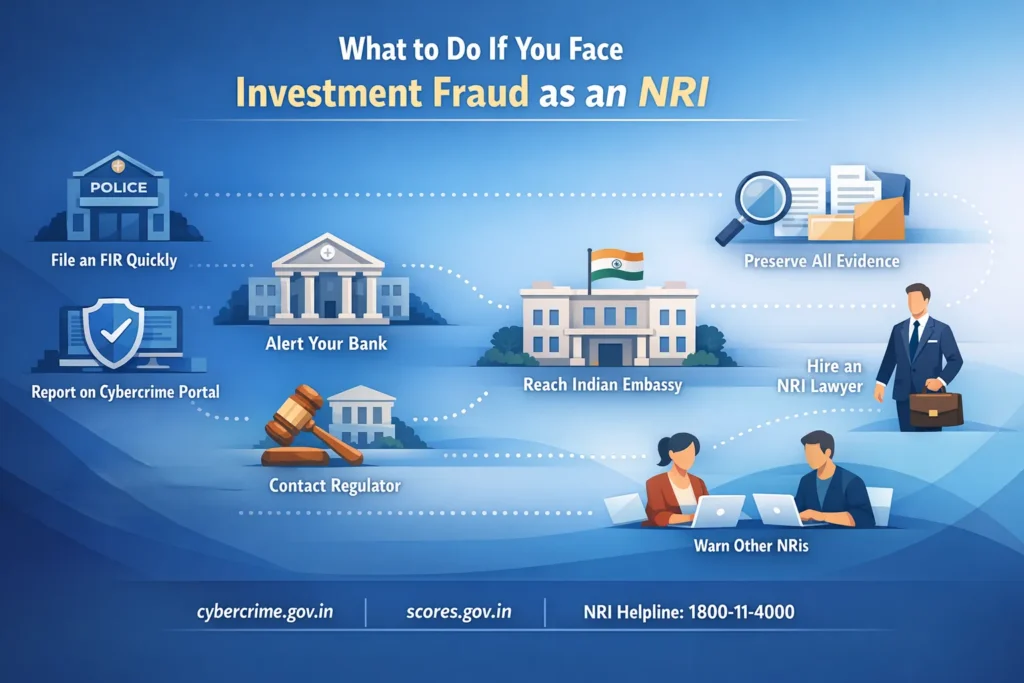
Despite your best efforts, sometimes fraud still happens. Maybe someone forged documents. Maybe a trusted person betrayed you. Maybe a scammer was just that good. If you’ve been defrauded, don’t panic. And definitely don’t give up.
Here’s your action plan:
File an FIR immediately. Contact the local police station where the fraud occurred. You can do this online through the Indian embassy or consulate in your country. Time is critical. The faster you report, the better your chances of recovery.
Report to cybercrime authorities. Visit the National Cybercrime Portal (cybercrime.gov.in) and file a complaint. This is especially important for online fraud, phishing, or fake investment platforms.
Contact the relevant regulator. If it’s a real estate fraud, file a complaint with RERA. If it involves securities or mutual funds, use SEBI’s SCORES portal (scores.gov.in). These regulators can take action against licensed entities.
Notify your banks. If the fraud involved unauthorized transactions or account access, immediately inform your bank. Request them to freeze accounts or reverse transfers if possible.
Reach out to the Indian embassy. Most embassies have NRI grievance cells. They can guide you through the legal process and connect you with local authorities.
Hire a specialized lawyer. Find a lawyer who has experience with NRI cases and fraud recovery. They’ll know the best legal strategies and can represent you in Indian courts even while you’re abroad.
Preserve all evidence. Save every email, message, receipt, contract, and communication related to the fraud. Document everything chronologically. This evidence will be crucial for legal proceedings.
Warn others. Share your experience (without compromising your legal case) on NRI forums and communities. Your story might prevent someone else from falling for the same scam.
Important resources:
- National Cybercrime Portal: cybercrime.gov.in
- SEBI Complaints: scores.gov.in
- Consumer helpline: 1800-11-4000
- Your country’s Indian embassy website will have NRI-specific helpline numbers
Recovery isn’t guaranteed. Legal processes can be slow. But taking action gives you a fighting chance. And it helps authorities track down fraudsters and prevent future scams.
Safe Investment Options for NRIs
After reading about all these scams, you might be thinking: “Is there any safe way to invest in India?”
Yes. Absolutely yes.
The key is sticking to regulated, transparent options.
RERA-approved real estate projects. If you want to invest in property, only consider projects registered with RERA. Check the builder’s track record. Visit the site if possible. Use a lawyer for due diligence. Stick to established developers with completed projects, not fly-by-night operators promising luxury at unrealistic prices.
Government bonds and securities. These are backed by the Indian government. Risk is minimal. Returns might not be spectacular, but your capital is safe. Consider options like RBI bonds or government treasury bills.
NRE and NRO bank deposits. These are specifically designed for NRIs. NRE (Non-Resident External) accounts offer tax-free interest and full repatriation. NRO (Non-Resident Ordinary) accounts are good for managing India-sourced income. Stick to established banks. Compare interest rates but don’t chase unrealistic offers.
SEBI-regulated mutual funds. Mutual funds managed by registered AMCs are transparent and regulated. You can track performance, read fund documents, and exit when needed. Choose funds based on your risk appetite and investment horizon. Avoid obscure fund houses you’ve never heard of.
Blue-chip equity investments. If you understand the stock market, investing directly in well-established, large-cap companies can work. These are companies with strong fundamentals, good governance, and transparent reporting. Avoid penny stocks and tips from “experts” on social media.
Public Provident Fund (PPF) and National Pension System (NPS). Long-term, government-backed savings schemes. Great for retirement planning. Completely safe.
The common thread in all these options? Regulation and transparency. You know where your money is going. You can track it. You can exit if needed. And there are authorities you can complain to if something goes wrong.
Safe investing might seem boring compared to “double your money in 6 months” schemes. But boring means you sleep well at night. Boring means your money is actually there when you need it.
Frequently Asked Questions
What scams are most common among NRIs investing in India?
Real estate fraud tops the list. This includes selling properties with unclear titles, unregistered projects, or land that doesn’t exist. Ponzi schemes promising guaranteed returns are also extremely common, especially those targeting NRIs through social media and WhatsApp. Power of Attorney misuse, where trusted individuals sell or mortgage properties without permission, is another major issue. Fake mutual fund platforms and phishing attacks targeting NRI bank accounts are growing rapidly too.
Can NRIs take legal action against fraud from abroad?
Yes, you can. File an FIR through the Indian embassy or consulate in your country. Use online portals like the National Cybercrime Portal for digital fraud. Contact regulatory bodies like SEBI or RERA depending on the fraud type. Hire a lawyer in India who specializes in NRI cases. They can represent you in court even while you’re abroad. The process might be slower and more complex than if you were in India, but legal recourse is definitely available.
How do I verify a real estate project is genuine?
Start by checking RERA registration on your state’s RERA website. Every legitimate project must be registered there. Verify the builder’s track record by looking at their past completed projects. Get a lawyer to conduct title verification to ensure the land ownership is clear and dispute-free. Confirm all NOCs and approvals with municipal authorities. If possible, visit the site in person or send a trusted representative. Check online reviews and complaints from other buyers. Never invest based solely on brochures or website claims.
What should I do if someone misuses my Power of Attorney?
Act immediately. File an FIR for cheating and forgery. Revoke the Power of Attorney officially through a registered deed and publish a notice in local newspapers. Inform all relevant banks, property registrars, and authorities about the revocation. Hire a lawyer to start legal proceedings for recovery of assets or damages. If properties were sold, you may be able to challenge the sale in court if you can prove unauthorized use. Document all evidence of the misuse. Contact the Indian embassy for support with the legal process.
Conclusion
You’ve worked hard for your money. You’ve sent remittances home. You’ve saved for years. Don’t let scammers steal it. Protecting your Indian investments from abroad isn’t complicated. It just requires vigilance, verification, and common sense. Always verify before you invest. Use registered advisors and platforms only.
Keep detailed documentation. Monitor your investments regularly. And trust your instincts when something feels wrong. Yes, there are risks. Yes, fraud exists. But thousands of NRIs successfully invest in India every year without falling victim to scams. You can too. Stay informed. Stay skeptical. Stay safe. Your financial security depends on it.


0 Comments