



NRI Glossary for Taxation, Investment, Banking & More
If you are an NRI, managing money in India often feels complicated. Different rules. Different accounts. Different tax treatment.
This glossary is built to solve exactly that.
Below is a full-fledged, easy-to-understand Indian NRI glossary covering every important term related to taxation, investments, banking, property, FEMA, compliance and general finance. No jargon. No legal fluff. Just clarity.
Bookmark this page. You will keep coming back to it.
NRI Status & Residency Terms
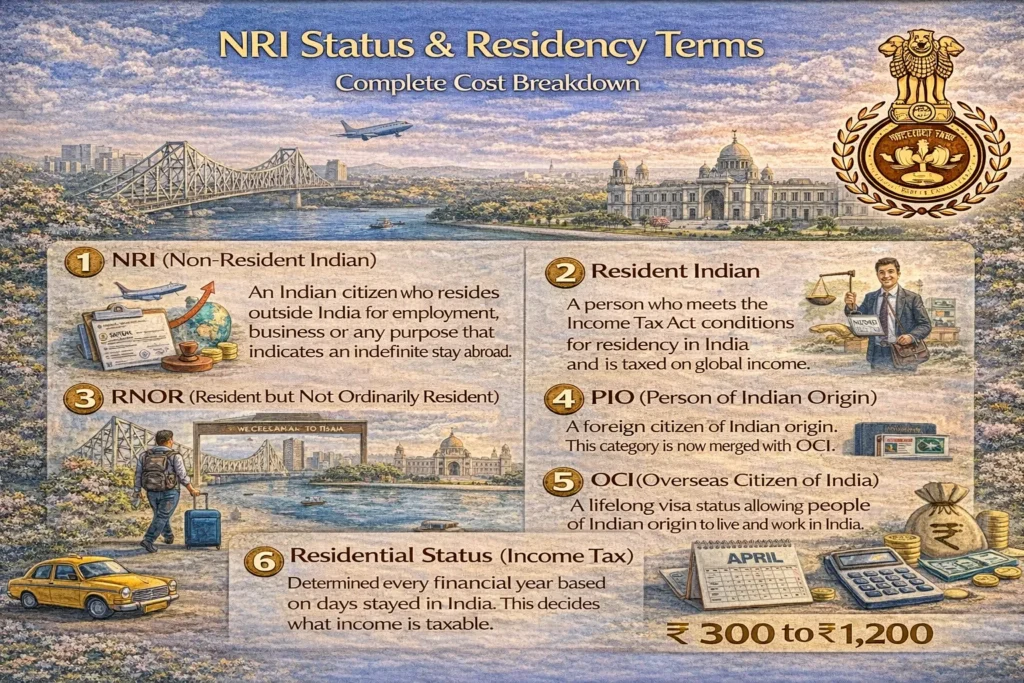
NRI (Non-Resident Indian): An Indian citizen who resides outside India for employment, business or any purpose that indicates an indefinite stay abroad.
Resident Indian: A person who meets the Income Tax Act conditions for residency in India and is taxed on global income.
RNOR (Resident but Not Ordinarily Resident): A temporary residential status when an NRI returns to India after long-term overseas stay.
PIO (Person of Indian Origin): A foreign citizen of Indian origin. This category is now merged with OCI.
OCI (Overseas Citizen of India): A lifelong visa status allowing people of Indian origin to live and work in India, excluding voting and political rights.
Residential Status (Income Tax): Determined every financial year based on days stayed in India. This decides what income is taxable.
NRI Banking & Account Terms
NRE Account (Non-Resident External): An INR account for foreign income. Fully repatriable. Interest is tax-free in India.
NRO Account (Non-Resident Ordinary): Used to manage income earned in India such as rent, pension or dividends. Interest is taxable.
FCNR Account (Foreign Currency Non-Resident): Fixed deposit held in foreign currency. Protects against exchange rate risk.
Repatriation: Transfer of money from India to an overseas account.
Non-Repatriable Funds: Money that must remain in India and cannot be freely sent abroad.
Joint NRI Account: An NRE or NRO account held jointly with another NRI or a resident Indian, subject to RBI rules.
Mandate Holder: A resident Indian authorised to operate an NRI account on behalf of the NRI.
NRI Taxation Terms
Income Tax Act, 1961: The main law governing taxation in India.
Taxable Income (NRI): Only income earned or received in India is taxable for NRIs.
Global Income: Worldwide income. Taxable in India only if you are a resident.
TDS (Tax Deducted at Source): Tax deducted by the payer before paying income to the NRI.
Higher TDS for NRIs: NRIs usually face higher TDS rates compared to resident Indians.
DTAA (Double Taxation Avoidance Agreement): A treaty between India and another country to avoid taxing the same income twice.
Tax Residency Certificate (TRC): Proof of tax residency in a foreign country to claim DTAA benefits.
Form 15CA: Declaration required before remitting money abroad.
Form 15CB: CA certificate confirming applicable taxes before remittance.
Advance Tax: Tax paid in installments during the year if tax liability exceeds the threshold.
Self-Assessment Tax: Balance tax paid while filing income tax returns.
Investment Terms for NRIs
NRI Demat Account: Demat account linked with NRE or NRO account to hold Indian securities.
PIS (Portfolio Investment Scheme): RBI-approved route for NRIs to invest in Indian equities.
Repatriable Investment: Investment whose proceeds can be sent abroad.
Non-Repatriable Investment: Investment where proceeds must remain in India.
Mutual Funds (NRI): NRIs can invest in Indian mutual funds subject to KYC and country-specific restrictions.
Direct Equity: Buying shares of Indian companies through stock exchanges.
IPO (Initial Public Offering): When a company offers its shares to the public for the first time.
Capital Gains: Profit earned from selling assets such as shares or property.
Short-Term Capital Gains (STCG): Gains from assets held for a shorter period.
Long-Term Capital Gains (LTCG): Gains from assets held for a longer period, usually taxed at lower rates.
Property & Real Estate Terms for NRIs
Inherited Property: Property received through a will or legal succession.
Power of Attorney (PoA): Legal authority given to someone in India to manage property or finances.
Sale Deed: Legal document confirming transfer of property ownership.
Stamp Duty: State government tax paid during property registration.
Registration Charges: Fees paid to officially register property documents.
Rental Income: Income earned from renting out property in India. Taxable for NRIs.
Repatriation of Property Sale Proceeds: Sending money abroad after selling property, subject to RBI limits.
FEMA & Regulatory Terms
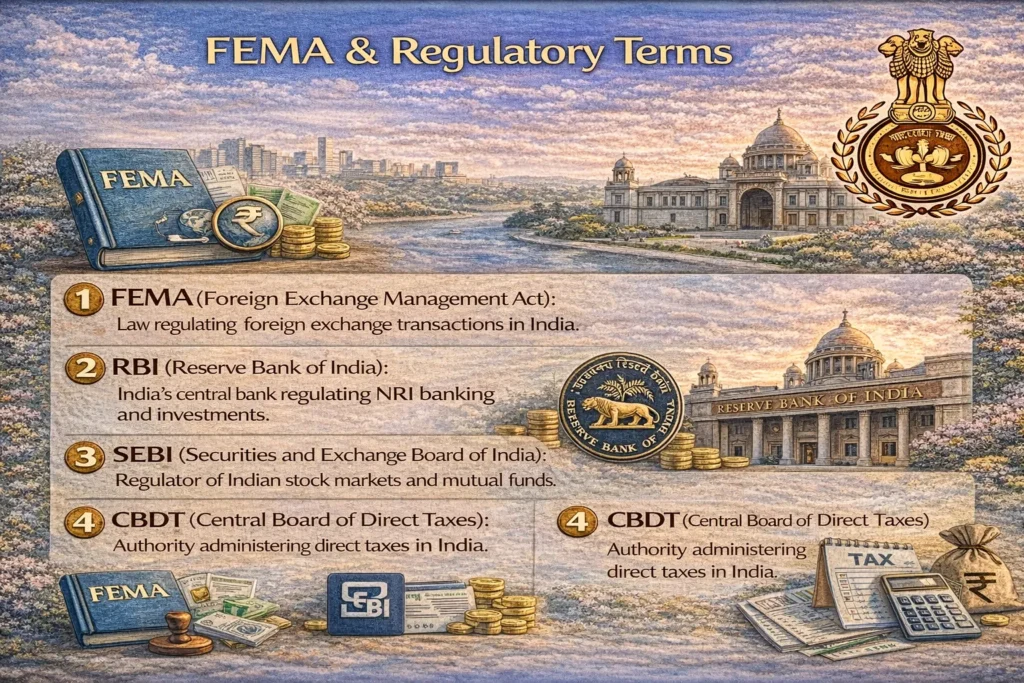
FEMA (Foreign Exchange Management Act): Law regulating foreign exchange transactions in India.
RBI (Reserve Bank of India): India’s central bank regulating NRI banking and investments.
SEBI (Securities and Exchange Board of India): Regulator of Indian stock markets and mutual funds.
CBDT (Central Board of Direct Taxes): Authority administering direct taxes in India.
Compliance, KYC & Documentation
KYC (Know Your Customer): Mandatory identity and address verification.
PAN (Permanent Account Number): Required for investments, taxation and financial transactions.
Aadhaar: Not mandatory for NRIs, but sometimes requested for verification.
CKYC: Centralised KYC registry used by financial institutions.
Income Tax Return (ITR): Annual filing of income and tax details.
Rectification: Correction of errors in filed tax returns.
Income Tax Notice: Official communication from the tax department.
Insurance & Retirement Terms
NPS (National Pension System): Long-term retirement investment scheme open to NRIs.
Life Insurance (NRI): Life insurance policies issued in India for NRIs.
Health Insurance (India): Medical insurance covering treatment in India.
ULIP (Unit Linked Insurance Plan): Product combining insurance and market-linked investment.
Annuity: Regular income paid post-retirement.
Remittance & Forex Terms
Inward Remittance: Money received in India from abroad.
Outward Remittance: Money sent from India to overseas accounts.
Forex Rate: Exchange rate between two currencies.
Wire Transfer: Electronic international money transfer.
LRS (Liberalised Remittance Scheme): Scheme allowing resident Indians to remit money abroad within limits.
Generic Financial Terms NRIs Should Know
Financial Year (FY) : 1 April to 31 March.
Assessment Year (AY): Year following the financial year in which income is assessed.
Net Worth: Total assets minus liabilities.
Liquidity: Ease of converting assets into cash.
Asset Allocation: Distribution of investments across asset classes.
Risk Appetite: Level of financial risk an investor is comfortable taking.
Final Note
This Indian NRI glossary is designed as a one-stop reference for anyone managing money, investments or compliance in India while living abroad.


0 Comments