



Earning income from multiple countries sounds exciting until taxes enter the picture. Many NRIs, freelancers, remote workers, investors, and international businesses end up paying taxes in two countries on the same income. This situation is called double taxation, and it can significantly reduce your earnings if not handled properly.
To prevent this problem, countries sign Double Taxation Avoidance Agreements (DTAA). These agreements help taxpayers avoid paying taxes twice. However, to claim DTAA benefits, taxpayers must prove their country of residence through a Tax Residency Certificate, commonly known as a TRC.
This guide explains everything about the tax residency certificate India, including eligibility, benefits, Form 10FA, Form 10F, and the complete process of how to get tax residency certificate in India.
What is Tax Residency Certificate (TRC)?
A Tax Residency Certificate is an official document issued by a country’s tax authority confirming that an individual or business is a tax resident of that country during a specific financial year. In India, the certificate is issued by the Income Tax Department and is required to claim DTAA benefits.
The TRC tax residency certificate acts as proof that your primary tax residence is India. Without this document, foreign tax authorities may deny treaty benefits, resulting in higher taxes or double taxation on your income.
Why is a Tax Residency Certificate Important?

A TRC becomes important when you earn income outside your resident country. For example, if an Indian resident earns salary, dividends, interest, or rental income abroad, both countries may try to tax the same income. The TRC helps establish your tax residency and allows you to claim relief under DTAA.
The certificate is also widely used for foreign remittances, international investments, overseas consultancy payments, and business transactions involving multiple countries. Many banks and financial institutions ask for a tax residency certificate for foreign remittance before processing transactions.
Understanding DTAA and Its Connection With TRC
India has signed DTAA agreements with nearly 100 countries, including United States, United Kingdom, Canada, and Australia. These agreements ensure taxpayers do not pay taxes twice on the same income in two countries.
To claim benefits under these treaties, submitting a valid Tax Residency Certificate is usually mandatory under Sections 90(4) and 90A(4) of the Income Tax Act. Without a TRC, treaty benefits may be rejected.
Who Needs a Tax Residency Certificate?
A TRC is useful for individuals and businesses earning cross-border income. NRIs earning income in India, Indian residents working abroad, companies receiving royalties, freelancers working with foreign clients, and investors earning foreign dividends commonly require this certificate.
Businesses involved in international trade or foreign remittances also use TRCs to establish tax residency. In many cases, banks request a tax residency certificate online copy before approving international fund transfers or overseas transactions.
Types of Income Covered Under TRC
A Tax Residency Certificate helps taxpayers avoid paying tax twice on the same income earned in different countries. It is especially useful for NRIs, foreign investors, freelancers, remote workers, and businesses dealing internationally. A valid TRC allows taxpayers to claim DTAA benefits and lower tax rates on foreign income.
- Salary Income Earned Abroad: If you work in another country, your salary may be taxed there and again in your resident country. A TRC helps claim tax relief under DTAA and prevents double taxation.
- Interest From Foreign Bank Accounts: Interest earned from overseas savings accounts or fixed deposits may attract foreign taxes. With a TRC, taxpayers can claim lower withholding tax rates.
- Rental Income From Overseas Property: Income earned from property located abroad can become taxable in two countries. A TRC helps avoid paying tax twice on the same rental income.
- Foreign Dividend Income: Dividends from foreign shares or mutual funds often face tax deductions at source. A Tax Residency Certificate helps investors claim reduced tax rates under DTAA.
- Capital Gains on Foreign Investments: Selling foreign property, stocks, or investments may generate taxable capital gains abroad. A TRC helps determine tax liability and treaty benefits.
- Royalty Income: Royalties earned from trademarks, patents, copyrights, or digital content may attract high withholding taxes. A TRC helps reduce these tax deductions legally.
- Consultancy and Professional Income: Freelancers and consultants working with foreign clients may face overseas tax deductions on payments. A TRC helps claim treaty benefits and reduce excess taxes.
- International Business Profits: Businesses earning profits from exports or overseas operations may face taxation in multiple countries. A TRC establishes tax residency and helps avoid double taxation.
- Income From Foreign Investments: Earnings from bonds, overseas funds, and international securities may be taxed abroad. A valid TRC helps investors claim DTAA relief on such income.
- Agricultural Income Earned Abroad: Agricultural income from foreign land may also attract taxes in another country. A TRC helps determine the correct tax treatment under international agreements.
Residential Status Under Indian Income Tax
Before applying for a TRC, understanding your residential status is important because taxation rules depend on it. Under Indian tax laws, an individual can be classified as Resident and Ordinarily Resident (ROR), Resident but Not Ordinarily Resident (RNOR), or Non-Resident (NR).
The residential status mainly depends on the number of days spent in India during a financial year. Your tax liability on Indian and global income changes based on this classification.
Resident and Ordinarily Resident (ROR)
An individual generally qualifies as Resident and Ordinarily Resident if they stay in India for 182 days or more during a financial year. Additional conditions related to previous years’ stay also apply under Section 6 of the Income Tax Act.
ROR individuals are taxed on their worldwide income in India. This means income earned both in India and abroad becomes taxable, making the Tax Residency Certificate extremely important for claiming DTAA relief.
Resident but Not Ordinarily Resident (RNOR)
RNOR status is commonly applicable to returning NRIs who recently shifted back to India. Individuals falling under this category receive partial relief from taxation on foreign income for a certain period.
This status acts as a transition phase between Non-Resident and full Resident status. RNOR taxpayers may still need a TRC while dealing with overseas income, investments, or foreign tax authorities.
Non-Resident (NR)
An individual becomes a Non-Resident if they do not satisfy the minimum stay conditions in India. Usually, staying less than 182 days during a financial year may qualify someone as an NR.
Non-Residents are taxed only on income earned or received in India. However, NRIs often require TRCs from their resident country to avoid double taxation on Indian income such as rent, dividends, or interest earnings.
Benefits of Tax Residency Certificate
The biggest benefit of a Tax Residency Certificate is avoiding double taxation. It ensures that taxpayers do not end up paying tax twice on the same income in two different countries. This helps individuals and businesses save substantial amounts legally through DTAA provisions.
Another major advantage is reduced withholding tax. Many countries deduct high taxes on dividends, royalties, and consultancy fees. A valid TRC helps claim lower tax rates under treaty agreements and simplifies international financial transactions.
Tax Residency Certificate for Foreign Remittance
Many taxpayers search for a tax residency certificate for foreign remittance because banks frequently request this document during international transfers. Financial institutions use the TRC to determine applicable tax rates and treaty benefits before processing payments.
This requirement is common for foreign salary receipts, overseas investments, import-export payments, royalties, and international consultancy transactions. Furnishing a TRC helps avoid unnecessary tax deductions and delays in remittance approvals.
How to Get Tax Residency Certificate in India?
Many taxpayers search online for how to get tax residency certificate in India because the process can initially seem confusing. In India, the TRC application is made through the Income Tax Department using Form 10FA.
Once the application is verified, the Assessing Officer issues the certificate through Form 10FB. The certificate then serves as official proof of Indian tax residency for claiming DTAA benefits.
Tax Residency Certificate India Form 10FA
The tax residency certificate India Form 10FA is the official application form used for requesting a TRC. Taxpayers need to provide details such as PAN, Aadhaar, nationality, residential status, and purpose for obtaining the certificate.
Accurate information is extremely important because incorrect details may delay approval. Supporting documents like identity proof, tax returns, and foreign income details may also be required during verification.Tax Residency Certificate India Online Process
Tax Residency Certificate India Online Process
The government has made the tax residency certificate India online process simple through the Income Tax e-filing portal. Taxpayers can apply digitally without visiting the Income Tax office. The process mainly involves filing Form 10FA, uploading documents, and getting approval from the Assessing Officer.
Below is the complete step-by-step process to apply for a TRC tax residency certificate online.
Step 1: Visit the Income Tax E-Filing Portal
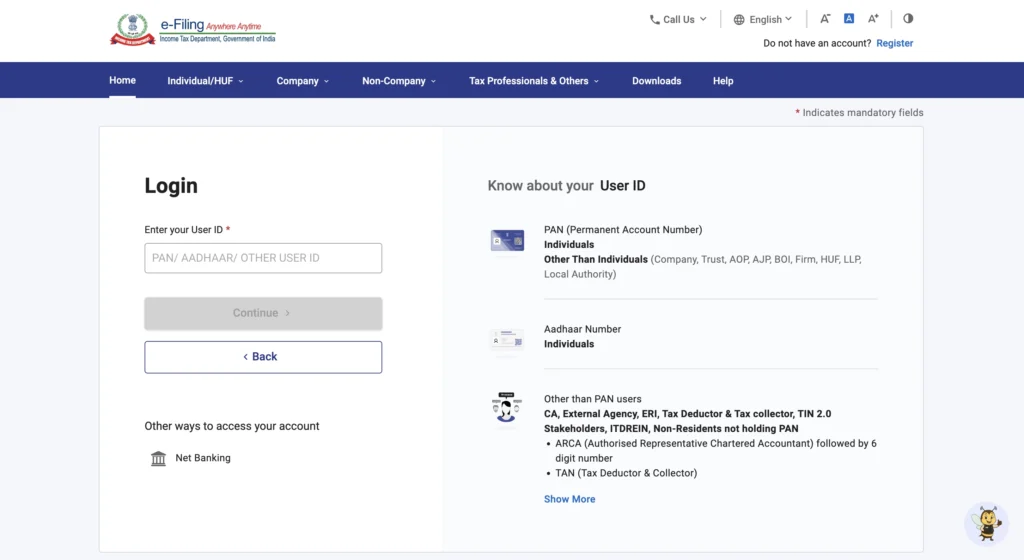
Go to the official Income Tax e-filing website and log in using your PAN, password, and captcha code. Taxpayers must have a registered account to apply online.
Step 2: Go to Form 10FA
After logging in, open the “e-File” section and search for Form 10FA. This is the official application form used for applying for a Tax Residency Certificate in India.
Step 3: Fill Personal and Tax Details
Enter all required details carefully, including:
- Name of taxpayer
- PAN or Aadhaar number
- Nationality
- Residential status
- Address details
- Purpose of TRC
- Assessment year
Incorrect details may delay approval.
Step 4: Enter Foreign Country Details
Mention the country for which you need the TRC and specify the period for which the certificate is required. This helps establish your tax residency for DTAA purposes.
Step 5: Upload Supporting Documents
Upload required documents such as:
- PAN card
- Passport copy
- Aadhaar card
- Tax return copies
- Address proof
- Foreign income proof
Clear and valid documents help speed up verification.
Step 6: Verify and Submit Form
Check all information carefully before submission. Once verified, submit Form 10FA electronically using Aadhaar OTP, DSC, or EVC verification methods.
Step 7: Application Review by Assessing Officer
After submission, the Income Tax Department reviews the application and documents. The Assessing Officer may ask for additional clarification if required.
Step 8: Issuance of TRC in Form 10FB
Once approved, the Income Tax Department issues the Tax Residency Certificate through Form 10FB. Taxpayers can download it online from the portal.
Step 9: Use the TRC for DTAA Benefits
After receiving the certificate, taxpayers can submit it to foreign tax authorities, banks, or financial institutions to claim DTAA benefits and reduced tax rates.
Documents Required for TRC Application

Taxpayers need to submit certain identity, tax, and financial documents while applying for a TRC tax residency certificate. Proper documentation helps the Income Tax Department verify residential status and process the application faster.
Below are the important documents generally required for a tax residency certificate online application.
- PAN Card: PAN is one of the most important documents for TRC application. It is used to verify the taxpayer’s identity and tax records.
- Aadhaar Card: Aadhaar works as identity and address proof for Indian residents while applying for the certificate.
- Passport Copy: Passport details help verify nationality and international travel records, especially for NRIs and foreign income cases.
- Address Proof: Documents such as electricity bills, bank statements, voter ID, or driving licence may be required to confirm residential address.
- Income Tax Return (ITR) Copies: Previous income tax return filings help establish tax residency and income details for the relevant financial year.
- Foreign Income Proof: Taxpayers earning income abroad may need salary slips, foreign bank statements, dividend statements, or rental agreements as proof.
- Tax Identification Number (TIN): If applicable, taxpayers may need to provide their foreign country Tax Identification Number for DTAA purposes.
- Bank Statements: Bank account statements may be required to verify foreign remittances, overseas income, or international transactions.
- Form 10FA: This is the official application form for obtaining a Tax Residency Certificate in India and must be filled correctly.
- Business Incorporation Certificate: Companies and firms may need incorporation certificates to establish business identity and legal registration.
- GST Registration Details: Businesses involved in international trade or services may also need to submit GST registration information.
- Foreign Transaction Records: Export invoices, consultancy agreements, royalty contracts, or overseas payment records may be required in business-related TRC applications.
- Digital Signature Certificate (DSC) or Aadhaar Verification: Online applications may require DSC, EVC, or Aadhaar OTP verification before final submission.
Conclusion
A Tax Residency Certificate plays a crucial role for taxpayers earning income across multiple countries. Whether you are an NRI, freelancer, investor, remote worker, or international business owner, having a valid TRC helps avoid double taxation and ensures smoother tax compliance.
Understanding how to get TRC certificate, the tax residency certificate India online process, and Form 10FA requirements can help you claim DTAA benefits easily. Since the certificate remains valid for only one financial year, timely renewal is equally important for uninterrupted tax relief.
FAQs
What is Form 10F?
Form 10F is another important document related to DTAA claims. It is mainly required when the Tax Residency Certificate does not contain all prescribed information required under Indian tax rules.
NRIs and foreign taxpayers commonly submit Form 10F along with the TRC while claiming lower TDS rates or treaty benefits in India. The form acts as a supporting declaration regarding tax residency information.
Is TRC Mandatory for DTAA Benefits?
Yes, in most cases, furnishing a TRC is mandatory for claiming DTAA benefits under Indian tax law. Without this certificate, foreign income may become taxable in both countries, increasing the taxpayer’s overall liability.
The Income Tax Act specifically requires taxpayers to provide a valid TRC along with Form 10F in certain situations. Failure to do so may lead to denial of treaty benefits and higher withholding taxes.
Validity of Tax Residency Certificate
A Tax Residency Certificate is generally valid for one financial year from the date of issue. Taxpayers who regularly deal with foreign income or international transactions need to renew the certificate annually.
Applying for renewal before expiry is advisable because processing time may vary. Delays in renewal can create problems while claiming DTAA benefits or processing international remittances.
Common Mistakes to Avoid While Applying for TRC
Many TRC applications get delayed because of incorrect PAN details, mismatch in passport information, incomplete Form 10FA, or wrong residential status declarations. Even small errors can slow down approval significantly.
Taxpayers should carefully verify all information before submission. Keeping proper foreign income records and updated tax filings also improves the chances of faster approval for the TRC tax residency certificate.
Also read: Who Bears the Penalty When TDS Is Not Deducted on NRI Property Sale
Also read: 5 Important Deadlines Every NRI Must Remember for Tax Filing


0 Comments