


Introduction
GIFT City is suddenly everywhere in the news. From Fortune 500 companies setting up offices to the government pushing it as India's answer to Singapore and Dubai, this smart city is making headlines.
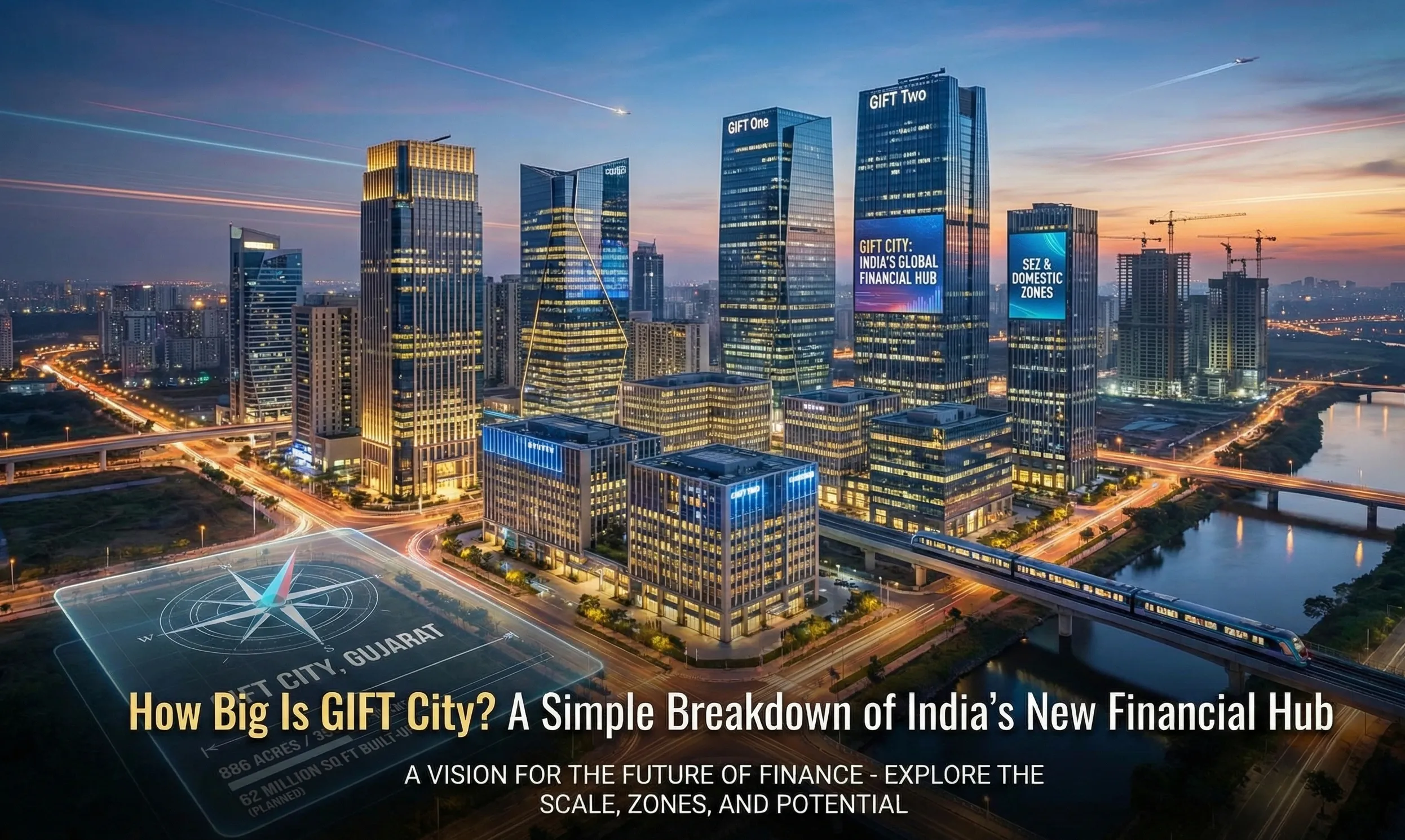
One question keeps popping up: How big is GIFT City?
Is it just another business district? A small cluster of towers? Or something much larger?
This guide breaks down GIFT City's actual size, how the land is divided, what's built so far, and what's coming next. Simple facts. No jargon.
What Is GIFT City?
GIFT City stands for Gujarat International Finance Tec-City. It's India's first International Financial Services Centre (IFSC), designed to bring global financial services to Indian soil.
Think of it as a mini financial capital with its own special economic zone, tax benefits, and world-class infrastructure. Located between Ahmedabad and Gandhinagar in Gujarat, GIFT City combines finance, technology, and smart city planning under one massive project.
Quick Answer: How Big Is GIFT City?
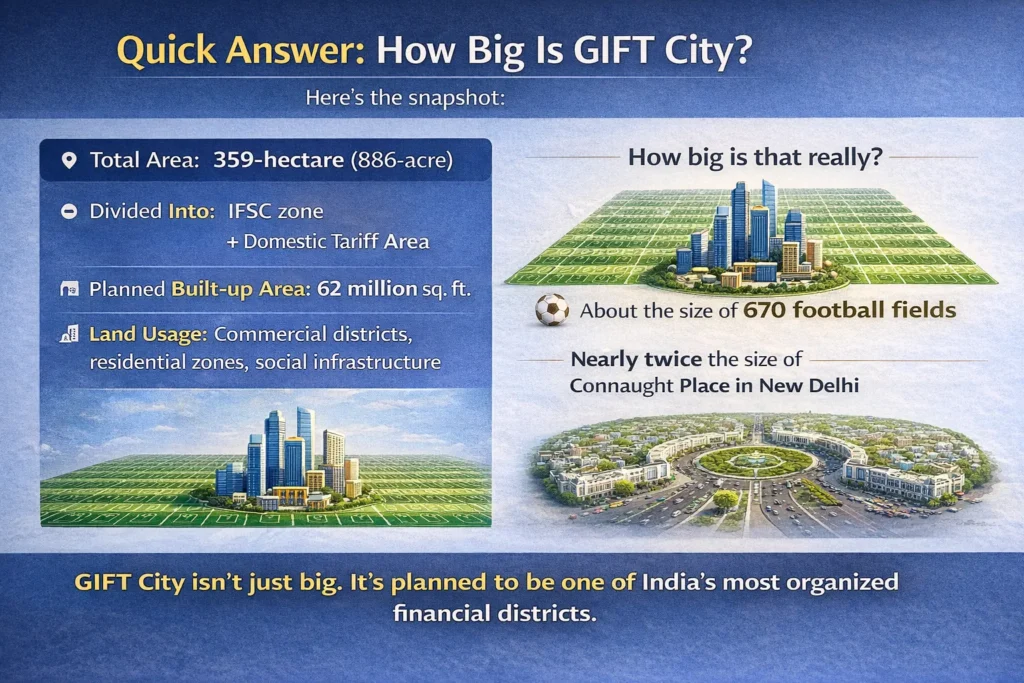
Here's the snapshot:
- Total Area: 359-hectare (886-acre)
- Divided Into: IFSC zone + Domestic Tariff Area
- Planned Built-up Area: 62 million sq. ft.
- Land Usage: Commercial districts, residential zones, social infrastructure
How big is that really?
- About the size of 670 football fields
- Nearly twice the size of Connaught Place in New Delhi
GIFT City isn't just big. It's planned to be one of India's most organized financial districts.
Detailed Breakdown of the GIFT City Area
Zone 1: IFSC (International Financial Services Centre)
Purpose: This is the heart of GIFT City. The IFSC zone operates under special regulations that allow global financial activities with tax benefits and easier compliance.
Land Allocation: A significant portion of the 886 acres falls under IFSC jurisdiction.
Who Operates Here: International banks, insurance companies, fintech startups, asset management firms, brokers, aircraft leasing companies, and bullion exchanges. Companies like JP Morgan, Goldman Sachs, and several Indian banks have set up operations here.
Zone 2: Domestic Tariff Area
Purpose: This zone functions under regular Indian tax and business laws. It supports domestic businesses that want proximity to the IFSC but don't need special zone benefits.
What Type of Companies Operate Here: IT firms, consulting agencies, domestic financial institutions, and support services.
Land and Building Usage: Office complexes, service centers, and ancillary infrastructure that supports the IFSC ecosystem.
How the Land Is Used: Key Components
GIFT City's 886 acres are divided into multiple functional zones:
Commercial District
The core business area with office towers, financial institutions, and corporate headquarters. High-rise buildings dominate this zone, designed for maximum efficiency and modern workspace requirements.
Residential District
Planned housing for professionals working in GIFT City. Apartments, villas, and serviced residences are being developed to create a live-work environment within the city.
GIFT Riverfront
A recreational zone along the Sabarmati River. This area includes walking paths, green spaces, and leisure facilities to balance the corporate atmosphere.
Social Infrastructure
Schools, hospitals, community centers, and public spaces. GIFT City is designed as a complete city, not just an office park.
Educational and Institutional Area
Universities, training centers, and research institutions focused on finance, technology, and management. These facilities support skill development for the financial sector.
Retail and Hospitality Zone
Shopping centers, restaurants, hotels, and entertainment venues. This zone serves both residents and the thousands of daily professionals working in GIFT City.
Utility and Tech-Based Infrastructure
GIFT City runs on advanced infrastructure including district cooling systems, automated waste management, underground utilities, and high-speed connectivity. Everything is designed for efficiency and sustainability.
GIFT City’s Infrastructure in Numbers
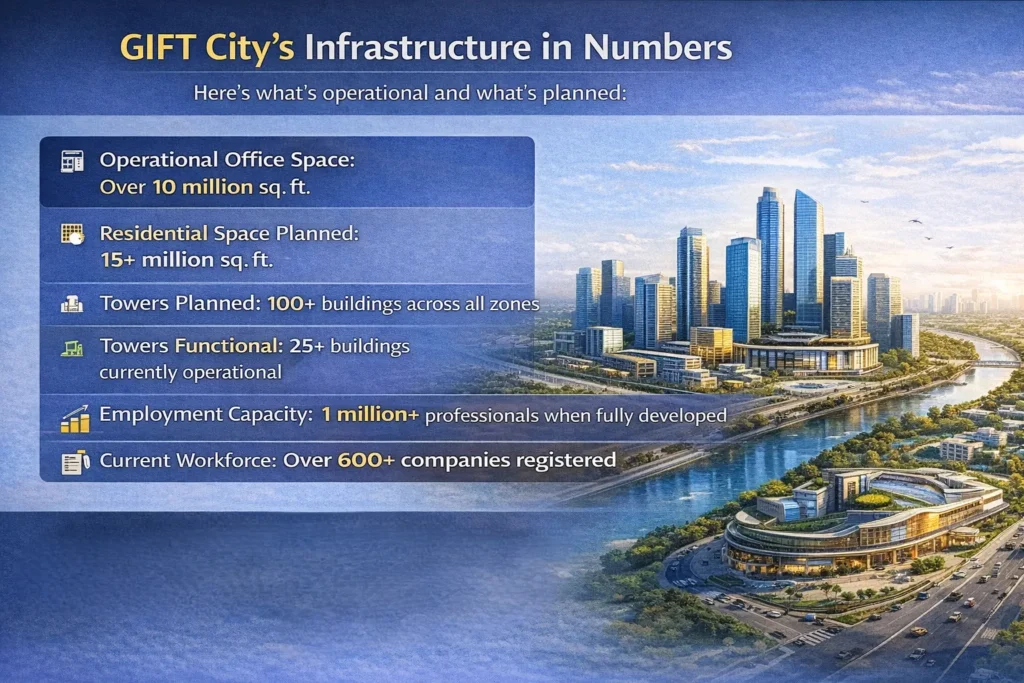
Here's what's operational and what's planned:
- Operational Office Space: Over 10 million sq. ft.
- Residential Space Planned: 15+ million sq. ft.
- Towers Planned: 100+ buildings across all zones
- Towers Functional: 25+ buildings currently operational
- Employment Capacity: Estimated to create jobs for over 1 million professionals when fully developed
- Current Workforce: Growing rapidly with over 600+ companies registered
These numbers keep changing as new phases get completed.
GIFT City’s Expansion Plan
Current Phase
The first phase focused on establishing the IFSC zone with core infrastructure. Major towers like GIFT One, GIFT Two, and GIFT SEZ are operational. Banking, insurance, and capital market firms have already moved in.
Next Phase (Over Next 5–10 Years)
The second and third phases will expand commercial space, complete residential districts, and develop social infrastructure. More office towers, hotels, hospitals, and educational institutions are under construction.
Future Expected Area Usage
By 2030, GIFT City aims to utilize the full 886 acres with complete build-out of all zones. The goal is to create a self-sustaining financial city that rivals global financial centers.
New Sectors Entering
Beyond banking and insurance, GIFT City is attracting aircraft leasing companies, bullion trading platforms, fund management firms, fintech startups, and even aviation finance. The government is actively promoting new sectors to diversify the financial ecosystem.
Why the Size of GIFT City Matters
For Investors
The sheer scale means long-term stability. GIFT City isn't a small experiment. With 886 acres and 62 million sq. ft. of planned space, this is a multi-decade project backed by government commitment.
For Companies Moving to GIFT City
Size translates to capacity. There's room for thousands of companies to set up operations without space constraints. The infrastructure can support massive growth in employment and business activity.
For NRIs
A large, well-planned financial hub means better opportunities for investment, employment, and business setup. GIFT City's size allows it to accommodate diverse needs from banking to real estate.
For India's Global Finance Ambitions
India needs a city that can compete with Singapore, Hong Kong, and Dubai. The 886-acre GIFT City provides the physical foundation to build that global reputation. Size matters when attracting multinational corporations and positioning India as a financial superpower.
FAQs
How many acres is GIFT City?
GIFT City spans 886 acres, making it one of India's largest planned financial districts.
How big is the IFSC zone in GIFT City?
The IFSC zone occupies a major portion of GIFT City's total area, dedicated exclusively to international financial services with special regulatory benefits.
How much land is developed so far in GIFT City?
Approximately 30-40% of the total area is currently developed with operational office towers, infrastructure, and initial residential projects. Development is ongoing across multiple phases.
How much office space is available in GIFT City?
Over 10 million sq. ft. of office space is currently operational, with plans to expand to over 30 million sq. ft. in the coming years.
How fast is GIFT City expanding?
GIFT City is expanding rapidly with multiple towers under construction. New companies are registering every month, and infrastructure development is progressing across all zones.
What companies are already present in GIFT City?
Over 600 companies including major banks like JP Morgan, HSBC, Bank of America, insurance firms, fintech companies, and several Indian financial institutions have established operations.
Is GIFT City bigger than other Indian financial districts?
Yes. GIFT City's 886 acres make it significantly larger than Mumbai's Bandra Kurla Complex (370 acres) and comparable to major global financial districts in terms of planned capacity.
Conclusion
GIFT City is 886 acres of planned financial infrastructure. That's the simple answer.
But the real story is what happens on that land. A complete financial ecosystem with international banks, insurance companies, fintech startups, and world-class infrastructure. A city designed from scratch to handle India's growing role in global finance.
The size matters because it shows ambition. India isn't building just another business district. GIFT City has the space, planning, and government backing to become a true alternative to Singapore and Dubai.
As more companies move in and more infrastructure gets built, those 886 acres will define India's financial future.
Want to know more about investing or setting up in GIFT City Funds? Check out our complete guide to GIFT City regulations, tax benefits, and business opportunities.
Also Read: Gift City Tax Benefits for NRIs


0 Comments