
Category: GIFT City

  • GIFT City Minimum Dropped to $75,000: Six USD Routes NRIs Can Enter at a Smaller Ticket in 2026

    GIFT City Minimum Dropped to $75,000: Six USD Routes NRIs Can Enter at a Smaller Ticket in 2026

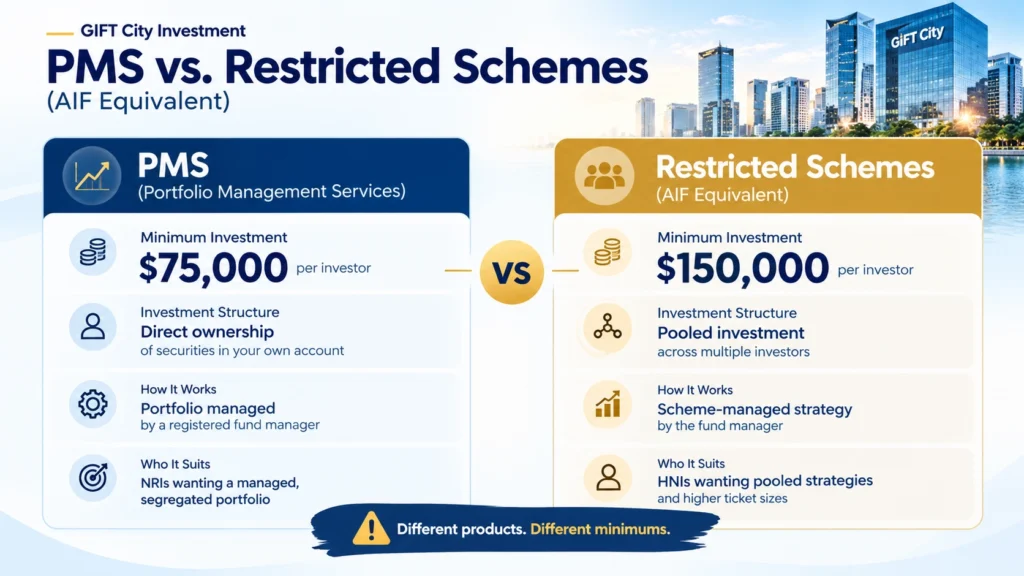
    For years, the standard answer to “How much do I need to invest in GIFT City?” was USD 150,000. That number kept many salaried NRIs and OCIs out of India’s International Financial Services Centre. In February 2025, the International Financial Services Centres Authority (IFSCA) notified the IFSCA (Fund Management) Regulations, 2025, and one change got most of the attention: the minimum investment for Portfolio Management Services (PMS) was halved from USD 150,000 to USD 75,000.

    Here is the part many articles get wrong. The USD 75,000 floor applies to PMS, not to Alternative Investment Funds. Restricted schemes, which are the GIFT City equivalent of AIFs, still require USD 150,000 per investor under Regulation 32(2), as amended up to 10 September 2026. Venture capital schemes require USD 250,000. If you read that GIFT City AIFs now start at USD 75,000, the regulation does not support it.

    The good news is that the smaller ticket is real, and it is not the only one. Between PMS at USD 75,000, retail schemes with much lower minimums, the joint investor rule, and USD deposits, an NRI with USD 10,000 to USD 75,000 now has genuine options. This guide covers six of them.

    What IFSCA Actually Changed in February 2025

    The IFSCA (Fund Management) Regulations, 2025 were published in the Official Gazette on 19 February 2025. The changes relevant to NRI investors were:

    • PMS minimum reduced from USD 150,000 to USD 75,000
    • Minimum corpus for both retail and non-retail schemes reduced from USD 5 million to USD 3 million
    • Open-ended schemes can start investing at USD 1 million, with 12 months to reach USD 3 million
    • Closed-ended retail schemes investing over 15 percent in unlisted securities need a USD 10,000 minimum per investor

    Lower corpus requirements make it easier for fund managers to launch new schemes, which means more choice for investors over time.

    GIFT City Minimum Investment by Product

    ProductMinimum per InvestorWho It Suits
    Portfolio Management ServicesUSD 75,000NRIs wanting a managed, segregated portfolio
    Restricted schemes (AIF-equivalent)USD 150,000HNIs wanting pooled strategies
    Restricted schemes, employees of the fund managerUSD 40,000Staff and directors
    Venture capital schemesUSD 250,000Experienced private market investors
    Accredited investorsNo minimumInvestors meeting net worth or income tests
    Closed-ended retail schemes (over 15 percent unlisted)USD 10,000Smaller investors
    Open-ended retail schemes and feeder fundsSet by the scheme, often a few hundred dollarsSalaried NRIs starting small

    Route 1: GIFT City PMS at USD 75,000

    The headline route. A PMS is not a pooled fund. You own the securities directly in your own account, and a registered fund manager runs the portfolio.

    Examples of GIFT City PMS strategies listed at the USD 75,000 indicative minimum include:

    • Parag Parikh Global Investing Strategy (PPFAS), focused on global markets
    • Phillip International Pioneer Portfolio Global PMS (PhillipCapital), built on global ETFs

    Always confirm the current minimum in the disclosure document before investing.

    Why this matters for NRIs: when a GIFT City PMS buys foreign securities, the gains for a non-resident are foreign-sourced income and generally sit outside Indian tax. When it buys Indian securities, normal NRI capital gains rules apply. Our PMS for NRIs desk compares GIFT City PMS with onshore PMS through an NRE account.

    Route 2: Restricted Schemes Through the Joint Investor Rule

    If you want a GIFT City AIF but don’t have USD 150,000 on your own, the regulations offer a family route. Under Regulation 32(2), up to two individuals who are spouses, parents, or children can invest jointly, provided their total investment is at least USD 150,000.

    In practice:

    • You and your spouse can invest USD 75,000 each
    • A parent and an adult child can pool to meet the threshold
    • Both investors complete KYC with the fund manager

    Restricted schemes available to NRIs include Category III style equity strategies from managers such as Alchemy, Carnelian, Renaissance, Motilal Oswal, and Nippon India, along with feeder funds from ABSL, DSP, ICICI Prudential, Bandhan, and HDFC AMC International (IFSC), typically at USD 150,000.

    Route 3: Accredited Investor Status

    The minimum investment threshold does not apply to accredited investors under both Regulation 20 and Regulation 32. Accreditation is based on net worth or income tests and is granted by an accreditation agency.

    This route suits NRIs with substantial wealth who want to spread money across several strategies in smaller amounts instead of locking USD 150,000 into each one.

    Route 4: Retail Schemes and Feeder Funds

    Retail schemes are the most important development for salaried NRIs. They are regulated for wider participation and carry much lower entry points.

    • The Tata India Dynamic Equity Fund was reported as the first retail inbound GIFT City fund after IFSCA approval in September 2025, with an entry point of around USD 500
    • Other fund houses, including Nippon India and Mirae Asset, have been reported to be planning retail GIFT City launches

    Retail schemes let you invest in Indian equities in US dollars, avoid converting money into rupees, and redeem back into dollars. They work well alongside onshore mutual funds for NRIs.

    Route 5: Closed-Ended Retail Schemes at USD 10,000

    Closed-ended retail schemes that put more than 15 percent into unlisted securities must take at least USD 10,000 per investor. These suit NRIs who want exposure to unlisted or private opportunities at a fraction of the AIF ticket and can accept a fixed tenure without an early exit.

    Route 6: USD Fixed Deposits at IFSC Banking Units

    Not every GIFT City route is a fund. Banks run IFSC Banking Units in GIFT City that accept USD fixed deposits, with some starting from around USD 500.

    Benefits for NRIs:

    • Deposits stay in US dollars, so there is no rupee conversion risk
    • Interest earned by non-residents on IFSC deposits enjoys favourable tax treatment
    • Funds are fully repatriable

    They are a good parking spot while you decide on a PMS or fund allocation. For a broader view of these options, our guide to investment options for NRIs and OCIs in GIFT City compares each product.

    Tax Treatment for NRIs

    GIFT City was designed to be tax-efficient for non-residents. Key points:

    • Income of eligible IFSC funds attributable to non-resident unitholders enjoys exemptions under the Income Tax Act
    • PMS gains are taxed based on the underlying securities, since you own them directly
    • Foreign securities held by a non-resident generally create no Indian tax
    • GST does not apply to many IFSC fund management services under the IFSC framework

    Rules have been renumbered under the Income Tax Act 2025, so check current section references. Our breakdown of GIFT City tax benefits explains each exemption in detail.

    How to Choose Your Route

    If You HaveConsider
    USD 500 to USD 10,000Retail schemes, feeder funds, USD fixed deposits
    USD 10,000 to USD 75,000Closed-ended retail schemes, multiple retail funds
    USD 75,000GIFT City PMS
    USD 75,000 each with a spouseRestricted schemes through the joint investor route
    USD 150,000 or moreRestricted schemes and AIF strategies
    Accredited investor statusMultiple strategies without the minimum

    Also consider your plans. If you might return to India, check how your GIFT City holdings will be treated once you become a resident. Our Returnee NRI Transition Services team plans that shift.

    Common Mistakes

    • Believing GIFT City AIFs now start at USD 75,000
    • Confusing PMS with a pooled fund
    • Ignoring the joint investor route for couples
    • Picking a closed-ended scheme when you need liquidity
    • Forgetting home-country tax rules, such as PFIC reporting for US persons
    • Skipping KYC alignment across passport, OCI, and PAN

    How MostlyNRI Helps

    At MostlyNRI, we help NRIs and OCIs across the USA, UAE, UK, Canada, Singapore, and Australia with:

    • GIFT City fund, PMS, and deposit selection through our GIFT City Funds service
    • Joint investor structuring for couples and families
    • Onshore and offshore portfolio allocation
    • Tax planning under the Income Tax Act 2025
    • ITR filing and Schedule FA disclosures

    Our team serves clients from over 33 countries across 13 Indian cities.

    Want to start in GIFT City with USD 75,000 or less? Book a consultation with our specialists at beige-spoonbill-433256.hostingersite.com/ to find the right route for your ticket size, currency goals, and residency plans.

    Frequently Asked Questions (FAQs)

    Did the GIFT City AIF minimum really drop to USD 75,000?

    No. The USD 75,000 minimum introduced in February 2025 applies to Portfolio Management Services. Restricted schemes, the AIF equivalent, still require USD 150,000 per investor under Regulation 32(2), and venture capital schemes require USD 250,000.

    When did IFSCA reduce the PMS minimum to USD 75,000?

    IFSCA notified the IFSCA (Fund Management) Regulations, 2025 in the Official Gazette on 19 February 2025. The regulations cut the PMS minimum from USD 150,000 to USD 75,000 and reduced minimum fund corpus from USD 5 million to USD 3 million.

    Can a married couple combine investments to meet the USD 150,000 AIF minimum?

    Yes. Under Regulation 32(2), up to two individuals who are spouses, parents, or children can invest jointly if their combined investment is at least USD 150,000. Each joint investor completes KYC with the fund manager.

    What is the cheapest way for an NRI to invest in GIFT City?

    Retail schemes and feeder funds offer the lowest entry, with some reported from around USD 500. USD fixed deposits at IFSC Banking Units also start low with some banks. These suit salaried NRIs building a position gradually in dollars.

    Do accredited investors have a minimum investment in GIFT City funds?

    No. The minimum investment thresholds for venture capital and restricted schemes do not apply to accredited investors. Accreditation is based on net worth or income tests and lets investors spread money across several strategies.

    Is a GIFT City PMS taxed like a mutual fund?

    No. In a PMS you own the securities directly, so tax follows the underlying securities. Gains on foreign securities for non-residents are generally outside Indian tax, while Indian securities follow normal NRI capital gains rules.

    Can NRIs invest in GIFT City in US dollars?

    Yes. GIFT City products are denominated in foreign currency, usually US dollars. NRIs invest from overseas bank accounts or NRE accounts, avoid rupee conversion, and redeem back into dollars, which keeps proceeds fully repatriable.

    What is the minimum for closed-ended retail schemes in GIFT City?

    Closed-ended retail schemes that invest more than 15 percent in unlisted securities must take at least USD 10,000 per investor. Other retail schemes set their own minimums, which are often much lower.

    Are US-based NRIs affected by PFIC rules on GIFT City funds?

    Possibly. US persons holding non-US pooled funds may face PFIC reporting and punitive taxation. A PMS, where you own securities directly, can be easier to manage. US-based NRIs should check with a US tax adviser before investing.

    How can MostlyNRI help me invest in GIFT City?

    MostlyNRI compares GIFT City PMS, restricted schemes, retail funds, and USD deposits, structures joint investments for couples, plans tax under the Income Tax Act 2025, and aligns GIFT City holdings with your onshore portfolio and ITR filings.

  • What Are GIFT City Dollar ULIPs for NRIs? 226 Products, Tax Rules, and Comparison With Regular ULIPs

    What Are GIFT City Dollar ULIPs for NRIs? 226 Products, Tax Rules, and Comparison With Regular ULIPs

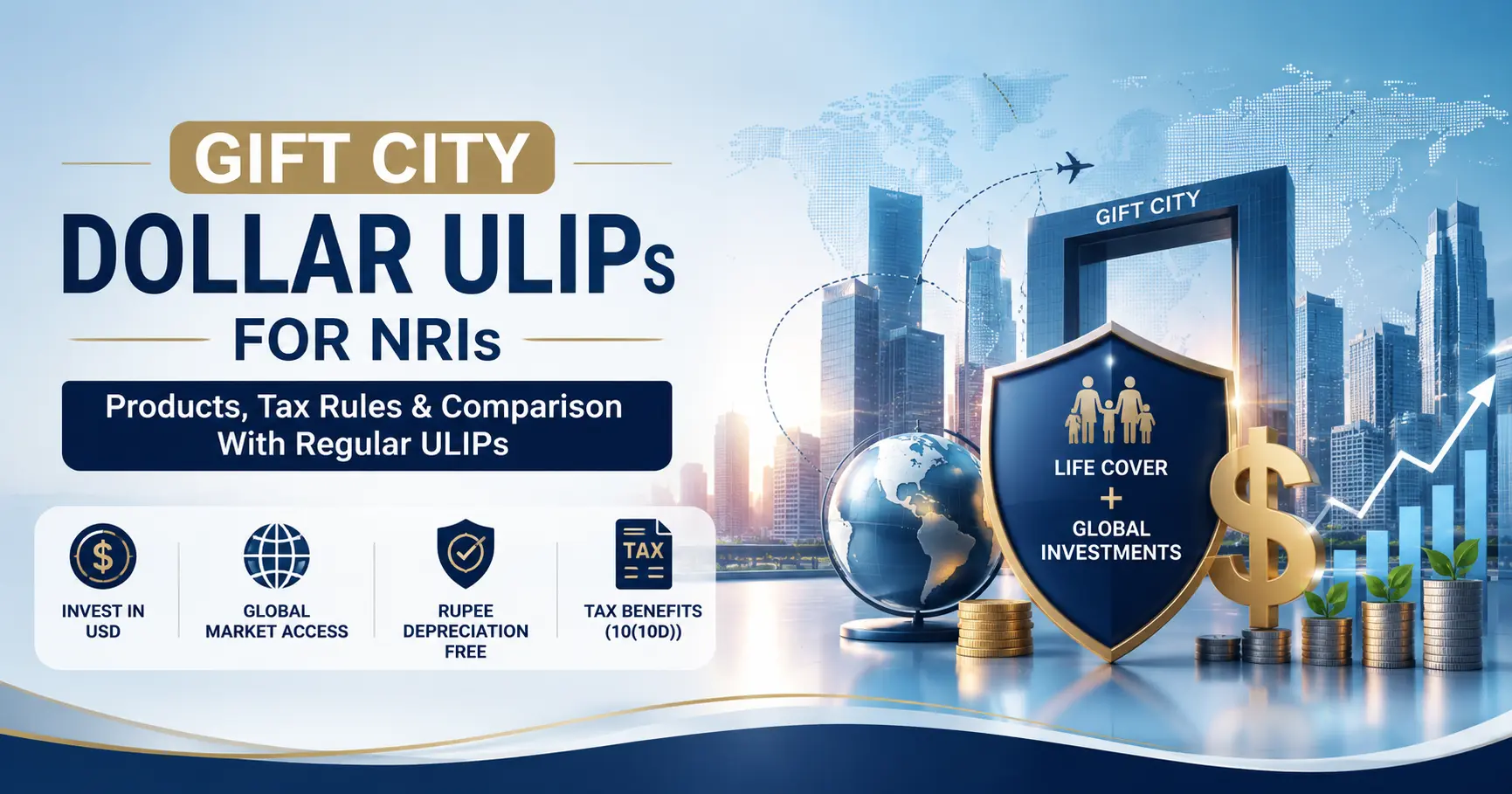
    GIFT City Dollar ULIPs are Unit Linked Insurance Plans issued from India’s International Financial Services Centre (IFSC) in GIFT City, Gujarat, denominated in US dollars or other permitted foreign currencies. For NRIs, these products offer rupee-depreciation-free insurance and investment exposure, as well as access to global equities, gold ETFs, oil funds, and international debt, all within the regulatory framework of the International Financial Services Centres Authority (IFSCA).

    The market has grown fast. 226 GIFT City ULIP products are now available across seven major life insurers, with cumulative gross written premiums at IFSC insurance offices growing nearly 45 times since 2020-21. For NRIs planning children’s foreign education, retirement, or dollar-denominated legacy transfer, these plans are becoming a serious alternative to buying regular Indian ULIPs or holding cash in NRE accounts.

    This guide breaks down everything an NRI needs to know: what GIFT City Dollar ULIPs are, how they compare with regular ULIPs, tax rules, key products, currency benefits, and what to watch out for before signing up.

    What Are GIFT City Dollar ULIPs

    A GIFT City Dollar ULIP is a life insurance-cum-investment product issued from an IFSC unit in GIFT City. Instead of receiving premiums in rupees and investing in Indian markets, the insurer collects premiums in US dollars (or other approved currencies) and invests them in global equities, international bonds, commodity ETFs, and currency instruments.

    Key features:

    • Regulator: IFSCA (not IRDAI)
    • Currency: USD, GBP, EUR, SGD, and other permitted foreign currencies
    • Structure: Combines life cover with market-linked investment
    • Target audience: NRIs, PIOs, OCIs, and resident Indians using the LRS route (up to USD 250,000 per year)

    Because premiums and payouts happen in foreign currency, the entire product hedges against rupee depreciation for NRIs planning dollar goals such as a US college education, foreign property purchase, or offshore retirement.

    To understand which route best fits your goals, explore our GIFT City Funds service designed exclusively for NRIs.

    Why GIFT City Matters: The IFSC Advantage for NRIs

    GIFT City (Gujarat International Finance Tec-City) is India’s first International Financial Services Centre. It is treated as an offshore jurisdiction for regulatory purposes, even though it sits on Indian soil.

    For NRIs, this delivers three big shifts:

    • Transactions happen in foreign currency, avoiding rupee conversion twice
    • Products are regulated by IFSCA, a unified regulator built for global finance
    • Access to a wider investment universe, including US equities, global ETFs, and international debt

    The framework was set up so that Indians (including NRIs) do not have to route their global goals only through Singapore, Dubai, or London. GIFT City brings that global exposure onshore in India while keeping the currency dollar-denominated.

    GIFT City ULIP vs Regular ULIP: The Full Comparison

    The table below highlights the differences NRIs should understand before choosing between the two.

    ParameterGIFT City ULIPRegular (Domestic) ULIP
    RegulatorIFSCAIRDAI
    CurrencyUSD or other permitted foreign currenciesIndian rupee (INR)
    Currency RiskEliminates rupee depreciation risk for foreign currency goalsRupee-denominated, exposed to depreciation
    Investment UniverseGlobal equities, overseas debt, international funds, commodity ETFs (gold, silver)Mostly domestic equities, debt, and money market instruments
    Target CustomersNRIs, PIOs, OCIs, and resident Indians (up to USD 250K through LRS)Primarily resident Indians and NRIs on rupee routes
    Tax on MaturityEligible for Section 10(10D) exemption if the sum assured is at least 10 times the annual premium; Rs. 2.5 lakh premium cap not applicableSection 10(10D) exemption available, but Rs. 2.5 lakh annual premium cap applies
    Minimum PremiumTypically USD 100 to USD 300 per monthRs. 1,500 to Rs. 5,000 per month

    GIFT City ULIP Products at a Glance

    Seven of India’s top insurers have launched IFSC offerings. Here is a snapshot of the leading GIFT City ULIP products available to NRIs.

    InsurerProduct NameFund Options
    HDFC Life InternationalGlobal Wealth AdvantageGlobal Multi-asset Funds, Global Equity
    Axis Max LifeSmart Global Investment Fostering PlanGlobal Diversified Advantage, US Technology
    ICICI PrudentialSmart Choice Global PlanUS Equity, Global Equity, AI & Technology Leaders
    Tata AIA LifeShubh Global InvestUS Equity, US Treasury, Global Commodities
    Star Union Dai-ichi LifeInternational Wealth CreatorGlobal Bond, Debt Fund
    Canara HSBC LifeWealth Wise Investment PlanGlobal Multi-asset
    IndiaFirst LifeGlobal Equity Fund, Debt FundGlobal Equity, Debt

    Minimum premium levels start from around USD 100 to USD 300 per month, making them accessible to salaried NRIs, not just ultra-high-net-worth investors.

    Who Can Invest in GIFT City ULIPs

    Eligibility is broader than most NRIs assume:

    • NRIs (Non-Resident Indians)
    • PIOs (Persons of Indian Origin)
    • OCIs (Overseas Citizens of India)
    • Foreign nationals working with global companies
    • Resident Indians using the Liberalised Remittance Scheme (LRS), up to USD 250,000 per financial year

    For NRIs, the buying process is straightforward and can typically be completed digitally with a passport, OCI card, visa proof, and address details. Payment can be made from an NRE account or directly through international wire transfer.

    If you are unsure about your residency classification, use our NRI Tax Residency Calculator before beginning the application.

    Tax Rules for NRIs on GIFT City Dollar ULIPs

    Taxation is one of the strongest reasons NRIs and HNIs are shifting to GIFT City ULIPs.

    Section 10(10D) Exemption

    Maturity proceeds are tax-exempt in India under Section 10(10D) if the sum assured is at least 10 times the annual premium. This exemption is what makes ULIPs attractive over pure mutual funds for long-horizon goals.

    The Rs. 2.5 Lakh Cap Does Not Apply

    Under the Finance Act 2021 amendment, domestic ULIPs with an annual premium above Rs. 2.5 lakh lose their Section 10(10D) exemption and are taxed as capital gains. However, GIFT City ULIPs are outside this cap, giving high-premium investors a legitimate tax-efficient wrapper.

    Home Country Tax Still Applies

    For NRIs living in the USA, UK, Canada, or Australia, the maturity or partial withdrawal from a GIFT City ULIP may still attract tax in the home country under local rules or PFIC provisions (in the US). Always evaluate cross-border implications before purchasing.

    TDS on Withdrawals

    Withdrawals for NRIs are generally not subject to Indian TDS if the Section 10(10D) exemption is available. Where it is not applicable, the TDS rules under Section 195 may kick in. Our team helps you plan exits before liquidity events.

    Read our detailed Capital Gain Tax advisory for cross-border tax planning.

    What GIFT City Dollar ULIPs Offer NRIs

    The investment universe available inside GIFT City ULIPs is significantly wider than what regular Indian ULIPs allow.

    Typical fund options include:

    • US equity indices (S&P 500, NASDAQ 100 exposure)
    • Global diversified equity funds
    • US Treasury bonds and international debt
    • Gold ETFs and silver ETFs
    • Commodity funds, including oil-linked exposure
    • Technology thematic funds (AI, semiconductors, cloud)
    • Currency instruments

    This makes GIFT City ULIPs a strong option for NRIs who want a single Indian-issued product that gives global exposure without opening a US brokerage or navigating PFIC-heavy mutual fund investing.

    Key Benefits of Dollar-Denominated Insurance for NRIs

    • Rupee-depreciation hedge: All premiums, benefits, and payouts are in USD, protecting against long-term INR weakness
    • Global exposure onshore: Access to overseas equities and debt without opening foreign brokerage accounts
    • Higher tax efficiency: No Rs. 2.5 lakh premium cap under Section 10(10D)
    • Simple estate planning: Nomination and claim settlement happen in dollars
    • NRE-friendly payments: Premiums can be paid from NRE or NRO accounts
    • Digital onboarding: Most insurers allow full digital purchase for NRIs
    • Wide currency options: USD, GBP, EUR, SGD available across products

    For NRIs planning to fund a child’s US or UK education, a dollar-denominated retirement corpus, or an inheritance in foreign currency, these plans align the currency of the goal with the currency of the investment.

    Points of Caution NRIs Must Consider

    GIFT City is still a nascent market. Experts caution against mixing insurance and investing without a clear plan.

    Key watch-outs:

    • Product category is new: Long-term performance data is limited
    • Currency risk works both ways: If the rupee strengthens, dollar-linked returns may underperform
    • Charges and mortality costs vary widely across products
    • Grievance redressal goes through IFSCA rather than IRDAI; escalation timelines can differ
    • Long lock-in: ULIPs need at least 5 to 10 years of commitment to deliver returns
    • Overlap with pure investing: For pure market exposure, a global mutual fund may be simpler than a ULIP

    If you already have adequate life cover, prioritise pure investment products for global exposure. If you need both, then a GIFT City ULIP may be the right structure.

    How to Buy a GIFT City ULIP as an NRI

    The process is largely digital and follows these steps:

    1. Confirm eligibility: NRI, PIO, or OCI with valid identity proof
    2. Choose currency and premium frequency: USD monthly, quarterly, or annual
    3. Select fund allocation: Equity, debt, commodity, or multi-asset mix
    4. Complete KYC with passport, visa, OCI card, and overseas address proof
    5. Fund payment through NRE account or international wire transfer
    6. Receive the policy document issued by the IFSC unit of the insurer

    If you are also planning to invest in mutual funds or PMS from GIFT City, review our Mutual Fund and PMS for NRI services.

    How MostlyNRI Helps You Decide the Right GIFT City Product

    Choosing between a GIFT City ULIP, a global mutual fund, a PMS, or a plain equity strategy is not a one-size-fits-all decision. It depends on your residency status, tax country, goal currency, time horizon, and existing insurance cover.

    At MostlyNRI, we help NRIs across the USA, UAE, UK, Canada, Singapore, and Australia with:

    • GIFT City product evaluation across insurers and fund options
    • Currency-goal matching so you invest in the right currency
    • Dual-tax analysis for your country of residence
    • Section 10(10D) planning to preserve exemption
    • Portfolio integration with Indian mutual funds, PMS, and NRE deposits
    • Documentation and onboarding assistance for GIFT City units

    Our team operates across 13 Indian cities and serves clients from over 33 countries.

    Frequently Asked Questions (FAQs)

    What is a GIFT City Dollar ULIP for NRIs?

    A GIFT City Dollar ULIP is a US dollar-denominated Unit Linked Insurance Plan issued from India’s IFSC in GIFT City. It combines life cover with global market investments and is regulated by IFSCA instead of IRDAI, offering NRIs currency-hedged, tax-efficient exposure.

    How many GIFT City ULIP products are available for NRIs?

    Around 226 GIFT City ULIP and insurance products are available across seven major insurers, including HDFC Life International, Axis Max Life, ICICI Prudential, Tata AIA Life, Star Union Dai-ichi, Canara HSBC Life, and IndiaFirst Life.

    Are GIFT City ULIP maturity proceeds tax-free for NRIs?

    Yes, if the sum assured is at least 10 times the annual premium, maturity proceeds are exempt under Section 10(10D). Importantly, the Rs. 2.5 lakh annual premium cap on domestic ULIPs does not apply to GIFT City ULIPs.

    Can resident Indians buy GIFT City Dollar ULIPs?

    Yes. Resident Indians can invest through the Liberalised Remittance Scheme (LRS), up to USD 250,000 per financial year. This makes GIFT City ULIPs accessible for parents saving in dollars for children’s overseas education or retirement.

    What is the minimum premium for a GIFT City ULIP?

    Minimum premiums typically start at USD 100 to USD 300 per month, depending on the insurer and plan variant. Some products also offer annual premium modes starting around USD 1,000 to USD 3,000 per year.

    How does GIFT City ULIP hedge against rupee depreciation?

    Because premiums, invested corpus, and maturity payouts are all in US dollars or other foreign currencies, NRIs planning dollar goals such as US education or overseas retirement avoid rupee conversion losses if the Indian currency weakens over time.

    Who regulates GIFT City ULIPs?

    IFSCA (International Financial Services Centres Authority) is the unified regulator for all products issued from GIFT City, including Dollar ULIPs. This is different from IRDAI, which regulates traditional Indian insurance policies sold in rupees.

    What is the tax arbitrage for HNIs shifting to GIFT City ULIPs?

    Domestic ULIPs with an annual premium above Rs. 2.5 lakh lose Section 10(10D) exemption. GIFT City ULIPs are outside that cap, allowing high-net-worth NRIs to invest large dollar premiums while preserving tax-free maturity under Indian law.

    Can NRIs pay GIFT City ULIP premiums from an NRE account?

    Yes. NRIs can pay premiums from their NRE account or through an international wire transfer in the eligible currency. NRO accounts may also be permitted by some insurers, but NRE is the preferred route for repatriation-friendly payouts.

    Should NRIs choose a GIFT City ULIP or a global mutual fund?

    If you need both life cover and global investment, a GIFT City ULIP fits well. If you have adequate cover and want pure market exposure, a global mutual fund or PMS is simpler. Match the product to your actual goal.

  • GIFT City Tax Benefits: A Complete Guide for International Investors

    GIFT City Tax Benefits: A Complete Guide for International Investors

    Introduction

    Finance companies are shifting from Dubai and Singapore to GIFT City for one big reason: tax advantages. As global markets become increasingly competitive, businesses are constantly searching for locations that offer not just regulatory ease but also significant financial incentives. India’s Gujarat International Finance Tec-City (GIFT City) has emerged as that destination—a world-class international financial services center that rivals established hubs while offering unmatched tax benefits.

    For international investors, fund managers, aircraft leasing companies, and fintech entrepreneurs, GIFT City represents a strategic opportunity to access India’s growing economy while enjoying exemptions and incentives typically associated with offshore jurisdictions. This comprehensive guide breaks down all the major tax benefits available in GIFT City’s International Financial Services Centre (IFSC), helping you understand why global businesses are making the move and how you can leverage these advantages for your operations.

    Whether you’re a foreign company exploring Asian expansion, an NRI looking for tax-efficient investment routes, or a financial institution seeking cost-effective operations, understanding GIFT City’s tax framework is essential for making informed decisions.

    What Is GIFT City and IFSC?

    GIFT City stands as India’s first and flagship International Financial Services Centre, strategically located between Ahmedabad and Gandhinagar in Gujarat. Launched with the vision of bringing global financial services back to India, GIFT City operates as a special economic zone designed specifically for finance, technology, and related services.

    The IFSC (International Financial Services Centre) within GIFT City functions as a jurisdictionally distinct zone where financial institutions can conduct transactions with non-resident entities in foreign currency. Think of it as India’s answer to London’s Canary Wharf or Dubai’s DIFC—a globally compliant financial district operating within Indian territory but with international standards.

    GIFT City welcomes diverse sectors including banking, capital markets, fund management, aircraft and ship leasing, bullion trading, insurance, reinsurance, wealth management, and fintech innovation. The entire ecosystem is regulated by the International Financial Services Centres Authority (IFSCA), which provides unified regulatory oversight, ensuring that businesses enjoy streamlined approvals and global-standard compliance frameworks.

    This unique positioning allows companies to serve international clients while benefiting from India’s growing economic influence and exceptional tax incentives unavailable elsewhere in the country.

    Types of Tax Benefits in GIFT City

    a) Corporate Income Tax Benefits

    GIFT City offers some of the most attractive corporate tax structures for qualifying IFSC units:

    • 10-year tax holiday: IFSC units enjoy 100% income tax exemption for the first 10 consecutive years from commencement of operations
    • Subsequent reduced rates: After the initial holiday period, units benefit from concessional tax rates significantly lower than standard Indian corporate tax
    • Specific activity coverage: Benefits apply to banking, insurance, fund management, aircraft leasing, securities trading, and other eligible financial services
    • No Minimum Alternate Tax (MAT): Unlike other Special Economic Zones, IFSC units are exempt from MAT during the tax holiday period
    • Carry-forward provisions: Losses can be carried forward and set off against future profits under specified conditions

    These incentives make GIFT City exceptionally competitive when compared to traditional corporate tax structures in major financial centers globally.

    b) Capital Gains Tax Exemptions

    Capital gains treatment in GIFT City creates unique advantages for investors and fund managers:

    • Exemption on securities transactions: Capital gains from transactions conducted on recognized stock exchanges in IFSC by non-residents are completely exempt from tax
    • Relocation benefits for foreign funds: Foreign portfolio investors (FPIs) and funds relocating their fund management activities to GIFT City receive special capital gains exemptions
    • Aircraft and ship leasing gains: Capital gains from lease rentals and transfers of aircraft/ships by IFSC units are tax-exempt
    • Zero tax on derivative transactions: Profits from derivative trading on IFSC exchanges face no capital gains tax
    • Offshore fund structuring: Fund managers can structure investments through GIFT City to optimize tax outcomes for global investors

    These exemptions position GIFT City as an ideal hub for asset managers looking to serve Asian and global markets efficiently.

    c) GST & Indirect Tax Benefits

    Indirect taxation in GIFT City follows an export-oriented model that significantly reduces operational costs:

    • Zero GST on export services: Services provided to clients outside India (offshore clients) are treated as exports and carry 0% GST
    • No GST on financial services: Transactions in securities, derivatives, and other financial instruments on IFSC platforms are GST-exempt
    • Customs duty exemptions: Goods imported into IFSC for authorized operations face no customs duties, providing substantial savings on equipment and technology
    • Simplified input tax credit: Even domestic transactions enjoy streamlined GST treatment with clear input credit mechanisms
    • SEZ benefits: As a Special Economic Zone, GIFT City units can import capital goods, raw materials, and consumables without duty

    For businesses accustomed to VAT structures in the Middle East or GST frameworks in Singapore, GIFT City’s indirect tax regime offers comparable or superior benefits.

    d) Personal Tax Benefits

    GIFT City extends tax advantages beyond corporations to the talented professionals who drive financial services:

    • Income tax exemptions for employees: Under specific conditions, allowances and perquisites for employees working in IFSC units receive favorable tax treatment
    • Concessional rates for expatriates: Foreign nationals working in GIFT City can benefit from special tax regimes and exemptions on certain allowances
    • Housing and relocation allowances: Tax-exempt treatment for qualified housing benefits makes relocation more attractive for global talent
    • Wealth accumulation incentives: Special provisions for stock options and long-term incentive plans in IFSC entities
    • Reduced compliance burden: Simplified tax filing and withholding requirements for IFSC employees

    These personal tax benefits help IFSC entities attract and retain top-tier international talent necessary for competing with established financial hubs.

    e) Tax Benefits for Specific Sectors

    GIFT City has tailored incentives for industries crucial to its financial ecosystem:

    Aircraft Leasing:

    • Complete tax exemption on lease rentals received from Indian and foreign airlines
    • Zero capital gains on aircraft sale or transfer
    • No withholding tax on lease payments to non-resident lessors

    Fund Management:

    • Tax pass-through status for funds registered in IFSC
    • Exemption from Securities Transaction Tax (STT) on certain transactions
    • Beneficial tax treatment for fund managers relocating operations

    Bullion Trading:

    • No customs duty on gold imports into IFSC for trading
    • Simplified taxation on bullion transactions
    • Infrastructure for compliant precious metals trading

    Insurance and Reinsurance:

    • Tax benefits for reinsurance companies setting up in IFSC
    • Preferential treatment for offshore insurance products
    • Simplified regulatory framework under IFSCA

    Fintech Ecosystems:

    • Tax incentives for technology service providers supporting IFSC entities
    • Exemptions for innovation-focused startups in financial technology
    • Regulatory sandboxes with tax-efficient structures

    Who Can Claim These Tax Benefits?

    Understanding eligibility is crucial for leveraging GIFT City’s tax advantages. The following entities and individuals qualify:

    Foreign Companies: International corporations establishing IFSC units for banking, trading, fund management, leasing, or other financial services can access the complete range of tax benefits.

    Global Banks and Financial Institutions: International banks setting up IFSC Banking Units (IBUs) receive tax holidays and exemptions on qualifying income from offshore transactions.

    Fund Managers: Asset management companies, private equity funds, venture capital funds, and alternative investment funds registered with IFSCA enjoy pass-through taxation and capital gains exemptions.

    NRIs (Non-Resident Indians): Indian nationals residing abroad can invest through GIFT City platforms and benefit from tax-efficient investment routes, particularly in securities and mutual funds.

    Offshore Trading Firms: Proprietary trading firms, market makers, and algorithmic trading operations conducting business through IFSC exchanges qualify for capital gains exemptions.

    Aviation and Shipping Companies: Entities engaged in aircraft leasing, ship leasing, or aviation finance receive sector-specific tax benefits when operating from GIFT City.

    Conditions to Qualify: To claim these benefits, entities must be registered with IFSCA, maintain substantial business operations in GIFT City, comply with minimum capital requirements where applicable, conduct transactions primarily in foreign currency with non-resident counterparties, and adhere to all regulatory and compliance obligations under IFSC regulations.

    GIFT City vs Other Global Financial Hubs

    Understanding how GIFT City compares to established competitors helps contextualize its value proposition:

    FeatureGIFT CityDubai (DIFC)Singapore
    Corporate Tax0% (10-year holiday), then reduced rates0% (50-year guarantee)17% standard rate
    GST / VAT0% on export services0% VAT in free zone8–9% GST
    Capital Gains TaxExempt for qualifying transactionsExemptUp to 15–20% depending on asset
    Withholding TaxExempt/reduced for IFSC transactionsExempt in DIFCReduced under treaties
    Cost of OperationsLow (30–40% lower than Singapore)HighVery High
    Market AccessDirect India access + global reachMiddle East + Africa focusAsia-Pacific gateway
    Regulatory FrameworkIFSCA (unified authority)DFSAMAS
    Time ZoneIST (advantageous for Asian markets)GST +4SGT +5:30

    Key Advantage: GIFT City combines aggressive tax incentives with significantly lower operational costs while providing direct access to India’s massive consumer market and Asia’s growing economies. For businesses seeking value without compromising on regulatory standards, GIFT City offers compelling advantages over traditional hubs.

    Compliance & Regulatory Ease

    One of GIFT City’s strongest selling points beyond tax benefits is its simplified regulatory environment:

    The International Financial Services Centres Authority (IFSCA) serves as the unified regulator for all financial services in GIFT City, eliminating the complexity of dealing with multiple regulators. This single-window clearance system dramatically accelerates licensing, approvals, and ongoing compliance.

    Faster licensing processes mean businesses can commence operations in weeks rather than months. IFSCA has designed streamlined application procedures specifically for international entities familiar with global standards.

    Global-standard policies ensure that GIFT City’s regulatory framework aligns with international best practices, making it comfortable for foreign institutions to operate while meeting their home country compliance requirements.

    Operational benefits include reduced paperwork, transparent fee structures, digitized compliance reporting, and proactive regulatory guidance. For CFOs and compliance officers, this translates to predictable timelines, lower legal costs, and minimal operational friction—savings that complement the direct tax benefits significantly.

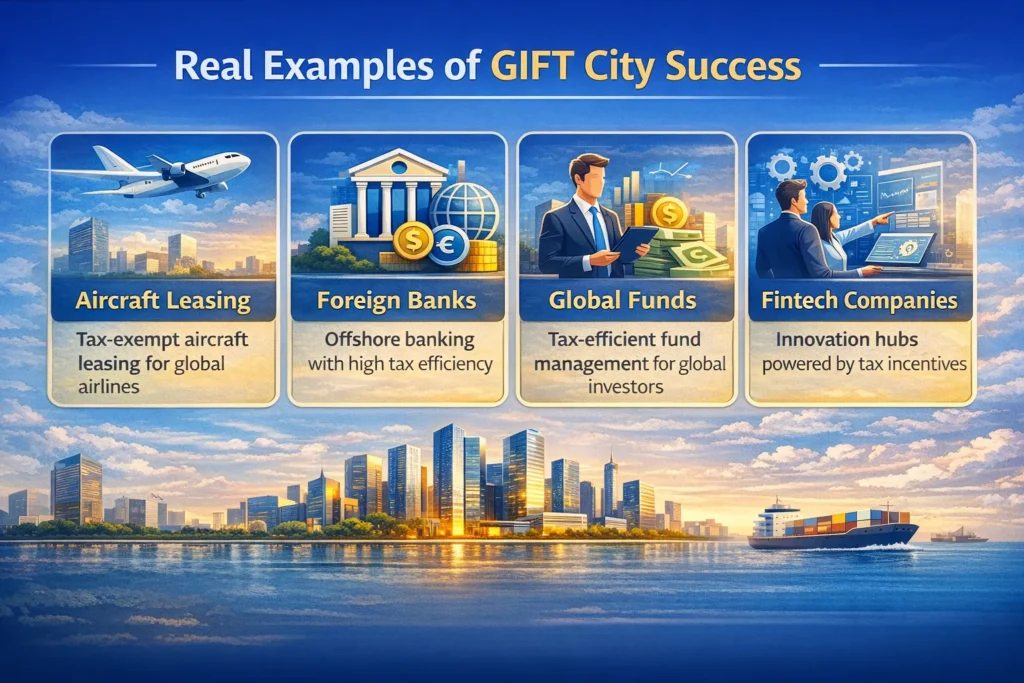
    Real Examples of GIFT City Success

    While confidentiality prevents naming specific entities, several notable trends demonstrate GIFT City’s practical appeal:

    Aircraft Leasing Companies have established substantial presence in GIFT City, taking advantage of the complete tax exemption on lease rentals. These entities now serve airlines across Asia and beyond, benefiting from both tax savings and India’s growing aviation market.

    Foreign Banks from North America, Europe, and Asia have opened IFSC Banking Units to serve offshore clients and conduct treasury operations with significant tax efficiency compared to their onshore Indian operations.

    Global Funds are increasingly relocating or establishing new fund management operations in GIFT City to serve international investors seeking exposure to Indian and Asian markets through tax-efficient structures.

    Fintech Companies have built innovation centers in GIFT City and investing in Gift City Fund, leveraging the regulatory sandbox environment and tax incentives to develop and test cutting-edge financial technologies for deployment across multiple markets.

    These examples demonstrate that GIFT City’s benefits aren’t theoretical—they’re delivering real value to diverse financial services businesses already operating within the ecosystem.

    Frequently Asked Questions

    What tax benefits do foreign companies get in GIFT City?

    Foreign companies establishing IFSC units receive a 10-year complete income tax holiday, zero GST on export services, capital gains tax exemptions, no customs duty on imports, and sector-specific benefits depending on their business activities.

    Is GST applicable inside GIFT City IFSC?

    No, services provided to offshore clients from GIFT City IFSC are treated as exports and carry 0% GST. Domestic transactions within IFSC also enjoy simplified GST treatment, and goods imported for use in IFSC operations face no GST.

    How long is the tax holiday in GIFT City?

    Qualifying IFSC units enjoy a 100% income tax exemption for 10 consecutive years from the commencement of operations, followed by concessional tax rates thereafter.

    Do NRIs also get tax incentives?

    Yes, NRIs investing through GIFT City IFSC platforms can benefit from capital gains exemptions on securities transactions, tax-efficient mutual fund investments, and simplified compliance compared to onshore Indian investments.

    What sectors get the biggest tax savings?

    Aircraft leasing companies, fund managers, bullion traders, insurance and reinsurance entities, and banking operations typically realize the most substantial tax savings due to the complete exemptions on their core income streams.

    Is GIFT City safer than traditional tax havens?

    Absolutely. Unlike offshore tax havens that face increasing scrutiny, GIFT City operates under robust IFSCA regulations aligned with international standards, provides legal certainty, and maintains full compliance with global anti-money laundering and tax transparency frameworks.

    Conclusion

    GIFT City represents a transformative opportunity for international investors and global financial institutions. With its comprehensive tax benefits—including 10-year income tax holidays, zero GST on export services, capital gains exemptions, and sector-specific incentives—GIFT City delivers financial advantages that rival or exceed established hubs while offering significantly lower operational costs.

    This is an exceptional time for global companies to establish presence in India’s flagship IFSC. As India positions itself as a major player in global finance, early movers in GIFT City gain not just immediate tax savings but strategic positioning in one of the world’s fastest-growing major economies.

    Whether you’re considering relocating operations, establishing a new Asian hub, or exploring tax-efficient investment structures, GIFT City deserves serious evaluation. The combination of aggressive incentives, regulatory ease, market access, and India’s economic trajectory creates a compelling value proposition.

    Ready to explore GIFT City for your business? Connect with specialized IFSC consultants who can assess your specific situation, guide you through the registration process, and structure your operations for maximum tax efficiency. Stay updated with IFSCA’s latest regulatory announcements and sector-specific guidelines to ensure you’re leveraging every available advantage.

    The future of Asian finance is being built in GIFT City—and the tax benefits ensure it’s not just strategically smart but financially rewarding to be part of that future.

    Also Read: How Big Is GIFT City? A Simple Breakdown of India’s New Financial Hub

  • How Big Is GIFT City? A Simple Breakdown of India’s New Financial Hub

    How Big Is GIFT City? A Simple Breakdown of India’s New Financial Hub

    Introduction

    GIFT City is suddenly everywhere in the news. From Fortune 500 companies setting up offices to the government pushing it as India’s answer to Singapore and Dubai, this smart city is making headlines.

    One question keeps popping up: How big is GIFT City?

    Is it just another business district? A small cluster of towers? Or something much larger?

    This guide breaks down GIFT City’s actual size, how the land is divided, what’s built so far, and what’s coming next. Simple facts. No jargon.

    What Is GIFT City?

    GIFT City stands for Gujarat International Finance Tec-City. It’s India’s first International Financial Services Centre (IFSC), designed to bring global financial services to Indian soil.

    Think of it as a mini financial capital with its own special economic zone, tax benefits, and world-class infrastructure. Located between Ahmedabad and Gandhinagar in Gujarat, GIFT City combines finance, technology, and smart city planning under one massive project.

    Quick Answer: How Big Is GIFT City?

    Here’s the snapshot:

    • Total Area: 359-hectare (886-acre)
    • Divided Into: IFSC zone + Domestic Tariff Area
    • Planned Built-up Area: 62 million sq. ft.
    • Land Usage: Commercial districts, residential zones, social infrastructure

    How big is that really?

    • About the size of 670 football fields
    • Nearly twice the size of Connaught Place in New Delhi

    GIFT City isn’t just big. It’s planned to be one of India’s most organized financial districts.

    Detailed Breakdown of the GIFT City Area

    Zone 1: IFSC (International Financial Services Centre)

    Purpose: This is the heart of GIFT City. The IFSC zone operates under special regulations that allow global financial activities with tax benefits and easier compliance.

    Land Allocation: A significant portion of the 886 acres falls under IFSC jurisdiction.

    Who Operates Here: International banks, insurance companies, fintech startups, asset management firms, brokers, aircraft leasing companies, and bullion exchanges. Companies like JP Morgan, Goldman Sachs, and several Indian banks have set up operations here.

    Zone 2: Domestic Tariff Area

    Purpose: This zone functions under regular Indian tax and business laws. It supports domestic businesses that want proximity to the IFSC but don’t need special zone benefits.

    What Type of Companies Operate Here: IT firms, consulting agencies, domestic financial institutions, and support services.

    Land and Building Usage: Office complexes, service centers, and ancillary infrastructure that supports the IFSC ecosystem.

    How the Land Is Used: Key Components

    GIFT City’s 886 acres are divided into multiple functional zones:

    Commercial District

    The core business area with office towers, financial institutions, and corporate headquarters. High-rise buildings dominate this zone, designed for maximum efficiency and modern workspace requirements.

    Residential District

    Planned housing for professionals working in GIFT City. Apartments, villas, and serviced residences are being developed to create a live-work environment within the city.

    GIFT Riverfront

    A recreational zone along the Sabarmati River. This area includes walking paths, green spaces, and leisure facilities to balance the corporate atmosphere.

    Social Infrastructure

    Schools, hospitals, community centers, and public spaces. GIFT City is designed as a complete city, not just an office park.

    Educational and Institutional Area

    Universities, training centers, and research institutions focused on finance, technology, and management. These facilities support skill development for the financial sector.

    Retail and Hospitality Zone

    Shopping centers, restaurants, hotels, and entertainment venues. This zone serves both residents and the thousands of daily professionals working in GIFT City.

    Utility and Tech-Based Infrastructure

    GIFT City runs on advanced infrastructure including district cooling systems, automated waste management, underground utilities, and high-speed connectivity. Everything is designed for efficiency and sustainability.

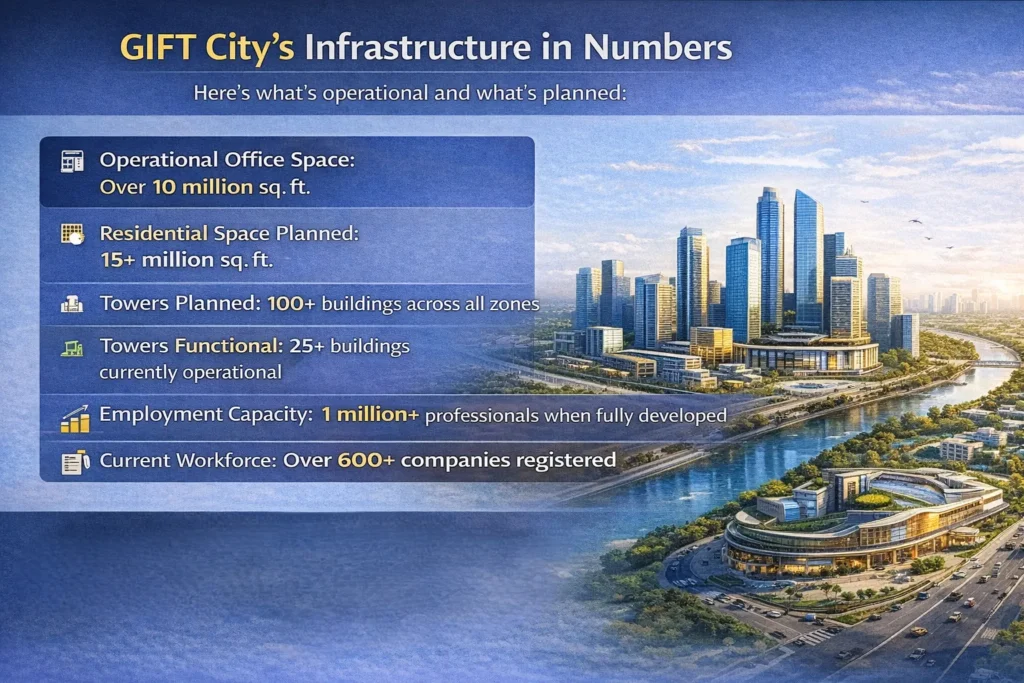
    GIFT City’s Infrastructure in Numbers

    Here’s what’s operational and what’s planned:

    • Operational Office Space: Over 10 million sq. ft.
    • Residential Space Planned: 15+ million sq. ft.
    • Towers Planned: 100+ buildings across all zones
    • Towers Functional: 25+ buildings currently operational
    • Employment Capacity: Estimated to create jobs for over 1 million professionals when fully developed
    • Current Workforce: Growing rapidly with over 600+ companies registered

    These numbers keep changing as new phases get completed.

    GIFT City’s Expansion Plan

    Current Phase

    The first phase focused on establishing the IFSC zone with core infrastructure. Major towers like GIFT One, GIFT Two, and GIFT SEZ are operational. Banking, insurance, and capital market firms have already moved in.

    Next Phase (Over Next 5–10 Years)

    The second and third phases will expand commercial space, complete residential districts, and develop social infrastructure. More office towers, hotels, hospitals, and educational institutions are under construction.

    Future Expected Area Usage

    By 2030, GIFT City aims to utilize the full 886 acres with complete build-out of all zones. The goal is to create a self-sustaining financial city that rivals global financial centers.

    New Sectors Entering

    Beyond banking and insurance, GIFT City is attracting aircraft leasing companies, bullion trading platforms, fund management firms, fintech startups, and even aviation finance. The government is actively promoting new sectors to diversify the financial ecosystem.

    Why the Size of GIFT City Matters

    For Investors

    The sheer scale means long-term stability. GIFT City isn’t a small experiment. With 886 acres and 62 million sq. ft. of planned space, this is a multi-decade project backed by government commitment.

    For Companies Moving to GIFT City

    Size translates to capacity. There’s room for thousands of companies to set up operations without space constraints. The infrastructure can support massive growth in employment and business activity.

    For NRIs

    A large, well-planned financial hub means better opportunities for investment, employment, and business setup. GIFT City’s size allows it to accommodate diverse needs from banking to real estate.

    For India’s Global Finance Ambitions

    India needs a city that can compete with Singapore, Hong Kong, and Dubai. The 886-acre GIFT City provides the physical foundation to build that global reputation. Size matters when attracting multinational corporations and positioning India as a financial superpower.

    FAQs

    How many acres is GIFT City?

    GIFT City spans 886 acres, making it one of India’s largest planned financial districts.

    How big is the IFSC zone in GIFT City?

    The IFSC zone occupies a major portion of GIFT City’s total area, dedicated exclusively to international financial services with special regulatory benefits.

    How much land is developed so far in GIFT City?

    Approximately 30-40% of the total area is currently developed with operational office towers, infrastructure, and initial residential projects. Development is ongoing across multiple phases.

    How much office space is available in GIFT City?

    Over 10 million sq. ft. of office space is currently operational, with plans to expand to over 30 million sq. ft. in the coming years.

    How fast is GIFT City expanding?

    GIFT City is expanding rapidly with multiple towers under construction. New companies are registering every month, and infrastructure development is progressing across all zones.

    What companies are already present in GIFT City?

    Over 600 companies including major banks like JP Morgan, HSBC, Bank of America, insurance firms, fintech companies, and several Indian financial institutions have established operations.

    Is GIFT City bigger than other Indian financial districts?

    Yes. GIFT City’s 886 acres make it significantly larger than Mumbai’s Bandra Kurla Complex (370 acres) and comparable to major global financial districts in terms of planned capacity.

    Conclusion

    GIFT City is 886 acres of planned financial infrastructure. That’s the simple answer.

    But the real story is what happens on that land. A complete financial ecosystem with international banks, insurance companies, fintech startups, and world-class infrastructure. A city designed from scratch to handle India’s growing role in global finance.

    The size matters because it shows ambition. India isn’t building just another business district. GIFT City has the space, planning, and government backing to become a true alternative to Singapore and Dubai.

    As more companies move in and more infrastructure gets built, those 886 acres will define India’s financial future.

    Want to know more about investing or setting up in GIFT City Funds? Check out our complete guide to GIFT City regulations, tax benefits, and business opportunities.

    Also Read: Gift City Tax Benefits for NRIs

  • Gift City Funds – Everything You Need to Know

    Gift City Funds – Everything You Need to Know

    Investment products such as mutual funds, AIFs, and PMS are offered by GIFT City Funds, an International Financial Services Center (IFSC) located in Gujarat International Finance Tec-City (GIFT City), India. These funds, which are governed by the IFSCA (IFSCA) in accordance with international standards, give Indian and non-resident Indian investors access to international markets (such as the US, China, etc.) using foreign currencies (such as USD) with substantial tax advantages (such as reduced dividend and capital gains taxes) and simpler repatriation, circumventing many of the limitations associated with traditional Indian investments.

    Gujarat International Finance Tec-City (GIFT City) has quickly become India’s financial hub for global investments. For NRIs, OCIs, and even Indian residents, Gift City funds are creating new opportunities to diversify portfolios, invest in international markets, and enjoy tax benefits — all from a single gateway.

    What is GIFT City?

    Gift City Funds

    GIFT City (Gujarat International Finance Tec-City), located in Gandhinagar, Gujarat, is India’s first International Financial Services Centre (IFSC). It was conceived in 2008 and has grown into a smart financial hub with:

    • Banks and IFSC Banking Units (IBUs)
    • Asset Management Companies (AMCs)
    • Insurance and reinsurance firms
    • Stock exchanges like NSE IFSC & India INX

    For investors, GIFT City bridges India and global markets by allowing seamless cross-border investments.

    What are GIFT City Funds

    Gift City, also called Gujarat International Finance Tec-City, is the first International Financial Services Center (IFSC) in India. Banks, financial institutions, and other multinational corporations call it home, providing them with a favorable setting in which to set up shop and efficiently conduct business. Gift City funds are funds that asset management companies (AMCs) have introduced in Gift City. They have a special set of advantages that help non-resident Indians (NRIs) and Indian citizens living abroad (OCIs) with mutual fund investing in India.

    Key features of GIFT City Funds

    Regulated by IFSCA

    Governed by the International Financial Services Centres Authority.

    Global investments

    Funds can invest in equities, bonds, ETFs, derivatives, and alternative assets across markets.

    Multi-currency access

    USD, EUR, GBP, and other major currencies.

    Offshore structure

    Treated like international funds but managed in India.

    Understanding GIFT City Mutual Funds

    A GIFT City mutual fund is an investment vehicle offered through the International Financial Services Centre (IFSC) in GIFT City, Gujarat, designed to give investors access to international markets. These funds allow you to invest in global equities, debt instruments, and other international assets while being regulated by the IFSCA. Both Indian residents and NRIs can use these funds as a simpler alternative to making direct overseas investments.

    What Makes GIFT City Mutual Funds Distinctive

    Access to Global Markets: These funds provide exposure to a diverse range of international securities, including global stocks, bonds, and commodities, all accessible through a single platform.

    Streamlined Investment Process: They eliminate the complexity of opening foreign brokerage accounts, managing currency exchanges, and navigating foreign tax requirements that typically come with overseas investing.

    Foreign Currency Denomination: Most GIFT City funds are denominated in currencies like USD, which helps you avoid repeated currency conversion costs and protects your returns from exchange rate fluctuations.

    Professional Management and Regulation: Investment teams with international expertise manage these funds under IFSCA oversight, offering you a professionally managed investment experience similar to domestic mutual funds.

    LRS Framework: Investments fall under the Liberalized Remittance Scheme parameters established by the Reserve Bank of India, permitting outward remittances up to $250,000 per financial year per individual.

    Comparing GIFT City Funds with Regular Indian Mutual Funds

    FeatureGIFT City Mutual FundRegular Indian Mutual Fund
    Underlying AssetsGlobal equities, debt, and international securitiesPrimarily Indian equities, debt, and domestic securities
    CurrencyForeign currency denominated (typically USD)Indian Rupee (INR) denominated
    Investment ProcessStreamlined process through IFSCA-regulated platformsStandard domestic investment procedures
    Tax HandlingFund manages foreign tax obligations; investors handle Indian tax complianceInvestors manage Indian tax obligations only

    Types of Investment Options in GIFT City

    Investment Avenues via GIFT City – MostlyNRI

    Investment AvenueWho Can InvestKey Highlights
    Mutual Funds (Global Funds)NRIs & ResidentsAccess to global equities and bonds; repatriation-friendly
    Alternative Investment Funds (AIFs)HNIs, Institutions$150,000+ ticket size; private equity, real estate, hedge funds
    Portfolio Management Services (PMS)HNIs, NRIsDiscretionary & advisory portfolio services
    NSE IFSC Receipts (UDRs)Residents & NRIsFractional ownership of top 50 US stocks
    GIFT NiftyNRIs & TradersExtended trading hours; high liquidity derivatives
    Offshore DepositsNRIsMulti-currency deposits with competitive interest rates

    Features of GIFT City Funds

    GIFT City Funds offers investors a unique opportunity to participate in the growth of India’s premier International Financial Services Centre.

    Tax Benefits of GIFT City Funds

    Benefit from substantial tax exemptions on dividends, interest income, and capital gains—specially tailored for NRIs and OCIs.

    Global Reach, Local Advantage

    Tap into a strong network of international banks, insurers, and asset managers—while gaining exposure to India’s fast-growing economy.

    Global Financial Gateway

    GIFT City is emerging as India’s gateway to global finance, similar to the roles played by Singapore and Hong Kong in their regions. Experience seamless trading in a tech-enabled ecosystem featuring global derivatives, cutting-edge fintech innovations, and smart, investor-focused solutions.

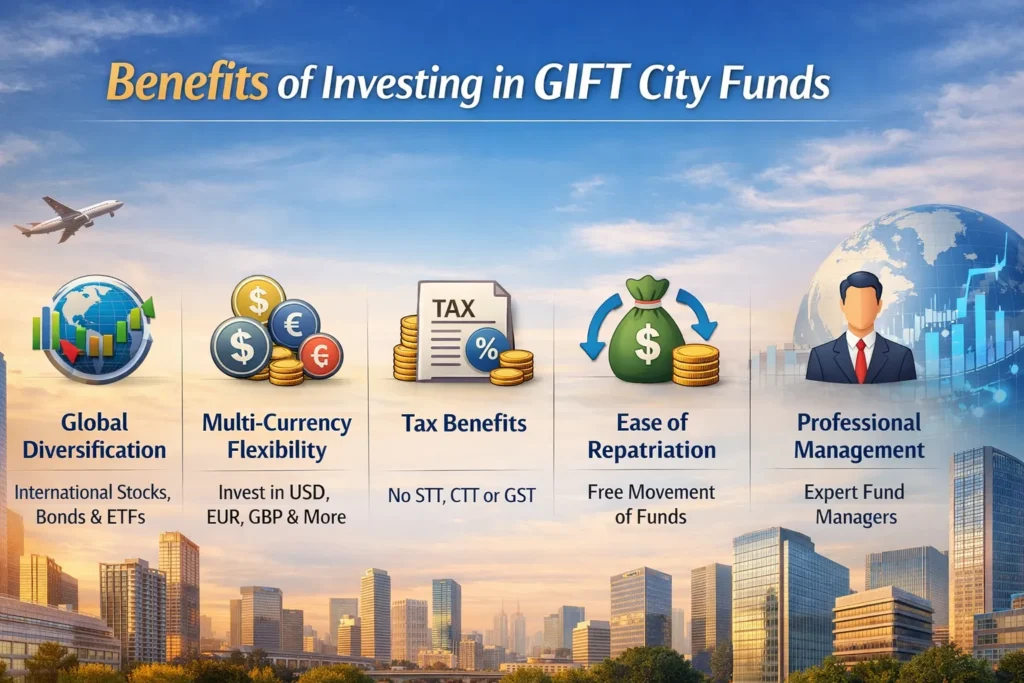
    Benefits of Investing in GIFT City Funds

    1. Global Diversification – Access international equities, bonds, ETFs, and alternatives from one platform.
    2. Multi-Currency Flexibility – Invest in USD, EUR, GBP, etc. without mandatory INR conversion.
    3. Tax Benefits – No STT, CTT, or GST; concessional tax rates on bonds and dividends.
    4. Ease of Repatriation – Funds can be moved in and out freely, subject to RBI’s LRS limit ($250,000 per person per year).
    5. Professional Management – Experienced fund managers handle portfolios with global expertise.

    Risks You Should Know

    Like any market-linked investment, Gift City funds carry risks:

    • High Minimum Investment – AIFs start at $150,000+, limiting access to HNIs.
    • Liquidity Risk – Harder to exit quickly vs domestic mutual funds.
    • Market Risk – Returns fluctuate with global markets.
    • Currency Risk – Exchange rate changes can impact returns.

    Tax Benefits of GIFT City Investments

    • No STT, CTT, Stamp Duty, or GST on IFSC transactions.
    • Concessional TDS on dividends (lower than outside IFSC).
    • Tax-free Interest Income from lending to IFSC units.
    • Bond Benefits:
      • Issued before July 1, 2023 → taxed at 4%
      • Issued after July 1, 2023 → taxed at 9%
    • NRI-Specific Benefits: Many double-taxation treaties (DTAA) reduce tax burden further.

    ⚠️ Note: For Indian residents, LTCG (12.5%) and STCG (20%) apply. TCS (20%) is charged for remittances above ₹10 lakh under RBI’s LRS, but it can be adjusted as advance tax.

    How Can NRIs and Residents Invest in GIFT City Funds?

    You can invest through:

    • Direct AMC Websites – e.g., Edelweiss, DSP, Mirae Asset.
    • Banks with IFSC Units – ICICI, HDFC, Standard Chartered.
    • Registered Brokers – NSE IFSC brokers provide accounts and access.
    • Financial Advisors/Wealth Managers – Especially for HNIs investing in AIFs or PMS.

    GIFT City Funds vs Domestic Mutual Funds vs Direct Overseas Investment

    GIFT City Funds vs Domestic vs Direct Overseas (LRS)

    FeatureGIFT City FundsDomestic Mutual FundsDirect Overseas (LRS)
    Market AccessGlobal + IndianMostly IndianGlobal
    TaxationNo STT/CTT/GST, concessional taxTDS, GST, STT applyCountry-specific
    Minimum Investment$150k+ (AIFs)₹5k–10kFlexible
    Currency OptionsUSD, EUR, GBPINR onlyUSD, EUR
    Ease of RepatriationHighRestrictedVaries

    What are GIFT City Funds?

    GIFT City Fund is a mutual fund that invests in companies and sectors benefiting from the development of Gujarat International Finance Tec-City (GIFT City), focusing on urban growth, finance, and infrastructure.

    Who should invest in GIFT City Funds?

    Investors looking for exposure to India’s emerging smart city economy and those seeking long-term growth through diversified urban sector investments can consider this fund.

    Can I invest in GIFT City Funds through SIP?

    Yes, the fund offers flexible investment options, including Systematic Investment Plans (SIPs) and lump-sum investments to suit different investor needs.

    What level of risk is associated with GIFT City Funds?

    The fund typically involves moderate to high risk as it invests in sectors related to infrastructure and finance, which can be affected by market fluctuations.

    Can NRIs invest in Gift City Funds?

    Yes. NRIs and OCIs can invest freely under FEMA and SEBI rules, in multiple currencies.

    Is GIFT City tax-free?

    Not fully. It offers several tax incentives (no STT, no GST, concessional TDS), but LTCG/STCG may still apply depending on residency.

    What is the minimum investment?

    AIFs require $150,000+, but retail-focused funds like the DSP Global Equity Fund allow smaller tickets.

    How does GIFT City differ from regular mutual funds?

    Regular MFs focus on India and are taxed normally. GIFT City funds allow global exposure, multiple currencies, and tax savings.

    Can foreigners invest?

    Yes. Foreign Portfolio Investors (FPIs), NRIs, and institutions can all invest.

    How to Invest in DSP Global Equity Fund from GIFT City

    Investing in the DSP Global Equity Fund through u003ca href=u0022https://giftgujarat.in/u0022 data-type=u0022linku0022 data-id=u0022https://giftgujarat.in/u0022u003eGIFT Cityu003c/au003e involves completing an application, transferring funds in USD via your bank, and receiving unit allocation after verification. Here’s how the process works.u003cbru003eu003cbru003eGetting Started with Your Application: Begin by downloading the DSP IFSC application form from the DSP Mutual Fund website and filling in your personal details. You’ll need to prepare your KYC documents, including the completed application form along with valid ID and address proofs.u003cbru003eu003cbru003eSubmitting Your Documentation: Send scanned copies of your completed form and supporting documents to u003ca href=u0022mailto:[email protected]@dspim.comu003c/au003e. Additionally, courier the original documents to DSP’s GIFT City office. The fund house will create a zero-balance folio for you once they process your application.u003cbru003eu003cbru003eTransferring Funds Through LRS: After your folio is created, you’ll receive remittance instructions. Approach your bank to initiate a transfer under the Liberalised Remittance Scheme (LRS), which allows you to send up to $250,000 per financial year per PAN. Your bank will handle the rupee-to-dollar conversion and transfer the amount to the fund’s GIFT City account.u003cbru003eu003cbru003eFinalizing Your Investment: Once you’ve completed the remittance, email your proof of transfer along with your folio number to u003ca href=u0022mailto:[email protected]@dspim.comu003c/au003e. DSP Mutual Fund will verify the transaction and allocate units to your account. You’ll receive a confirmation email and Statement of Account when the process is complete.

  • What Are Investment Options for NRIs/OCIs in GIFT City?

    What Are Investment Options for NRIs/OCIs in GIFT City?

    What Are Investment Options for NRIs/OCIs in GIFT City?

    #giftcity, #nriguide, #investmentopportunities
    If you’re an NRI (Non-Resident Indian) or OCI (Overseas Citizen of India) looking to invest in India, GIFT City (Gujarat International Finance Tec-City) might just be the perfect gateway. Imagine a financial hub designed to make global investing easier, more efficient, and tax-friendly—that’s GIFT City for you.But what exactly can you invest in, and how much money do you need to get started? Let’s break it down.

    Why GIFT City Is a Big Deal for NRIs/OCIs?

    #giftcitybenefits, #nriinvestments, #globalmarkets
    GIFT City operates under India’s International Financial Services Centre (IFSC) framework—think of it as a mini financial world within India that follows global standards. Here’s what makes it stand out:
    • Tax-Friendly Environment: Enjoy lower tax rates, tax exemptions, and fewer compliance headaches.
    • Global Market Access: Invest in both Indian and international financial products from one place.
    • Multi-Currency Transactions: No more juggling currency conversions—transact in INR, USD, EUR, and more.
    • High-Tech Infrastructure: Trading and investments here are backed by state-of-the-art technology and regulatory ease.
    Now, let’s dive into the different ways you can put your money to work.

    1. Opening Offshore Accounts at GIFT City Banks

    #offshorebanking, #giftcityaccounts, #multicurrencyaccounts
    Several Indian banks have international banking units in GIFT City. Through these:
    • Multi-Currency Accounts: Hold your funds in different currencies without the usual hassles.
    • FCNR Deposits: Lock in attractive interest rates on foreign currency deposits.
    • Structured Products: Explore investment products that mix fixed income with market-linked returns.
    Minimum Investment: You can often start with as little as a few thousand dollars (or equivalent INR) for fixed deposits. Some banks may have even lower thresholds for savings accounts. It’s always best to check with the specific bank you’re interested in.

    2. Investing in Global Markets

    #globalinvestments, #giftcitymarkets, #internationalstocks
    Ever wanted to diversify beyond Indian shores while staying connected to India? GIFT City makes it easy:
    • International Equities & ETFs: Invest in global stocks and ETFs listed on overseas exchanges.
    • Foreign Bonds: Add stability to your portfolio with foreign currency-denominated bonds.
    • Derivatives Trading: Hedge your bets and manage risk with commodity and currency derivatives.
    Minimum Investment: Depending on your chosen brokerage, you could start with as little as a few hundred dollars. Most brokers set a low barrier to entry, so it’s accessible even for smaller investors.

    3. Diving into Indian Stocks and Debt Markets

    #indianstocks, #giftcityinvestments, #nridebtmarkets
    • Want to tap into India’s growth story? GIFT City’s IFSC makes it straightforward:
      • Foreign Portfolio Investor (FPI) Route: Register as an FPI and invest in Indian equities, mutual funds, and bonds.
      • Government & Corporate Bonds: Earn a steady stream of interest with potentially lower tax rates.
      • Mutual Funds: Access a wide range of Indian mutual funds without complicated red tape.
      Minimum Investment: Many mutual funds allow you to start with as low as ₹5,000 (around $70). For direct equities, you could start with even less, depending on the stock price. Bonds typically require a slightly higher minimum, but many start in the range of ₹10,000–₹50,000 (about $140–$700).

    4. Alternate Investment Funds (AIFs)

    #aifinvestments, #giftcityalternates, #venturecapital
    • Looking for something beyond the usual stocks and bonds? Consider AIFs:
      • Private Equity/Venture Capital Funds: Get exposure to high-growth Indian startups.
      • Real Estate Funds: Participate in the growth of India’s property market without directly owning real estate.
      • Hedge Funds: For experienced investors looking for complex strategies and potentially higher returns.
      Minimum Investment: AIFs generally cater to more affluent investors. Expect to commit at least ₹1 crore (approximately $140,000) for many AIFs. It’s a bigger ticket option, but offers unique diversification.

    5. Real Estate in GIFT City

    #giftcityrealestate, #commercialspaces, #residentialinvestment
    • If you prefer tangible assets, GIFT City’s rapidly developing infrastructure offers:
      • Commercial Spaces: High-quality office spaces that can be leased out.
      • Residential Apartments: Modern homes with the city’s perks at your doorstep.
      • Retail Outlets: Investments in malls and retail complexes for rental income.
      Minimum Investment: Real estate investments typically require a larger sum. While smaller studio apartments might start around ₹30–40 lakhs (about $40,000–$55,000), commercial properties can go higher.

    6. Precious Metals and Commodities

    #commodityinvestments, #preciousmetals, #giftcitycommodities
    • Hedge against inflation or diversify with gold and other commodities:
      • Gold Trading: Add a reliable store of value to your portfolio.
      • Commodity Derivatives: Invest in energy, metals, and agriculture commodities via derivatives.
      Minimum Investment: You can buy small amounts of gold or other commodities. For gold ETFs, you can start with the price of just 1 gram of gold (a few thousand rupees).

    7. Insurance and Reinsurance

    • Secure your future with insurance products:
      • Life & Health Insurance: Get customized policies offered by insurers stationed at GIFT City.
      • Reinsurance Investments: A niche area for sophisticated investors or those in the insurance business.
      Minimum Investment: Insurance premiums vary widely. A basic term insurance policy can start from just a few hundred dollars annually.

    Final Thoughts

    • GIFT City is more than just a place to park your money; it’s a gateway that blends India’s growth potential with global opportunities. NRIs/OCIs of all investment sizes—big or small—can find something that fits their strategy. Whether you’re investing for the first time or expanding an already diverse portfolio, GIFT City offers a world of possibilities.
  • How Does GIFT City Help NRIs/OCIs Invest in India?​

    How Does GIFT City Help NRIs/OCIs Invest in India?​

    How Does GIFT City Help NRIs/OCIs Invest in India?

    If you’re an NRI (Non-Resident Indian) or OCI (Overseas Citizen of India), you’ve probably considered investing in India’s booming economy. But navigating regulations, currency issues, and tax complexities can be a challenge. That’s where GIFT City—India’s International Financial Services Centre (IFSC) in Gujarat—comes in as a game-changer.

    GIFT City (Gujarat International Finance Tec-City) is designed to make global financial transactions seamless, and it offers numerous benefits for NRIs and OCIs looking to invest in India. Let’s explore how.

    Also read How Much Does an NRI/OCI Need to Retire in India?​

    Also read Streamlined NRI Tax Services in Calcutta – Trusted Guidance for Expats

    What Is GIFT City?

    #giftcity, #ifsc, #smartcity, #financialhub

    GIFT City is India’s first operational smart city and IFSC, located in Gandhinagar, Gujarat. It serves as a hub for international financial services, akin to Singapore or Dubai. The city operates under its own special regulatory framework, which provides a global platform for financial transactions while offering incentives for businesses and investors.

    Benefits of Investing Through GIFT City:

    #giftcity, #nriinvestment, #taxbenefits
    1. Access to Global Investment Products
      GIFT City allows NRIs/OCIs to invest in international and Indian markets seamlessly:

      • You can open accounts with Indian banks operating in the IFSC to trade in global equities, bonds, and other financial instruments.
      • It provides access to India’s international financial products, such as offshore derivatives and foreign currency-denominated bonds.
    2. Special Tax Incentives
      One of the key attractions of GIFT City is its tax-friendly framework:

      • No Capital Gains Tax: Investments in certain categories (e.g., derivatives or specified debt securities) are exempt from capital gains tax.
      • No Dividend Distribution Tax (DDT): Companies operating in the IFSC are exempt from DDT, ensuring better returns for investors.
      • Reduced Tax on Interest Income: NRIs investing in debt instruments through GIFT City benefit from reduced withholding tax rates on interest income.
    3. Ease of Compliance
      The IFSC operates under relaxed regulatory norms tailored to attract international investors:

      • Faster onboarding for NRIs and OCIs due to simplified Know Your Customer (KYC) norms.
      • Access to a single-window clearance system for all regulatory approvals.
    4. Multi-Currency Transactions
      GIFT City banks and financial institutions facilitate transactions in multiple currencies, making it easier for NRIs/OCIs to manage foreign exchange risks.
    5. Real Estate Investments
      NRIs/OCIs can also invest in real estate through GIFT City. With high-quality commercial and residential projects being developed, the city is positioned as a global financial hub with excellent infrastructure.
    6. FPI (Foreign Portfolio Investment) Opportunities
      NRIs/OCIs can register as Foreign Portfolio Investors (FPIs) through GIFT City, allowing them to invest in Indian stocks, mutual funds, and other securities with fewer regulatory restrictions.
    7. Wealth Management Services
      GIFT City hosts world-class financial institutions offering tailored wealth management solutions for NRIs/OCIs. These services help streamline investments and align them with your financial goals.

    How to Start Investing in GIFT City?

    #giftcity, #nriinvestmentguide, #howtoinvest
    1. Open a GIFT City Bank Account
      Indian banks operating in GIFT City, such as SBI, HDFC, or ICICI, offer special accounts for NRIs/OCIs. These accounts enable you to transact in foreign and Indian currencies.
    2. Register as an FPI (Optional)
      If you wish to access India’s stock and bond markets through GIFT City, you can register as an FPI via authorized institutions.
    3. Choose Your Investment Products
      Decide whether you want to invest in:

      • Global financial products
      • Indian equities, mutual funds, or bonds
      • Real estate projects within GIFT City
    4. Consult a Financial Advisor
      Navigating tax laws, currency exchanges, and regulatory requirements can be complex. A professional advisor familiar with GIFT City’s offerings can simplify the process.

    Why GIFT City Is a Game-Changer for NRIs/OCIs

    #giftcity, #globalfinance, #investmentopportunities

    By bridging the gap between India and global financial markets, GIFT City has emerged as a one-stop destination for NRIs/OCIs to invest in India. Its tax-friendly policies, regulatory ease, and access to diverse investment opportunities make it an attractive option for those looking to diversify their portfolios while staying connected to India’s growth story.

    So, whether you’re planning to invest in global equities, Indian markets, or even real estate, GIFT City offers a unique blend of flexibility and opportunity tailored for NRIs/OCIs.

    Also Read: How can NRIs help parents obtain PMJAY benefits?

    Also read: IRS Form 1040 Filing Guide: How to Fill Out Your U.S. Individual Income Tax Return