



Picture this. You moved to the US for work. You built a life there. But your heart is still tied to India. Now tax season arrives. And you feel stuck between two countries, two tax systems, and a pile of confusing forms.
I have been there. Well, sort of. I helped my cousin figure this out last year. He is an NRI in Texas. He had income in both countries. And he was scared of making a mistake.
The truth is simple. Filing US taxes as an NRI is not rocket science. You just need the right steps in the right order.
Let me walk you through it.
Who Is Considered an NRI for Tax Purposes?
Here is where most people get confused. You might be a resident in one country but a non-resident in the other.
Indian Tax Residency Rules
The Income Tax Department India looks at your physical stay. You become an NRI if:
- You stay in India for less than 182 days in a financial year
- Or you stay for less than 365 days in the last 4 years and less than 60 days in the current year
Simple enough, right?
US Tax Residency Rules
The IRS uses two tests:
The Green Card Test – If you hold a valid green card, you are a US resident for tax purposes. Plain and simple.
The Substantial Presence Test – This one involves math. You count your days in the US over 3 years. All days of the current year. One-third of last year's days. One-sixth of the year before that. If the total crosses 183, you are a US resident.
So you can be a US tax resident and an Indian NRI at the same time. Welcome to the cross-border life.
Do NRIs Need to File Taxes in the US?

Short answer? Often yes.
You must file a US tax return if:
- You earned income while in the US
- Your income crosses the IRS filing threshold
- You have certain visa types that require tax compliance
Even if you moved back to India, you might still need to file. The IRS cares about where you earned the money, not just where you live now.
Let me give you an example. My friend worked in New York for 3 years. He moved back to Pune last December. But he still has a US bank account earning interest. He must file.
Documents Required for US Tax Filing
Before you start, gather these. Trust me, hunting for documents midway through filing is painful.
| Document | What It Shows |
|---|---|
| W-2 Form | Your salary and taxes withheld |
| 1099 Forms | Interest, dividends, contract income |
| SSN or ITIN | Your tax identification number |
| Bank statements | All accounts, US and foreign |
| Previous returns | Last year's filing for reference |
| Investment statements | Stocks, mutual funds, sales |
| Rent agreements | If you have Indian rental property |
Keep digital copies of everything. The IRS moves slow. You might need to prove something years later.
Step-by-Step Process to File US Taxes as an NRI
Step 1 – Determine Your Filing Status
Your status affects your tax slab and deductions. The common options are:
- Single
- Married Filing Jointly
- Married Filing Separately
- Head of Household
Pick carefully. Married Filing Jointly often gives better rates. But if your spouse lives in India and has no US income, the paperwork gets trickier.
Step 2 – Gather All Income Information
List every source. I mean every single one.
US sources:
- Salary from US employer
- US bank interest
- Dividends from US stocks
- Rental income from US property
Global sources:
- Indian bank interest
- Rent from Indian property
- Capital gains from Indian investments
- Any freelance income worldwide
The US taxes global income. So if you earned money in Mumbai while sitting in California, report it.
Step 3 – Choose the Right Tax Forms
Form 1040 is your main return. Think of it as the mother form. Everything flows into it.
But you might need others:
| Form | What It Does |
|---|---|
| Form 1040 | Main tax return |
| Schedule B | Reports interest and dividends |
| Schedule C | Business income |
| Schedule E | Rental income |
| Form 2555 | Excludes foreign earned income |
| Form 1116 | Claims foreign tax credit |
Do not guess which forms you need. Tax software usually figures this out for you.
Step 4 – Report Your Foreign Income
This step scares people. It should not.
You report foreign income just like US income. The IRS wants to know about that fixed deposit interest in SBI. And that rental income from your Pune apartment.
But here is the good part. You likely paid taxes in India on that money already. That brings us to the next step.
Step 5 – Claim Tax Credits or Exclusions
You have two powerful tools to avoid double taxation.
Foreign Earned Income Exclusion (FEIE)
This lets you exclude a chunk of your foreign earnings from US tax. For 2023, the limit was around $120,000. But it only applies to earned income, not investment income.
Foreign Tax Credit (FTC)
This is my favorite. You get a dollar-for-dollar credit for taxes paid to India. If you paid ₹1 lakh in Indian taxes, you reduce your US tax by the equivalent amount.
The math works like this. You report your Indian rental income. You show the tax paid in India. Form 1116 calculates the credit. Your US tax bill drops.
Step 6 – File Your Tax Return Online
Most NRIs file electronically. The IRS loves e-filing. It processes faster. You get refunds quicker.
Tax software guides you question by question. It checks for errors. It calculates everything automatically.
If your income is simple, software works fine. If you have businesses in both countries or large investments, consider professional help.
Step 7 – Pay Any Tax or Receive Your Refund
After filing, two things can happen.
You might owe money. Pay online through the IRS website. Credit cards work but fees apply. Bank transfers are cheaper.
Or you might get a refund. The IRS sends it to your US bank account. Keep that account open until the money arrives.
Tax Deadlines for NRIs Filing US Taxes
Mark these dates on your calendar.
| Filing Type | Deadline |
|---|---|
| Regular filing | April 15 |
| Automatic extension | October 15 |
| Extension request due | April 15 |
Missing deadlines hurts. The IRS charges penalties and interest. An extension gives you more time to file, not more time to pay. If you owe money, pay by April 15 even if you file later.
Double Taxation Avoidance Between India and the US
The Double Taxation Avoidance Agreement saves NRIs thousands of dollars.
Think of it as a peace treaty between two tax authorities. They agree not to tax the same income twice.
Here is how it works in practice.
You earn rental income from India. India taxes it. You report it in the US. The US says, "Show us what you paid India." You show the proof. The US gives you a credit for that amount.
Same income. One tax payment. Fair for everyone.
The DTAA also has specific rules for different income types. Pensions. Dividends. Capital gains. Each has its own article in the treaty.
Filing Income Tax Return in India for NRIs
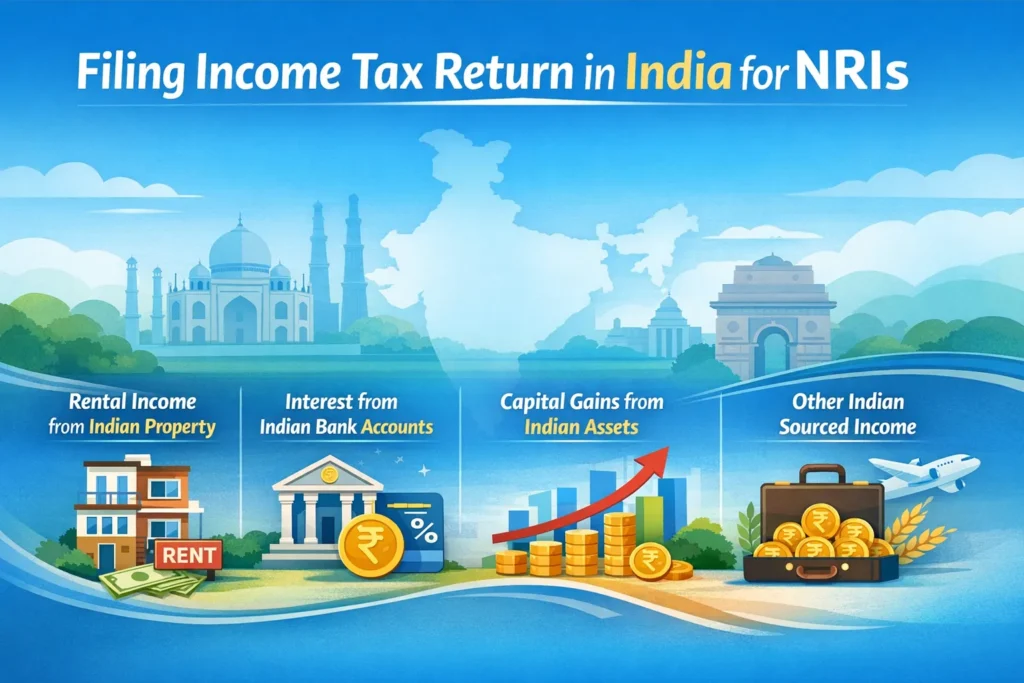
Here is something many NRIs miss. Moving to the US does not end your tax ties with India.
You still file in India if you have:
- Rental income from Indian property
- Interest from Indian bank accounts
- Capital gains from selling Indian assets
- Any other income sourced in India
The key word is "sourced." India taxes income that comes from India. Even if you live in California.
Which ITR Form NRIs Use in India
Pick the right form. Wrong form means rejected return.
| Form | When to Use |
|---|---|
| ITR-2 | Salary, capital gains, rental income |
| ITR-3 | Business or professional income |
| ITR-1 | Not for NRIs. Never use this. |
Most NRIs with simple Indian income use ITR-2. If you run a business in India alongside your US job, you need ITR-3.
Common Mistakes NRIs Make in Tax Filing
I have seen these errors ruin people's peace of mind.
Not reporting foreign accounts
The FBAR requirement catches many off guard. If your foreign accounts total $10,000 or more at any time, you must file FinCEN Form 114. Penalties for missing it are brutal.
Ignoring tax treaty benefits
Some NRIs pay US tax on Indian income without claiming the treaty benefits. They overpay by thousands.
Mixing up residency status
One year you are resident. Next year you are not. Use the substantial presence test correctly.
Missing state tax obligations
Federal taxes get attention. State taxes get ignored. But states like California chase their residents aggressively.
Forgetting about Indian capital gains
Selling that family property in Delhi triggers tax in India. Report it properly in both countries.
Tips to Reduce Tax Liability Legally
Nobody likes paying more tax than necessary. Here is how to keep more of your money.
Time your moves carefully
If you plan to return to India, consider the timing. Partial years can work in your favor for tax purposes.
Use the foreign tax credit fully
Every rupee of Indian tax paid should reduce your US tax. Document everything.
Keep investments tax-efficient
Taxable bonds in the US might not make sense if you are moving back. Municipal bonds could be better. Talk to someone who understands both systems.
Maximize retirement contributions
401(k) and IRA contributions reduce your taxable income now. They grow tax-free until withdrawal.
Track your days in each country
A simple calendar can save you thousands. Mark every day you spend in the US and India. This helps with residency tests and treaty claims.
When Should NRIs Hire a Tax Professional?
Software works for simple cases. But sometimes you need a human.
Hire a pro if:
- You have income in both countries
- You own a business
- You sold property in either country
- You have complex investments
- You are unsure about your residency status
- You received notices from the IRS or Income Tax Department
A good cross-border tax specialist costs money but saves more. They know the tricks. They catch mistakes. They handle the scary stuff.
When I helped my cousin, we used a professional. His situation was too messy for software. The cost was worth the peace of mind.
Conclusion
Filing US taxes as an NRI feels overwhelming at first. Two countries. Two systems. Two sets of rules. But underneath the complexity, the logic is simple.
Report all your income. Claim all your credits. Pay what you owe. Nothing more.
The key is understanding how the pieces fit together. Your US salary. Your Indian rental income. The taxes you paid in Mumbai. The treaty that stops double taxation.
Take it step by step. Gather your documents first. Know your residency status. Choose the right forms. File on time.
And if it gets too messy, call a professional. Your peace of mind is worth it.
Because at the end of the day, taxes are just numbers. Your life is the real story. The life you built between two countries, two cultures, two homes. That is worth protecting.
FAQs
Do NRIs need to file US taxes every year?
Yes, if your US-source income exceeds IRS thresholds or you meet substantial presence test. Even moving back to India doesn't automatically end your filing requirement if you earned income while in America.
Can I file US taxes from India?
Absolutely. Use IRS-approved software or hire a cross-border tax professional. File electronically from anywhere. The IRS accepts returns worldwide. Just ensure you have your SSN or ITIN ready before starting.
What happens if I don't file?
Penalties pile up fast. Interest charges compound daily. The IRS can freeze bank accounts or garnish future wages. Serious non-compliance affects visa renewals and green card applications. Not worth the risk.
Do I need to report Indian bank interest?
Yes. The US taxes global income. Every rupee earned in India must appear on your US return. But you'll likely claim the foreign tax credit for taxes already paid to India on that interest.
Which ITR form do NRIs use in India?
ITR-2 for most NRIs with salary, rental income, or capital gains. ITR-3 if you have business income. Never use ITR-1. Wrong form means rejected return and delayed processing.
How does the DTAA help me?
The Double Taxation Avoidance Agreement prevents paying tax twice on the same income. You claim credit in the US for taxes paid in India. Your total tax bill stays fair and legal.
What is FBAR and who files it?
FBAR is FinCEN Form 114. File if your foreign accounts total $10,000 or more at any time. Penalties for missing it start at $10,000 per violation. Don't ignore this requirement.
Can I use tax software as an NRI?
Yes for simple situations. One W-2, some Indian interest, straightforward. But if you own property, run a business, or sold assets in either country, hire a professional who understands both systems.
When is the filing deadline?
April 15 for regular filing. October 15 if you file extension. But pay any tax owed by April 15 even with extension. Late payments attract interest regardless of filing date.
Do I need an ITIN without an SSN?
Yes. Apply using Form W-7 attached to your tax return. Processing takes 6-8 weeks minimum. Start early. Without valid identification, your return sits unprocessed and refunds stay frozen.


0 Comments