
For years, the standard answer to “How much do I need to invest in GIFT City?” was USD 150,000. That number kept many salaried NRIs and OCIs out of India’s International Financial Services Centre. In February 2025, the International Financial Services Centres Authority (IFSCA) notified the IFSCA (Fund Management) Regulations, 2025, and one change got most of the attention: the minimum investment for Portfolio Management Services (PMS) was halved from USD 150,000 to USD 75,000.
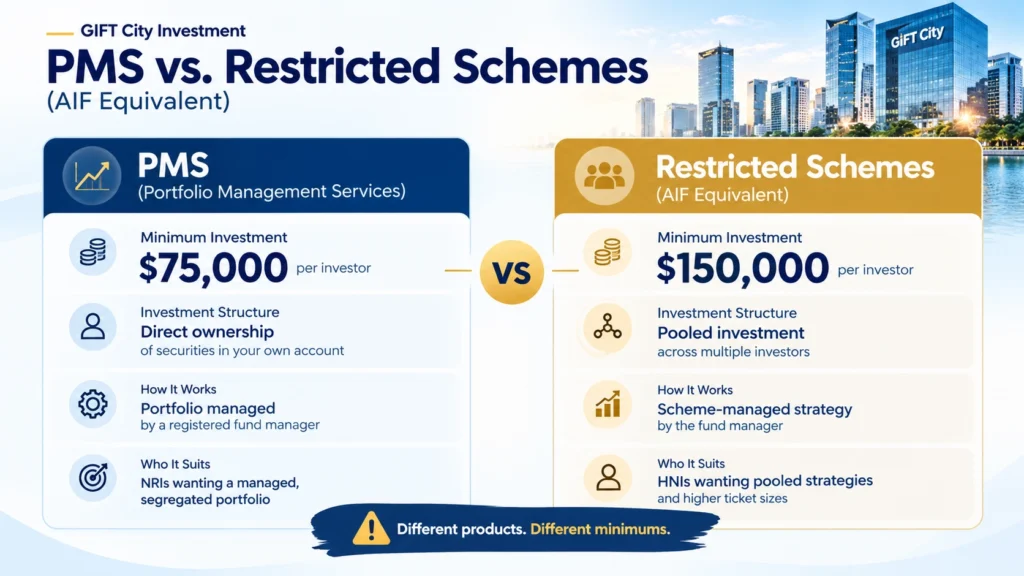
Here is the part many articles get wrong. The USD 75,000 floor applies to PMS, not to Alternative Investment Funds. Restricted schemes, which are the GIFT City equivalent of AIFs, still require USD 150,000 per investor under Regulation 32(2), as amended up to 10 September 2026. Venture capital schemes require USD 250,000. If you read that GIFT City AIFs now start at USD 75,000, the regulation does not support it.
The good news is that the smaller ticket is real, and it is not the only one. Between PMS at USD 75,000, retail schemes with much lower minimums, the joint investor rule, and USD deposits, an NRI with USD 10,000 to USD 75,000 now has genuine options. This guide covers six of them.
What IFSCA Actually Changed in February 2025
The IFSCA (Fund Management) Regulations, 2025 were published in the Official Gazette on 19 February 2025. The changes relevant to NRI investors were:
- PMS minimum reduced from USD 150,000 to USD 75,000
- Minimum corpus for both retail and non-retail schemes reduced from USD 5 million to USD 3 million
- Open-ended schemes can start investing at USD 1 million, with 12 months to reach USD 3 million
- Closed-ended retail schemes investing over 15 percent in unlisted securities need a USD 10,000 minimum per investor
Lower corpus requirements make it easier for fund managers to launch new schemes, which means more choice for investors over time.
GIFT City Minimum Investment by Product
| Product | Minimum per Investor | Who It Suits |
|---|---|---|
| Portfolio Management Services | USD 75,000 | NRIs wanting a managed, segregated portfolio |
| Restricted schemes (AIF-equivalent) | USD 150,000 | HNIs wanting pooled strategies |
| Restricted schemes, employees of the fund manager | USD 40,000 | Staff and directors |
| Venture capital schemes | USD 250,000 | Experienced private market investors |
| Accredited investors | No minimum | Investors meeting net worth or income tests |
| Closed-ended retail schemes (over 15 percent unlisted) | USD 10,000 | Smaller investors |
| Open-ended retail schemes and feeder funds | Set by the scheme, often a few hundred dollars | Salaried NRIs starting small |
Route 1: GIFT City PMS at USD 75,000
The headline route. A PMS is not a pooled fund. You own the securities directly in your own account, and a registered fund manager runs the portfolio.
Examples of GIFT City PMS strategies listed at the USD 75,000 indicative minimum include:
- Parag Parikh Global Investing Strategy (PPFAS), focused on global markets
- Phillip International Pioneer Portfolio Global PMS (PhillipCapital), built on global ETFs
Always confirm the current minimum in the disclosure document before investing.
Why this matters for NRIs: when a GIFT City PMS buys foreign securities, the gains for a non-resident are foreign-sourced income and generally sit outside Indian tax. When it buys Indian securities, normal NRI capital gains rules apply. Our PMS for NRIs desk compares GIFT City PMS with onshore PMS through an NRE account.
Route 2: Restricted Schemes Through the Joint Investor Rule
If you want a GIFT City AIF but don’t have USD 150,000 on your own, the regulations offer a family route. Under Regulation 32(2), up to two individuals who are spouses, parents, or children can invest jointly, provided their total investment is at least USD 150,000.
In practice:
- You and your spouse can invest USD 75,000 each
- A parent and an adult child can pool to meet the threshold
- Both investors complete KYC with the fund manager
Restricted schemes available to NRIs include Category III style equity strategies from managers such as Alchemy, Carnelian, Renaissance, Motilal Oswal, and Nippon India, along with feeder funds from ABSL, DSP, ICICI Prudential, Bandhan, and HDFC AMC International (IFSC), typically at USD 150,000.
Route 3: Accredited Investor Status
The minimum investment threshold does not apply to accredited investors under both Regulation 20 and Regulation 32. Accreditation is based on net worth or income tests and is granted by an accreditation agency.
This route suits NRIs with substantial wealth who want to spread money across several strategies in smaller amounts instead of locking USD 150,000 into each one.
Route 4: Retail Schemes and Feeder Funds
Retail schemes are the most important development for salaried NRIs. They are regulated for wider participation and carry much lower entry points.
- The Tata India Dynamic Equity Fund was reported as the first retail inbound GIFT City fund after IFSCA approval in September 2025, with an entry point of around USD 500
- Other fund houses, including Nippon India and Mirae Asset, have been reported to be planning retail GIFT City launches
Retail schemes let you invest in Indian equities in US dollars, avoid converting money into rupees, and redeem back into dollars. They work well alongside onshore mutual funds for NRIs.
Route 5: Closed-Ended Retail Schemes at USD 10,000
Closed-ended retail schemes that put more than 15 percent into unlisted securities must take at least USD 10,000 per investor. These suit NRIs who want exposure to unlisted or private opportunities at a fraction of the AIF ticket and can accept a fixed tenure without an early exit.
Route 6: USD Fixed Deposits at IFSC Banking Units
Not every GIFT City route is a fund. Banks run IFSC Banking Units in GIFT City that accept USD fixed deposits, with some starting from around USD 500.
Benefits for NRIs:
- Deposits stay in US dollars, so there is no rupee conversion risk
- Interest earned by non-residents on IFSC deposits enjoys favourable tax treatment
- Funds are fully repatriable
They are a good parking spot while you decide on a PMS or fund allocation. For a broader view of these options, our guide to investment options for NRIs and OCIs in GIFT City compares each product.
Tax Treatment for NRIs
GIFT City was designed to be tax-efficient for non-residents. Key points:
- Income of eligible IFSC funds attributable to non-resident unitholders enjoys exemptions under the Income Tax Act
- PMS gains are taxed based on the underlying securities, since you own them directly
- Foreign securities held by a non-resident generally create no Indian tax
- GST does not apply to many IFSC fund management services under the IFSC framework
Rules have been renumbered under the Income Tax Act 2025, so check current section references. Our breakdown of GIFT City tax benefits explains each exemption in detail.
How to Choose Your Route

| If You Have | Consider |
|---|---|
| USD 500 to USD 10,000 | Retail schemes, feeder funds, USD fixed deposits |
| USD 10,000 to USD 75,000 | Closed-ended retail schemes, multiple retail funds |
| USD 75,000 | GIFT City PMS |
| USD 75,000 each with a spouse | Restricted schemes through the joint investor route |
| USD 150,000 or more | Restricted schemes and AIF strategies |
| Accredited investor status | Multiple strategies without the minimum |
Also consider your plans. If you might return to India, check how your GIFT City holdings will be treated once you become a resident. Our Returnee NRI Transition Services team plans that shift.
Common Mistakes
- Believing GIFT City AIFs now start at USD 75,000
- Confusing PMS with a pooled fund
- Ignoring the joint investor route for couples
- Picking a closed-ended scheme when you need liquidity
- Forgetting home-country tax rules, such as PFIC reporting for US persons
- Skipping KYC alignment across passport, OCI, and PAN
How MostlyNRI Helps
At MostlyNRI, we help NRIs and OCIs across the USA, UAE, UK, Canada, Singapore, and Australia with:
- GIFT City fund, PMS, and deposit selection through our GIFT City Funds service
- Joint investor structuring for couples and families
- Onshore and offshore portfolio allocation
- Tax planning under the Income Tax Act 2025
- ITR filing and Schedule FA disclosures
Our team serves clients from over 33 countries across 13 Indian cities.
Want to start in GIFT City with USD 75,000 or less? Book a consultation with our specialists at beige-spoonbill-433256.hostingersite.com/ to find the right route for your ticket size, currency goals, and residency plans.
Frequently Asked Questions (FAQs)
Did the GIFT City AIF minimum really drop to USD 75,000?
No. The USD 75,000 minimum introduced in February 2025 applies to Portfolio Management Services. Restricted schemes, the AIF equivalent, still require USD 150,000 per investor under Regulation 32(2), and venture capital schemes require USD 250,000.
When did IFSCA reduce the PMS minimum to USD 75,000?
IFSCA notified the IFSCA (Fund Management) Regulations, 2025 in the Official Gazette on 19 February 2025. The regulations cut the PMS minimum from USD 150,000 to USD 75,000 and reduced minimum fund corpus from USD 5 million to USD 3 million.
Can a married couple combine investments to meet the USD 150,000 AIF minimum?
Yes. Under Regulation 32(2), up to two individuals who are spouses, parents, or children can invest jointly if their combined investment is at least USD 150,000. Each joint investor completes KYC with the fund manager.
What is the cheapest way for an NRI to invest in GIFT City?
Retail schemes and feeder funds offer the lowest entry, with some reported from around USD 500. USD fixed deposits at IFSC Banking Units also start low with some banks. These suit salaried NRIs building a position gradually in dollars.
Do accredited investors have a minimum investment in GIFT City funds?
No. The minimum investment thresholds for venture capital and restricted schemes do not apply to accredited investors. Accreditation is based on net worth or income tests and lets investors spread money across several strategies.
Is a GIFT City PMS taxed like a mutual fund?
No. In a PMS you own the securities directly, so tax follows the underlying securities. Gains on foreign securities for non-residents are generally outside Indian tax, while Indian securities follow normal NRI capital gains rules.
Can NRIs invest in GIFT City in US dollars?
Yes. GIFT City products are denominated in foreign currency, usually US dollars. NRIs invest from overseas bank accounts or NRE accounts, avoid rupee conversion, and redeem back into dollars, which keeps proceeds fully repatriable.
What is the minimum for closed-ended retail schemes in GIFT City?
Closed-ended retail schemes that invest more than 15 percent in unlisted securities must take at least USD 10,000 per investor. Other retail schemes set their own minimums, which are often much lower.
Are US-based NRIs affected by PFIC rules on GIFT City funds?
Possibly. US persons holding non-US pooled funds may face PFIC reporting and punitive taxation. A PMS, where you own securities directly, can be easier to manage. US-based NRIs should check with a US tax adviser before investing.
How can MostlyNRI help me invest in GIFT City?
MostlyNRI compares GIFT City PMS, restricted schemes, retail funds, and USD deposits, structures joint investments for couples, plans tax under the Income Tax Act 2025, and aligns GIFT City holdings with your onshore portfolio and ITR filings.
