



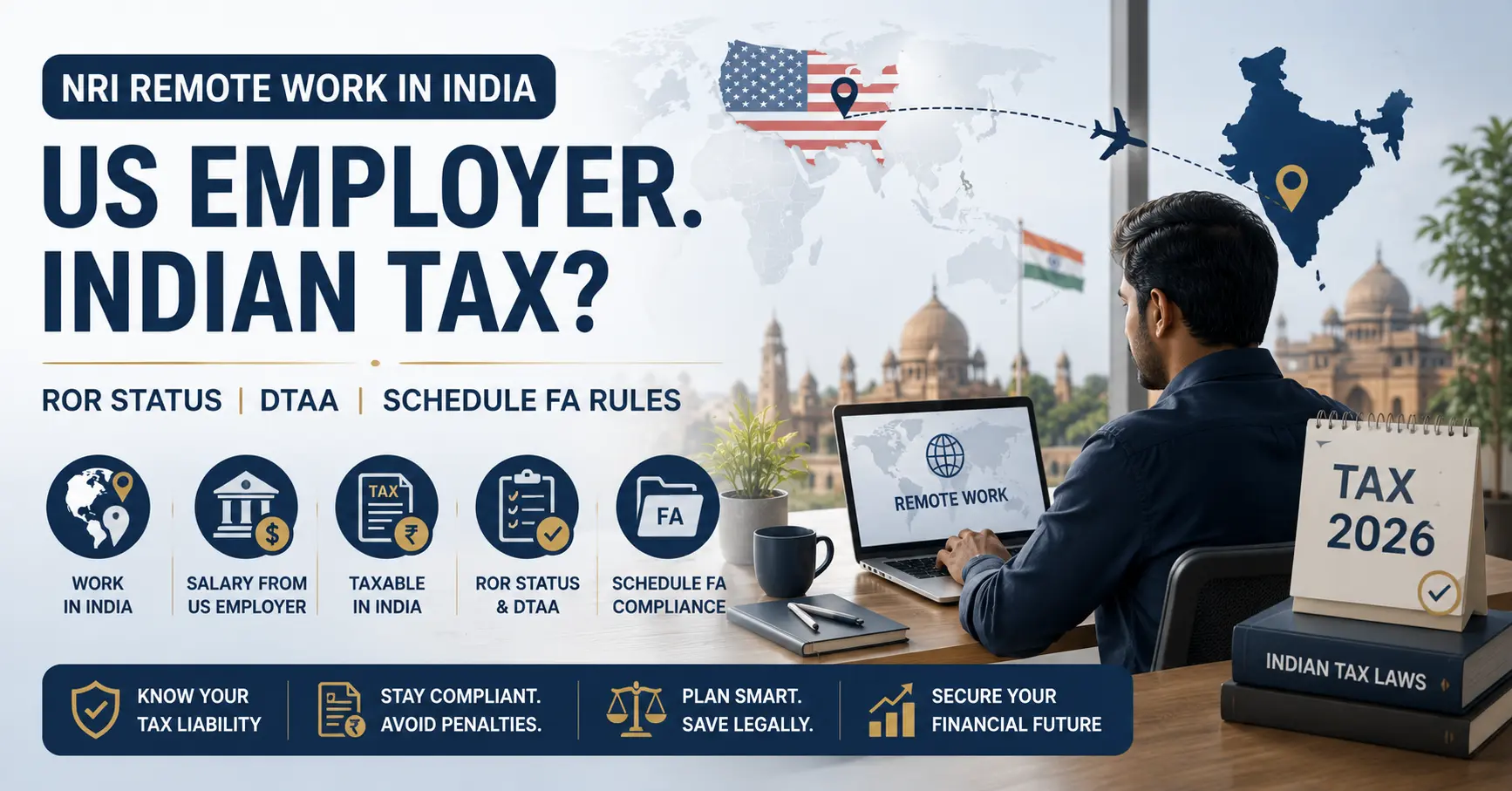
Thousands of former NRIs who returned to India during and after COVID are now working remotely for US employers while continuing to hold US bank accounts, IRAs, brokerage accounts, and 401(k) balances. As paycheques continue to hit US bank accounts, a common question keeps coming up: "If my salary is credited in the US, can I avoid paying Indian tax on it?"
The short answer is no. Under the Income Tax Act 2025, which came into effect on 1 April 2026, a person qualifying as Resident and Ordinarily Resident (ROR) in India is taxed on global income, regardless of where it is earned, received, or credited. The India-USA Double Taxation Avoidance Agreement (DTAA) does not rescue you here either. The right to tax remote-work salary generally rests with the country where the work is performed, which is India.
This guide breaks down exactly how the tax works, why the place of credit is irrelevant, what Schedule FA now demands, the FEMA repatriation rule, and the hidden Permanent Establishment (PE) risk your US employer may face.
The ROR Reality Check for Remote Workers
If you have been living in India since COVID (2020 or 2021), by FY 2026-27, you have crossed the residency thresholds under both the Income Tax Act and FEMA. You are almost certainly an ROR for tax purposes.
Under the Income Tax Act 2025, an individual is treated as ROR if:
- Stay in India during the financial year is 182 days or more, or
- Stay is 60 days or more in the year, and 365 days or more in the preceding 4 years, and
- They have been residents in 2 out of the last 10 years, and
- Their stay in India over the last 7 years is more than 729 days
Someone who moved back in 2020 or 2021 has already cleared these thresholds by 2026-27. That means you are no longer an NRI, no longer eligible for RNOR benefits, and your entire global income is taxable in India.
Unsure of your status? Start with our NRI Tax Residency Calculator for an instant assessment.
Why the Income Tax Act 2025 Matters More Than the 1961 Act
The Income Tax Act 2025, notified with effect from 1 April 2026, replaces the old Income Tax Act 1961. For remote workers billing US employers from India, the scope-of-total-income provisions are what govern the taxability question.
Key ROR provisions in the new Act:
- ROR is taxed on all income, irrespective of where it accrues, is received, or is credited
- Includes salary paid by a foreign employer for work done in India
- Includes overseas rental, interest, dividends, and capital gains
- Foreign asset and income disclosures continue under Schedule FA and Schedule FSI
The place where the salary hits your bank account is irrelevant. The moment the work is performed in India, the income is treated as earned in India.
Place of Receipt Does Not Determine Taxability
Many remote workers assume that keeping the paycheck in a US account somehow shields it from Indian tax. This is one of the most common and costly misunderstandings.
Under Indian tax law:
- Income is taxed based on where it is earned and the residential status of the earner, not where it is deposited
- A ROR's global income forms part of the total taxable income
- Even income credited abroad but arising from services rendered in India is treated as India-sourced
So if you sit in Bengaluru and write code for a US firm, your salary is Indian income for Indian tax purposes, even though the wire hits your Chase or Bank of America account.
For accurate ITR preparation, use our Income Tax Returns Filing service designed for cross-border workers.
India-US DTAA: Why It Will Not Save Your Salary
Many remote workers cite the India-USA Double Taxation Avoidance Agreement, hoping to sidestep Indian tax. In this scenario, the DTAA actually confirms India's right to tax.
Under Article 16 (Dependent Personal Services) of the India-US DTAA, salary is taxable in the country where the employment is exercised. If you are physically present in India while performing the work, that is the country of exercise. The right to tax the salary belongs to India, not the US.
What DTAA does help with:
- Preventing double taxation through foreign tax credits
- Allowing you to claim credit for any US tax withheld
- Regulating tax on interest, dividends, capital gains, and royalties
What DTAA does not help with:
- Removing India's right to tax your remote-work salary
- Exempting your US bank credits from Indian tax
- Waiving Schedule FA disclosure requirements
Schedule FA: The Foreign Asset Disclosure That Trips Up Returnees
As an ROR, you must disclose every foreign asset and foreign income in Schedule FA of your Indian ITR. Failure to do so brings Black Money Act provisions into play, with penalties that can go up to 300% of the tax due and prosecution risk.
Assets that must be reported include:
- US bank accounts (checking, savings, money market)
- IRA and 401(k) balances
- US brokerage accounts and holdings
- Foreign stock options and RSUs
- Overseas real estate
- Foreign insurance policies with cash value
- Signing authority in any foreign account
- Beneficial ownership in foreign entities
Reporting must be transaction-wise and account-wise, not summary. Even a dormant US bank account with a balance of $100 must be disclosed.
Many returnees also miss Schedule FSI (Foreign Source Income) and Schedule TR (Tax Relief), which are required to claim DTAA credits.
FEMA Rule: The 180-Day Repatriation Requirement
Beyond income tax, FEMA (Foreign Exchange Management Act) adds another compliance layer. Once you are a FEMA resident:
- Salary received in a US bank account must be realised and repatriated to India within 180 days of receipt
- You must operate resident bank accounts, not NRE or NRO
- Foreign currency retention above prescribed limits requires an RFC or LRS-linked structure
- You cannot continue treating the US account as a primary financial base
Missing repatriation deadlines is a compoundable offence under FEMA. It can attract penalties even where no tax is due.
For clarity on which India accounts you should be operating, use our NRI Bank Account Type Advisor.
Permanent Establishment Risk: The Hidden Landmine for Your US Employer
Here is a critical issue most remote workers do not realise: your presence in India as an employee of a US company can create Permanent Establishment (PE) exposure for that employer in India.
If the tax department treats your home office in India as a fixed place of business for the US employer, or you as a dependent agent, the US company may become liable for:
- Corporate tax in India on profits attributable to your work
- Withholding tax obligations
- Transfer pricing compliance
- GST registration in some cases
This is why many US employers now require formal engagement through:
- An Employer of Record (EOR) in India
- A contractor arrangement with GST and TDS compliance
- A local Indian subsidiary's payroll
If you are a senior employee with signing authority, client-facing responsibilities, or decision-making power, PE risk is real. It is worth flagging this proactively with your US employer to avoid future litigation.
What If You Are Still in the RNOR Window?
Resident but Not Ordinarily Resident (RNOR) status offers a short protective window for genuinely recent returnees. You qualify as RNOR if:
- You were a non-resident in 9 out of the 10 preceding financial years, or
- Your stay in India during the last 7 years is 729 days or fewer
If you moved to India in late 2024 or 2025, you may still be in the RNOR window for FY 2026-27. During this period:
- Foreign salary and pension may remain outside Indian tax
- Overseas bank interest, dividends, and capital gains are protected
- Only India-sourced income is taxed
However, someone who returned during COVID (2020-2021) has almost certainly exited the RNOR window by FY 2026-27 and is now a full ROR.
Read more on the transition process in our Returnee NRI Transition Services guide.
Common Mistakes Remote Workers Make in India
The most expensive errors are avoidable. Common slip-ups include:
- Assuming the US bank credit avoids Indian tax
- Missing Schedule FA disclosure of US bank, IRA, brokerage
- Not filing Schedule FSI and TR to claim DTAA credit
- Ignoring the FEMA 180-day repatriation rule
- Overlooking PE exposure for the US employer
- Continuing to operate an NRE account after becoming a FEMA resident
- Skipping advance tax on the US salary component in India
- Treating the arrangement as a contractor role without any US and Indian compliance
- Missing social security totalisation claims where applicable
If you have already received a notice on any of these, our NRI Income Tax Notice Solutions team helps you draft a compliant reply.
How Indian Tax Actually Applies to Your US Salary
Here is the simplified flow for an ROR working remotely from India for a US employer.
| Step | What Happens |
| 1. Salary paid in USD | Credited to your US bank account |
| 2. Deemed Indian income | Because work is performed in India |
| 3. Indian tax applies | Taxed at slab rates as salary income |
| 4. US tax withheld (if any) | You can claim a foreign tax credit in India under the DTAA |
| 5. FEMA repatriation | 180 days to bring the salary to India |
| 6. Schedule FA and FSI | Full disclosure in ITR-2 or ITR-3 |
| 7. Advance tax | Paid in quarterly instalments in India |
You are not saving tax by keeping money in the US. You are only increasing compliance risk.
How MostlyNRI Helps Returnees and Remote Workers
Filing Indian taxes as a remote worker for a US employer is not a simple ITR exercise. It involves residency analysis, DTAA optimisation, Schedule FA and FSI disclosures, PE risk review, FEMA compliance, and advance tax planning.
At MostlyNRI, we help returnees and remote workers with:
- Residency status and RNOR-to-ROR transition planning
- ITR filing with correct Schedule FA, FSI, and TR entries
- Foreign tax credit claims under DTAA
- US 401(k), IRA, and brokerage planning
- Capital gains structuring on US and Indian assets
- Permanent Establishment risk review for your employer
- Advance tax planning and estimated payments
- Response to tax notices on foreign income and assets
Our team has served remote workers from across the USA, UAE, UK, Canada, Singapore, and Australia across 13 Indian cities.
Frequently Asked Questions (FAQs)
Can I avoid Indian tax on my US salary if it is credited to my US bank account?
No. As a Resident and Ordinarily Resident (ROR), your global income is taxable in India irrespective of where it is received or credited. The place of payment does not determine taxability under the Income Tax Act 2025.
Does the India-US DTAA exempt my salary from Indian tax?
No. Under Article 16 of the India-USA DTAA, salary is taxable where the employment is exercised. Since you work from India, India has the primary right to tax. DTAA only helps claim credit for US taxes paid.
Do I need to disclose my US bank and IRA accounts in the Indian ITR?
Yes. As an ROR, you must disclose all foreign bank accounts, IRA, 401(k), and brokerage holdings in Schedule FA of your ITR. Non-disclosure invites Black Money Act penalties of up to 300% of tax due and prosecution.
When does the Income Tax Act 2025 apply to remote workers?
The Income Tax Act 2025 came into effect on 1 April 2026 and applies from FY 2026-27 onwards. All ROR global income provisions, Schedule FA disclosures, and DTAA claim procedures are governed by this new Act.
What is the FEMA rule on receiving salary in a US bank account?
Under FEMA, a resident individual must realise and repatriate foreign salary received abroad within 180 days of receipt. Continuing to hold salary in a US account beyond this window is a compoundable FEMA offence.
Does my US employer face any tax risk from my remote work in India?
Yes. Your presence in India can create a Permanent Establishment (PE) for your US employer, exposing them to Indian corporate tax, withholding, and transfer pricing. Many US firms now use an Employer of Record to eliminate this risk.
Can I still be an NRI if I have been living in India since COVID?
No. If you have lived in India continuously since 2020 or 2021, by FY 2026-27, you have crossed all residency thresholds. You are no longer an NRI. You are almost certainly an ROR, taxed on global income.
How do I claim credit for US taxes on my remote-work income?
You claim the credit through Schedule FSI and Schedule TR in your Indian ITR under the DTAA. You will need Form 67, proof of US tax paid, and the payslip breakup. Our team can prepare these end-to-end.
Which ITR form should I file as a remote worker in India?
Most remote workers file ITR-2 if their income is from salary and investments. If you also earn business or professional income (freelance, contractor), you must file ITR-3. Both forms include Schedule FA, FSI, and TR.
Should I move my US salary to India every month?
Yes. FEMA requires repatriation within 180 days, and Indian advance tax obligations are quarterly. Regularly repatriating your salary to an Indian resident account helps you meet both FEMA and tax deadlines without penalties.


0 Comments