


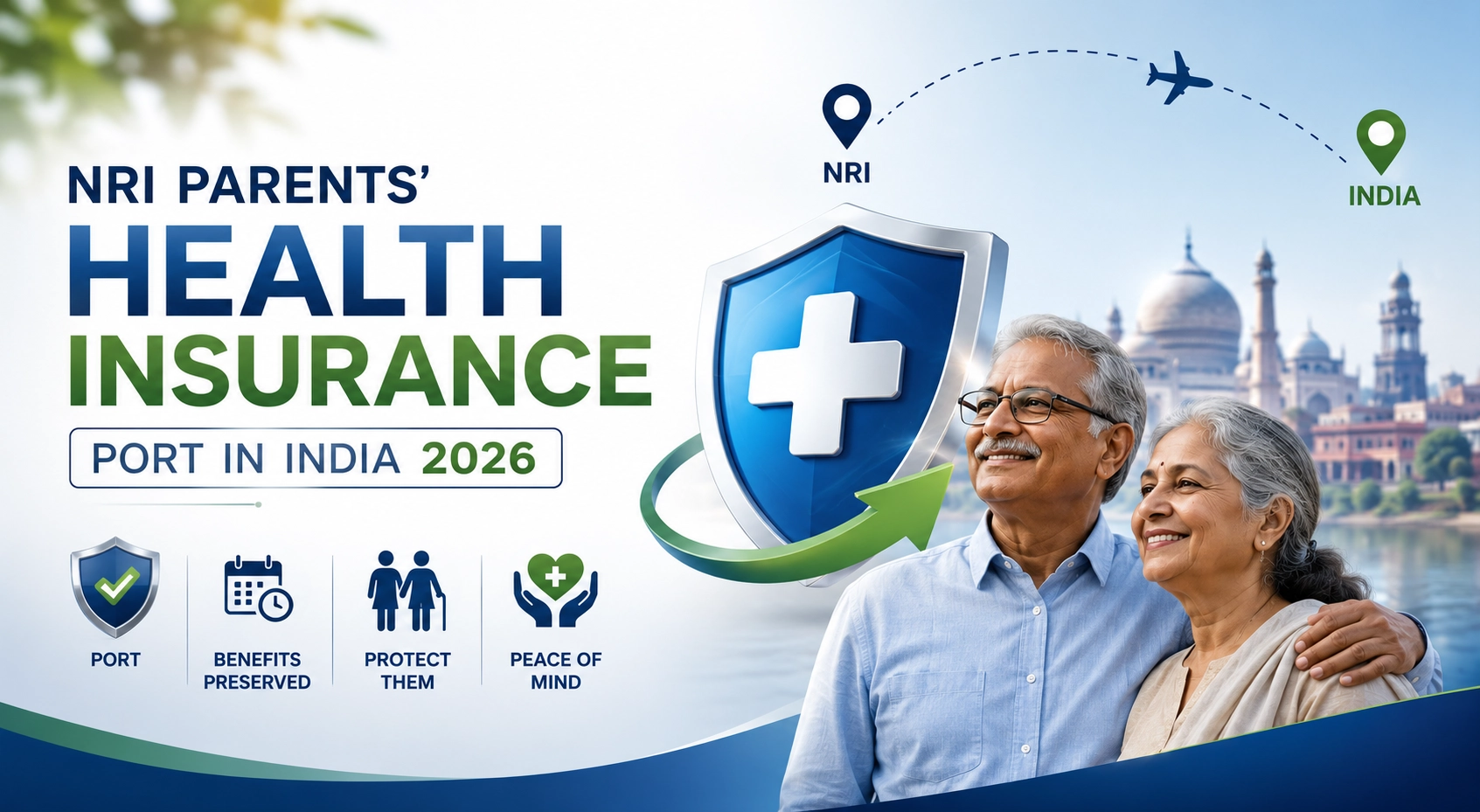
Managing health insurance for ageing parents in India from thousands of miles away is one of the toughest tasks a Non-Resident Indian handles. When the premium doubles at renewal, the network hospital drops out, or claim service turns unreliable, most NRIs consider porting the policy to another insurer. On paper, portability is designed exactly for this. In practice, it has become one of the most misused reforms in the Indian insurance sector.
Recent industry reporting shows that nearly 1 in 4 customers did not renew their existing health plan in FY26, and a significant share of that churn is being driven by intermediary sales incentives rather than genuine customer need. Worse, in many cases, what NRIs believe is a port is actually a fresh policy sold under the same label, resetting every waiting period, no-claim bonus, and moratorium credit that took years to build.
This guide breaks down what health insurance portability actually is, the IRDAI rules that protect ported policyholders, the two big transparency failures every NRI should know, the pitfalls specific to porting parents' cover from abroad, and the step-by-step safe way to do it.
What is Health Insurance Portability in India
Health insurance portability was introduced by the Insurance Regulatory and Development Authority of India (IRDAI) to ensure that policyholders are not trapped in unsuitable policies. The idea is simple: let policyholders switch insurers without losing benefits they have already earned.
When a policy is ported:
- The acquiring insurer picks up the policy from the old insurer
- Credit for waiting periods already served is carried forward
- The no-claim bonus earned so far is preserved
- Progress towards the 60-month moratorium clause travels with the policy
- Underwriting and claims history are shared through the Insurance Information Bureau of India (IIB)
To keep the mechanism customer-friendly, IRDAI has barred intermediaries from earning commission in the first year of the ported policy. On paper, the system works. In practice, it has developed cracks that hit NRIs hardest.
Why NRIs Face a Bigger Portability Risk
An NRI porting a parent's cover has three structural disadvantages compared to a resident:
- Distance: You cannot meet the intermediary or the insurer face-to-face
- Language and paperwork: Elderly parents often rely on the agent to interpret forms
- Time zone gap: Follow-up calls and documentation clarifications are delayed
- Premium payment complexity: You pay through an NRE or NRO account, adding one more layer of verification
- Emotional urgency: A parent's health scare can push you to act quickly and skip due diligence
This is exactly the environment where mis-selling thrives. What is meant to protect your parents can, if handled carelessly, leave them without cover at the worst possible moment.
For NRIs planning a return to India for parental care, our Returnee NRI Transition Services helps you set the health insurance layer correctly from day one.
IRDAI Rules That Protect Ported Policyholders
Under current IRDAI norms, a properly ported policy must preserve:
- Waiting period credit: If your parent has already served 3 out of 4 years for a pre-existing disease waiting period, only 1 more year applies with the new insurer
- No-claim bonus (NCB): Bonus accumulated under the previous policy carries forward
- Moratorium clock: Progress towards the 60-month moratorium (after which the insurer cannot reject a claim except for fraud) travels with the policy
- Continuity of specific disease coverage is already covered before
All porting requests must be routed through the Insurance Information Bureau (IIB) central repository, giving the new insurer access to the underwriting and claims history within a specified period.
If any of these benefits are missing after your parents' port, something has gone wrong.
The Two Big Failures Every NRI Should Watch For
Failure 1: Portability Being Sold as a New Policy
Some intermediaries sell a fresh policy under the guise of a port. The pitch sounds like a switch. The paperwork, however, may be a new proposal form, a new proposer relationship, and a new start date for every waiting period. For a parent with diabetes, hypertension, or a heart condition, this can be devastating: pre-existing disease waiting periods reset from year zero, no-claim bonus disappears, and any moratorium progress is lost.
FY26 retention data shows roughly one in four customers did not renew their existing health plan. The data does not reveal whether they ported, switched with the same insurer, or dropped cover altogether. But insurers privately acknowledge that a significant share of this churn is driven by sales incentives rather than customer need.
Failure 2: The Transparency Gap
Nearly 15 years after introducing portability, IRDAI still does not publish enough data to assess whether the mechanism is working. Insurer public disclosures do not report the number of policies ported in and out each year. There is also no public data on claims rejected in ported policies, which is exactly the number NRIs need to compare insurers.
Since the acquiring insurer already has access to the parent's underwriting and claims history through the IIB, a claim rejected on non-disclosure grounds in a ported policy raises obvious questions. Without published data, NRIs cannot separate reliable insurers from those that misuse portability rules.
What NRIs Should Verify Before Porting Parents' Cover
Before signing any port paperwork, an NRI should verify:
- The application form is titled Portability Request, not a new proposal
- The existing policy number and cumulative bonus are pre-filled correctly
- The date of first entry into any health insurance shows the original policy start, not today
- Any pre-existing disease waiting periods reflect the credit already earned
- The moratorium clock shows carried-forward progress
- The sum insured matches or exceeds the current cover
- The network hospital list in your parents' city is adequate
- The claim settlement ratio and incurred claim ratio of the new insurer are strong
Reading the fine print in Section VII of the portability form is non-negotiable. Ask the intermediary to send a signed copy of the port acknowledgement from the IIB before payment.
Documents Required for Portability
Standard documents required to port a parent's health insurance:
- Portability request form signed by the proposer (usually the NRI child)
- Existing policy schedule and the last two renewal certificates
- Claim history statement from the current insurer
- Medical records, if a claim was made in the current policy year
- KYC of the proposer (NRI): passport, OCI card, overseas address
- KYC of the parents (insured): Aadhaar, PAN, address proof
- Bank account details for premium payment (usually NRE or NRO)
- Medical tests, if required by the acquiring insurer
The port request must be initiated at least 45 days before the renewal date of the existing policy. Any later and the acquiring insurer may reject the port on timing grounds.
Timing: When to Port Parents' Insurance from Abroad
The IRDAI mandates a strict timeline:
| Stage | Ideal Timeline |
| Port request initiated | 45 to 60 days before renewal |
| Documents submitted | Within 7 days of the request |
| Acquiring insurer decision | Up to 15 days |
| Policy issued (if approved) | Effective from the renewal date |
| Free-look period | 30 days for return |
NRIs should start the process at least two months before renewal. The extra buffer accommodates international courier delays, medical test scheduling for parents, and time zone lag in email exchanges.
Tax Impact for NRIs: Section 80D on Parents' Health Insurance
If you pay premiums for your parents' health insurance in India, you may be able to claim a deduction under Section 80D of the Income Tax Act.
Key rules for NRIs:
- The deduction is available if you have taxable income in India under the old regime
- Under the new tax regime, Section 80D is generally not available
- Deduction available: Rs. 25,000 for parents below 60
- Enhanced to Rs. 50,000 if parents are senior citizens (60 or above)
- Payment must be made through a non-cash mode (NRE, NRO, or other traceable route)
- The proposer of the policy should be the NRI claiming the deduction
For NRIs with only NRO interest, rental, or capital gains as Indian income, Section 80D can offset a meaningful portion of the tax. Explore our Income Tax Returns Filing service to structure this correctly.
Which NRI Bank Account to Use for Premium Payment
Premiums for parents' health insurance can be paid from any of the following:
- NRE savings account (if premium is paid from NRE-linked debit card or net banking)
- NRO savings account (most common route, fully repatriable premium reimbursement remains restricted)
- Resident savings account of a family member (not ideal because it disturbs the traceability chain for Section 80D)
Payment mode matters not just for tax but also for KYC and claims correspondence. Choose the account that matches the proposer's name on the policy.
Use our NRI Bank Account Type Advisor to pick the right account for insurance premium routing.
Red Flags NRIs Should Watch For
Any of the following should stop you before signing:
- The intermediary asks for a fresh proposal form instead of a portability form
- The new policy start date matches today rather than the original policy inception date
- No-claim bonus does not appear on the new policy schedule
- Any waiting period appears to start from zero
- The intermediary insists on immediate payment before sharing the IIB acknowledgement
- The sum insured is quietly increased or decreased without your consent
- The policy is issued in the intermediary's own KYC temporarily
- The intermediary offers a kickback, gift, or premium discount funded personally
If any of these appear, walk away and file a complaint with IRDAI's Bima Bharosa portal.
Step by Step: How NRIs Can Port Parents' Health Insurance Safely
Follow this sequence to reduce risk:
- Review the existing policy at least 60 days before renewal
- Shortlist 3 acquiring insurers based on claim settlement ratio and network hospitals in the parents' city
- Request a formal portability proposal in writing (email, not WhatsApp)
- Confirm the port is a port, not a fresh policy
- Verify credit for waiting periods, NCB, and moratorium on the draft schedule
- Complete parents' medical tests if required
- Pay the premium from an NRE or NRO account traceable to the NRI proposer
- Preserve the IIB acknowledgement for future claim protection
- Reconcile the new policy schedule against the old one line by line
- Save the intermediary's IRDAI licence number and email trail
How MostlyNRI Helps You Manage Parents' Cover From Abroad
Managing parents' health insurance is one of the most important financial responsibilities NRIs carry. At MostlyNRI, we help you connect the insurance layer with the rest of your NRI financial life.
Our services include:
- Section 80D tax optimisation for premiums paid on parents' health insurance
- Old vs new regime analysis for NRIs claiming Section 80D
- NRE, NRO, and resident account structuring for premium payments
- ITR filing with correct 80D claim and disclosure
- Handling of tax notices where 80D claims are questioned
- Returnee planning for NRIs relocating to care for parents
Our team has served NRIs from over 33 countries across 13 Indian cities.
Frequently Asked Questions (FAQs)
Can NRIs port their parents' health insurance in India?
Yes. Health insurance portability in India is available to any policyholder, and NRIs can initiate a port for their parents' policy. The port must be requested at least 45 days before renewal and processed through the IIB central repository as per IRDAI rules.
What is the biggest risk when NRIs port their parents' policy?
The biggest risk is the port being secretly sold as a new policy. Waiting periods, no-claim bonus, and moratorium credit reset from zero, leaving elderly parents effectively uninsured for pre-existing conditions during the most vulnerable years of their lives.
What benefits are preserved when a health policy is ported?
A properly ported policy preserves waiting period credit, no-claim bonus, moratorium progress towards 60 months, and continuity of pre-existing disease coverage. The new insurer accesses the parent's underwriting and claims history through the IIB central repository automatically.
Can NRIs claim Section 80D deduction on parents' health insurance?
Yes, provided the NRI has taxable Indian income under the old regime. Deduction is Rs. 25,000 for parents below 60 and Rs. 50,000 for senior citizens. Payment must be through a non-cash mode, and the NRI must be the proposer.
When is the ideal time for NRIs to start a health insurance policy?
NRIs should start the port process 60 days before the renewal date of the existing policy. This buffer covers international document exchange, parent medical tests, IRDAI's 15-day insurer decision window, and any coordination delays with intermediaries in India.
Which bank account should NRIs use to pay parents' insurance premiums?
Use your NRE or NRO account for traceability, tax records, and Section 80D compliance. Avoid paying from a family member's resident account, as it disturbs proposer's identity, KYC alignment, and any subsequent claim or tax scrutiny with the insurer or department.
What documents do NRIs need to port parents' health insurance?
You need the portability request form, existing policy schedule, claim history statement, medical records if any, NRI proposer KYC (passport, OCI), parents' KYC, and NRE or NRO bank details. Additional medical tests may be required by the acquiring insurer.
What is the IRDAI moratorium clause in health insurance?
The IRDAI 60-month moratorium means that after five continuous years of an active policy, the insurer cannot reject a claim except in cases of proven fraud. This progress is carried forward when a policy is properly ported, protecting elderly parents.
How do NRIs verify their parents' policy was actually ported?
Check the new policy schedule for the original policy inception date, carried-forward no-claim bonus, waiting period credit, and IIB acknowledgement number. If any of these are missing or reset to today's date, the intermediary likely sold a fresh policy under the port label.
How can MostlyNRI help NRIs with parents' health insurance tax planning?
MostlyNRI helps NRIs claim Section 80D correctly, choose the right bank account for premium payments, file the ITR with proper deduction disclosure, and respond to any tax notices. Our team supports NRIs across 30+ countries end-to-end.


0 Comments