




Few situations feel more distressing than a tax notice arriving in a deceased parent's name, months after the loss. For Non-Resident Indians living in the US, UK, UAE, Canada, Singapore, or Australia, the shock is compounded by distance. The notice may reference a pending return, a Section 148 reassessment, or a demand from years earlier. It arrives with strict timelines and technical language, in a country the heir may not have lived in for years.
Under the Income Tax Act 2025, effective 1 April 2026, the framework governing tax notices to deceased persons has moved from Section 159 of the old Act to Section 302 of the new Act. Courts have repeatedly ruled in 2025 and 2026 that a notice addressed to a person who has already died is void from the outset, but the tax liability itself does not disappear. The legal heir has both a shield (the notice may be quashed) and a duty (to file returns, deal with pending assessments, and pay any dues from inherited assets).
This guide explains exactly what NRI legal heirs should do when such a notice lands, the legal position under Section 302 and Section 312, the court rulings that protect you, and the step-by-step response process from abroad.
The Legal Framework: Section 302 of the Income Tax Act 2025
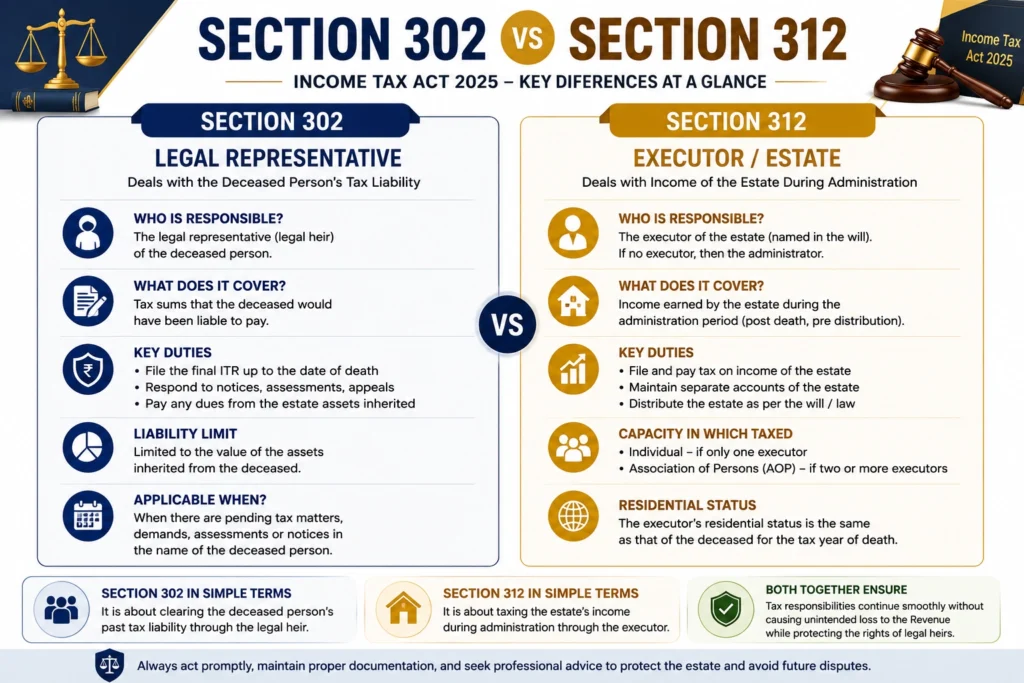
Under Section 302 of the Income Tax Act 2025, the legal representative of a deceased person is responsible for the tax sums that the deceased would have been liable to pay. If the taxpayer died during a financial year, the representative must:
- File the final ITR for income earned by the deceased up to the date of death
- Separately account for income earned by the estate after death (until distribution)
- Pay any pending tax dues from the estate assets inherited
- Respond to pending notices, appeals, and assessments in a representative capacity
The liability is limited to the value of the assets inherited. No legal heir can be asked to pay from personal funds beyond what they receive from the estate.
Section 312 of the same Act deals with the estate itself during the administration period. The income of the estate is chargeable in the hands of the executor, whose residential status is treated as the same as the deceased for the tax year of death.
For a personalised residency and heir status review, use our NRI Tax Residency Calculator.
Are Tax Notices Issued to a Deceased Person Legally Valid?
This is the most important question. Courts have consistently held that a notice addressed to a person who has already died is void.
The reasoning is straightforward: a deceased person is not a legal entity and cannot receive a notice or participate in assessment proceedings. If the department knew or could reasonably have known about the death, the notice cannot be cured later by simply substituting the legal heir's name.
However, this shield has limits:
- If the limitation period is still open, the department can issue a fresh notice to the legal representative
- Once the limitation period has expired, the defect is generally incurable
- If the legal heir has not informed the department of the death, the notice may still bind them
Key Court Rulings NRI Legal Heirs Should Know

Several rulings in 2025 and 2026 have reinforced the position that notices to deceased persons are void.
- Allahabad High Court (Smt. Asha Dubey v. Union of India): A reassessment notice under Section 148 issued in the name of a deceased person is void from the outset. The department cannot cure the defect by later substituting the heir's name.
- Allahabad High Court (Sanjay Dubey case, July 2026): A reassessment notice issued in March 2025 to a taxpayer who died in January 2024 was quashed. The legal heir successfully challenged the notice itself instead of merely participating in reassessment.
- Calcutta High Court (Kripa Shankar Mahawar v. Principal CIT, 2025): Held that tax proceedings cannot be initiated against a deceased person. Notices issued in the name of a dead assessee are null and void.
- ITAT Ahmedabad (Heta Rawal v. DCIT, 2025): Appellate proceedings conducted in the name of a deceased assessee are legally unsustainable. The tribunal directed substitution of legal heirs.
These rulings mean an NRI legal heir has a strong legal basis to challenge a notice addressed to a deceased parent, provided they act promptly.
For end-to-end handling of such notices, our NRI Income Tax Notice Solutions team represents clients from over 33 countries.
The Legal Representative’s Duties Under Section 302
If you are the legal heir, your responsibilities include:
- Notify the department of the death promptly with a death certificate
- Register as legal representative on the e-filing portal
- File the deceased's final ITR for income up to the date of death
- Handle income earned by the estate after death separately
- Reserve funds for any established or reasonably anticipated tax liability
- Distribute the estate only after the tax position is clear
- Respond to notices through rectification, appeal, or stay as appropriate
Ignoring a notice is the worst possible response. Even if the notice is technically void, the underlying tax liability may survive, and the department can issue a fresh notice to the legal heir if within limitation.
The Two Returns: Deceased’s Final ITR and Heir’s Own Return
A common mistake is to combine everything into one return. The correct treatment is to file two separate returns.
| Return | Whose PAN | What Goes In |
|---|---|---|
| Return 1: Deceased's Final ITR | Deceased's PAN | All income earned by the deceased from 1 April to date of death |
| Return 2: Legal Heir's Own ITR | Legal heir's PAN | Post-death income from inherited assets (rent, interest, dividends) |
For example, if a parent died on 30 September 2025:
- Return 1 covers the parent's salary, pension, rent, and interest from 1 April to 30 September 2025, filed on the parent's PAN by the legal heir as representative
- Return 2 covers any interest, rent, or dividends the same assets earn from 1 October 2025 to 31 March 2026, added to the NRI heir's own income and filed on the heir's own PAN
The value of the assets inherited itself is not taxable. Only the income generated by those assets after death falls into the heir's return.
For accurate filing of both returns, use our Income Tax Returns Filing service.
Section 312 and the Role of the Executor
Where a will names an executor, the income of the estate during the administration period is taxed in the executor's hands under Section 312 of the Income Tax Act 2025. The executor is treated:
- As an individual if there is only one executor
- As an Association of Persons (AOP) if there are two or more executors
- With residential status equal to the deceased's for the tax year of death
Executor assessments are made separately from the executor's own personal tax return. This provision matters when the estate has significant income (rental portfolio, business, brokerage) and cannot be distributed immediately.
How NRI Legal Heirs Should Respond to a Notice: Step by Step
Follow this sequence carefully from abroad.
- Do not ignore the notice, even if it appears addressed to the deceased
- Verify the date of the notice vs the date of death
- Collect the death certificate, PAN of the deceased, and your PAN
- Register as legal heir on the e-filing portal using the deceased's PAN
- Upload the death certificate, legal heir certificate, or succession certificate
- File the deceased's final ITR for income up to the date of death
- Respond to the notice as legal representative, citing court rulings where applicable
- Seek rectification, appeal, or stay depending on the notice type
- Preserve records of all communication for future scrutiny
- Distribute inheritance only after the tax position is fully cleared
If the notice is a Section 148 reassessment issued in the deceased's name after death, courts have quashed such notices repeatedly. But challenging the notice requires filing a writ petition or a formal reply pointing to the death, and this should be done through professional counsel to avoid procedural errors.
Registering as Legal Heir on the Income Tax Portal from Abroad
The e-filing portal now allows NRI legal heirs to register fully online, without visiting India.
Documents required for online registration:
- Death certificate of the deceased
- PAN card of the deceased
- PAN card of the legal heir
- Legal heir certificate, or surviving member certificate, or succession certificate, or probated will
- Family pension order where applicable
- Registered will if applicable
Registration timeline is usually 7 to 30 days, depending on the department's verification and any queries raised. Once approved, the legal heir can file the deceased's ITR, respond to notices, and claim any refunds due.
FEMA and Repatriation for NRI Heirs of Indian Estates
Once the tax position is clean, NRI heirs typically want to repatriate the inherited assets. FEMA governs this side.
- Inherited amounts credited to an NRO account are freely usable within India
- Repatriation outside India is subject to the USD 1 million per financial year limit from an NRO account
- Form 15CA and 15CB must be filed for each outward remittance
- Chartered Accountant certification is required to confirm tax has been paid on the underlying inheritance
- CG on inherited property applies only when the heir sells the property, using the deceased's original cost of acquisition
For a full walkthrough of NRO structuring and repatriation, use our NRI Bank Account Type Advisor.
Read our Capital Gain Tax advisory for gains arising on later sale of inherited assets.
Common Mistakes NRI Legal Heirs Make
The most costly errors are avoidable:
- Ignoring the notice, hoping it will not escalate
- Responding in the deceased's name rather than as legal representative
- Failing to register as a legal heir on the e-filing portal
- Combining pre-death and post-death income into one return
- Missing the belated return window for the deceased's final ITR
- Not obtaining a legal heir certificate before responding
- Distributing the estate before tax clearance, leaving no reserve for liabilities
- Missing court-based challenge windows on void notices under Section 148
- Repatriating funds before completing Form 15CA and 15CB paperwork
- Losing carry-forward losses by not filing the deceased's ITR on time
If you have already missed a step, our NRI Income Tax Notice Solutions team helps regularise the position and close reassessment risks.
How MostlyNRI Helps NRI Legal Heirs From Abroad
Handling tax notices for a deceased parent is not a single-step exercise. It involves court ruling analysis, portal registration, dual return filing, executor tax planning, FEMA compliance, and estate distribution coordination.
At MostlyNRI, we help NRI legal heirs across the USA, UAE, UK, Canada, Singapore, and Australia with:
- Notice review and legal challenge under recent court rulings
- Legal heir registration on the e-filing portal
- Filing the deceased's final ITR and the heir's own ITR
- Section 312 executor assessments for estates under administration
- Handling reassessment notices under Section 148 or Section 302
- FEMA repatriation of inherited assets via Form 15CA and 15CB
- CG planning on later sale of inherited property or securities
- Coordination with Indian siblings and family for a single-window response
Our team has served NRIs from over 33 countries across 13 Indian cities.
Received a tax notice in a deceased parent's name? Book a consultation with our specialists at MostlyNRI.com and get your legal heir position, return filings, and notice response handled from abroad with care and confidentiality.
Frequently Asked Questions (FAQs)
Can a tax notice be issued in a deceased person's name in 2026?
No. Courts have consistently ruled that a notice issued to a person who has already died is void from the outset, since a deceased person is not a legal entity. However, the department may issue a fresh notice to the legal heir if within the limitation period.
Which section of the Income Tax Act 2025 covers the legal representative?
Section 302 of the Income Tax Act 2025, effective 1 April 2026, replaced the old Section 159 of the 1961 Act. It makes the legal representative responsible for tax sums the deceased would have owed, limited to the value of the inherited estate.
Is the NRI legal heir personally liable for the deceased's tax dues?
No. The heir's liability is limited to the value of the assets inherited. Personal funds beyond the inherited estate cannot be attached. However, tax dues must be paid before the estate is distributed, or the heir may be treated as personally liable.
What returns must the NRI legal heir file for a deceased parent?
Two separate returns: the deceased's final ITR on the parent's PAN covering income from 1 April to the date of death, and the heir's own ITR covering post-death income from inherited assets on the heir's own PAN.
How does an NRI register as a legal heir on the income tax portal?
Log in with your PAN, go to Authorised Partners and then Register as Representative Assessee, upload the death certificate, legal heir certificate, PAN of the deceased, and family relationship proof. Approval typically takes 7 to 30 days. Registration is fully online from abroad.
What documents do NRIs need to file a deceased parent's ITR?
Death certificate, PAN of deceased, PAN of legal heir, legal heir certificate or succession certificate or probated will, bank statements, Form 26AS, AIS, and any income proofs for the period up to the date of death. Registered will if available.
Can NRI heirs challenge a reassessment notice under Section 148?
Yes. Recent rulings from the Allahabad and Calcutta High Courts and ITAT Ahmedabad confirm that Section 148 reassessment notices issued in a deceased person's name are void. The heir should file a writ petition or formal reply citing these judgments to seek quashing.
What is Section 312 of the Income Tax Act 2025?
Section 312 governs the taxation of a deceased person's estate during administration. Income of the estate is taxed in the hands of the executor as an individual or AOP. The executor's residential status matches the deceased's for the tax year of death.
How can NRI heirs repatriate inherited money abroad?
Inherited amounts credited to an NRO account are repatriable up to USD 1 million per financial year, subject to filing Form 15CA and 15CB with a Chartered Accountant certificate confirming that the applicable Indian tax has been paid on the inherited assets and post-death income.
How can MostlyNRI help NRI legal heirs with a deceased parent's tax notice?
MostlyNRI reviews the notice, registers you as a legal heir on the portal, files the deceased's final ITR and your own return, handles Section 148 challenges under recent court rulings, and coordinates FEMA repatriation. We support NRI heirs across 30+ countries end to end.


0 Comments