




For most Non-Resident Indians, managing property in India from New York, London, Dubai, Toronto, or Singapore is impractical without a Power of Attorney (POA). Whether it is renting a Bengaluru flat, selling ancestral land in Kerala, resolving a mutation record in Delhi, or attending a society AGM in Mumbai, flying to India for every signature is neither realistic nor economical. A properly drafted, attested, and registered POA in favour of a trusted relative is the legal bridge that keeps your Indian property matters moving while you live abroad.
But POA rules have tightened noticeably in 2026. The Ministry of External Affairs has rolled out an e-Apostille service for inbound documents, several states are moving towards mandatory registration of property-related POAs, and the 90-day adjudication window is being strictly enforced. Recent NCRB data shows 18,400 registered POA-linked fraud cases in FY 2024-25, most of them involving forged or misused documents.
This guide breaks down exactly how NRIs should appoint a relative as their POA holder in 2026, the types of POA to choose from, the attestation and registration process from abroad, state-wise stamp duty benefits for close relatives, and the safeguards every NRI must build in.
The Two Types of POA NRIs Should Understand
Two main POA structures apply to NRI property matters. The choice between them decides your risk profile.
| Type | Scope | Duration | Typical Use | Risk Profile |
|---|---|---|---|---|
| General POA (GPA) | Broad, covers most affairs | Often open-ended | Long-term overall management | High risk of misuse |
| Specific / Special POA (SPA) | Narrow, tied to one act | Task-bound or time-bound | Sale of one flat, one court case | Low risk if drafted precisely |
Best practice from legal experts and courts in 2026 is unambiguous: use one SPA per transaction, not a blanket GPA. A GPA covering all your Indian property is the single most common source of NRI property fraud. If a specific transaction is needed, execute a targeted SPA for that transaction only, and revoke it when the task is complete.
For NRIs who want to grant a relative operational authority over a bank account (like an NRO account), the NRI Bank Account Type Advisor clarifies the correct structure before you draft the POA.
Who NRIs Can Appoint as Their POA Holder

Under the Powers of Attorney Act 1882 and general Indian contract law, there is no legal restriction on who can be your POA holder. Practical choices include:
- Parents, siblings, spouse, adult children, or in-laws
- Extended family members with a stable Indian address
- Trusted family friends with strong professional standing
- Chartered Accountants, lawyers, or property professionals for transaction-specific POAs
However, banks, sub-registrars, and buyers routinely apply extra scrutiny when a POA is granted to a non-family member. Additionally, stamp duty concessions are available in most states only when the POA holder is a close blood relative. For these reasons, a close relative is almost always the safest and most economical choice.
The POA holder should be:
- Resident in India
- 18 years or older
- Mentally competent
- Available at the property's jurisdiction
- Digitally reachable (email, WhatsApp) for coordination
- Free from significant financial or legal exposure of their own
Unsure of your residency status before drafting? The NRI Tax Residency Calculator confirms it in a minute.
Documents Required to Appoint a Relative as POA
You will need to prepare the following before executing the POA abroad:
- Draft POA prepared by an Indian lawyer, printed on plain paper
- Passport of the NRI (principal) with valid visa or OCI card
- Overseas address proof (utility bill, bank statement, or driving licence)
- PAN card of the NRI
- Aadhaar or ID proof of the POA holder (relative in India)
- Property title documents (sale deed, index copy, mutation)
- Two witnesses, ideally with photo ID
- Recent passport-size photographs of the NRI and POA holder
- International courier tracking receipt for onward dispatch to India
Missing any of these can cause rejection at the consulate, notary, or sub-registrar.
The Step-by-Step Process: Creating POA from Abroad
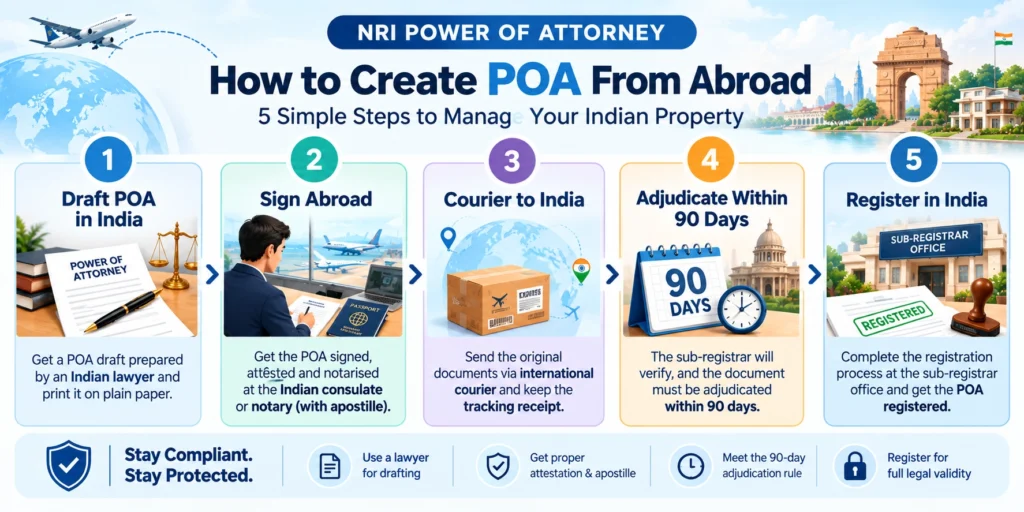
Follow this sequence carefully. Skipping a step can invalidate the entire document.
Step 1: Draft the POA in India
Engage a property lawyer in the state where the property is located. The draft must specify:
- Names, addresses, and identity of principal and attorney
- Exact powers granted, worded narrowly
- Property details with survey or plot numbers
- Duration of the POA (6 to 24 months is standard)
- Revocation and termination clauses
- Indemnity clause protecting the NRI from unauthorised acts
- Governing law and jurisdiction
Step 2: Sign the POA Abroad
You have two attestation routes.
- Route A: Indian Consulate or Embassy attestation (any country). Book an appointment, carry your passport, OCI card, witnesses, and the unsigned POA. Sign in presence of the consular officer. Fee is typically USD 25 to 50.
- Route B: Local notary plus apostille (Hague Convention countries such as USA, UK, Canada, Australia, Singapore). Notarise before a local notary public, then get the document apostilled by the designated authority. In the US, this is the Secretary of State. In the UK, the FCDO. In Singapore, the MFA.
For NRIs in non-Hague countries such as the UAE, the Indian Embassy or Consulate route is mandatory.
Step 3: Courier the Original to India
Send the wet-ink original to your relative in India via a secure international courier. Digital copies and scanned versions have no legal standing for property transactions. Retain the tracking receipt to establish the date the document entered Indian territory. This starts the 90-day clock.
Step 4: Adjudication Within 90 Days
Within 90 days of receipt in India, the POA holder must present the document to the Superintendent of Stamps or the appropriate state authority for adjudication. The authority assesses the document and orders stamp duty payment.
Failure to adjudicate within 90 days can attract a penalty of up to 10 times the applicable stamp duty. Some states, including Maharashtra and Karnataka, now offer an e-Adjudication portal in 2026 for online payment.
Step 5: Registration at Sub-Registrar
For property-related POAs, register the document at the sub-registrar of assurances in the district where the property is located. Registration is strongly recommended and, for many transactions like sale or gift, effectively mandatory. Physical presence of the POA holder is required at registration.
State-Wise Stamp Duty on POA to a Close Relative
Most states offer generous stamp duty concessions when the POA holder is a close relative. Rates vary widely, so always confirm with a local lawyer before drafting.
| State | POA to Close Relative | POA to Non-Relative |
|---|---|---|
| Maharashtra | Rs 500 | 5% to 7% of Ready Reckoner value (deemed conveyance) |
| Gujarat | Rs 300 | Market-value-based, significantly higher |
| Karnataka | Nominal fee, adjudicated | Higher, may be treated as conveyance |
| Delhi | Low fixed rate | Higher, based on transaction value |
| Tamil Nadu | Nominal fixed rate | Market-value-based |
Close relatives typically include father, mother, brother, sister, spouse, son, daughter, grandson, and granddaughter. Non-blood relatives, friends, or third parties may attract stamp duty at market rates, which can run into lakhs.
What Powers to Include and What to Exclude
The core drafting principle is narrow scope, explicit language. Include only the powers actually needed.
Powers to consider including:
- Managing rentals, tenants, and rent collection
- Paying property tax, utilities, and society dues
- Filing municipal mutation and title updates
- Attending society meetings, filing complaints
- Representing you in litigation (court appearances)
- Operating NRO account for property-related receipts
- Registering documents at sub-registrar
- Applying for OC, CC, or other municipal certificates
- Handling FEMA-related paperwork with the RBI
Powers to exclude unless specifically required:
- Gift of property (must be expressly stated; general wording is not enough)
- Sale or transfer without your explicit written confirmation of price
- Mortgage or lien creation
- Voting rights or personal acts (voting, making will, adoption cannot be delegated)
- Transactions with the POA holder's own family
- Operating NRE or FCNR accounts unless the bank specifically permits
- Blanket powers for future acquired property
For NRIs concerned about tax notices arising from POA-managed rentals or capital gains, our NRI Income Tax Notice Solutions team handles disputes end to end, and the Capital Gain Tax desk supports any authorised sale.
Common Mistakes NRIs Make While Appointing POA
The most costly errors are avoidable:
- Using a General POA (GPA) when a Specific POA would suffice
- Missing the 90-day adjudication window and losing document validity
- Skipping registration at the sub-registrar and having banks or buyers reject the document
- Not defining scope precisely and leaving gift or sale power inferable
- Choosing a POA holder with financial or legal exposure
- Digital signature or scanned copies (not legally valid in India)
- Wrong jurisdictional sub-registrar (must be in property's district)
- Missing revocation clause and inability to end the POA cleanly
- Overlooking stamp duty concessions by not naming the close relative correctly in the deed
- No time limit, leaving the POA active for years after purpose is served
How to Revoke a POA Safely
Revoke a POA the moment its purpose is served or you have any concerns.
- Draft a revocation deed with the same formalities as the original POA
- Get it attested at the Indian Consulate or notarised and apostilled abroad
- Send to India, adjudicate, and register the revocation at the same sub-registrar
- Notify the POA holder by registered post with acknowledgment
- Publish a public notice in a local newspaper covering the property's jurisdiction
- Notify all third parties: banks, tenants, buyers, courts, RWAs
Without public notice, a third party acting in good faith on the earlier POA may still be protected. Revocation does not have retroactive effect on transactions already completed in good faith.
How MostlyNRI Helps NRIs Manage POA-Linked Property Compliance
Drafting the POA itself is a legal task best handled by a property lawyer in India. But the tax and financial compliance around POA-managed property is a specialist domain, and that is where MostlyNRI adds continuous value.
At MostlyNRI, we support NRIs across the USA, UAE, UK, Canada, Singapore, and Australia with:
- Annual ITR filing for POA-managed rental and investment income
- Capital gains computation and Schedule CG entries on authorised sales
- Section 197 lower TDS certificate applications before property sale
- NRO account structuring so POA-related flows are tax-clean
- Response to tax notices arising from POA-managed transactions
- FEMA compliance on repatriation of POA-executed sale proceeds
- Schedule FA and FSI disclosures for cross-border holdings
- Coordination with your property lawyer on the tax and financial angles
Our team has served NRIs from over 33 countries across 13 Indian cities.
Planning to appoint a relative as your POA in 2026? Book a consultation with our specialists at MostlyNRI.com to structure the tax, banking, and FEMA compliance around your POA before you execute it abroad.
Frequently Asked Questions (FAQs)
Can NRIs appoint a relative as Power of Attorney to manage property in India?
Yes. NRIs can appoint any adult resident Indian as a POA holder, and a close relative is usually the safest and most economical choice. Most states offer stamp duty concessions for POAs granted to blood relatives, reducing costs to nominal fixed amounts.
What is the difference between a General POA and a Special POA for NRIs?
A General POA grants broad powers over multiple matters and is typically open-ended. A Special POA grants narrow powers for a specific act or time. NRIs are strongly advised to use Special POAs to reduce the risk of misuse and property fraud.
How can NRIs execute a POA from abroad in 2026?
NRIs draft the POA in India, sign it before an Indian Consulate or Embassy officer abroad, or notarise it locally and get it apostilled in Hague Convention countries, and courier the wet-ink original to India for adjudication within 90 days of receipt.
What is the 90-day adjudication rule for NRI POAs?
Under Indian stamp laws, a POA executed abroad must be presented for adjudication and stamp duty payment within 90 days of receipt in India. Missing this window can attract a penalty of up to 10 times the applicable stamp duty and invalidate the document.
Is registration of an NRI POA mandatory in India?
Registration at the sub-registrar is technically optional under Section 18 of the Registration Act 1908, but it is practically mandatory for property-related POAs. Banks, buyers, and sub-registrars routinely refuse to accept unregistered POAs. Karnataka has proposed mandatory registration from 2025.
What is the stamp duty for a POA to a close relative in Maharashtra?
In Maharashtra, a POA granted by an NRI to a close blood relative (father, mother, spouse, brother, sister, son, daughter, grandson, granddaughter) attracts a nominal stamp duty of Rs 500 in 2026, plus basic document handling fees at the sub-registrar's office.
Can a POA holder sell an NRI's property in India?
Yes, but only if the POA specifically authorises the sale, names the property, and is properly stamped and registered. A general power to manage the property is not sufficient. The Gujarat High Court has recently voided transactions lacking specific transfer authority.
Can NRIs use a digital or scanned POA for property transactions?
No. Digital, scanned, or emailed POAs are not legally valid for property transactions in India. Only the wet-ink signed original, properly attested and stamped, is accepted at sub-registrar offices, banks, and courts. Physical originals are mandatory.
How can NRIs revoke a Power of Attorney granted to a relative?
Execute a revocation deed with the same formalities as the original POA, register it at the same sub-registrar, send registered notice to the POA holder, publish a newspaper notice, and inform all third parties. Revocation is not retroactive on acts already done in good faith.
How can MostlyNRI help with POA-linked property tax compliance?
MostlyNRI handles the tax and financial compliance side of POA-managed property: ITR filing, capital gains, Section 197 certificates, NRO structuring, FEMA repatriation, and tax notice responses. We coordinate with your property lawyer on legal and financial angles.


0 Comments