




If you are one of the estimated 3.5 million Indians planning to return home from the United Arab Emirates in 2026, the physical move takes a day, but the financial transition takes years. Cancelling your Emirates ID and boarding an evening flight to Delhi, Mumbai, or Bengaluru does not automatically end your UAE tax residency, close your Dubai bank account, or dissolve your DIFC will. It also does not, by itself, activate your RNOR window in India or protect your gratuity and RSU proceeds from Indian tax.
Returning from the UAE is uniquely complex because you are moving between two systems that overlap in structure but differ sharply in rules. The India-UAE Double Taxation Avoidance Agreement (DTAA) decides which country taxes your income during the transition. UAE Corporate Tax, since June 2023, has changed how business-linked NRIs must plan their exits. India's Income Tax Act 2025 and the FAST-DS 2026 foreign asset disclosure window have reshaped the compliance calendar on the Indian side.
This guide breaks down the 6-step homecoming checklist every UAE returnee should complete, the tax residency triggers on both sides, and how to protect your gratuity, real estate, RSUs, and investments during the transition.
Why the UAE-to-India Return Is Uniquely Complex
Unlike NRIs returning from the US, UK, or Canada, UAE returnees face a specific set of asymmetries.
- The UAE does not tax individual salary income, so there is no personal exit tax
- UAE Corporate Tax at 9 percent applies to businesses above AED 375,000 profit
- Emirates ID cancellation is not the same as UAE tax residency termination
- The India-UAE DTAA uses a tie-breaker test (permanent home, centre of vital interests, habitual abode, nationality)
- End of Service Gratuity (EOSB) is a large lump sum that needs careful timing
- DIFC or ADGM wills must be reviewed alongside Indian succession laws
- Free-zone companies attract distinct liquidation or continuation decisions
For UAE returnees, the Returnee NRI Transition Services framework at MostlyNRI runs a full India-side integration alongside your UAE exit.
Step 1: When Does Your UAE Tax Residency Actually End?
The first mistake returning NRIs make is assuming that visa cancellation equals tax residency termination. Under the UAE's Federal Tax Authority (FTA) domestic framework, an individual qualifies as a UAE tax resident if any of the following are true:
- Usual or customary place of residence and centre of financial and personal interests is in the UAE, or
- Physical presence in the UAE for 90 days or more within a rolling 12-month period, with financial or personal interests in the UAE and either UAE nationality, valid residency, or a permanent home, or
- Physical presence in the UAE for 183 days or more in a rolling 12-month period
For treaty purposes under the India-UAE DTAA, the 183-day physical presence test is the most relevant benchmark. If you meet this on the UAE side and simultaneously become a resident on the Indian side, the treaty tie-breaker decides which country taxes what.
Confirm your dual-residency position using our NRI Tax Residency Calculator before your move.
Step 2: Get Your Exit Documents in Order Before You Fly

Before you board the flight, build a record of your UAE life that can be produced years later for Indian tax scrutiny or DTAA relief.
Collect and preserve:
- UAE Tax Residency Certificate (TRC) for the relevant year
- Passport movement records showing entry and exit stamps
- Visa and Emirates ID documents (including cancellation stamps)
- Tenancy or home ownership documents (Ejari, title deeds)
- Employment records including offer letters, salary certificates, EOSB calculation
- Bank and investment statements for at least 3 years
- Free zone or mainland company trade licences and shareholding records
- Corporate Tax and VAT registration and filing records
These documents are your defence in any India-side reassessment on residency, source of funds, or Schedule FA disclosure.
Step 3: Update Your UAE Accounts and Investment Records
Once you have a firm return date, notify all UAE financial institutions of your change in residency status. This is not optional; UAE banks and brokers must update CRS and FATCA data based on your new tax residence.
Update:
- Residential address on record with every UAE bank
- Tax residence status flagged as Indian resident
- KYC information including new PAN and Indian address
- CRS self-certification with India as reportable jurisdiction
- FATCA details where you also have US person status
Missing this step means UAE institutions may report the account to the wrong tax authority under CRS or FATCA rules, triggering mismatch notices in India later.
For guidance on which India-side accounts to open (NRO, NRE, or Resident savings), the NRI Bank Account Type Advisor maps them to your specific goals.
Step 4: List and Structure Your UAE Assets
Becoming an Indian resident does not require you to sell UAE assets. Many are still permissible under FEMA and can generate tax-efficient income during your RNOR window.
Make a complete inventory of:
- UAE bank and deposit accounts (AED, USD, and other currencies)
- Shares, ETFs, mutual funds, and securities in UAE brokerages
- UAE companies, free zone entities, or businesses where you hold stakes
- RSUs, stock options, and vested employer holdings
- Real estate (Dubai, Abu Dhabi, Sharjah)
- Gold, jewellery, and physical assets stored in the UAE
- Insurance policies with cash value
For each business-linked asset, additionally verify:
- Corporate Tax and VAT positions
- Accounting and licensing status
- Filing requirements for the current and next financial year
- Beneficial ownership and KYC compliance
- Authorised signatories after you leave
Careful tracking of foreign asset positions is what the FAST-DS 2026 disclosure scheme rewards, and what the Black Money Act punishes if missed later.
Step 5: UAE Filings Do Not Stop When You Fly
Moving to India does not automatically end your UAE business obligations. If you hold a UAE free zone company, mainland LLC, or a stake in a partnership, the compliance calendar continues.
Ongoing UAE filings to track:
- UAE Corporate Tax returns for eligible entities
- VAT filings (quarterly or monthly as applicable)
- Economic Substance Regulations (ESR) where relevant
- Ultimate Beneficial Ownership (UBO) filings
- Emirates Trade Licence renewals
- Board resolutions and annual filings for free zone entities
Failure to file after moving to India can result in licence cancellations, blacklisting, and difficulty repatriating any final proceeds. If you plan to dissolve the entity, execute the liquidation before or shortly after the move.
Our NRI Taxation and Compliance team coordinates with your UAE counsel to keep both sides synchronised.
Step 6: Plan Your UAE Succession Before You Leave
Succession is the step returnees most commonly postpone. Yet a UAE-based will drafted years ago may not reflect your new life in India.
Review and update:
- DIFC or ADGM will in favour of Indian heirs
- Bank and investment nominations across all UAE accounts
- Power of attorney documents granted to UAE-based friends or advisors
- Property ownership documents and title deeds
- Business interests including shareholding, agreements, and beneficiary structures
- Insurance policy nominations
Without an updated will, your UAE assets can face different succession laws than your Indian assets. UAE Personal Status Law (or Sharia principles in some Emirates) may apply to expatriates who have not opted into DIFC or ADGM wills.
The India-Side Triggers: FEMA and RNOR
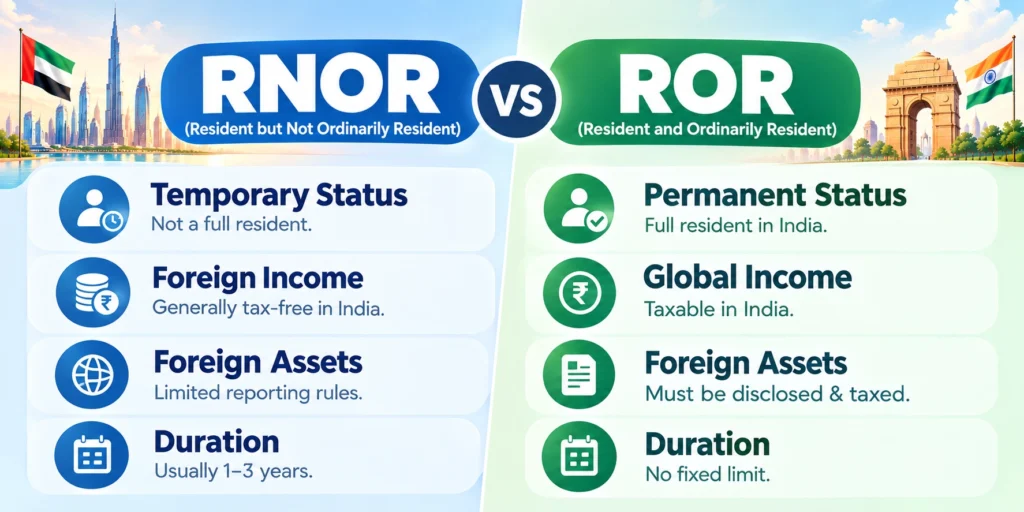
Alongside the UAE checklist, your Indian tax and FEMA status must be actively managed.
FEMA residency switches to resident the moment you arrive with the intention to stay. That day triggers:
- NRE and NRO accounts must be redesignated as resident savings or RFC accounts
- FCNR deposits can continue until maturity, then convert
- All Indian financial institutions must be notified
Income Tax residency is more nuanced. Depending on your day-count and prior residency history, you can qualify as:
- RNOR (Resident but Not Ordinarily Resident) for 2 to 3 years, protecting your UAE income and offshore assets from Indian tax
- ROR (Resident and Ordinarily Resident) with full global income taxation
UAE returnees also face the Section 6(1A) deemed resident test. If your Indian income exceeds Rs 15 lakh in a year and you are not liable to personal tax in the UAE, you can be treated as a deemed resident (RNOR by classification) even without meeting normal residency thresholds.
Gratuity, RSUs, and Real Estate: How India Taxes UAE Money
The three biggest financial pieces UAE returnees bring home need careful sequencing.
End of Service Gratuity (EOSB):
- Received before Indian residency change: not taxable in India
- Received after becoming ROR: taxable as income from other sources
- During RNOR window: typically not taxable if earned for foreign services
- Timing the exit and gratuity payout can save lakhs
RSUs and Stock Options:
- Vesting during UAE tenure: UAE-source, no India tax during RNOR window
- Vesting after Indian residency change: India-source based on workday allocation
- Sale of vested shares: capital gains apply based on residency at sale date
Dubai and UAE Real Estate:
- Rental income is taxable in India once you become ROR
- Capital gain on sale during RNOR is generally outside Indian tax
- After ROR, sale gain is taxable with DTAA credit for any UAE tax paid
- FEMA permits continued holding of UAE real estate
Our Capital Gains Tax desk models the ideal sale timing across the RNOR to ROR transition.
Common Mistakes UAE Returnees Make
The most expensive errors are avoidable:
- Assuming Emirates ID cancellation equals UAE tax residency termination
- Not obtaining a UAE TRC before leaving
- Missing the CRS and FATCA update at UAE banks
- Ignoring ongoing Corporate Tax and VAT filings for UAE entities
- Failing to redesignate NRE and NRO accounts within a reasonable time
- Overlooking Section 6(1A) deemed resident exposure on Indian income above Rs 15 lakh
- Missing the FAST-DS 2026 window for legacy foreign asset disclosure
- Not updating DIFC or ADGM wills and nominations
- Cashing out RSUs at the wrong time and losing RNOR protection
- Forgetting to file Form 41 with updated TRC under the new Income Tax Act 2025
Where notices have already been issued on residency or foreign asset positions, our NRI Income Tax Notice Solutions team closes the file efficiently.
How MostlyNRI Helps UAE Returnees Land Cleanly
The 6-step guidebook is a strong framework, but executing it in real life across two tax systems, three currencies, and multiple entities requires professional integration. At MostlyNRI, we help UAE returnees with:
- RNOR window planning aligned to gratuity, RSU, and asset sale timing
- India-UAE DTAA tie-breaker analysis and TRC procurement
- Section 6(1A) deemed resident risk assessment for high-income NRIs
- NRE, NRO, RFC redesignation and FEMA compliance
- ITR filing under the Income Tax Act 2025 with correct form references
- FAST-DS 2026 eligibility review and disclosure execution
- Schedule FA, FSI, and TR disclosures with full DTAA credit optimisation
- Coordination with your UAE counsel for entity liquidation, corporate tax, and VAT filings
Our team has served returnees from the UAE and the wider Gulf, with a client footprint spanning 33 countries and 13 Indian cities.
Planning your UAE-to-India return in 2026? Book a consultation with our specialists at MostlyNRI.com to build your 6-step homecoming plan with RNOR, TRC, gratuity, and Schedule FA compliance mapped end-to-end.
Frequently Asked Questions (FAQs)
Does UAE tax residency end automatically when I leave the UAE?
No. Emirates ID cancellation and physical departure do not automatically terminate UAE tax residency. UAE Federal Tax Authority uses day-count, permanent home, and centre of financial interests tests, and the India-UAE DTAA uses a 183-day and tie-breaker rule for treaty purposes.
Do I need a UAE Tax Residency Certificate before returning to India?
Yes, strongly recommended. A UAE TRC protects your India-UAE DTAA claims for the transition year and supports any dual-residency defence during Indian scrutiny. Apply for the TRC through the UAE Federal Tax Authority portal before you cancel your Emirates ID.
What is RNOR status and how long does it last for UAE returnees?
Resident but Not Ordinarily Resident (RNOR) protects UAE returnees from Indian tax on foreign income for 2 to 3 financial years. You qualify if you were a non-resident in 9 of the last 10 years or spent 729 days or less in India during the past 7 years.
Is end-of-service gratuity from a UAE employer taxable in India?
If the gratuity is received before you become an Indian tax resident or during the RNOR window for foreign services, it is generally not taxable in India. Timing the payout around your residency change and RNOR eligibility can save substantial tax.
Do I have to sell my Dubai property when I return to India?
No. FEMA permits continued holding of UAE real estate after you become an Indian resident. Rental income becomes taxable in India after ROR classification, and capital gains on eventual sale can be optimised through timing within your RNOR window.
What happens to my UAE company or free zone entity when I move to India?
Corporate Tax, VAT, ESR, and UBO filings continue for your UAE entity even after you move. You can maintain, restructure, or liquidate the entity, but ongoing compliance obligations must be met from India or through your UAE counsel to avoid licence cancellation.
Am I liable to Indian tax under Section 6(1A) as a UAE NRI?
Possibly. If your Indian income exceeds Rs 15 lakh and you are not liable to personal income tax in the UAE, Section 6(1A) treats you as a deemed resident (RNOR by classification). You then pay Indian tax on India-sourced income but not on UAE salary.
Do I need to redesignate my NRE and NRO accounts when I move back?
Yes. Under FEMA, you must redesignate your NRE and NRO accounts to resident savings accounts, or move NRE balances to Resident Foreign Currency (RFC) accounts to retain foreign currency exposure. Notify all Indian banks within a reasonable period.
Should UAE returnees use the FAST-DS 2026 foreign asset disclosure scheme?
Yes, if your Schedule FA history is incomplete and your undisclosed UAE assets fall under Rs 5 crore or income under Rs 1 crore. FAST-DS 2026 offers immunity from Black Money Act penalties up to 300 percent and prosecution risk if disclosure is voluntary.
How can MostlyNRI help me plan my UAE-to-India return?
MostlyNRI structures RNOR planning, TRC procurement, DTAA tie-breaker analysis, gratuity and RSU timing, NRE and NRO redesignation, ITR filing under the Income Tax Act 2025, and FAST-DS 2026 disclosures, coordinating with UAE counsel for a single-window return.


0 Comments