




Moving back to India after years in the United States rarely means a clean tax break. The IRS does not stop at the airport. From green card obligations and Substantial Presence Test rules to RSU sourcing, 401(k) withdrawals, FIRPTA on US property, and estate tax on US-situs assets, returning NRIs often continue to owe US tax long after they land in Bengaluru, Mumbai, or Hyderabad.
The scale of the trap is bigger than most professionals realise. A US green card is not just an immigration document; it is a tax residency status that continues until you formally surrender it. RSUs granted during your US years can trigger US tax years after you leave. Your IRA and 401(k) are subject to a default 30% US withholding, and your US brokerage account may face steep withholding and estate tax risks the day you become a Non-Resident Alien.
This guide breaks down exactly when your US tax residency ends, how your US assets are taxed after you move, the exit tax rules that hit long-term green card holders, and the compliance steps every returning NRI should complete before boarding the flight.
When Does Your US Tax Residency Actually End?
Two distinct events end your US tax exposure: your immigration status ending and your tax residency ending. They are not the same.
Green Card Holders
A US green card creates tax residency for as long as it is valid. Simply leaving the US does not end it. You must:
- File Form I-407 with USCIS to formally abandon the green card
- Continue as a US tax resident until the date of formal abandonment
- File a dual-status tax return for the year of surrender
If you keep the green card just in case, the IRS keeps taxing you on worldwide income, even after you have physically moved back to India.
H-1B, L-1 and Other Visa Holders
For visa-based residents, US tax residency is governed by the Substantial Presence Test (SPT). You are a US resident for tax purposes if you are physically present:
- 31 days during the current year, and
- 183 days on a weighted formula over the current year and preceding two years (all days current year, one-third of prior year, one-sixth of two years back)
Visa holders leaving the US mid-year typically end residency on their last day of physical presence, provided they establish a closer connection to India.
Unsure of your NRI tax residency status? Start with our NRI Tax Residency Calculator for an instant assessment.
The Dual Status Departure Year: Form 1040 Rules
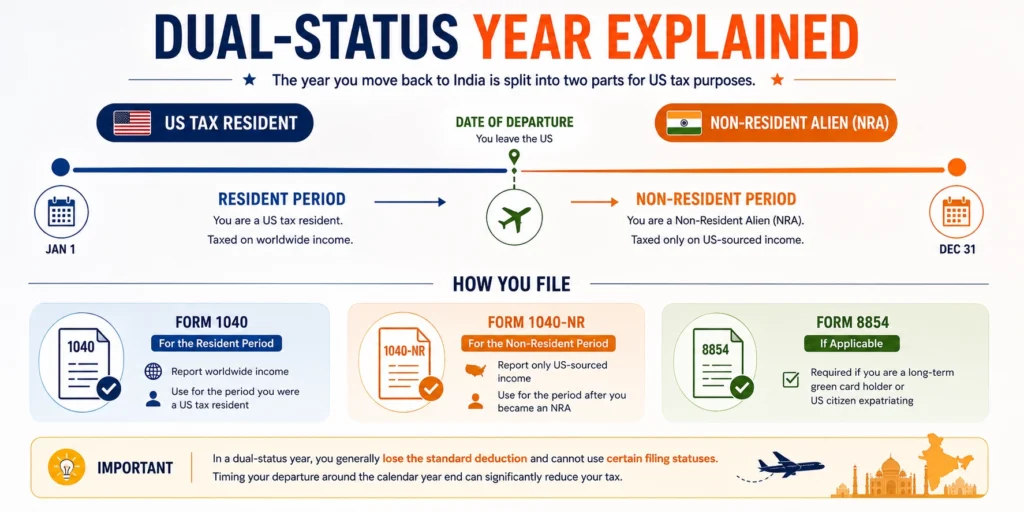
The year you move back is almost always a dual-status year. Part of it you are a US tax resident; part of it you are a Non-Resident Alien (NRA).
For this year, you file:
- Form 1040 for the resident portion (worldwide income)
- Form 1040-NR for the non-resident portion (US-sourced income only)
- Attach a statement declaring dual-status residency
- File Form 8854 if you are a long-term green card holder or US citizen expatriating
You lose several advantages in a dual-status year, including the standard deduction and certain filing statuses. This is why timing your departure around the calendar year end can materially reduce tax.
After You Move to India: The Non-Resident Alien Position

Once your US residency ends, you become a Non-Resident Alien (NRA) for US tax purposes. The IRS still taxes you, but only on US-sourced income.
Two categories apply:
- FDAP income (Fixed, Determinable, Annual, or Periodic): interest, dividends, rent, royalties. Taxed at a flat 30% withholding at source, reducible under the India-US DTAA to as low as 15% or 10% for certain streams
- Effectively Connected Income (ECI): income from a US trade or business. Taxed at graduated rates with deductions allowed
To claim the DTAA rate on FDAP income, you must file Form W-8BEN with each US financial institution. Without it, they will continue to withhold the full 30% or, worse, apply 28% backup withholding if your tax ID is not in order.
For a full walkthrough of the India-side transition, see our Returnee NRI Transition Services framework.
What Happens to Your US Assets: A Category-by-Category Guide
Your US financial life does not fold neatly into an Indian tax return. Each asset type carries its own rules.
| Asset Type | US Tax Treatment for NRA | India Tax Treatment (Post-RNOR) |
|---|---|---|
| US brokerage stocks and ETFs | Capital gains generally exempt from US tax for NRA | Taxable in India once ROR (with DTAA credit) |
| US dividends | 25% withholding (India-US DTAA rate) | Taxable in India once ROR |
| US bank interest | Generally exempt from US tax | Taxable in India once ROR |
| 401(k) withdrawals | 30% US withholding (may reduce via DTAA) | Complex; DTAA relief needed |
| Traditional IRA withdrawals | 30% US withholding at source | Taxable in India once ROR |
| Roth IRA qualified withdrawals | Tax-free in US | Position uncertain; often taxable in India |
| US real estate sale | FIRPTA 15% withholding + regular tax on gain | Taxable in India once ROR |
| RSUs vesting after departure | Partial US-source (based on work days in US) | Partial India-source; DTAA sourcing rules |
| US LLC or S-Corp income | May remain ECI, taxable at graduated rates | Additional Indian tax layer possible |
Stocks and Brokerage Accounts
As an NRA, capital gains on US-listed stocks are generally exempt from US tax. Dividends attract a 25% withholding under the India-US DTAA. Update your account with Form W-8BEN the day your residency ends. Skipping this leads to unnecessary withholding.
RSUs and Stock Options: The Sourcing Trap
RSUs granted during your US years but vesting after you move to India trigger a pro-rata sourcing calculation. The portion attributable to the days you worked in the US is US-source income, taxable by the IRS. The portion attributable to Indian workdays is India-source, taxable in India.
Employers often withhold assuming full US residency, leading to over-withholding. Reclaiming this requires filing Form 1040-NR, along with careful workday documentation.
401(k) and Traditional IRA
Withdrawals from a 401(k) or traditional IRA attract a default 30% US withholding. The India-US DTAA can reduce this if the income is treated as pension under the treaty, but the interpretation is not automatic and requires proper Form W-8BEN filing.
On the India side, once you become ROR, these withdrawals are taxable as income, with a foreign tax credit for the US tax paid.
US Real Estate: FIRPTA Withholding
Selling US property as an NRA triggers FIRPTA (Foreign Investment in Real Property Tax Act) withholding of 15% of the gross sale price. This is not the tax owed; it is a deposit. The actual tax on the gain is calculated on Form 1040-NR and any excess withholding is refunded.
For a personalised sale-side analysis, see our Capital Gain Tax advisory.
The US Exit Tax: Who Actually Owes It
The US exit tax is one of the most misunderstood parts of leaving America. It does not apply to everyone.
You are a covered expatriate subject to the exit tax if you are a US citizen renouncing citizenship or a long-term green card holder (held for 8 of the last 15 years) and you meet any one of:
- Net worth of USD 2 million or more on the date of expatriation
- Average annual US federal income tax liability above approximately USD 190,000 (indexed annually) over the past 5 years
- Failure to certify 5 years of full US tax compliance on Form 8854
If covered, the IRS treats you as having sold all worldwide assets at fair market value the day before expatriation. This mark-to-market taxation applies to unrealised gains. An exclusion of around USD 800,000 applies.
Green card holders who have held the card for fewer than 8 years typically escape the exit tax entirely. This is why timing the surrender is so important.
The US Estate Tax Trap Almost Nobody Talks About
This is the sleeper risk. Non-Resident Aliens face a very different US estate tax rule than US citizens or residents.
- US citizens and residents: estate tax exemption of around USD 13.6 million
- Non-Resident Aliens: exemption of only USD 60,000
If you die as an Indian resident holding US-situs assets (US stocks, US real estate, US-based accounts) worth more than USD 60,000, the excess above that threshold can be taxed at rates up to 40%.
This trap catches returning NRIs who continue to hold US brokerage accounts, US ETFs, and US property in their own name. Restructuring before departure through joint holdings, trusts, or partial liquidation is often more efficient than dealing with it after moving.
The Pre-Departure Checklist Every Returning NRI Should Complete
Complete these steps in the final 6 months before your return.
- Establish your US tax residency end date
- File Form I-407 (green card) or document last-presence date (visa)
- Update W-9 to W-8BEN with every US bank, broker, retirement account provider
- Update your US mailing address to a reliable forwarding address
- Review and settle state tax obligations (California, New York in particular)
- Download 10 years of brokerage, retirement, and payroll statements
- Get your 401(k) and IRA distribution plan in place
- Time large capital gain realisations around your residency change
- Restructure US real estate holdings to reduce FIRPTA and estate tax exposure
- File FBAR and Form 8938 for the departure year and any prior years missed
- Confirm your RSU vesting schedule and workday allocation
- Preserve documentation of every India workday for future sourcing claims
Common Mistakes Returning NRIs Make
The most expensive slip-ups are avoidable:
- Keeping the green card as a backup without realising it keeps US tax residency alive
- Failing to file Form W-8BEN with US financial institutions, leading to over-withholding
- Missing the dual-status return for the year of departure
- Ignoring state exit rules, especially in California
- Forgetting FBAR and Form 8938 for the departure year
- Overlooking US estate tax on US-situs assets
- Cashing out 401(k) or IRA all at once, triggering large withholding
- Selling US property without FIRPTA planning
- Assuming the India-US DTAA credit is automatic
- Missing the India-side RNOR window and losing tax-free withdrawal opportunities
If you have already returned and missed some steps, our NRI Income Tax Notice Solutions team helps regularise Indian filings and coordinate with your US CPA.
How MostlyNRI Helps Returning US NRIs
Moving back from the US is one of the most complex tax transitions any professional undertakes. The IRS handles the US side; MostlyNRI handles the India side and coordinates with your US CPA so nothing falls between the two systems.
At MostlyNRI, we help returning US NRIs with:
- India residency planning and RNOR window optimisation
- Indian ITR filing with Schedule FA, FSI, and TR entries
- DTAA credit claims on US income already taxed
- Capital gains structuring on 401(k), IRA, brokerage, and RSU proceeds
- US property sale planning on the India side
- NRE, NRO, RFC account structuring for repatriated funds
- Response to Indian tax notices on US-sourced income
- Long-term wealth structuring to reduce dual-country friction
Our team has served US-returning NRIs from over 33 countries across 13 Indian cities.
Planning to move back to India from the US? Book a consultation with our specialists at MostlyNRI.com and get your India-side residency, ITR, and asset transition mapped before you board the flight.
Frequently Asked Questions (FAQs)
Do returning NRIs still owe US tax after moving back to India?
Yes. Your US tax obligations continue on US-sourced income (dividends, interest, IRA and 401(k) withdrawals, US property sales, and certain RSU vesting) even after you become an Indian resident. Filing Form W-8BEN and Form 1040-NR is essential.
How do green card holders formally end US tax residency?
Green card holders must file Form I-407 with USCIS to formally abandon the card. Until that filing is complete, the IRS continues to treat them as US tax residents on worldwide income, regardless of physical presence in India.
What is the Substantial Presence Test for US tax residency?
The Substantial Presence Test treats you as a US resident if you are present 31 days in the current year and 183 days on a weighted formula across the current year plus one-third of the prior year and one-sixth of the year before that.
Are RSUs taxable in India after a returning NRI moves back?
Partially. RSUs granted in the US but vesting after your return are split under sourcing rules based on your US and India workdays. The India portion is taxable in India; the US portion continues to face IRS withholding requiring Form 1040-NR reconciliation.
How are 401(k) and IRA withdrawals taxed for returning NRIs?
401(k) and traditional IRA withdrawals attract a default 30% US withholding. The India-US DTAA may reduce this rate. On the India side, they become taxable once you become ROR, with foreign tax credit available for the US tax paid.
What is FIRPTA and does it affect returning NRIs selling US property?
Yes. FIRPTA requires a 15% withholding on the gross sale price of US real estate sold by a Non-Resident Alien. This is a deposit, not the final tax. The actual gain is calculated on Form 1040-NR and excess withholding is refundable.
Do returning NRIs face the US exit tax?
Only if you are a US citizen renouncing citizenship or a long-term green card holder (8 of last 15 years) and are a covered expatriate. Triggers include net worth above USD 2 million or high average federal tax over the past five years.
What is the US estate tax exemption for Non-Resident Aliens?
Just USD 60,000, compared to around USD 13.6 million for US citizens and residents. This means US stocks, ETFs, and property held by Indian residents can face up to 40% estate tax on the amount above USD 60,000 at death.
Which form do returning NRIs file with US brokerages after moving?
You must file Form W-8BEN with every US bank, brokerage, and retirement provider to certify your Non-Resident Alien status and claim India-US DTAA rates on dividends, interest, and other FDAP income. Without it, full 30% withholding continues.
How can MostlyNRI help returning NRIs from the US?
MostlyNRI handles the India-side transition: residency planning, RNOR optimisation, ITR filing with Schedule FA and FSI, DTAA credit claims, and account structuring. We coordinate with your US CPA to ensure no filing or credit falls between the two tax systems.


0 Comments