



You filed your ITR. You picked the right residential status. You filled in your income, claimed your deductions, and clicked submit.
Job done. Or so you thought.
Months later, a notice arrives from the Income Tax Department. It's about foreign assets. A UK savings account. A US brokerage. A flat you still own in Dubai. Assets you never declared because you didn't know you had to.
This is what happens to many returning NRIs every single year. They continue filing as if their foreign financial life is outside the Indian tax system. That works while they are NRI or RNOR. But the moment they become Resident and Ordinarily Resident, Schedule FA becomes mandatory. And if they miss it, things can get complicated fast.
This guide covers exactly how returning NRIs can declare foreign assets in Indian income tax returns. Who must file Schedule FA. What needs to be declared. How to fill it step by step in ITR-2. What the penalties look like. And critically, what to do if you missed it in a previous year.
Let's start from the beginning.
Who Is Required to Disclose Foreign Assets in ITR: NRI, RNOR, or Resident?
This is the question that trips up the most people. The answer is simpler than you expect. But the consequences of getting it wrong are not.
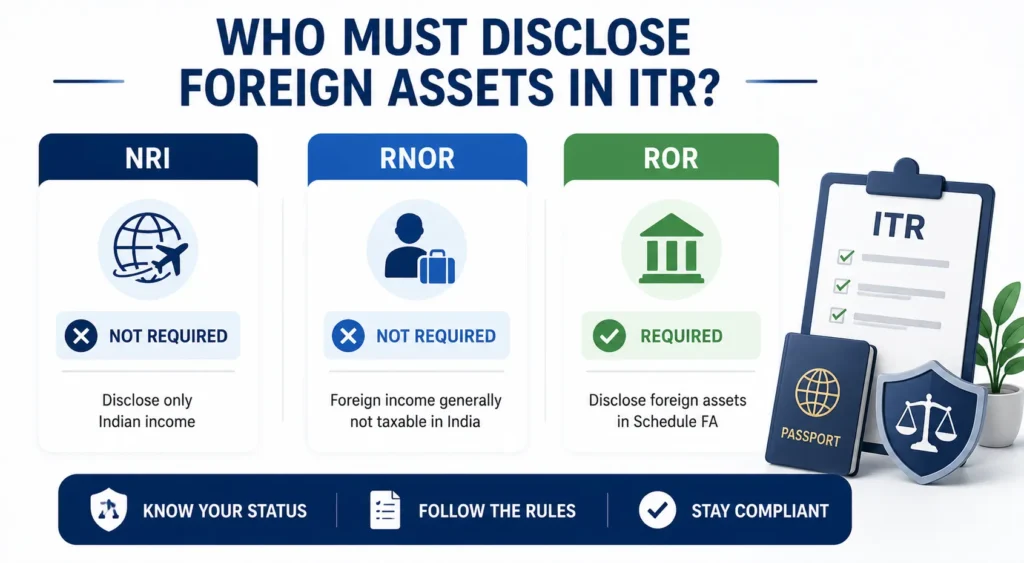
NRI (Non-Resident Indian): Not required to disclose foreign assets in Schedule FA. NRIs file their Indian ITR only on income earned or received in India. Foreign assets don't come into the picture at all.
RNOR (Resident but Not Ordinarily Resident): Not required to disclose foreign assets in Schedule FA. Foreign income generally remains outside Indian taxation during RNOR, subject to specific exceptions.
ROR (Resident and Ordinarily Resident): Required to disclose foreign assets in Schedule FA. Every single year. Without exception.
Here is the direct answer that most returning NRIs are searching for:
NRIs and RNOR taxpayers are not required to disclose foreign assets in their Indian ITR. But the moment they become ROR, Schedule FA becomes mandatory. From that point, foreign assets and foreign income both come into the Indian tax picture.
That last part is what causes the confusion. During RNOR, foreign income is generally exempt. So people assume the filing works the same even after they become fully resident. But foreign asset reporting is a completely separate obligation. It kicks in once you become ROR.
Think of it this way. As an NRI, your Indian ITR and your foreign financial life were two completely separate boxes. They never touched. As an RNOR, those boxes still mostly remain separate. But the moment you become ROR, those two boxes merge. Your foreign assets, foreign income, and Indian tax filing now need to speak to each other clearly.
| Residential Status | Schedule FA Required? | Foreign Income Taxable in India? |
|---|---|---|
| NRI | No | No |
| RNOR | No | Generally no |
| ROR | Yes | Yes (fully taxable) |
What Is Schedule FA and What Foreign Assets Must Be Declared?
Schedule FA stands for Foreign Assets. It is a dedicated schedule within the Indian ITR form. ROR taxpayers use it to disclose all foreign assets held at any point during the relevant calendar year.
Not just assets held on 31 March. At any point. During the relevant calendar year.
Here is what must be declared:
Foreign bank accounts: Every account held outside India. Savings, current, fixed deposit, investment accounts. All of them. Including the one you forgot about five years ago and haven't touched since.
Financial interests in foreign entities: Shares, partnership interests, or any ownership stake in a foreign company or firm.
Immovable property outside India: Residential property, commercial property, or land held abroad.
Foreign custodial accounts: Brokerage accounts, demat accounts, or investment accounts held with a foreign custodian.
Foreign trusts: Any trust created outside India where you are a trustee, beneficiary, or settlor.
Foreign equity and debt interest: Stocks, bonds, or other securities held outside India.
Cash value insurance and annuity contracts: Foreign life insurance or annuity products that carry a cash value.
Any other financial asset held outside India.
Now here is the part that surprises almost every returning NRI the first time they read it.
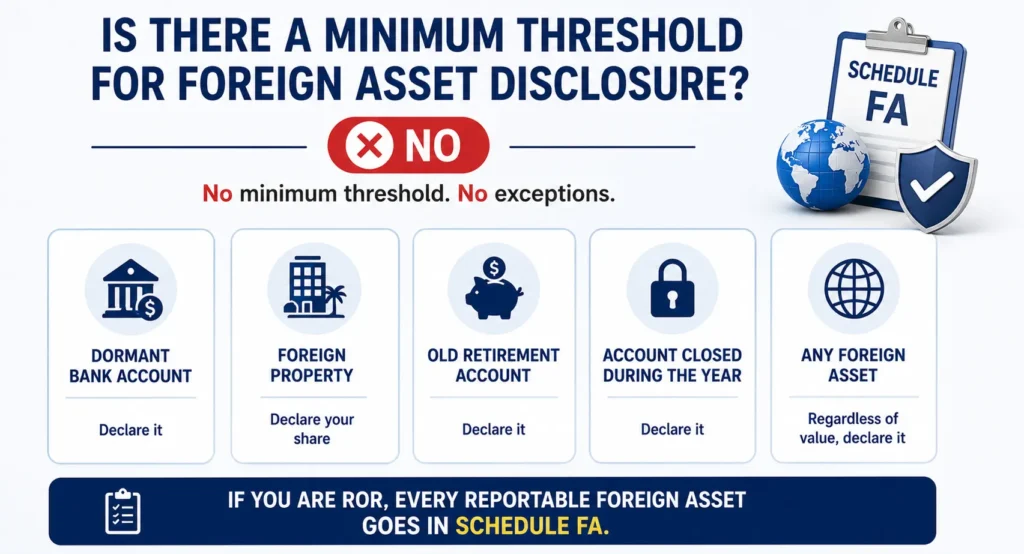
There is no minimum threshold for Schedule FA disclosure.
Zero balance in that old UK current account you forgot to close? Still must be declared once you are ROR. A small 401(k) from your years working in the US? Declare it. A co-owned apartment in Dubai worth far less than your flat in Pune? Declare your share.
There is no floor. No exemption for small balances. No relief for dormant accounts. We will dedicate a full section to this below, because it matters more than almost anything else in this guide.
Which ITR Form Contains Schedule FA and How to Access It
Before getting into the filing process itself, you need to know exactly where Schedule FA lives inside the ITR system.
Schedule FA is part of ITR-2. This is the form used by most returning residents with capital gains, foreign assets, or multiple income sources. If you are ROR with any foreign assets at all, ITR-2 is almost certainly your form.
ITR-3 also contains Schedule FA. But that form is for taxpayers with business or professional income.
ITR-1 does not contain Schedule FA at all. This is one of the core reasons returning residents with foreign assets simply cannot use the simplified ITR-1 Sahaj form. Even if your Indian income looks completely straightforward on paper.
To access Schedule FA in ITR-2, log in to incometax.gov.in and select ITR-2 for AY 2026-27. Once inside the online filing interface, you will see Schedule FA appear as a separate tab. It sits right alongside your income schedules, deductions, and capital gains sections.
Schedule FA is divided into sub-schedules A through F. Each covers a different category of foreign asset. The next section walks through every single one of them.
(If you are new to online ITR filing, the MostlyNRI guide on how NRIs can file ITR online walks through the complete portal process step by step.)
Step-by-Step: How to Fill Schedule FA in ITR-2
This is the practical core of the entire guide. Here is how to complete Schedule FA for AY 2026-27, one sub-schedule at a time.
Step 1: Log in and navigate to Schedule FA
Go to incometax.gov.in. Log in using your PAN and password. Under the e-File menu, choose Income Tax Returns and then File Income Tax Return. Select AY 2026-27. Choose ITR-2. Once inside the filing interface, find the Schedule FA tab and open it.
Step 2: Schedule FA-A — Foreign Bank Accounts
This is where every foreign bank account you held during the relevant calendar year gets declared.
For each account you need: the country where the account is held, the name and full address of the bank, the account number, the account type (savings, current, or fixed deposit), the date the account was opened, the peak balance during the relevant calendar year in foreign currency and its INR equivalent, the closing balance as per the Schedule FA reporting requirement in foreign currency and INR equivalent, and whether any income from this account has been included in your ITR.
Step 3: Schedule FA-B — Financial Interest in Foreign Entity
For any ownership stake in a foreign company, firm, or other entity. Enter the entity name, country, nature of your interest, date of acquisition, and any income derived from that interest during the year.
Step 4: Schedule FA-C — Immovable Property Outside India
Declare the full address and country of the property, the date you acquired it, the total amount invested in INR, and any income derived such as rental income.
Step 5: Schedule FA-D — Any Other Capital Asset Outside India
This is the catch-all sub-schedule. Foreign stocks, bonds, and other securities that aren't covered above go here. Enter the asset description, country, acquisition date, investment value, and income derived.
Step 6: Schedule FA-E — Account in Which You Have Signing Authority
This one surprises people. Sometimes a taxpayer has signing authority over a foreign account without actually owning it. A joint account with a spouse still living abroad. A company account you were a signatory on. Even with no beneficial ownership, if you had signing authority over a foreign account at any point during the relevant reporting period, it must appear here.
Step 7: Schedule FA-F — Trusts Outside India
Any involvement in a foreign trust as settlor, trustee, or beneficiary gets declared here. Enter the trust name, country, date of creation, and your specific role in it.
Step 8: Review everything before you submit
Cross-check every single entry against your actual foreign account statements and ownership documents. A mismatch between what you declare and what FATCA or CRS data already shows can trigger scrutiny. Even when the intent behind your filing was completely honest.
Where to Find the Exchange Rate for Schedule FA Conversion
Every foreign currency amount in Schedule FA must be converted to INR. The Income Tax Rules require the telegraphic transfer buying rate, or TT buying rate, of State Bank of India, as applicable under the relevant Schedule FA instructions.
SBI publishes these rates on their website under the forex rates section. Use the correct SBI TT buying rate based on the specific value and date required under the applicable Schedule FA table.
It sounds like a small detail. But use the wrong rate or the wrong date, and you've introduced an error into a legally sensitive schedule. Your CA can help verify the exact rates if you're unsure.
- [MID-CONTENT CTA] Need help filling Schedule FA or disclosing your foreign assets the right way? Talk to an NRI Tax Expert at MostlyNRI. We handle Schedule FA filings for returning NRIs once they become ROR taxpayers.
Is There a Minimum Threshold for Foreign Asset Disclosure?
No.
There isn't one. Not a small one. Not a hidden one. Not one buried in a rule nobody reads.
There is no minimum threshold for Schedule FA disclosure. The Black Money Act provides zero de minimis exemption. None at all.
We mentioned this earlier. But it deserves its own section because this single misconception is responsible for more Schedule FA errors than almost anything else. People hope there's a threshold. They search for it. They ask their friends. Their friends guess a number. And then they leave out the small accounts.
That is a mistake.
Here are real situations that returning NRIs commonly assume are exempt once they become ROR:
"My UK current account has been dormant for years. It had zero balance at the end of the reporting period." If the account was technically open at any point during the relevant reporting period, declare it.
"I co-own a small apartment in Dubai with my brother. My share is tiny." Declare your share of the property.
"I have an old 401(k) from my US years. There's barely anything left in it." Declare it.
"My Singapore account was closed in December 2025." It existed during the relevant calendar year. It goes in Schedule FA.
Every reportable foreign asset. Regardless of value. If you are ROR, it goes in Schedule FA.
Write that down somewhere. It will save you from a very unpleasant surprise.
Penalty for Not Disclosing Foreign Assets: What the Black Money Act Says
Let's be direct about what's at stake. Because the numbers here are not small.
Non-disclosure of foreign assets in Schedule FA can fall under the Black Money (Undisclosed Foreign Income and Assets) and Imposition of Tax Act, 2015. The Black Money Act, as most people call it.
Here is what it may prescribe, depending on the facts of the case:
Penalty for non-disclosure: Rs. 10 lakh for failure to furnish information about foreign assets or accounts. This is not a percentage of the asset value.
Tax on undisclosed foreign assets: 30% of the fair market value of the asset. Assessed at market value, not the amount you originally invested.
Additional penalty on that tax: 90% of the tax assessed. Put these two together. The combined exposure, tax plus the penalty on that tax, can become very serious in severe cases.
Prosecution: In serious cases involving wilful non-disclosure or evasion, prosecution may also be initiated under the applicable provisions of law.
Now here is the detail that makes non-disclosure a particularly risky strategy in 2025 and beyond.
India is part of FATCA and CRS.
FATCA is the US-origin framework. CRS is the global equivalent backed by the OECD. Under these frameworks, foreign financial account information may be exchanged with the Indian Income Tax Department where applicable. This data exchange happens across many major jurisdictions. The UK, UAE, Singapore, Canada, Australia, and the US are all part of this broader information-sharing environment.
So the foreign bank where you hold that account may already have reported relevant details to the tax authorities, depending on the account type, jurisdiction, and reporting rules. The question is whether your Schedule FA matches what the department can access.
Think of it like a puzzle. The IT department may already have several pieces from the FATCA and CRS data. They're waiting to see if you hand them the rest. If you do, it all fits together and there's no problem. If you don't, they can see exactly which piece is missing.
Non-disclosure is not a safe strategy. It is a detectable gap. And it becomes more detectable every year.
What If You Did Not Declare Foreign Assets in Previous Years?
Let's be honest. Many people reading this section are not here out of general curiosity.
They missed Schedule FA last year. Or two years ago. And now they're worried about what happens next.
Here's what you can actually do, depending on your specific situation.
If the assessment year is still open
The revised return window for AY 2026-27 typically stays open until 31 December 2026, subject to the applicable provisions. If you are within this window, file a revised ITR with Schedule FA correctly and completely filled in. This is the cleanest route available. Use it if you can. Don't wait.
If the assessment year is closed and you haven't received a notice yet
This is harder. You cannot file a revised return at this point. Consult a qualified CA or NRI tax advisor immediately. The options that are available to you depend heavily on the specific assets involved, the assessment year, and your overall tax profile.
India doesn't currently have a formal ongoing voluntary disclosure scheme. But approaching the situation proactively, with full documentation and complete transparency, is consistently safer than waiting to be identified through automatic FATCA or CRS data exchange. The difference in outcome between proactive correction and being identified can be very significant.
If a notice has already arrived
Do not ignore it. Seriously. Do not.
Respond within the deadline specified in the notice. Provide complete details of every foreign asset. Engage a CA or NRI tax specialist right away. This is legal territory that requires professional handling, and timing matters enormously.
The principle running through all three scenarios is the same: proactive disclosure is always better than reactive disclosure. The penalties and prosecution risk for those caught through automatic data exchange can be substantially higher than for those who correct the issue early. Every week of delay after receiving a notice makes things more complicated, not less.
Foreign Income vs Foreign Assets: An Important Distinction
These two things are closely connected. But they are not the same thing. Mixing them up causes real, costly filing errors every single year.
Foreign assets (Schedule FA) must be declared by ROR taxpayers. Regardless of whether those assets generate any income whatsoever.
Foreign income, the money those assets actually generate, is treated differently based on your residential status.
For RNOR: Foreign income is generally exempt from Indian tax, subject to specific exceptions. You are also generally not required to fill Schedule FA.
For ROR: Foreign income is fully taxable in India. You declare the assets in Schedule FA and include the income generated in the appropriate income schedule. You pay tax on it at your slab rate.
A concrete example to make this clearer. You hold an RFC account with USD 100,000 in it.
If you are RNOR: the RFC account generally does not go into Schedule FA. The interest it earns is generally exempt from Indian tax, subject to the applicable rules.
If you are ROR: the RFC account goes into Schedule FA. Mandatory. The interest is now taxable. It goes into income from other sources and gets included in your total taxable income for the year.
Two types of errors come from mixing these up. RNOR filers sometimes include foreign income they are fully exempt from, paying tax they simply don't owe. ROR filers sometimes focus so hard on reporting the income correctly that they forget to fill Schedule FA at all.
Both mistakes are avoidable. And both end up costing money.
(For more on how foreign income is taxed based on residential status, see the MostlyNRI guide on what income is taxable for NRIs and the RNOR investment guide.)
Disclaimer: This article is for informational purposes only and does not constitute legal, tax, or financial advice. Tax obligations under Schedule FA and the Black Money Act depend on individual circumstances, including residential status, the nature and value of foreign assets, and the specific assessment years involved. Penalties and prosecution risk vary significantly based on the specific facts of each case. If you have undisclosed foreign assets or missed Schedule FA in a previous year, consult a qualified CA or NRI tax advisor before taking any action.
Need Help Filing Schedule FA or Disclosing Foreign Assets?
Talk to an NRI Tax Expert at MostlyNRI. Whether you are filing Schedule FA for the first time as ROR, catching up on missed disclosures, or responding to a notice, our team is here to help.
Frequently Asked Questions
Is an NRI required to disclose foreign assets in ITR?
No. NRIs are not required to disclose foreign assets in Schedule FA. RNOR taxpayers are also generally not required to disclose foreign assets in Schedule FA. The obligation begins when the taxpayer becomes Resident and Ordinarily Resident. From that point forward, every reportable foreign asset must be declared in Schedule FA, regardless of whether it generates any income in India.
How do I declare foreign assets in ITR in India?
Use ITR-2 for AY 2026-27 if you are ROR and do not have business or professional income. Navigate to Schedule FA within the online filing interface on incometax.gov.in. Fill in each applicable sub-schedule: FA-A for foreign bank accounts, FA-B for financial interests in foreign entities, FA-C for immovable property, FA-D for other capital assets, FA-E for accounts where you have signing authority, and FA-F for foreign trusts. Convert all amounts to INR using the applicable SBI TT buying rate as per the relevant Schedule FA instructions.
How do I declare a foreign bank account in ITR?
Foreign bank accounts are declared in Schedule FA-A of ITR-2. For each account, you need the bank name and full address, country, account number, account type, date of opening, peak balance in foreign currency and INR, closing balance as per the relevant reporting requirement, and whether any income from that account is included in your ITR for the year.
What happens if you do not disclose foreign assets in ITR?
Under the Black Money Act 2015, failure to furnish information about foreign assets or accounts can attract serious penalties. Tax at 30% of the fair market value of an undisclosed foreign asset may also be levied, with an additional penalty of 90% of that tax. In serious cases involving wilful non-disclosure or evasion, prosecution may also be initiated. FATCA and CRS automatic reporting means the IT department may receive foreign account data, making non-disclosure increasingly easy to detect.
Is there a minimum threshold for foreign asset disclosure in ITR?
No. There is no minimum threshold under Schedule FA. Even a dormant foreign bank account with zero balance at the end of the reporting period must be declared if the account was technically open at any point during the relevant reporting period and you are ROR. The Black Money Act provides no de minimis exemption. Every reportable foreign asset, regardless of value, must be reported.
Do I need to declare assets in ITR?
It depends on your residential status and the type of asset. NRIs and RNOR taxpayers do not need to declare foreign assets in Schedule FA. ROR taxpayers must declare all reportable foreign assets in Schedule FA with no minimum threshold. All taxpayers must also declare Indian assets above certain thresholds in Schedule AL if their total income exceeds Rs. 50 lakh.
What happens if I voluntarily disclose foreign assets after missing a deadline?
If the revised return window is still open, file a revised ITR with Schedule FA completed immediately. If the window has closed and no notice has arrived, consult a CA right away and start building your documentation. If a notice has already arrived, respond within the deadline with full disclosure and engage professional help. Proactive correction is consistently safer than disclosure triggered by FATCA or CRS data.
What is the penalty for not reporting foreign assets in India?
Under the Black Money Act 2015, failure to furnish information about foreign assets or accounts can attract a penalty of Rs. 10 lakh, depending on the facts of the case. On top of that, 30% tax on the fair market value of an undisclosed foreign asset may be levied, plus a 90% penalty on that tax amount. The total combined exposure in severe cases can become very serious.
Which schedule in ITR is used for foreign assets?
Schedule FA (Foreign Assets) in ITR-2, or ITR-3 for those with business income, is the dedicated schedule for declaring foreign assets. It is divided into sub-schedules A through F, covering bank accounts, financial interests in foreign entities, immovable property, other capital assets, accounts with signing authority, and foreign trusts.


0 Comments