



Most NRIs assume that filing an income tax return in India means booking a flight, visiting a CA, or sending signed paperwork by post. That assumption costs people time, money, and missed deadlines every year. The truth? You can file your ITR in India completely online. From anywhere in the world. In a few hours. The Income Tax e-filing portal at incometax.gov.in handles the entire process. No India visit required. This guide covers everything: who needs to file, which ITR form to use, how to register on the portal, a step-by-step filing walkthrough, and how to verify your return, all without setting foot in India.
Do NRIs Need to File an ITR in India?
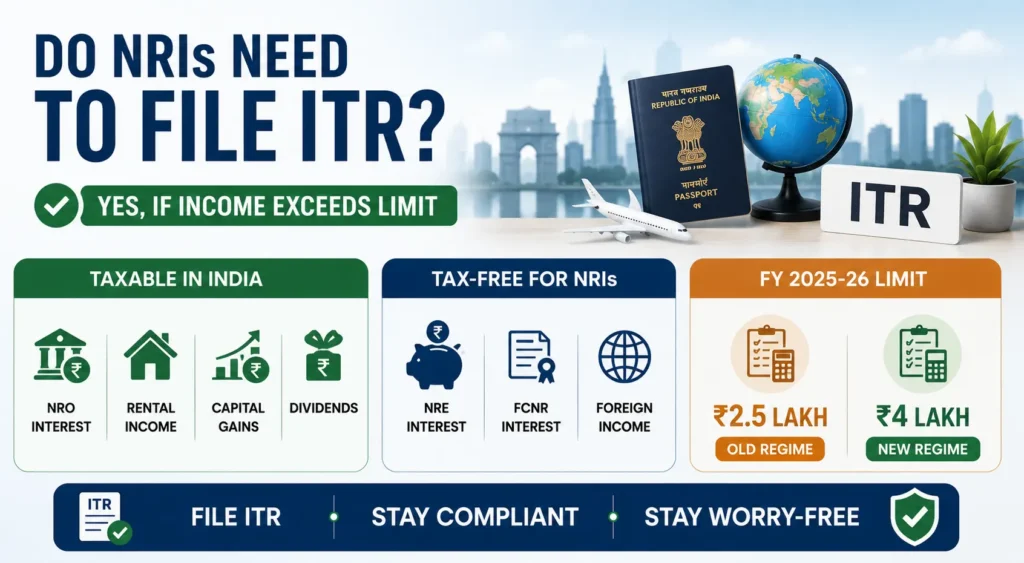
Yes. NRIs must file an ITR in India if their Indian income exceeds the basic exemption limit. For FY 2025-26, that limit is Rs. 2.5 lakh under the old tax regime and Rs. 4 lakh under the new tax regime.
What counts as Indian income? Things like:
- Interest earned on your NRO account
- Rent from property you own in India
- Capital gains from selling Indian property, shares, or mutual funds
- Dividends received from Indian companies
What does NOT count toward the taxable threshold:
- Interest on your NRE account (fully exempt)
- FCNR deposit interest during NRI or RNOR status (also exempt)
- Any income you earn abroad (not taxable in India for NRIs)
Here is the part many NRIs miss. Even if your Indian income is below the exemption limit, you should still file. Why? Because TDS is often deducted at source, typically at 30% on NRO interest. The only way to claim that money back is by filing an ITR. Skip the filing, and you leave your own money on the table.
Which ITR Form Should NRIs Use?
This is one of the most searched questions among NRIs filing in India, and the answer is simpler than most people think.
| ITR Form | Applicable to NRI? | When to Use |
|---|---|---|
| ITR-1 (Sahaj) | No | Only for resident individuals. NRIs cannot use this form. |
| ITR-2 | Yes | NRIs with salary, NRO interest, rental income, capital gains, or foreign assets. Most NRIs use this. |
| ITR-3 | Yes | NRIs who also have income from a business or profession in India. |
| ITR-4 (Sugam) | No | Only for residents under presumptive taxation. Not for NRIs. |
The bottom line: most NRIs will use ITR-2. If you have NRO interest, rental income, capital gains, or a mix of these, ITR-2 is your form. If you also run a business in India, you may need ITR-3. When in doubt, a tax advisor can confirm the right choice.
One important thing to remember: filing ITR-1 as an NRI is a mistake. The return will be treated as invalid. More on this in the common mistakes section.
What Income Must NRIs Report in Their ITR?
Think of your ITR as a snapshot of everything India-related. Here is what goes in, and what stays out.
Must be reported:
- NRO account interest - taxable in India, with TDS already deducted at 30%
- Rental income from Indian property - after a standard deduction and home loan interest if applicable
- Capital gains from selling Indian property, shares, or mutual funds
- Dividends received from Indian companies
- Any other income sourced from India
Does not need to be reported:
- NRE account interest (exempt from Indian tax)
- FCNR deposit interest during NRI or RNOR status
- Your foreign income - India has no claim on income you earn abroad as an NRI
One thing to pay attention to: if you have become Resident and Ordinarily Resident (ROR), you may need to report foreign assets in Schedule FA. This is a separate schedule within the ITR. Missing it can attract penalties under the Black Money Act, which can be significant. RNOR taxpayers generally do not have this reporting requirement. If your residential status has recently changed, this is worth checking with an advisor. (Our RNOR blog explains this in detail.)
How to Register on the Income Tax Portal as an NRI
Good news: registering on incometax.gov.in is straightforward, and you do not need Aadhaar to complete it.
Here is the process, step by step:
- Go to incometax.gov.in
- Click Register and select Individual as your user type
- Enter your PAN number - this becomes your permanent user ID on the portal
- Verify your details: name, date of birth, and address as they appear in your PAN records
- Enter your mobile number and email ID - OTPs will be sent to both for verification
- Set your password and complete registration
No Aadhaar? No problem. NRIs are exempt from the mandatory PAN-Aadhaar linking requirement. You can complete registration and file entirely using PAN-based verification.
If you have filed before and already have login credentials, just log in. You do not need to re-register.
One practical tip: make sure the mobile number you use is accessible to you abroad. The portal sends OTPs during registration and login. Use a number you can receive SMS on from wherever you are.
Step-by-Step: How to File ITR Online as an NRI
NRIs can file their Indian income tax return entirely online using the Income Tax e-filing portal at incometax.gov.in - no visit to India is required. Most NRIs use ITR-2 and can complete registration, filing, and e-verification using PAN, net banking EVC, or DSC from anywhere in the world.
This is the core of the process. Follow these steps carefully.
Step 1: Log in to incometax.gov.in using your PAN and password.
Step 2: Navigate to e-File > Income Tax Returns > File Income Tax Return.
Step 3: Select the Assessment Year. For income earned in FY 2025-26, you will select AY 2026-27.
Step 4: Choose your filing mode. Select Online (recommended for most NRIs). The offline mode is for complex returns that require a separately prepared XML file.
Step 5: Select your ITR form. For most NRIs, that is ITR-2.
Step 6: Select your reason for filing: "Taxable income above basic exemption limit" if your income crosses the threshold, or "Claiming TDS refund" if you are filing to recover TDS already deducted.
Step 7: The portal will display pre-filled data based on your Form 26AS and AIS (Annual Information Statement). This includes income details, TDS credits, and some deductions. Do not just accept this data. Verify every figure against your own records. Discrepancies can occasionally occur, and you are responsible for the accuracy of what you submit.
Step 8: Fill in all income details manually where pre-filled data is missing or incorrect. This includes NRO interest, rental income, and capital gains. Add Schedule FA if required based on your residential status and foreign asset reporting obligations.
Step 9: Claim your deductions. This includes Section 80C investments, Section 80D health insurance premiums, and if applicable, DTAA relief and foreign tax credit via Schedule TR and Form 67. (See our Form 67 guide for a full walkthrough of this step.)
Step 10: Review the tax computation. The portal will calculate whether a refund is due to you or additional tax needs to be paid.
Step 11: If additional tax is payable, pay it via Challan 280 before submitting the return. Do not submit with outstanding tax due.
Step 12: Submit the return.
Step 13: Verify the return within 30 days of submission. This is mandatory. A submitted but unverified return is treated as not filed at all.
How NRIs Can Verify Their ITR Without Aadhaar OTP
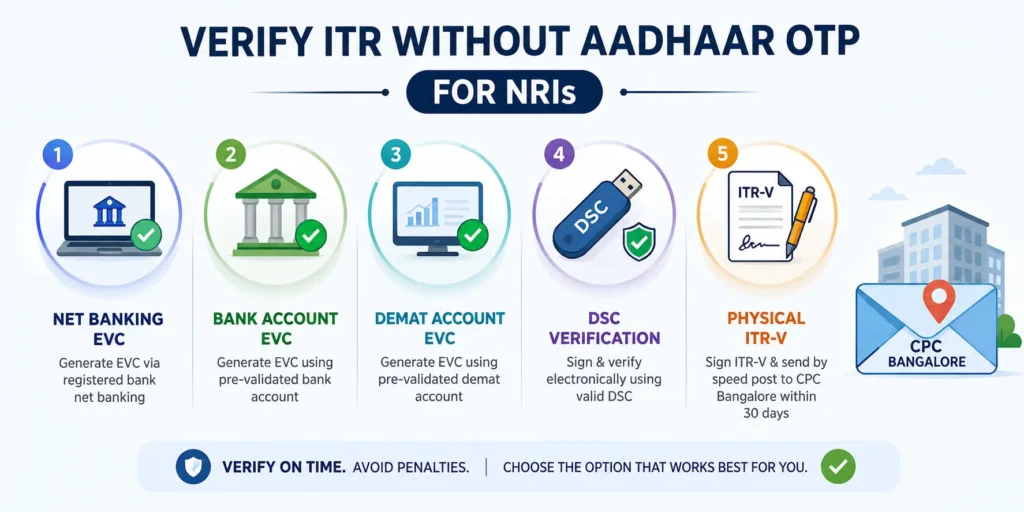
Many guides skip this, but it is a real practical issue for NRIs. Aadhaar OTP verification does not work for everyone abroad. Here are the alternatives:
- Net banking EVC: Generate an Electronic Verification Code through your registered Indian bank's net banking portal. Quick and widely used.
- Bank account EVC: Generate an EVC through your pre-validated bank account directly on the income tax portal.
- Demat account EVC: If you have a pre-validated demat account on the portal, you can generate an EVC through that as well.
- DSC (Digital Signature Certificate): The most secure option. If you have a valid DSC, you can use it to sign and verify electronically.
- Physical ITR-V: If none of the above options work, download the ITR-V acknowledgement after submission, sign it physically, and send it by speed post to CPC Bangalore within 30 days.
The physical route takes longer for processing, so use an electronic method wherever possible.
How to Claim a TDS Refund in Your ITR as an NRI
A lot of NRIs file their ITR for one specific reason: to get their TDS back.
Here is how it works. Banks deduct TDS at 30% on NRO account interest. But your actual tax liability on that income, after applying DTAA benefits or slab rates, may be significantly lower. The difference between what was deducted and what you actually owe is refundable. You just have to file to claim it.
The process:
- Before filing, check your Form 26AS and AIS on the portal. Every TDS deduction made against your PAN should appear here. If something is missing, contact your bank before filing.
- When filling out the ITR, the portal will match TDS credits from Form 26AS automatically. Verify these match your actual deductions.
- After you file and the return is processed, the refund is credited directly to your pre-validated bank account on the portal.
- Refunds are generally issued after the return is processed, though timelines vary depending on verification status and processing workload.
A few important things to double check: your bank account must be pre-validated on the portal. The IFSC and account number must be exactly correct. Ensure your bank account is pre-validated on the portal before filing. Check the latest portal guidelines and your bank's requirements regarding eligible refund accounts.
For NRIs claiming DTAA relief, the Form 67 filing is a separate but linked step. Do not skip it if you want to avoid being taxed twice on the same income. Our Form 67 guide walks through this in detail.
Common Mistakes NRIs Make While Filing ITR in India
These are the errors that show up again and again, and most of them are completely avoidable.
1. Filing ITR-1 instead of ITR-2. ITR-1 is not applicable to NRIs. Filing the wrong form may result in the return being treated as defective or invalid. Always check the form applicability before you start.
2. Not reporting capital gains. Gains from selling Indian mutual funds, shares, or property must be reported. Many NRIs assume that because the buyer deducted TDS, they are covered. They are not. The ITR still needs to be filed with capital gains details.
3. Skipping Schedule FA. If you are RNOR or ROR and have foreign assets, Schedule FA is mandatory. Missing it can attract heavy penalties under the Black Money Act.
4. Not pre-validating the bank account. Your refund cannot be credited without a pre-validated account on the portal. Set this up before filing, not after.
5. Missing the verification deadline. Many NRIs submit the return but forget to verify it. An unverified return is the same as no return. You have 30 days from submission to verify.
6. Not claiming DTAA relief. If India has a tax treaty with your country of residence, you may be entitled to pay reduced tax (or no tax) on certain income. Many NRIs pay the full 30% TDS and never claim back what the treaty entitles them to.
ITR Filing Deadlines for NRIs: When to File
Missing a deadline costs money. Know the dates.
- July 31, 2026: The standard deadline for FY 2025-26 returns (AY 2026-27), unless extended by the Income Tax Department. This is the due date for most NRI filers.
- October 31, 2026: Extended deadline if your accounts require an audit.
- December 31, 2026: Last date for a belated return. You can still file after July 31, but a late filing fee of Rs. 1,000 to Rs. 5,000 applies under Section 234F.
- December 31, 2026: Also the deadline for filing a revised return to correct errors in your original filing.
- Section 234A interest: If tax was due and you filed late, interest at 1% per month applies on the unpaid amount from the due date.
Practical tip: set a calendar reminder for July 15 each year. That gives you two weeks to gather documents, log into the portal, and file before the July 31 deadline without any last-minute rush.
Want an Expert to File Your NRI ITR? Let MostlyNRI Handle It.
Filing your ITR from abroad is completely doable. But between choosing the right form, claiming DTAA relief, handling capital gains reporting, and making sure verifications go through without Aadhaar OTP, there are enough moving parts to trip anyone up. If you would rather hand it off to someone who does this every day, MostlyNRI's NRI tax experts can file your ITR accurately and on time, from wherever you are in the world.
Disclaimer: This article is for informational purposes only and does not constitute tax advice. Individual NRI tax situations vary based on residential status, income types, country of residence, and applicable DTAA provisions. Please consult a qualified NRI tax advisor for personalised guidance specific to your situation.
Frequently Asked Questions
How do I file an income tax return online in India as an NRI?
Log in to incometax.gov.in using your PAN. Go to e-File > Income Tax Returns > File Income Tax Return. Select the relevant assessment year, choose ITR-2, fill in your income details, claim deductions, and submit. Verify the return within 30 days using net banking EVC, demat EVC, DSC, or by posting a signed ITR-V to CPC Bangalore.
Can NRIs file ITR in India?
Yes, absolutely. NRIs can file their ITR entirely online through the Income Tax e-filing portal. No physical visit to India is required. The portal is accessible from any country, and verification can be done electronically.
Can NRIs register on the income tax portal?
Yes. Go to incometax.gov.in, click Register, and select Individual. Use your PAN as the user ID. NRIs can complete registration without Aadhaar, using PAN along with mobile and email OTP verification.
What are the new rules for NRIs in India?
Key updates for AY 2026-27: the new tax regime is now the default regime (you need to actively opt for the old regime). The basic exemption limit under the new regime is Rs. 3 lakh. Eligible NRIs generally remain exempt from mandatory PAN-Aadhaar linking while they continue to qualify as non-residents under the applicable rules. Tax rules are updated each Budget season, so it is worth checking the current year's Finance Act for any changes that apply to your situation.
Do I need to file ITR-1 or ITR-2 as an NRI?
ITR-2. ITR-1 (Sahaj) is only for resident individuals and is not applicable to NRIs. Using ITR-1 as an NRI will result in the return being treated as invalid. Most NRIs with interest, rental income, or capital gains will use ITR-2.
Can I file ITR online myself as an NRI?
Yes, you can file it yourself if your income sources are straightforward. The portal's online mode is user-friendly and includes pre-filled data from Form 26AS. For complex situations involving DTAA claims, capital gains from property, or multiple income types, working with an NRI tax advisor is advisable.
What ITR form should an NRI use?
ITR-2 for most NRIs. Use ITR-3 only if you also have income from a business or profession in India. Avoid ITR-1 and ITR-4, which are not applicable to NRIs.
How much income is tax-free for NRIs in India?
Under the old tax regime, income up to Rs. 2.5 lakh is tax-free for NRIs. Under the new tax regime (the default for AY 2026-27), the basic exemption limit is Rs. 3 lakh. NRE account interest and FCNR interest are fully exempt and do not count toward this threshold. Note that NRIs do not get the enhanced exemption limits (Rs. 3 lakh for senior citizens, Rs. 5 lakh for super senior citizens) that resident Indians above 60 or 80 years of age receive.


0 Comments