



If you are a Non-Resident Indian holding cryptocurrency, NFTs, or any Virtual Digital Asset (VDA) linked to India, the 2026 filing season demands your full attention. India taxes crypto gains at a flat 30% rate plus surcharge and cess, deducts 1% TDS on most transactions, and disallows nearly every form of loss adjustment. These rules have been in force since 2022 under the Finance Act, but many NRIs still misfile, miss disclosures, or receive tax notices they never expected.
This guide explains everything an NRI needs to know before filing an Income Tax Return (ITR) for crypto income in India during 2026: the tax rate structure, TDS mechanics, allowable deductions, correct ITR form selection, and overseas disclosure obligations under the Black Money Act.
Are NRIs Liable to Pay Tax on Crypto in India?
Yes. If you earn income from a Virtual Digital Asset that is transferred through an Indian exchange, held on an Indian platform, or sourced from India, you are liable to pay tax under Indian law regardless of your residential status.
The Income Tax Act treats all VDA gains identically. There is no lower slab, no threshold exemption, and no concessional rate for long-term holdings. Whether you sold crypto after one week or five years, the tax remains a flat 30% plus 4% cess and applicable surcharge.
For NRIs, this income is reported in India through:
- ITR-2 if crypto is treated as a capital asset
- ITR-3 if crypto trading qualifies as business income
You cannot use ITR-1 or ITR-4, since Schedule VDA (mandatory for crypto disclosures) is available only in ITR-2 and ITR-3.
If you also hold crypto outside India, do not assume that offshore holdings escape scrutiny. India taxes global income only for residents, but NRIs must still be careful with source rules and remittance patterns.
For a personalised review of your residential status and crypto liability, our team at NRI Taxation and Compliance Services can help you file correctly.
The Framework: How India Taxes Virtual Digital Assets
The taxation framework for VDAs is built around three provisions of the Income Tax Act:
- Section 2(47A) defines what qualifies as a Virtual Digital Asset
- Section 115BBH taxes income from the transfer of VDAs at 30%
- Section 194S mandates 1% TDS on specified crypto transfers
Additional rules include Section 56(2)(x) on gifted crypto and Section 285BAA, which requires exchanges to report every crypto transaction to the tax department.
The VDA definition is deliberately wide. It covers cryptocurrencies like Bitcoin and Ethereum, stablecoins, non-fungible tokens (NFTs), and anything else the government may notify. Excluded items are Indian and foreign currency, Central Bank Digital Currency (CBDC), gift cards, mileage points, and NFTs whose transfer conveys ownership of an underlying tangible asset.
The 30% Flat Tax on Crypto Transfers Explained
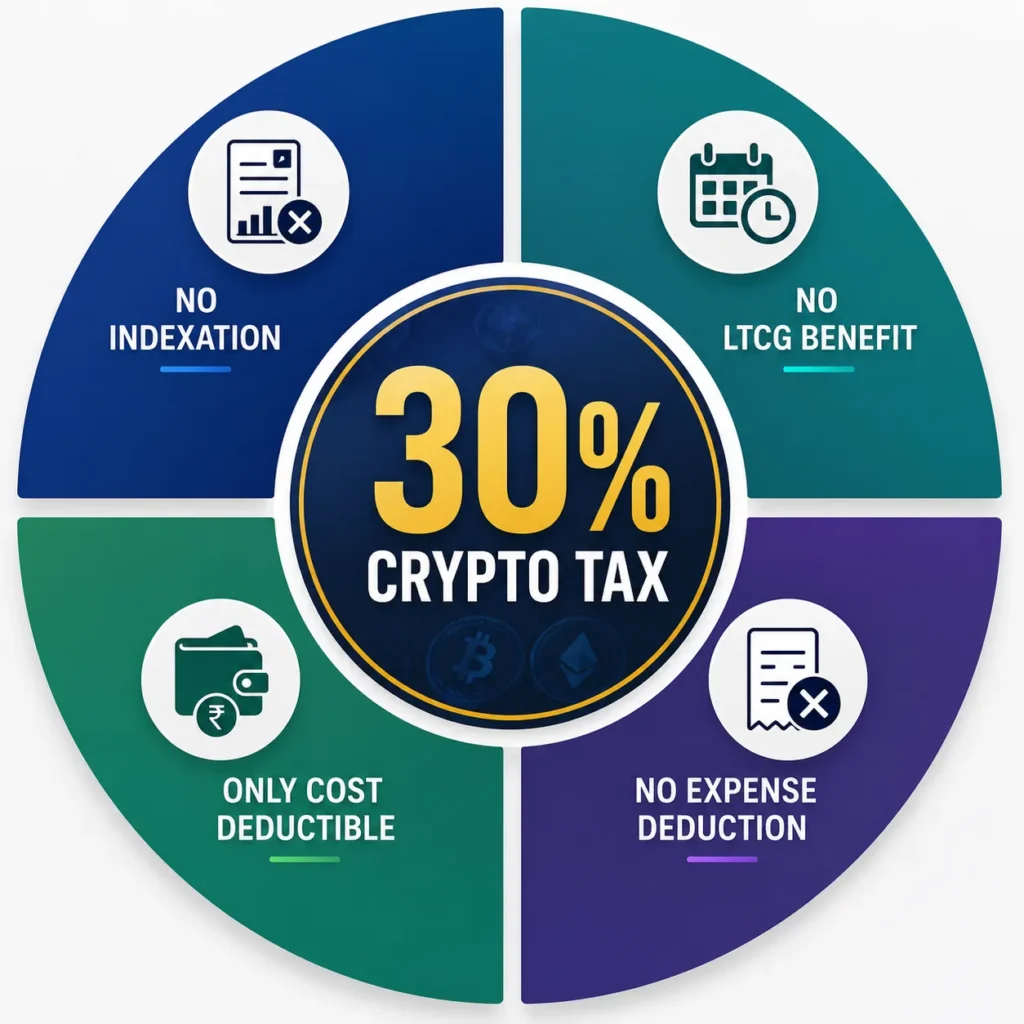
Every time you transfer a VDA, the profit is taxed at 30%, plus surcharge and 4% cess. This applies whether you sold Bitcoin for cash, swapped Ethereum for a stablecoin, or exchanged one NFT for another.
Key points NRIs should note:
- The concepts of short-term and long-term capital gains do not apply to crypto
- No indexation benefit is available
- No concessional rate is available for holdings above 24 months
- Only the cost of acquisition is deductible
You cannot claim:
- Exchange fees or brokerage
- Wallet or transaction charges
- Gas fees, blockchain fees, or mining costs
- Electricity or internet expenses used for mining
- Any other operational cost
This makes crypto one of the most heavily taxed asset classes in India today.
Which Crypto Transactions Are Taxable for NRIs
The table below summarises the most common transactions and how they are treated.
| Transaction | Taxable? | How It Is Taxed |
| Sell crypto for cash (INR) | Yes | 30% on gains |
| Crypto-to-crypto swap | Yes | 30% on gains |
| Stablecoin trade | Yes | 30% on gains |
| NFT sale | Yes | 30% on gains |
| P2P transaction | Yes | 30% on gains |
| OTC (over-the-counter) trade | Yes | 30% on gains |
| Transfer between own wallets | No | No transfer of ownership |
| Airdrops received | Yes | Taxed on receipt at Fair Market Value |
| Staking rewards | Yes | Taxed on receipt |
| Gifts received | Depends | Taxable above Rs. 50,000 unless exempt |
| Mining rewards | Yes | Income taxable, practical valuation issues remain |
Wallet-to-wallet transfers between accounts held by the same person are not taxable events, since there is no change in ownership. Everything else, including P2P and OTC deals, is taxed identically at 30%.
How 1% TDS Works on Crypto for NRIs
Under Section 194S, a 1% TDS applies on the consideration paid to residents for VDA transfers above certain thresholds. For NRIs, the situation is more complex. Payments to non-residents can attract TDS under Section 195 at higher rates depending on the nature of income and the DTAA relief available in your country of residence.
Here is how the standard 1% TDS mechanism functions:
- You sell your crypto through an Indian exchange
- The buyer or the exchange deducts 1% TDS
- The tax deducted is deposited with the Income Tax Department
- The credit reflects in your Form 26AS and AIS
- You claim this credit while filing your ITR
If the exchange fails to deduct or deposit the TDS, the deductor is treated as an assessee-in-default and can face interest, penalty, and prosecution risk.
For NRIs using foreign exchanges or P2P routes, the responsibility of reporting the income still lies with the taxpayer. Skipping TDS reconciliation is one of the most common reasons NRIs receive tax notices.
Our team at NRI ITR Filing Services helps NRIs reconcile 26AS, AIS, and Schedule VDA data before submission.
The Harsh Loss Rules NRIs Must Understand
Crypto tax rules are especially unforgiving on the loss side. NRIs must know these restrictions before adjusting any figures in their ITR.
You cannot:
- Offset a Bitcoin loss against an Ethereum gain
- Offset one Bitcoin loss against another Bitcoin gain
- Offset crypto loss against equity, mutual fund, or property gains
- Offset crypto loss against salary or business income
- Carry forward crypto losses to future financial years
Every crypto asset stands alone. If you made Rs. 1 lakh profit on Ethereum and Rs. 1 lakh loss on Solana, you still pay 30% tax on the Ethereum profit. The Solana loss simply disappears.
This is why tax-loss harvesting, a common strategy with equities, does not work for crypto. NRIs should plan disposals carefully within a single financial year.
Which ITR Form Should an NRI File for Crypto Income
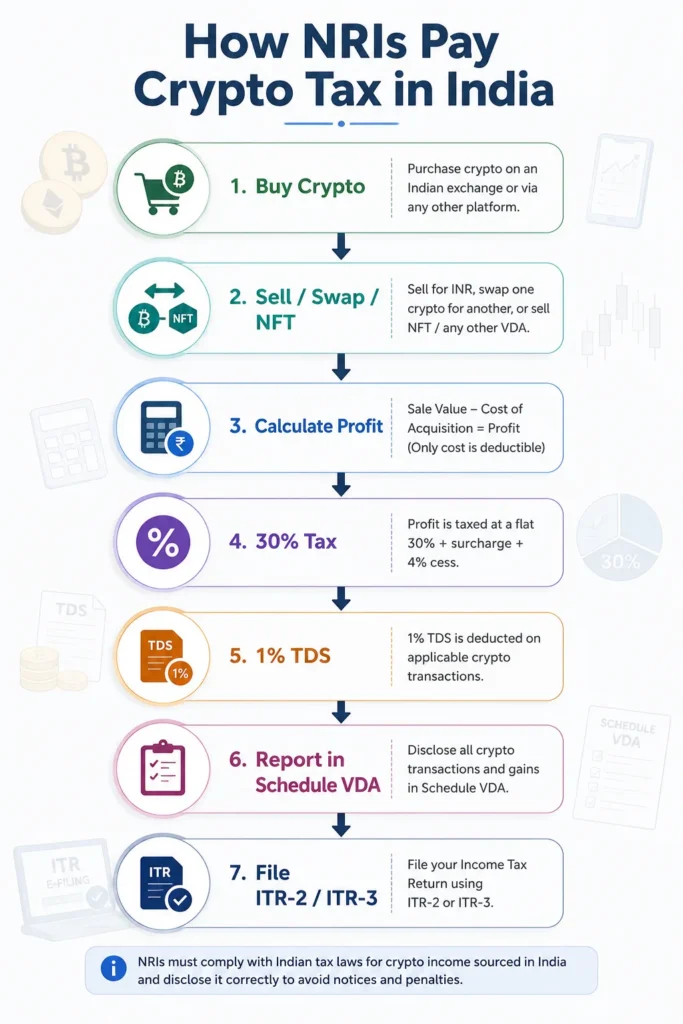
Filing the wrong ITR form is one of the top causes of tax notices. Here is the correct mapping:
- ITR-2: If you hold crypto as a capital asset (investor)
- ITR-3: If crypto trading is your business income (frequent trader)
Schedule VDA is mandatory in both forms. You must report:
- Date-wise details of each transaction
- Cost, consideration, and net gain per trade
- Transaction-wise data, not aggregates
Netting losses across VDAs or reporting only summary figures is a common mistake that triggers notices under the mismatch category.
Special Situations Every NRI Should Know
Some crypto scenarios have distinct treatment. Understanding these can save both tax and stress.
Airdrops and Staking Rewards
Both are taxed as income at fair market value on the date of receipt. That same value becomes your cost of acquisition for the eventual sale, which is again taxed at 30%.
Gifted Crypto
Gifts of VDAs above Rs. 50,000 in a financial year are taxable in the recipient's hands, unless received from specified relatives or on occasions such as marriage.
Worthless Tokens
If a token collapses to zero value, you cannot claim a loss unless there is an actual sale, transfer, or extinguishment of rights. The tax law does not accept notional write-downs.
Mining Rewards
Mining income is taxable, but practical valuation issues remain. NRIs mining crypto through Indian infrastructure should consult professionals to avoid classification errors.
Overseas Crypto Holdings and Disclosure Rules for NRIs
If you become a resident under Indian tax law and hold crypto abroad, your entire global income becomes taxable in India. Non-disclosure of foreign VDAs can invite provisions of the Black Money Act, which carries penalties up to 300% of the tax due and prosecution risk.
For genuine NRIs (non-resident status confirmed under Section 6 of the Income Tax Act), only India-sourced crypto income is taxable. However, if you switch residency during the year or hold RNOR status, the rules change. Read our detailed explainer on NRI Taxation and Compliance to understand your specific liability.
If you also hold US crypto assets, PFIC concerns and dual-tax risks may apply.
Common Reasons NRIs Receive Crypto Tax Notices
The department has become aggressive in matching data across sources. NRIs commonly receive notices for:
- AIS or Form 26AS mismatch with declared income
- Exchange data not matching the ITR
- Netting crypto losses across different VDAs
- Missing crypto-to-crypto swaps in reporting
- Wrong Schedule VDA entries
- Incorrect TDS claims
- Non-reporting of overseas holdings
- High trading volume with no crypto income shown
If you have already received a notice, do not respond without professional review. Our NRI ITR Filing team helps clients respond within statutory deadlines and reduce penalty exposure.
How MostlyNRI Helps NRIs Stay Compliant on Crypto
Filing crypto taxes correctly is not a matter of ticking one Schedule VDA row. It involves residential status analysis, TDS reconciliation, DTAA benefit evaluation, foreign asset disclosure, and defensive documentation for future notices.
At MostlyNRI, we help Non-Resident Indians with:
- NRI ITR Filing with correct Schedule VDA reporting
- Crypto TDS Reconciliation across Indian exchanges
- DTAA benefit claims where applicable
- Advisory on residential status and RNOR planning
- Foreign asset disclosure review for Black Money Act compliance
- NRI Wealth Management for post-tax portfolio structuring
Our clients across the USA, UAE, UK, Canada, Singapore, and Australia rely on our team for accurate and audit-ready filings.
Frequently Asked Questions (FAQs)
What is the crypto tax rate for NRIs in India in 2026?
NRIs pay a flat 30% tax on all Virtual Digital Asset gains, plus applicable surcharge and 4% cess. The rate is the same as for residents, and no long-term concessional rate or indexation benefit is available for crypto income.
Do NRIs need to pay 1% TDS on crypto in India?
Yes. Section 194S imposes 1% TDS on VDA transfers through Indian exchanges. For NRIs, higher TDS under Section 195 may also apply based on transaction type and DTAA relief. The credit appears in Form 26AS.
Which ITR form should NRIs use to report crypto income?
NRIs must file ITR-2 if crypto is a capital asset, or ITR-3 if it qualifies as business income. Only these forms include Schedule VDA. ITR-1 and ITR-4 cannot be used to declare any crypto-related gains.
Can NRIs set off crypto losses against other income in India?
No. Crypto losses cannot be offset against any other income, including equity, property, salary, or business gains. Even a Bitcoin loss cannot offset an Ethereum gain, and no crypto loss can be carried forward to future years.
Are crypto airdrops and staking rewards taxable for NRIs?
Yes. Airdrops and staking rewards are taxed as income at fair market value on the date of receipt. The same value becomes the cost of acquisition for any future sale, which is again taxed at the flat 30% rate under Section 115BBH.
Do NRIs need to disclose foreign crypto holdings in India?
Non-Resident Indians are taxed only on India-sourced income, so foreign crypto holdings are generally outside scope. However, if you hold RNOR or resident status, you must disclose global VDAs to avoid Black Money Act penalties and prosecution risk.
Is a wallet-to-wallet crypto transfer taxable for NRIs?
No. Transfers between wallets owned by the same person do not attract tax, since there is no change in ownership. However, you must maintain proper records to prove that both wallets belong to you if the department raises questions later.
Can NRIs claim deductions for exchange fees or gas fees?
No. The Income Tax Act allows only the cost of acquisition as a deduction on VDA transfers. Exchange fees, brokerage, wallet charges, gas fees, blockchain costs, mining electricity, and internet expenses are all disallowed under Section 115BBH.
What happens if an NRI does not report crypto income in the ITR?
Non-reporting can trigger notices, reassessment, interest, penalties under Section 270A, and, in wilful cases, prosecution. The department already matches AIS, Form 26AS, exchange data, and TDS records, so undisclosed crypto gains are quickly detected today.
How can NRIs file crypto tax returns correctly with MostlyNRI?
MostlyNRI offers end-to-end NRI ITR filing with correct Schedule VDA reporting, TDS reconciliation, DTAA benefit evaluation, and audit-ready documentation. Our experts help NRIs across the USA, UAE, UK, Canada, Singapore, and Australia file confidently without notices.


0 Comments