




If you are a Non-Resident Indian planning to sell property in India, 1 October 2026 is now the most important date on your calendar. Under the current framework, any resident buyer purchasing property from an NRI must first obtain a TAN (Tax Deduction and Collection Account Number) to deduct and deposit TDS. This single requirement has quietly killed thousands of NRI property deals over the years, as buyers refuse to complete the TAN application, delay the sale, or push for last-minute discounts to offset the hassle.
That changes from 1 October 2026. Under the amended Section 397(1)(c) of the Income Tax Act 2025, brought in by the Finance Act 2026, resident individual and HUF buyers will no longer need a TAN when purchasing property from an NRI. TDS can be deducted and deposited using the buyer's PAN through a simple challan-cum-statement, similar to the mechanism already used for resident-to-resident property deals.
But there is a critical catch. Property sales completed before 1 October 2026 still fall under the old rules. If your buyer has not applied for a TAN, the deal cannot legally close. This guide breaks down exactly what changes, who benefits, when to wait, when to help the buyer apply, and how NRIs should plan their property sale timeline around the 1 October 2026 cutoff.
What Actually Changes on 1 October 2026
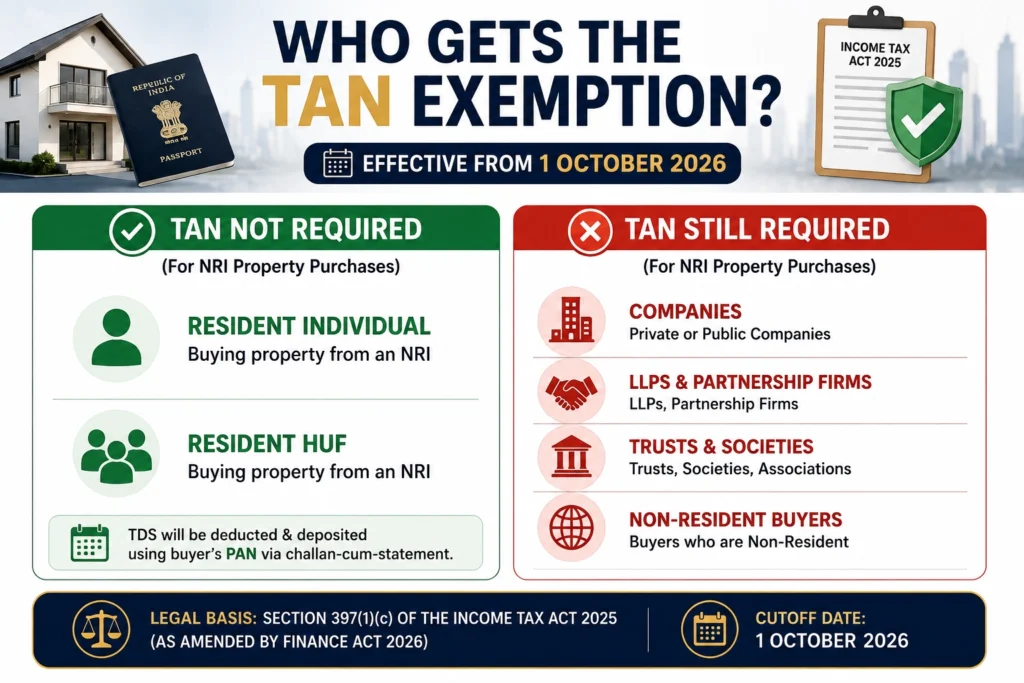
The Finance Act 2026 amendment applies specifically to Section 397(1)(c) of the Income Tax Act 2025. The change is procedural, not substantive.
Before 1 October 2026:
- Resident buyer must obtain a TAN to deduct TDS on NRI property purchase
- TDS is deposited quarterly through Form 144 (which replaced the old Form 27Q)
- Buyer must retain TAN, file quarterly returns, and manage compliance for months
From 1 October 2026:
- Resident individual and HUF buyers no longer need a TAN for NRI property purchases
- TDS is deducted and deposited using the buyer's PAN via a challan-cum-statement
- The mechanism aligns with Form 141 (which replaced Form 26QB for resident-to-resident deals)
- No quarterly Form 144 filing for this specific transaction
The tax rate, PAN requirement of the NRI seller, and capital gains liability remain unchanged. This is a compliance simplification, not a tax cut.
An NRI Tax Residency Calculator can confirm your status before you sign the sale deed.
Why the Old Buyer’s TAN Requirement Killed So Many Deals
Under the previous framework, buying property from an NRI required a resident buyer to complete four separate compliance layers:
- Apply online for a TAN through the NSDL/Protean portal
- Wait 5 to 10 working days for TAN allotment
- Deduct TDS at the higher NRI rate under Section 393(2)
- File quarterly Form 144 (previously Form 27Q) returns
- Retain the TAN indefinitely even though it may never be used again
For a one-time property purchase, this burden was not something most buyers signed up for. Many NRI sellers report having to give a discount of 1 to 3 percent on the sale price just to persuade the buyer to go through the TAN process. Others faced deal fall-throughs at the last minute.
Section 397(1)(c) of the Income Tax Act 2025 Explained
Section 397(1)(c) governs TDS deposit procedures under the new Act. The Finance Act 2026 amendment inserts an exemption for:
- Resident individual or HUF buyers, purchasing property from an NRI seller, where TDS is deducted under Section 393(2) on the transfer of immovable property
For such buyers, TAN is no longer required from 1 October 2026. TDS will instead be deposited using PAN through a challan-cum-statement mechanism.
Section 393(2) is the substantive TDS provision, replacing the old Section 195. It requires the buyer to deduct TDS at applicable rates before paying the NRI seller. That deduction rate does not change; only the mechanism for depositing the tax simplifies.
Who Benefits and Who Does Not
Not every buyer benefits from the 1 October 2026 relief. Here is who is inside and outside the exemption.
| Buyer Type | TAN Needed After 1 October 2026? |
|---|---|
| Resident individual | No |
| Resident HUF | No |
| Companies (private or public) | Yes, mandatory |
| LLPs and partnership firms | Yes, mandatory |
| Trusts and societies | Yes, mandatory |
| Non-resident buyer | Not covered by this exemption |
So if your buyer is a resident individual looking to buy your Mumbai flat or Bengaluru villa, the transaction becomes much smoother after 1 October 2026. But if your buyer is a corporate entity looking to buy commercial real estate, the TAN requirement continues indefinitely.
Should NRIs Wait Until 1 October 2026 to Sell?
This is the core decision. The right answer depends on your buyer, timeline, and holding cost.
Wait if:
- Your buyer is a resident individual or HUF with no existing TAN
- The buyer is delaying paperwork specifically because of the TAN process
- Your property holding cost (maintenance, tax, EMI) is low enough to absorb the wait
- Sale price is not tied to a short-window opportunity (limited-time offer, distressed sale)
Do not wait if:
- Your buyer already has a TAN (many high-net-worth resident buyers do)
- You need funds by a specific date (education, medical, relocation)
- The property market in your city is cooling, and delay may reduce sale value
- Buyer is a company, LLP, or firm (TAN is required regardless)
- You need to complete the sale before 31 March 2026, the financial year-end, for tax planning
For most residential property sales to individual buyers, the delay of a few weeks or months to reach 1 October 2026 is worth it. For urgent or commercial sales, proceed under the old rules.
Our Capital Gain Tax team helps NRIs model both timing options with full tax impact.
How to Apply for TAN Online Before 1 October 2026
If you are selling before the cutoff and your buyer does not have a TAN, help them apply immediately.
Steps to apply for TAN online:
- Visit the NSDL/Protean e-Governance portal and access Form 49B
- Fill in buyer details (name, address, PAN, contact)
- Select category of deductor as Individual/HUF
- Choose Others as area code and appropriate range code
- Pay the fee of Rs 65 plus GST online
- Print and sign the acknowledgment
- Send the physical acknowledgment to the NSDL address in Pune
- TAN is allotted in 5 to 10 working days
The buyer's TAN must be quoted on the sale deed, TDS challan, and any subsequent Form 144 filing. Without a valid TAN, the sub-registrar office will not register the sale deed.
For NRIs whose buyer is missing a PAN card link or has an inoperative PAN, our PAN Card service resolves this before the deal closes.
TDS Rates on NRI Property Sale in 2026
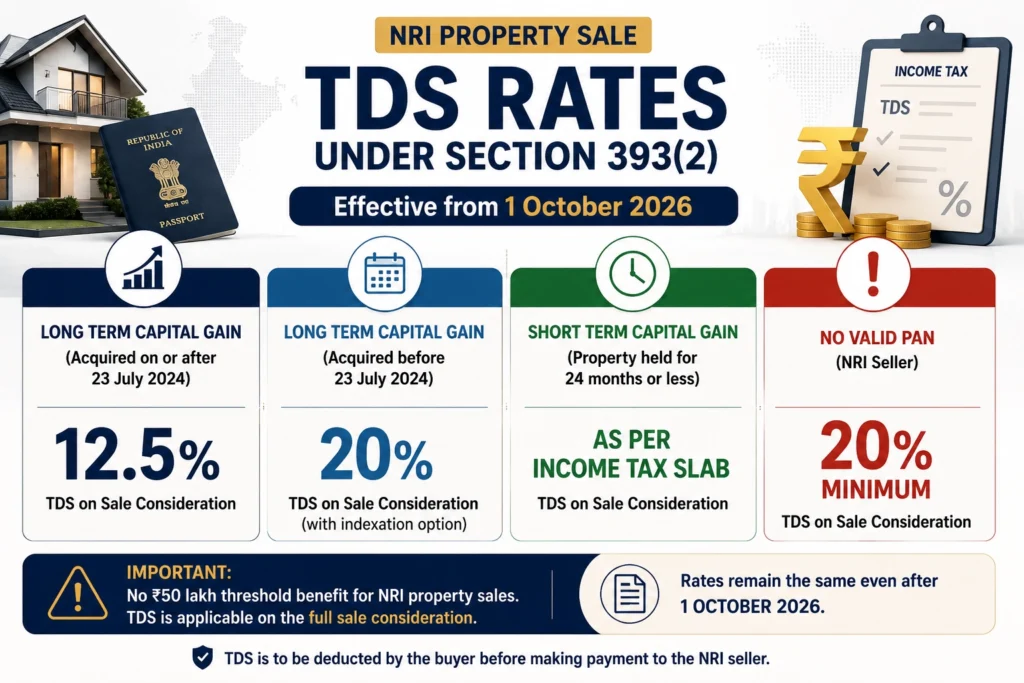
The TAN change does not affect the TDS rate. NRIs should still plan for the correct deduction under Section 393(2).
| Type of Gain | TDS Rate | Applicability |
|---|---|---|
| LTCG on property (post 23 July 2024 acquisitions) | 12.5% + surcharge + cess | Held for more than 24 months |
| LTCG on property (pre 23 July 2024 acquisitions) | 20% + surcharge + cess (with indexation option) | Held for more than 24 months |
| STCG on property | Slab rate + surcharge + cess | Held for 24 months or less |
| Where NRI seller does not furnish valid PAN | Higher of applicable rate or 20% | Section 397(2)(b)(i) |
| Where NRI is high-income | Additional surcharge up to 15% | Above threshold slabs |
Note: There is no threshold for TDS on NRI property sales. Even a Rs 5 lakh sale triggers TDS, unlike resident sales where the Rs 50 lakh threshold applies.
The Section 197 Lower TDS Certificate: Your Best Defence
Regardless of the TAN change, the single most important tool for NRIs selling Indian property is the lower TDS certificate under the equivalent of Section 197 (now filed through Form 128, which replaced Form 13).
Without a lower TDS certificate:
- The buyer deducts TDS on the entire sale consideration, not the net gain
- On a Rs 3 crore property with actual LTCG of Rs 50 lakh, TDS is around Rs 37.5 lakh at 12.5% on the full price, instead of around Rs 6.25 lakh on the actual gain
- The excess must be recovered through an ITR refund, which takes 6 to 18 months
Form 128 must be filed and approved before the sale deed is registered. NRIs discovering this after the deed is signed have no recourse but to wait for a refund. The NRI TDS Refund Calculator helps estimate exactly how much is stuck if you missed this step.
Post-Sale Compliance for NRIs: What Does Not Change
The TAN change is procedural for the buyer. NRI sellers must still complete:
- File ITR-2 with correct Schedule CG entries showing capital gain calculation
- Reconcile Form 26AS and AIS for the TDS credit
- Claim the excess TDS refund if no Section 197 certificate was obtained
- Complete Form 145 and 146 (which replaced Form 15CA and 15CB) for foreign remittance
- Obtain a Chartered Accountant certificate for the tax paid
- Repatriate up to USD 1 million per financial year from an NRO account
The full return-filing workflow is handled by our Income Tax Returns Filing team for NRIs across 33 countries.
FEMA Rules on Repatriation Remain Unchanged
The 1 October 2026 amendment does not affect FEMA repatriation rules. NRIs must still:
- Credit sale proceeds to an NRO account (mandatory in most cases)
- Complete Form 145 and 146 for outward remittance
- Obtain a CA certificate confirming Indian tax has been paid
- Stay within the USD 1 million per financial year NRO repatriation ceiling
- Use two consecutive financial years if the amount exceeds the annual cap
Our NRI Bank Account Type Advisor helps you structure NRE, NRO, and FCNR accounts correctly for a property sale flow.
Common Mistakes NRIs Make on Property Sale Timing
The most expensive errors are avoidable:
- Signing a sale deed before checking the buyer's TAN status and getting stuck at registration
- Selling before 1 October 2026 when the buyer is a resident individual willing to wait
- Missing the Section 197 lower TDS certificate and losing months in refund cycles
- Assuming the TDS rate has changed (it has not; only the mechanism has)
- Selling to a company or LLP and expecting them to skip TAN
- Ignoring Form 145 and 146 requirements for post-sale repatriation
- Not reconciling Form 26AS with the buyer's TDS deposit before filing ITR
- Missing the higher 20% TDS trap when seller's PAN is inoperative
- Not planning the holding period carefully around 24 months for LTCG treatment
- Distributing sale proceeds to family before tax clearance is complete
Where notices have already been received on past property sales, our NRI Income Tax Notice Solutions team closes the file efficiently.
How MostlyNRI Helps NRIs Time and Execute Property Sales
Selling Indian property as an NRI is one of the most complex cross-border transactions you will handle. It involves residency verification, buyer eligibility, TDS rate optimisation, Section 197 certificate filing, capital gains structuring, ITR filing, and FEMA repatriation.
At MostlyNRI, we support NRIs across the USA, UAE, UK, Canada, Singapore, and Australia with:
- Timing analysis around the 1 October 2026 TAN cutoff
- Buyer TAN application guidance where the sale cannot wait
- Section 197 lower TDS certificate filing before sale deed registration
- Capital gains computation and Schedule CG preparation
- ITR filing with correct TDS and refund optimisation
- Form 145 and 146 repatriation paperwork
- Chartered Accountant certification for outward remittance
- Notice handling for past property sale mismatches
Our team has served NRIs from over 33 countries across 13 Indian cities.
Planning to sell Indian property as an NRI in 2026? Book a consultation with our specialists at MostlyNRI.com and structure the sale timing, TDS optimisation, and repatriation for maximum cash in hand.
Frequently Asked Questions (FAQs)
Can NRIs sell Indian property before 1 October 2026 without a buyer's TAN?
No. Property sales completed before 1 October 2026 still require the resident buyer to obtain a TAN under the current framework. The Section 397(1)(c) exemption only kicks in from that date onwards for resident individual and HUF buyers.
What is Section 397(1)(c) of the Income Tax Act 2025?
Section 397(1)(c), amended by the Finance Act 2026, exempts resident individual and HUF buyers from obtaining a TAN when purchasing property from an NRI, effective 1 October 2026. TDS is deposited using the buyer's PAN via a challan-cum-statement instead.
Do companies and LLPs also get the TAN exemption on NRI property purchase?
No. The Section 397(1)(c) exemption applies only to resident individual and HUF buyers. Companies, LLPs, partnership firms, trusts, and societies must continue to obtain and use a TAN for TDS deduction on NRI property purchases even after 1 October 2026.
What is the TDS rate on NRI property sale in 2026?
TDS is deducted at 12.5% plus surcharge and cess on LTCG for property acquired on or after 23 July 2024. For pre-July 2024 acquisitions, sellers may opt for 20% with indexation. STCG attracts slab rates. Without a valid PAN, minimum TDS is 20%.
How do NRIs avoid excess TDS on property sale?
File Form 128 (which replaced Form 13) with the Assessing Officer to obtain a lower TDS certificate under the equivalent of Section 197. This limits deduction to actual capital gain rather than the full sale price, saving lakhs in refund lockup.
Should NRIs delay property sale to benefit from the new TAN rule?
Delay only if your buyer is a resident individual or HUF without a TAN, and your holding cost allows waiting. If the buyer already has TAN, is a company, or your sale is time-critical for tax or personal reasons, proceed under the current rules.
How can a resident buyer apply for TAN online for an NRI property deal?
Fill Form 49B on the NSDL or Protean portal, select Individual or HUF as deductor category, pay Rs 65 plus GST, and post the signed acknowledgment to NSDL Pune. TAN is allotted in 5 to 10 working days for use on the sale deed.
Is the FEMA repatriation limit changing on 1 October 2026?
No. FEMA rules on repatriation of NRI property sale proceeds remain unchanged. NRIs can repatriate up to USD 1 million per financial year from NRO accounts, subject to filing Form 145 and 146 with a Chartered Accountant certificate.
What happens if the NRI seller does not have a valid PAN?
Under Section 397(2)(b)(i) of the Income Tax Act 2025, TDS is deducted at the higher of the applicable rate or 20% if the NRI seller does not furnish a valid PAN. This applies regardless of whether the sale is before or after 1 October 2026.
How can MostlyNRI help with an NRI property sale in 2026?
MostlyNRI structures the sale timing around the 1 October 2026 rule, files Section 197 certificate applications, computes capital gains, files the ITR, handles FEMA repatriation via Form 145 and 146, and coordinates with the buyer or CA for TAN and TDS compliance.


0 Comments