


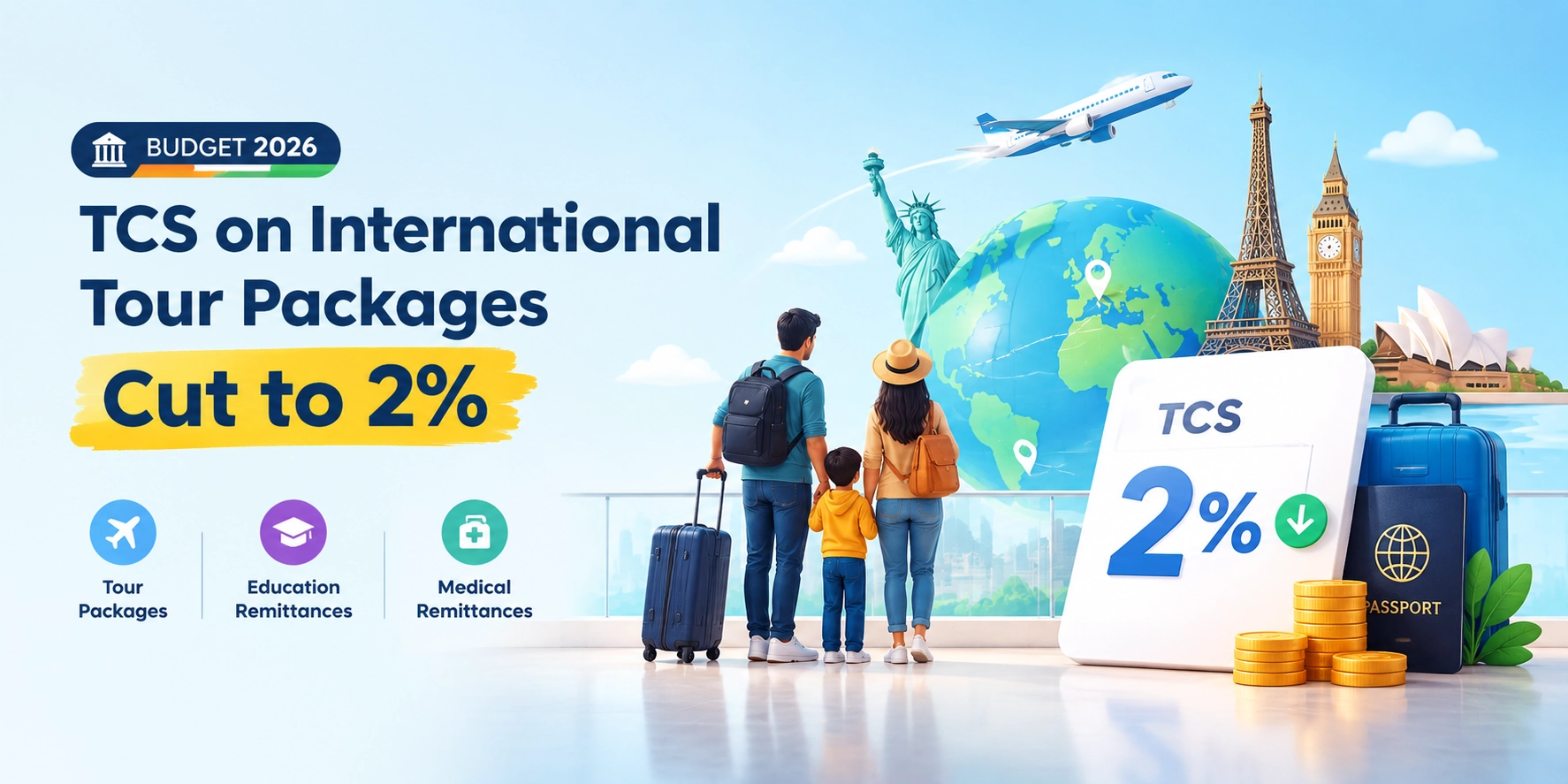
Budget 2026 delivered one of the most direct cost cuts NRI families have seen in years. On 1 February 2026, Finance Minister Nirmala Sitharaman announced a flat 2 percent Tax Collected at Source (TCS) on overseas tour packages, replacing the earlier dual rate of 5 percent up to Rs 10 lakh and 20 percent above Rs 10 lakh. The Rs 10 lakh threshold for tour packages has been removed entirely. In parallel, TCS on education and medical remittances under the Liberalised Remittance Scheme (LRS) has also been cut from 5 percent to 2 percent.
For NRI families whose parents fund a US or Canada visit, whose siblings book tour packages for family reunions, whose spouses study in an American or UK university, or whose relatives need overseas medical treatment, the change is a direct cash-flow win. On a Rs 15 lakh European tour that previously carried Rs 1.5 lakh TCS at the higher slab, the new outgo is just Rs 30,000. A parent funding a Rs 40 lakh medical treatment abroad saves close to Rs 1.2 lakh in blocked cash upfront.
This guide breaks down exactly what changed under Section 206C(1G), how much NRI families save on India visits and return trips, who qualifies, when the old rates still apply, and how to claim a TCS refund if the tax cannot be adjusted.
What Changed on 1 February 2026: The Budget 2026 TCS Reset
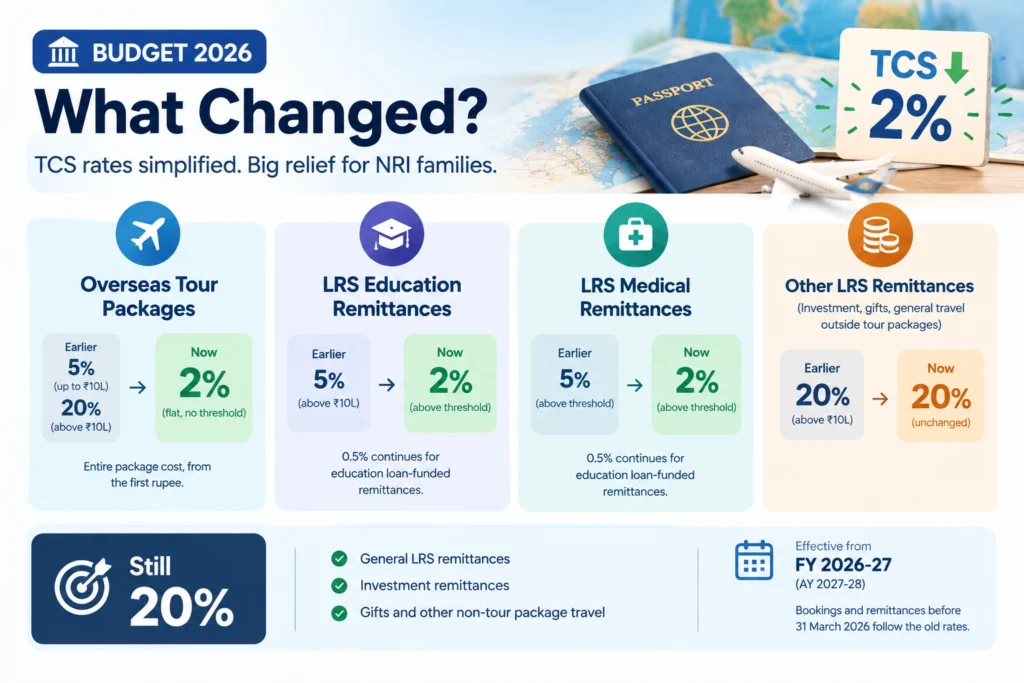
The Finance Bill 2026 rationalised TCS rates across the three main LRS categories that touch NRI families most often.
- Overseas tour programme packages: flat 2 percent, no threshold
- LRS education remittances: 2 percent on amounts exceeding the threshold
- LRS medical treatment remittances: 2 percent on amounts exceeding the threshold
- Education loan-funded remittances: continue at 0.5 percent under Section 80E-linked concession
- Other LRS remittances (investment, gifts, general travel outside tour packages): unchanged at 20 percent above Rs 10 lakh
The changes are effective from FY 2026-27 (AY 2027-28). Bookings made and remittances sent before 31 March 2026 follow the older rate structure.
For an NRI family based in the US, UAE, UK, Canada, Singapore, or Australia planning a large India visit or return trip, this is a clean savings window. Our NRI Tax Residency Calculator confirms your residency classification before you plan any large remittance.
TCS on International Tour Packages: The Flat 2 Percent Rate
This is the headline change. Under Section 206C(1G), an overseas tour programme package includes travel, hotel stay, boarding, lodging, and any similar related expenditure sold as a single package.
Before Budget 2026:
- 5 percent TCS on aggregate package cost up to Rs 10 lakh
- 20 percent TCS on the portion exceeding Rs 10 lakh
After Budget 2026:
- Flat 2 percent on the entire package cost
- No minimum threshold
- Applies from the first rupee of the tour package
The tour operator collects the TCS at the time of booking and deposits it against your PAN. It is not an additional tax; it is a prepaid credit that can be adjusted against your final tax liability in India or claimed as a refund in your ITR.
TCS on Education Remittances Under LRS: 2 Percent Relief
For NRI-linked families paying overseas tuition and living expenses from India, the education TCS cut is a major cash-flow relief.
Before Budget 2026:
- 5 percent TCS on amounts exceeding Rs 10 lakh
- 0.5 percent TCS if remittance was funded by a recognised education loan under Section 80E
After Budget 2026:
- 2 percent on amounts exceeding the applicable threshold
- 0.5 percent rate for education loan-funded remittances continues
- Bank, forex dealer, or authorised remitter collects the TCS at the time of transfer
For NRI parents in India sending children to the US, UK, Canada, or Australia for education, the effective upfront tax on a Rs 40 lakh annual fee remittance drops from Rs 1.5 lakh to Rs 60,000. That is Rs 90,000 back in the family's cash flow at the exact moment tuition and rent are due.
TCS on Medical Remittances: The Critical Cash-Flow Fix
The 2 percent rate on medical LRS remittances is the most humane change in the package. Overseas medical treatment often runs into tens of lakhs, and previously families were forced to send 5 percent extra upfront at the worst possible moment.
Before Budget 2026: 5 percent above the applicable threshold.
After Budget 2026: 2 percent above the applicable threshold.
For a Rs 50 lakh cancer treatment package overseas, the upfront TCS falls from Rs 2 lakh to Rs 80,000. That difference sits in the family's account when medical bills are being paid, not with the tax department awaiting refund.
If your relative is receiving treatment abroad and TCS has already been blocked, the NRI TDS Refund Calculator helps estimate how much can be recovered through an ITR filing.
Old vs New TCS Rates: The Complete Budget 2026 Comparison
| Purpose | Old TCS Rate | New TCS Rate (Budget 2026) |
|---|---|---|
| Overseas tour package (up to Rs 10 lakh) | 5% | 2% |
| Overseas tour package (above Rs 10 lakh) | 20% | 2% |
| LRS education (above Rs 10 lakh, own funds) | 5% | 2% |
| LRS education (loan-funded, Section 80E) | 0.5% | 0.5% (unchanged) |
| LRS medical (above Rs 10 lakh) | 5% | 2% |
| LRS general purpose (above Rs 10 lakh) | 20% | 20% (unchanged) |
| LRS investment abroad (above Rs 10 lakh) | 20% | 20% (unchanged) |
The pattern is clear: essential and family-linked remittances (tour, education, medical) benefit; discretionary remittances (investment, general transfers) remain at the higher slab.
How the New Rules Benefit NRI Families
NRI families interact with LRS and tour package TCS in more scenarios than most realise. Consider how the flat 2 percent rate flows through common situations.
- Parents in India booking a package tour to visit an NRI son or daughter in the US or Canada
- Siblings arranging a family reunion tour in Europe or Southeast Asia
- NRI's Indian family funding a child's overseas education
- Elderly parents seeking medical treatment abroad, funded from India by the NRI's siblings
- Return trips for the NRI's family through Indian tour operators
- India-outbound honeymoons and destination weddings with global family members
In each case, the cash outgo at the point of booking or remittance drops materially, freeing up funds for the actual purpose rather than a refundable tax deposit.
NRI-Specific Scenarios: Who Saves and How Much
Scenario 1: Parents visiting an NRI child in the US on a Rs 12 lakh tour package
- Old TCS: Rs 50,000 (5% on Rs 10 lakh) plus Rs 40,000 (20% on Rs 2 lakh) = Rs 90,000
- New TCS: Rs 24,000 (flat 2% on Rs 12 lakh)
- Savings: Rs 66,000
Scenario 2: NRI's sister in India funding overseas medical treatment of Rs 25 lakh
- Old TCS: 5% on Rs 15 lakh (above threshold) = Rs 75,000
- New TCS: 2% on Rs 15 lakh = Rs 30,000
- Savings: Rs 45,000
Scenario 3: Indian grandparents paying US university fees of Rs 35 lakh (own funds)
- Old TCS: 5% on Rs 25 lakh (above threshold) = Rs 1,25,000
- New TCS: 2% on Rs 25 lakh = Rs 50,000
- Savings: Rs 75,000
Scenario 4: Family destination wedding in Bali costing Rs 30 lakh as one package
- Old TCS: Rs 50,000 (5% on Rs 10 lakh) plus Rs 4 lakh (20% on Rs 20 lakh) = Rs 4,50,000
- New TCS: 2% flat on Rs 30 lakh = Rs 60,000
- Savings: Rs 3,90,000
The high-ticket, single-package trips see the biggest gains because the punitive 20 percent slab is fully replaced by 2 percent.
The Rs 10 Lakh Threshold and How to Plan Around It
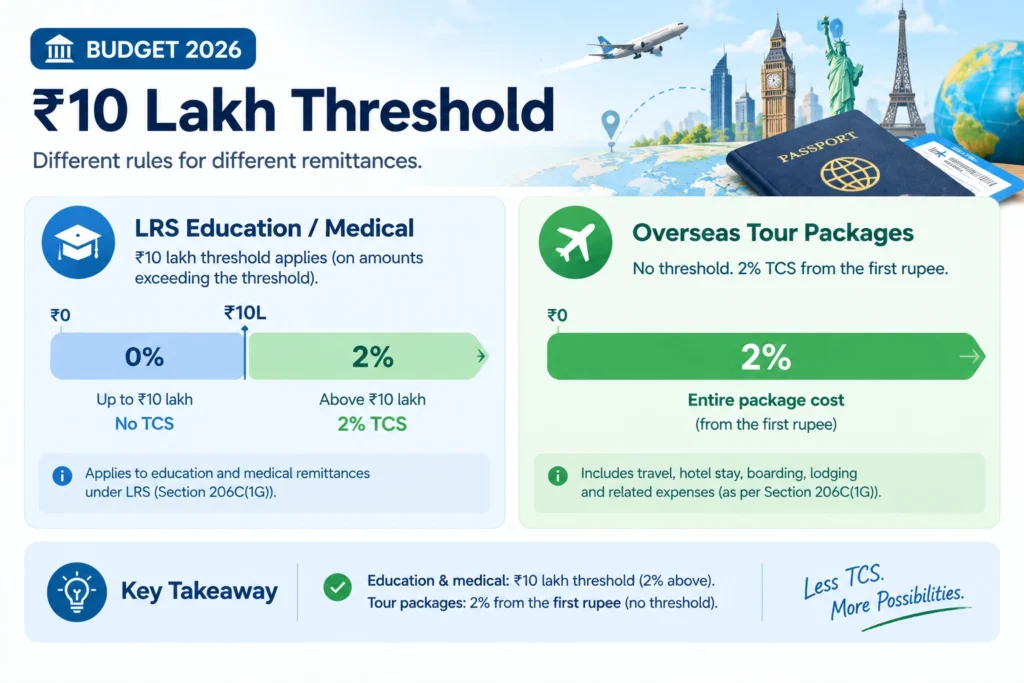
The Rs 10 lakh annual threshold applies per PAN, per financial year, per category. This means:
- Amounts below Rs 10 lakh for LRS education and medical remittances continue to attract zero TCS
- Amounts above Rs 10 lakh attract the 2 percent rate on the excess portion
- For tour packages, no threshold applies; 2 percent kicks in from the first rupee
If your family is planning multiple remittances during one FY, TCS is calculated on the cumulative annual total per PAN. Splitting between two PANs (say father and son) can help stay under thresholds where feasible.
For a personalised remittance and TCS plan, our NRI Taxation and Compliance team maps the annual outgo to the right PAN.
LRS: What NRIs Should Know About Who Qualifies
The Liberalised Remittance Scheme is fundamentally a resident individual scheme. NRIs themselves cannot use LRS from outside India, but the rules matter because:
- Resident Indian family members using LRS to fund NRI-linked expenses are subject to TCS
- Resident Indian parents sending money to NRI children are governed by LRS
- The USD 250,000 annual cap per resident individual applies across all LRS purposes
- Once the NRI moves back to India, LRS applies to them as well
- HUFs with resident status can also use LRS
For NRIs planning a return to India, our Returnee NRI Transition Services framework flags LRS obligations that kick in from the day of return.
How to Claim TCS Refund When You Cannot Adjust It
TCS is not an additional tax; it is a prepaid credit. If your final Indian tax liability is lower than the TCS collected, or if you have no taxable Indian income, you can claim the balance as a refund.
Steps to claim TCS refund:
- Check Form 26AS and AIS for the TCS credit posted against your PAN
- File ITR-2 if you have capital gains, foreign income, or non-business income
- File ITR-3 if you also have business or professional income
- Report the TCS in the taxes paid section along with your PAN details
- Reconcile with the challan reference from the tour operator or bank
- File within the due date to avoid interest calculation reversals
Refund processing typically takes 4 to 12 weeks after e-verification. Our Income Tax Returns Filing team handles NRI-linked TCS refunds end to end.
Common Mistakes NRI Families Make on TCS Planning
The most avoidable errors:
- Booking tour packages before 31 March 2026 at old rates when the trip could wait
- Splitting a package into flight and hotel separately, treating it as general LRS and triggering 20 percent
- Ignoring Section 80E education loan benefits that give a 0.5 percent rate
- Missing Form 26AS reconciliation and losing the refund window
- Using a non-resident's PAN for tour bookings (LRS is for residents only)
- Assuming TCS is a tax cost instead of a prepaid credit
- Failing to file the Indian ITR to claim the refund
- Overlooking Rs 10 lakh threshold planning across the financial year
If TCS refund claims have triggered mismatch notices in past filings, our NRI Income Tax Notice Solutions team closes the file efficiently.
How MostlyNRI Helps You Maximise the Budget 2026 TCS Savings
The Budget 2026 TCS cut is real cash back in NRI family pockets, but it needs correct planning to capture. At MostlyNRI, we help NRIs and their India-based families with:
- Annual LRS remittance planning for education, medical, and tour expenses
- Section 80E and 0.5 percent rate structuring for education loans
- TCS refund claims through correct ITR filing
- Form 26AS and AIS reconciliation before filing
- Return migration planning for NRIs who will move to LRS status themselves
- Cross-border DTAA analysis for related payments
- Response to tax notices on TCS mismatch or refund delays
Our team serves NRIs across the USA, UAE, UK, Canada, Singapore, and Australia, with client footprint spanning 33 countries and 13 Indian cities.
Planning a tour, education transfer, or medical remittance under the new Budget 2026 rules? Book a consultation with our specialists at MostlyNRI.com to structure your annual remittance calendar, TCS planning, and refund route for maximum cash retention.
Frequently Asked Questions (FAQs)
What is the new TCS rate on international tour packages under Budget 2026?
The TCS rate on overseas tour programme packages has been cut to a flat 2 percent with no threshold, effective FY 2026-27. This replaces the earlier dual structure of 5 percent up to Rs 10 lakh and 20 percent above Rs 10 lakh.
What is the new TCS rate on LRS education remittances in 2026?
TCS on LRS education remittances has been reduced from 5 percent to 2 percent on amounts above the applicable threshold. Remittances funded by a recognised education loan under Section 80E continue at the concessional rate of 0.5 percent.
What is the new TCS rate on LRS medical remittances?
For medical treatment abroad under LRS, TCS has been cut from 5 percent to 2 percent on amounts above the applicable threshold. This eases upfront cash flow for families managing overseas medical treatments where costs often run into tens of lakhs of rupees.
Does the Rs 10 lakh threshold apply to tour packages after Budget 2026?
No. The Rs 10 lakh threshold has been removed for tour packages. The flat 2 percent TCS now applies from the first rupee of any overseas tour package, making bundling a full package more tax-efficient than booking flights and hotels separately.
Are NRIs subject to LRS TCS on their own remittances abroad?
No. The Liberalised Remittance Scheme applies to resident individuals, not NRIs. However, NRIs indirectly benefit because their resident Indian family members who fund tours, education, or medical treatment for NRI-linked purposes now pay lower TCS.
Can NRI families claim a refund of TCS collected on tour packages?
Yes. TCS is a prepaid tax credit, not an additional cost. Any excess TCS over the final Indian tax liability can be claimed as a refund by filing ITR-2 or ITR-3 with proper Form 26AS reconciliation and PAN entries in the taxes paid section.
When do the new TCS rates come into effect?
The new flat 2 percent rates apply from FY 2026-27 (AY 2027-28), effective 1 April 2026. Bookings made and remittances sent before that date follow the older rate structure of 5 percent and 20 percent depending on category and amount.
Which LRS purposes still attract the higher 20 percent TCS?
General purpose remittances and investment-related LRS transfers above Rs 10 lakh continue to attract the unchanged 20 percent TCS. Only education, medical, and overseas tour packages received the 2 percent concession under Budget 2026 reforms.
What is the difference between booking a tour package vs separate flights and hotels?
A bundled tour package attracts a flat 2 percent TCS from the first rupee. Separately booked flights and hotels may be treated as general LRS remittance, attracting the 20 percent rate above Rs 10 lakh. Bundling is now significantly more tax-efficient for large trips.
How can MostlyNRI help me plan TCS savings under Budget 2026?
MostlyNRI structures annual LRS remittance plans, applies Section 80E and 0.5 percent education loan benefits, files ITRs to claim TCS refunds, reconciles Form 26AS and AIS, and responds to any mismatch notices. Our team supports NRI families across 30+ countries.


0 Comments