



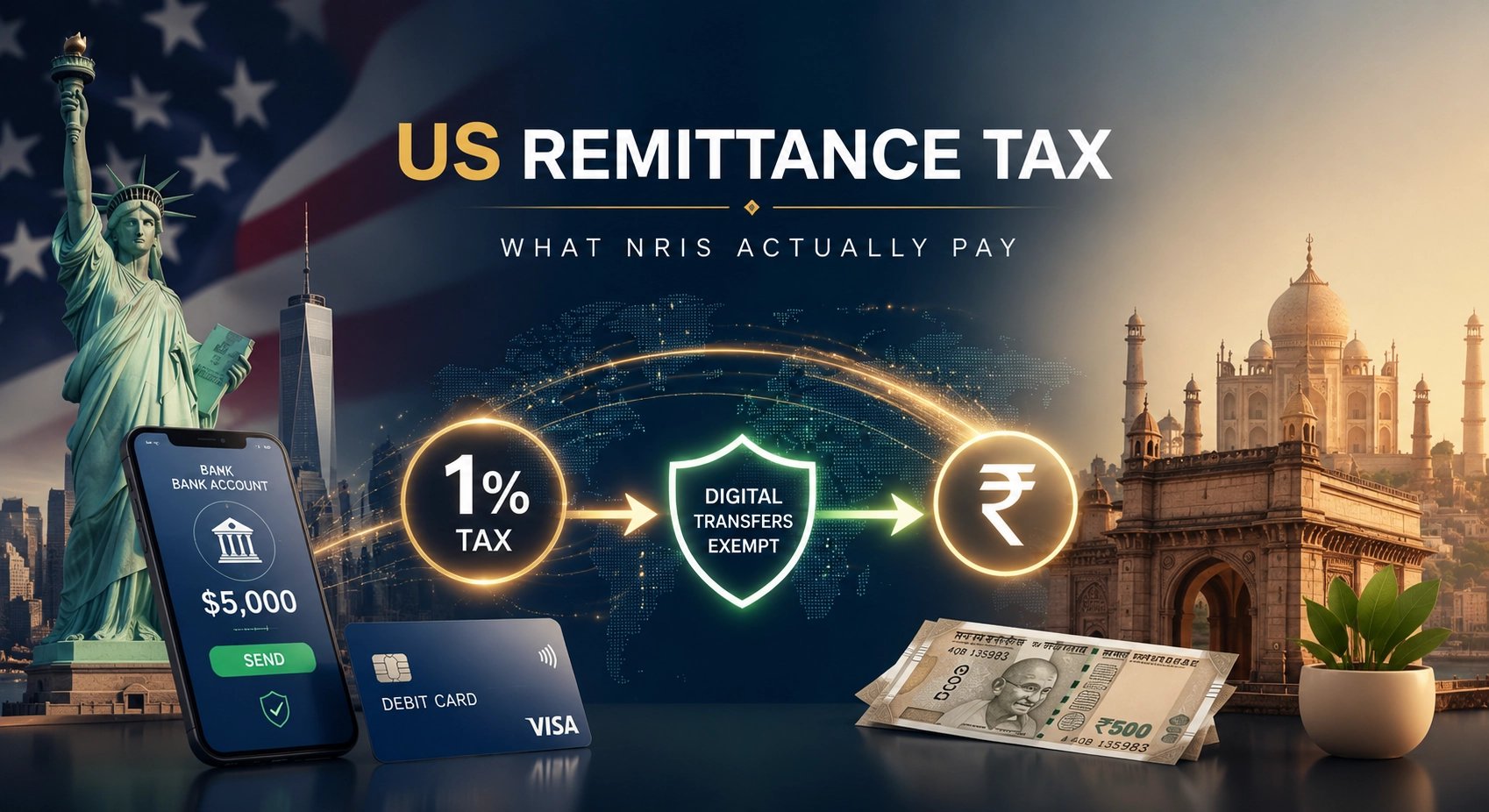
If you have been forwarded a panicked WhatsApp message this year claiming the US now taxes every dollar NRIs send home, you are not alone. Family groups have been buzzing since January 2026 with warnings, screenshots, and half-baked advice about the new US remittance tax.
Here is the calm truth: the tax is real, but almost no NRI actually pays it in practice. If you send money to India using Wise, Remitly, a bank wire, ACH, or a US debit or credit card, your remittance tax on that transfer is zero.
This guide breaks down what the law actually says, who really pays, and how to keep every dollar of your India transfers.
What the New US Remittance Tax Actually Is
The 1% remittance tax was signed into US law on July 4, 2025, as part of the One Big Beautiful Bill Act (OBBBA). It lives inside the Internal Revenue Code as new Section 4475, and it took effect on January 1, 2026.
The plain facts:
- It is a 1% federal excise tax on certain outbound international money transfers from the United States.
- The rate started as a proposed 5%, dropped to 3.5% during debate, and was finally set at 1%.
- It applies only to cash-funded transfers. That means physical cash, money orders, and cashier's checks handed over at an agent counter.
- It has no minimum threshold. Even a $50 cash transfer counts.
- It is not based on visa or immigration status. H-1B, green card, US citizen, or student visa, the rule is the same. Only the payment method matters.
- It is collected by the transfer provider (Western Union, MoneyGram, and others) and remitted to the IRS quarterly on Form 720.
Treasury and the IRS also issued proposed regulations on April 10, 2026, confirming that most electronic transfers are exempt.
The WhatsApp Myth vs the Actual Law
Most family-chat panic mixes up three things: earlier proposed rates, the final law, and who the tax was politically aimed at. Let us clear the fog.
Myth 1: The tax is 5% on all money sent to India
Reality: The 5% and 3.5% figures were early drafts. The enacted rate is 1%, and it applies only to cash-based transfers.
Myth 2: Every NRI has to pay it
Reality: If you fund your transfer from a US bank account, debit card, credit card, ACH, wire, or a digital wallet like Apple Pay, you owe zero.
Myth 3: You have to file an extra US tax form
Reality: The provider adds the 1% at checkout and files it with the IRS. You do not file anything separately on your Form 1040 for this.
Myth 4: It applies to the receiver in India
Reality: The tax is on the sender in the US. Your family in Mumbai, Bengaluru, or Hyderabad receives the full principal amount.
Method-by-Method Breakdown: Who Pays, Who Does Not
This is the table to save and share. It compares the most common ways NRIs move money from the US to India in 2026.
| Transfer Method | Funded By | 1% Remittance Tax? | Best For |
| Wise (online) | US bank, debit or credit card | Exempt (0%) | Transparent mid-market rates |
| Remitly (app) | US bank, debit or credit card | Exempt (0%) | Fast transfers to Indian bank accounts |
| Xoom by PayPal | US bank, debit or credit card | Exempt (0%) | Quick top-ups, small transfers |
| Bank wire transfer (SWIFT) | US bank account | Exempt (0%) | Large transfers, property funding |
| ACH transfer | US bank account | Exempt (0%) | Recurring family support |
| Western Union online / app | US bank, debit or credit card | Exempt (0%) | Same brand, digital route |
| Western Union cash pickup at the counter | Physical cash | Taxed at 1% | Only if receiver has no bank access |
| MoneyGram in-person counter | Physical cash | Taxed at 1% | Rare for digital NRIs |
| Cashier's check remittance | Cashier's check | Taxed at 1% | Uncommon for India transfers |
Look carefully at that table. You have to actively choose the taxed option. You have to physically walk into a store and hand over cash. Almost no modern NRI sending money home does that.
Who Actually Ends Up Paying the 1%
The law reads broadly, but the profile of an actual payer is narrow. You will pay the tax only if you:
- Walk into a Western Union or MoneyGram agent and pay in physical cash.
- Fund a transfer with a money order bought from a post office or store.
- Use a cashier's check for an international transfer.
If your salary hits a US bank account and you send money through an app or your bank's transfer service, you are outside the tax entirely. As Wise, Remitly, and even Western Union have publicly confirmed, digital transfers are not affected.
A Real Numbers Example
Say you want to send $5,000 to your parents in Pune for a home repair.
- Cash at Western Union counter: $5,000 principal + $50 remittance tax + provider fee. You lose $50 to the IRS.
- Wise from your Chase account: $5,000 principal + Wise fee (about $24 to $30). Zero remittance tax.
- Bank wire from Bank of America: $5,000 principal + wire fee (typically $30 to $45). Zero remittance tax.
- Remitly from your Wells Fargo debit card: $5,000 principal + Remitly fee. Zero remittance tax.
The gap is not small over a year. An NRI sending $2,000 a month in cash would pay $240 a year in avoidable tax. The same person on Wise, ACH, or a wire pays nothing extra.
How to Stay Fully Exempt in 2026 and Beyond
Three practical rules keep you outside the 1% bracket for good:
- Never fund a transfer with physical cash, money orders, or cashier's checks. Ever.
- Use a US bank account for outbound transfers. If you do not have one yet, open one before you next remit.
- Keep a receipt for every transfer for at least three years. It shows the funding method if the IRS ever asks.
The IRS also mentioned a potential tax credit under IRC Section 36C for remittance tax paid. As of mid-2026, no guidance has been released, so do not claim it on your Form 1040 yet. Retain receipts and wait for official rules.
What This Means for Your Indian Tax Filing
Here is where many NRIs get tripped up. Even if you pay zero US remittance tax, the money you send to India still has an Indian tax footprint that has nothing to do with OBBBA.
Common issues our team at MostlyNRI sees every filing season:
- NRO interest is taxable in India, and banks deduct TDS at 30% by default.
- Rental income from Indian property is taxable in India regardless of how the rent is remitted.
- Capital gains on Indian mutual funds, stocks, and property are Indian-side tax events.
- DTAA credits between the US and India let you avoid paying tax twice, but only if you file correctly on both sides.
If any of your remittances fund investments in India, they interact directly with your Indian ITR and, on the US side, with FBAR and Form 8938. Getting the sequencing right is where mistakes get expensive.
How MostlyNRI Helps NRIs in the US
We built MostlyNRI.com precisely for this cross-border reality. Whether you send money home casually or run a full India investment portfolio, our services include:
- NRI ITR filing with full DTAA credit optimization for US-based NRIs.
- NRI taxation and compliance covering FEMA, RBI reporting, and repatriation limits.
- NRI wealth management across mutual funds, property, and GIFT City investments.
- India-US DTAA guidance so you never pay tax twice on the same income.
- City-specific pages for Mumbai, Bengaluru, Hyderabad, Pune, and more.
Conclusion
The 1% US remittance tax is a narrowly targeted rule dressed up as a broad panic by WhatsApp forwards. If you already send money to India through an app or your bank, nothing has changed for you. Your parents in Jaipur or your spouse in Chandigarh receive the same amount they always did.
What has changed is that the paperwork on the India side keeps getting more detailed every year. New Income Tax Act 2025 provisions, the Budget 2026 foreign asset disclosure window, and tighter TDS rules on NRI transactions mean your Indian filing needs more care than ever.
If you want to make sure your US remittances and Indian investments are stitched together cleanly, talk to a MostlyNRI expert before the July 31 ITR deadline. We handle the cross-border complexity so you can keep sending money home with confidence.
FAQs
Does the 1% US remittance tax apply to money I send from my US bank account?
No. Transfers funded directly from a US bank account are exempt under IRC Section 4475. This includes ACH transfers, wire transfers, and app-based transfers linked to your bank account, regardless of amount.
Are Wise and Remitly transfers to India taxed under OBBBA?
No. Both Wise and Remitly are fully digital services funded through US bank accounts, debit cards, or credit cards. Their transfers to India sit outside the 1% remittance tax entirely, no matter how much you send.
Do H-1B visa holders pay this tax when sending money to India?
The tax has nothing to do with visa status. H-1B, L-1, F-1, green card holders, and US citizens follow the same rule. Only cash-funded transfers are taxed. Digital transfers stay exempt for everyone.
What is the exact effective date of the 1% remittance tax?
The tax took effect on January 1, 2026. Any transfer completed on or before December 31, 2025, is outside the new levy, even if it was cash-based at a Western Union or MoneyGram counter.
Is there any minimum amount before the tax kicks in?
No. The 1% applies to cash-funded transfers of any size. A $100 cash transfer incurs $1 in tax. A $10,000 cash transfer incurs $100. Bank and card-funded transfers stay at zero regardless of size.
Does the receiver in India pay anything under this US law?
No. The remittance tax is a US federal excise tax paid by the sender at the point of transfer. Your family in India receives the full principal amount. Their Indian tax treatment of that money is a separate matter.
Do I need to report the remittance tax on my US Form 1040?
No individual filing is needed. The remittance provider automatically collects the 1% and files it with the IRS quarterly on Form 720. Keep transaction receipts for three years for audit protection or future credit claims.
Can I claim a US tax credit for remittance tax I paid on cash transfers?
IRC Section 36C references a potential credit, but the IRS has not issued instructions yet. Do not claim it on Form 1040 until official guidance is released. Retain all receipts in case it becomes claimable later.
Does the 1% tax affect my Indian ITR filing in any way?
No. The 1% is a US-side excise tax, not an income tax, and it has no impact on your Indian ITR. Your NRO interest, rental income, and capital gains still follow standard Indian rules and DTAA treatment.
What is the safest way for a US-based NRI to send money to India in 2026?
Use a digital transfer method funded by your US bank account, debit card, or credit card. Wise, Remitly, Xoom, and direct bank wires are all fully exempt. Avoid cash-based counter transfers to stay at zero tax.


0 Comments