




The 31 July 2026 deadline for filing ITR for AY 2025-26 has passed for salaried taxpayers, but freelancers, F&O traders, consultants, and business-income earners still have time. If your books require an audit, you have until 31 October 2026 to file. That extra window is not a break; it is a compliance minefield.
For NRIs earning consulting fees from Indian clients, running online businesses, trading Indian stock F&O, or supplementing their salary with side hustles from India, the filing exercise involves multiple ITR schedules, careful loss classification, AIS reconciliation, and Schedule FA disclosures. Choosing between ITR-3 and ITR-4, between speculative and non-speculative F&O treatment, or between standard and presumptive taxation decides your final tax bill and future carry-forward rights.
This guide breaks down exactly how NRI freelancers and F&O traders should file their ITR for AY 2025-26, what schedules to fill, when presumptive taxation works, and the common traps that trigger notices.
The Extended Deadline: When NRI Freelancers and Traders Must File
Your due date depends on whether your books require an audit under Section 44AB.
| Category | Due Date |
|---|---|
| Salaried NRIs without business | 31 July 2026 (passed) |
| NRI freelancers / F&O traders without audit | 31 July 2026 (passed) |
| NRIs with audit requirement | 31 October 2026 |
| NRIs with transfer pricing (international transactions) | 30 November 2026 |
An audit is required if:
- Business turnover exceeds Rs 1 crore (Rs 10 crore if 95% of transactions are digital), or
- Professional receipts exceed Rs 50 lakh, or
- You are opting out of a presumptive scheme where profits are below the deemed rate
Missing the correct deadline attracts late fees under Section 234F, interest under 234A, and loss of certain carry-forward rights.
For accurate ITR preparation, use our Income Tax Returns Filing service built for NRI freelancers, consultants, and traders.
ITR-3 or ITR-4: Which Form Should an NRI Actually Use?
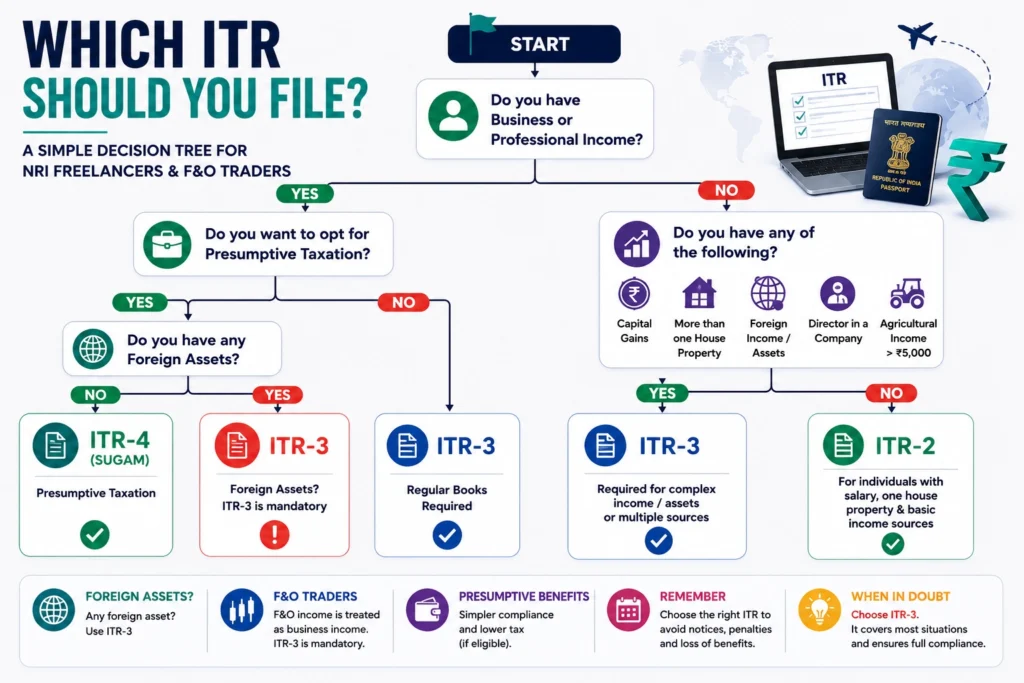
The choice depends on the nature of income and whether you elect presumptive taxation.
ITR-3
- For individuals with business or professional income
- Mandatory for F&O traders, since F&O is treated as non-speculative business income under Section 43(5)
- Required if you have capital gains, foreign income, or foreign assets along with business income
- Allows full schedule-wise disclosure and detailed loss adjustment
ITR-4 (Sugam)
- For individuals opting for presumptive taxation
- Available under Section 44AD (business) with turnover up to Rs 2 crore (or Rs 3 crore if 95% digital)
- Available under Section 44ADA (specified professionals) with receipts up to Rs 50 lakh (or Rs 75 lakh if 95% digital)
- Not available if you have capital gains, foreign assets, or more than one house property
Important for NRIs: The presumptive scheme is available, but if you hold foreign bank accounts, foreign investments, or need to disclose Schedule FA, you cannot use ITR-4. Most NRIs default to ITR-3 for this reason.
The Presumptive Taxation Question for NRIs
Presumptive schemes were designed to simplify tax for small businesses and professionals. They can work for NRIs in narrow cases.
Section 44AD (business):
- Presumes 8% of turnover as taxable income (6% for digital receipts)
- Available for turnover up to Rs 2 crore (or Rs 3 crore with 95% digital)
- No detailed books required
- Cannot switch back to normal accounting for 5 years once opted
Section 44ADA (specified professions):
- Presumes 50% of gross receipts as taxable income
- Available for professionals in listed categories (legal, medical, engineering, architecture, accountancy, technical consultancy, interior decoration, IT professionals)
- Receipt cap: Rs 50 lakh (Rs 75 lakh if 95% digital)
- Ideal for NRI consultants, doctors, and IT professionals with Indian-source receipts
NRI-specific caveats:
- Presumptive can be claimed only if you file ITR-4
- ITR-4 does not allow Schedule FA, so if you have any foreign asset, you must use ITR-3 with regular books
- Payment must be received in India or in a mode traceable to your NRE or NRO account
F&O Trading Classification: Speculative vs Non-Speculative
This is where most F&O traders and NRIs slip up.
- F&O trades in listed derivatives are treated as non-speculative business income under Section 43(5)
- Intraday equity trading (buying and selling the same day without delivery) is speculative business income
- Delivery-based equity trading is capital gains (short or long term depending on holding period)
Why does the classification matter? Because losses have different set-off rules.
| Type | Set-Off Against | Carry Forward |
|---|---|---|
| F&O (non-speculative) losses | Any income except salary | 8 years |
| Intraday (speculative) losses | Only speculative gains | 4 years |
| Short-term capital losses | Any capital gains | 8 years |
| Long-term capital losses | Only long-term capital gains | 8 years |
An NRI doing F&O plus intraday trading must maintain separate books for each stream. Clubbing them incorrectly changes the loss adjustment picture entirely.
Explore our Capital Gain Tax advisory for structuring your equity and F&O disclosures correctly.
Freelance Income for NRIs: How India Taxes It
If you are an NRI providing freelance services to Indian or global clients, the taxability depends on where the service is rendered and where payment is received.
When Indian tax applies:
- Service is rendered from India during your visit
- Payment is received in an Indian bank account (NRE or NRO)
- Client is Indian, and TDS is deducted under Section 194J or 194C
- Business is effectively controlled from India
When Indian tax does not apply (for genuine non-residents):
- Service is rendered entirely outside India
- Payment is received in an overseas bank account
- No permanent establishment or business connection in India
For freelance work with US, UK, or UAE clients billed from India, the income is fully taxable here. TDS at 10% under Section 194J is typical for professional fees. Excess TDS is claimable as a refund through your ITR.
Use our NRI TDS Refund Calculator to estimate your refund before filing.
The ITR Schedules NRI Freelancers and Traders Must Complete
An NRI running a freelance practice or trading F&O in India may need to fill up to 10 or more schedules.
| Schedule | Applicability for NRIs |
|---|---|
| Schedule S | Salary income, if any |
| Schedule BP | Business or profession income (freelancers, consultants, F&O traders) |
| Trading P&L and Balance Sheet | Where books are maintained |
| Schedule CYLA | Current year loss adjustment |
| Schedule BFLA | Brought forward loss adjustment |
| Schedule CFL | Carry forward eligible losses |
| Schedule OS | Interest, dividends, other sources |
| Schedule CG | Capital gains on Indian and foreign assets |
| Schedule FSI | Foreign source income (for RNOR or ROR) |
| Schedule FA | Foreign bank accounts, brokerage, IRA, 401(k), etc. |
| Schedule TR | Tax relief claimed under DTAA |
| Schedule AL | Assets and liabilities if income exceeds Rs 50 lakh |
Filing even one of these incorrectly can trigger a mismatch notice.
AIS Reconciliation: The Data-Matching Trap
The Annual Information Statement (AIS) now captures a vast range of NRI transactions:
- Broker turnover and F&O contract data
- Dividends and interest from Indian institutions
- Rental credits in NRO accounts
- TDS deducted by all payers
- Property sale entries from registrars
- Mutual fund purchases and redemptions
Before filing, reconcile:
- AIS against your broker P&L, bank statements, and Form 26AS
- TDS entries against your consulting invoices
- Contract-level F&O turnover against your trading books
- Speculative and non-speculative buckets separately
Any mismatch, especially in F&O turnover (which can run into crores), is a top trigger for Section 148 reassessment notices. Our NRI Income Tax Notice Solutions team handles these cases regularly.
Loss Adjustment and Carry Forward Rules for NRIs
Losses are as important to report as income. Missing this in your ITR forfeits your right to carry them forward.
Business losses (including F&O):
- Can be carried forward for 8 years
- Can be set off against any income except salary in subsequent years
- Must file ITR before the due date to carry forward
Speculative losses (intraday):
- Can be carried forward for 4 years
- Can be set off only against speculative gains
Capital losses:
- Carried forward for 8 years
- STCL sets off both STCG and LTCG
- LTCL sets off only LTCG
NRI-specific point: For business losses to be carried forward, your ITR must reach the department before the due date. Missing the audit-linked October deadline forfeits carry-forward rights entirely.
Beware of Common Tax Traps for NRI Freelancers and Traders
Errors that regularly trigger notices for NRIs:
- Misclassifying F&O as speculative or as capital gains
- Claiming presumptive taxation on ITR-4 while holding foreign assets
- Ignoring AIS mismatches on broker turnover
- Reporting only net gain on F&O instead of turnover-based figures
- Missing TDS entries in Form 26AS reconciliation
- Skipping Schedule FA despite holding US, UK, or UAE bank accounts
- Missing advance tax on freelance receipts
- Claiming losses without filing by the due date
- Not maintaining separate books for speculative and non-speculative streams
- Choosing the wrong ITR form and later filing revised returns
How MostlyNRI Helps Freelancers and F&O Traders File Correctly
Filing an NRI ITR with freelance or trading income is not a simple exercise. It requires classification of every income stream, reconciliation of AIS with hundreds of transactions, loss allocation, and DTAA planning.
At MostlyNRI, we help NRI freelancers, consultants, and traders with:
- ITR-3 filing with correct schedules for business, profession, and trading
- Section 44AD and 44ADA presumptive scheme evaluation
- F&O turnover and P&L computation aligned to Guidance Note standards
- AIS reconciliation across brokers, banks, and clients
- TDS refund optimisation on Section 194J and 194C deductions
- Schedule FA and FSI disclosures for foreign holdings
- DTAA credit claims on cross-border consulting income
- Audit coordination with chartered accountants for Section 44AB cases
- Notice response for AIS mismatches and reassessment
Our team has served NRIs from over 33 countries across 13 Indian cities.
Are you an NRI freelancer or F&O trader filing your Indian ITR? Book a consultation with our specialists at MostlyNRI.com before the 31 October 2026 audit deadline to file with full loss carry-forward and DTAA benefit.
Frequently Asked Questions (FAQs)
Which ITR form should NRI freelancers and F&O traders file for AY 2025-26?
Most NRI freelancers and F&O traders should file ITR-3, since it accommodates business or professional income, capital gains, and Schedule FA disclosures for foreign assets. ITR-4 is only for those opting for presumptive taxation without foreign assets.
Is F&O trading treated as speculative or non-speculative income in India?
F&O trading in listed derivatives is classified as non-speculative business income under Section 43(5). Intraday equity trading (same-day buy and sell without delivery) is treated as speculative business income, with stricter loss set-off and carry-forward rules.
Can NRIs use Section 44ADA presumptive taxation?
Yes, provided the NRI is a specified professional (IT, legal, medical, technical consultancy, etc.), gross receipts are up to Rs 50 lakh (Rs 75 lakh if 95% digital), and they do not hold foreign assets, since ITR-4 does not allow Schedule FA disclosure.
What is the ITR deadline for NRIs whose books require audit?
The audit-linked ITR deadline is 31 October 2026. Books require audit if business turnover exceeds Rs 1 crore, professional receipts exceed Rs 50 lakh, or you opt out of a presumptive scheme with declared profits below deemed rates.
How are F&O losses set off against other income for NRIs?
F&O losses (non-speculative business) can be set off against any income except salary in the same year, and carried forward for 8 years. Intraday speculative losses can only be set off against speculative gains and carried forward for 4 years.
Do NRI freelancers need to disclose foreign bank accounts in ITR?
Yes, if they qualify as ROR during any part of the year. Schedule FA requires disclosure of all foreign bank accounts, brokerage, IRAs, 401(k)s, and beneficial ownership. Non-disclosure invites Black Money Act penalties up to 300% of tax due.
Is TDS deducted on freelance income paid to NRIs by Indian clients?
Yes. Indian clients typically deduct 10% TDS under Section 194J for professional fees, or higher rates under Section 195 for non-residents. Any excess deduction is claimable as a refund through the ITR-3 with proper Schedule TR entries.
Can NRIs carry forward F&O losses without filing on time?
No. To carry forward F&O business losses for 8 years, the ITR must be filed by the applicable due date (usually 31 October 2026 for audit cases). Missing this deadline forfeits the carry-forward right permanently, even if losses are correctly reported.
How should NRIs reconcile AIS with their broker P&L?
Match your broker contract-level P&L, bank credits, and Form 26AS entries against the AIS turnover, dividend, interest, and TDS figures. Reconciliation should happen before filing. Any mismatch is a top reason for AIS-triggered reassessment notices under Section 148.
How can MostlyNRI help NRI freelancers and F&O traders file ITR correctly?
MostlyNRI classifies each income stream (freelance, F&O, intraday, capital gains), reconciles AIS, prepares Schedule BP with proper books, files Schedule FA and FSI, and coordinates audit where required. Our team supports NRI professionals from 30+ countries end to end.


0 Comments