



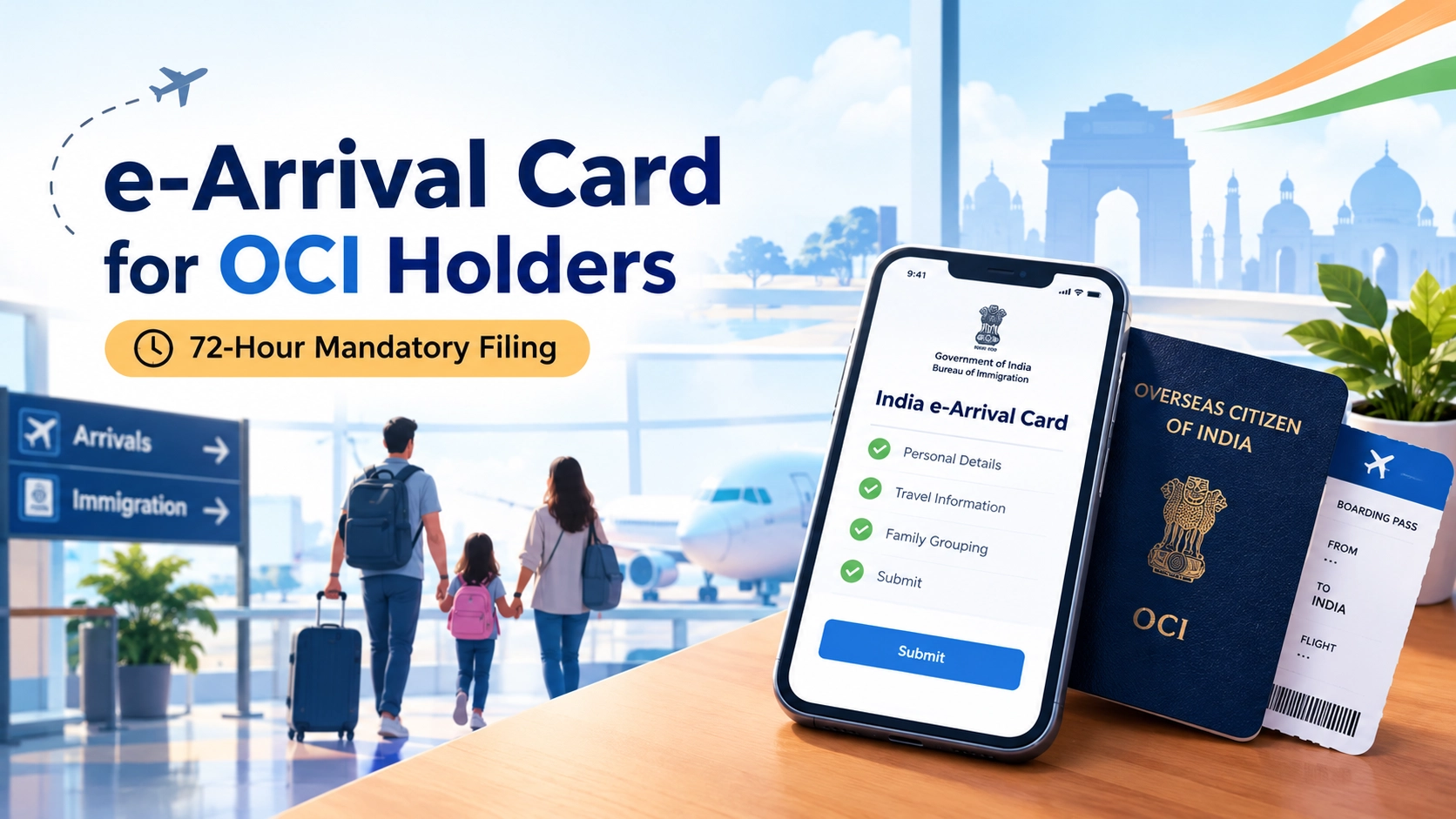
The India e-Arrival Card is now mandatory for every OCI cardholder flying into India. Effective from 1 April 2026, the Government of India has withdrawn the earlier OCI exemption, bringing all Overseas Citizens of India into the same digital pre-arrival filing system as foreign nationals. The paper disembarkation cards that used to be filled onboard are gone. In their place is a 72-hour pre-arrival digital form submitted on the official portal before boarding.
Missing the form does not get you blocked outright, but it does mean airline check-in delays, longer immigration queues, and in some cases, a diverted stop at the airport help desk while you fill it on patchy airport WiFi. For OCI families travelling together, there is a specific family grouping option that lets minors ride on a parent's entry rather than filing separately, but even that has rules worth getting right.
This guide breaks down exactly how the e-Arrival Card works for OCI holders in 2026, the 72-hour filing window, step-by-step portal process, family grouping rules, how it fits with the e-OCI card update, and the common mistakes that cost NRI families time at the airport.
What is the India e-Arrival Card and Why It Now Covers OCI Holders
The India e-Arrival Card is a digital pre-arrival declaration form, housed on the Bureau of Immigration portal at indianvisaonline.gov.in/earrival/. It replaces the physical disembarkation forms that passengers used to complete on the plane or at the immigration desk.
Who it applies to from 1 April 2026:
- All foreign nationals entering India
- All OCI cardholders (previously exempt)
- All PIO cardholders travelling on foreign passports
Who is still exempt:
- Indian citizens travelling on Indian passports
- Airside transit passengers who do not clear immigration
- Diplomatic passport holders under specific protocols
The policy aligns India's border process with digital arrival systems operating in Singapore, the UK, Australia, and other countries. For NRIs, it is a procedural shift that must now be built into the pre-trip checklist alongside the e-OCI passport link and the three-month update rule.
For NRIs who need to align identity documents across OCI, PAN, and bank KYC before travel, the NRI Taxation and Compliance framework at MostlyNRI connects every piece.
The 72-Hour Rule: When OCI Holders Must File
The e-Arrival Card can only be submitted within 72 hours (3 days) before your scheduled arrival in India. The portal's date picker enforces this strictly.
- Earliest filing: 72 hours before scheduled arrival
- Latest filing: Before boarding your flight to India
- No early filing: The system does not accept submissions more than 3 days out
- No post-arrival submission: You cannot complete it after landing without going to the airport help desk
For OCI holders flying from the USA, UAE, UK, Canada, Singapore, and Australia, the 72-hour window usually opens while you are still at home. The best practice is to file within 24 to 48 hours of departure, giving you buffer time for any portal issues or data corrections.
What Information OCI Holders Must Provide
The e-Arrival Card asks for details already in your passport and travel plan. Have the following ready before opening the portal.
| Field | What to Enter |
|---|---|
| Full name | Exactly as printed on your passport |
| Passport number | Foreign passport (OCI holders do not hold Indian passports) |
| Nationality | Your current country of citizenship |
| Visit purpose | Tourism, business, medical, family visit, etc. (dropdown) |
| Flight number and arrival time | From your current booking |
| Countries visited in the past 6 days | List all stops, not just origin |
| Indian address | Hotel, host residence, or your own property |
| Email ID | Active email for confirmation |
| Mobile number | Reachable number (home country or Indian) |
| Emergency contact | Name and number of someone to reach |
| CAPTCHA | Portal verification step |
The Indian address is the most frequently missed or incorrectly filled field. Immigration officers do check it, and a vague entry like "with family" can lead to secondary questioning. Provide the actual street address or hotel name.
Family Grouping: How OCI Families Can Travel Together
For OCI parents travelling with children, the portal provides a family grouping option. This avoids multiple separate submissions for the same travelling party.
How family grouping works:
- Minors (typically under 18) can be linked to a parent's e-Arrival Card entry
- Spouses should file separate entries under their own OCI and passport details
- Both parents can also file individually with the minor listed under one of them
- The portal collects a basic set of details for each dependent child
- At immigration, the linked entry displays all travellers in the family group
Important nuances:
- Each adult OCI holder files their own form (family grouping does not replace adult filings)
- A child with their own passport still needs to be declared, even if riding on a parent's entry
- Separate families on the same booking should not share one entry
- If one spouse has an OCI and the other has a tourist e-Visa, they file separately under their respective categories
For NRIs structuring their Indian financial setup before family relocation, our NRI Bank Account Type Advisor ensures the family's banking and KYC align with the correct identity documents.
Step-by-Step: How to File the e-Arrival Card
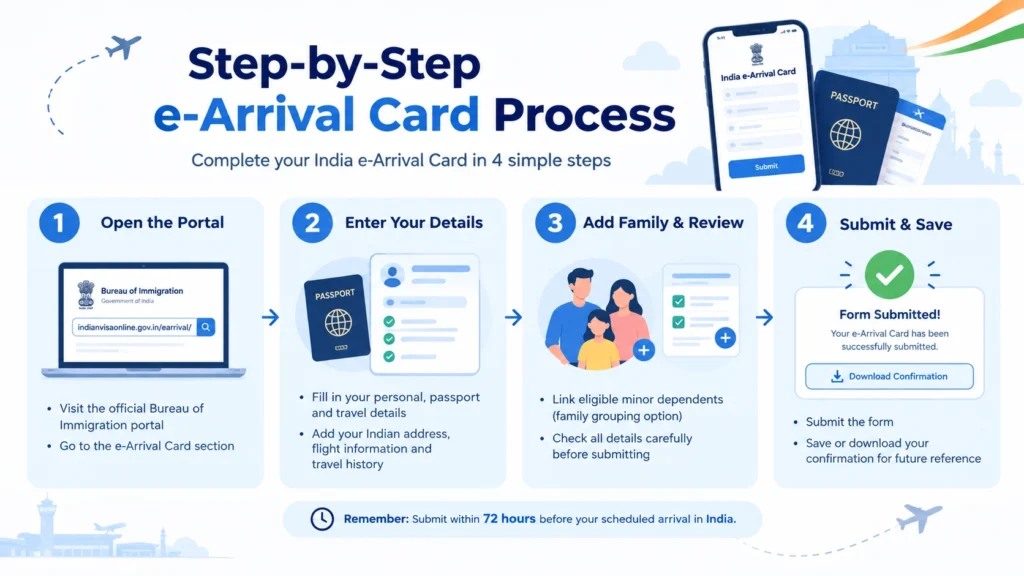
The process typically takes 5 to 10 minutes per adult once you have your details ready.
- Visit indianvisaonline.gov.in/earrival/ on a laptop or mobile browser
- Click Fill e-Arrival Card
- Select OCI Card as your document type
- Enter your OCI number and passport details
- Fill in flight, address, and travel history details
- Add minor dependents if applicable through the family grouping option
- Complete CAPTCHA verification
- Review the full entry carefully before submission
- Submit and download or print the confirmation
- Keep a PDF copy on your phone for airport staff on request
The service is completely free on the official portal. The same filing is also available through the Indian Visa Su-Swagatam mobile app released by the Bureau of Immigration.
Avoid any third-party website or paid visa agent offering to file the form for you. The form is simple enough to complete yourself and does not require middlemen.
e-Arrival Card vs e-OCI vs e-Visa: Three Different Digital Credentials
NRIs often confuse these three. They are separate credentials with separate purposes.
| Credential | What It Is | Who Needs It | When to File |
|---|---|---|---|
| e-OCI Card | Digital OCI identity under Citizenship Amendment Rules 2026 | OCI holders | On application and after passport renewal |
| e-Arrival Card | Pre-arrival digital disembarkation form | OCI holders, foreign nationals | Within 72 hours before each India trip |
| e-Visa | Entry visa for foreign nationals without OCI or PIO | Foreign nationals without OCI | Before applying for travel |
An OCI holder does not need an e-Visa. But from April 2026, they do need the e-Arrival Card for every trip. The e-OCI is a one-time digital identity bound to your passport, updated when your passport changes.
For NRIs confused by overlapping identity documents, our PAN Card and OCI reconciliation service aligns everything before you fly.
What Happens If You Do Not File the e-Arrival Card
The government has not announced a specific monetary penalty for missing the e-Arrival Card. However, the practical consequences at the airport and on arrival are real.
- Airline check-in delays: Many airlines flag passengers without completed e-Arrival Cards at the boarding gate
- Boarding risk: Some airlines may delay boarding until compliance is confirmed
- Immigration queue extension: Fliers without a submitted form are routed to a separate help desk at Indian airports
- Secondary questioning: Officers may ask more questions about your travel purpose if arrival data is incomplete
- Family group separation: If one family member missed the filing, their airport processing time may delay others
Compared to the former paper form, the digital pre-arrival filing is actually faster when done correctly. The friction is entirely from skipping the step rather than completing it.
Common Mistakes OCI Holders Make With the e-Arrival Card
The most avoidable errors:
- Filing outside the 72-hour window and the portal rejecting the date
- Using a third-party paid website instead of the official portal
- Confusing the e-Arrival Card with the e-Visa (OCI holders do not need an e-Visa)
- Confusing the e-Arrival Card with ATITHI customs declaration (that is separate)
- Not updating the e-OCI to the new passport first, then entering a mismatched number
- Leaving the Indian address field blank or vague
- Filing one entry for the whole family including adult spouses
- Missing the minor dependent declaration even when riding on a parent's entry
- Not keeping a PDF or screenshot copy for airline staff to verify
- Filing while in flight on patchy WiFi after missing the pre-boarding window
For OCI holders whose banking or tax records have been affected by delayed arrivals or identity mismatches, our NRI Income Tax Notice Solutions team handles the follow-up compliance.
How the e-Arrival Card Fits With Your Broader NRI Compliance Calendar
A smooth trip to India in 2026 depends on three documents being correctly aligned.
- Your e-OCI card is updated to your current passport under the three-month rule
- Your e-Arrival Card is filed within 72 hours of each trip
- Your Indian PAN is linked, operative, and matches your OCI name
- Your NRE, NRO, or FCNR accounts reflect your current KYC
- Your ITR filings under the Income Tax Act 2025 are current
A missed e-Arrival Card is a travel-day inconvenience. A missed e-OCI update can create airline boarding issues. A missed PAN link can delay refunds, mutual fund transactions, and property deals. Keeping all three aligned is the compliance baseline for NRI families in 2026.
For capital gains planning linked to Indian property or investment sales during a visit, our Capital Gains Tax team coordinates the TDS, Section 197 certificate, and ITR steps.
How MostlyNRI Helps OCI Families Stay Travel-Ready
The e-Arrival Card itself is a simple form, but it sits inside a larger set of OCI, PAN, bank, and tax records that NRIs manage from abroad. One mismatch anywhere can slow a property transaction, a refund, or a bank account opening. At MostlyNRI, we help NRIs across the USA, UAE, UK, Canada, Singapore, and Australia with:
- OCI and e-OCI reconciliation after passport renewals
- PAN card application, correction, and OCI name match
- NRE, NRO, FCNR, and RFC account structuring with updated identity
- ITR filing under the Income Tax Act 2025
- Property transaction KYC for OCI buyers and sellers
- TRC and Form 41 filings under the new Act
- Response to tax notices arising from identity or residency mismatches
- End-to-end travel-ready compliance for OCI families planning India visits
Our team serves NRIs from over 33 countries across 13 Indian cities.
Flying to India as an OCI holder in 2026? Book a consultation with our specialists at MostlyNRI.com to align your e-OCI, PAN, bank, and ITR records before your next trip and avoid airport day surprises.
Frequently Asked Questions (FAQs)
Is the India e-Arrival Card mandatory for OCI holders in 2026?
Yes. From 1 April 2026, the India e-Arrival Card is mandatory for all OCI cardholders travelling to India. The previous OCI exemption has been withdrawn by the Bureau of Immigration, bringing OCI holders in line with other foreign nationals.
What is the 72-hour rule for the e-Arrival Card?
The e-Arrival Card can only be filed within 72 hours (3 days) before your scheduled arrival in India. Earlier submissions are blocked by the portal. The best time to file is 24 to 48 hours before departure to allow buffer for corrections.
Where do OCI holders file the India e-Arrival Card?
The official portal is indianvisaonline.gov.in/earrival/, or the Su-Swagatam mobile app released by the Bureau of Immigration. The service is completely free. Avoid third-party paid websites that may charge for the same filing.
Can OCI families group minor children on one e-Arrival Card entry?
Yes. The portal supports family grouping, allowing minor children to be linked to a parent's e-Arrival Card entry. However, each adult OCI holder, including spouses, must file their own individual entry under their own passport details.
Is the e-Arrival Card the same as an e-Visa?
No. The e-Arrival Card is a pre-arrival disembarkation form required for every trip to India. An e-Visa is an entry visa for foreign nationals who do not hold OCI or PIO status. OCI holders do not need an e-Visa but do need the e-Arrival Card.
What happens if an OCI holder forgets to file the e-Arrival Card?
Non-filing can cause airline check-in delays, extended immigration queues, and routing to a help desk at the Indian airport for on-the-spot completion. Some airlines may delay boarding until compliance is confirmed. There is currently no specific monetary penalty.
What is the official e-Arrival Card portal URL for India?
The official URL is **https://indianvisaonline.gov.in/earrival/**. This is the only portal that files the e-Arrival Card at no cost. Third-party websites may charge fees for the same service, which is unnecessary for OCI holders.
Can OCI holders file the e-Arrival Card using a mobile phone?
Yes. The official portal is mobile-browser friendly, and the Bureau of Immigration's Su-Swagatam app also supports filing. OCI holders can file from any device within the 72-hour window. A PDF copy of the confirmation should be kept on the phone.
Does the e-Arrival Card require OCI holders to update their e-OCI first?
Yes, indirectly. Your e-Arrival Card entry must use your current passport number. If your passport was recently renewed but your OCI has not been updated under the three-month rule, airline and immigration staff may flag the mismatch at check-in.
How can MostlyNRI help OCI holders stay travel-ready for India?
MostlyNRI aligns your e-OCI, PAN, bank KYC, and ITR records before travel, resolves identity mismatches, handles Form 41 TRC filings, and supports property and tax compliance for OCI holders across 30+ countries including the USA, UAE, UK, Canada, Singapore, and Australia.


0 Comments