




Gifting money to a Hindu Undivided Family (HUF) is one of the most common ways Non-Resident Indians pass funds back home to a family pool. Yet the tax treatment is one of the most misunderstood. If you are a UK, US, UAE, or Singapore-based NRI planning to transfer savings from your NRO account to your father's HUF, three separate tax questions have to be answered: Is the gift itself taxable? Is the income earned by the HUF from investing that gift taxable? Is it clubbed back with your income?
The short answer under the Income Tax Act 2025 (effective 1 April 2026) is that the gift itself is generally not taxable in the HUF's hands if you are a member of the family. But under Section 64(2), the income earned by the HUF from investing that money is clubbed back in your hands as an NRI member. Get this wrong and you could face a decade of Section 148 reassessment notices.
This guide breaks down everything an NRI should know about gifting to an HUF in 2026, the relative exemption, the clubbing trap, FEMA position, documentation, and the new Form 41 refile process if your Tax Residency Certificate needs to be updated.
Are NRI Gifts to HUF Taxable in India?
The taxability of a gift is always assessed in the hands of the receiver, not the giver. The person making the gift never faces a tax liability just for making the gift. So if you, as an NRI, transfer Rs 25 lakh from your NRO account to your father's HUF, you owe no Indian income tax on that transfer.
The question therefore shifts to the HUF as the recipient. Under Section 56(2)(x) of the Income Tax Act, any sum of money received by a person (including an HUF) without consideration exceeding Rs 50,000 in a financial year is taxable as Income from Other Sources.
However, this rule has a crucial exception for gifts received from relatives. In the case of an HUF, its members are treated as its relatives. That means a gift from an NRI member to the HUF is fully exempt from Section 56 taxability.
For a personalised NRI residency and taxation review before making a large transfer, start with our NRI Tax Residency Calculator.
The Two-Sided Analysis: Giver vs Receiver
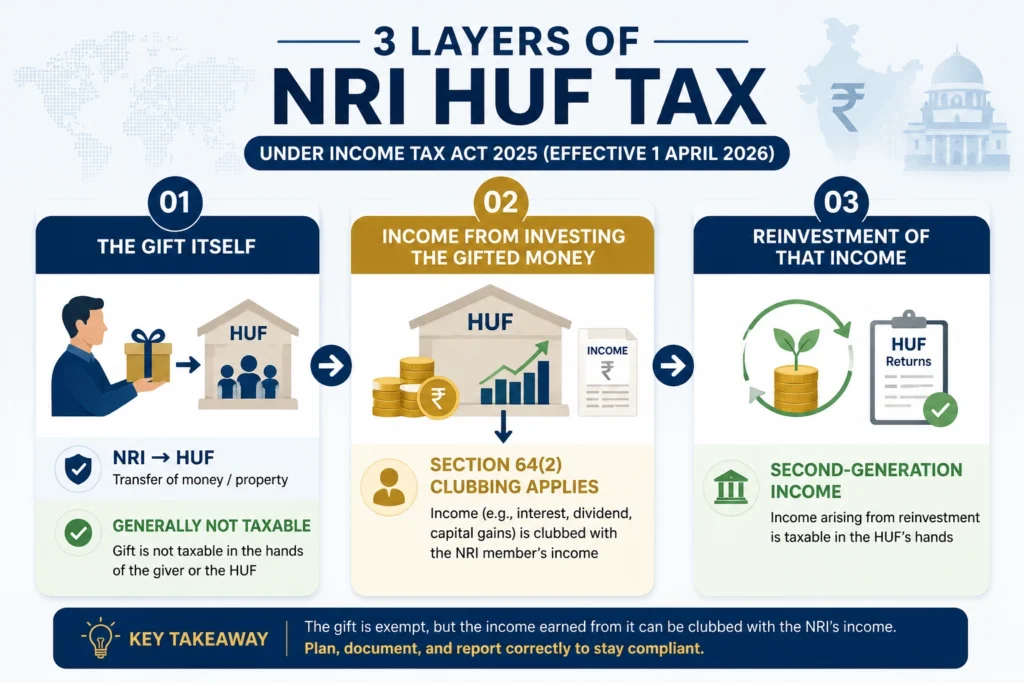
Understanding NRI gifts to an HUF requires separating three distinct tax layers.
| Layer | Who Is Assessed | Taxable? |
|---|---|---|
| The gift itself (transfer of money) | NRI giver | Not taxable |
| Gift receipt in HUF's hands | HUF | Not taxable if giver is a member (relative) |
| Income from investing the gifted money | HUF and NRI member | Clubbed with NRI's income under Section 64(2) |
| Reinvestment of that income | HUF | Taxable in HUF's hands (second-generation income) |
Missing any of these layers is how NRIs walk into unnecessary tax notices. Handled correctly, the structure is fully compliant and often preferred over gifting to individual family members.
Section 56(2)(x): The HUF Exception Explained
Under the Income Tax Act, any sum of money, immovable property, or specified movable property received without adequate consideration above Rs 50,000 in aggregate during a financial year is taxable in the recipient's hands as Income from Other Sources.
The Act carves out a list of specified relatives whose gifts are outside this rule. For an HUF, the following are considered relatives:
- Any member of the HUF (including the karta and coparceners)
- Spouse of the karta
- Brothers and sisters of the karta
- Any lineal ascendant or descendant of the karta
- Spouse of any of the above
Since you as an NRI son or daughter are a member of your father's HUF, any gift from you is exempt. The exemption is not capped; you can gift Rs 5,000 or Rs 5 crore without triggering Section 56 in the HUF's hands.
The Clubbing Provision Trap: Section 64(2)
This is the point most NRIs miss. Section 64(2) of the Income Tax Act contains a specific anti-avoidance rule for HUFs. It says that when an individual member transfers their own property (including money) to the HUF without adequate consideration, the income arising from that transferred property is clubbed with the transferor member's income for tax purposes.
In plain terms:
- You gift Rs 25 lakh from your NRO account to your father's HUF (Year 1)
- The HUF invests it in an Indian mutual fund
- Year 2 dividends and capital gains of, say, Rs 1.75 lakh arise
- This Rs 1.75 lakh is added back to your total income, not the HUF's
- You pay tax on it as if it were your income
The clubbing continues as long as the original gifted property (or its identifiable form) remains with the HUF. If the HUF reinvests the clubbed income into further assets, the second-generation income is generally taxable in the HUF's hands, not the member's. This nuance is why professional structuring matters.
Read our detailed Capital Gain Tax advisory for structuring HUF investments.
FEMA Position on NRI Gifts to an Indian HUF
Beyond the Income Tax Act, FEMA (Foreign Exchange Management Act) is the other regulator NRIs must satisfy. The good news: FEMA does not restrict an NRI from gifting money to an Indian HUF where the NRI is a member.
Key FEMA points:
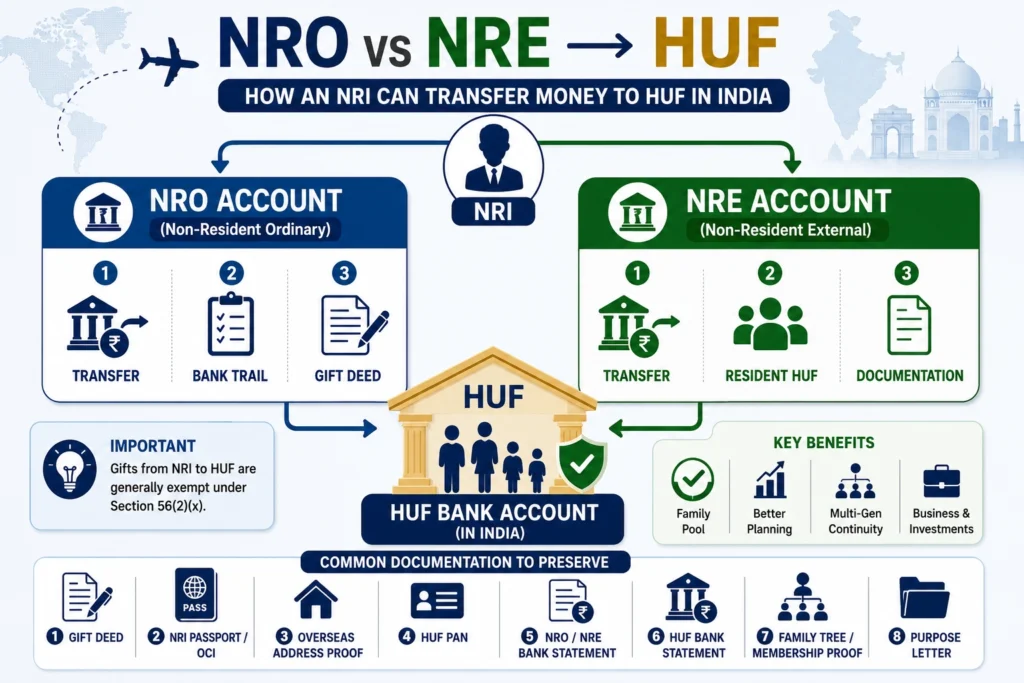
- Gifts from NRO to a resident HUF account are freely permitted
- Gifts from NRE to a resident HUF account are permitted; funds change character to resident
- No prior approval or LRS ceiling applies to gifts to a family HUF
- Documentation should be maintained to show the gift was made from legitimately sourced foreign or Indian earnings
- A signed gift deed is strongly recommended
For clarity on which account structure best fits your goals, use our NRI Bank Account Type Advisor.
Practical Structure: How NRIs Should Gift to an HUF
Follow this sequence to keep the gift clean, tax-efficient, and audit-ready.
- Confirm your HUF membership through the family tree and HUF PAN records
- Draft a gift deed clearly identifying the giver, recipient HUF, amount, and purpose
- Transfer funds from NRO or NRE to the HUF's Indian bank account by NEFT or RTGS
- Preserve bank statements showing the source of funds in the NRO or NRE account
- Report the gift in the HUF's books of account and ITR
- Track clubbing on any income the HUF earns from that specific pool
- Include the clubbed income in your own ITR (as an NRI, use ITR-2 or ITR-3)
- Retain the gift deed for at least 8 years, ideally longer, for reassessment protection
Documentation Every NRI Should Preserve
Documentation is what separates a compliant gift from a tax notice. Keep the following for every HUF gift:
- Signed and dated gift deed on stamp paper of appropriate value
- Photocopy of NRI passport, visa or OCI card
- Overseas address proof of the NRI giver
- PAN card of the HUF and karta
- Bank statements of NRO or NRE account showing debit
- Bank statements of HUF account showing credit
- Purpose letter if the gift is for a specific investment or purchase
- Family tree showing your relationship to the karta
For gifts above Rs 10 lakh, register the deed at your sub-registrar office. It is not mandatory for cash gifts, but it strengthens your defence in any future scrutiny.
Form 41 Refile Under the Income Tax Act 2025
If you are an NRI providing services to Indian clients (like consultancy from Singapore, UAE, UK, or US), you file Form 41 online along with your Tax Residency Certificate (TRC) to claim treaty benefits under the DTAA.
Under the Income Tax Act 2025, the department clarified through FAQs that Form 41 cannot be revised or edited once filed. However, the e-filing portal currently allows Form 41 to be filed again with corrections.
If you make a mistake, such as attaching an old-year TRC instead of the current year:
- The earlier Form 41 becomes non-actionable
- The newly filed Form 41 is treated as the valid form from the date of re-filing
- All treaty benefits from that point forward are governed by the new filing
This means if you accidentally attached your 2025 TRC when your consultancy income arose in 2026, you can refile Form 41 with the correct 2026 TRC. The refiled form supersedes the earlier one for future tax deduction and DTAA claim purposes.
Explore our NRI Taxation and Compliance service for Form 41, TRC, and DTAA claim handling.
Why NRIs Prefer Gifting to an HUF Over Direct Individual Gifts
For high-net-worth NRIs supporting family in India, gifting to an HUF instead of an individual family member offers several advantages:
- Consolidated family pool for investments, real estate, and business capital
- Independent PAN and ITR allowing separate tax slab benefits (subject to clubbing)
- Multi-generational continuity without repeated gift deeds
- Simpler estate planning compared to individual gifts
- Business capital for family-run ventures under a single legal entity
However, the clubbing rule under Section 64(2) limits the tax arbitrage on income from directly gifted funds. The second-generation income planning is where a professional structure adds real value.
Common Mistakes NRIs Make on HUF Gifts
The most costly slip-ups are avoidable. Watch out for:
- Skipping the gift deed on the assumption that family transfers do not need paperwork
- Missing the clubbing disclosure in the NRI's Indian ITR
- Assuming the exemption under Section 56 applies to all HUF gifts (it does not; only member gifts qualify)
- Gifting from NRE and expecting the HUF income to be tax-free (it is not; clubbing still applies)
- Ignoring the second-generation income distinction from clubbed income
- Not maintaining a separate ledger for the gifted corpus vs HUF's own funds
- Missing the Form 41 refile deadline when TRC is corrected
- Filing the wrong ITR form (NRIs with HUF-linked clubbed income use ITR-2 or ITR-3)
If you have already received a notice, our NRI Income Tax Notice Solutions team helps close the file with correct disclosures.
How MostlyNRI Helps You Structure HUF Gifts Correctly
Gifting to an HUF is not a one-signature task. It involves income tax classification, clubbing analysis, FEMA compliance, DTAA optimisation, and long-term investment planning.
At MostlyNRI, we help NRIs from the USA, UAE, UK, Canada, Singapore, and Australia with:
- HUF gift structuring with Section 56 and Section 64(2) analysis
- Clubbing computation for the NRI member's Indian ITR
- Gift deed drafting and documentation review
- Form 41 and TRC filing under the Income Tax Act 2025
- DTAA benefit claims on Indian source consultancy income
- NRO and NRE account structuring for gifting flows
- ITR filing with correct schedules including Schedule FA and FSI
- Notice response for reassessment on gift and clubbing issues
Our team has served NRIs from over 33 countries across 13 Indian cities.
Planning to gift savings to your family HUF in India? Book a consultation with our specialists at MostlyNRI.com and structure the transfer with the right documentation, clubbing analysis, and DTAA cover.
Frequently Asked Questions (FAQs)
Are NRI gifts to a father's HUF taxable in India in 2026?
No. Under Section 56(2)(x), gifts from HUF members (including NRI sons and daughters) are exempt from taxation in the HUF's hands. The giver also does not pay tax simply for making the gift. Only Section 64(2) clubbing applies to future income.
What is Section 64(2) of the Income Tax Act and how does it affect NRI gifts?
Section 64(2) clubs any income earned by the HUF from a member's gifted property back with the member's income. So if an NRI gifts Rs 25 lakh to their HUF, the HUF's dividends, interest, or capital gains on that pool are taxed in the NRI's hands.
Can NRIs gift money from an NRO account to an HUF without any FEMA issue?
Yes. FEMA does not restrict NRI gifts to an Indian HUF where the NRI is a member. Transfers from NRO or NRE accounts to the HUF's resident account are freely permitted. A signed gift deed and clean bank trail are recommended for documentation.
Is there any upper limit on the amount an NRI can gift to an HUF?
No. There is no monetary ceiling on the amount an NRI can gift to their father's or family HUF. The Rs 50,000 Section 56 threshold does not apply because the exemption for gifts from members overrides it entirely, regardless of amount.
Do NRIs need to file a gift deed for transferring money to an HUF?
Yes, strongly recommended. A signed gift deed on appropriate stamp paper, listing the giver, recipient HUF, amount, and purpose, is the primary document that proves the transaction is a gift and not a loan, salary, or income. Register deeds above Rs 10 lakh.
Is the income earned by an HUF on gifted money taxable in the HUF's hands?
Not directly. Under Section 64(2), the income arising from the gifted property is clubbed with the NRI member's income and taxed in the NRI's hands. Only the second-generation income (from reinvested clubbed amounts) is taxable to the HUF.
Can NRIs claim DTAA relief on income clubbed under Section 64(2)?
Possibly. Since the clubbed income is added to the NRI's total income, DTAA relief may be claimed for any tax paid in the country of residence on the same income. However, DTAA application depends on the nature of income and treaty article involved.
Can NRIs refile Form 41 with a corrected Tax Residency Certificate?
Yes. Under the Income Tax Act 2025, once filed, Form 41 cannot be edited, but a fresh Form 41 can be filed on the e-filing portal. The earlier form becomes non-actionable, and the new form applies from the date of re-filing for all DTAA purposes.
Which ITR form should NRIs use to report income clubbed from an HUF gift?
Use ITR-2 if you have salary, capital gains, and other income. Use ITR-3 if you also have business or professional income. Both forms permit clubbed income disclosure and Schedule FA foreign asset reporting for NRI residents abroad.
How can MostlyNRI help with NRI gifts to an HUF?
MostlyNRI structures HUF gifts with Section 56 and Section 64(2) analysis, drafts gift deeds, computes clubbing for the NRI's ITR, handles Form 41 and TRC filings, and responds to tax notices. Our team supports NRIs across 30+ countries end to end.
1. Are NRI gifts to a father's HUF taxable in India in 2026?
No. Under Section 56(2)(x), gifts from HUF members (including NRI sons and daughters) are exempt from taxation in the HUF's hands. The giver also does not pay tax simply for making the gift. Only Section 64(2) clubbing applies to future income.
2. What is Section 64(2) of the Income Tax Act and how does it affect NRI gifts?
Section 64(2) clubs any income earned by the HUF from a member's gifted property back with the member's income. So if an NRI gifts Rs 25 lakh to their HUF, the HUF's dividends, interest, or capital gains on that pool are taxed in the NRI's hands.
3. Can NRIs gift money from an NRO account to an HUF without any FEMA issue?
Yes. FEMA does not restrict NRI gifts to an Indian HUF where the NRI is a member. Transfers from NRO or NRE accounts to the HUF's resident account are freely permitted. A signed gift deed and clean bank trail are recommended for documentation.
4. Is there any upper limit on the amount an NRI can gift to an HUF?
No. There is no monetary ceiling on the amount an NRI can gift to their father's or family HUF. The Rs 50,000 Section 56 threshold does not apply because the exemption for gifts from members overrides it entirely, regardless of amount.
5. Do NRIs need to file a gift deed for transferring money to an HUF?
Yes, strongly recommended. A signed gift deed on appropriate stamp paper, listing the giver, recipient HUF, amount, and purpose, is the primary document that proves the transaction is a gift and not a loan, salary, or income. Register deeds above Rs 10 lakh.
6. Is the income earned by an HUF on gifted money taxable in the HUF's hands?
Not directly. Under Section 64(2), the income arising from the gifted property is clubbed with the NRI member's income and taxed in the NRI's hands. Only the second-generation income (from reinvested clubbed amounts) is taxable to the HUF.
7. Can NRIs claim DTAA relief on income clubbed under Section 64(2)?
Possibly. Since the clubbed income is added to the NRI's total income, DTAA relief may be claimed for any tax paid in the country of residence on the same income. However, DTAA application depends on the nature of income and treaty article involved.
8. Can NRIs refile Form 41 with a corrected Tax Residency Certificate?
Yes. Under the Income Tax Act 2025, once filed, Form 41 cannot be edited, but a fresh Form 41 can be filed on the e-filing portal. The earlier form becomes non-actionable, and the new form applies from the date of re-filing for all DTAA purposes.
9. Which ITR form should NRIs use to report income clubbed from an HUF gift?
Use ITR-2 if you have salary, capital gains, and other income. Use ITR-3 if you also have business or professional income. Both forms permit clubbed income disclosure and Schedule FA foreign asset reporting for NRI residents abroad.
10. How can MostlyNRI help with NRI gifts to an HUF?
MostlyNRI structures HUF gifts with Section 56 and Section 64(2) analysis, drafts gift deeds, computes clubbing for the NRI's ITR, handles Form 41 and TRC filings, and responds to tax notices. Our team supports NRIs across 30+ countries end to end.


0 Comments