




The Union Budget 2026-27, presented by Finance Minister Nirmala Sitharaman on 1 February 2026, was not headline-grabbing on income tax slabs. Rates stayed where the 2024 Budget left them. But look past the slab table and Budget 2026 quietly delivers seven structural changes that touch almost every decision an NRI has to make: the new Income Tax Act 2025 takes over from 1 April 2026, the OCI listed-company holding cap has been raised for the first time in years, NRI property paperwork has been simplified, a six-month foreign asset disclosure window has opened, TCS on outward remittances has been cut, the Baggage Rules 2026 kicked in for NRI travellers, and ITR filing deadlines have been staggered.
For NRIs in the USA, UAE, UK, Canada, Singapore, and Australia, these changes shift both the numbers and the compliance calendar for 2026-27. Missing the six-month disclosure window can expose you to the Black Money Act. Waiting for 1 October 2026 can save your buyer weeks of TAN paperwork. Restructuring your Indian equity portfolio can double your per-company exposure without breaking FEMA limits.
Change 1: New Income Tax Act 2025 Takes Over from 1 April 2026
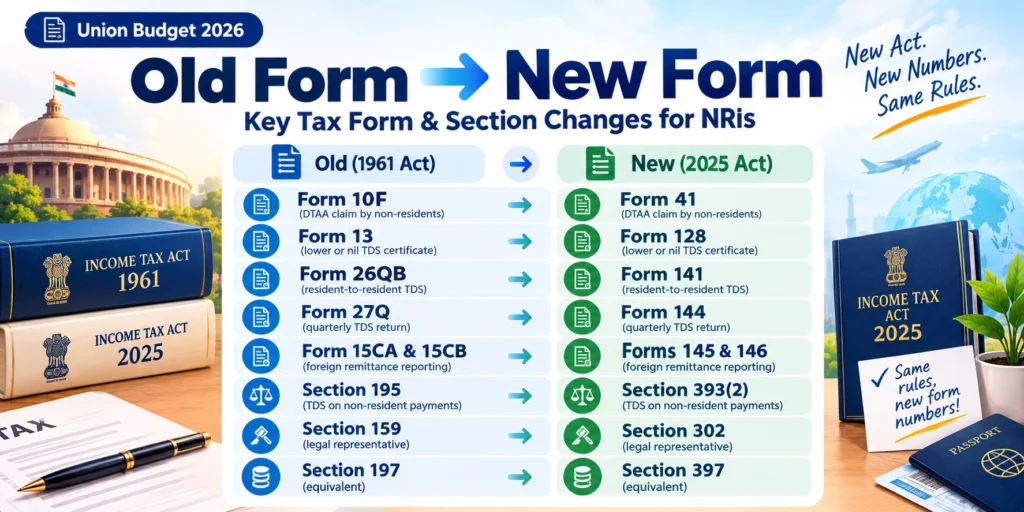
The most consequential change is not a rate cut but a full statutory replacement. The Income Tax Act 2025 replaces the Income Tax Act 1961 from 1 April 2026. Every section number, form number, and procedural reference NRIs have used for decades now has a new label.
Key form renumbering NRIs should note:
- Form 10F replaced by Form 41 (DTAA claim by non-residents)
- Form 13 replaced by Form 128 (lower or nil TDS certificate)
- Form 26QB replaced by Form 141 (challan-cum-statement for resident-to-resident TDS)
- Form 27Q replaced by Form 144 (quarterly TDS return for non-resident payments)
- Form 15CA and 15CB replaced by Forms 145 and 146 (foreign remittance reporting)
- Section 195 replaced by Section 393(2) (TDS on non-resident payments)
- Section 159 replaced by Section 302 (legal representative)
- Section 197 equivalent under Section 397
The substantive law on residency, capital gains, DTAA relief, and Schedule FA disclosures continues in largely the same shape, but every filing reference must now cite the new numbers. Our NRI Taxation and Compliance team files all NRI returns under the new Act with correct form references.
Change 2: OCI and NRI Listed Company Holding Cap Raised
Budget 2026 delivered one of the longest-pending NRI investor asks. Under the FEMA Non-Debt Instruments Rules, individual NRIs and OCIs were previously restricted to holding 5 percent of the paid-up equity capital of a single listed Indian company, with the aggregate NRI-OCI cap at 10 percent (raisable to 24 percent by company special resolution).
The new limits:
- Individual NRI or OCI cap: raised from 5 percent to 10 percent of paid-up capital in a single listed company
- Aggregate NRI-OCI cap: raised to 24 percent (with special resolution flexibility retained)
- Applies to Portfolio Investment Scheme (PIS) holdings routed through designated banks
For high-net-worth NRIs building concentrated positions in Indian midcap or largecap names, this doubles the per-company exposure ceiling. If you are also considering diversified vehicles, our Invest in Mutual Funds and PMS for NRI services align portfolio construction with the new headroom.
Change 3: NRI Property Paperwork Simplified from 1 October 2026
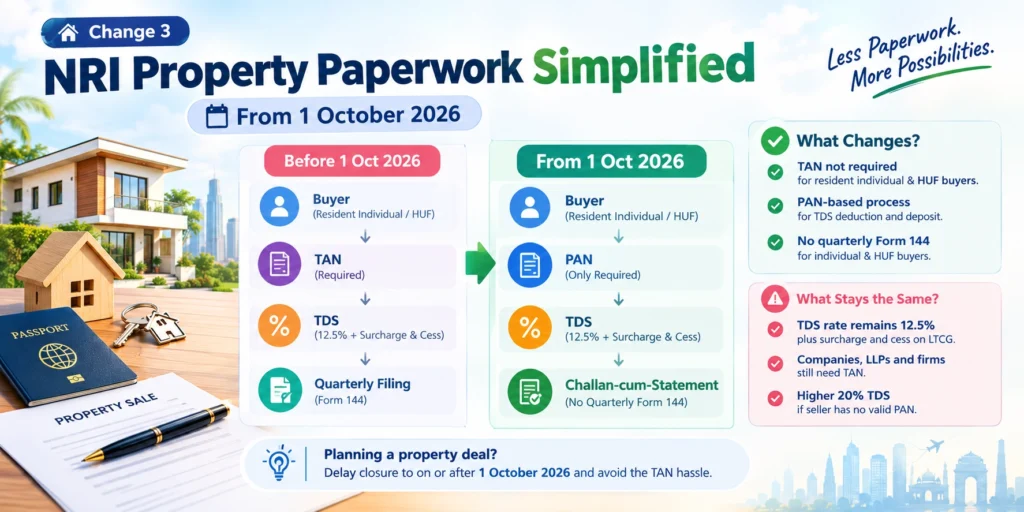
Under the amended Section 397(1)(c) of the Income Tax Act 2025, resident individual and HUF buyers purchasing property from an NRI will no longer need a TAN from 1 October 2026. TDS will be deducted and deposited using the buyer's PAN via a challan-cum-statement mechanism.
What changes and what does not:
- Change: Resident individual and HUF buyers can transact with just a PAN
- Change: No quarterly Form 144 return burden for individual and HUF buyers
- Not changed: TDS rate remains 12.5 percent plus surcharge and cess on LTCG
- Not changed: Companies, LLPs, and firms still need TAN
- Not changed: Higher 20 percent TDS if seller has no valid PAN
For NRIs currently in a property sale negotiation, delaying closure to on or after 1 October 2026 can eliminate the entire TAN pain point for individual buyers. Our Capital Gain Tax team models both timing options, and the NRI TDS Refund Calculator estimates any refund exposure.
Change 4: Six-Month Foreign Asset Disclosure Scheme (FAST-DS 2026)
The Foreign Assets of Small Taxpayers Disclosure Scheme 2026, or FAST-DS 2026, is the single most important compliance opportunity Budget 2026 opened for NRIs and returning residents.
Who it targets:
- Returning NRIs who forgot to disclose foreign bank accounts, brokerage, or IRAs in past Schedule FA filings
- Students and technology professionals with dormant overseas accounts
- Former deputees with legacy foreign employer holdings (RSUs, ESOPs, pension plans)
- Individuals who had a period of Indian tax residency during COVID or relocation and missed disclosures then
Category A: Undisclosed foreign income up to Rs 1 crore Category B: Undeclared foreign assets up to Rs 5 crore
In return for disclosure within the six-month window, participants receive immunity from penalties and prosecution under the Black Money (Undisclosed Foreign Income and Assets) Act. This is a rare reset opportunity because the Black Money Act allows a 10-year look-back and imposes penalties up to 300 percent of tax due, with prosecution risk.
Our Returnee NRI Transition Services framework audits your foreign asset position to determine whether you qualify for FAST-DS 2026 before the window closes.
Change 5: TCS on Outward Remittances Cut to Flat 2 Percent
Budget 2026 rationalised Tax Collected at Source (TCS) under the Liberalised Remittance Scheme (LRS) and overseas tour programme packages under Section 206C(1G).
| Purpose | Old TCS Rate | New TCS Rate |
|---|---|---|
| Overseas tour packages (up to Rs 10 lakh) | 5% | 2% flat, no threshold |
| Overseas tour packages (above Rs 10 lakh) | 20% | 2% flat |
| LRS education (above threshold, own funds) | 5% | 2% |
| LRS education (loan-funded, Section 80E) | 0.5% | 0.5% unchanged |
| LRS medical (above threshold) | 5% | 2% |
| LRS general purpose | 20% | 20% unchanged |
For NRI families whose India-based parents or siblings fund tours, education, or medical treatment abroad, this saves thousands of rupees per remittance. On a Rs 15 lakh European tour package that previously carried Rs 1.5 lakh TCS, the new outgo is just Rs 30,000.
The NRI TDS Refund Calculator helps estimate any recoverable TCS from past filings.
Change 6: Baggage Rules 2026 for NRI Travellers
The Baggage Rules 2026, which came into effect on 2 February 2026, provide two direct benefits for NRIs travelling to India:
- Higher duty-free allowance on personal effects and gifts
- Cleaner rule on gold jewellery brought by returning residents
- Simpler declarations at the customs desk on arrival
For NRIs returning permanently, the updated allowance eases the transition. For NRIs visiting India for weddings or family occasions, gift and jewellery limits have been rationalised to reduce customs friction. Combined with the Returnee NRI Transition Services framework, the rules cut the paperwork on a physical move meaningfully.
Change 7: Staggered ITR Filing Deadlines
Budget 2026 introduced staggered filing deadlines to reduce end-of-July congestion on the e-filing portal.
- ITR-1 and ITR-2 (individuals, capital gains, salary): 31 July
- Non-audit business cases and trusts: 31 August
- Audit cases (business, F&O traders, professionals with high receipts): 31 October
- Transfer pricing (international transactions): 30 November
For NRIs filing ITR-2 (which covers most residents-abroad with capital gains, rent, and other income), the 31 July deadline continues. For NRIs with freelance or F&O business income requiring audit under Section 44AB, the 31 October window applies. Our Income Tax Returns Filing team maps your correct due date based on the income profile.
The Broader Signal: Budget 2026 Rewards Compliance and Participation
Look at all seven changes together and a policy direction emerges. Budget 2026:
- Eases entry into Indian equity markets (raised OCI caps)
- Reduces friction on cross-border remittances (TCS cut)
- Simplifies property transactions (PAN-based TDS for individual buyers)
- Rewards voluntary disclosure (FAST-DS 2026 with immunity)
- Lowers physical-move barriers (Baggage Rules 2026)
- Modernises the statute (new Income Tax Act 2025)
- Rationalises compliance calendar (staggered ITR deadlines)
The subtext is that India wants NRI capital and participation, but on audited, disclosed, compliant terms. NRIs who use 2026 to clean up legacy Schedule FA gaps, rebalance under new equity caps, and time property sales around 1 October are set up for years of smoother filings.
Immediate Action Checklist for NRIs in 2026
Concrete steps to take before the windows close:
- Audit your Schedule FA history for any unreported foreign bank accounts, RSUs, IRAs, or pensions
- Evaluate FAST-DS 2026 eligibility if legacy assets are under Rs 5 crore
- Delay property sale closure to on or after 1 October 2026 if buyer is an individual or HUF
- Restructure Indian equity portfolio to use the new 10 percent per-company cap
- Refile Form 41 with correct TRC under the new Income Tax Act 2025 if needed
- Update your ITR filing calendar based on the staggered deadlines
- Time large LRS remittances to fall in FY 2026-27 for the 2 percent TCS benefit
- Consult on GIFT City options where dollar-denominated exposure is preferred
Our GIFT City Funds service maps the dollar-denominated NRI options for portfolio integration.
How MostlyNRI Helps You Execute the Budget 2026 Opportunities
Budget 2026 is a compliance and planning window, not just a set of announcements. Capturing the benefits requires residency analysis, portfolio restructuring, disclosure scheme evaluation, DTAA planning, property timing, and forms transition under the new Act.
At MostlyNRI, we help NRIs across the USA, UAE, UK, Canada, Singapore, and Australia with:
- FAST-DS 2026 evaluation and disclosure execution
- Property sale timing around the 1 October 2026 PAN-based TDS window
- Portfolio restructuring under the new 10 percent OCI equity cap
- ITR filing under the Income Tax Act 2025 with correct form references
- Form 41 filings and TRC applications
- Schedule FA and FSI disclosures with DTAA credit optimisation
- NRE, NRO, FCNR account structuring for remittance planning
- Baggage and returnee planning for NRIs relocating in 2026-27
Our team serves NRIs from over 33 countries across 13 Indian cities.
Ready to act on the Budget 2026 windows before they close? Book a consultation with our specialists at MostlyNRI.com to build your 2026-27 tax, property, and remittance playbook under the new Income Tax Act.
Frequently Asked Questions (FAQs)
What are the seven structural changes for NRIs in Budget 2026?
Budget 2026 introduced the new Income Tax Act 2025, raised OCI equity limits, simplified NRI property TDS from 1 October 2026, launched FAST-DS 2026 foreign asset disclosure, cut TCS to 2 percent, updated Baggage Rules 2026, and staggered ITR deadlines.
When does the new Income Tax Act 2025 take effect for NRIs?
The Income Tax Act 2025 takes effect from 1 April 2026 and applies to FY 2026-27 (AY 2027-28) onwards. It replaces the 1961 Act with new section numbers and forms while keeping most substantive rules on residency, capital gains, and DTAA relief unchanged.
What is the new OCI listed company holding cap under Budget 2026?
Budget 2026 doubled the individual NRI or OCI cap in a single listed Indian company from 5 percent to 10 percent of paid-up equity. The aggregate NRI-OCI cap has been raised to 24 percent, giving high-net-worth NRIs materially more headroom in concentrated positions.
What is FAST-DS 2026 and who qualifies?
FAST-DS 2026 is a six-month Foreign Assets of Small Taxpayers Disclosure Scheme offering immunity from Black Money Act penalties. It covers returning NRIs, students, and professionals with undisclosed income up to Rs 1 crore (Category A) or foreign assets up to Rs 5 crore (Category B).
How does the 1 October 2026 property TDS change help NRI sellers?
From 1 October 2026, resident individual and HUF buyers purchasing property from an NRI can deduct TDS using their PAN without obtaining a TAN. This removes weeks of paperwork and quarterly Form 144 filings, though the 12.5 percent LTCG rate remains unchanged.
What is the new TCS rate on outward remittances under Budget 2026?
TCS on overseas tour packages is now a flat 2 percent with no threshold. TCS on LRS education and medical remittances above the applicable threshold has been reduced from 5 percent to 2 percent. General LRS purposes continue at 20 percent above Rs 10 lakh.
What are the new ITR filing deadlines for NRIs in 2026?
ITR-1 and ITR-2 filers, including most NRIs with capital gains and passive income, continue with a 31 July deadline. Non-audit business filers get 31 August, and audit cases get 31 October. Transfer pricing cases have a 30 November deadline.
Do the Baggage Rules 2026 benefit returning NRIs?
Yes. The Baggage Rules 2026, effective 2 February 2026, provide a higher duty-free allowance and a cleaner rule on gold jewellery brought by returning residents. This eases the customs experience for NRIs relocating to India or bringing gifts during family visits.
Should NRIs disclose foreign assets under FAST-DS 2026?
Yes, if your Schedule FA history is incomplete and your undisclosed foreign assets fall within the scheme's thresholds. The cost of the scheme is far lower than the Black Money Act penalty of up to 300 percent with 10-year look-back and prosecution risk on future detection.
How can MostlyNRI help me execute Budget 2026 opportunities?
MostlyNRI evaluates FAST-DS 2026 eligibility, times property sales around 1 October 2026, restructures portfolios under new OCI caps, files ITRs under the Income Tax Act 2025, and handles Form 41, TRC, and Schedule FA disclosures for NRIs across 30+ countries.


0 Comments