




GST 2.0 went live on 22 September 2025, and it reshaped how India taxes goods and services. Most of the attention went to the new two-slab structure of 5 percent and 18 percent, with a separate 40 percent rate for luxury and sin goods. For freelancers selling IT development, UI and graphic design, content, marketing, and consulting services to clients abroad, the rate itself matters less than three older ideas that GST 2.0 has now made easier to use: zero-rated exports, the Letter of Undertaking (LUT), and OIDAR classification.
For Non-Resident Indians, there is a more basic question first. Does Indian GST apply to you at all? An NRI coder in Toronto billing a Canadian startup sits outside Indian GST entirely. The same coder working from Pune after moving back sits squarely inside it.
This guide explains who is covered, what GST 2.0 changed, how to file an LUT, and when OIDAR rules pull NRIs selling digital products to Indian buyers into the GST net.
Does GST Apply to NRI Freelancers at All?
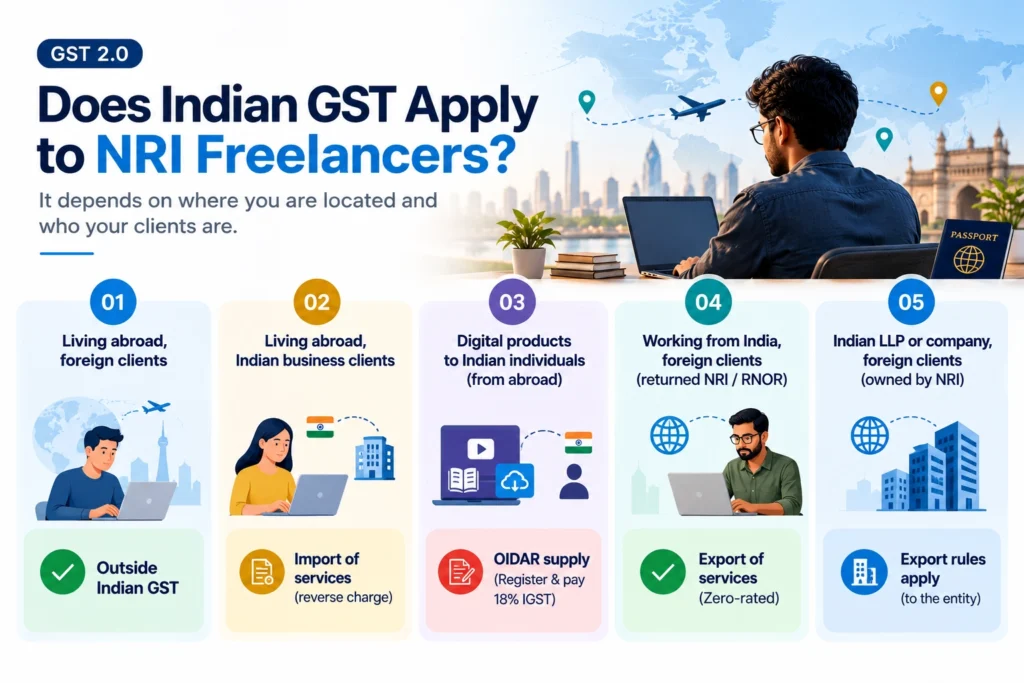
Indian GST on services turns on the location of the supplier and the place of supply. For most professional services, the place of supply is the location of the recipient under Section 13(2) of the IGST Act. That gives five common NRI scenarios.
| Your Situation | GST Position |
|---|---|
| NRI living abroad, working abroad, foreign clients | Outside Indian GST. No registration needed |
| NRI living abroad, Indian business clients | Import of services. Your registered Indian client pays GST under reverse charge |
| NRI abroad selling online courses, e-books, templates, or software to Indian individuals | OIDAR supply. You must register and pay 18 percent IGST |
| Returned NRI, RNOR, or NRI freelancing from India for a long stay, foreign clients | Export of services. Zero-rated if all conditions are met |
| NRI owning an Indian LLP or company that bills foreign clients | The entity is a supplier in India. Export rules apply to the entity |
The fourth row catches people. Returning NRIs often keep overseas clients after moving home. Once you deliver work from India, you are a supplier located in India, and registration, LUT filing, and returns follow once you cross the threshold.
Residency for GST is separate from residency for income tax. Your NRI tax residency status under the Income Tax Act decides how your freelance income is taxed, while GST asks only where the service is supplied from.
What GST 2.0 Changed for Service Exporters
The 56th GST Council meeting on 3 September 2025 approved the GST 2.0 package. For freelancers and consultants exporting services, the useful changes are:
- Rate rationalisation from 22 September 2025: most IT, design, and consulting services stay at 18 percent, which only matters when you supply to Indian clients
- Provisional refund of 90 percent for zero-rated supplies from 1 November 2025, through an amendment to Rule 91(2) of the CGST Rules, based on system-driven risk evaluation
- Simplified registration from 1 November 2025 for small, low-risk applicants, with registration granted within three working days
- Removal of the refund threshold for exports made with payment of tax, through a proposed amendment to Section 54(14) of the CGST Act
- Intermediary services: the Council recommended omitting Section 13(8)(b) of the IGST Act, so intermediaries serving foreign clients could qualify as exporters (this needs a legislative amendment, so confirm its status before relying on it)
The practical win is cash flow. Refund claims on IGST paid, or on input tax credit for laptops, software, and coworking rent, now get 90 percent provisionally instead of waiting months.
When is a Service an Export? The Five Conditions
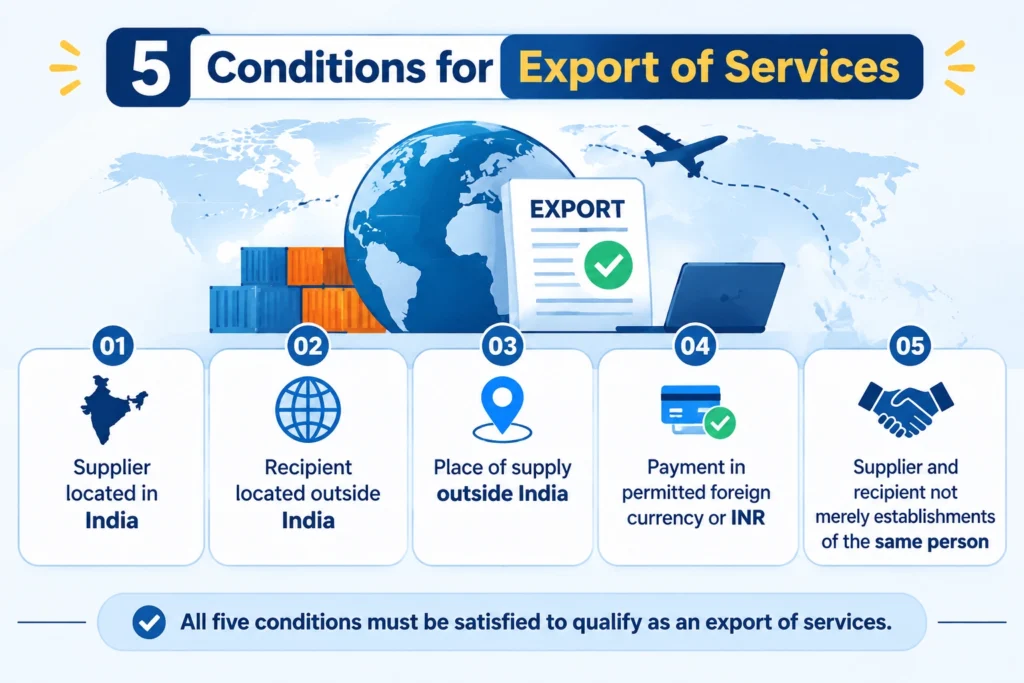
Under Section 2(6) of the IGST Act, a supply counts as an export of services only when all five conditions are met at the same time:
- The supplier is located in India
- The recipient is located outside India
- The place of supply is outside India
- Payment is received in convertible foreign exchange, or in Indian rupees where RBI permits
- The supplier and recipient are not merely establishments of the same person
Miss any one, and the supply becomes domestic at 18 percent. Keep the FIRC or FIRA from your bank or payment platform for every invoice as proof of foreign exchange receipt. The fifth condition means a service from an Indian branch to its own foreign head office is not an export.
Registration Threshold: When Freelancers Must Register
GST registration for service providers becomes mandatory once aggregate turnover crosses Rs 20 lakh in a financial year (Rs 10 lakh in special category states). Export turnover counts toward aggregate turnover.
- Crossing Rs 20 lakh triggers registration within 30 days
- Voluntary registration below the threshold lets you claim refunds of GST paid on business expenses
- OIDAR suppliers located abroad must register regardless of turnover
Freelancers planning to scale can set up the right structure early. Our Business and Startup Support for NRIs desk helps you choose between sole proprietorship, LLP, and private limited before registration locks you in.
The Letter of Undertaking (LUT): Export Without Paying IGST
An exporter has two options under Section 16 of the IGST Act:
- Export under LUT without paying IGST, then claim a refund of accumulated input tax credit
- Export with payment of IGST at 18 percent, then claim a refund of the IGST paid
For freelancers, the LUT route is almost always better because no cash leaves your account at the time of invoicing.
How to File an LUT
- Log in to gst.gov.in
- Go to Services, then User Services, then Furnish Letter of Undertaking (LUT)
- Select the financial year
- Enter details of two independent witnesses
- Sign with DSC or EVC and submit Form GST RFD-11
- Download the ARN acknowledgement, which is usually auto-accepted
The LUT is valid for one financial year and must be renewed every April. File it before the first export invoice of the year, otherwise that invoice is treated as an export with payment of tax.
Invoice and Return Requirements
- Mark each export invoice with "Supply meant for export under LUT without payment of IGST"
- Show IGST at 0 percent and the foreign currency value
- Report the invoice in Table 6A of GSTR-1
- Report the value in Table 3.1(b) of GSTR-3B as zero-rated supply
OIDAR: The Rule That Reaches NRIs Living Abroad
OIDAR stands for Online Information Database Access and Retrieval services. It is the one GST category that can apply to an NRI who has never worked a single day from India.
The Finance Act 2023 widened the OIDAR definition from 1 October 2023. The old condition that services must involve minimal human intervention was removed, so the definition now covers services delivered over the internet more broadly. The definition of non-taxable online recipient was also expanded to include unregistered persons in India.
Typical OIDAR supplies by NRI creators include online courses, e-books, templates, stock images, SaaS tools, plugins, apps, and paid memberships.
If you live abroad and sell these to Indian individuals or unregistered buyers, you are supplying OIDAR services into India. You must take simplified registration through Form GST REG-10, file GSTR-5A returns, and pay 18 percent IGST. If your buyer is a GST-registered Indian business, that business pays tax under reverse charge instead.
Custom one-to-one work, such as building a website for a client in Mumbai, is generally a professional service rather than OIDAR. The line is about how the service is delivered and whether it is a standard digital product.
The Intermediary Trap
Some freelancers act as agents, such as sourcing Indian vendors for a foreign brand, recruiting for an overseas employer, or arranging sales for a foreign SaaS company. Under Section 13(8)(b) of the IGST Act, the place of supply for intermediary services is the location of the supplier. If you are in India, the supply is domestic, so you charge 18 percent GST even though your client is abroad. The 56th GST Council recommended removing this clause. Until the change is notified, structure your contracts carefully and price GST into intermediary engagements.
How GST Fits With Your Income Tax Return
GST and income tax are separate, but they must agree. Turnover in GSTR-1 should match gross receipts in your ITR, since AIS captures both. You can use the Section 44ADA presumptive scheme and still be GST-registered, and returned NRIs in their RNOR window still owe GST compliance on services exported from India.
Our guide to ITR filing for NRI freelancers and F&O traders explains the ITR-3 and ITR-4 choice, and our Income Tax Returns Filing team reconciles GST turnover with your return before submission.
Common GST Mistakes NRI Freelancers Make
- Registering while still living and working abroad with only foreign clients
- Ignoring OIDAR registration when selling courses or templates to Indian buyers
- Issuing the first export invoice before filing the LUT
- Losing FIRC or FIRA records for platform payouts
- Treating intermediary commissions as exports
- Letting GST turnover and ITR receipts drift apart
If a mismatch has already produced a notice, our NRI Income Tax Notice Solutions team handles the response.
How MostlyNRI Helps NRI and Returning Freelancers
At MostlyNRI, we help NRIs and returning professionals across the USA, UAE, UK, Canada, Singapore, and Australia with:
- Residency analysis to confirm whether GST and Indian income tax apply
- ITR filing with Section 44ADA and GST turnover reconciliation
- Returnee planning so overseas clients move with you cleanly, through our Returnee NRI Transition Services
- Bank set-up for foreign inward remittances using our NRI Bank Account Type Advisor
Our team serves clients from over 33 countries across 13 Indian cities.
Freelancing for overseas clients from India, or selling digital products to Indian buyers? Book a consultation with our specialists at MostlyNRI.com to map your GST, LUT, and income tax obligations before your next invoice.
Frequently Asked Questions (FAQs)
Does GST apply to an NRI freelancer living abroad with foreign clients?
No. If you live and work abroad and your clients are outside India, you are not a supplier located in India, so Indian GST does not apply. GST becomes relevant only when you supply from India or sell OIDAR services to Indian consumers.
What is GST 2.0 and when did it start?
GST 2.0 is the rate and compliance overhaul approved by the 56th GST Council. New rates took effect on 22 September 2025, with 5 percent and 18 percent as the main slabs. Provisional refund and simplified registration changes followed from 1 November 2025.
Is GST payable on export of IT and design services?
No, if all five export conditions are met. Exports of services are zero-rated under Section 16 of the IGST Act. You either export under an LUT without paying IGST, or pay 18 percent IGST and claim a refund.
What is an LUT and how often must freelancers file it?
An LUT is a Letter of Undertaking filed on Form GST RFD-11 that lets you export without paying IGST. It is valid for one financial year and must be filed before the first export invoice of each year, usually in April.
What is an LUT and how often must freelancers file it?
An LUT is a Letter of Undertaking filed on Form GST RFD-11 that lets you export without paying IGST. It is valid for one financial year and must be filed before the first export invoice of each year, usually in April.
When must a returned NRI freelancer register for GST?
Registration becomes mandatory when aggregate turnover, including exports, crosses Rs 20 lakh in a financial year, or Rs 10 lakh in special category states. You can register voluntarily below this limit to claim refunds of GST paid on business expenses.
What is OIDAR and how does it affect NRI creators?
OIDAR covers digital services delivered online, such as courses, e-books, and SaaS. NRIs abroad selling these to Indian individuals must register through Form GST REG-10, file GSTR-5A, and pay 18 percent IGST on those sales.
Do NRIs need GST registration to work for Indian companies from abroad?
Usually no. When an NRI abroad provides services to a GST-registered Indian business, the Indian business pays GST under reverse charge as an import of services. The NRI does not need to register, though the client may ask for a tax residency certificate.
What proof of foreign payment do service exporters need?
Keep the FIRC or FIRA from your bank or payment provider for every export invoice. It proves payment arrived in convertible foreign exchange, which is one of the five conditions for zero-rated export treatment under Section 2(6) of the IGST Act.
What proof of foreign payment do service exporters need?
Keep the FIRC or FIRA from your bank or payment provider for every export invoice. It proves payment arrived in convertible foreign exchange, which is one of the five conditions for zero-rated export treatment under Section 2(6) of the IGST Act.
Are commission and agency services treated as exports?
Not under current law. Under Section 13(8)(b) of the IGST Act, intermediary services take the supplier's location as place of supply, so they attract 18 percent GST. The GST Council recommended changing this, so check notification status before invoicing.
How can MostlyNRI help freelancers with GST and income tax?
MostlyNRI confirms whether GST applies to you, supports business set-up, reconciles GST turnover with your ITR, files returns under the Income Tax Act 2025, and handles notices, so returning NRIs and freelancers stay compliant on both fronts.


0 Comments