




India's Digital Rupee, also called the e-Rupee or e₹, is the Central Bank Digital Currency (CBDC) issued by the Reserve Bank of India. It is legal tender, just like a currency note, except it lives in a digital wallet on your phone. Since the retail pilot started in December 2022, the RBI has steadily widened it: more banks, non-bank wallets such as CRED and MobiKwik, payments at any UPI QR code, offline testing, programmable welfare payments, and early work on cross-border CBDC pilots. The RBI's annual report put e-Rupee in circulation at around Rs 1,016 crore in 2025.
For Non-Resident Indians, the obvious question follows. Can you hold e-Rupee, receive it from family, or send it abroad? The honest answer for 2026 is mostly no, for now. Bank e-Rupee wallets are linked to resident Indian savings or current accounts, and the pilot has not been opened to NRE or NRO accounts. There is also no route to repatriate e-Rupee overseas.
That does not make the topic irrelevant. If you are planning to return to India, if your parents use e-Rupee, or if you follow the cross-border pilots, you need to know how it works and where it may go next. This guide explains it all.
What is the Digital Rupee?
The e-Rupee is a digital form of the Indian rupee issued directly by the RBI. It comes in two types:
- Retail CBDC (e₹-R): for individuals and merchants, held in wallets
- Wholesale CBDC (e₹-W): for banks and financial institutions settling large transactions
Key features of the retail e-Rupee:
- It is legal tender and a direct liability of the RBI
- It is non-interest-bearing, just like cash
- It sits in a digital wallet offered by a participating bank or approved app
- You can load it from your bank account and redeem it back to your account
- You can pay any merchant that shows a UPI QR code
Think of it as cash on your phone, not a bank deposit.
e-Rupee vs UPI vs Bank Account
Many NRIs confuse the e-Rupee with UPI. They are different things.
| Feature | e-Rupee (CBDC) | UPI | NRE or NRO Account |
|---|---|---|---|
| What it is | Digital currency issued by RBI | Payment system moving bank money | Bank deposit |
| Issuer or liability | RBI | Your bank | Your bank |
| Earns interest | No | Not applicable | Yes |
| Available to NRIs | Generally no | Yes, in select countries with NRE or NRO accounts | Yes |
| Works offline | Being piloted | No | No |
| Repatriable abroad | No | No | NRE fully, NRO up to USD 1 million a year |
For NRIs, UPI is already a practical tool. NPCI allows linking NRE and NRO accounts to UPI using international mobile numbers in select countries. The UPI for NRIs guide covers setup, and the article on UPI One World and cross-border payments explains how visitors pay inside India.
Can NRIs Hold the e-Rupee in 2026?
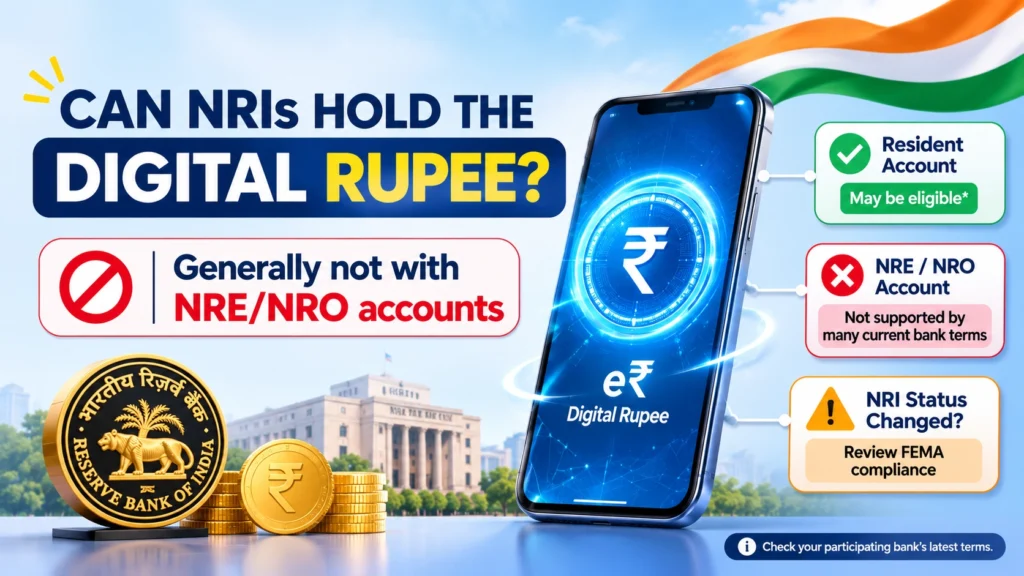
Under current bank terms, generally no. Here is why:
- Bank terms link the wallet to a resident Indian savings or current account. Axis Bank's terms, for example, refer to "resident Indian savings and/or current bank account(s)"
- NRE and NRO accounts are non-resident accounts and are not named in bank e-Rupee terms
- Wallet registration and recovery depend on the mobile number registered with the bank
- Under FEMA, once you become a non-resident, your resident savings account must be redesignated as an NRO account
So an NRI who correctly holds only NRE and NRO accounts has no eligible account to link. An NRI who still holds an old resident savings account has a FEMA problem to fix first, not an e-Rupee opportunity.
If you are unsure which accounts you should hold, our NRI Bank Account Type Advisor maps the right structure in minutes.
Can NRIs Receive e-Rupee From Family in India?
Not into a wallet abroad. The e-Rupee works only within India's wallet network. Your parents can pay a shop, send e-Rupee to another wallet holder, or redeem to their bank account, but they cannot send it to you overseas.
If your family wants to send you money, the correct routes are still:
- Transfer to your NRO account within India
- Remit abroad through a bank under the Liberalised Remittance Scheme, which applies to residents
- Gifts from relatives, which are generally not taxable for the recipient in India
Can NRIs Repatriate e-Rupee Abroad?
No. There is no repatriation route for e-Rupee. It is domestic legal tender, and FEMA restricts holding and moving Indian currency across borders outside approved banking channels.
Money leaves India for NRIs through bank channels only:
- NRE balances are fully repatriable
- NRO balances are repatriable up to USD 1 million per financial year, after tax
- Outward remittances need Form 145 and Form 146 (which replaced Forms 15CA and 15CB under the Income Tax Act 2025) where applicable
What About the Cross-Border CBDC Pilots?
The RBI has said it is exploring cross-border CBDC pilots with other central banks and international bodies. Market reports have mentioned discussions with partners such as the UAE and Singapore, both important remittance corridors for Indian NRIs.
What this could mean in the future:
- Faster, cheaper remittances settled directly in CBDC
- Less reliance on correspondent banking chains
- Possible interoperability between the e-Rupee and other central bank digital currencies
What it does not mean today:
- There is no live product for NRIs to send or receive e-Rupee across borders
- No date has been announced for retail NRI access
- Any app claiming to offer e-Rupee remittances to NRIs should be treated with caution
How the e-Rupee Helps Your Family in India

Even if you cannot use it yourself, your resident family can. Benefits for parents and relatives include:
- Payments at UPI QR codes without merchants needing separate onboarding
- Cash-like privacy features being explored for small payments
- Offline payments being tested for areas with poor connectivity
- Programmable payments for welfare schemes and government benefits
Typical bank limits include a wallet balance of Rs 1 lakh and per-transaction limits of around Rs 10,000, with a lower cap in the first 24 hours. Limits vary by bank.
e-Rupee for Returning NRIs
The picture changes once you move back. Under FEMA, you become a resident when you return to India with the intention to stay. At that point:
- You redesignate NRE and NRO accounts to resident accounts, or move foreign currency to an RFC account
- You become eligible to link an e-Rupee wallet to your resident savings account
- Your income tax status may be RNOR for two to three years, which protects much of your foreign income
Our Returnee NRI Transition Services team sequences the bank conversions, KYC updates, and tax steps so nothing falls through the cracks.
Tax and Compliance Points
- The e-Rupee earns no interest, so it creates no interest income
- Converting between bank money and e-Rupee is not a taxable event
- Business receipts in e-Rupee are taxed like any other income
- Holding e-Rupee does not need a separate disclosure, but your bank accounts must be reported correctly in your ITR
If your bank structure or past transactions have triggered questions from the tax department, our NRI Income Tax Notice Solutions team can help, and our Income Tax Returns Filing service files your return under the Income Tax Act 2025.
Better Digital Options for NRIs Right Now
While the e-Rupee stays resident-only, NRIs already have strong digital tools:
- UPI on NRE and NRO accounts with international mobile numbers
- Online NRE and NRO banking for transfers and bill payments
- USD investments through GIFT City, with fully repatriable proceeds, through our GIFT City Funds service
- Digital KYC for mutual funds and investment platforms
Common Misconceptions
- "e-Rupee is a cryptocurrency." It is not. It is legal tender issued by the RBI
- "NRIs can open an e-Rupee wallet with an NRE account." Bank terms do not currently allow this
- "e-Rupee is a cheaper way to remit money abroad." No such route exists today
- "e-Rupee earns interest like a deposit." It does not
- "Keeping my old resident account lets me use e-Rupee." Holding a resident account as an NRI breaches FEMA
How MostlyNRI Helps
At MostlyNRI, we help NRIs across the USA, UAE, UK, Canada, Singapore, and Australia with:
- NRE, NRO, FCNR, and RFC account structuring
- FEMA-compliant repatriation with Form 145 and Form 146 support
- Returnee planning including bank redesignation and RNOR status
- ITR filing under the Income Tax Act 2025
- USD investing through GIFT City
Our team serves clients from over 33 countries across 13 Indian cities.
Want a clean, FEMA-compliant banking setup in India? Book a consultation with our specialists at MostlyNRI.com to sort your NRE, NRO, and repatriation plan, and to be ready when the e-Rupee opens up further.
Frequently Asked Questions (FAQs)
What is the Digital Rupee or e-Rupee?
The e-Rupee is India's Central Bank Digital Currency issued by the Reserve Bank of India. It is legal tender held in a digital wallet, works like cash on your phone, earns no interest, and can pay any merchant that displays a UPI QR code.
Can NRIs open an e-Rupee wallet in 2026?
Generally, no. Bank e-Rupee wallets are linked to resident Indian savings or current accounts. NRE and NRO accounts are not covered in current bank terms, and the RBI has not opened the retail pilot to non-residents.
Can my parents in India send me e-Rupee abroad?
No. The e-Rupee works only within India's wallet network and cannot be sent overseas. Family can transfer money to your NRO account, and residents can remit abroad through banks under the Liberalised Remittance Scheme.
Can NRIs repatriate e-Rupee to a foreign bank account?
No. There is no repatriation route for e-Rupee. NRIs repatriate money through bank channels only, with NRE balances fully repatriable and NRO balances repatriable up to USD 1 million per financial year after tax.
Is the e-Rupee the same as UPI?
No. The e-Rupee is digital currency issued by the RBI. UPI is a payment system that moves money between bank accounts. The e-Rupee wallet can pay at UPI QR codes, but they are separate systems.
Does the e-Rupee earn interest?
No. The e-Rupee is non-interest-bearing legal tender, just like a currency note. Money you want to earn interest on should stay in a bank deposit, such as an NRE or FCNR deposit for NRIs.
Is the RBI running cross-border e-Rupee pilots?
The RBI has said it is exploring cross-border CBDC pilots with other central banks. No live product exists for NRIs to send or receive e-Rupee across borders, and no date has been announced for retail NRI access.
Can a returning NRI use the e-Rupee?
Yes, once resident. After returning, you redesignate NRE and NRO accounts to resident accounts under FEMA. You can then link an e-Rupee wallet to your resident savings account through a participating bank or approved app.
Is the e-Rupee taxable for NRIs or their families?
Holding e-Rupee creates no income because it earns no interest, and converting it to bank money is not taxable. Income received in e-Rupee, such as business receipts, is taxed like any other income.
How can MostlyNRI help with digital banking and repatriation?
MostlyNRI structures NRE, NRO, FCNR, and RFC accounts, supports FEMA-compliant repatriation with Form 145 and Form 146, plans bank redesignation for returning NRIs, and files ITRs under the Income Tax Act 2025.


0 Comments