




Quick answer: The India-USA DTAA caps or allocates tax on each type of income. India can tax your Indian rent and capital gains in full, and interest at up to 15 percent. The US taxes your worldwide income but gives a foreign tax credit on Form 1116 for the Indian tax you actually paid. You need a Tax Residency Certificate and Form 10F or Form 41 to claim treaty rates in India.
Key takeaways
- Capital gains are taxable in both countries under Article 13, with credit in the US
- US citizens and green card holders are covered by the saving clause, so the US taxes them as if the treaty did not exist
- Claim US credit only for final Indian tax, not TDS you will get back as a refund
- US Social Security is taxable only in the US under Article 20(2)
If you live in the US and still earn in India, two tax systems see the same income. The US taxes its residents and citizens on worldwide income. India taxes Indian-source income of non-residents. Without the India-USA Double Taxation Avoidance Agreement, rent from your Pune flat or interest on your NRO deposit could be fully taxed twice.
The treaty, signed on 12 September 1989 and in force since 18 December 1990, does not make Indian income tax-free. It decides which country taxes first, how much the source country can take, and how the other country gives credit. Understanding it, income by income, is what stops NRIs in the US from overpaying.
How the India-USA DTAA Avoids Double Taxation
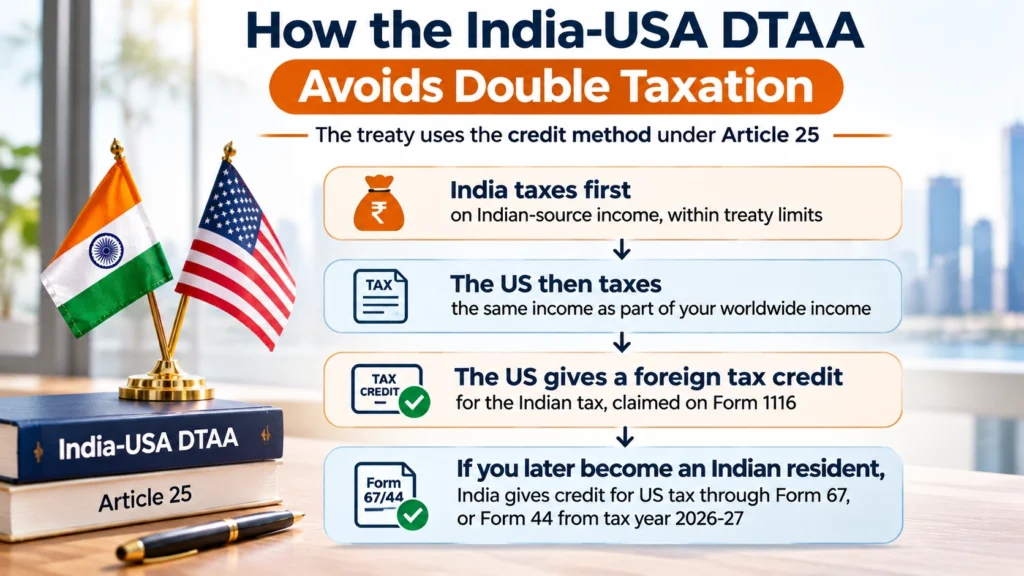
The treaty uses the credit method under Article 25:
- India taxes first on Indian-source income, within treaty limits
- The US then taxes the same income as part of your worldwide income
- The US gives a foreign tax credit for the Indian tax, claimed on Form 1116
- If you later become an Indian resident, India gives credit for US tax through Form 67, or Form 44 from tax year 2026-27
The Saving Clause for US Citizens and Green Card Holders
Article 1(3) lets the US tax its citizens and residents as if the treaty did not exist. In practice:
- US citizens and green card holders cannot use the treaty to reduce US tax on most Indian income
- The foreign tax credit under Article 25 is preserved, so double tax is still avoided through credit
- A few articles, such as those for students and government employees, are protected for people who are neither citizens nor green card holders
India-USA DTAA Rates by Income Type
| Income | Treaty Article | Who Can Tax | Indian Rate Under the Treaty |
|---|---|---|---|
| Rent from Indian property | Article 6 | India first, US with credit | No cap. Normal Indian rates apply |
| NRO interest | Article 11 | India first, US with credit | Up to 15 percent (10 percent for banks) |
| Dividends | Article 10 | India first, US with credit | 25 percent, or 15 percent for companies owning 10 percent or more |
| Capital gains on property, shares, mutual funds | Article 13 | Both, under domestic law | Normal Indian rates |
| Salary for work done in India | Article 16 | India, with a short-stay exception | Normal Indian rates |
| Private pensions | Article 20(1) | Country of residence | Not taxed in India if you live in the US and are not covered by the saving clause |
| US Social Security | Article 20(2) | US only | Not taxed in India |
Always check the treaty text for your exact situation.
Rent From Indian Property
India has the first right to tax rent under Article 6. Your tenant deducts TDS at around 31.2 percent on rent paid to an NRI, and you file an ITR in India to settle the real tax after the 30 percent standard deduction and home loan interest.
The US also taxes the rent as worldwide income, after depreciation and expenses under US rules. You then claim a foreign tax credit for the Indian tax.
Interest on NRO Accounts
Under Article 11, India can tax NRO interest paid to a US resident at up to 15 percent, compared with 31.2 percent TDS under Indian law. To get the treaty rate:
- Get a US Tax Residency Certificate, which is IRS Form 6166, by applying on Form 8802
- File Form 10F online for income up to FY 2025-26, or Form 41 from tax year 2026-27
- Give both to your bank, or claim the treaty rate in your ITR
NRE interest is tax-free in India but taxable in the US. Since no Indian tax is paid, there is no credit to claim.
Capital Gains on Indian Property and Mutual Funds

This is where the US treaty differs from others. Article 13 lets each country tax capital gains under its own law. Unlike the India-Singapore treaty, there is no rule giving the residence country the sole right.
- India taxes the gain at its normal rates, such as 12.5 percent on long-term gains
- The US taxes the same gain as part of worldwide income
- The US gives credit for Indian tax, limited to the US tax on that income
Indian mutual funds also raise PFIC issues for US persons, which can make US tax on them far higher than the Indian tax.
Worked Example: Rent and NRO Interest for a US-Based NRI
Anita lives in Texas on an H-1B and is a US tax resident but not a US citizen. In FY 2025-26 she earns in India:
- Rent: Rs 6,00,000, so taxable rent after the 30 percent standard deduction is Rs 4,20,000
- NRO interest: Rs 2,00,000
Indian tax under the new regime
- Total income: Rs 6,20,000
- Tax at 5 percent on Rs 2,20,000 above Rs 4 lakh: Rs 11,000, plus cess = Rs 11,440
TDS deducted
- On rent at 31.2 percent: Rs 1,87,200
- On NRO interest at 31.2 percent: Rs 62,400
- Total TDS: Rs 2,49,600
What she should do
- File an Indian ITR and claim a refund of about Rs 2,38,160
- Claim a US foreign tax credit only for the Rs 11,440 of final Indian tax
This is the most common US-India mistake. The IRS does not allow credit for tax you can get refunded. File in India first, then claim credit in the US.
How to Claim India-USA DTAA Benefits
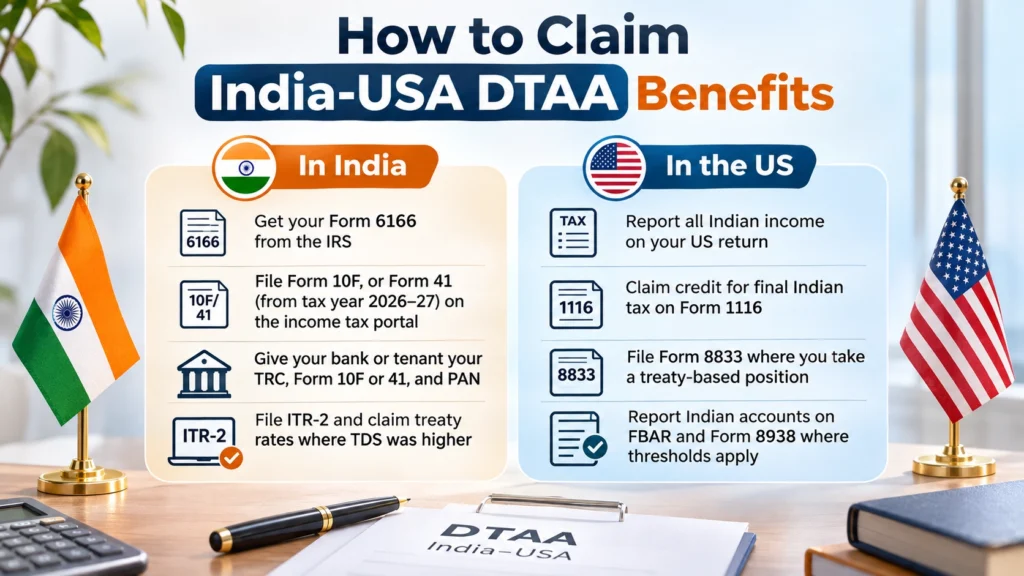
In India
- Get your Form 6166 from the IRS
- File Form 10F, or Form 41 from tax year 2026-27 on the income tax portal
- Give your bank or tenant your TRC, Form 10F or 41, and PAN
- File ITR-2 and claim treaty rates where TDS was higher
In the US
- Report all Indian income on your US return
- Claim credit for final Indian tax on Form 1116
- File Form 8833 where you take a treaty-based position
- Report Indian accounts on FBAR and Form 8938 where thresholds apply
MostlyNRI handles NRI income tax return filing on the Indian side and coordinates with your US preparer.
Common Mistakes
- Claiming US credit for refundable TDS
- Assuming capital gains are taxed only in the US
- Not getting Form 6166, so the 15 percent interest rate is never applied
- Forgetting that NRE interest is taxable in the US
- US citizens assuming the treaty cuts US tax despite the saving clause
Conclusion
For NRIs in the US, our desk handles TRC and Form 10F or Form 41 filings, treaty rate claims with banks and tenants, Indian ITR filing with refunds, capital gains computation, and the Indian figures your US preparer needs for Form 1116. MostlyNRI works with NRIs across 33 countries, including thousands of families in the US.
Earning in India while living in the US? Book a consultation with our specialists at MostlyNRI.com for US-India NRI tax filing that keeps you from paying twice.
FAQs
What is the India-USA DTAA?
It is the tax treaty between India and the US, in force since 1990. It decides which country taxes each type of income, caps Indian tax on interest and dividends, and lets each country give credit for tax paid in the other.
Does the India-USA DTAA make Indian income tax-free in the US?
No. The US taxes residents and citizens on worldwide income. The treaty lets you claim a foreign tax credit on Form 1116 for Indian tax paid, so the same income is not fully taxed twice.
What is the DTAA rate on NRO interest for US residents?
Under Article 11, India can tax NRO interest paid to a US resident at up to 15 percent, instead of 31.2 percent TDS. You need a US Tax Residency Certificate (Form 6166) and Form 10F or Form 41.
Are capital gains in India taxed in the US for NRIs?
Yes. Article 13 lets each country tax capital gains under its own law. India taxes the gain first, and the US taxes it as worldwide income, with a foreign tax credit for the Indian tax.
Can US citizens use the India-USA DTAA?
Partly. The saving clause in Article 1(3) lets the US tax its citizens as if the treaty did not exist. The foreign tax credit is preserved, so US citizens still avoid double tax through credit.
How do US residents get a Tax Residency Certificate for India?
Apply to the IRS on Form 8802 for Form 6166, the US certificate of residency. Then file Form 10F, or Form 41, for tax year 2026-27, on the Indian income tax portal.
Is NRE interest taxable in the US?
Yes. NRE interest is tax-free in India but taxable in the US for US tax residents and citizens. Since no Indian tax is paid on it, there is no foreign tax credit to claim.
Can I claim US foreign tax credit for TDS deducted in India?
Only for the final Indian tax. TDS that you can recover as an Indian refund does not qualify. File your Indian ITR first, then claim credit for the tax actually payable.
Is US Social Security taxable in India?
No. Under Article 20(2) of the India-USA DTAA, US Social Security benefits are taxable only in the US, even if you return and live in India as a resident. Report them in your ITR as exempt income where required.
How can MostlyNRI help NRIs in the US with DTAA claims?
MostlyNRI files your TRC and Form 10F or Form 41, applies treaty rates with banks and tenants, files your Indian ITR to recover excess TDS, and gives your US preparer the Indian tax figures for Form 1116.


0 Comments