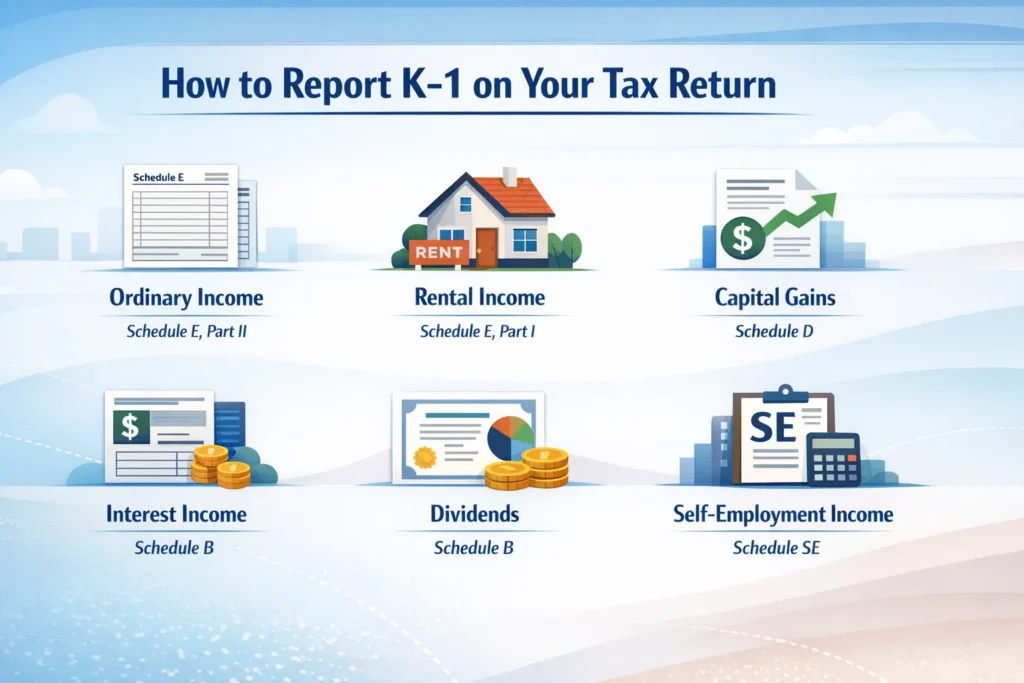
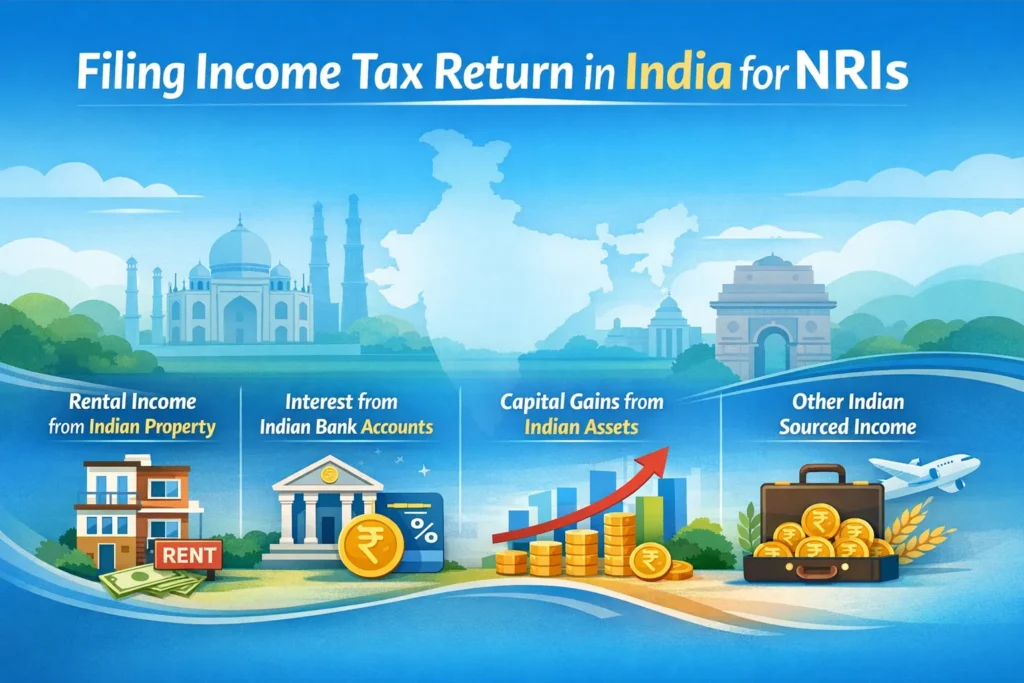
Quick answer: The India-USA DTAA caps or allocates tax on each type of income. India can tax your Indian rent and capital gains in full, and interest at up to 15 percent. The US taxes your worldwide income but gives a foreign tax credit on Form 1116 for the Indian tax you actually paid. You need a Tax Residency Certificate and Form 10F or Form 41 to claim treaty rates in India.
Key takeaways
Capital gains are taxable in both countries under Article 13, with credit in the US
US citizens and green card holders are covered by the saving clause, so the US taxes them as if the treaty did not exist
Claim US credit only for final Indian tax, not TDS you will get back as a refund
US Social Security is taxable only in the US under Article 20(2)
If you live in the US and still earn in India, two tax systems see the same income. The US taxes its residents and citizens on worldwide income. India taxes Indian-source income of non-residents. Without the India-USA Double Taxation Avoidance Agreement, rent from your Pune flat or interest on your NRO deposit could be fully taxed twice.
The treaty, signed on 12 September 1989 and in force since 18 December 1990, does not make Indian income tax-free. It decides which country taxes first, how much the source country can take, and how the other country gives credit. Understanding it, income by income, is what stops NRIs in the US from overpaying.
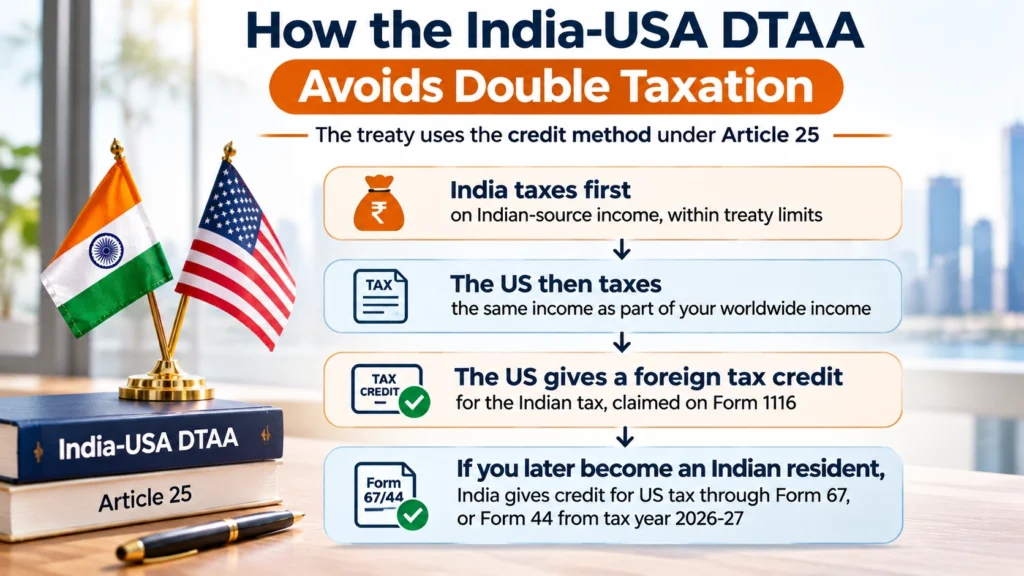
How the India-USA DTAA Avoids Double Taxation
The treaty uses the credit method under Article 25:
India taxes first on Indian-source income, within treaty limits
The US then taxes the same income as part of your worldwide income
The US gives a foreign tax credit for the Indian tax, claimed on Form 1116
If you later become an Indian resident, India gives credit for US tax through Form 67, or Form 44 from tax year 2026-27
The Saving Clause for US Citizens and Green Card Holders
Article 1(3) lets the US tax its citizens and residents as if the treaty did not exist. In practice:
US citizens and green card holders cannot use the treaty to reduce US tax on most Indian income
The foreign tax credit under Article 25 is preserved, so double tax is still avoided through credit
A few articles, such as those for students and government employees, are protected for people who are neither citizens nor green card holders
India-USA DTAA Rates by Income Type
Income
Treaty Article
Who Can Tax
Indian Rate Under the Treaty
Rent from Indian property
Article 6
India first, US with credit
No cap. Normal Indian rates apply
NRO interest
Article 11
India first, US with credit
Up to 15 percent (10 percent for banks)
Dividends
Article 10
India first, US with credit
25 percent, or 15 percent for companies owning 10 percent or more
Capital gains on property, shares, mutual funds
Article 13
Both, under domestic law
Normal Indian rates
Salary for work done in India
Article 16
India, with a short-stay exception
Normal Indian rates
Private pensions
Article 20(1)
Country of residence
Not taxed in India if you live in the US and are not covered by the saving clause
US Social Security
Article 20(2)
US only
Not taxed in India
Always check the treaty text for your exact situation.
Rent From Indian Property
India has the first right to tax rent under Article 6. Your tenant deducts TDS at around 31.2 percent on rent paid to an NRI, and you file an ITR in India to settle the real tax after the 30 percent standard deduction and home loan interest.
The US also taxes the rent as worldwide income, after depreciation and expenses under US rules. You then claim a foreign tax credit for the Indian tax.
Interest on NRO Accounts
Under Article 11, India can tax NRO interest paid to a US resident at up to 15 percent, compared with 31.2 percent TDS under Indian law. To get the treaty rate:
Get a US Tax Residency Certificate, which is IRS Form 6166, by applying on Form 8802
File Form 10F online for income up to FY 2025-26, or Form 41 from tax year 2026-27
Give both to your bank, or claim the treaty rate in your ITR
NRE interest is tax-free in India but taxable in the US. Since no Indian tax is paid, there is no credit to claim.
Capital Gains on Indian Property and Mutual Funds
This is where the US treaty differs from others. Article 13 lets each country tax capital gains under its own law. Unlike the India-Singapore treaty, there is no rule giving the residence country the sole right.
India taxes the gain at its normal rates, such as 12.5 percent on long-term gains
The US taxes the same gain as part of worldwide income
The US gives credit for Indian tax, limited to the US tax on that income
Indian mutual funds also raise PFIC issues for US persons, which can make US tax on them far higher than the Indian tax.
Worked Example: Rent and NRO Interest for a US-Based NRI
Anita lives in Texas on an H-1B and is a US tax resident but not a US citizen. In FY 2025-26 she earns in India:
Rent: Rs 6,00,000, so taxable rent after the 30 percent standard deduction is Rs 4,20,000
NRO interest: Rs 2,00,000
Indian tax under the new regime
Total income: Rs 6,20,000
Tax at 5 percent on Rs 2,20,000 above Rs 4 lakh: Rs 11,000, plus cess = Rs 11,440
TDS deducted
On rent at 31.2 percent: Rs 1,87,200
On NRO interest at 31.2 percent: Rs 62,400
Total TDS: Rs 2,49,600
What she should do
File an Indian ITR and claim a refund of about Rs 2,38,160
Claim a US foreign tax credit only for the Rs 11,440 of final Indian tax
This is the most common US-India mistake. The IRS does not allow credit for tax you can get refunded. File in India first, then claim credit in the US.
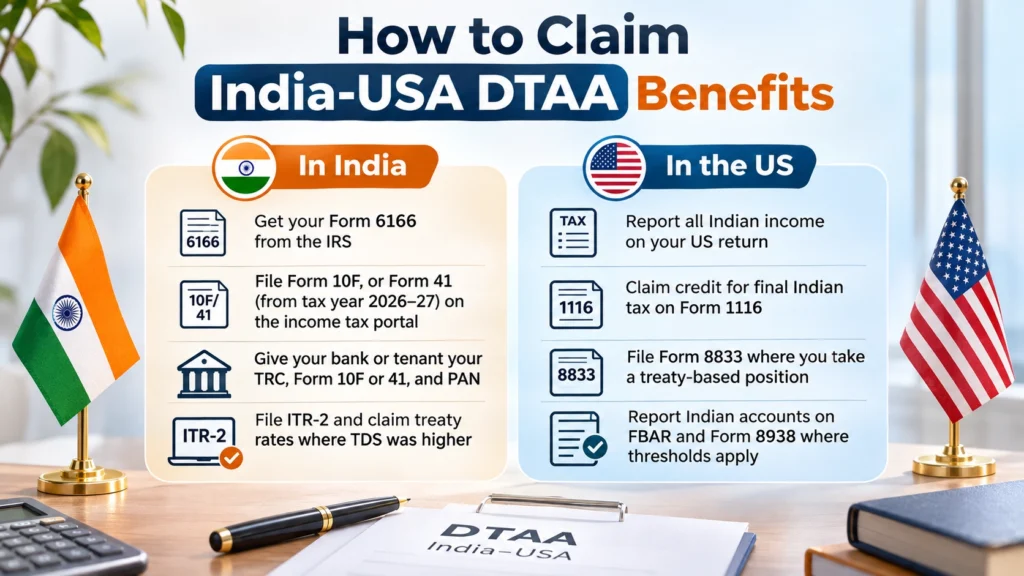
How to Claim India-USA DTAA Benefits
In India
Get your Form 6166 from the IRS
File Form 10F, or Form 41 from tax year 2026-27 on the income tax portal
Give your bank or tenant your TRC, Form 10F or 41, and PAN
File ITR-2 and claim treaty rates where TDS was higher
In the US
Report all Indian income on your US return
Claim credit for final Indian tax on Form 1116
File Form 8833 where you take a treaty-based position
Report Indian accounts on FBAR and Form 8938 where thresholds apply
Not getting Form 6166, so the 15 percent interest rate is never applied
Forgetting that NRE interest is taxable in the US
US citizens assuming the treaty cuts US tax despite the saving clause
Conclusion
For NRIs in the US, our desk handles TRC and Form 10F or Form 41 filings, treaty rate claims with banks and tenants, Indian ITR filing with refunds, capital gains computation, and the Indian figures your US preparer needs for Form 1116. MostlyNRI works with NRIs across 33 countries, including thousands of families in the US.
Earning in India while living in the US? Book a consultation with our specialists at beige-spoonbill-433256.hostingersite.com/ for US-India NRI tax filing that keeps you from paying twice.
FAQs
What is the India-USA DTAA?
It is the tax treaty between India and the US, in force since 1990. It decides which country taxes each type of income, caps Indian tax on interest and dividends, and lets each country give credit for tax paid in the other.
Does the India-USA DTAA make Indian income tax-free in the US?
No. The US taxes residents and citizens on worldwide income. The treaty lets you claim a foreign tax credit on Form 1116 for Indian tax paid, so the same income is not fully taxed twice.
What is the DTAA rate on NRO interest for US residents?
Under Article 11, India can tax NRO interest paid to a US resident at up to 15 percent, instead of 31.2 percent TDS. You need a US Tax Residency Certificate (Form 6166) and Form 10F or Form 41.
Are capital gains in India taxed in the US for NRIs?
Yes. Article 13 lets each country tax capital gains under its own law. India taxes the gain first, and the US taxes it as worldwide income, with a foreign tax credit for the Indian tax.
Can US citizens use the India-USA DTAA?
Partly. The saving clause in Article 1(3) lets the US tax its citizens as if the treaty did not exist. The foreign tax credit is preserved, so US citizens still avoid double tax through credit.
How do US residents get a Tax Residency Certificate for India?
Apply to the IRS on Form 8802 for Form 6166, the US certificate of residency. Then file Form 10F, or Form 41, for tax year 2026-27, on the Indian income tax portal.
Is NRE interest taxable in the US?
Yes. NRE interest is tax-free in India but taxable in the US for US tax residents and citizens. Since no Indian tax is paid on it, there is no foreign tax credit to claim.
Can I claim US foreign tax credit for TDS deducted in India?
Only for the final Indian tax. TDS that you can recover as an Indian refund does not qualify. File your Indian ITR first, then claim credit for the tax actually payable.
Is US Social Security taxable in India?
No. Under Article 20(2) of the India-USA DTAA, US Social Security benefits are taxable only in the US, even if you return and live in India as a resident. Report them in your ITR as exempt income where required.
How can MostlyNRI help NRIs in the US with DTAA claims?
MostlyNRI files your TRC and Form 10F or Form 41, applies treaty rates with banks and tenants, files your Indian ITR to recover excess TDS, and gives your US preparer the Indian tax figures for Form 1116.
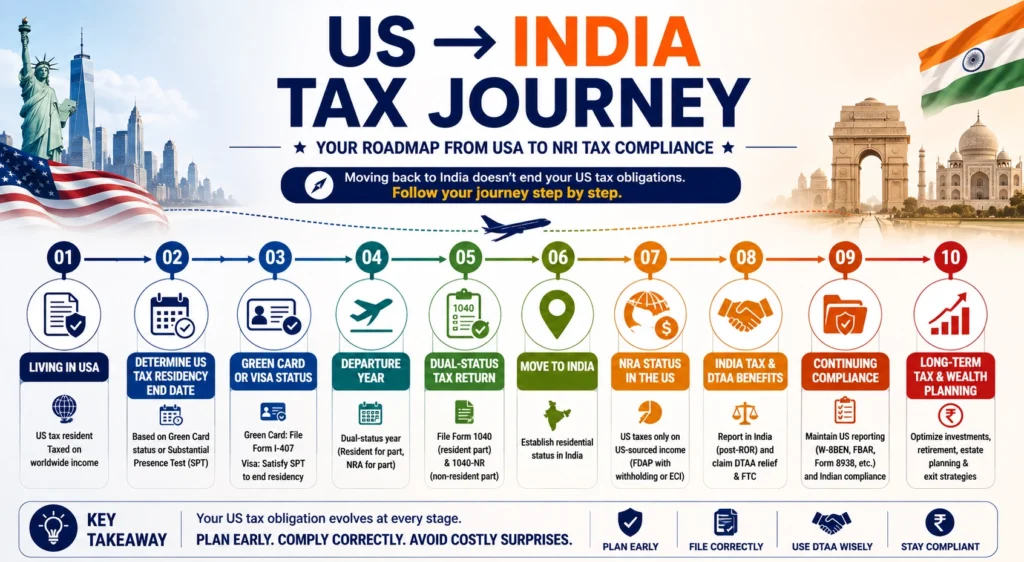
Moving back to India after years in the United States rarely means a clean tax break. The IRS does not stop at the airport. From green card obligations and Substantial Presence Test rules to RSU sourcing, 401(k) withdrawals, FIRPTA on US property, and estate tax on US-situs assets, returning NRIs often continue to owe US tax long after they land in Bengaluru, Mumbai, or Hyderabad.
The scale of the trap is bigger than most professionals realise. A US green card is not just an immigration document; it is a tax residency status that continues until you formally surrender it. RSUs granted during your US years can trigger US tax years after you leave. Your IRA and 401(k) are subject to a default 30% US withholding, and your US brokerage account may face steep withholding and estate tax risks the day you become a Non-Resident Alien.
This guide breaks down exactly when your US tax residency ends, how your US assets are taxed after you move, the exit tax rules that hit long-term green card holders, and the compliance steps every returning NRI should complete before boarding the flight.
When Does Your US Tax Residency Actually End?
Two distinct events end your US tax exposure: your immigration status ending and your tax residency ending. They are not the same.
Green Card Holders
A US green card creates tax residency for as long as it is valid. Simply leaving the US does not end it. You must:
File Form I-407 with USCIS to formally abandon the green card
Continue as a US tax resident until the date of formal abandonment
File a dual-status tax return for the year of surrender
If you keep the green card just in case, the IRS keeps taxing you on worldwide income, even after you have physically moved back to India.
H-1B, L-1 and Other Visa Holders
For visa-based residents, US tax residency is governed by the Substantial Presence Test (SPT). You are a US resident for tax purposes if you are physically present:
31 days during the current year, and
183 days on a weighted formula over the current year and preceding two years (all days current year, one-third of prior year, one-sixth of two years back)
Visa holders leaving the US mid-year typically end residency on their last day of physical presence, provided they establish a closer connection to India.
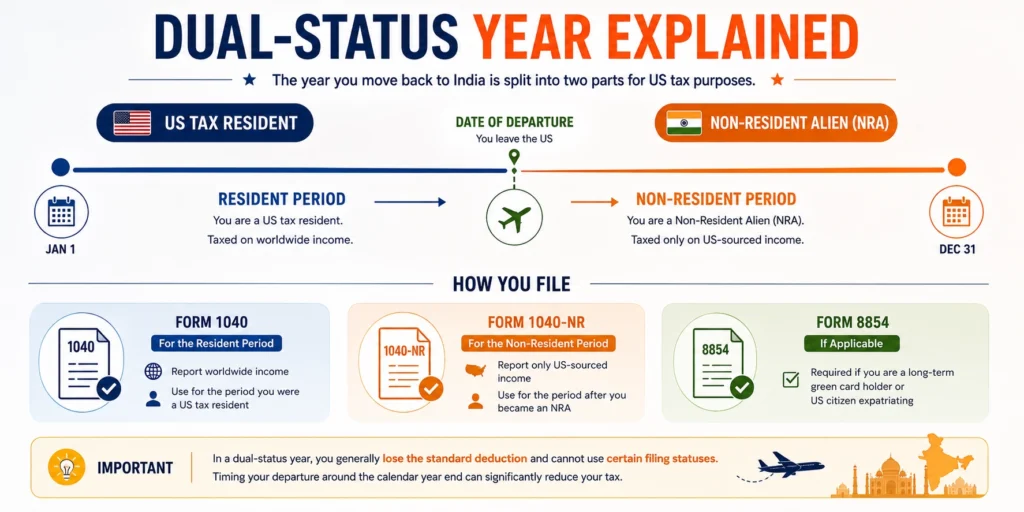
The year you move back is almost always a dual-status year. Part of it you are a US tax resident; part of it you are a Non-Resident Alien (NRA).
For this year, you file:
Form 1040 for the resident portion (worldwide income)
Form 1040-NR for the non-resident portion (US-sourced income only)
Attach a statement declaring dual-status residency
File Form 8854 if you are a long-term green card holder or US citizen expatriating
You lose several advantages in a dual-status year, including the standard deduction and certain filing statuses. This is why timing your departure around the calendar year end can materially reduce tax.
After You Move to India: The Non-Resident Alien Position
Once your US residency ends, you become a Non-Resident Alien (NRA) for US tax purposes. The IRS still taxes you, but only on US-sourced income.
Two categories apply:
FDAP income (Fixed, Determinable, Annual, or Periodic): interest, dividends, rent, royalties. Taxed at a flat 30% withholding at source, reducible under the India-US DTAA to as low as 15% or 10% for certain streams
Effectively Connected Income (ECI): income from a US trade or business. Taxed at graduated rates with deductions allowed
To claim the DTAA rate on FDAP income, you must file Form W-8BEN with each US financial institution. Without it, they will continue to withhold the full 30% or, worse, apply 28% backup withholding if your tax ID is not in order.
What Happens to Your US Assets: A Category-by-Category Guide
Your US financial life does not fold neatly into an Indian tax return. Each asset type carries its own rules.
Asset Type
US Tax Treatment for NRA
India Tax Treatment (Post-RNOR)
US brokerage stocks and ETFs
Capital gains generally exempt from US tax for NRA
Taxable in India once ROR (with DTAA credit)
US dividends
25% withholding (India-US DTAA rate)
Taxable in India once ROR
US bank interest
Generally exempt from US tax
Taxable in India once ROR
401(k) withdrawals
30% US withholding (may reduce via DTAA)
Complex; DTAA relief needed
Traditional IRA withdrawals
30% US withholding at source
Taxable in India once ROR
Roth IRA qualified withdrawals
Tax-free in US
Position uncertain; often taxable in India
US real estate sale
FIRPTA 15% withholding + regular tax on gain
Taxable in India once ROR
RSUs vesting after departure
Partial US-source (based on work days in US)
Partial India-source; DTAA sourcing rules
US LLC or S-Corp income
May remain ECI, taxable at graduated rates
Additional Indian tax layer possible
Stocks and Brokerage Accounts
As an NRA, capital gains on US-listed stocks are generally exempt from US tax. Dividends attract a 25% withholding under the India-US DTAA. Update your account with Form W-8BEN the day your residency ends. Skipping this leads to unnecessary withholding.
RSUs and Stock Options: The Sourcing Trap
RSUs granted during your US years but vesting after you move to India trigger a pro-rata sourcing calculation. The portion attributable to the days you worked in the US is US-source income, taxable by the IRS. The portion attributable to Indian workdays is India-source, taxable in India.
Employers often withhold assuming full US residency, leading to over-withholding. Reclaiming this requires filing Form 1040-NR, along with careful workday documentation.
401(k) and Traditional IRA
Withdrawals from a 401(k) or traditional IRA attract a default 30% US withholding. The India-US DTAA can reduce this if the income is treated as pension under the treaty, but the interpretation is not automatic and requires proper Form W-8BEN filing.
On the India side, once you become ROR, these withdrawals are taxable as income, with a foreign tax credit for the US tax paid.
US Real Estate: FIRPTA Withholding
Selling US property as an NRA triggers FIRPTA (Foreign Investment in Real Property Tax Act) withholding of 15% of the gross sale price. This is not the tax owed; it is a deposit. The actual tax on the gain is calculated on Form 1040-NR and any excess withholding is refunded.
For a personalised sale-side analysis, see our Capital Gain Tax advisory.
The US Exit Tax: Who Actually Owes It
The US exit tax is one of the most misunderstood parts of leaving America. It does not apply to everyone.
You are a covered expatriate subject to the exit tax if you are a US citizen renouncing citizenship or a long-term green card holder (held for 8 of the last 15 years) and you meet any one of:
Net worth of USD 2 million or more on the date of expatriation
Average annual US federal income tax liability above approximately USD 190,000 (indexed annually) over the past 5 years
Failure to certify 5 years of full US tax compliance on Form 8854
If covered, the IRS treats you as having sold all worldwide assets at fair market value the day before expatriation. This mark-to-market taxation applies to unrealised gains. An exclusion of around USD 800,000 applies.
Green card holders who have held the card for fewer than 8 years typically escape the exit tax entirely. This is why timing the surrender is so important.
The US Estate Tax Trap Almost Nobody Talks About
This is the sleeper risk. Non-Resident Aliens face a very different US estate tax rule than US citizens or residents.
US citizens and residents: estate tax exemption of around USD 13.6 million
Non-Resident Aliens: exemption of only USD 60,000
If you die as an Indian resident holding US-situs assets (US stocks, US real estate, US-based accounts) worth more than USD 60,000, the excess above that threshold can be taxed at rates up to 40%.
This trap catches returning NRIs who continue to hold US brokerage accounts, US ETFs, and US property in their own name. Restructuring before departure through joint holdings, trusts, or partial liquidation is often more efficient than dealing with it after moving.
The Pre-Departure Checklist Every Returning NRI Should Complete
Complete these steps in the final 6 months before your return.
Establish your US tax residency end date
File Form I-407 (green card) or document last-presence date (visa)
Update W-9 to W-8BEN with every US bank, broker, retirement account provider
Update your US mailing address to a reliable forwarding address
Review and settle state tax obligations (California, New York in particular)
Download 10 years of brokerage, retirement, and payroll statements
Get your 401(k) and IRA distribution plan in place
Time large capital gain realisations around your residency change
Restructure US real estate holdings to reduce FIRPTA and estate tax exposure
File FBAR and Form 8938 for the departure year and any prior years missed
Confirm your RSU vesting schedule and workday allocation
Preserve documentation of every India workday for future sourcing claims
Common Mistakes Returning NRIs Make
The most expensive slip-ups are avoidable:
Keeping the green card as a backup without realising it keeps US tax residency alive
Failing to file Form W-8BEN with US financial institutions, leading to over-withholding
Missing the dual-status return for the year of departure
Ignoring state exit rules, especially in California
Forgetting FBAR and Form 8938 for the departure year
Overlooking US estate tax on US-situs assets
Cashing out 401(k) or IRA all at once, triggering large withholding
Selling US property without FIRPTA planning
Assuming the India-US DTAA credit is automatic
Missing the India-side RNOR window and losing tax-free withdrawal opportunities
If you have already returned and missed some steps, our NRI Income Tax Notice Solutions team helps regularise Indian filings and coordinate with your US CPA.
How MostlyNRI Helps Returning US NRIs
Moving back from the US is one of the most complex tax transitions any professional undertakes. The IRS handles the US side; MostlyNRI handles the India side and coordinates with your US CPA so nothing falls between the two systems.
At MostlyNRI, we help returning US NRIs with:
India residency planning and RNOR window optimisation
Indian ITR filing with Schedule FA, FSI, and TR entries
DTAA credit claims on US income already taxed
Capital gains structuring on 401(k), IRA, brokerage, and RSU proceeds
US property sale planning on the India side
NRE, NRO, RFC account structuring for repatriated funds
Response to Indian tax notices on US-sourced income
Long-term wealth structuring to reduce dual-country friction
Our team has served US-returning NRIs from over 33 countries across 13 Indian cities.
Planning to move back to India from the US? Book a consultation with our specialists at beige-spoonbill-433256.hostingersite.com/ and get your India-side residency, ITR, and asset transition mapped before you board the flight.
Frequently Asked Questions (FAQs)
Do returning NRIs still owe US tax after moving back to India?
Yes. Your US tax obligations continue on US-sourced income (dividends, interest, IRA and 401(k) withdrawals, US property sales, and certain RSU vesting) even after you become an Indian resident. Filing Form W-8BEN and Form 1040-NR is essential.
How do green card holders formally end US tax residency?
Green card holders must file Form I-407 with USCIS to formally abandon the card. Until that filing is complete, the IRS continues to treat them as US tax residents on worldwide income, regardless of physical presence in India.
What is the Substantial Presence Test for US tax residency?
The Substantial Presence Test treats you as a US resident if you are present 31 days in the current year and 183 days on a weighted formula across the current year plus one-third of the prior year and one-sixth of the year before that.
Are RSUs taxable in India after a returning NRI moves back?
Partially. RSUs granted in the US but vesting after your return are split under sourcing rules based on your US and India workdays. The India portion is taxable in India; the US portion continues to face IRS withholding requiring Form 1040-NR reconciliation.
How are 401(k) and IRA withdrawals taxed for returning NRIs?
401(k) and traditional IRA withdrawals attract a default 30% US withholding. The India-US DTAA may reduce this rate. On the India side, they become taxable once you become ROR, with foreign tax credit available for the US tax paid.
What is FIRPTA and does it affect returning NRIs selling US property?
Yes. FIRPTA requires a 15% withholding on the gross sale price of US real estate sold by a Non-Resident Alien. This is a deposit, not the final tax. The actual gain is calculated on Form 1040-NR and excess withholding is refundable.
Do returning NRIs face the US exit tax?
Only if you are a US citizen renouncing citizenship or a long-term green card holder (8 of last 15 years) and are a covered expatriate. Triggers include net worth above USD 2 million or high average federal tax over the past five years.
What is the US estate tax exemption for Non-Resident Aliens?
Just USD 60,000, compared to around USD 13.6 million for US citizens and residents. This means US stocks, ETFs, and property held by Indian residents can face up to 40% estate tax on the amount above USD 60,000 at death.
Which form do returning NRIs file with US brokerages after moving?
You must file Form W-8BEN with every US bank, brokerage, and retirement provider to certify your Non-Resident Alien status and claim India-US DTAA rates on dividends, interest, and other FDAP income. Without it, full 30% withholding continues.
How can MostlyNRI help returning NRIs from the US?
MostlyNRI handles the India-side transition: residency planning, RNOR optimisation, ITR filing with Schedule FA and FSI, DTAA credit claims, and account structuring. We coordinate with your US CPA to ensure no filing or credit falls between the two tax systems.
You get a call from your CA. Or maybe an email from your Indian bank. The message is simple: “Please submit Form 10F before we process your payment.”
And your first thought is: what even is Form 10F?
This happens to hundreds of NRIs every year. You’re receiving interest on your NRO account, a royalty from an Indian company, or dividends from your Indian portfolio. And your payer refuses to apply the lower tax treaty rate until you submit this form. Without it, TDS gets deducted at 20% or higher. With it, you could be paying half that or less. This guide covers what Form 10F is, who actually needs to file it, what documents to keep ready, and a step-by-step walkthrough of how to file Form 10F online on the Income Tax e-filing portal. By the end, you’ll know exactly what to do.
What Is Form 10F and What Is Its Purpose?
Form 10F is a self-declaration form filed by non-resident taxpayers under Rule 21AB of the Income Tax Rules. It provides residency and identity details that are missing from their Tax Residency Certificate, allowing them to claim DTAA benefits and lower TDS rates on income received from India. It is required under Section 90 or Section 90A of the Income Tax Act.
Think of it this way. Your Tax Residency Certificate (TRC) is like your ID card. It proves you live and pay taxes in another country. But some ID cards don’t carry all the details Indian tax law requires. Form 10F fills those gaps. It is your supplementary declaration that says: here is the information my TRC didn’t include.
Without Form 10F, your Indian payer has no basis to apply the lower DTAA rate. So they default to the higher rate under Indian domestic law. That’s the financial hit you’re trying to avoid.
Form 10F is filed online on the Income Tax e-filing portal at incometax.gov.in. It is linked to a specific assessment year and must be filed before the payment is made or TDS is deducted.
Who Needs to File Form 10F: Applicability
Not every NRI needs to file Form 10F. But most do. Here is the full picture.
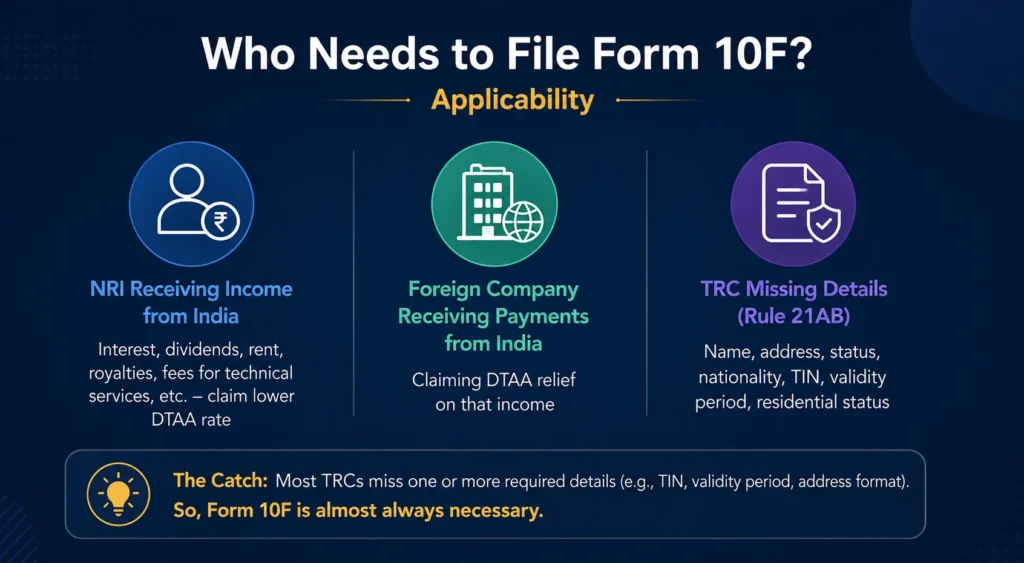
You need to file Form 10F if you are:
An NRI receiving income from India, including interest on NRO accounts, dividends, rent, royalties, or fees for technical services, and you want to claim the lower DTAA rate instead of the default TDS rate
A foreign company receiving payments from an Indian entity and claiming DTAA relief on that income
Any non-resident whose TRC does not include all the details required under Rule 21AB: name, address, status, nationality, Tax Identification Number (TIN), period of TRC validity, and residential status
Here’s the catch. Technically, if your TRC already contains all the above details, you don’t need to file Form 10F separately. But in practice, most TRCs issued by foreign governments are missing one or more of these fields. A UAE TRC, for instance, may not mention your TIN or specify the exact period. A UK certificate may omit your address in the format India requires. So even if you think your TRC is complete, Form 10F is almost always necessary.
If you are an RNOR filing to claim foreign tax credits or documenting your DTAA position, you may also encounter Form 10F as part of your paperwork. The same applies to returning NRIs in transition years. For a deeper look at RNOR status and its tax implications, the MostlyNRI RNOR Checklist covers that ground well.
What Information and Documents Are Required for Form 10F?
Before you sit down to file, get everything in order. This is a ten-minute task if you’re prepared. It becomes an hour-long headache if you are not.
Information you will enter directly in Form 10F:
Name of the taxpayer (as it appears on your passport or TRC)
Status: individual, company, firm, or other
Nationality (for individuals) or country of incorporation (for entities)
Taxpayer Identification Number (TIN) or unique identification number issued by your country of residence
Period for which the TRC is valid (start and end dates)
Address of the taxpayer in the country of residence during the TRC validity period
Documents to have ready before you start:
Tax Residency Certificate (TRC): issued by the tax authority of the country where you reside. This is mandatory. Without it, Form 10F has no legal backing
PAN (if you hold one): you will use this to log in to the portal. If you do not have a PAN, read the section below on the CBDT relaxation
Passport and visa details: useful for identity verification during registration
Bank account details for the Indian income source: sometimes needed for EVC verification
A small but important note: double-check that the TIN you enter in Form 10F matches exactly what appears on your TRC. Even a single digit mismatch can cause a rejection or create issues when the payer verifies the form. Also, ensure the period you mention in the form falls within the TRC’s validity dates. These are two of the most common errors, and both are completely avoidable.
For context on how Form 10F connects to your broader tax filing, especially if you are also claiming Foreign Tax Credit under Form 67, check the MostlyNRI Form 67 guide.
Step-by-Step: How to File Form 10F Online on the Income Tax Portal
This is the section you actually came for. Let’s walk through it.
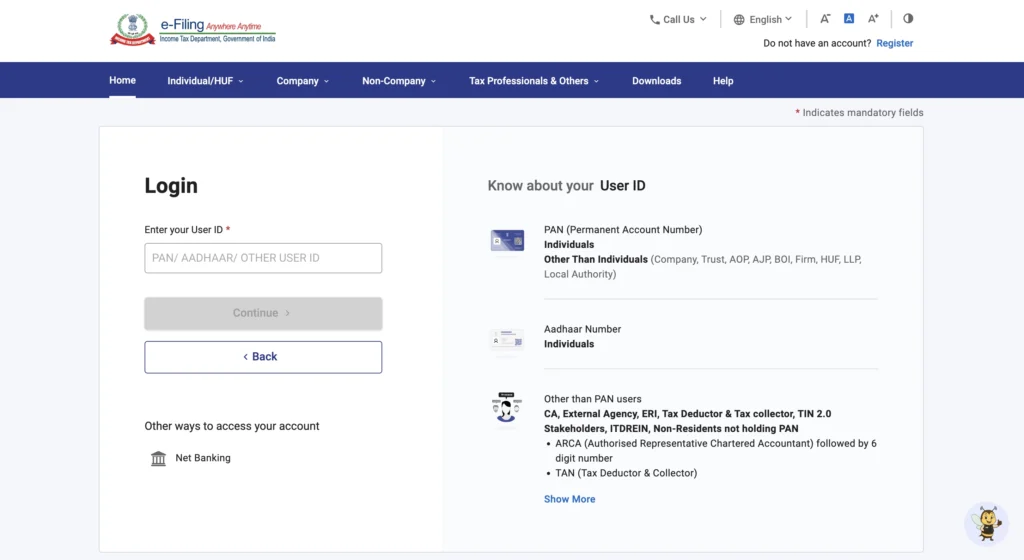
Step 1: Go to the Income Tax e-filing portal at incometax.gov.in
Step 2: Log in using your PAN and password. If you are an NRI without a PAN, see the H3 section below on the CBDT relaxation route for non-PAN filers.
Step 3: Once logged in, go to the top menu and click on e-File. From the dropdown, select Income Tax Forms, then click File Income Tax Forms.
Step 4: In the search bar or the list of forms, look for Form 10F. Select it.
Step 5: Choose the relevant Assessment Year. For income received in FY 2025-26, select AY 2026-27.
Step 6: Fill in all the required details in the form:
Name, status, nationality
TIN or unique identification number from your country of residence
Period of TRC validity (exact start and end dates)
Your address in the foreign country during that period
Step 7:Upload your TRC as a supporting document. The portal will prompt you to attach it. Make sure the file is clear, legible, and in PDF or image format within the size limits specified.
Step 8:Verify the form. You have two options:
DSC (Digital Signature Certificate): used by NRIs who have a registered DSC on the portal. More common for companies and professionals.
EVC (Electronic Verification Code): the more common route for individual NRIs. You can generate an EVC via net banking, Aadhaar OTP (if linked), or through your bank account.
Step 9:Submit. The portal will generate a transaction ID and an acknowledgement number. Save both.
Step 10:Download the submitted Form 10F as a PDF. Share this with your Indian payer. They will need it on record before applying the lower DTAA rate on your income.
One important rule: File Form 10F before the payment is made or TDS is deducted. If TDS has already been deducted at the higher rate, Form 10F cannot fix that retroactively at the source. Your only option then is to claim a refund through your ITR, which takes far longer.
Note: The Income Tax portal UI is updated periodically by CBDT. The navigation path above reflects the general structure at the time of writing. Always verify the current steps directly on the live portal before filing.
Filing Form 10F Without PAN: The CBDT Relaxation Explained
This is the question most non-resident filers ask. “I don’t have an Indian PAN. Can I still file Form 10F online?”
The answer is yes.
CBDT issued a relaxation specifically for non-resident taxpayers who do not hold a PAN. Under this, NRIs and foreign entities can register on the Income Tax e-filing portal using their foreign tax identification details and file Form 10F through that route.
During registration, you use your passport details, foreign TIN, and country of residence instead of a PAN. Once registered, the filing process follows the same steps outlined above.
This relaxation was introduced because the earlier requirement of a PAN was creating genuine hardship for non-residents who had no other reason to obtain one. If you fall into this category, verify the exact current registration path on the portal or with a qualified NRI tax advisor, as CBDT updates these instructions periodically.
TRC vs Form 10F: What Is the Difference and Do You Need Both?
Short answer: yes, you need both. They are not interchangeable.
Here is a clean breakdown:
TRC (Tax Residency Certificate)
Form 10F
What it is
A certificate proving your tax residency in a foreign country
A self-declaration form providing supplementary details missing from the TRC
Who issues it
The foreign country’s tax authority (e.g., HMRC in the UK, IRS in the US, FTA in UAE)
Filed by the non-resident taxpayer themselves on the Indian IT portal
What it contains
Proof of residence, sometimes TIN, name, and period
No: if it lacks Rule 21AB details, it is incomplete
No: has no legal value without a valid TRC to back it
Think of the TRC as the foundation and Form 10F as the supporting wall. Neither stands without the other. The Indian payer needs to see both documents before they can apply the treaty rate.
A common error: some NRIs assume that submitting the TRC to their payer is sufficient. It is not. Most Indian payers, including banks and companies, will ask for Form 10F specifically. Do not skip it assuming your TRC covers everything.
When to File Form 10F: Timing and Validity
Timing matters a lot here. Miss the window and you end up paying excess TDS and chasing a refund for months.
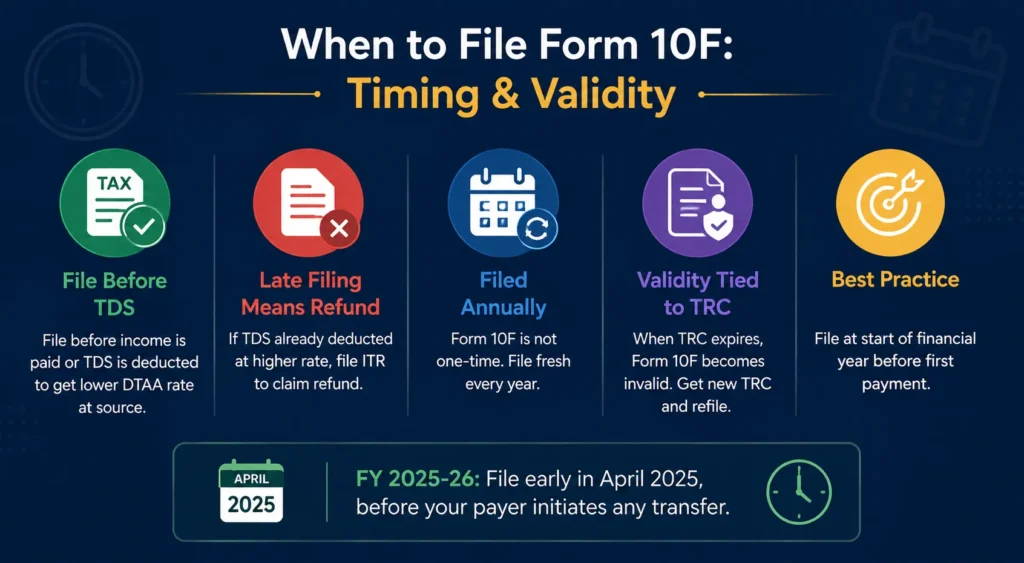
File before the income is paid or TDS is deducted: That is the only way the lower DTAA rate gets applied at source.
If TDS has already been deducted at the higher rate and you file Form 10F later, the payer cannot revise what they have already deposited with the government. You would need to file an Indian ITR and claim a refund. That is an avoidable delay.
Form 10F is filed annually: It is not a one-time permanent declaration. You file it fresh for each assessment year.
Its validity is tied to your TRC. When your TRC expires, Form 10F based on that TRC also becomes invalid. You need a fresh TRC first, then refile Form 10F.
Best practice: File at the beginning of each financial year, before the first payment is expected. For FY 2025-26, that means filing early in April 2025, well before your payer initiates any transfer.
What Happens If Form 10F Is Not Filed?
Here is the practical reality.
Your Indian payer must deduct TDS at the default rate if you have not submitted Form 10F. Under Section 195, that rate is typically 20% plus applicable surcharge and cess. The lower DTAA rate, often 10-15% or even lower depending on the treaty, cannot be applied without Form 10F on record.
What can you do if this happens? You can file an Indian Income Tax Return and claim a refund of the excess TDS. It works, but it takes time. The refund process can stretch over months, and it involves paperwork you could have easily avoided.
In some cases, especially with banks and large corporate payers, they may simply refuse to process the payment until Form 10F is submitted. They are protecting themselves from liability. So practically, you may not receive your money at all until the form is in order.
There is no specific penalty for not filing Form 10F. But the financial cost of excess TDS deducted is very real, and the hassle of claiming a refund even more so.
Common Mistakes to Avoid While Filing Form 10F
Filing for the wrong assessment year: Form 10F must match the financial year in which the income is received. Income in FY 2025-26 means AY 2026-27.
TRC and Form 10F period mismatch: The TRC validity dates must cover the period for which Form 10F is being filed. If your TRC is valid from January to December but you’re filing for an April-to-March financial year, there may be a gap. Check the dates carefully.
Incorrect TIN: Your Taxpayer Identification Number must match exactly what appears on your TRC. No extra spaces, no abbreviations, no guesswork.
Filing after TDS has already been deducted: As covered above, this doesn’t help at source. File early.
Not downloading and sharing the acknowledgement: After filing, download the PDF acknowledgement from the portal. Send it to your Indian payer. They need this for their own records before they can apply the treaty rate. Skipping this step means the payer may still deduct at the higher rate even if you’ve filed.
Conclusion
Form 10F is an important compliance requirement for NRIs and foreign taxpayers who want to claim DTAA benefits on income earned from India. While the form itself is simple, missing it can lead to higher TDS deductions, delayed payments, and the hassle of claiming refunds later through an Indian tax return.
The key is to treat Form 10F and your Tax Residency Certificate as a pair. Your TRC proves your foreign tax residency, while Form 10F provides the additional details Indian tax rules require. Filing both on time ensures that your bank, company, or payer can apply the lower treaty rate correctly.
If you regularly earn income from India, it is best to make Form 10F part of your annual NRI tax checklist. A few minutes spent filing it at the beginning of the financial year can save you unnecessary tax deductions, paperwork, and months of waiting for refunds later.
Frequently Asked Questions
How to download Form 10F online?
After logging in to incometax.gov.in, go to e-File, then Income Tax Forms, and select Form 10F. You can view and download the blank form from there. After filing, the submitted form with the acknowledgement is also available for download under your filed forms history.
Who is required to file Form 10F online?
Any non-resident taxpayer claiming DTAA benefits on income received from India. This includes NRIs receiving NRO interest, dividends, rent, royalties, or fees for technical services, and foreign companies receiving payments from Indian entities under a tax treaty.
What is a 10F document?
It is a self-declaration form under Rule 21AB of the Income Tax Rules. A non-resident files it to provide details not included in their Tax Residency Certificate, specifically to claim the lower TDS rate available under a DTAA.
Is Form 10F to be filed every year?
Yes. It is filed annually for each assessment year. It is linked to the validity of your TRC. When the TRC is renewed, Form 10F must be refiled.
How to fill in Form 10F India?
Log in to incometax.gov.in, navigate to e-File, then Income Tax Forms, then File Income Tax Forms. Select Form 10F, choose the assessment year, and fill in your name, status, nationality, TIN, TRC validity period, and foreign address. Upload your TRC and verify using DSC or EVC. Full steps are covered in the how-to section above.
What if Form 10F is not filed?
The Indian payer will deduct TDS at the default higher rate, typically 20% plus surcharge and cess, instead of the lower DTAA rate. You can later claim a refund by filing an Indian ITR, but this takes time and is avoidable if you file Form 10F before the payment is processed.
What are examples of Form 10F being used?
Three common scenarios: First: An NRI living in the UAE receives interest on their NRO savings account. The bank asks for Form 10F backed by a UAE TRC to apply the 12.5% DTAA rate instead of 30%. Second: A UK-based software company receives royalties from an Indian business partner. The Indian company needs Form 10F and TRC before remitting at the lower 10% treaty rate for royalties. Third: An Indian-origin consultant based in Canada provides technical advisory services to an Indian firm. The firm needs Form 10F to apply the 15% treaty rate on fees for technical services instead of the 20% domestic TDS rate.
How much does a CA charge to file Form 10F or an ITR?
CA fees vary widely depending on the complexity of your income and the professional you engage. For NRI-specific filings, you are likely looking at anywhere between Rs. 2,000 and Rs. 10,000 or more for ITR filing, and a smaller fee for Form 10F assistance. For personalised guidance on DTAA claims and Form 10F compliance, MostlyNRI’s NRI tax advisory can help.
What is the difference between Form 10F and Form 10FA?
These are two different forms. Form 10F is a self-declaration filed by a non-resident to support their DTAA claim and provide TRC supplement details. Form 10FA is an application to the Assessing Officer for a certificate under Section 197 for deduction of TDS at a lower rate. They serve different purposes and should not be confused.
Picture this. You worked in the US for six years. You paid your taxes there, every single year, on time. You move back to India. You sit down to file your ITR. And then… the tax department asks you to pay tax on that same income again. Your stomach drops. That cannot be right.
But it happens. All the time.
This is called double taxation. And here is the thing most people do not know. You do not have to accept it. There is a perfectly legal way to avoid it. It is called the Foreign Tax Credit, and you claim it using Form 67 under Rule 128 of the Income Tax Rules.
Most NRIs either do not know this form exists… or they miss the deadline by a few days and lose the benefit entirely. This guide will walk you through how to fill Form 67 and claim foreign tax credit step by step. What the form is, who needs it, how to submit it online, and what to do if you missed it in a previous year.
What Is Foreign Tax Credit and Why Does It Matter for NRIs?
Think of Foreign Tax Credit like a receipt system between two countries.
You paid tax in the US on your salary. India also wants to tax that salary because you are now a resident here. The Foreign Tax Credit says: “Wait. He already paid tax on this. Let us give him credit for that, and only charge him the difference.”
That is the whole idea. No double payment. No getting taxed twice on the same rupee.
This relief is available under Rule 128 of the Income Tax Rules, 1962. It is also supported by DTAA — Double Taxation Avoidance Agreements that India has signed with over 90 countries. The US, UK, UAE, Canada, Germany. Most major countries are covered.
Here is a simple example. You paid Rs. 3 lakh in US federal tax on your American income. That same income is also taxable in India. Without Form 67, India charges you full tax on it. With Form 67, your Indian tax bill goes down by up to Rs. 3 lakh. You keep that money. Legally.
Form 67 is the official form that makes this credit real. It is your documented claim, backed by proof, that tax has already been paid somewhere else on that income.
Who Can Claim Foreign Tax Credit Using Form 67?
Not everyone qualifies. So let us be clear about who this is actually for.
Resident Indians (ROR) with foreign income are eligible. This covers salary from a foreign employer, rental income from property abroad, dividends from overseas stocks, or capital gains from foreign assets. If that income is taxable both abroad and in India, you can claim the credit.
RNOR taxpayers can also benefit in specific situations. If you recently returned to India and qualify as Resident but Not Ordinarily Resident, some of your foreign income may still attract Indian tax. In those cases, Form 67 becomes relevant.
Returning NRIs in their first year as full Resident (ROR) are probably the group that benefits the most. The moment you become ROR, your global income becomes taxable in India. But you may have already paid tax on that income abroad. Form 67 is how you avoid paying again.
Now, a few conditions you must meet before filing:
The foreign tax must have actually been paid or accrued. A disputed tax bill or an estimate does not count.
The income you are claiming credit on must appear in your Indian ITR. You cannot claim credit on income you have not disclosed.
NRIs are generally not eligible because their foreign income is not taxable in India in the first place. There is nothing to offset. However, under certain DTAAs, edge cases exist. Those need professional advice.
What Is Form 67 and What Does It Contain?
Before we get into how to fill it… let us understand what Form 67 actually is.
Form 67 is the prescribed form under Rule 128(9) for claiming Foreign Tax Credit in India. It is your official, documented claim that you have already paid tax in another country on a specific income, and you want India to give you credit for it.
The form asks for:
The country where you paid foreign tax
The type of income — salary, dividends, capital gains, etc.
The amount of foreign tax paid, both in the original currency and the INR equivalent
The DTAA article being invoked, if you are relying on a tax treaty
The credit amount you are claiming against your Indian tax
Here is something important. Form 67 is filed online on the Income Tax e-filing portal. It is not a paper form. You cannot walk into a tax office and hand it over. It has to go through the portal.
And here is the part that trips most people up. Form 67 is not the same as Schedule TR in your ITR. They are two different things. Both are required. Filing only one of them is not enough. We will cover this distinction properly in a dedicated section below.
Step-by-Step: How to Fill and Submit Form 67 Online
This is the practical part. The part that actually gets you across the finish line. Here is the Form 67 income tax filing online process, step by step.
Step 1: Log in to the Income Tax e-filing portal at incometax.gov.in using your PAN credentials.
Step 2: Navigate to e-File, then Income Tax Forms, then File Income Tax Forms. Find Form 67 from the list.
Step 3: Select the correct Assessment Year. For income earned in FY 2025-26, you will select AY 2026-27.
Step 4: Part A of the form contains your personal taxpayer details. This is pre-filled from your profile. Just verify it and move forward.
Step 5: Part B is where the real work happens. Enter the country name, income type, foreign tax amount in the original currency, the exchange rate used for conversion, the INR equivalent, and the relevant DTAA article if applicable.
Step 6: Upload your supporting documents. This means the foreign tax return or tax payment certificate, the Tax Residency Certificate (TRC) from the foreign government, and Form 10F if your TRC is incomplete.
Step 7: Verify and submit using either a DSC (Digital Signature Certificate) or EVC (Electronic Verification Code).
Step 8: File your ITR. This is critical. Form 67 must be filed before or along with your ITR, never after. The portal will not allow a late Form 67 once the ITR deadline has passed.
One more rule to remember. The FTC credit you claim cannot exceed your Indian tax payable on that income. So if you paid Rs. 4 lakh in foreign tax but India would only have charged Rs. 2.5 lakh on that same income, your credit is capped at Rs. 2.5 lakh. The excess is not refunded.
Documents You Need Before Filling Form 67
Get these ready before you even open the portal. Missing any one of these mid-way through is frustrating.
Foreign tax return or tax payment certificate issued by the tax authority of the foreign country
Tax Residency Certificate (TRC) from the foreign government confirming your tax residency there during the relevant period
Form 10F if your TRC does not contain all required details like name, address, Tax Identification Number, and period of residence
Bank statements or remittance records showing that the tax was actually deducted or paid
Exchange rate reference using the RBI reference rate for the relevant date of payment
A Worked Example: How Foreign Tax Credit Reduces Your Indian Tax Bill
Let us put real numbers to this. Because tax concepts always make more sense with an actual example.
Rajan’s situation: Rajan is a software consultant. He worked in the US for eight years and moved back to India in late 2023. In FY 2024-25, he was RNOR. In FY 2025-26, he becomes a full Resident (ROR) and his global income is now taxable in India.
During FY 2025-26, Rajan earns Rs. 18 lakh in consulting fees from a US-based client. He pays approximately USD 4,200 in US federal income tax on this, which works out to roughly Rs. 3.5 lakh at the applicable exchange rate.
In India, his tax liability on that Rs. 18 lakh comes to around Rs. 4.2 lakh after applicable deductions.
Without Form 67: He pays Rs. 4.2 lakh in India on top of the Rs. 3.5 lakh already paid in the US. Total outgo on the same income: Rs. 7.7 lakh.
With Form 67: He claims a credit of Rs. 3.5 lakh. His Indian tax on that income drops to Rs. 70,000. Same income. Two countries. But he only pays the difference.
A simpler case: Priya is a resident Indian with UK dividend income of Rs. 4 lakh. She paid Rs. 40,000 in UK withholding tax on it. She includes this in her Indian ITR and files Form 67. Her Indian tax on that dividend is reduced by the Rs. 40,000 she already paid in the UK.
The exact credit depends on your slab rate, the foreign tax rate, and the applicable DTAA. Always run the numbers with a tax advisor before finalising your claim, especially in your first ROR year.
What Is the Deadline for Filing Form 67 and What Happens If You Miss It?
This section matters a lot. Missing this deadline is the single most common and most expensive mistake NRIs make.
Form 67 must be filed on or before the ITR due date for that assessment year. For most individual taxpayers, that is 31st July. No extensions apply specifically to Form 67. If the ITR deadline passes and you have not filed Form 67, the foreign tax credit is disallowed entirely for that year.
Courts and tribunals have been clear about this. The Supreme Court and multiple ITAT rulings have treated this deadline as mandatory, not directory. That means no room for “I forgot” or “I did not know.”
A few nuances worth knowing:
If you file a belated or revised ITR, you can still file Form 67 along with it, within the deadline for revised returns. This is typically 31st December of the relevant assessment year. So if you catch the mistake early enough, you may still be able to fix it.
Some ITAT benches have shown leniency in very specific situations. But these are rare exceptions. Do not plan your filing strategy around hoping for leniency.
If you missed Form 67 for a past year, speak to a tax advisor about whether a rectification under Section 154 or a revised return is still possible, depending on how much time has passed.
The simple rule: file Form 67 before or with your ITR, every single year. Do not leave it as an afterthought.
Form 67 vs Schedule TR: What Is the Difference and Do You Need Both?
This is one of the most searched questions among NRIs figuring out foreign tax credit rules for NRIs in India. And the answer surprises most people.
Think of it this way. Schedule TR is like telling your employer you have a medical bill to reimburse. Form 67 is the actual bill with all the receipts attached. You need both. Telling them without showing them gets you nothing.
Here is the clear breakdown:
Form 67
Schedule TR
What it is
A standalone form filed separately on the e-filing portal
A schedule that sits inside your ITR form
Where it is filed
Under e-File, Income Tax Forms on the portal
Inside ITR-2 or ITR-3
What it contains
Full details: country, income type, foreign tax paid, exchange rate, DTAA article, credit claimed
Summary country-wise disclosure of foreign taxes paid
Mandatory for FTC?
Yes. Without this, the credit is not granted
Yes. But alone, it is not enough to claim FTC
Schedule TR is the declaration. Form 67 is the detailed claim with proof.
Most people fill Schedule TR, assume they are done, and move on. Then they wonder why the credit was not applied. Filing both is the only way the credit actually works.
Conclusion
Double taxation is not inevitable. It is a problem with a clear, legal solution.
Form 67 exists so that returning NRIs and resident Indians with foreign income do not end up paying tax twice on the same money. The process is not complicated once you understand it. Log in to the portal. Fill in the details. Attach the right documents. Submit before your ITR due date. That is it.
The two mistakes that cost people the most are filing too late and confusing Schedule TR with Form 67. Now you know the difference. And you know the deadline is not flexible.
If you are in your first or second year back in India as RNOR or ROR, this is the year to get it right. The amounts involved are often significant. A few hours of effort on Form 67 can save you lakhs in tax that you have already paid abroad.
One last thing. Tax law changes. DTAA provisions vary by country. Your individual situation affects the exact credit you can claim. Use this guide to understand the process. But bring in a qualified NRI tax advisor before you file.
Frequently Asked Questions
What is Form 67 for foreign tax credit?
Form 67 is the official form under Rule 128(9) of the Income Tax Rules. It is how Indian taxpayers formally claim credit for taxes paid in a foreign country against their Indian tax liability on the same income. It exists to prevent double taxation. Without filing it, the credit is not granted, even if you genuinely paid tax abroad.
Is Form 67 mandatory for claiming foreign tax credit in India?
Yes. Absolutely mandatory. Schedule TR in your ITR is not a substitute. Courts have been consistent: if Form 67 is not filed within the ITR due date, the foreign tax credit claim is disallowed. There is no workaround.
When should Form 67 be submitted?
On or before the ITR due date for that assessment year. This is typically 31st July for individual taxpayers. It can also be filed with a belated or revised ITR, but only within the extended deadline for those returns, usually 31st December.
How do I claim foreign tax credit in ITR using Form 67 step by step?
Log in to incometax.gov.in. Go to e-File, then Income Tax Forms, then Form 67. Select the assessment year. Fill in income details, foreign tax paid, exchange rate, and DTAA article. Attach TRC, Form 10F, and foreign tax certificate. Submit before filing your ITR.
What documents are needed to file Form 67 for foreign tax credit?
You need a foreign tax payment certificate or return, a Tax Residency Certificate from the foreign government, Form 10F if the TRC is incomplete, bank records showing the deduction, and the RBI exchange rate for the payment date.
What is the difference between Schedule TR and Form 67 in Indian ITR?
Schedule TR is a summary inside your ITR where you declare foreign taxes paid. Form 67 is a separate form filed outside the ITR with full details and documentation. Think of TR as the declaration and Form 67 as the supported claim. Both are required to actually receive the credit.
Can an NRI claim foreign tax credit in India?
Generally, no. NRIs are not taxed in India on their foreign income, so there is nothing to offset. But returning NRIs who become RNOR or ROR may have foreign income that is suddenly taxable in India. In those cases, Form 67 becomes directly relevant and often very valuable.
What is a foreign tax credit example for an NRI?
Say you earned Rs. 20 lakh from a UK employer and paid Rs. 2.8 lakh in UK income tax. The same income is now taxable in India at Rs. 4.5 lakh. You file Form 67 and claim a credit of Rs. 2.8 lakh. Your Indian tax liability on that income comes down to Rs. 1.7 lakh. You do not pay twice.
What is the difference between Section 67 and Section 67A of the Income Tax Act?
These two sections have nothing to do with Form 67 or foreign tax credit. Section 67 deals with computing income from an insurance business. Section 67A deals with income computation for an Association of Persons (AOP) or Body of Individuals. They are entirely separate provisions. Form 67 comes from Rule 128(9) of the Income Tax Rules, not from any section of the Act. Do not confuse the two.
Earning income from multiple countries sounds exciting until taxes enter the picture. Many NRIs, freelancers, remote workers, investors, and international businesses end up paying taxes in two countries on the same income. This situation is called double taxation, and it can significantly reduce your earnings if not handled properly.
To prevent this problem, countries sign Double Taxation Avoidance Agreements (DTAA). These agreements help taxpayers avoid paying taxes twice. However, to claim DTAA benefits, taxpayers must prove their country of residence through a Tax Residency Certificate, commonly known as a TRC.
This guide explains everything about the tax residency certificate India, including eligibility, benefits, Form 10FA, Form 10F, and the complete process of how to get tax residency certificate in India.
What is Tax Residency Certificate (TRC)?
A Tax Residency Certificate is an official document issued by a country’s tax authority confirming that an individual or business is a tax resident of that country during a specific financial year. In India, the certificate is issued by the Income Tax Department and is required to claim DTAA benefits.
The TRC tax residency certificate acts as proof that your primary tax residence is India. Without this document, foreign tax authorities may deny treaty benefits, resulting in higher taxes or double taxation on your income.
Why is a Tax Residency Certificate Important?
A TRC becomes important when you earn income outside your resident country. For example, if an Indian resident earns salary, dividends, interest, or rental income abroad, both countries may try to tax the same income. The TRC helps establish your tax residency and allows you to claim relief under DTAA.
The certificate is also widely used for foreign remittances, international investments, overseas consultancy payments, and business transactions involving multiple countries. Many banks and financial institutions ask for a tax residency certificate for foreign remittance before processing transactions.
Understanding DTAA and Its Connection With TRC
India has signed DTAA agreements with nearly 100 countries, including United States, United Kingdom, Canada, and Australia. These agreements ensure taxpayers do not pay taxes twice on the same income in two countries.
To claim benefits under these treaties, submitting a valid Tax Residency Certificate is usually mandatory under Sections 90(4) and 90A(4) of the Income Tax Act. Without a TRC, treaty benefits may be rejected.
Who Needs a Tax Residency Certificate?
A TRC is useful for individuals and businesses earning cross-border income. NRIs earning income in India, Indian residents working abroad, companies receiving royalties, freelancers working with foreign clients, and investors earning foreign dividends commonly require this certificate.
Businesses involved in international trade or foreign remittances also use TRCs to establish tax residency. In many cases, banks request a tax residency certificate online copy before approving international fund transfers or overseas transactions.
Types of Income Covered Under TRC
A Tax Residency Certificate helps taxpayers avoid paying tax twice on the same income earned in different countries. It is especially useful for NRIs, foreign investors, freelancers, remote workers, and businesses dealing internationally. A valid TRC allows taxpayers to claim DTAA benefits and lower tax rates on foreign income.
Salary Income Earned Abroad: If you work in another country, your salary may be taxed there and again in your resident country. A TRC helps claim tax relief under DTAA and prevents double taxation.
Interest From Foreign Bank Accounts: Interest earned from overseas savings accounts or fixed deposits may attract foreign taxes. With a TRC, taxpayers can claim lower withholding tax rates.
Rental Income From Overseas Property: Income earned from property located abroad can become taxable in two countries. A TRC helps avoid paying tax twice on the same rental income.
Foreign Dividend Income: Dividends from foreign shares or mutual funds often face tax deductions at source. A Tax Residency Certificate helps investors claim reduced tax rates under DTAA.
Capital Gains on Foreign Investments: Selling foreign property, stocks, or investments may generate taxable capital gains abroad. A TRC helps determine tax liability and treaty benefits.
Royalty Income: Royalties earned from trademarks, patents, copyrights, or digital content may attract high withholding taxes. A TRC helps reduce these tax deductions legally.
Consultancy and Professional Income: Freelancers and consultants working with foreign clients may face overseas tax deductions on payments. A TRC helps claim treaty benefits and reduce excess taxes.
International Business Profits: Businesses earning profits from exports or overseas operations may face taxation in multiple countries. A TRC establishes tax residency and helps avoid double taxation.
Income From Foreign Investments: Earnings from bonds, overseas funds, and international securities may be taxed abroad. A valid TRC helps investors claim DTAA relief on such income.
Agricultural Income Earned Abroad: Agricultural income from foreign land may also attract taxes in another country. A TRC helps determine the correct tax treatment under international agreements.
Residential Status Under Indian Income Tax
Before applying for a TRC, understanding your residential status is important because taxation rules depend on it. Under Indian tax laws, an individual can be classified as Resident and Ordinarily Resident (ROR), Resident but Not Ordinarily Resident (RNOR), or Non-Resident (NR).
The residential status mainly depends on the number of days spent in India during a financial year. Your tax liability on Indian and global income changes based on this classification.
Resident and Ordinarily Resident (ROR)
An individual generally qualifies as Resident and Ordinarily Resident if they stay in India for 182 days or more during a financial year. Additional conditions related to previous years’ stay also apply under Section 6 of the Income Tax Act.
ROR individuals are taxed on their worldwide income in India. This means income earned both in India and abroad becomes taxable, making the Tax Residency Certificate extremely important for claiming DTAA relief.
Resident but Not Ordinarily Resident (RNOR)
RNOR status is commonly applicable to returning NRIs who recently shifted back to India. Individuals falling under this category receive partial relief from taxation on foreign income for a certain period.
This status acts as a transition phase between Non-Resident and full Resident status. RNOR taxpayers may still need a TRC while dealing with overseas income, investments, or foreign tax authorities.
Non-Resident (NR)
An individual becomes a Non-Resident if they do not satisfy the minimum stay conditions in India. Usually, staying less than 182 days during a financial year may qualify someone as an NR.
Non-Residents are taxed only on income earned or received in India. However, NRIs often require TRCs from their resident country to avoid double taxation on Indian income such as rent, dividends, or interest earnings.
Benefits of Tax Residency Certificate
The biggest benefit of a Tax Residency Certificate is avoiding double taxation. It ensures that taxpayers do not end up paying tax twice on the same income in two different countries. This helps individuals and businesses save substantial amounts legally through DTAA provisions.
Another major advantage is reduced withholding tax. Many countries deduct high taxes on dividends, royalties, and consultancy fees. A valid TRC helps claim lower tax rates under treaty agreements and simplifies international financial transactions.
Tax Residency Certificate for Foreign Remittance
Many taxpayers search for a tax residency certificate for foreign remittance because banks frequently request this document during international transfers. Financial institutions use the TRC to determine applicable tax rates and treaty benefits before processing payments.
This requirement is common for foreign salary receipts, overseas investments, import-export payments, royalties, and international consultancy transactions. Furnishing a TRC helps avoid unnecessary tax deductions and delays in remittance approvals.
How to Get Tax Residency Certificate in India?
Many taxpayers search online for how to get tax residency certificate in India because the process can initially seem confusing. In India, the TRC application is made through the Income Tax Department using Form 10FA.
Once the application is verified, the Assessing Officer issues the certificate through Form 10FB. The certificate then serves as official proof of Indian tax residency for claiming DTAA benefits.
Tax Residency Certificate India Form 10FA
The tax residency certificate India Form 10FA is the official application form used for requesting a TRC. Taxpayers need to provide details such as PAN, Aadhaar, nationality, residential status, and purpose for obtaining the certificate.
Accurate information is extremely important because incorrect details may delay approval. Supporting documents like identity proof, tax returns, and foreign income details may also be required during verification.Tax Residency Certificate India Online Process
Tax Residency Certificate India Online Process
The government has made the tax residency certificate India online process simple through the Income Tax e-filing portal. Taxpayers can apply digitally without visiting the Income Tax office. The process mainly involves filing Form 10FA, uploading documents, and getting approval from the Assessing Officer.
Below is the complete step-by-step process to apply for a TRC tax residency certificate online.
Step 1: Visit the Income Tax E-Filing Portal
Go to the official Income Tax e-filing website and log in using your PAN, password, and captcha code. Taxpayers must have a registered account to apply online.
Step 2: Go to Form 10FA
After logging in, open the “e-File” section and search for Form 10FA. This is the official application form used for applying for a Tax Residency Certificate in India.
Step 3: Fill Personal and Tax Details
Enter all required details carefully, including:
Name of taxpayer
PAN or Aadhaar number
Nationality
Residential status
Address details
Purpose of TRC
Assessment year
Incorrect details may delay approval.
Step 4: Enter Foreign Country Details
Mention the country for which you need the TRC and specify the period for which the certificate is required. This helps establish your tax residency for DTAA purposes.
Step 5: Upload Supporting Documents
Upload required documents such as:
PAN card
Passport copy
Aadhaar card
Tax return copies
Address proof
Foreign income proof
Clear and valid documents help speed up verification.
Step 6: Verify and Submit Form
Check all information carefully before submission. Once verified, submit Form 10FA electronically using Aadhaar OTP, DSC, or EVC verification methods.
Step 7: Application Review by Assessing Officer
After submission, the Income Tax Department reviews the application and documents. The Assessing Officer may ask for additional clarification if required.
Step 8: Issuance of TRC in Form 10FB
Once approved, the Income Tax Department issues the Tax Residency Certificate through Form 10FB. Taxpayers can download it online from the portal.
Step 9: Use the TRC for DTAA Benefits
After receiving the certificate, taxpayers can submit it to foreign tax authorities, banks, or financial institutions to claim DTAA benefits and reduced tax rates.
Documents Required for TRC Application
Taxpayers need to submit certain identity, tax, and financial documents while applying for a TRC tax residency certificate. Proper documentation helps the Income Tax Department verify residential status and process the application faster.
Below are the important documents generally required for a tax residency certificate online application.
PAN Card: PAN is one of the most important documents for TRC application. It is used to verify the taxpayer’s identity and tax records.
Aadhaar Card: Aadhaar works as identity and address proof for Indian residents while applying for the certificate.
Passport Copy: Passport details help verify nationality and international travel records, especially for NRIs and foreign income cases.
Address Proof: Documents such as electricity bills, bank statements, voter ID, or driving licence may be required to confirm residential address.
Income Tax Return (ITR) Copies: Previous income tax return filings help establish tax residency and income details for the relevant financial year.
Foreign Income Proof: Taxpayers earning income abroad may need salary slips, foreign bank statements, dividend statements, or rental agreements as proof.
Tax Identification Number (TIN): If applicable, taxpayers may need to provide their foreign country Tax Identification Number for DTAA purposes.
Bank Statements: Bank account statements may be required to verify foreign remittances, overseas income, or international transactions.
Form 10FA: This is the official application form for obtaining a Tax Residency Certificate in India and must be filled correctly.
Business Incorporation Certificate: Companies and firms may need incorporation certificates to establish business identity and legal registration.
GST Registration Details: Businesses involved in international trade or services may also need to submit GST registration information.
Foreign Transaction Records: Export invoices, consultancy agreements, royalty contracts, or overseas payment records may be required in business-related TRC applications.
Digital Signature Certificate (DSC) or Aadhaar Verification: Online applications may require DSC, EVC, or Aadhaar OTP verification before final submission.
Conclusion
A Tax Residency Certificate plays a crucial role for taxpayers earning income across multiple countries. Whether you are an NRI, freelancer, investor, remote worker, or international business owner, having a valid TRC helps avoid double taxation and ensures smoother tax compliance.
Understanding how to get TRC certificate, the tax residency certificate India online process, and Form 10FA requirements can help you claim DTAA benefits easily. Since the certificate remains valid for only one financial year, timely renewal is equally important for uninterrupted tax relief.
FAQs
What is Form 10F?
Form 10F is another important document related to DTAA claims. It is mainly required when the Tax Residency Certificate does not contain all prescribed information required under Indian tax rules. NRIs and foreign taxpayers commonly submit Form 10F along with the TRC while claiming lower TDS rates or treaty benefits in India. The form acts as a supporting declaration regarding tax residency information.
Is TRC Mandatory for DTAA Benefits?
Yes, in most cases, furnishing a TRC is mandatory for claiming DTAA benefits under Indian tax law. Without this certificate, foreign income may become taxable in both countries, increasing the taxpayer’s overall liability. The Income Tax Act specifically requires taxpayers to provide a valid TRC along with Form 10F in certain situations. Failure to do so may lead to denial of treaty benefits and higher withholding taxes.
Validity of Tax Residency Certificate
A Tax Residency Certificate is generally valid for one financial year from the date of issue. Taxpayers who regularly deal with foreign income or international transactions need to renew the certificate annually. Applying for renewal before expiry is advisable because processing time may vary. Delays in renewal can create problems while claiming DTAA benefits or processing international remittances.
Common Mistakes to Avoid While Applying for TRC
Many TRC applications get delayed because of incorrect PAN details, mismatch in passport information, incomplete Form 10FA, or wrong residential status declarations. Even small errors can slow down approval significantly. Taxpayers should carefully verify all information before submission. Keeping proper foreign income records and updated tax filings also improves the chances of faster approval for the TRC tax residency certificate.
If you’re an NRI dealing with US income, taxes, or investments, you’ve probably hit this wall.
Someone asks for your “tax ID.” You stare at the form. You’re not sure if they want your SSN, your ITIN, or something else entirely. And the more you Google, the more confused you get.
Here’s the thing. SSN, ITIN, and Tax ID are not the same. But they’re not completely different either. Think of them like three members of the same family. Related, yes. Interchangeable, no.
This guide breaks it all down. Plain English. No tax jargon.
What is a Taxpayer Identification Number (TIN)?
Start here. Before anything else.
A Taxpayer Identification Number, or TIN, is simply an umbrella term. It’s the broad category that covers multiple types of ID numbers the US government uses to track taxpayers.
Think of TIN like the word “vehicle.” A car is a vehicle. So is a truck. So is a motorcycle. But you wouldn’t call a motorcycle a car.
Same logic applies here.
Under the TIN umbrella, you have three main types:
SSN (Social Security Number)
ITIN (Individual Taxpayer Identification Number)
EIN (Employer Identification Number, used by businesses)
Each one exists for a different reason. Each one goes to a different kind of person or entity. When someone asks for your “Tax ID,” they usually mean one of these three. Which one depends entirely on your situation.
Is a Taxpayer Identification Number the Same as an SSN?
No. And this is where most people get tripped up.
Your SSN is a TIN. But not every TIN is an SSN.
It’s like saying every square is a rectangle, but not every rectangle is a square. Your SSN is one specific type of taxpayer ID. ITIN is another type. They live in the same family but serve very different purposes.
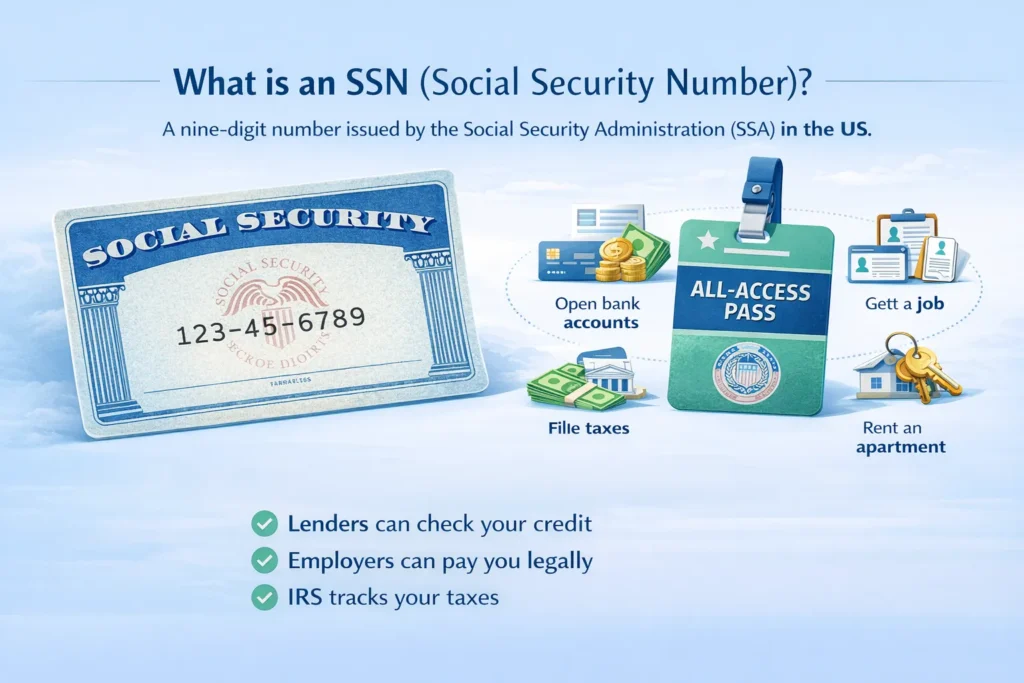
It was originally created to track individual earnings for Social Security benefits. Over time, it became the primary identifier for almost everything in American life. Opening a bank account. Filing taxes. Getting a job. Even renting an apartment.
Think of the SSN as your all-access pass to the American financial system.
Once you have one, doors open. Lenders can check your credit. Employers can pay you legally. The IRS knows exactly who you are come tax season.
Who is Eligible for an SSN?
Not everyone can just apply and get one. The SSA is specific about this.
You’re eligible for an SSN if you are:
A US citizen (born in the US or naturalized)
A permanent resident (Green Card holder)
A temporary worker who is authorized to work in the US (on a work visa like H-1B, L-1, O-1, etc.)
That last category is important. “Authorized to work” is the key phrase. You need a visa that explicitly permits employment in the US.
F-1 students on OPT or CPT? Usually eligible. Someone on a B-1 tourist visa? Not eligible. It’s that specific.
Can NRIs Get an SSN?
The short answer: sometimes.
If you’re working in the US legally on a qualifying visa, yes. You can and should apply for an SSN. Your employer will need it to process payroll and report your income to the IRS.
But if you’re an NRI sitting in India, investing in US stocks or collecting rental income from a US property you own? You are not eligible for an SSN. You have no US employment authorization. The SSA has no reason to issue you one.
This is where the ITIN comes in.
What is an ITIN (Individual Taxpayer Identification Number)?
The ITIN is also a nine-digit number. It looks a lot like an SSN. But it starts with the digit 9, which sets it apart.
It’s issued by the IRS (Internal Revenue Service), not the SSA. And it was created for one specific reason: to give people without SSN eligibility a way to still file US tax returns and comply with US tax laws.
Here’s a good analogy. Think of the ITIN as a guest badge at an office building. It lets you in. It gets you where you need to go. But it doesn’t give you the same access as a full employee ID card.
The ITIN gets you into the US tax system. Nothing more, nothing less.
Who Needs an ITIN?
You need an ITIN if you have a US tax obligation but you don’t qualify for an SSN.
That includes:
NRIs earning US income through dividends, interest, rental income, or freelance work
Foreign investors with stakes in US companies or real estate
Non-resident taxpayers who need to file US returns
Spouses or dependents of US citizens or residents who don’t qualify for an SSN
For example: say you’re an NRI based in Pune, and you invest in US stocks through a brokerage account. You earn dividends. The US government wants a piece of that. To file a return and potentially claim a treaty benefit, you need a tax ID. Since you have no SSN, the IRS issues you an ITIN instead.
What is an ITIN Used For?
The ITIN is only for tax purposes. Full stop.
Specifically, you can use it to:
File US federal tax returns
Report US-sourced income to the IRS
Claim treaty benefits under agreements like the US-India DTAA
Open certain investment accounts that require a tax ID on file
It does not give you work authorization. It does not give you access to Social Security benefits. It doesn’t prove immigration status or anything beyond the fact that you’re in the IRS system.
SSN vs ITIN: Key Differences
Here’s where it all comes together. Side by side.
Feature
SSN
ITIN
Issued by
Social Security Administration
Internal Revenue Service
Who gets it
US citizens, residents, authorized workers
Non-residents, foreign nationals, NRIs
Main purpose
Work + taxes + benefits
Tax filing only
Social Security benefits
Yes
No
Valid for employment
Yes
No
Starts with
Any digit (except 9)
Always starts with 9
The biggest difference? Purpose.
An SSN is your full identity number for life in the US. An ITIN is a limited-use tax number. You use it to talk to the IRS. That’s it.
SSN vs Tax ID vs ITIN: Let’s Clear This Up Once and For All
People mix these terms up constantly. Here’s the simplest version:
TIN = the parent category. Any number used to identify a taxpayer in the US.
SSN = a type of TIN. Used by eligible individuals for work, taxes, and benefits.
ITIN = another type of TIN. Used by people who can’t get an SSN but have US tax obligations.
EIN = yet another type. Used by businesses, not individuals.
So when someone says “give me your Tax ID,” they’re asking for your TIN. Which specific TIN depends on which one you have.
If you have an SSN, use that. If you don’t have one, your ITIN is your Tax ID.
SSN or ITIN for NRIs: Which One Do You Actually Need?
Let’s make this simple. Ask yourself one question:
Are you working in the US with legal work authorization?
If yes, apply for an SSN. Your employer needs it. The SSA processes it. You’re in the system.
If no, and you still have US income or tax obligations, you need an ITIN.
Here are some real-world NRI scenarios:
US stock investment from India You buy Apple shares through a US brokerage. You earn dividends. You need to file a US return. You need an ITIN.
Rental income from a US property You own an apartment in New Jersey and rent it out. That rental income is US-sourced. The IRS wants it reported. ITIN required.
Freelancing for a US client You’re in India, billing a US company. They issue you a 1099 form. You may need to file a US return. ITIN is the tool for the job.
Working in the US on an H-1B visa You’ve relocated. Your employer is sponsoring you. You’re on payroll. You need an SSN, and you’re eligible to get one.
Spouse of a US resident, no work authorization Your spouse is in the US on a work visa. You’re filing jointly. You don’t work. You still need to be on the return. Apply for an ITIN.
How to Apply for an ITIN: Step-by-Step
The process is straightforward. But it requires patience.
Step 1: Fill out Form W-7
This is the official IRS application form for an ITIN. Download it from the IRS website. Fill it out carefully. The form asks for your name, address, country of citizenship, and the reason you need an ITIN.
Step 2: Gather your identity documents
You need to prove your foreign status and identity. A valid passport is the most accepted document. If you’re submitting a certified copy, make sure it’s certified by the issuing authority, not just notarized.
Step 3: Attach it to your tax return
Here’s the part people miss. The W-7 is not submitted alone. You attach it to your US tax return (Form 1040-NR for non-residents). You’re applying for the ITIN while filing your return.
There is an exception: if you qualify for an allowable exception (like a treaty benefit claim), you may be able to apply without a return.
Step 4: Submit to the IRS
You can mail the package to the IRS ITIN Operations center in Texas, take it to an IRS Taxpayer Assistance Center, or use an IRS-authorized Certifying Acceptance Agent (CAA), which is often the easiest route for NRIs outside the US.
Step 5: Wait for processing
The IRS typically takes 6 to 11 weeks to process ITIN applications. During tax season, it can stretch longer. Once issued, the IRS mails you a letter with your ITIN.
How to Apply for an SSN
If you are eligible (authorized worker, Green Card holder, citizen), the process is simpler.
Visit your local Social Security Administration office. Bring:
Your work visa or immigration document
Your passport
Form I-94 (arrival/departure record)
Evidence of your work authorization (like an offer letter or I-20 with OPT approval)
The SSA processes applications and mails your card within a few weeks. Some employers start you on payroll before the card arrives, using a receipt notice in the meantime.
Can You Use an SSN as a Tax ID?
Yes. Absolutely.
Your SSN is your Tax ID if you’re an eligible individual. When you file a US tax return and you have an SSN, you use that in the Tax ID field. They are the same thing, in your case.
The confusion arises because non-eligible people need a different tax ID (the ITIN). That difference makes people wonder if there’s some separate “Tax ID” separate from their SSN. There isn’t. If you have an SSN, it doubles as your Tax ID.
Can You Use an ITIN for Employment?
No. And this is a hard no.
An ITIN does not authorize you to work in the US. It does not substitute for an SSN when an employer runs payroll. It does not give you access to Social Security benefits, Medicare, or any work-related government programs.
If you try to use an ITIN to get a job in the US, that’s a problem. The IRS created ITINs specifically for tax compliance, not employment.
ITIN Limitations You Should Know
Beyond the employment restriction, there are a few more limits worth knowing:
No social security benefits. ITIN holders don’t accrue Social Security credits.
No proof of immigration status. Having an ITIN says nothing about your legal right to be in the US.
ITINs expire. If you haven’t filed a US tax return for three consecutive years, your ITIN becomes inactive. You’ll need to renew it.
Some states won’t accept it. Certain state-level forms require an SSN, not an ITIN.
Common Confusions, Answered Directly
Is a Tax ID the same as an SSN? It depends on who you are. If you’re a US citizen or eligible resident, your SSN is your Tax ID. For everyone else, the Tax ID is their ITIN (or EIN if it’s a business).
Is your SSN your Taxpayer ID? Yes. For anyone who has an SSN, it functions as their taxpayer identification number.
Taxpayer ID vs Social Security Number: what’s the difference? A Social Security Number is one type of Taxpayer ID. Not all Taxpayer IDs are SSNs. Taxpayer ID is the broader term.
Conclusion
SSN and ITIN are not the same thing. But they’re not at odds with each other either. They simply exist for different people in different situations.
If you’re an NRI with any kind of US income, whether that’s dividends, rent, freelance fees, or business earnings, there’s a good chance you need an ITIN. It’s your legal way to stay compliant with US tax rules without being a US resident or worker.
Getting it right from the start saves you headaches. And potentially, penalties.
Before filing your next US return or opening that brokerage account, take five minutes to figure out which ID applies to you. The answer is usually simpler than it seems.
Frequently Asked Questions
What is SSN or ITIN?
Both are US tax identification numbers. An SSN (Social Security Number) is issued by the Social Security Administration to US citizens, residents, and authorized workers. An ITIN (Individual Taxpayer Identification Number) is issued by the IRS to people who have US tax obligations but don’t qualify for an SSN. Different purposes, same family.
Is SSN available in India?
No. The SSN is a US government-issued number. It is only available to people who live or work in the US with proper authorization. If you’re based in India with no US work authorization, you simply cannot apply for one. NRIs needing a US tax ID should look at ITIN instead.
What is the SSN for NRI?
There is no SSN equivalent specifically for NRIs. If you’re an NRI working legally in the US on a qualifying visa, you can get an SSN. If you’re earning US income without working there, the ITIN is your equivalent. It’s your identity number inside the US tax system.
Can a non-US citizen get an ITIN number?
Yes, absolutely. The ITIN was specifically designed for non-US citizens. If you’re a foreign national, NRI, or non-resident with US income or tax filing requirements, you’re eligible. Citizenship is not a requirement. Having a US tax obligation is. Fill out Form W-7 and apply directly through the IRS.
How to get ITIN from India?
You apply using IRS Form W-7, attach your valid passport as identity proof, and submit it along with your US tax return. From India, the easiest route is through an IRS-authorized Certifying Acceptance Agent (CAA). They verify your documents locally so you don’t mail your original passport to the US.
What if I don’t have a US TIN number?
Without a US TIN, you can’t file a US tax return, claim treaty benefits, or legally report US income. Withholding tax on your income may also be higher. If you have US tax obligations, apply for an ITIN immediately. Ignoring it doesn’t make the obligation disappear. It just adds penalties.
How to get TIN number for NRI?
For most NRIs, the relevant US TIN is an ITIN. Apply by submitting Form W-7 to the IRS with proof of identity and foreign status. A valid passport works best. You can use a Certifying Acceptance Agent in India to simplify the process. Processing typically takes 6 to 11 weeks.
Do we have a TIN in India?
India had a Tax Identification Number (TIN) system used for VAT registration by businesses. For individuals, the closest equivalent is your PAN (Permanent Account Number), issued by the Income Tax Department. PAN serves as your primary tax identity in India, just like an SSN or ITIN does in the US.
Is TIN still used in India?
The old TIN system for VAT has largely been replaced by GSTIN (Goods and Services Tax Identification Number) following the GST rollout in 2017. For individuals, PAN remains the active and valid tax identifier. So while the term TIN is still referenced, GSTIN and PAN are what actually matter today.
Can I use PAN instead of TIN?
Not for US tax purposes. PAN is an Indian tax identifier. The US IRS does not recognize it. For US filings, you need either an SSN or an ITIN. However, under the US-India tax treaty (DTAA), your PAN may be referenced in certain disclosures. But it cannot replace a valid US TIN.
Imagine you are a partner in a small business. The year ends. Your business does not send you a W-2. It does not send you a 1099 either. Instead, a few weeks later, you get a form that says Schedule K-1 at the top. And your first thought is: “What on earth is this?”
You are not alone. K-1 forms confuse thousands of taxpayers every year. They look unusual. They feel complicated. But once you understand the core idea behind them, everything clicks into place.
This guide breaks it all down. Simple language. Step-by-step explanations. Real examples. By the end, you will know exactly what a K-1 is, who gets one, and what to do with it when tax season arrives.
What is a Schedule K-1 Tax Form?
A Schedule K-1 is a tax document. It reports your share of income, losses, deductions, and credits from a business or entity that you are part of.
Think of it like this. You own 30% of a small business. That business made $100,000 in profit this year. You did not receive all of it in cash. But your share is $30,000. The K-1 is the form that tells you, and the IRS, about that $30,000.
The K-1 is not like a W-2 (which reports salary from an employer) or a 1099 (which reports freelance or investment income). It is specifically designed for pass-through entities. These are businesses where income “passes through” directly to the owners, instead of being taxed at the business level.
Key idea: The business does not pay the tax. You do. The K-1 tells you how much income to report on your personal tax return.
What Does “K-1” Mean in Taxes?
The name comes from the IRS form numbering system. The “K” in Schedule K refers to the section of the tax code that deals with partner and shareholder reporting. It has nothing fancy behind it. It is just a label that stuck.
What matters is what it does. The K-1 tells you your specific portion of the entity’s financial activity for the year. It is your personal summary of what happened inside a business or trust that you have a stake in.
Types of Schedule K-1 Forms
There are three different K-1 forms, each used for a different type of entity.
Form Type
Issued By
Received By
K-1 (Form 1065)
Partnerships and multi-member LLCs
Partners and LLC members
K-1 (Form 1120-S)
S Corporations
Shareholders
K-1 (Form 1041)
Estates and Trusts
Beneficiaries
Each form looks slightly different, but they all serve the same purpose: reporting your share of the entity’s financials.
How Does a K-1 Tax Form Work?
Let’s use a simple analogy. Think of a pizza business owned by three friends: Alex (50% share), Ben (30% share), and Clara (20% share). The business earns $200,000 in profit this year.
The business itself does not pay tax on that $200,000. Instead, the income passes straight through to the owners. Alex reports $100,000 on his personal return. Ben reports $60,000. Clara reports $40,000.
Each of them receives a K-1 from the pizza business. That K-1 tells them exactly how much to report. The IRS gets a copy too, so they know what to expect on each person’s return.
This is pass-through taxation in a nutshell. The business is the vehicle. The income flows straight to the owners.
What Information Is Included in a K-1?
A K-1 covers a lot of ground. Here is what you will typically find on one:
Ordinary business income or loss (your share of day-to-day business profits or losses)
Rental income (if the entity owns rental properties)
Interest and dividend income
Capital gains and losses (short-term and long-term)
Deductions (such as Section 179 expensing or other business deductions)
Credits (tax credits passed through to you)
Your ownership percentage
Your beginning and ending capital account balance
Each line item on the K-1 gets reported in a specific place on your personal tax return. Some income types are taxed differently. Long-term capital gains, for example, are taxed at lower rates than ordinary income. That distinction matters, and your K-1 will spell it out clearly.
What is a K-1 Tax Document Used For?
The short answer: it is the bridge between the entity’s tax return and your personal tax return.
Without it, the IRS would have no way to know what income passed through to you. The entity files its own return (Form 1065, 1120-S, or 1041), reports the total income or loss, and then issues individual K-1s to each partner, shareholder, or beneficiary showing their allocated portion.
You then use that K-1 to complete your own Form 1040.
Who Receives a Schedule K-1?
You will receive a K-1 if you are one of the following:
A partner in a general or limited partnership
A member of a multi-member LLC (single-member LLCs generally do not issue K-1s)
A shareholder in an S corporation
A beneficiary of an estate or trust (for example, if a family member passed away and you inherited a portion of their estate)
It does not matter if you are an active participant in the business or a silent investor. If you hold an ownership stake, you will get one.
K-1 Tax Form for LLCs, Partnerships and Investments
Many common investment vehicles use the K-1 structure. If you have invested in any of the following, a K-1 is almost certainly in your future:
Real estate limited partnerships (LPs): Very common for real estate syndications and deals
Private equity funds: These almost always issue K-1s
Hedge funds structured as partnerships
Oil and gas investments
Investment syndicates and crowdfunded real estate platforms
Even startup founders who structure their company as an LLC or partnership can receive K-1s.
It is also worth noting: publicly traded partnerships (PTPs) issue K-1s too. So if you bought a master limited partnership (MLP) through your brokerage account, you will get a K-1 instead of a 1099. Many first-time MLP investors are caught off guard by this.
K-1 Tax Form Deadlines
Here is where many people run into trouble. K-1 deadlines are different from what most taxpayers are used to. Before a K-1 can be sent to you, the entity has to file its own tax return first. So the timeline looks like this:
Entity Type
Entity Return Due
Extension Possible Until
Partnerships (Form 1065)
March 15
September 15
S Corporations (Form 1120-S)
March 15
September 15
Estates and Trusts (Form 1041)
April 15
September 30
When Are K-1 Tax Forms Due? (And Why They Are Often Late)
This is probably the most frustrating part of K-1 investing. Your personal tax return is due April 15. But the partnership sending your K-1 may not file its own return until September if they file an extension. That puts you in a tough spot. You cannot complete your return without the K-1.
This is a very common situation, and the IRS is aware of it. Your options are:
File a tax extension (Form 4868): This gives you until October 15 to file. Note that an extension to file is not an extension to pay. If you expect to owe taxes, you should still pay an estimate by April 15.
File an amended return (Form 1040-X): If you already filed and your K-1 arrives later, you can amend your return.
Use an estimate: Some experienced investors use prior-year K-1 data to estimate and file on time, then amend if needed.
Pro tip: If you invest in private partnerships or real estate syndications, plan for this every year. Filing an extension is completely normal and takes just a few minutes.
How Will a K-1 Affect My Taxes?
The honest answer: it depends on what is on the K-1.
If the K-1 shows income, it increases your taxable income. This could push you into a higher tax bracket, increase your overall tax bill, or affect your eligibility for certain deductions and credits.
If the K-1 shows a loss, it may reduce your taxable income. This is one of the reasons real estate partnerships are so popular. Depreciation and other deductions often generate paper losses that investors use to offset other income.
But there is a catch. Passive activity loss rules limit how much loss you can deduct. If you are not an active participant in the business, those losses may be “suspended” and carried forward to future years.
K-1 Income Tax Treatment
Not all K-1 income is taxed the same way. Here is a breakdown:
Income Type
Where It Goes on Your Return
Tax Rate
Ordinary business income
Schedule E, Part II
Your regular income tax rate
Long-term capital gains
Schedule D
0%, 15%, or 20% (lower rates)
Short-term capital gains
Schedule D
Your regular income tax rate
Rental income
Schedule E, Part I
Your regular income tax rate
Tax-exempt interest
Informational only
Generally not taxed
Self-employment income (active partners)
Schedule SE
Income tax + SE tax (~15.3%)
One thing to watch: if you are a general partner or active LLC member, your share of ordinary income may be subject to self-employment tax on top of regular income tax. This catches many people off guard the first time.
How to File Taxes with a K-1 (Step-by-Step)
Filing taxes with a K-1 is not as scary as it sounds. Here is the process, broken down simply.
Step 1: Receive your K-1: The entity will mail or electronically deliver it to you. Check your email and physical mail, especially in March and April.
Step 2: Review every line carefully: Check your name, address, Social Security number, and ownership percentage. Errors happen. If something looks wrong, contact the entity immediately.
Step 3: Identify the income types: Look at which boxes are filled in. Box 1 (ordinary income), Box 2 (rental income), Box 9 (capital gains)? Each one flows to a different part of your tax return.
Step 4: Enter the data into your tax software: Most major tax software platforms (TurboTax, H&R Block, TaxAct) have a dedicated K-1 entry section. The software will guide you through each box and place it in the right spot.
Step 5: Review carried-forward items: Some K-1 items, like passive losses that cannot be used yet, carry forward to next year. Your software should track these automatically.
Step 6: File your return: Once everything is entered, review your overall return to make sure the K-1 data looks correct. Then file.
How to Report K-1 on Your Tax Return
Here is where each type of K-1 income ends up on your personal tax return:
Ordinary income (Box 1): Schedule E, Part II
Rental income (Box 2): Schedule E, Part I
Capital gains (Box 8 and 9): Schedule D
Interest income (Box 5): Schedule B
Dividends (Box 6): Schedule B
Self-employment income (active partners): Schedule SE
If you use tax software, it handles all of this automatically once you enter the K-1 data. If you file manually or use a CPA, make sure they have a copy of every K-1 you received.
Can You File Taxes Without a K-1?
Technically, yes. But it is not a good idea.
The IRS already receives a copy of your K-1 directly from the entity. If you do not report the income on your return, the IRS will notice. This typically leads to a notice, an audit, or penalties.
If your K-1 is late, file an extension. It is the cleanest solution by far.
K-1 Tax Form for Inheritance (Trusts and Estates)
Let’s say a relative passes away and leaves behind an estate or a trust. You are named as a beneficiary. You may receive distributions from that estate during the year. And you will likely receive a K-1 (Form 1041) to report it.
This K-1 works the same way as any other. It tells you how much of the estate’s income, deductions, or credits are allocated to you. You report that on your personal tax return.
One common confusion: the inheritance itself (the principal amount you inherit) is generally not taxable income. The K-1 typically covers income generated by the estate’s assets, such as interest earned, dividends, or capital gains from selling estate property.
K-1 for Business Owners
If you are an active partner or managing member of an LLC, your K-1 situation is a bit different from a passive investor.
Your ordinary income from the business is likely subject to self-employment tax, which is approximately 15.3% on net earnings up to a certain threshold, and 2.9% above that. Many business owners are surprised by this when they first encounter it.
It also matters whether you are taking a guaranteed payment (similar to a salary) versus a profit distribution. Both can show up on your K-1, but they are treated differently for tax purposes. Guaranteed payments, for example, are always subject to self-employment tax, regardless of whether the business made a profit.
Filing K-1 for Multiple Investments
If you have invested in several partnerships or funds, you may receive multiple K-1 forms. This is actually quite common among real estate investors and private equity participants.
Managing multiple K-1s can get complex, especially when some entities file extensions and others do not, or when passive losses from one investment can offset passive income from another. You may also have income allocated to multiple states, which can trigger nonresident state tax filing requirements in states where you do not live.
If you are dealing with five or more K-1s across different entities, consider getting professional help. The time saved and errors avoided usually outweigh the cost.
Common Issues with K-1 Tax Forms
Even experienced investors run into K-1 problems. Here are the most common ones.
Late arrival. As discussed, K-1s can arrive in March, April, or even later. The fix: file your own extension (Form 4868) so you are not under pressure.
Errors on the form. Your ownership percentage might be wrong. Your name or Social Security number could have a typo. If you spot an error, contact the general partner, fund administrator, or trustee right away. They will need to issue a corrected K-1. File your return after you receive the corrected version.
Complex reporting. Some K-1s have dozens of line items. This is common with oil and gas investments or complex real estate partnerships. Tax software helps, but these situations often benefit from professional review.
Multi-state income. If the partnership does business in multiple states, you might owe state income taxes in states where you do not even live. The K-1 will usually indicate how much income is allocated to each state. This is one of the less-known complications of K-1 investing.
When to Consult a Tax Professional
There are situations where doing your K-1 taxes yourself is perfectly fine. And there are situations where professional help is clearly worth it.
Consider getting professional help if:
You have three or more K-1s to report
Any K-1 shows a large dollar amount (say, over $50,000)
You have passive losses from previous years that you are trying to use
The K-1 has complex items related to oil and gas, Section 743(b) adjustments, or foreign income
You received a K-1 from an estate or trust and are unsure of the tax treatment
You are a non-resident or international investor dealing with US tax obligations
You received a notice from the IRS related to a K-1
A qualified CPA or tax attorney who specializes in pass-through entities can save you from costly mistakes. And in many cases, their fee is itself tax-deductible.
Conclusion
Here is the core idea behind every K-1: pass-through taxation. The business does not pay the tax. You do. The K-1 just tells you your share.
Once you understand that concept, the form becomes much less intimidating. Yes, the deadlines can be tricky. Yes, some K-1s are more complex than others. But the underlying logic is always the same.
A few things to remember before you go:
File an extension if your K-1 has not arrived by April 15
Report every K-1 you receive. The IRS already has a copy
Different income types on your K-1 are taxed differently, so review each box carefully
If you are dealing with multiple K-1s, complex structures, or large amounts, get professional help
The K-1 is not your enemy. For many investors, it is actually a sign that their money is working in tax-efficient structures. Real estate depreciation, business losses, and capital gains treatment can all work in your favour. Understanding your K-1 is not just about avoiding mistakes. It is about making smarter decisions with your money and your taxes.
FREQUENTLY ASKED QUESTIONS
What is a K-1 tax form used for?
It reports your share of income, losses, deductions, and credits from a pass-through entity such as a partnership, LLC, S corporation, or trust. You use it to complete your personal tax return.
How do I get a K-1 tax form?
You do not request it. The entity you are invested in prepares and sends it to you after they file their own return. If you have not received it by mid-April and the entity has not filed an extension, contact them directly.
When are K-1 tax forms due?
Partnership and S corporation K-1s are tied to the entity’s March 15 return deadline (with a possible extension to September 15). Trust and estate K-1s follow the April 15 deadline (with extension to September 30). In practice, many arrive late when the entity files an extension.
Can I file taxes without a K-1?
It is not advisable. The IRS already has a copy. If you do not report the income, you risk a notice or penalties. Filing your own extension (Form 4868) is the smart move if your K-1 has not arrived yet.
Is K-1 income taxable?
Yes, in most cases. Ordinary income and rental income are taxed at your regular income tax rates. Long-term capital gains benefit from lower rates. Some items, like tax-exempt interest, are not taxable. The K-1 itself will indicate how each item should be treated.
What is the difference between a K-1 and a 1099?
A 1099 reports income paid directly to you, such as freelance payments or dividends from public stocks. A K-1 reports your allocated share of income from an entity you own a piece of. With a 1099, you received the money. With a K-1, you may or may not have received cash, but you are still responsible for reporting your allocated share.
Do I need a CPA for K-1 filing?
Not always. If you have one simple K-1 with a few line items, tax software can handle it. But if your K-1 is complex, involves large amounts, or you have multiple K-1s across different entities, a CPA is worth the investment.
What happens if I ignore a K-1?
The IRS receives a copy directly from the entity. If you do not report the income, the IRS will notice the discrepancy. This typically leads to a CP2000 notice, where the IRS proposes additional tax, interest, and possibly penalties. It is not worth the risk. Report every K-1 you receive.
You land that promotion or a new job. The salary hits six figures. $150,000 a year. It feels great. Finally, you have room to breathe, save, and enjoy life.
Then tax season arrives.
You see the number withheld from your paychecks. You calculate what you might owe. It stings. A huge chunk of your hard work is gone.
But here’s the truth most people miss: Paying too much tax is a choice. Not a legal one, but a choice based on poor planning. The government isn’t going to hand you a manual on how to keep your money. That’s on you.
This guide is that manual. We are talking about legal tax optimization. No loopholes. No evasion. Just smart, logical strategies to ensure you keep more of what you earn. Let’s dive into exactly how to pay less taxes on your $150K income.
How Much Tax Do You Actually Pay on $150K?
Before we fix the problem, let’s look at the numbers. The tax rate on 150k isn’t as scary as it seems at first glance. Many people confuse their marginal tax bracket with their overall tax bill.
Your income tax on 150k depends on a few things:
Filing Status: Are you single or married filing jointly?
Deductions: Are you taking the standard deduction or listing out your expenses?
Location: Does your state have an income tax?
Here is a simplified breakdown. For a single filer in 2024, the federal income tax brackets are progressive. This means you don’t pay 24% on your entire income. You pay 10% on the first chunk, 12% on the next, and so on.
After the standard deduction (which is over $14,000 for individuals), your taxable income drops. So, what is 150k after taxes? A rough estimate for a single filer in a state with no income tax might look like this:
Federal Income Tax: ~$24,000 – $28,000
Social Security / Medicare (FICA): ~$11,000
Net Take-Home Pay:~$111,000 – $115,000
Your effective tax rate (the actual percentage of your total income paid in taxes) lands around 18% to 24% . But here’s the kicker. With smart planning, you can shrink that number significantly and push your take-home pay even higher.
Why High Earners Often Overpay
Making more money should mean keeping more money, right? Not always. High earners often fall into predictable traps. They overpay because they assume their tax situation is too complex to handle or, conversely, too simple to worry about.
Common reasons people overpay:
They let their employer handle everything and never check the details.
They think deductions are only for the ultra-wealthy or business owners.
They ignore accounts designed specifically to save them money (like a 401(k) or HSA).
They don’t think about the tax impact of their investments.
The goal of how to pay less in taxes isn’t about finding a secret trick. It’s about avoiding these common pitfalls and being intentional with your money.
Top Ways to Pay Less Taxes on $150K Income
Ready to build a plan? Here are the most effective strategies for someone in your income bracket.
1. Max Out Your Retirement Contributions (The #1 Strategy)
This is the simplest and most powerful tool for any salaried employee. A traditional 401(k) lets you put money in before the government takes its cut.
Think of it this way. Every dollar you contribute to a traditional 401(k) disappears from your W-2. You don’t pay income tax on it today. The tax man waits until you withdraw it in retirement.
In 2024, you can contribute up to $23,000. If you are 50 or older, you can add another $7,500 as a “catch-up” contribution.
Let’s do the math. If you earn $150,000 and contribute $20,000 to your 401(k), your taxable income instantly drops to $130,000. That could save you thousands in federal income tax for the year. This is a primary way how to reduce the tax on salary effectively.
2. Use a Health Savings Account (HSA)
If you have a high-deductible health plan (HDHP), you likely have access to an HSA. This account is the best retirement and tax-saving vehicle you aren’t using.
Why? It offers a “triple tax benefit.”
Tax-Free In: The money you put in is tax-deductible, just like a 401(k).
Tax-Free Growth: Any interest or investment gains in the account are not taxed.
Tax-Free Out: Withdrawals are tax-free as long as you use them for qualified medical expenses. In retirement, you can even use it for non-medical expenses (it just acts like a traditional IRA then).
For 2024, you can contribute up to $4,150 for an individual or $8,300 for a family. For a high earner, this is a no-brainer. It reduces your taxable income now and builds a medical nest egg for the future.
3. Claim All Available Deductions
The tax code rewards certain behaviors. If you do these things, make sure you are claiming them. You must itemize to get these benefits, meaning you skip the standard deduction and list your expenses instead.
Common deductions for someone earning $150K:
Mortgage Interest: Interest paid on the first $750,000 of your mortgage debt.
State and Local Taxes (SALT): You can deduct up to $10,000 of combined state income and property taxes.
Charitable Donations: If you give money or goods to qualified charities, keep the receipts.
Student Loan Interest: You can deduct up to $2,500 in interest paid, even if you don’t itemize.
4. Pick the Right Deduction Strategy
This is a simple but crucial choice. You have two options:
Standard Deduction: A flat amount you can subtract from your income. For 2024, it’s $14,600 for singles and $29,200 for married couples filing jointly.
Itemized Deduction: The total of all your eligible expenses (mortgage interest, charity, etc.).
The rule is simple: choose the higher number. Many people assume the standard deduction is best because it’s easy. But if you own a home or give a lot to charity, itemizing might save you more. Always run the numbers both ways.
5. Focus on Tax Credits (They Are More Powerful)
A deduction lowers the amount of income that gets taxed. A credit lowers your actual tax bill, dollar for dollar.
Think of it this way. A $1,000 deduction might save you $240 if you are in the 24% tax bracket. A $1,000 credit saves you the full $1,000.
Important credits for your income level:
Child Tax Credit: Worth up to $2,000 per qualifying child. It begins to phase out at higher income levels, but at $150K, you may still qualify for a partial credit.
Child and Dependent Care Credit: If you pay for childcare so you can work, you may be eligible for a credit.
Lifetime Learning Credit / American Opportunity Tax Credit: If you or a dependent are in college or taking courses to improve job skills, look into these.
6. Optimize Your Investment Taxes
If you have a brokerage account (investing outside of a retirement plan), how you buy and sell matters.
Hold for the Long Term: Assets held for over a year are taxed at the long-term capital gains rate (0%, 15%, or 20%). This is almost always lower than your ordinary income tax rate.
Tax-Loss Harvesting: This is a fancy term for a simple idea. Sell an investment that has lost value. Use that loss to offset any gains you made from selling other investments. If your losses exceed your gains, you can even use up to $3,000 of loss to lower your regular taxable income.
7. Use Flexible Spending Accounts (FSA)
Your employer might offer an FSA. This is another “use it or lose it” account, so be careful. But if you have predictable expenses, it’s a great tool.
You contribute pre-tax money to the account. You then use that money for eligible expenses.
Healthcare FSA: For co-pays, prescriptions, glasses, and other medical costs not covered by insurance.
Dependent Care FSA: For daycare or after-school care costs for children under 13.
The money you put in lowers your taxable income, saving you on federal, state, and even Social Security and Medicare taxes.
8. Time Your Income and Expenses
You have some control over when you get paid and when you pay certain bills. This is called tax timing.
Defer Bonuses: If you expect a big year-end bonus, see if your employer can pay it in January instead of December. This pushes the tax liability into the next year.
Accelerate Deductions: If you plan to itemize, you can “bunch” expenses. For example, make your January mortgage payment in December to get an extra year of interest. Or make your charitable donations for next year in December of this year.
9. Structure Business or Side Income
If you have a side hustle, freelance work, or a small business, how you structure it matters.
When you are a sole proprietor, your business income is simply added to your W-2 income. You pay self-employment tax on top of income tax.
But registering as an LLC or S-Corp opens up options. You can deduct legitimate business expenses directly from your business income. This includes a home office, a portion of your internet bill, software subscriptions, and even some travel. This directly lowers your taxable income. This is a powerful way for how can i pay less in taxes when you have multiple income streams.
Sample Tax Savings Breakdown on $150K
Let’s see how this adds up. Imagine a single filer earning $150,000.
Strategy
Action
Tax Savings (Estimate)
401(k)
Contribute $20,000
~$4,800
HSA
Contribute $4,000 (Family)
~$960
Itemized Deductions
Mortgage interest + charity > Standard Deduction
~$2,000
Tax Credits
Child Tax Credit (if applicable)
~$2,000
TOTAL POTENTIAL SAVINGS
~$9,760+
These are rough estimates. Your actual savings depend on your tax bracket and specific situation. But the point is clear. By using these strategies, you can potentially save $8,000 to $15,000 or more each year.
Common Mistakes to Avoid
Saving money is also about not losing it to common errors. Avoid these tax traps.
Assuming the standard deduction is always best. Do the math or ask a pro.
Leaving “free money” on the table. Not contributing enough to your 401(k) to get the full employer match is a huge mistake. It’s literally turning down a raise.
Filing status errors. Married couples often file separately when filing jointly would save them thousands.
Forgetting about side hustle taxes. If you make money from a side gig, you likely need to pay estimated taxes quarterly. Ignoring this can lead to penalties.
Missing the deadline for contributions. You have until the tax filing deadline (usually April 15th) to make prior-year IRA and HSA contributions. Mark your calendar.
Advanced Tax Strategies for High Earners
If you’ve mastered the basics, here are some advanced moves for those earning $150K or more.
Backdoor Roth IRA
High earners often can’t contribute directly to a Roth IRA because of income limits. But there’s a legal workaround.
You contribute to a traditional IRA (which has no income limits). Then, you immediately convert that traditional IRA into a Roth IRA. You pay taxes on any growth in between (which should be minimal if you do it right away). After that, the money grows tax-free forever. It’s a bit of paperwork, but it opens the door to tax-free wealth for high-income earners.
Real Estate Depreciation
If you own rental property, the IRS lets you deduct a portion of the building’s cost every year as “depreciation.” This is a non-cash deduction. It lowers your taxable rental income on paper, even if the property is actually generating cash flow. It can dramatically reduce or even eliminate the tax you owe on your rental income.
Income Splitting
If you own a business, you might be able to split income with family members in lower tax brackets. For example, you could legitimately employ your child in the business. Their earned income is taxed at their rate, which is likely much lower than yours. This must be done carefully and legally, with real work performed.
How Filing Status Impacts Taxes on $150K
Your marital status on December 31st determines your filing status for the entire year. This choice has a massive impact.
For example, the taxes on $150k married filing jointly are much friendlier than filing as a single person. The tax brackets for married couples are almost double the size of the single brackets.
A single person hits the 24% bracket at $100,525 of taxable income.
A married couple filing jointly doesn’t hit the 24% bracket until they earn $201,050.
So, if you are married and one spouse earns $150,000 while the other stays home, your joint income is still $150,000. You get to use the wider, lower tax brackets designed for two people. This can result in a significantly lower tax bill compared to two single people each earning $75,000.
Tools and Resources for Tax Planning
You don’t have to figure this all out alone. Use these resources:
Tax Calculators: Use online calculators (like those from SmartAsset or NerdWallet) to estimate your tax liability and see the impact of changes.
Tax Preparation Software: Tools like TurboTax or H&R Block walk you through deductions and credits step-by-step.
Certified Public Accountant (CPA) or Enrolled Agent (EA): If your situation is complex (side business, rental properties, RSUs), paying a few hundred dollars for professional advice can save you thousands.
Conclusion
Earning $150,000 puts you in a strong financial position. But how much of it you actually get to keep comes down to one thing: planning.
Paying less tax isn’t about finding shady loopholes. It’s about understanding the rules of the game and playing by them. It’s about choosing to put money in a 401(k) instead of a regular bank account. It’s about using an HSA for medical expenses. It’s about timing your donations.
These small, smart choices are not complicated. They just require intention. Start with the retirement account. Look into an HSA. Track your potential deductions. Even implementing just two of these strategies can put thousands of dollars back in your pocket every single year.
Don’t let taxes take a bigger bite than they have to. Take control, make a plan, and keep more of what you earn.
FAQs
How much federal tax do I pay on $150K as a single filer?
You will likely pay between $24,000 and $28,000 in federal income tax. Your exact bill depends on your deductions and credits, but the effective rate usually falls between 18% and 24%.
What is the best way to lower my taxable income quickly?
Max out your traditional 401(k). For 2024, you can contribute up to $23,000. This money comes out of your paycheck before taxes, instantly lowering your reported income and your current tax bill.
Can I contribute to a Roth IRA if I make $150K?
Single filers phase out of Roth eligibility starting at $146,000. However, you can use the “backdoor Roth IRA” strategy. This involves contributing to a traditional IRA and then converting it to a Roth.
Is an HSA better than a 401(k) for tax savings?
For medical expenses, yes. An HSA offers a triple tax benefit: tax-deductible contributions, tax-free growth, and tax-free withdrawals for qualified medical costs. It is an incredibly powerful savings tool.
Should I itemize deductions on $150K?
Maybe. Compare your total eligible expenses (mortgage interest, charity, state taxes) to the standard deduction ($14,600 for singles in 2024). If your itemized total is higher, you should itemize to save more.
How does marriage affect my taxes on $150K?
Marriage can lower your taxes significantly. The married filing jointly tax brackets are almost double the size of single brackets, meaning more of your income is taxed at lower rates compared to being single.
What tax credits can I get with a $150K income?
You may qualify for the Child Tax Credit (up to $2,000 per child) and the Child and Dependent Care Credit. These are more valuable than deductions because they reduce your tax bill dollar-for-dollar.
How can my side hustle reduce my taxes?
A side hustle lets you deduct legitimate business expenses like a home office, software, and equipment. These deductions lower your total taxable income, saving you money on both your side income and your main salary.
What is tax-loss harvesting?
It means selling an investment at a loss to offset the taxes on an investment you sold at a gain. You can also use up to $3,000 in net losses to lower your regular taxable income each year.
Can I pay zero taxes on $150K?
For a salaried employee, it is not realistic to pay zero federal income tax. However, by strategically using pre-tax retirement accounts, an HSA, and all available credits, you can reduce your bill by thousands of dollars.
Picture this. You moved to the US for work. You built a life there. But your heart is still tied to India. Now tax season arrives. And you feel stuck between two countries, two tax systems, and a pile of confusing forms.
I have been there. Well, sort of. I helped my cousin figure this out last year. He is an NRI in Texas. He had income in both countries. And he was scared of making a mistake.
The truth is simple. Filing US taxes as an NRI is not rocket science. You just need the right steps in the right order.
Let me walk you through it.
Who Is Considered an NRI for Tax Purposes?
Here is where most people get confused. You might be a resident in one country but a non-resident in the other.
Indian Tax Residency Rules
The Income Tax Department India looks at your physical stay. You become an NRI if:
You stay in India for less than 182 days in a financial year
Or you stay for less than 365 days in the last 4 years and less than 60 days in the current year
Simple enough, right?
US Tax Residency Rules
The IRS uses two tests:
The Green Card Test – If you hold a valid green card, you are a US resident for tax purposes. Plain and simple.
The Substantial Presence Test – This one involves math. You count your days in the US over 3 years. All days of the current year. One-third of last year’s days. One-sixth of the year before that. If the total crosses 183, you are a US resident.
So you can be a US tax resident and an Indian NRI at the same time. Welcome to the cross-border life.
Do NRIs Need to File Taxes in the US?
Short answer? Often yes.
You must file a US tax return if:
You earned income while in the US
Your income crosses the IRS filing threshold
You have certain visa types that require tax compliance
Even if you moved back to India, you might still need to file. The IRS cares about where you earned the money, not just where you live now.
Let me give you an example. My friend worked in New York for 3 years. He moved back to Pune last December. But he still has a US bank account earning interest. He must file.
Documents Required for US Tax Filing
Before you start, gather these. Trust me, hunting for documents midway through filing is painful.
Document
What It Shows
W-2 Form
Your salary and taxes withheld
1099 Forms
Interest, dividends, contract income
SSN or ITIN
Your tax identification number
Bank statements
All accounts, US and foreign
Previous returns
Last year’s filing for reference
Investment statements
Stocks, mutual funds, sales
Rent agreements
If you have Indian rental property
Keep digital copies of everything. The IRS moves slow. You might need to prove something years later.
Step-by-Step Process to File US Taxes as an NRI
Step 1 – Determine Your Filing Status
Your status affects your tax slab and deductions. The common options are:
Single
Married Filing Jointly
Married Filing Separately
Head of Household
Pick carefully. Married Filing Jointly often gives better rates. But if your spouse lives in India and has no US income, the paperwork gets trickier.
Step 2 – Gather All Income Information
List every source. I mean every single one.
US sources:
Salary from US employer
US bank interest
Dividends from US stocks
Rental income from US property
Global sources:
Indian bank interest
Rent from Indian property
Capital gains from Indian investments
Any freelance income worldwide
The US taxes global income. So if you earned money in Mumbai while sitting in California, report it.
Step 3 – Choose the Right Tax Forms
Form 1040 is your main return. Think of it as the mother form. Everything flows into it.
But you might need others:
Form
What It Does
Form 1040
Main tax return
Schedule B
Reports interest and dividends
Schedule C
Business income
Schedule E
Rental income
Form 2555
Excludes foreign earned income
Form 1116
Claims foreign tax credit
Do not guess which forms you need. Tax software usually figures this out for you.
Step 4 – Report Your Foreign Income
This step scares people. It should not.
You report foreign income just like US income. The IRS wants to know about that fixed deposit interest in SBI. And that rental income from your Pune apartment.
But here is the good part. You likely paid taxes in India on that money already. That brings us to the next step.
Step 5 – Claim Tax Credits or Exclusions
You have two powerful tools to avoid double taxation.
Foreign Earned Income Exclusion (FEIE)
This lets you exclude a chunk of your foreign earnings from US tax. For 2023, the limit was around $120,000. But it only applies to earned income, not investment income.
Foreign Tax Credit (FTC)
This is my favorite. You get a dollar-for-dollar credit for taxes paid to India. If you paid ₹1 lakh in Indian taxes, you reduce your US tax by the equivalent amount.
The math works like this. You report your Indian rental income. You show the tax paid in India. Form 1116 calculates the credit. Your US tax bill drops.
Step 6 – File Your Tax Return Online
Most NRIs file electronically. The IRS loves e-filing. It processes faster. You get refunds quicker.
Tax software guides you question by question. It checks for errors. It calculates everything automatically.
If your income is simple, software works fine. If you have businesses in both countries or large investments, consider professional help.
Step 7 – Pay Any Tax or Receive Your Refund
After filing, two things can happen.
You might owe money. Pay online through the IRS website. Credit cards work but fees apply. Bank transfers are cheaper.
Or you might get a refund. The IRS sends it to your US bank account. Keep that account open until the money arrives.
Tax Deadlines for NRIs Filing US Taxes
Mark these dates on your calendar.
Filing Type
Deadline
Regular filing
April 15
Automatic extension
October 15
Extension request due
April 15
Missing deadlines hurts. The IRS charges penalties and interest. An extension gives you more time to file, not more time to pay. If you owe money, pay by April 15 even if you file later.
Double Taxation Avoidance Between India and the US
The Double Taxation Avoidance Agreement saves NRIs thousands of dollars.
Think of it as a peace treaty between two tax authorities. They agree not to tax the same income twice.
Here is how it works in practice.
You earn rental income from India. India taxes it. You report it in the US. The US says, “Show us what you paid India.” You show the proof. The US gives you a credit for that amount.
Same income. One tax payment. Fair for everyone.
The DTAA also has specific rules for different income types. Pensions. Dividends. Capital gains. Each has its own article in the treaty.
Filing Income Tax Return in India for NRIs
Here is something many NRIs miss. Moving to the US does not end your tax ties with India.
You still file in India if you have:
Rental income from Indian property
Interest from Indian bank accounts
Capital gains from selling Indian assets
Any other income sourced in India
The key word is “sourced.” India taxes income that comes from India. Even if you live in California.
Which ITR Form NRIs Use in India
Pick the right form. Wrong form means rejected return.
Form
When to Use
ITR-2
Salary, capital gains, rental income
ITR-3
Business or professional income
ITR-1
Not for NRIs. Never use this.
Most NRIs with simple Indian income use ITR-2. If you run a business in India alongside your US job, you need ITR-3.
Common Mistakes NRIs Make in Tax Filing
I have seen these errors ruin people’s peace of mind.
Not reporting foreign accounts
The FBAR requirement catches many off guard. If your foreign accounts total $10,000 or more at any time, you must file FinCEN Form 114. Penalties for missing it are brutal.
Ignoring tax treaty benefits
Some NRIs pay US tax on Indian income without claiming the treaty benefits. They overpay by thousands.
Mixing up residency status
One year you are resident. Next year you are not. Use the substantial presence test correctly.
Missing state tax obligations
Federal taxes get attention. State taxes get ignored. But states like California chase their residents aggressively.
Forgetting about Indian capital gains
Selling that family property in Delhi triggers tax in India. Report it properly in both countries.
Tips to Reduce Tax Liability Legally
Nobody likes paying more tax than necessary. Here is how to keep more of your money.
Time your moves carefully
If you plan to return to India, consider the timing. Partial years can work in your favor for tax purposes.
Use the foreign tax credit fully
Every rupee of Indian tax paid should reduce your US tax. Document everything.
Keep investments tax-efficient
Taxable bonds in the US might not make sense if you are moving back. Municipal bonds could be better. Talk to someone who understands both systems.
Maximize retirement contributions
401(k) and IRA contributions reduce your taxable income now. They grow tax-free until withdrawal.
Track your days in each country
A simple calendar can save you thousands. Mark every day you spend in the US and India. This helps with residency tests and treaty claims.
When Should NRIs Hire a Tax Professional?
Software works for simple cases. But sometimes you need a human.
Hire a pro if:
You have income in both countries
You own a business
You sold property in either country
You have complex investments
You are unsure about your residency status
You received notices from the IRS or Income Tax Department
A good cross-border tax specialist costs money but saves more. They know the tricks. They catch mistakes. They handle the scary stuff.
When I helped my cousin, we used a professional. His situation was too messy for software. The cost was worth the peace of mind.
Conclusion
Filing US taxes as an NRI feels overwhelming at first. Two countries. Two systems. Two sets of rules. But underneath the complexity, the logic is simple.
Report all your income. Claim all your credits. Pay what you owe. Nothing more.
The key is understanding how the pieces fit together. Your US salary. Your Indian rental income. The taxes you paid in Mumbai. The treaty that stops double taxation.
Take it step by step. Gather your documents first. Know your residency status. Choose the right forms. File on time.
And if it gets too messy, call a professional. Your peace of mind is worth it.
Because at the end of the day, taxes are just numbers. Your life is the real story. The life you built between two countries, two cultures, two homes. That is worth protecting.
FAQs
Do NRIs need to file US taxes every year?
Yes, if your US-source income exceeds IRS thresholds or you meet substantial presence test. Even moving back to India doesn’t automatically end your filing requirement if you earned income while in America.
Can I file US taxes from India?
Absolutely. Use IRS-approved software or hire a cross-border tax professional. File electronically from anywhere. The IRS accepts returns worldwide. Just ensure you have your SSN or ITIN ready before starting.
What happens if I don’t file?
Penalties pile up fast. Interest charges compound daily. The IRS can freeze bank accounts or garnish future wages. Serious non-compliance affects visa renewals and green card applications. Not worth the risk.
Do I need to report Indian bank interest?
Yes. The US taxes global income. Every rupee earned in India must appear on your US return. But you’ll likely claim the foreign tax credit for taxes already paid to India on that interest.
Which ITR form do NRIs use in India?
ITR-2 for most NRIs with salary, rental income, or capital gains. ITR-3 if you have business income. Never use ITR-1. Wrong form means rejected return and delayed processing.
How does the DTAA help me?
The Double Taxation Avoidance Agreement prevents paying tax twice on the same income. You claim credit in the US for taxes paid in India. Your total tax bill stays fair and legal.
What is FBAR and who files it?
FBAR is FinCEN Form 114. File if your foreign accounts total $10,000 or more at any time. Penalties for missing it start at $10,000 per violation. Don’t ignore this requirement.
Can I use tax software as an NRI?
Yes for simple situations. One W-2, some Indian interest, straightforward. But if you own property, run a business, or sold assets in either country, hire a professional who understands both systems.
When is the filing deadline?
April 15 for regular filing. October 15 if you file extension. But pay any tax owed by April 15 even with extension. Late payments attract interest regardless of filing date.
Do I need an ITIN without an SSN?
Yes. Apply using Form W-7 attached to your tax return. Processing takes 6-8 weeks minimum. Start early. Without valid identification, your return sits unprocessed and refunds stay frozen.
Here’s something that catches thousands of cross-border taxpayers off guard every year. You earn income in India. You’re also taxed in the United States. Suddenly, you’re paying tax on the same income twice.
That’s where the US-India Income Tax Treaty comes in. It’s designed to prevent exactly this kind of double taxation. But here’s the catch. The treaty doesn’t work automatically. You need to actively claim its benefits.
Most people don’t realize this until it’s too late.
This guide will walk you through everything you need to know about the US-India DTAA (Double Taxation Avoidance Agreement). What it covers. How it protects you. And most importantly, the exact steps to claim relief.
Let’s start with the basics.
What Is a DTAA and What Does the US-India Treaty Cover?
DTAA stands for Double Taxation Avoidance Agreement.
Think of it as a contract between two countries. They agree on who gets to tax what income. And how to give relief when both countries have taxing rights.
The purpose is simple. Without these treaties, you could end up paying 30% tax in India and another 25% in the US on the same income. That’s 55% gone. Obviously unfair.
The US-India treaty solves this in two ways. First, it assigns primary taxing rights. For certain income, only one country gets to tax it. Second, when both countries can tax the same income, the treaty ensures you get credit for tax paid in one country when filing in the other.
The official treaty document runs over 40 pages. It’s dense legal text. But the core principles are straightforward once you break them down. One important thing to understand. The treaty sits above domestic tax law in most cases. If the treaty says India can only charge 15% on dividends, Indian domestic law (which might say 20%) takes a back seat. But you need to prove you’re entitled to treaty benefits. That’s where most people struggle.
Main Benefits for Taxpayers
The US-India treaty gives you five major protections.
Benefit 1: Avoid double taxation
This is the big one. If you pay tax on income in one country, you won’t be fully taxed again on the same income in the other country. You’ll either get an exemption (no tax in the second country) or a credit (tax in the second country is reduced by what you already paid).
For example, say you earn rental income from property in India. India taxes it at 30%. When you report this income on your US return, the US allows you a foreign tax credit for the 30% you already paid. You don’t pay double.
Benefit 2: Reduced withholding tax rates
When money crosses borders (dividends, interest, royalties), the source country typically withholds tax before sending it out.
Without the treaty, these withholding rates can be brutal. India’s domestic withholding rate on dividends paid to non-residents can be 20%. On interest, it can be 30% or more.
The treaty reduces these rates. Dividends typically get capped at 15%. Interest at 10% to 15%. Royalties at 10% to 15%, depending on the type.
That’s real money saved. On a $100,000 dividend payment, you’re looking at $5,000 to $10,000 in savings.
Benefit 3: Residence tie-breaker rules
Sometimes you could be considered a tax resident of both countries. Maybe you split your time between India and the US. Or your circumstances are ambiguous.
The treaty has a tie-breaker test. It looks at where your permanent home is. Where your personal and economic ties are strongest. Where you habitually live. And as a last resort, your nationality.
This test determines your single treaty residence. You’re treated as a resident of only one country for treaty purposes. This prevents both countries from claiming full taxing rights simultaneously.
Benefit 4: Clearer rules for business taxation
The treaty defines when a business becomes taxable in the other country. This is the concept of “Permanent Establishment” or PE.
Without a PE, your business profits are only taxed in your home country. Even if you have some activity in the other country.
This is crucial for companies and consultants doing cross-border work. The PE rules tell you exactly when you cross the line from “just doing business with the other country” to “having a taxable presence there.”
Benefit 5: Dispute resolution mechanism
If the tax authorities in one country deny treaty benefits or tax you in a way that violates the treaty, you have recourse.
The treaty includes a Mutual Agreement Procedure (MAP). Both countries’ tax authorities can discuss your case and reach an agreement. This prevents you from being caught in the middle of conflicting interpretations.
MAP cases take time. But they’re your safety valve when things go wrong.
Key Treaty Concepts Explained
Now let’s dig into the important technical concepts. Don’t worry. I’ll keep it simple.
Residence & Tie-Breaker Rules
The treaty only protects residents of the US or India. Not third-country residents.
So the first question is always: are you a resident for treaty purposes?
Each country has its own domestic rules for determining residence. In the US, it’s based on citizenship, green card status, or substantial presence (roughly 183 days over three years). In India, it’s based on physical presence during the financial year.
What happens if both countries consider you a resident?
The treaty’s Article 4 kicks in with the tie-breaker test. It applies this hierarchy:
Step 1: Permanent home: Where do you have a permanent home available to you? If it’s only in one country, that country wins.
Step 2: Centre of vital interests: If you have a home in both countries, where are your personal and economic ties stronger? Family, property, business interests all count.
Step 3: Habitual abode: Where do you habitually live? Where do you spend most of your time?
Step 4: Nationality: If it’s still unclear, which country are you a citizen of?
Step 5: Mutual agreement: If all else fails, the tax authorities of both countries discuss and decide.
Most cases get resolved at Step 1 or Step 2. You’re usually clearly more connected to one country than the other.
This determination matters for everything else in the treaty. Your treaty residence controls which benefits you can claim.
Permanent Establishment (PE)
This is where business taxation gets interesting.
A PE is a fixed place of business through which you carry out your business in the other country. If you have a PE, that country can tax the profits attributable to that PE.
If you don’t have a PE, your business profits are only taxed in your home country. Even if you have customers in the other country.
What counts as a PE?
Fixed place PE: An office, factory, workshop, warehouse, or construction site lasting more than 6 months (in some cases 9 months). The key is permanence and a fixed location.
Agency PE: If you have an agent in the other country who habitually concludes contracts on your behalf, that creates a PE. Even if you don’t have a physical office.
Service PE: If you provide services through employees or personnel in the other country for more than 90 days in any 12-month period, that can create a PE.
Here’s an example. You’re a US-based software company. You have customers in India who buy your product online. No PE. Your profits aren’t taxed in India.
But if you open an office in Bangalore with employees who sell and support customers, that’s a PE. India can tax the profits from that office. Or if you send consultants to India for a 6-month project, that might create a service PE. India could tax the income from that project. PE rules are complex. If you’re doing significant business in the other country, get professional advice. The stakes are high.
Source Rules and Taxing Rights
The treaty assigns taxing rights based on income type.
Business profits: Only taxed in your home country, unless you have a PE in the other country.
Employment income: Generally taxed where you perform the work. But there are exceptions if your stay is short and your employer isn’t in that country.
Dividends: The country where the company is located can withhold tax (up to treaty limits). Your home country also taxes it but gives credit for the withholding.
Interest: Similar to dividends. Source country withholding (at treaty rates) plus taxation in home country with credit.
Royalties: Source country can withhold at treaty rates. Home country taxes with credit.
Capital gains: Usually taxed in your country of residence. Except for real estate (taxed in the country where the property is located) and sometimes shares in real estate companies.
The treaty specifies exactly which country gets primary, secondary, or exclusive taxing rights for each income type.
Relief Mechanism: Credit vs Exemption
When both countries can tax the same income, the treaty ensures you don’t pay double.
There are two methods:
Exemption method: One country simply doesn’t tax that income at all. It’s completely exempt.
Credit method: Both countries tax the income, but one gives you a credit for tax paid in the other country.
The US-India treaty primarily uses the credit method.
Here’s how it works. Say you earn rental income in India. India taxes it at 30%. When you report this on your US tax return, the US calculates its tax on that income. Let’s say it comes to 28%. The US gives you a credit for the 30% you paid to India. Result: you don’t pay any additional US tax on that income.
If the US tax came to 35%, you’d get a credit for 30% (what you paid India). You’d pay the remaining 5% to the US. The credit ensures you never pay more than the higher of the two countries’ tax rates. Not the sum of both rates.
India also uses the credit method for foreign taxes paid by Indian residents on foreign income. The key is documentation. You need to prove you paid tax in the other country to claim the credit. Form 26AS in India and foreign tax credit forms in the US are essential.
Typical Withholding Rates Under the India-US Treaty
Let’s talk real numbers.
The treaty caps withholding rates on cross-border payments. Here’s what you can typically expect:
Income Type
Treaty Maximum Rate
Notes
Dividends
15%
Sometimes 25% if ownership is below 10%
Interest
10% to 15%
Bank interest may be exempt in certain cases
Royalties (equipment)
10%
For use of industrial, commercial, or scientific equipment
Royalties (other)
15%
Copyrights, patents, trademarks, etc.
Fees for technical services
10% to 15%
Depends on service type and treaty article
Capital gains
Generally 0%
Taxed in residence country, except real estate
These are maximum rates. The actual rate can be lower if domestic law provides a lower rate.
Important caveat. These rates apply only if you qualify as the “beneficial owner” of the income. You can’t use a shell company in one country just to access treaty benefits. There are substance requirements and anti-avoidance rules.
Also, these rates are from the current treaty. Treaties get amended. Always verify the current provisions before relying on these numbers for actual tax planning.
The treaty text is publicly available. Check it whenever you’re dealing with significant cross-border income.
How Taxpayers Actually Claim Treaty Benefits
Here’s where theory meets practice.
The treaty exists. Great. But tax authorities won’t just apply treaty rates automatically. You need to claim them. And provide proof.
Let me break down the process for the two most common situations.
Non-Residents Receiving India-Source Income
You’re a US resident. You receive dividends, interest, or royalties from India.
Without the treaty, India will withhold tax at the high domestic rate. To get the reduced treaty rate, follow these steps:
Step 1: Obtain a Tax Residency Certificate (TRC)
This is your proof that you’re a US tax resident.
In the US, this means getting Form 6166 from the IRS. To get Form 6166, you first file Form 8802 with the IRS.
Form 8802 is your application for the certificate. You provide your details, the period you need certification for, and the reason (treaty benefits). The IRS reviews it and issues Form 6166 if you qualify.
Here’s the catch. Form 8802 processing takes time. Six to eight weeks is typical. Sometimes longer during busy periods.
Plan ahead. Don’t wait until the week before you need to claim treaty benefits.
Step 2: Submit TRC and Form 10F to the Indian payer
Form 10F is an Indian tax form. It’s your self-declaration of tax residency details. You fill it out with information from your TRC.
You submit both documents to whoever is paying you the income. Could be a company paying dividends. A bank paying interest. A licensee paying royalties.
The payer needs these documents before they can apply the reduced treaty withholding rate. If you don’t provide them, they’ll withhold at the higher domestic rate.
Some payers ask for these documents well in advance. Others are more flexible. But you need to provide them eventually to get treaty benefits.
Step 3: File your US tax return and claim foreign tax credit
Even though India withheld at the reduced treaty rate, you still need to report this income on your US return.
The US taxes your worldwide income. But you get a credit for the tax withheld in India.
Use Form 1116 to claim the foreign tax credit. You’ll need to provide details of the foreign income and taxes paid.
Keep all documentation. The IRS might ask for proof during an audit.
Indian Residents with US-Source Income
The process works similarly in reverse.
If you’re an Indian resident receiving US dividends or interest, you need:
A TRC from India. Apply through the Indian income tax department. This is quicker than the US process, usually takes 2-3 weeks.
US tax forms as required. If you’re receiving dividends from a US company, you’ll likely need to submit Form W-8BEN. This is the US equivalent of Form 10F. It declares your foreign status and treaty eligibility.
Documentation to support treaty claims. The US payer might ask for additional proof of your Indian residency and beneficial ownership.
Then, when filing your Indian ITR, you report the US income and claim foreign tax credit for any US tax withheld.
Corporate Taxpayers and PE Situations
For businesses, the process is more complex.
You need to establish:
Your tax residency. Via TRC from your home country.
PE status. Document why you don’t have a PE in the other country (if that’s your position). Or if you do have a PE, calculate attributable profits correctly.
Transfer pricing compliance. If you have related-party transactions, you need transfer pricing documentation to prove arm’s length pricing.
MAP filing if needed. If tax authorities deny treaty benefits or create double taxation, consider filing for Mutual Agreement Procedure.
Corporate treaty claims often involve significant amounts. Professional tax advice is essential. Don’t DIY this part.
When Relief Is Denied: Appeals, MAP & Dispute Resolution
Sometimes things go wrong.
Maybe the Indian tax authority denies your treaty claim. Or the US doesn’t give you full credit for Indian taxes. Or both countries tax the same income in ways that don’t match the treaty.
You have options.
Option 1: Administrative review or appeal
In India, if your treaty claim is denied, you can file an appeal with the Commissioner of Income Tax (Appeals). Explain why you qualify for treaty benefits. Provide all supporting documents.
In the US, if the IRS denies your foreign tax credit or treaty position, you can request an appeal within the IRS. Or eventually go to Tax Court if needed.
Option 2: Mutual Agreement Procedure (MAP)
This is the nuclear option. And it’s powerful.
MAP is built into the treaty. If you believe you’re being taxed contrary to the treaty, you can ask your home country’s tax authority to initiate MAP.
The tax authorities of both countries then discuss your case. They work together to resolve the double taxation or treaty interpretation dispute.
MAP is typically used for:
Transfer pricing disputes
PE attribution issues
Dual residence situations
Complex business income allocation
The process takes time. Often 2-3 years. But it’s binding once both countries reach agreement.
To initiate MAP:
File a written request with your home country’s competent authority (in India, the Central Board of Direct Taxes; in the US, the IRS)
Provide full details of the issue, why it violates the treaty, and what relief you’re seeking
Be prepared to provide extensive documentation
MAP is resource-intensive. It makes sense for significant amounts (usually at least $100,000 in disputed tax).
For smaller amounts, administrative appeals are more practical.
FAQs
Does the treaty automatically give me lower withholding rates on Indian dividends?
No. You must provide your Tax Residency Certificate (Form 6166 for US residents) and Form 10F to the Indian payer before they can apply the treaty rate. Without these documents, they’ll withhold at the higher domestic rate.
How long does it take to get Form 6166?
Plan for 6-8 weeks after filing Form 8802 with the IRS. Processing times vary. During peak periods, it can take longer. Always apply well in advance of when you need it.
Can a US citizen living in India be taxed on US income?
Generally, US citizens are taxed on worldwide income regardless of where they live. The treaty doesn’t change this. However, you may be able to claim foreign tax credits for Indian taxes paid, or in some cases use the Foreign Earned Income Exclusion for US employment income.
What happens if I’m a tax resident of both countries?
The treaty’s tie-breaker rules (Article 4) determine your single treaty residence based on permanent home, centre of vital interests, habitual abode, and nationality. This prevents both countries from claiming you’re solely their resident for treaty purposes.
Do I need to file tax returns in both countries?
Possibly. The US taxes its citizens and residents on worldwide income, requiring a US return. India taxes residents on worldwide income and non-residents on India-source income. Whether you need to file in each country depends on your residency status and income sources in each location.
Can I get a refund if too much tax was withheld?
Yes. File a tax return in the country that over-withheld. In India, file the appropriate ITR form showing the TDS withheld and claim the excess as a refund. In the US, file Form 1040-NR if you’re a non-resident or Form 1040 if you’re a US taxpayer.
What if the treaty and domestic law conflict?
Generally, treaty provisions override domestic law when they’re more favorable. But there are anti-avoidance provisions and some domestic law limitations that can apply. The interplay can be complex, so consult a tax professional for significant amounts.
How do I prove beneficial ownership?
Provide documentation showing you have the rights to use and enjoy the income. This includes bank statements in your name, shareholder certificates, custody account statements, and explanations of the economic substance of your ownership. Avoid structures where you’re merely a nominee.