
Category: Retirement & Returning to India

  • How Should NRIs Returning From the UAE to India Plan Their Tax Exit in 2026? TRC, RNOR Status and 6-Step Homecoming Checklist

    How Should NRIs Returning From the UAE to India Plan Their Tax Exit in 2026? TRC, RNOR Status and 6-Step Homecoming Checklist

    If you are one of the estimated 3.5 million Indians planning to return home from the United Arab Emirates in 2026, the physical move takes a day, but the financial transition takes years. Cancelling your Emirates ID and boarding an evening flight to Delhi, Mumbai, or Bengaluru does not automatically end your UAE tax residency, close your Dubai bank account, or dissolve your DIFC will. It also does not, by itself, activate your RNOR window in India or protect your gratuity and RSU proceeds from Indian tax.

    Returning from the UAE is uniquely complex because you are moving between two systems that overlap in structure but differ sharply in rules. The India-UAE Double Taxation Avoidance Agreement (DTAA) decides which country taxes your income during the transition. UAE Corporate Tax, since June 2023, has changed how business-linked NRIs must plan their exits. India’s Income Tax Act 2025 and the FAST-DS 2026 foreign asset disclosure window have reshaped the compliance calendar on the Indian side.

    This guide breaks down the 6-step homecoming checklist every UAE returnee should complete, the tax residency triggers on both sides, and how to protect your gratuity, real estate, RSUs, and investments during the transition.

    Why the UAE-to-India Return Is Uniquely Complex

    Unlike NRIs returning from the US, UK, or Canada, UAE returnees face a specific set of asymmetries.

    • The UAE does not tax individual salary income, so there is no personal exit tax
    • UAE Corporate Tax at 9 percent applies to businesses above AED 375,000 profit
    • Emirates ID cancellation is not the same as UAE tax residency termination
    • The India-UAE DTAA uses a tie-breaker test (permanent home, centre of vital interests, habitual abode, nationality)
    • End of Service Gratuity (EOSB) is a large lump sum that needs careful timing
    • DIFC or ADGM wills must be reviewed alongside Indian succession laws
    • Free-zone companies attract distinct liquidation or continuation decisions

    For UAE returnees, the Returnee NRI Transition Services framework at MostlyNRI runs a full India-side integration alongside your UAE exit.

    Step 1: When Does Your UAE Tax Residency Actually End?

    The first mistake returning NRIs make is assuming that visa cancellation equals tax residency termination. Under the UAE’s Federal Tax Authority (FTA) domestic framework, an individual qualifies as a UAE tax resident if any of the following are true:

    • Usual or customary place of residence and centre of financial and personal interests is in the UAE, or
    • Physical presence in the UAE for 90 days or more within a rolling 12-month period, with financial or personal interests in the UAE and either UAE nationality, valid residency, or a permanent home, or
    • Physical presence in the UAE for 183 days or more in a rolling 12-month period

    For treaty purposes under the India-UAE DTAA, the 183-day physical presence test is the most relevant benchmark. If you meet this on the UAE side and simultaneously become a resident on the Indian side, the treaty tie-breaker decides which country taxes what.

    Confirm your dual-residency position using our NRI Tax Residency Calculator before your move.

    Step 2: Get Your Exit Documents in Order Before You Fly

    Before you board the flight, build a record of your UAE life that can be produced years later for Indian tax scrutiny or DTAA relief.

    Collect and preserve:

    • UAE Tax Residency Certificate (TRC) for the relevant year
    • Passport movement records showing entry and exit stamps
    • Visa and Emirates ID documents (including cancellation stamps)
    • Tenancy or home ownership documents (Ejari, title deeds)
    • Employment records including offer letters, salary certificates, EOSB calculation
    • Bank and investment statements for at least 3 years
    • Free zone or mainland company trade licences and shareholding records
    • Corporate Tax and VAT registration and filing records

    These documents are your defence in any India-side reassessment on residency, source of funds, or Schedule FA disclosure.

    Step 3: Update Your UAE Accounts and Investment Records

    Once you have a firm return date, notify all UAE financial institutions of your change in residency status. This is not optional; UAE banks and brokers must update CRS and FATCA data based on your new tax residence.

    Update:

    • Residential address on record with every UAE bank
    • Tax residence status flagged as Indian resident
    • KYC information including new PAN and Indian address
    • CRS self-certification with India as reportable jurisdiction
    • FATCA details where you also have US person status

    Missing this step means UAE institutions may report the account to the wrong tax authority under CRS or FATCA rules, triggering mismatch notices in India later.

    For guidance on which India-side accounts to open (NRO, NRE, or Resident savings), the NRI Bank Account Type Advisor maps them to your specific goals.

    Step 4: List and Structure Your UAE Assets

    Becoming an Indian resident does not require you to sell UAE assets. Many are still permissible under FEMA and can generate tax-efficient income during your RNOR window.

    Make a complete inventory of:

    • UAE bank and deposit accounts (AED, USD, and other currencies)
    • Shares, ETFs, mutual funds, and securities in UAE brokerages
    • UAE companies, free zone entities, or businesses where you hold stakes
    • RSUs, stock options, and vested employer holdings
    • Real estate (Dubai, Abu Dhabi, Sharjah)
    • Gold, jewellery, and physical assets stored in the UAE
    • Insurance policies with cash value

    For each business-linked asset, additionally verify:

    • Corporate Tax and VAT positions
    • Accounting and licensing status
    • Filing requirements for the current and next financial year
    • Beneficial ownership and KYC compliance
    • Authorised signatories after you leave

    Careful tracking of foreign asset positions is what the FAST-DS 2026 disclosure scheme rewards, and what the Black Money Act punishes if missed later.

    Step 5: UAE Filings Do Not Stop When You Fly

    Moving to India does not automatically end your UAE business obligations. If you hold a UAE free zone company, mainland LLC, or a stake in a partnership, the compliance calendar continues.

    Ongoing UAE filings to track:

    • UAE Corporate Tax returns for eligible entities
    • VAT filings (quarterly or monthly as applicable)
    • Economic Substance Regulations (ESR) where relevant
    • Ultimate Beneficial Ownership (UBO) filings
    • Emirates Trade Licence renewals
    • Board resolutions and annual filings for free zone entities

    Failure to file after moving to India can result in licence cancellations, blacklisting, and difficulty repatriating any final proceeds. If you plan to dissolve the entity, execute the liquidation before or shortly after the move.

    Our NRI Taxation and Compliance team coordinates with your UAE counsel to keep both sides synchronised.

    Step 6: Plan Your UAE Succession Before You Leave

    Succession is the step returnees most commonly postpone. Yet a UAE-based will drafted years ago may not reflect your new life in India.

    Review and update:

    • DIFC or ADGM will in favour of Indian heirs
    • Bank and investment nominations across all UAE accounts
    • Power of attorney documents granted to UAE-based friends or advisors
    • Property ownership documents and title deeds
    • Business interests including shareholding, agreements, and beneficiary structures
    • Insurance policy nominations

    Without an updated will, your UAE assets can face different succession laws than your Indian assets. UAE Personal Status Law (or Sharia principles in some Emirates) may apply to expatriates who have not opted into DIFC or ADGM wills.

    The India-Side Triggers: FEMA and RNOR
    Alongside the UAE checklist, your Indian tax and FEMA status must be actively managed.

    FEMA residency switches to resident the moment you arrive with the intention to stay. That day triggers:

    • NRE and NRO accounts must be redesignated as resident savings or RFC accounts
    • FCNR deposits can continue until maturity, then convert
    • All Indian financial institutions must be notified

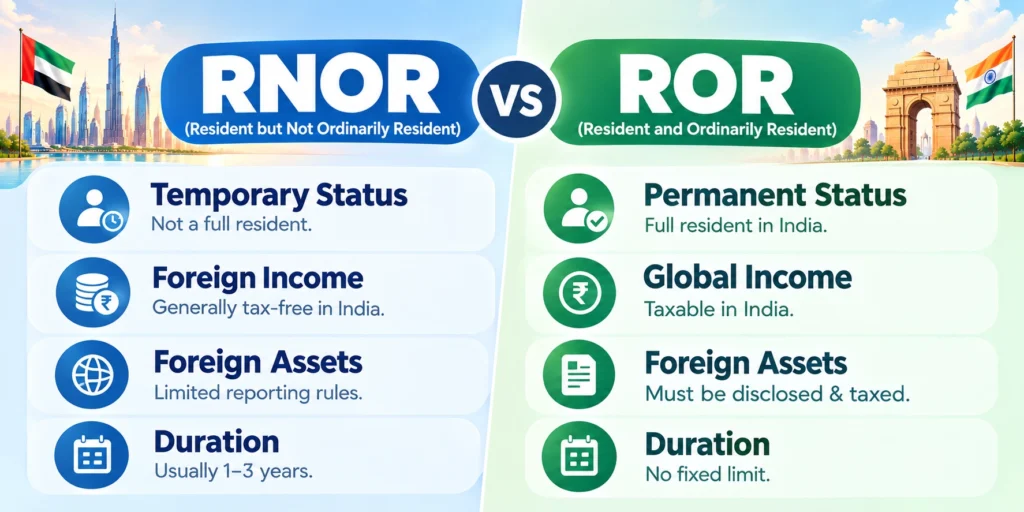
    Income Tax residency is more nuanced. Depending on your day-count and prior residency history, you can qualify as:

    • RNOR (Resident but Not Ordinarily Resident) for 2 to 3 years, protecting your UAE income and offshore assets from Indian tax
    • ROR (Resident and Ordinarily Resident) with full global income taxation

    UAE returnees also face the Section 6(1A) deemed resident test. If your Indian income exceeds Rs 15 lakh in a year and you are not liable to personal tax in the UAE, you can be treated as a deemed resident (RNOR by classification) even without meeting normal residency thresholds.

    Gratuity, RSUs, and Real Estate: How India Taxes UAE Money

    The three biggest financial pieces UAE returnees bring home need careful sequencing.

    End of Service Gratuity (EOSB):

    • Received before Indian residency change: not taxable in India
    • Received after becoming ROR: taxable as income from other sources
    • During RNOR window: typically not taxable if earned for foreign services
    • Timing the exit and gratuity payout can save lakhs

    RSUs and Stock Options:

    • Vesting during UAE tenure: UAE-source, no India tax during RNOR window
    • Vesting after Indian residency change: India-source based on workday allocation
    • Sale of vested shares: capital gains apply based on residency at sale date

    Dubai and UAE Real Estate:

    • Rental income is taxable in India once you become ROR
    • Capital gain on sale during RNOR is generally outside Indian tax
    • After ROR, sale gain is taxable with DTAA credit for any UAE tax paid
    • FEMA permits continued holding of UAE real estate

    Our Capital Gains Tax desk models the ideal sale timing across the RNOR to ROR transition.

    Common Mistakes UAE Returnees Make

    The most expensive errors are avoidable:

    • Assuming Emirates ID cancellation equals UAE tax residency termination
    • Not obtaining a UAE TRC before leaving
    • Missing the CRS and FATCA update at UAE banks
    • Ignoring ongoing Corporate Tax and VAT filings for UAE entities
    • Failing to redesignate NRE and NRO accounts within a reasonable time
    • Overlooking Section 6(1A) deemed resident exposure on Indian income above Rs 15 lakh
    • Missing the FAST-DS 2026 window for legacy foreign asset disclosure
    • Not updating DIFC or ADGM wills and nominations
    • Cashing out RSUs at the wrong time and losing RNOR protection
    • Forgetting to file Form 41 with updated TRC under the new Income Tax Act 2025

    Where notices have already been issued on residency or foreign asset positions, our NRI Income Tax Notice Solutions team closes the file efficiently.

    How MostlyNRI Helps UAE Returnees Land Cleanly

    The 6-step guidebook is a strong framework, but executing it in real life across two tax systems, three currencies, and multiple entities requires professional integration. At MostlyNRI, we help UAE returnees with:

    • RNOR window planning aligned to gratuity, RSU, and asset sale timing
    • India-UAE DTAA tie-breaker analysis and TRC procurement
    • Section 6(1A) deemed resident risk assessment for high-income NRIs
    • NRE, NRO, RFC redesignation and FEMA compliance
    • ITR filing under the Income Tax Act 2025 with correct form references
    • FAST-DS 2026 eligibility review and disclosure execution
    • Schedule FA, FSI, and TR disclosures with full DTAA credit optimisation
    • Coordination with your UAE counsel for entity liquidation, corporate tax, and VAT filings

    Our team has served returnees from the UAE and the wider Gulf, with a client footprint spanning 33 countries and 13 Indian cities.

    Planning your UAE-to-India return in 2026? Book a consultation with our specialists at beige-spoonbill-433256.hostingersite.com/ to build your 6-step homecoming plan with RNOR, TRC, gratuity, and Schedule FA compliance mapped end-to-end.

    Frequently Asked Questions (FAQs)

    Does UAE tax residency end automatically when I leave the UAE?

    No. Emirates ID cancellation and physical departure do not automatically terminate UAE tax residency. UAE Federal Tax Authority uses day-count, permanent home, and centre of financial interests tests, and the India-UAE DTAA uses a 183-day and tie-breaker rule for treaty purposes.

    Do I need a UAE Tax Residency Certificate before returning to India?

    Yes, strongly recommended. A UAE TRC protects your India-UAE DTAA claims for the transition year and supports any dual-residency defence during Indian scrutiny. Apply for the TRC through the UAE Federal Tax Authority portal before you cancel your Emirates ID.

    What is RNOR status and how long does it last for UAE returnees?

    Resident but Not Ordinarily Resident (RNOR) protects UAE returnees from Indian tax on foreign income for 2 to 3 financial years. You qualify if you were a non-resident in 9 of the last 10 years or spent 729 days or less in India during the past 7 years.

    Is end-of-service gratuity from a UAE employer taxable in India?

    If the gratuity is received before you become an Indian tax resident or during the RNOR window for foreign services, it is generally not taxable in India. Timing the payout around your residency change and RNOR eligibility can save substantial tax.

    Do I have to sell my Dubai property when I return to India?

    No. FEMA permits continued holding of UAE real estate after you become an Indian resident. Rental income becomes taxable in India after ROR classification, and capital gains on eventual sale can be optimised through timing within your RNOR window.

    What happens to my UAE company or free zone entity when I move to India?

    Corporate Tax, VAT, ESR, and UBO filings continue for your UAE entity even after you move. You can maintain, restructure, or liquidate the entity, but ongoing compliance obligations must be met from India or through your UAE counsel to avoid licence cancellation.

    Am I liable to Indian tax under Section 6(1A) as a UAE NRI?

    Possibly. If your Indian income exceeds Rs 15 lakh and you are not liable to personal income tax in the UAE, Section 6(1A) treats you as a deemed resident (RNOR by classification). You then pay Indian tax on India-sourced income but not on UAE salary.

    Do I need to redesignate my NRE and NRO accounts when I move back?

    Yes. Under FEMA, you must redesignate your NRE and NRO accounts to resident savings accounts, or move NRE balances to Resident Foreign Currency (RFC) accounts to retain foreign currency exposure. Notify all Indian banks within a reasonable period.

    Should UAE returnees use the FAST-DS 2026 foreign asset disclosure scheme?

    Yes, if your Schedule FA history is incomplete and your undisclosed UAE assets fall under Rs 5 crore or income under Rs 1 crore. FAST-DS 2026 offers immunity from Black Money Act penalties up to 300 percent and prosecution risk if disclosure is voluntary.

    How can MostlyNRI help me plan my UAE-to-India return?

    MostlyNRI structures RNOR planning, TRC procurement, DTAA tie-breaker analysis, gratuity and RSU timing, NRE and NRO redesignation, ITR filing under the Income Tax Act 2025, and FAST-DS 2026 disclosures, coordinating with UAE counsel for a single-window return.

  • What Does It Cost NRIs to Return to India for Ageing Parents? Tax, FEMA, and Financial Planning Rules Explained

    What Does It Cost NRIs to Return to India for Ageing Parents? Tax, FEMA, and Financial Planning Rules Explained

    For a growing number of Non-Resident Indians, life abroad eventually collides with the reality of ageing parents back home. According to the Back to India NRI Community Survey 2025-26, 74% of returning NRIs listed ageing parents among the top three reasons for their move back. What starts as a long-distance concern often turns into a life-changing decision to pack up overseas assets and relocate.

    But moving back is not just an emotional call. It reshapes your taxes, FEMA status, bank accounts, foreign investments, insurance cover, and cash flow, all at once. Between residency changes, RNOR eligibility, US or UK exit rules, and redesignation of NRE and NRO accounts, the financial transition is dense and time-sensitive.

    This guide breaks down exactly what it costs NRI Return to India for Ageing Parents, the compliance rules that kick in from day one, and the six to twelve month planning window every returnee should protect.

    Why NRIs Are Returning: The Ageing Parents Trigger

    The Back to India NRI Community Survey 2025-26 found that 74% of respondents placed elderly parents among the top three drivers of their return. This is backed by hard health data. The UNFPA India Ageing Report 2023 shows that 1 in 3 elderly Indians lives with an ongoing chronic health condition.

    For NRIs, the pattern is common: a sudden diagnosis, a hospitalisation, a fall, or a spouse’s death triggers the shift. Managing surgeries, medication schedules, and hospital paperwork across time zones becomes practically impossible.

    Many returnees say their physical presence has significantly improved their parents’ health outcomes, from managing cataract surgeries and cardiac care to routine medication review. But the emotional gain must be paired with a cold financial audit before the move is finalised.

    The True Cost of Returning: A Financial Reality Check

    Returning is rarely a lateral career move. Most NRIs accept significant financial trade-offs. Here is what typically shifts in the first 12 to 24 months back in India.

    Income Reset

    Returning professionals often accept lower salaries. Some returnees report starting at one-third of their overseas income, particularly if they relocate to Tier 2 or Tier 3 cities where matching roles are scarce. Freelancing, executive coaching, advisory work, and online teaching are common bridge options.

    Medical Expenses

    Health insurance in India rarely covers the full range of parental care. Costs commonly not reimbursed include:

    • Consumables during hospital stays
    • Doctor visits outside the network hospitals
    • Chemotherapy or specialised treatments beyond policy caps
    • Home nursing and physiotherapy
    • Diagnostic tests, imaging, and follow-ups

    Insurance premiums for elderly parents can consume 10% to 20% of a returnee’s monthly income, especially if the parents have pre-existing conditions.

    Household and Cash Flow Reset

    Rebuilding daily life in India includes school admissions for children, vehicle purchase, home setup, and often a temporary rental until permanent housing is decided. A 6 to 12-month liquidity buffer in an Indian bank account is essential.

    For a personalised cash flow and residency review before your move, start with our NRI Tax Residency Calculator.

    The FEMA Change: When You Become a Resident

    Under the Foreign Exchange Management Act (FEMA), an Indian citizen becomes a resident as soon as they arrive in India with the intention to stay. This is very different from the Income Tax Act, which uses a day-count test.

    The FEMA change means:

    • Your NRE and NRO accounts must be redesignated as resident savings accounts
    • Your NRE fixed deposits convert to Resident Foreign Currency (RFC) deposits or are re-tagged
    • You must notify all financial institutions: banks, brokers, mutual fund houses, and insurers
    • Overseas assets may need to be reported and structured for compliance

    Missing this step is one of the most common mistakes returnees make. Continuing to operate an NRE account after becoming a FEMA resident is a compoundable offence.

    RNOR Status: The Two to Three Year Tax Cushion

    The Income Tax Act allows a transitional category called Resident but Not Ordinarily Resident (RNOR). This status protects returning NRIs from being taxed on their foreign income, overseas salaries, and offshore retirement corpus for a limited window.

    You qualify as RNOR if:

    • You were a non-resident in 9 out of the 10 preceding financial years, or
    • Your stay in India during the last 7 years is 729 days or fewer

    Most returning NRIs enjoy RNOR status for 2 to 3 years after their move. During this window:

    • Foreign salary and pension income is not taxable in India
    • Overseas rental and dividend income stays outside Indian tax
    • US 401(k), UK pension, and other retirement funds are protected
    • Only India-sourced income is taxable

    This is your planning window. Selling appreciated foreign assets, closing brokerage accounts, or withdrawing retirement corpus during RNOR years can save significant tax later. Learn more through our Returnee NRI Transition Services.

    Redesignating NRE and NRO Accounts to Resident Accounts

    Once you cross the FEMA residency threshold, you must:

    1. Notify your bank in writing within a reasonable period
    2. Redesignate NRE savings to a resident savings account
    3. Convert NRE fixed deposits to RFC deposits (to retain foreign currency) or resident FDs (to convert to rupees)
    4. Update KYC across mutual funds, brokers, insurers, and NPS
    5. Close or transfer NRO accounts as needed
    6. Report foreign assets in the applicable Schedule of the ITR

    For clarity on which account structure fits your post-return needs, use our NRI Bank Account Type Advisor.

    Foreign Assets, 401(k)s and Double Taxation Risk

    The biggest tax trap for returnees is double taxation on overseas retirement or salary income. Without careful planning, both India and the source country may tax the same money.

    Assets that need review before your return:

    • US 401(k) and IRA balances
    • UK pension plans, workplace pensions, and SIPPs
    • Canadian RRSPs and TFSAs
    • Australian superannuation
    • Foreign brokerage accounts and stock options
    • Overseas rental property
    • Foreign insurance policies with cash value

    The right sequence and timing of withdrawal, transfer, or restructuring during your RNOR years can prevent a significant tax leak later.

    Read our detailed Capital Gain Tax advisory for cross-border asset planning.

    US Returnees: Form W-8BEN and Related Exit Steps

    If you are moving back from the United States, your compliance list includes:

    • File Form W-8BEN with US financial institutions to establish non-resident alien tax status
    • Retain the ability to withdraw 401(k) and IRA funds under US rules
    • Consider the impact of PFIC rules on Indian mutual funds
    • File your final US federal and state tax return correctly
    • Report any Indian mutual funds and financial accounts on FBAR and Form 8938 if still applicable
    • Plan Roth conversions or partial withdrawals during RNOR years

    Skipping W-8BEN can result in continued 30% withholding tax on your US investment income even after you have become an Indian resident.

    UK, Canada, and Other Countries Returnees: Exit Formalities

    Different countries impose different exit rules on residents leaving permanently.

    UK returnees must:

    • Complete first-year exit tax formalities with HMRC
    • File the correct residency change forms
    • Understand the Statutory Residence Test implications
    • Review UK pension withdrawal timing under the India-UK DTAA

    Canadian returnees should:

    • File a departure tax return with CRA
    • Report a deemed disposition on certain assets
    • Close or transfer TFSA (since it loses tax-free status)
    • Review RRSP withdrawal timing

    Australian returnees should:

    • Handle superannuation implications carefully
    • Update residency status with the ATO
    • Time for large asset sales around residency change

    Six to Twelve Month Planning Checklist for NRIs Returning

    Financial planners consistently recommend starting six to twelve months before your move. Here is a practical timeline.

    6 to 12 Months Before Return

    • Consult a cross-border tax advisor
    • Audit overseas assets, retirement corpus, and rental income
    • Review your RNOR eligibility
    • Plan the sequence of asset sales
    • Start restructuring the US 401(k) or UK pension decisions

    3 to 6 Months Before Return

    • Notify your employer and payroll
    • Open or update Indian bank accounts
    • Arrange health insurance for parents and family
    • Get KYC updated across Indian mutual funds and brokers
    • Build a 6 to 12-month cash buffer in India

    0 to 3 Months After Return

    • Redesignate NRE and NRO accounts
    • File W-8BEN or country-equivalent with foreign banks
    • Notify financial institutions of status change
    • File exit tax returns in the country of departure
    • Start tracking RNOR years for tax planning

    Our team at Returnee NRI Transition Services executes each of these steps with you.

    Common Mistakes Returning NRIs Make

    The most expensive errors are avoidable. NRIs commonly slip up by:

    • Continuing to operate NRE accounts after becoming a FEMA resident
    • Missing RNOR planning and losing tax-free withdrawal windows
    • Not filing W-8BEN with US institutions
    • Ignoring PFIC risk on Indian mutual funds held while still a US person
    • Assuming health insurance covers all parental medical costs
    • Making large investment commitments in the first six months back
    • Skipping Schedule FA disclosure in the Indian ITR for RNOR years
    • Overlooking double taxation on 401(k) or pension withdrawals

    If you have already returned and missed some of these steps, our Income Tax Notice Solutions team helps clean up disclosures and respond to any queries.

    How MostlyNRI Helps NRIs Return Home Smoothly

    Coming back to care for ageing parents is emotional. Making the money side work should not add to that stress. At MostlyNRI, we have built a complete return transition package for NRIs across the USA, UAE, UK, Canada, Singapore, and Australia.

    Our services cover:

    • Returnee NRI Transition planning end-to-end
    • RNOR eligibility analysis and multi-year tax planning
    • NRE, NRO, RFC account redesignation guidance
    • Foreign asset audit and repatriation planning
    • Capital gains structuring on overseas assets
    • ITR filing for RNOR and resident years
    • Health insurance advisory for parents and returning families
    • Handling of notices for late compliance

    Our team has served clients from over 33 countries across 13 Indian cities.

    Frequently Asked Questions (FAQs)

    1. When does an NRI become an Indian resident under FEMA?

    Under FEMA, an Indian citizen becomes a resident as soon as they arrive in India with the intention to stay. Unlike the Income Tax Act, FEMA does not use a day-count test. This triggers immediate bank account and compliance changes.

    2. What is RNOR status, and how long does it last?

    Resident but Not Ordinarily Resident (RNOR) is a transitional tax category applying to returning NRIs. It typically lasts 2 to 3 financial years and protects foreign salary, pension, and investment income from Indian tax during that window.

    3. Do I need to close my NRE account after returning to India?

    Yes. Once you become a FEMA resident, your NRE account must be redesignated as a resident savings account, or the balance can be transferred to a Resident Foreign Currency (RFC) account to retain foreign currency exposure.

    4. Will my US 401(k) be taxed in India after I return?

    During your RNOR years, your 401(k) income and withdrawals are generally not taxed in India. Once you become a Resident and Ordinarily Resident (ROR), global income becomes taxable, and DTAA relief must be evaluated on withdrawals.

    5. What is Form W-8BEN, and why must US-based NRIs file it?

    Form W-8BEN is filed with US financial institutions to establish your non-resident alien status after leaving the US. It ensures correct US withholding on investment income and avoids continued treatment as a US tax resident for reporting purposes.

    6. How much do medical expenses typically cost NRIs returning for ageing parents?

    Insurance and out-of-pocket medical expenses for elderly parents can consume 10% to 20% of a returnee’s monthly income. Common gaps include consumables, home nursing, physiotherapy, and treatments beyond insurance sub-limits, especially where chronic illnesses are involved.

    7. Can NRIs continue to hold foreign assets after returning to India?

    Yes, but you must report them in your Indian ITR once you become a Resident and Ordinarily Resident. During RNOR years, foreign income is protected, but Schedule FA and Schedule FSI disclosures still apply based on residency category.

    8. How early should NRIs start planning their return to India?

    Financial planners recommend beginning the transition 6 to 12 months in advance. This window lets you audit overseas assets, structure withdrawals during RNOR years, notify institutions, and maintain adequate liquidity without compromising long-term financial security.

    9. What happens if I miss redesignating my NRO or NRE accounts?

    Operating an NRE account after becoming a FEMA resident is a compoundable offence. It can attract penalties, bank freezes, and tax notices. Redesignation should be completed within a reasonable period, typically within 90 days of return.

    10. How can MostlyNRI help me plan my return to India?

    MostlyNRI offers a full Returnee NRI Transition Service covering RNOR planning, account redesignation, foreign asset audit, capital gains structuring, ITR filing, and health insurance advisory. Our experts guide NRIs across 30+ countries through every compliance step.

  • Where Should Returning NRIs Invest During Their RNOR Period? A Complete Investment Guide

    Where Should Returning NRIs Invest During Their RNOR Period? A Complete Investment Guide

    You’ve just returned to India after years abroad.

    And somewhere between the reunion dinners and the paperwork, a serious financial question is sitting quietly in the background. What do I do with all the money I saved abroad and how do I make sure I don’t lose a chunk of it to taxes I didn’t plan for?

    If you qualify for RNOR Resident but Not Ordinarily Resident status, you have a two to three year window where your foreign income is not taxed in India. That’s a meaningful advantage. But only if you use it deliberately.

    This guide covers exactly what returning NRIs should do with their money during the RNOR period. You’ll find:

    • What RNOR actually means for your investments and why the timing matters
    • What to do immediately after returning – which accounts to protect, which to convert, and what not to touch
    • The best investment options during RNOR – from FCNR deposits and RFC accounts to equity mutual funds and NPS
    • What to avoid – the common mistakes that cost returning NRIs lakhs in unnecessary tax
    • A worked example showing exactly how one returning NRI structured his RNOR plan across different asset types
    • Answers to the most common RNOR questions – including account conversion timelines, foreign asset reporting, and ITR filing

    The RNOR window doesn’t wait. The NRIs who get the most out of it are the ones who planned it early – not the ones who figured it out after it closed.

    Quick Recap Why the RNOR Window Is a Once-in-a-Lifetime Opportunity

    Think of RNOR status as a financial bridge.

    You’ve left your life abroad. But the Indian tax system hasn’t fully claimed you yet.

    During this period, typically 2 to 3 financial years, foreign income that accrues and is received outside India is generally not taxable in India. This can include overseas rental income, FCNR interest, and capital gains from foreign assets, subject to applicable tax rules and exceptions. Once RNOR ends and you become a Resident and Ordinarily Resident (ROR), your global income generally becomes taxable in India. Once RNOR ends and you become a Resident and Ordinarily Resident (ROR), everything changes. Your global income becomes taxable in India, at Indian rates.

    That’s why this window matters so much.

    It’s the optimal time to restructure your investments, remit your foreign savings in a planned way, and start building an India-based portfolio in the right order, at the right pace.

    (For the full breakdown of what RNOR status means and how it’s calculated, refer to our RNOR explanation blog in the MostlyNRI series.)

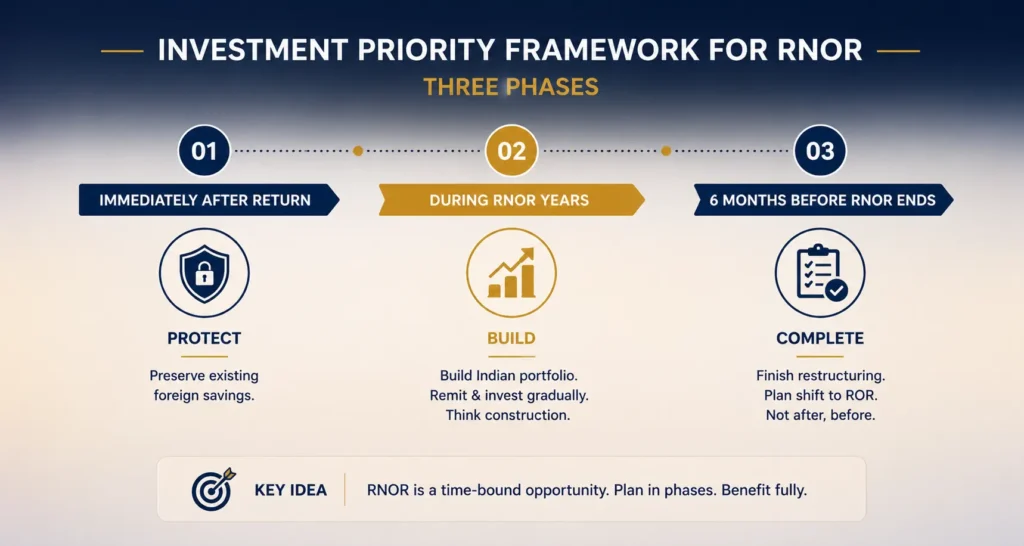
    The Investment Priority Framework for RNOR -Three Phases

    Before we get into specific products, let’s get the strategy right.

    Most returning NRIs make the mistake of treating RNOR as just a tax label. It’s not. It’s a time-bound opportunity with a clear beginning, middle, and end. Your investment decisions should reflect that.

    Here’s how to think about it:

    Phase 1 – Immediately After Return

    Protect your existing foreign savings. Don’t rush to convert. Don’t move money impulsively into Indian accounts. Your job in this phase is to preserve the tax-free structures you already have.

    Phase 2 – During the RNOR Years

    Gradually build your Indian investment portfolio. Use the tax-free window to remit foreign savings in a structured, deliberate way. Start RFC accounts. Continue FCNR deposits. Begin SIPs. Think of this phase as construction.

    Phase 3 – 6 Months Before RNOR Ends

    This is the completion phase. Finish your restructuring. Transfer or liquidate remaining foreign assets. Sit with a tax advisor and plan the shift to ROR before it happens, not after.

    Think of it like defusing a financial clock. Do it in the right sequence and you walk away with everything intact. Rush it or ignore it, and you leave a lot of money on the table.

    Phase 1 What to Do With Foreign Savings Immediately After Returning

    This is where most returning NRIs go wrong.

    Some panic-convert everything to rupees the moment they land. Others do nothing at all and let money sit in overseas accounts with no plan. Neither approach works.

    Here’s what to actually do:

    Don’t close your FCNR deposits: If you have Foreign Currency Non-Repatriable deposits running, leave them where they are. The interest remains tax-free during RNOR even after you’ve returned to India. There’s no urgency to break them early. In fact, breaking them before maturity usually comes with a penalty. Let them run.

    Open an RFC account immediately: A Resident Foreign Currency account is the right vehicle for you right now. It lets you hold and receive foreign currency income inside India. The interest earned is tax-free during your RNOR period. Think of it as the Indian home for your overseas money that doesn’t cost you in taxes. This should be your first financial action after return.

    Don’t convert NRE accounts to NRO prematurely: Interest on existing NRE deposits may continue to enjoy tax benefits during the RNOR period, subject to FEMA compliance and bank redesignation requirements. Once funds are held in an NRO account, the applicable interest becomes taxable under Indian tax rules. There is a right time to do this conversion. Day one is not that time.

    Keep foreign salary, rental income, and overseas capital gains where they are: Don’t route them into Indian savings accounts or NRO accounts. Once that money touches the wrong type of Indian account, the tax advantage disappears. It’s like letting a perfectly good tax shield rust in the rain.

    (Our RNOR Checklist blog and Foreign Currency Accounts blog cover the full account conversion sequence with step-by-step guidance.)

    Phase 2 Best Investment Options During the RNOR Period

    Now we get to the heart of it.

    What should you actually be investing in during these 2 to 3 years?

    There are two categories here. Investments that are tax-free during RNOR specifically, and investments that you should start building even though their returns will eventually be taxable. Both matter. Let’s take them one at a time.

    Tax-Free Investments to Prioritise During RNOR

    These are your highest-priority options. They’re tax-efficient because of your RNOR status. The window is open. Use it.

    FCNR Deposits

    Foreign Currency Non-Repatriable deposits are denominated in foreign currency. USD, GBP, EUR, and other accepted currencies. The interest you earn is completely tax-free during your RNOR period. You carry no currency risk because you’re earning and holding in the same currency. If you already have FCNR deposits, hold them to maturity. If you’re remitting fresh foreign savings, new FCNR deposits are worth considering for the portion you want to keep in foreign currency safely.

    Practical tip: Don’t break existing FCNR deposits just because you’re back in India. The tax-free status continues through RNOR regardless of where you are physically.

    RFC Account Deposits

    The RFC account is the unsung hero of RNOR planning. Very few returning NRIs know about it or open one quickly enough. You can park your overseas savings here in foreign currency, earn interest that is tax-free during RNOR, and the funds remain freely repatriable if you ever need to send money back abroad. It gives you flexibility without sacrificing the tax advantage.

    NRE Fixed Deposits

    These are rupee-denominated fixed deposits held in your NRE account. Interest is tax-free during RNOR. If you’re remitting foreign savings and converting to rupees, parking the converted funds in NRE FDs rather than a regular savings account gives you the same safety with a meaningful tax benefit. The interest rates on NRE FDs from Indian banks are often quite competitive too.

    ELSS Mutual Funds

    Equity Linked Savings Schemes are tax-saving mutual funds with a mandatory 3-year lock-in. Start buying ELSS units during your RNOR years. By the time the lock-in ends, you’ll have a growing equity portfolio. If you opt for the old tax regime, you may also claim Section 80C deductions on eligible investments. The compounding starts now. The payoff builds over time. Mutual fund investments are subject to market risk. Past performance does not guarantee future returns.

    Mutual fund investments are subject to market risk. Past performance does not guarantee future returns.

    Indian Investments to Start Building During RNOR

    These won’t be tax-free. But starting early is what makes the real difference in the long run.

    Think of RNOR as the construction phase of your India wealth portfolio. You’re laying the foundation while the tax environment is still relatively forgiving.

    Equity Mutual Funds

    Start SIPs in diversified equity mutual funds. Long-term capital gains on equity funds are taxed at 12.5% above Rs. 1.25 lakh after a holding period of one year. The earlier you start, the longer your compounding horizon. You don’t need massive lump sums. A consistent monthly SIP started during RNOR builds serious corpus over 10 to 15 years. Slow and steady genuinely wins here.

    PPF (Public Provident Fund)

    If you maintained a PPF account before moving abroad, you can continue contributing during RNOR. Contributions qualify for Section 80C deductions under the old tax regime. PPF maturity proceeds are tax-free. It’s a low-risk, long-term vehicle that makes strong sense to keep running.

    NPS (National Pension System)

    RNOR holders can contribute to NPS and claim deductions under Section 80CCD. The additional Rs. 50,000 deduction under Section 80CCD(1B) is available over and above the 80C limit. That’s meaningful tax saving during RNOR. It also builds a retirement corpus structured specifically for your India life going forward. Note that these deductions apply under the old tax regime.

    Indian Real Estate

    If you’re planning to buy property in India anyway, the RNOR period is a reasonable window to do it. Rental income will be taxable, but the acquisition itself doesn’t create any unusual tax complications. Capital appreciation is a long-term goal. And owning property early in your return helps anchor your financial life in India.

    Direct Equity

    Once your accounts are re-designated to resident status, you can invest in Indian stocks through a regular resident demat account. Start building a portfolio with a long-term horizon. The fundamentals of good stock investing don’t change, but starting early gives your holdings more time to grow.

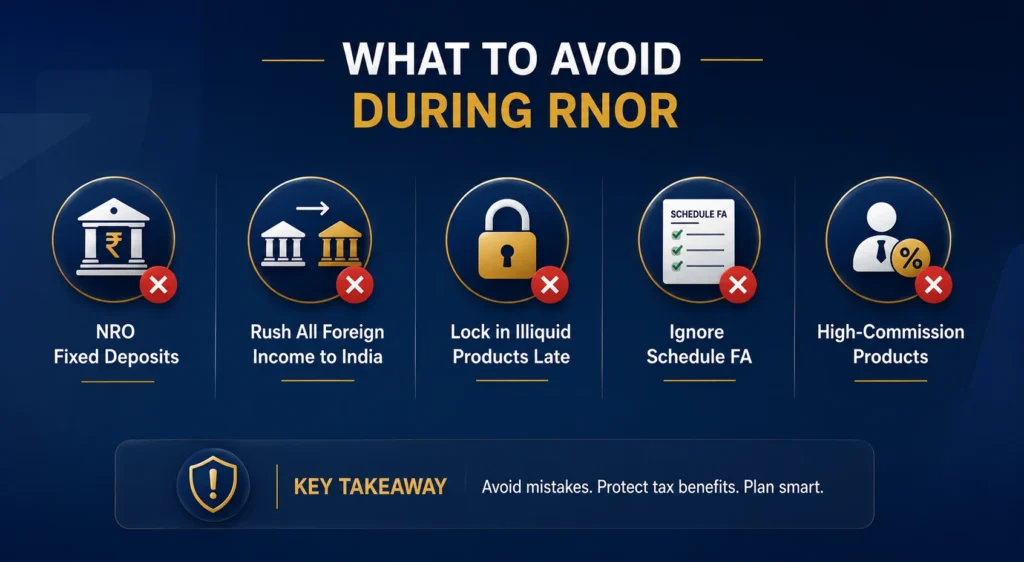
    What to Avoid Investing In During RNOR

    Knowing what not to do is just as important as knowing what to do.

    Here’s the honest list.

    Don’t put foreign savings into NRO fixed deposits: NRO interest is taxed at 30% with no threshold. That’s the same money that could be earning tax-free returns in FCNR or RFC. The difference over 2 to 3 years is significant. This is probably the most common and costly mistake returning NRIs make.

    Don’t rush all foreign income into Indian accounts: Once money lands in a regular Indian savings account, it loses its tax-advantaged status. Repatriation also becomes more complicated afterward. Move it in planned tranches, through the right account types, on a schedule that suits your RNOR timeline.

    Don’t lock large sums in illiquid products close to RNOR ending: The transition to ROR may require restructuring. If your money is tied up in long lock-in products you bought in a hurry, you lose the flexibility you’ll need most during that transition period.

    Don’t ignore Schedule FA in your ITR: Even as an RNOR, you are required to declare all foreign assets in Schedule FA of your Income Tax Return. Overseas bank accounts, foreign property, stocks held abroad, pension funds. All of it. Failure to disclose attracts penalties under the Black Money Act, up to Rs. 10 lakh per undisclosed asset per year. The Income Tax department receives foreign financial data automatically through FATCA and CRS international agreements. Non-disclosure is not a strategy. It’s a risk.

    Don’t buy high-commission products from agents who don’t understand RNOR: ULIPs and endowment plans are frequently sold to returning NRIs as “tax-saving” options. Most of them are unsuitable for this specific phase. Understand what you’re buying and why it fits your RNOR situation before signing anything.

    Build Your RNOR Investment Plan With an NRI Tax and Financial Expert. Talk to MostlyNRI.

    How Long Can You Keep Your NRE Account After Returning to India?

    This is one of the most searched questions by returning NRIs. Let’s answer it clearly.

    Under FEMA regulations, you are required to re-designate your NRE account to a resident savings account or an RFC account after returning to India permanently. RBI guidelines say this should happen within a “reasonable time,” but there is no fixed calendar deadline in the regulations.

    In practice, most banks allow NRE accounts to continue for a short transition period while documentation and residency status changes are being processed. But here’s the catch. Any interest that accrues after you become a resident is taxable, even if the account still technically carries the NRE label.

    For returning NRIs who wish to retain foreign currency exposure or maintain repatriation flexibility, an RFC account is often worth considering. RFC accounts preserve the foreign currency denomination, and interest may remain tax-efficient during the RNOR period subject to applicable rules.

    FCNR deposits are a different story. They can be held to their maturity date even after your return. No need to break them early. NRO accounts can simply continue as-is. They were always structured for resident use and were always taxable.

    (The full account conversion sequence with timing is covered in our RNOR Checklist blog.)

    Foreign Assets and Tax Reporting After Returning to India

    Foreign asset reporting requirements depend on your exact residential status under the Income Tax Act and the ITR form being filed. In general, the obligation to report foreign assets in Schedule FA applies to Resident and Ordinarily Resident (ROR) taxpayers.

    Returning NRIs should maintain complete records of overseas bank accounts, investments, pension funds, and foreign properties throughout the RNOR period. These records become particularly important as you approach ROR status and your reporting obligations may change.

    Failure to disclose reportable foreign assets when required can attract significant penalties under the Black Money Act. Since India receives financial information from many jurisdictions through international information-sharing arrangements such as FATCA and CRS, maintaining proper records and obtaining professional advice is strongly recommended.

    Sample RNOR Investment Plan A Practical Example

    Let’s make this concrete. Meet Arjun.

    Arjun is 45. He returned from the US in April 2025. Based on his residency history, he qualifies as RNOR for FY 2025-26 and FY 2026-27. Here’s what his financial picture looks like:

    • USD 200,000 in overseas savings
    • FCNR deposit of USD 50,000 maturing in December 2025
    • NRE fixed deposit of Rs. 30 lakh
    • NRO account with Rs. 5 lakh in rental income from an Indian property

    Here’s what a structured RNOR plan looks like for him:

    AssetAmountTax During RNORAction
    FCNR DepositUSD 50,000Tax-freeHold till December 2025 maturity, transfer proceeds to RFC
    RFC Account (new)USD 150,000Tax-freeOpen immediately after return, park bulk of overseas savings here
    NRE Fixed DepositRs. 30 lakhTax-freeMaintain till maturity, renew if still RNOR, convert to resident FD when RNOR ends
    Equity Mutual Funds (SIP)Rs. 50,000/month12.5% LTCG above Rs. 1.25LBegin SIP from RFC or NRE converted funds
    NPS ContributionRs. 50,000/yearDeductible under 80CCD(1B)Start contributions for additional deduction under old regime
    NRO AccountRs. 5 lakh rental incomeTaxable, TDS at 30%File ITR to claim refund on excess TDS deducted

    Arjun doesn’t move everything at once. He sequences it deliberately.

    FCNR runs to maturity. RFC is opened immediately for the bulk of overseas savings. NRE FD stays as-is. SIPs begin from converted funds. NPS contributions add a deduction layer. And the NRO account gets cleaned up through proper ITR filing.

    That’s the discipline that makes RNOR planning actually work.

    This example is illustrative only. Individual investment and tax situations vary significantly based on income sources, foreign asset types, residency history, and personal financial goals. Please consult a qualified NRI tax and financial advisor before making any investment decisions based on this example.

    Conclusion

    The RNOR period sounds long. Two to three years feels like plenty of time.

    It isn’t.

    Before you know it, the window is tightening and you’re scrambling to restructure. The NRIs who come out of this transition in the best financial shape are the ones who planned it early, moved deliberately, and got advice that was specific to their situation, not generic NRI advice from someone who doesn’t know the difference between RFC and NRO.

    Remember that RNOR taxation contains important exceptions. Foreign income that accrues and is received outside India is generally not taxable in India during RNOR. However, income derived from a business controlled in India or a profession set up in India may still be taxable. Professional advice is recommended before restructuring significant assets or investments.

    Start with Phase 1. Protect what you have. Then build from there.

    All investment information in this article is for general informational purposes only. Mutual fund investments are subject to market risk. Past performance does not guarantee future returns. This content does not constitute financial or tax advice. Individual situations vary significantly. Please consult a qualified NRI tax and financial advisor before making any investment or tax decisions.

    Frequently Asked Questions

    Can I keep my NRE account during RNOR status?

    Yes, for a transitional period. FEMA requires re-designation to a resident account or RFC account after return, but there is no fixed deadline. Most banks allow a short continuation period during documentation processing. The smarter option is converting NRE to RFC rather than a regular resident account. RFC preserves your foreign currency denomination and the tax-free interest status during RNOR.

    Does RNOR need to declare foreign assets?

    Foreign asset reporting requirements depend on your residential status and the applicable ITR provisions. In general, Schedule FA reporting applies to Resident and Ordinarily Resident (ROR) taxpayers. Returning NRIs should maintain complete records of all foreign assets and seek professional advice regarding their reporting obligations.

    Where should NRI invest in India?

    During RNOR, start with RFC accounts, FCNR deposits, and NRE fixed deposits for tax-free returns on foreign savings. Alongside those, begin building an equity mutual fund portfolio through SIPs, contribute to NPS, and consider continuing PPF. The goal during RNOR is to build the foundations of an India portfolio while keeping foreign income in tax-efficient structures for as long as possible.

    Which return should NRI file?

    Most NRIs and RNOR holders file ITR-2. It is required when you have income from more than one house property, capital gains, or foreign assets. If you hold any foreign assets, Schedule FA is a mandatory part of your filing. (See our ITR filing blog for the complete walkthrough.)

    How long is RNOR status valid?

    Typically 2 to 3 financial years, depending on your specific residency history. The exact duration is calculated based on how many years you were an NRI and your physical presence in India over the preceding 10 years. Once you no longer meet the RNOR conditions, you become ROR and your global income becomes fully taxable in India.

    What are the advantages of RNOR status?

    The primary advantage is that foreign income, including salary, rental income, capital gains, and interest on FCNR and RFC accounts, is not taxable in India during the RNOR period. This gives returning NRIs a tax-efficient window to remit savings, restructure investments, and build an India portfolio without the full burden of Indian tax on global wealth hitting immediately.

    What is the difference between NRI and RNOR?

    An NRI is someone who is not a tax resident of India, typically someone living abroad. An RNOR is someone who has returned to India but does not yet qualify as a Resident and Ordinarily Resident under the Income Tax Act. The key practical difference: both NRIs and RNOR holders pay no Indian tax on foreign income. But RNOR is a temporary transitional status. Once it ends, all global income becomes taxable in India.

    What is the 90-day rule for non-residents?

    Indian tax residency is determined primarily by physical presence in India and specific conditions under the Income Tax Act. Depending on your circumstances, different day-count thresholds may apply, including the commonly referenced 182-day and 120-day tests. Since the rules can vary based on citizenship, income levels, and travel history, residency status should be calculated using your actual facts and travel records.

    Will you get a notice if you don’t show foreign assets in ITR?

    If you are required to disclose foreign assets under applicable tax laws and fail to do so, there is a possibility of scrutiny or notices from the tax authorities. India participates in international information-sharing frameworks such as FATCA and CRS, under which financial information may be exchanged between jurisdictions. Maintaining accurate records and complying with applicable reporting requirements is important.

  • Checklist: What NRIs Must Do Before, During, and After Returning to India to Maximize RNOR Benefits

    Checklist: What NRIs Must Do Before, During, and After Returning to India to Maximize RNOR Benefits

    The flights are booked. The kids’ school admissions are sorted. The shipping container is packed.

    And then someone asks: “Have you spoken to a tax advisor yet?”

    Blank stare.

    Most NRIs spend months planning the logistics of moving back to India. The financial and tax side? That gets pushed to “I’ll figure it out once I land.” And that’s exactly where the problem starts. Because RNOR benefits — the legal window that keeps your foreign income tax-free for 2 to 3 years after return — are not automatic. They depend on eligibility, timing, how you handle your accounts, and what you do with your income during that window.

    This is a phase-wise RNOR checklist for returning NRIs. It covers what to do 12 to 18 months before you return, what to action at the time of arrival, and what to manage during the RNOR window itself. Follow it in sequence and you protect every rupee of your foreign income legally.

    Quick Recap: What Is RNOR and Why Does the Checklist Matter?

    RNOR stands for Resident but Not Ordinarily Resident. It is a transitional tax status under Section 6 of the Income Tax Act that sits between NRI and full resident status.

    Here is why it matters. The moment you become a full resident (called ROR — Resident and Ordinarily Resident), India taxes your global income. Everything. But during the RNOR period, only your Indian income is taxable. Foreign income stays protected.

    The window typically lasts 2 to 3 financial years after return. But it is not handed to you automatically. You have to qualify, document it, and manage it correctly. One wrong move — like routing foreign salary into your Indian savings account — and the benefit disappears.

    For a detailed explanation of RNOR eligibility and how the window works, read our full guide on RNOR status for returning NRIs.

    Here is exactly what you need to do, phase by phase.

    Phase 1: Before You Return (12 to 18 Months Out)

    This is the phase most NRIs skip entirely. And it is the most valuable one.

    Think of it like packing for a long trip. The people who pack two weeks early always travel better than those who throw things into a bag at midnight. The financial preparation for return works the same way. The decisions you make 12 to 18 months before landing have more impact than anything you do after.

    To maximise RNOR benefits, returning NRIs must plan in three phases: before returning (calculate eligibility and time the move), at the time of return (update accounts and open RFC), and during the RNOR window (file ITR correctly, report foreign assets, and manage income sources strategically).

    1. Calculate your RNOR eligibility now, not later

    Pull out your passports. Count your non-resident years over the past 10 financial years. Check your total India days over the past 7 financial years. You qualify as RNOR if you were a non-resident in 9 out of the last 10 financial years, OR if your total India stay was 729 days or less in the last 7 financial years.

    Why it matters: If you’re borderline on either condition, you need to know now — while you still have time to adjust travel plans.

    2. Choose your return date strategically

    India’s financial year runs from April 1 to March 31. Returning in April gives you the maximum number of RNOR years. Returning in February or March effectively wastes that financial year’s RNOR benefit.

    Why it matters: The difference between an April return and a March return can mean one full extra financial year of tax-free foreign income. That could be lakhs.

    3. Watch your India visits in the pre-return years

    Every day you spend in India counts toward the 729-day threshold. If you are visiting India frequently in the 2 to 3 years before your final return, you may be eating into your RNOR eligibility without realising it.

    Why it matters: Crossing 729 days in the preceding 7 years can cost you RNOR status — or shorten its duration significantly.

    4. Review your foreign income streams and consider realising gains before return

    Do you have foreign stocks, overseas property, or other assets you plan to sell? Consider selling them while you are still based abroad. Capital gains from foreign assets are not taxable in India during RNOR, but it is cleaner to book them before the transition begins.

    Why it matters: Once you become ROR, capital gains from foreign assets are fully taxable in India. Realising them during the RNOR window — or before returning — is better planning.

    5. Stop routing foreign income into Indian accounts right now

    If your overseas salary, rental income, or dividends are currently going directly into an Indian bank account — stop that arrangement. Re-route to your overseas account or an NRE account.

    Why it matters: Income received in Indian accounts can be treated as income received in India, making it taxable even during RNOR. This is one of the most avoidable mistakes.

    6. Organise your travel history records

    Collect passport copies showing all entry and exit stamps. Get your visa records in order. If you have multiple passports from the same period, keep all of them. Also gather foreign employment contracts, overseas tax return filings, and proof of overseas residence.

    Why it matters: If the Income Tax Department questions your RNOR status, your travel history is your primary evidence. You want this ready, not buried in a drawer.

    Phase 2: At the Time of Return (Month of Arrival and First 90 Days)

    You’ve landed. The boxes are being unpacked. And your financial to-do list is already waiting.

    This phase is about getting your accounts and registrations aligned correctly. The sequence matters here. Do things in the wrong order and you could trigger unnecessary tax on income that should have been protected.

    1. Inform your bank about your return

    This is legally required under FEMA. You must inform your bank that you have returned to India permanently. Your NRE account cannot continue as-is once you’re a resident. The bank will guide you on re-designation.

    Why it matters: Failing to inform the bank does not make the problem go away. It creates a FEMA compliance issue on top of everything else.

    2. Open an RFC (Resident Foreign Currency) account

    This is the most underused tool for returning NRIs. An RFC account lets you hold foreign currency in India legally. During the RNOR period, the interest on RFC deposits is tax-free. If you are still receiving foreign income — rent from overseas property, dividends, freelance payments — route it here.

    Why it matters: RFC accounts are specifically designed for this transition period. They protect your foreign currency income while you figure out the long-term plan.

    3. Do NOT convert NRE to NRO prematurely

    NRO account interest is taxable. NRE account interest, until re-designation, is still tax-free. Converting your NRE to NRO the day you land is a common and costly mistake.

    Why it matters: You lose tax-free interest income unnecessarily by moving too fast. The right move is to convert NRE to RFC or a resident savings account — not NRO.

    4. Do not break FCNR deposits

    Your FCNR (Foreign Currency Non-Resident) deposits can be held until maturity even after you return. The interest on FCNR deposits remains tax-free during the RNOR period.

    Why it matters: Breaking FCNR early costs you both the deposit benefit and the tax-free interest. Leave them untouched until they mature.

    5. Update your KYC and residential status everywhere

    This includes every bank, mutual fund registrar (CAMS and KFintech), demat account provider, insurance company, and any other financial institution. Update your status from NRI to Resident across all of them.

    Why it matters: Mismatched KYC status creates compliance problems and can flag your accounts for scrutiny.

    6. Update PAN records and Aadhaar address

    If your Aadhaar still shows an overseas address, update it. Ensure your PAN is linked correctly and that your residential address reflects your return.

    Why it matters: Your PAN and Aadhaar are the backbone of your India tax identity. Keep them clean and current.

    Which Accounts to Convert, Keep, or Open: A Quick Reference

    Account TypeWhat to Do at ReturnWhy
    NRE AccountRe-designate to RFC or resident savings accountCannot legally remain as NRE once you are resident; but do NOT convert to NRO
    NRO AccountCan be retained as a resident savings accountNRO interest is taxable; do not route foreign income here
    FCNR DepositHold until maturity — do not break earlyInterest remains tax-free during RNOR; breaking early loses this benefit
    RFC AccountOpen one immediately after returnDesigned for returning NRIs; holds foreign currency; interest tax-free during RNOR
    Indian Savings AccountUse for India expenses and income onlyForeign income deposited here may be treated as Indian income and taxed

    The golden rule: keep foreign income in foreign accounts or your RFC account for as long as possible during the RNOR period. The moment it touches your regular Indian savings account, you risk its tax-free status.

    Phase 3: During the RNOR Period (First 2 to 3 Financial Years After Return)

    The window is open. Now you have to manage it actively.

    This is not a “set it and forget it” situation. Every financial year during RNOR requires deliberate action on taxes, investments, and income management. Most people who lose RNOR benefits do not lose them before returning. They lose them during this phase, through careless mistakes that were entirely avoidable.

    1. File your ITR every year — as RNOR, not NRI or ROR

    Your residency status in your ITR must be accurate. You are no longer an NRI. But you are also not yet a full resident (ROR). Select RNOR as your status in the ITR form each year during this period.

    Why it matters: Filing as NRI when you are a resident is incorrect and can attract notices. Filing as ROR when you are RNOR means you may overpay tax on foreign income unnecessarily.

    2. Report all foreign assets in Schedule FA

    Schedule FA (Foreign Assets) in the ITR must be filled every year once you are RNOR. This includes overseas bank accounts, foreign property, foreign equity holdings, and any other assets held outside India.

    Why it matters: Non-disclosure of foreign assets under the Black Money (Undisclosed Foreign Income and Assets) Act attracts penalties up to Rs. 10 lakhs per asset per year. This is not a formality to skip.

    3. Re-check RNOR eligibility every April

    Each new financial year, run the eligibility test again. Count your non-resident years in the preceding 10. Count your India days in the preceding 7. Do not assume the RNOR status continues automatically.

    Why it matters: The year you stop qualifying but still file as RNOR is a compliance problem waiting to happen. Catch it early, not after a tax notice.

    4. Use this window to remit and restructure foreign savings

    The RNOR period is the best time to bring money from abroad to India in a tax-efficient way. You can remit foreign savings — from overseas accounts or maturing FCNR deposits — to your RFC or resident accounts without triggering Indian income tax, since these are capital remittances, not income.

    Why it matters: Once you become ROR, investment income generated by those foreign funds will be taxable. Getting the funds into the right Indian structures before ROR saves ongoing tax.

    5. Use DTAA and Form 67 for any income taxed in both countries

    If you have income that is taxable both in a foreign country and in India (for example, some types of pension or investment income), use India’s DTAA (Double Taxation Avoidance Agreement) with that country. Claim a foreign tax credit using Form 67 when filing your ITR.

    Why it matters: Without Form 67, you pay full tax in both countries. With it, you offset the foreign tax against your India liability.

    6. Start shifting investments to Indian products systematically

    Use the RNOR years to gradually move your portfolio into Indian mutual funds, fixed deposits, equity, or real estate — in a tax-efficient sequence. Do not try to do everything in year one.

    Why it matters: A planned investment shift avoids large taxable events in a single year and sets you up for a clean ROR transition.

    If you want a personalised roadmap for your specific return — including account sequencing, income routing, and investment timing — the MostlyNRI team can help you build one before you land.

    Documents Every Returning NRI Must Keep for RNOR

    Think of this as your RNOR evidence folder. Keep physical copies and scanned digital backups of everything below. Store them in one place — a dedicated folder or a secure cloud drive.

    • Passport copies showing all travel entries and exits across the RNOR eligibility years
    • Visa records and overseas residence permits for all countries where you lived
    • Foreign employment contracts and appointment letters confirming your overseas work
    • Foreign tax returns filed abroad for each year of NRI status
    • Tax Residency Certificate (TRC) from the foreign country — essential for DTAA claims
    • Form 10F filled and signed — required alongside TRC for DTAA treaty benefits
    • NRE, FCNR, and RFC bank statements showing interest income during the RNOR period
    • Records of all foreign assets — property documents, overseas investment statements, shareholding certificates
    • ITR filings from the NRI years in India, showing income and tax paid

    If the Income Tax Department ever questions your RNOR status or your foreign asset disclosures, this folder is your defence. Keep it updated every year, not just once.

    What Happens When RNOR Ends: Preparing for Full Residency

    At some point, the window closes. You re-check eligibility in April, and this time, you don’t qualify as RNOR anymore. You are now ROR — Resident and Ordinarily Resident. And from that year, your global income is fully taxable in India.

    This transition is not a cliff edge. But it does require preparation — ideally starting 6 months before the expected end of RNOR.

    Here is what to do before the window closes.

    Finalise the liquidation of foreign assets you were planning to sell. Capital gains from foreign assets during RNOR are not taxable in India. After ROR, they are. If you have been sitting on the fence about selling overseas property or closing foreign investment accounts, act before RNOR ends.

    Route remaining foreign income into India or stop it altogether. Any foreign income still flowing after you become ROR will be taxable. Either restructure the investment to stop generating income, or accept that it will now appear in your India ITR.

    Step up your Schedule FA reporting discipline. As ROR, your foreign asset disclosure obligations continue — and the scrutiny generally increases. Make sure every foreign account, property, and investment is correctly disclosed each year.

    Engage an NRI tax advisor well before the end of RNOR. Do not wait until you have already become ROR to start planning. The decisions you make in that 6-month window before transition can significantly reduce your ongoing tax burden.

    The MostlyNRI advisory team works with returning NRIs specifically on this end-of-RNOR transition planning. If you are 12 to 18 months away from that shift, this is the right time to talk.

    Frequently Asked Questions

    How do I maintain RNOR status in India?

    RNOR status is not something you actively “maintain” — it is a status you either qualify for or you don’t, based on your residency history. Each financial year, you check whether you were a non-resident in 9 of the previous 10 years, or whether your India days in the preceding 7 years were 729 or less. If you meet either condition, you are RNOR for that year. You cannot artificially extend it, but you can avoid mistakes that cause you to misfile.

    Can an RNOR maintain an NRE account?

    No. Once you become a resident in India (including RNOR status), you cannot legally maintain an NRE account under FEMA regulations. You must re-designate the NRE account to a resident savings account or an RFC account. The interest already earned on the NRE account during the NRI period and until re-designation remains tax-free, but you cannot continue adding funds to it as a resident.

    Does an RNOR need to declare foreign income?

    Foreign income does not need to be reported as taxable income during RNOR — it is exempt. However, the foreign assets generating that income must be disclosed in Schedule FA of your ITR every year. Exemption from taxation does not mean exemption from disclosure. Failing to report foreign assets attracts serious penalties under the Black Money Act.

    What are the advantages of RNOR status?

    The primary advantage is that foreign income — salary, rental income, capital gains, and investment income from abroad — is not taxable in India during the RNOR period. Interest on NRE and FCNR deposits also continues to be tax-free. This gives returning NRIs a genuine window to transition their finances from an overseas structure to an India-based one without an immediate global income tax hit.

    How long is the RNOR period in India?

    Typically 2 to 3 financial years, depending on your residency history and when you return. The exact duration varies because RNOR eligibility is re-tested every financial year. Returning in April (start of financial year) generally gives you the longest possible RNOR window. Once you no longer meet either eligibility condition, you transition to ROR.

    Can I lose my RNOR status?

    Technically, RNOR is not something you “lose” — you simply stop qualifying for it once your residency history no longer meets the conditions. However, you can effectively waste or reduce your RNOR window by returning mid-financial year, by miscounting your India days in prior years, or by filing the wrong tax status in your ITR. You cannot voluntarily give up RNOR — if you qualify, that is your correct legal status.

    How long can an NRI account be maintained after returning to India?

    Under FEMA, an NRE account must be re-designated to a resident account or RFC account within a reasonable time after becoming a resident. There is no fixed statutory deadline in days, but the general expectation is within a few months of return. FCNR deposits are an exception — they can be held to maturity even after you become a resident. Continuing to hold an NRE account as a resident without re-designation is a FEMA violation.

    What is the difference between NRI and RNOR?

    An NRI is someone who is not a resident of India in a financial year (typically spending less than 182 days in India). An RNOR is someone who is a resident (physically present in India enough to qualify as resident) but whose residency history is primarily overseas. The key tax difference: NRIs are taxed only on Indian income. RNORs are also taxed only on Indian income — plus they must disclose foreign assets. It is only when you become a full ROR that global income becomes taxable in India.

    What is the 90% rule for non-residents?

    This rule appears in certain DTAA treaties, particularly in the context of treaty country residents who earn most of their income in that country. It is not a core Indian Income Tax Act concept, but it is sometimes relevant when claiming treaty benefits. In a few treaties, a non-resident can claim specific deductions or exemptions if 90% or more of their total income originates from the treaty country. If this is relevant to your situation, verify it with a qualified advisor who knows the specific treaty applicable to your country of residence.

    Also read: RNOR vs NRI vs Resident: Which Tax Status Saves You the Most When Moving Back to India?

    Also read: How NRIs Can Use Paytm for International Transactions

  • Top 5 Investment Options for NRIs Planning to Retire in India

    Top 5 Investment Options for NRIs Planning to Retire in India

    You’ve spent years working abroad. Saving hard. Sending money home.

    Now retirement is on the horizon. And you want to come back. Back to your family, your city, your roots. But here’s the question that keeps you up at night: where exactly do you put your money?

    Retirement planning for NRIs is not the same as planning for someone who has lived in India their whole life. You’re dealing with foreign income, currency conversion, changing tax status, and the very real challenge of building a stable income in a country whose economy moves differently from where you’ve been working.

    Get it right, and retirement in India can be deeply comfortable. Get it wrong, and you’ll be dipping into your savings far sooner than you expected.

    This guide walks you through the five best investment options for NRIs retiring in India. Plain language. Real strategies. No fluff.

    Why NRI Retirement Planning in India is Different

    Here’s something most generic retirement guides don’t tell you.

    When you return to India after years abroad, your financial life doesn’t just relocate. It transforms. Your tax status changes. Your NRE accounts stop being tax-free. Your global income suddenly becomes taxable in India. And if you haven’t planned for this transition, it can hit hard.

    Currency risk is real. If most of your savings are in dollars or dirhams, a shift in exchange rates can quietly erode your retirement corpus. Something worth Rs 2 crore today might feel very different in five years if the rupee strengthens.

    Healthcare costs in India are rising. Not as fast as in the West, but faster than most people budget for. A serious illness in your 60s or 70s can cost lakhs in a matter of weeks.

    Inflation in India averages around 5-6% annually. That means the lifestyle you can afford today on Rs 60,000 a month will cost significantly more in ten years. Your investments need to grow, not just sit still.

    And then there’s the RNOR window. When you return to India, you don’t immediately become a full resident for tax purposes. There’s a transitional status called Resident but Not Ordinarily Resident (RNOR). During this period, your foreign income remains exempt from Indian tax. It’s a short window. But if you use it wisely, you can restructure your portfolio with significant tax savings.

    Key Factors NRIs Should Consider Before Investing

    Before you put a single rupee anywhere, ask yourself these five questions.

    How many years to retirement? If you have 10 or more years, you can afford to take some risk for higher growth. If you’re retiring in 3 years, safety and income generation become the priority.

    What monthly income will you need? Be honest. Factor in rent or EMI, healthcare, travel, lifestyle, and emergencies. Most financial planners suggest planning for 70-80% of your current monthly expenses as your retirement income target.

    What is your risk tolerance? Some people sleep fine knowing their money is in equity markets. Others lose sleep if the market dips 10%. Know yourself before you invest.

    What are the tax implications? This changes completely when you go from NRI to resident. Plan withdrawals and account transitions before you land in India.

    How liquid do you need your money to be? Real estate is great on paper. But if you need cash in 30 days, you can’t sell a flat that quickly.

    1. NRE Fixed Deposits: Safe and Tax-Free (While It Lasts)

    Let’s start with the option most NRIs are already using.

    An NRE Fixed Deposit is a fixed deposit held in your Non-Resident External account. The money comes from your foreign earnings. And here’s what makes it attractive: the interest is completely tax-free in India as long as you hold NRI status.

    Think of it like a locked treasure chest. The money is safe. It earns interest. And nobody touches that interest for tax purposes while you’re still abroad.

    Typical NRE FD rates from major Indian banks range between 6.5% to 7.5% per annum. Not spectacular, but very predictable.

    The big catch? The moment you return to India and your status changes from NRI to Resident, the tax-free benefit disappears. Interest on your NRE FD becomes fully taxable as per your income slab. If you’re in the 30% bracket, that changes the math considerably.

    What smart NRIs do: They use NRE FDs as a parking zone for capital before retirement. Then, as they approach the transition, they start planning a gradual shift into more tax-efficient instruments.

    Pros:

    • High capital safety
    • Fully repatriable (you can send the money back abroad if needed)
    • Tax-free interest while NRI status holds
    • Predictable, stable returns

    Cons:

    • Returns are lower than equity over the long term
    • Interest becomes taxable after you return to India
    • Doesn’t beat inflation by a meaningful margin on its own

    NRE FDs work best as one part of your portfolio. Not the whole thing.

    2. Mutual Funds: Your Growth Engine

    If NRE FDs are the safe parking zone, mutual funds are the engine that actually grows your wealth.

    Mutual funds in India allow NRIs to invest in equity markets, debt instruments, or a mix of both. The variety is enormous. And for retirement planning specifically, two strategies stand out.

    SIP for building corpus. A Systematic Investment Plan lets you invest a fixed amount every month. It’s disciplined. It removes the temptation to time the market. And over 10-15 years, the compounding effect can be significant. Think of it like a slow cooker. You put the ingredients in, turn it on, and let time do the work.

    SWP for retirement income. A Systematic Withdrawal Plan works in reverse. Once you retire, you set up a fixed monthly withdrawal from your mutual fund corpus. The rest stays invested and continues growing. It’s one of the cleanest ways to create a self-sustaining monthly income.

    For example, if you have Rs 1 crore in a balanced hybrid fund generating 10% annually on average, and you withdraw Rs 50,000 per month through SWP, your corpus can potentially sustain itself for 25 years or more.

    Best fund categories for NRI retirement:

    • Equity funds for long-term growth (10+ year horizon)
    • Debt funds for stability and lower risk
    • Hybrid/balanced funds for a mix of both
    • Index funds for low-cost, consistent market returns

    One important note for NRIs: Investors based in the US and Canada face restrictions from certain Indian fund houses due to FATCA compliance requirements. If you’re in those countries, check fund eligibility before investing.

    Tax angle: Equity mutual fund gains held for more than one year are taxed at 12.5% (Long Term Capital Gains above Rs 1.25 lakh). Debt fund gains are now taxed at your income slab rate. Plan accordingly.

    3. National Pension System (NPS): Built for Retirement

    The NPS is India’s government-backed retirement savings scheme. And it is genuinely designed for people who want a pension.

    NRIs are eligible to invest in NPS. The contributions go into a mix of equity, corporate bonds, and government securities, depending on the allocation you choose. At retirement (age 60), you can withdraw 60% of the corpus tax-free. The remaining 40% is used to purchase an annuity, which gives you a fixed monthly pension for life.

    That’s the part most people miss. Not just a lump sum. An actual monthly pension. For the rest of your life.

    Tax benefits are significant. Contributions up to Rs 1.5 lakh per year qualify for deduction under Section 80C. An additional Rs 50,000 is deductible under Section 80CCD(1B). That’s Rs 2 lakh in annual tax savings just from NPS contributions.

    Is NPS right for NRIs?

    It depends. If you’re 10 or more years from retirement and want a disciplined, long-term corpus builder with pension income, NPS is worth serious consideration. The low fund management charges (among the lowest of any investment product in India) make it even more attractive.

    The downside is low liquidity. You can’t pull money out easily before age 60. Partial withdrawals are allowed for specific reasons (illness, education, housing), but it’s not a flexible instrument. Don’t put money in NPS that you might need before retirement.

    Pros:

    • Specifically designed for retirement
    • Tax benefits on contribution
    • 60% tax-free lump sum at maturity
    • Guaranteed monthly pension via annuity

    Cons:

    • Locked in until age 60
    • Annuity returns can be modest
    • NRI contributions must be through NRE/NRO account

    4. Real Estate Investment in India: Tangible but Tricky

    Almost every NRI we know has either bought property in India or thought seriously about it.

    And there’s a reason for that. Real estate is tangible. You can see it. Touch it. Show it to your parents. It feels real in a way that mutual fund units don’t.

    Rental income from a well-located property can provide a steady monthly income. Capital appreciation in metros and Tier 1 cities has historically been strong over 15-20 year periods.

    But here’s the part people gloss over.

    Real estate is illiquid. If you need Rs 30 lakh urgently, you cannot sell half your flat. You either sell the whole thing (which takes months) or you don’t sell at all.

    Management from abroad is genuinely difficult. Tenant issues, maintenance, property tax, legal disputes. Unless you have a trusted family member or property manager in India, managing real estate remotely is stressful and unpredictable.

    Returns are not guaranteed. In many Tier 2 cities and suburban areas, property prices have remained flat for years. Rental yields in India average around 2-3%, which is actually quite low compared to the asset’s cost.

    Pros:

    • Tangible, physical asset
    • Potential for long-term capital appreciation
    • Rental income as passive revenue
    • Emotional security for many NRIs

    Cons:

    • Very low liquidity
    • High entry cost
    • Management challenges from abroad
    • Rental yields often disappointing
    • Tax complications on sale

    Real estate can work as part of a retirement plan. But it should be the home you actually plan to live in, not a speculative investment you’re counting on for income.

    5. Tax-Efficient Debt Instruments and Bonds

    This category doesn’t get enough attention. And it should.

    As you approach retirement, capital protection becomes as important as growth. This is where tax-efficient debt instruments come into play.

    RBI Floating Rate Savings Bonds currently offer around 8.05% interest. They’re government-backed. Extremely safe. The interest is taxable, but the safety of capital is virtually unmatched.

    Sovereign Gold Bonds (SGBs) are another underused option. They offer 2.5% annual interest plus gold price appreciation. If held to maturity (8 years), the capital gains are completely tax-free. For NRIs who want some gold exposure without physically storing gold, SGBs are elegant.

    Tax-Free Bonds issued by PSUs (like NHAI, REC, IRFC) offer fixed interest that is exempt from income tax. Secondary market availability is limited, but they’re worth watching.

    Corporate Fixed Deposits from reputed NBFCs offer higher interest than bank FDs but come with slightly higher risk. Choose AAA-rated companies only.

    This category is about defensive positioning. When markets are volatile, these instruments hold their value and generate reliable income. For a retiree, that stability is priceless.

    Comparison of Top 5 NRI Investment Options

    InvestmentRisk LevelPotential ReturnLiquidityTax Treatment
    NRE Fixed DepositLow6.5 – 7.5%HighTax-free (NRI); taxable after return
    Mutual FundsMedium10 – 14% (equity)MediumLTCG at 12.5%; debt at slab rate
    NPSMedium8 – 10%Low60% tax-free at maturity
    Real EstateMedium-HighVariableVery LowTaxable; LTCG indexation available
    Bonds and DebtLow-Medium7 – 8.5%MediumVaries by instrument

    How NRIs Can Create Monthly Income After Retirement

    This is the real goal. Not just a big corpus. A reliable monthly income.

    Here’s how you layer it:

    Layer 1: Fixed monthly income. NPS annuity and FD interest. Predictable. Non-negotiable. This covers your basic living expenses.

    Layer 2: Flexible income. SWP from mutual funds. You control the amount and can adjust based on needs.

    Layer 3: Occasional income. Rental income (if applicable). Can be irregular but adds a buffer.

    Layer 4: Growth. Keep a portion in equity mutual funds or index funds that you don’t touch for 7-10 years. This is your inflation hedge.

    Sample Retirement Income Plan

    This is not financial advice. It’s a framework to think with.

    Assume a retirement corpus of Rs 2 crore:

    AllocationAmountPurpose
    30% NRE FD / BondsRs 60 lakhStable, low-risk income
    30% Mutual Funds (SWP)Rs 60 lakhMonthly withdrawals + growth
    20% NPSRs 40 lakhMonthly pension post-60
    20% Real Estate / AlternateRs 40 lakhTangible asset / rental income

    Adjust based on your own risk profile, age, and income needs. The point is diversification. No single instrument should carry all your retirement weight.

    Tax Rules After Returning to India

    This is where things get real. And where most NRIs get caught off guard.

    RNOR status is your buffer period. When you return to India, you may qualify as Resident but Not Ordinarily Resident for 2-3 years depending on your abroad history. During RNOR, income earned outside India is generally not taxable in India. Use this window to restructure.

    Once you become a full Resident, your global income is taxable in India. Foreign bank accounts, dividends, rental income from abroad, everything.

    Capital gains on mutual funds follow standard Indian rules once you’re a resident. Plan your large redemptions before or during the RNOR window.

    NRE FD interest becomes taxable from the date you become a resident. You may want to let those mature and redeploy into tax-efficient instruments.

    Double Taxation Avoidance Agreement (DTAA) between India and most countries ensures you don’t pay tax twice on the same income. Make sure your tax advisor factors this in.

    Ideal Asset Allocation for NRIs at Different Life Stages

    Age GroupRecommended Strategy
    30 to 40Growth-focused: 60-70% equity, 20% NPS, 10-20% debt
    40 to 50Balanced: 40-50% equity, 25% NPS, 25-30% debt and FDs
    50 and aboveIncome-focused: 25% equity, 25% NPS, 50% FDs, bonds, and debt

    The older you get, the more you shift from building wealth to protecting and generating income from it. That shift is intentional and important.

    Real Estate vs Financial Assets: Which is Better for NRI Retirement?

    The honest answer? For most NRIs, financial assets win.

    Here’s why. Financial assets are liquid. They’re diversified. They’re easier to manage remotely. And they generate returns that are easier to predict and plan around.

    Real estate has a role. Buying the home you will actually live in retirement is a completely valid decision. It eliminates rent and gives you stability.

    But buying a second or third property as a pure investment, hoping for rental income and capital gains? The numbers often don’t justify the illiquidity, the management hassle, and the tax complexity.

    Exceptions exist. A well-located commercial property or a flat in a high-demand metro can outperform. But it requires local knowledge, active management, and patience for liquidity.

    If you must choose between putting Rs 50 lakh in a diversified mutual fund SIP or an additional investment property in a Tier 2 city, the mutual fund route is almost always more practical for a retiring NRI.

    Common Mistakes NRIs Make in Retirement Planning

    Over-investing in real estate. It feels safe. It looks solid. But three flats and no liquid corpus is a retirement risk, not a retirement plan.

    Ignoring the NRI-to-Resident tax transition. The switch from NRI to resident status has massive tax implications. Many NRIs discover this only after they’ve already returned. By then, restructuring is harder and costlier.

    Not planning for income, only for corpus. A Rs 3 crore corpus with no income strategy is like having a full tank of petrol and no road map. You need to know how you’ll draw from it, in what order, and at what rate.

    Lack of diversification. All FDs, or all real estate, or all equity. Any single-bucket approach exposes you to unnecessary risk.

    Not reviewing annually. Markets change. Tax laws change. Your health and needs change. A retirement plan that was perfect at 45 may need serious adjustment at 55.

    Tips for Better NRI Retirement Planning

    Keep it simple. You don’t need 15 different investments. You need 4 or 5 that work together.

    Start early. Every year you delay is a year of compounding you lose. And compounding, as anyone who has seen it work will tell you, is quietly extraordinary.

    Get a tax advisor who specialises in NRI taxation. Not a general CA. Someone who understands FEMA rules, DTAA treaties, RNOR status, and capital gains planning across jurisdictions.

    Build in a healthcare buffer. Separately. Don’t mix it with your retirement corpus. A sudden medical expense should not derail your monthly income plan.

    Review your plan every single year. Not every decade. Every year.

    Conclusion

    Retirement in India is a real, achievable goal for NRIs. But it doesn’t happen by accident.

    It takes planning. The right mix of safe instruments, growth vehicles, and income strategies. And an honest look at how your tax situation will change the moment you land back home.

    Start with a clear income target. Work backwards to the corpus you need. Then build a diversified portfolio across NRE FDs, mutual funds, NPS, and select debt instruments that can actually deliver that income reliably.

    The earlier you start, the more options you have. And the less stress you’ll carry into the years you actually want to enjoy.

    Frequently Asked Questions

    What are the safest investment options for NRIs?

    NRE Fixed Deposits, RBI Savings Bonds, and Sovereign Gold Bonds offer high capital safety. Among these, NRE FDs with major Indian banks are the most commonly used safe option for NRIs building a retirement base.

    Is NPS good for NRIs?

    Yes, especially for NRIs who are 10 or more years from retirement and want a disciplined corpus builder with guaranteed pension income. The tax benefits and low fund management charges make it attractive. The trade-off is low liquidity until age 60.

    Can NRIs invest in mutual funds?

    Yes. NRIs can invest in Indian mutual funds through NRE or NRO accounts. Some fund houses restrict investments from US and Canada-based NRIs due to FATCA regulations. Always check eligibility before investing.

    How to generate monthly income after retirement?

    A combination works best. NPS annuity for a base pension, SWP from mutual funds for flexible monthly withdrawals, and FD interest for predictable income. Layer these three and you have a resilient monthly income structure.

    What happens to NRE FD after returning to India?

    The interest on NRE FDs becomes fully taxable once you achieve Resident status in India. The principal remains accessible. Many returning NRIs let existing FDs mature before redirecting funds into more tax-efficient options.

    Should NRIs invest in property in India?

    For personal use, absolutely. For investment purposes, it depends heavily on location, rental yield, and your ability to manage it remotely. Financial assets generally offer better liquidity and comparable or better returns for most NRIs.

    What is the best asset allocation for retirement?

    It depends on your age and risk profile. A 50-plus NRI approaching retirement might consider 50% in debt and FDs, 25% in equity mutual funds, and 25% in NPS. The goal shifts from growth to income preservation.

    How to reduce taxes after returning to India?

    Use the RNOR window to restructure. Redeem high-tax instruments before becoming a full resident. Use DTAA benefits to avoid double taxation. Invest in tax-exempt instruments like SGBs and tax-free bonds where possible.

    Read more: How to invest as Indian NRI in India from Venuzuaila

    Also read: How to invest as Indian NRI in India from Chile

  • International Schools in India: A City-Wise Guide for NRIs Returning Home

    International Schools in India: A City-Wise Guide for NRIs Returning Home

    For NRIs planning a return to India, children’s education is often the biggest concern. Many NRI kids have studied in IB, Cambridge, or American systems overseas, and parents naturally look for schools that can offer continuity, global exposure, and academic flexibility.

    India has made significant progress in international education over the last decade. Today, most major cities offer world-class international schools that meet global standards and support smooth transitions for children returning from abroad.

    This guide covers:

    • Popular international curricula in India
    • City-wise lists of top international schools
    • Fees and admission expectations
    • How NRIs can plan education alongside long-term financial decisions

    International Curricula Commonly Offered in India

    Before shortlisting schools, it helps to understand the main curricula available:

    • IB (International Baccalaureate) – PYP, MYP, and Diploma Programme
    • Cambridge International (IGCSE & A-Levels)
    • American Curriculum
    • Hybrid schools offering IB/Cambridge at junior levels and CBSE/ISC later

    Most NRI families prefer IB or Cambridge due to their global acceptance and ease of relocation.

    City-Wise List of International Schools in India

    Below are reputed and commonly chosen international schools by NRI families, grouped by city.

    Bengaluru

    Bengaluru has the largest concentration of international schools in India, making it a top choice for returning NRIs.

    Notable International Schools:

    • The International School Bangalore (TISB) – IB, Cambridge
    • Indus International School – IB
    • Canadian International School – IB, Cambridge
    • Greenwood High International – IB, IGCSE
    • Oakridge International School – IB, Cambridge
    • Inventure Academy – IB, IGCSE
    • Stonehill International School – IB, American curriculum

    Mumbai & Navi Mumbai

    Mumbai offers premium international schools with excellent global exposure.

    Notable International Schools:

    • Dhirubhai Ambani International School – IB, IGCSE
    • Singapore International School – IB
    • Ecole Mondiale World School – IB
    • Bombay International School – IB, IGCSE
    • American School of Bombay – American curriculum, IB
    • NES International School (Mumbai/Navi Mumbai) – IB

    Delhi NCR (Gurugram, Noida, South Delhi)

    Delhi NCR is highly popular among NRIs returning from the US, UK, and Middle East.

    Notable International Schools:

    • The Shri Ram School (Aravali / Moulsari) – IB, IGCSE
    • Pathways World School (Gurugram / Noida) – IB
    • Heritage International Xperiential School – IB
    • Lancers International School – IB
    • GD Goenka World School – IB, Cambridge
    • American Embassy School, Delhi – American curriculum

    Hyderabad

    Hyderabad is emerging as a strong international education hub with relatively lower costs.

    Notable International Schools:

    • Indus International School Hyderabad – IB
    • Oakridge International School – IB, Cambridge
    • Chirec International School – IB, Cambridge
    • Aga Khan Academy – IB
    • Glendale International School – IB, IGCSE

    Chennai

    Chennai combines strong academic discipline with international exposure.

    Notable International Schools:

    • American International School Chennai – IB, American curriculum
    • British International School Chennai – IB, Cambridge
    • Gateway International School – IB
    • Vaels International School – Cambridge
    • HLC International School – IB

    Pune

    Pune is a preferred choice for families seeking quality education with a balanced lifestyle.

    Notable International Schools:

    • Mahindra International School – IB, IGCSE
    • Symbiosis International School – IB, Cambridge
    • Victorious Kidss Educares – IB
    • Mercedes-Benz International School – IB
    • Sanskriti School Pune – IB

    Fees: What NRIs Should Budget For

    International school fees in India typically range between:

    • ₹3–6 lakh per year (Primary grades)
    • ₹6–12+ lakh per year (Middle & Senior grades)

    Additional expenses may include:

    • One-time admission fees
    • Transport
    • School trips and activities

    Despite this, many NRIs find Indian international schools cost-effective compared to overseas options.

    Admissions: What Returning NRI Families Should Know

    • Applications should start 6–12 months in advance
    • Schools may require:
      • Academic transcripts
      • Transfer certificates
      • Entrance assessments or interviews
    • Age criteria can vary across curricula
    • Many schools allow virtual interactions before relocation

    Early planning is essential, especially for IB and senior grades.

    Education, Investments & Taxation: Planning Holistically

    When NRIs return to India, education is only one part of the bigger picture. Families also need clarity on:

    • Residential planning near good schools
    • Reclassifying residential status (NRI → Resident)
    • Managing overseas income and assets
    • Investing efficiently in Indian markets

    This is where informed guidance becomes crucial.

    How MostlyNRI Can Help NRIs

    beige-spoonbill-433256.hostingersite.com/ supports NRIs across their entire India journey—not just relocation.

    We help NRIs with:

    ✔ Investing in India

    • Guidance on NRI-friendly investment options
    • Real estate, equity, and long-term asset planning
    • Understanding FEMA-compliant investments

    ✔ Managing Taxation in India

    • NRI and RNOR tax planning
    • Capital gains on property and investments
    • Compliance with Indian income tax laws
    • Avoiding double taxation issues

    ✔ India-Focused Decision Support

    Our goal is to help NRIs transition smoothly, invest wisely, and stay tax-efficient in India.

    Final Thoughts

    India today offers international schools that meet global benchmarks while keeping children rooted in Indian culture. With the right planning—and the right advice—NRIs can ensure their children receive world-class education while building a strong financial future in India.

    If you’re an NRI planning your return, start early, plan holistically, and make informed decisions.

    MostlyNRI is here to help you every step of the way.

  • How Much Does an NRI/OCI Need to Retire in India?​

    How Much Does an NRI/OCI Need to Retire in India?​

    Most NRIs and OCIs need roughly ₹1.5 crore for a lean life, ₹3 crore for a comfortable one, and ₹6 crore or more for a premium metro lifestyle, in today’s money. The right number depends on how much you will spend each month, where you will live, and how well you plan for inflation and healthcare.

    The quick formula

    Start with your expected yearly spending in today’s rupees and multiply it by 25. This is the common “25x rule”, which assumes you withdraw about 4% of your corpus each year. Tata AIA’s guide uses the same method: ₹12 lakh a year needs about ₹3 crore. Some Indian planners use a more cautious 3.5% to 4% withdrawal rate, which is what Finnovate suggests for India.

    The table below applies both rates to three example lifestyles. The monthly spending figures are illustrative assumptions, not surveyed averages.

    LifestyleMonthly spend (today)Yearly spendCorpus at 4% (25x)Corpus at 3.5% (about 28.6x)
    Lean (smaller city)₹50,000₹6 lakh₹1.5 crore₹1.71 crore
    Comfortable (tier-1 city)₹1 lakh₹12 lakh₹3 crore₹3.43 crore
    Premium (metro, frequent travel)₹2 lakh₹24 lakh₹6 crore₹6.86 crore

    These totals should be treated as a starting point, not a guarantee. Retiring before 60, or planning for 30-plus years, calls for the higher number.

    Why inflation changes the answer

    India’s retail inflation was 5.54% in September 2026, up from 4.83% in August, with food inflation at 7.74%. The RBI expects 5.2% for FY27, against its 4% target.

    Most retirement planners therefore use about 6% a year for long-term planning. At that rate, prices roughly double every 12 years. A household that needs ₹1 lakh a month today will need about ₹3.2 lakh a month after 20 years and about ₹5.7 lakh after 30 years.

    This matters even if you move back now, because a retirement can last 30 years or more. Medical costs usually rise faster than general inflation, so it is safer to plan a little higher than the headline number.

    Costs NRIs and OCIs often miss

    • Healthcare. Comprehensive family health insurance can cost ₹1 to 2 lakh a year, and top-up covers are often needed. Buy cover 2 to 3 years before you return, because insurers may restrict or price cover higher at older ages.
    • Housing. A 2BHK in a good part of Bangalore can rent for ₹40,000 to ₹60,000 a month, per the same source. If you own a home, budget for renovation, maintenance and property tax.
    • City choice. Some NRIs settling in smaller towns find that ₹3 to 4 crore is enough, according to EastMojo.
    • Travel abroad. Many returnees keep visiting children or family overseas. Add a yearly travel line.
    • One-off costs. Shipping belongings, setting up a home, and helping children with education or a first home can each run to several lakh.
    • Emergency fund. Keep at least six months of expenses in rupees, separate from your investments.

    Money, tax and OCI points

    Where your savings sit matters. Money in NRE and FCNR accounts can be sent abroad freely, and the interest is tax-free in India while you are a non-resident. Money in an NRO account can be repatriated only up to USD 1 million per financial year, after taxes are paid. NRO interest is taxed at 30% plus surcharge and cess at source.

    Your tax status will change when you return. Once you spend enough time in India, you become a tax resident and your global income can become taxable here. Some returnees qualify for a few years as “resident but not ordinarily resident” (RNOR), which can limit tax on foreign income. Your NRE and FCNR accounts also need to be converted or redesignated. Speak to a chartered accountant before you book your flight, since the timing of your move can change the tax bill.

    OCI holders are in a slightly different position. An OCI card lets a foreign citizen of Indian origin live in India long term, but it does not make you an Indian citizen. Agricultural land, plantation property and farmhouses remain off-limits, and some government savings schemes are limited to resident Indian citizens, so check eligibility before you count on them.

    Count your foreign income. A pension, Social Security or rental income from abroad reduces the corpus you need. Subtract the yearly amount from your expected spending before multiplying by 25.

    A simple way to plan

    1. Estimate your monthly spending in today’s rupees, including healthcare, housing and travel.
    2. Multiply by 12, subtract any pension or foreign income you will keep, then multiply by 25 to 28.
    3. Add a buffer for one-off costs and a six-month emergency fund.
    4. Spend 2 to 3 months in your target city before committing, to test your numbers.
    5. Review your tax residency, account types and repatriation plan with a chartered accountant.

    This article is general information, not financial or tax advice. Your own numbers will differ.