



Planning your finances as an NRI can feel like walking a tightrope. On one side is your retirement. On the other side is your child’s education. Both are non-negotiable. Both need money. And if you don’t balance them well, you risk falling.
This guide shows you how to plan for both goals, without losing sleep or breaking your bank.
Why Dual-Goal Planning Matters for NRIs
Most people think of retirement and education as separate plans. For NRIs, they are two parts of the same puzzle.
Imagine this: You’re 45. Your child is 12. In six years, college fees kick in. Around the same time, you’re thinking of slowing down at work. Two massive expenses. Both demanding your attention.
Here’s the problem. If you put all your money into education, retirement suffers. If you only focus on retirement, your child’s future could be at risk. The solution? Plan for both.
Dual-goal planning is about balance. It’s about using different instruments for different timelines. Education needs money sooner. Retirement needs money for longer.
Retirement Planning as an NRI
Retirement is your safety net. If you ignore it, you’re essentially hoping someone else will take care of you later. That’s a gamble you shouldn’t take.
Currency Risk, Inflation and Return Objectives
Your retirement money may sit in India. Or it may stay abroad. Either way, currency movements matter.
Here’s an example. Suppose you’re in the US and earn in dollars. You invest in India. If the rupee weakens, your returns shrink when converted back to dollars. The reverse can also happen. But over decades, depreciation is more common.
Inflation is another silent killer. Healthcare in India is rising faster than general inflation. A hospital bill can wipe out years of savings if you don’t plan.
So your returns must not only beat inflation, but also absorb currency shocks.
Retirement in India vs Staying Abroad – Key Differences
If you plan to retire in India, you’ll need to think about:
- Local medical insurance.
- Cost of living in the city you choose.
- Rental income if you own property.
If you’ll stay abroad, you must:
- Keep track of tax treaties.
- Plan for social security in your host country.
- Factor in exchange rates for money transfers.
Estate Planning, Wills and Power of Attorney
A topic most people avoid. But as an NRI, it’s crucial. If you have assets in both India and abroad, things get messy after you’re gone. A will makes life simpler for your family.
And if you’re ever unable to take decisions, a power of attorney ensures someone you trust handles your finances.
Retirement Instruments for NRIs
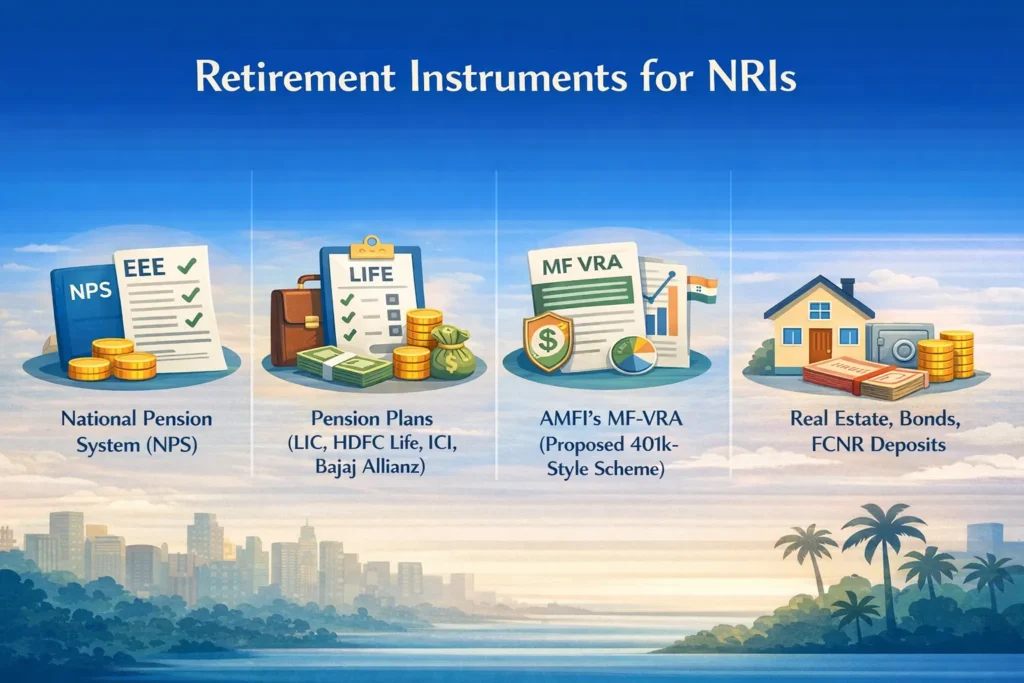
Here are the main retirement options. Each has its pros and cons.
National Pension System (NPS)
- Who can invest: NRIs aged 18–70.
- Why it matters: Triple tax benefits (EEE), long-term discipline, partial withdrawals allowed.
- Catch: Withdrawals are partly taxable. And liquidity is limited until retirement.
Pension Plans (LIC, HDFC Life, ICICI, Bajaj Allianz)
- Provide annuity or lump sum options.
- Tax benefits under Section 80C.
- Safe but often lower returns than mutual funds.
AMFI’s MF-VRA (Proposed 401k-Style Scheme)
- Still under discussion, but could give NRIs a structured way to invest like US retirement accounts.
- Worth keeping an eye on.
Real Estate, Bonds, FCNR Deposits
- Real Estate: Popular among NRIs returning to India. But comes with tenant hassles and liquidity issues.
- Bonds: Safer than stocks, taxable in India.
- FCNR Deposits: Park foreign currency, earn interest without exchange rate risk.
Planning Your Child’s Education Corpus
Your child’s education is a fixed event. Tuition bills won’t wait. Which means you need money ready at the right time.
SIPs and Mutual Funds – Why NRIs Prefer Them
Starting a SIP is like planting a tree. Small steps, month after month. Over 10 years, the corpus grows strong.
For example, investing ₹25,000 monthly for 10 years at 12% return creates ~₹55 lakh. That’s enough to cover most undergrad programs in India or contribute to overseas tuition.
Sukanya Samriddhi, PPF and FKRA – Restrictions for NRIs
- Sukanya Samriddhi: Great scheme for girl child education. But once you become an NRI, contributions are not allowed.
- PPF: Same story. NRIs can’t open new accounts. Existing ones can be maintained till maturity but not extended.
- FKRA: Few foreign schemes exist, but rules vary country to country.
Wealth Management Firms Specializing in Education Funds
Some firms now offer curated “education portfolios” for NRIs. They mix equity, debt, and deposits aligned with timelines. Useful if you don’t want to manage things yourself.
Cross-Border Financial Planning Essentials
Here’s where most NRIs get stuck. Your money is spread across two systems.
Handling Foreign Accounts like 401k or IRA as an NRI
If you’ve worked in the US, your 401k or IRA still holds value. But once you move back, taxation and withdrawals change. Some people leave them untouched. Others roll them into new accounts. Always take professional advice here.
DTAA, Tax Residency and Avoiding Double Taxation
The Double Tax Avoidance Agreement (DTAA) is your shield. It ensures the same income isn’t taxed twice. But you must prove tax residency in your host country with Form 10F and a certificate.
Example: You earn rent in India. Pay tax here. Then you claim credit in the US under DTAA. Simple if documented right. Painful if ignored.
Repatriation Rules for Education and Retirement Savings
Sending money abroad? RBI rules apply. NRE accounts are fully repatriable. NRO accounts have limits. FCNR deposits are flexible.
For education, outward remittance schemes let you send fees abroad legally. But paperwork is strict.
Common Mistakes NRIs Must Avoid

From analyzing HDFC, Dhan, and advisory blogs, here are the big pitfalls:
- Over-relying on real estate. Property feels safe, but liquidity is slow.
- Ignoring tax in both countries. Leads to penalties later.
- Not planning for currency depreciation. Returns look good in rupees, not so in dollars.
- Skipping estate planning. Families suffer later.
- Last-minute planning. Education funds need time. Retirement needs decades.
FAQs
Can NRIs claim tax benefits on Indian pension schemes?
Yes, but only under certain sections like 80C. Always check your country’s tax laws too.
How can I fund my child’s education abroad through Indian investments?
Build an INR corpus, then remit under RBI’s Liberalized Remittance Scheme. Keep forex risk in mind.
What happens to my NPS or PPF if I return to India permanently?
NPS continues as usual. PPF can be extended like any resident.
How much should I save monthly for education?
Work backwards. If fees are ₹40 lakh in 10 years, you need ₹20,000–25,000 SIP per month at 12% return.
Can NRIs invest in Sukanya Samriddhi?
Not after they become NRIs. Existing accounts stay but no fresh deposits.
Summary Table
| Goal | Instruments | Pros | Cons | Tax Rules |
|---|---|---|---|---|
| Retirement | NPS, Pension Plans, FCNR, Real Estate | Long-term, stable | Lock-in, inflation risk | 80C, DTAA |
| Education | SIPs, FDs, Bonds, Education Funds | Liquidity, compounding | Market risk | Limited tax benefits |
| Cross-Border | 401k/IRA, NRE/NRO, FCNR | Currency hedge, global options | Complex rules | DTAA, FATCA |
Conclusion
Financial planning for NRIs isn’t about choosing between retirement and education. It’s about balancing both with smart allocation.
Start early. Diversify. Respect tax rules. Avoid the common traps.
That’s how you give your child the education they deserve, and yourself the retirement you’ve earned.


0 Comments