



Quick answer: From 1 April 2026, Form 15CA is Form 145 and Form 15CB is Form 146. NRIs need them when sending taxable money abroad, such as NRO balances or property sale proceeds. Form 145 is a self-declaration filed online. Form 146 is a CA certificate, needed when taxable remittances exceed Rs 5 lakh in a year. CA fees usually run Rs 3,000 to Rs 10,000.
Key takeaways
- Banks still say "15CA and 15CB", but the portal now uses Form 145 and Form 146
- Form 145 has four parts: A, B, C, and D
- Form 146 must be filed by the CA before you file Form 145 Part C
- NRE and FCNR repatriation is generally not taxable, so Part D or no form applies
Every NRI who moves money out of India runs into the same two forms. The bank asks for "15CA and 15CB", the CA asks for documents, and the portal has quietly renamed both. Under the Income Tax Act 2025 and the Income-tax Rules 2026, Form 15CA became Form 145 and Form 15CB became Form 146 from 1 April 2026, with the old Rule 37BB now Rule 220. The purpose is unchanged: India wants to confirm that tax on money leaving the country has been paid.
Get the forms right and the bank processes your transfer quickly. Get them wrong, for example by declaring a taxable payment as non-taxable, and you risk a penalty of up to Rs 1 lakh and a stuck remittance.
What Are Form 15CA and Form 15CB?
| Old Name | New Name (from 1 April 2026) | What It Is | Who Files It |
|---|---|---|---|
| Form 15CA | Form 145 | Online declaration of the remittance and tax paid | The person sending the money (the remitter) |
| Form 15CB | Form 146 | Certificate on taxability and tax deducted | A Chartered Accountant |
The remittance date decides which form applies. Any transfer on or after 1 April 2026 uses Form 145 and Form 146, even if the underlying income or sale happened earlier.
Who Needs Form 15CA and 15CB?
NRIs typically need these forms when they send money abroad that is, or may be, taxable in India:
- Repatriating NRO balances to a foreign bank account
- Transferring NRO funds to an NRE account
- Repatriating property sale proceeds
- Repatriating inherited money
- Sending rent, dividends, or pension from NRO abroad
Residents paying non-residents, such as an Indian company paying a foreign consultant, also file these forms.
Who Does Not Need Them?
- NRE and FCNR repatriation: these balances are not taxable in India. Many banks need no form, and some ask for Form 145 Part D
- Remittances on the specified list: Rule 220 lists 33 categories where neither form is needed, including LRS remittances by residents for travel, education, medical treatment, gifts, and overseas investment. For these, the bank needs only Form A2 and a purpose code
Which Part of Form 145 Do You Need?
| Part | When It Applies | Form 146 Needed? |
|---|---|---|
| Part A | Taxable remittance, and the total to the recipient in the year is up to Rs 5 lakh | No |
| Part B | Taxable remittance above Rs 5 lakh, and you hold an Assessing Officer certificate or order on the tax to deduct | No, the AO order replaces it |
| Part C | Taxable remittance above Rs 5 lakh, with no AO certificate | Yes |
| Part D | Remittance not taxable in India, under the Act or a tax treaty | No |
Most NRIs repatriating NRO money or sale proceeds above Rs 5 lakh will file Part C with Form 146.
Step-by-Step: Filing Form 146 and Form 145 Online
- Add your CA on the income tax portal under Authorised Partners, then My Chartered Accountant
- The CA accepts the request from their login
- Share documents with the CA (see the checklist below)
- The CA prepares and files Form 146 with a digital signature
- Go to e-File, then Income Tax Forms, then File Income Tax Forms, and choose Form 145
- Select Part C, enter the Form 146 acknowledgement number, and fill in the remittance details
- E-verify using an EVC through net banking, a bank account, a demat account, or Aadhaar OTP, or with a digital signature
- Download the acknowledgement from the filed forms tab
- Submit to your bank with the bank's outward remittance form (Form A2) and supporting documents
For Part A or Part D, skip steps 1 to 4 and file Form 145 directly.
Documents Your CA Will Ask For
- PAN of the remitter and beneficiary details including name, address, bank, and SWIFT code
- NRO account statement showing how the balance built up
- Source-of-funds proof: sale deed, will or succession certificate, rent agreements, dividend statements
- TDS certificates for tax deducted on the money
- Capital gains computation, for property or investment sales
- ITR acknowledgement for the relevant year
- Passport, visa, or OCI card as proof of NRI status
- Tax Residency Certificate, if you claim a treaty rate
How Much Do Form 15CA and 15CB Cost?
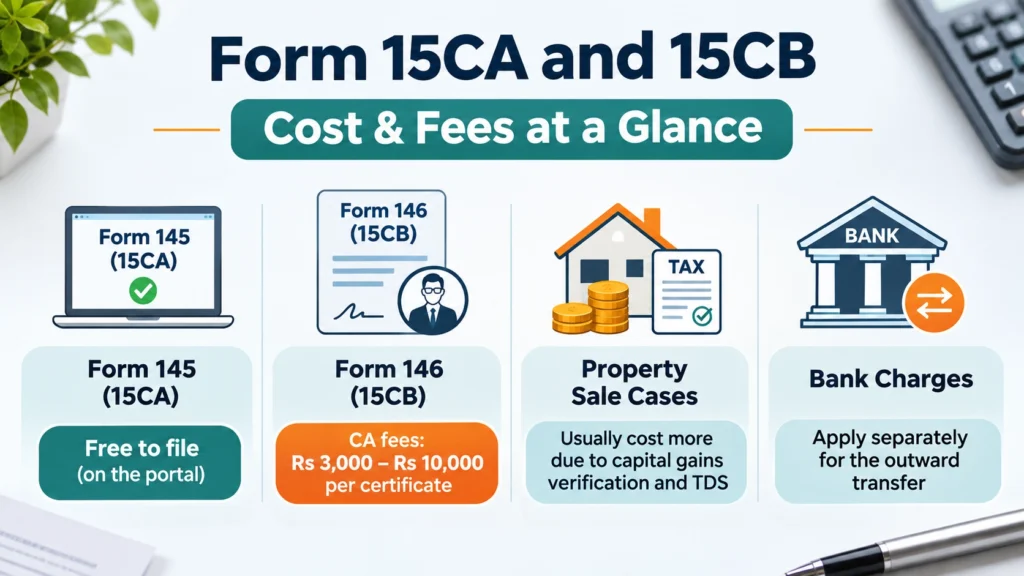
- Form 145: free to file on the portal
- Form 146: CA fees typically range from Rs 3,000 to Rs 10,000 per certificate, depending on complexity and city
- Property sale cases usually cost more because the CA must verify the capital gains computation and TDS
- Bank charges for the outward transfer apply separately
How Long Does the Process Take?
- Form 146: usually one to three working days once the CA has all documents
- Form 145: can be filed and e-verified the same day
- Bank processing: the transfer itself is usually quick once the bank accepts the forms, though some banks take a few working days to verify documents
The biggest delays come from missing documents and tax not yet paid. File your ITR and settle any tax before you start.
What Happens If You Get It Wrong?
- Wrongly declaring a taxable remittance as non-taxable under Part D can attract a penalty of up to Rs 1 lakh per default under Section 462 of the Income Tax Act 2025
- An incomplete or inconsistent form can lead the bank to reject the transfer
- Remitting without paying tax can lead to notices and FEMA issues
Common Mistakes NRIs Make
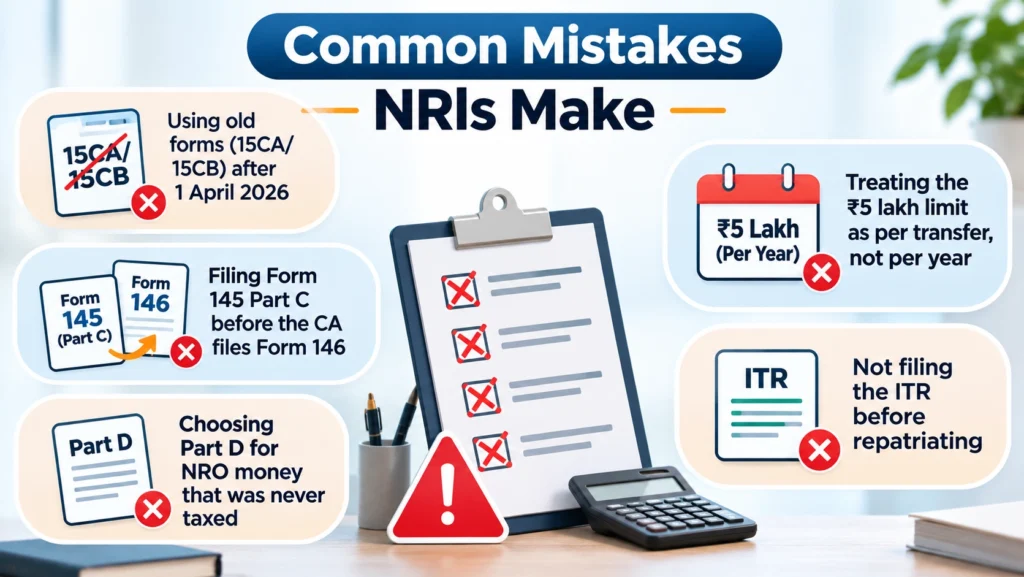
- Asking the bank for 15CA/15CB and filing old forms after 1 April 2026
- Filing Form 145 Part C before the CA has filed Form 146
- Choosing Part D for NRO money that was never taxed
- Forgetting that the Rs 5 lakh limit is the total for the year, not per transfer
- Not filing the ITR before repatriating
Conclusion
Our tax team prepares the paperwork behind every NRI remittance: settling tax, filing your income tax return, coordinating Form 146 with a CA, and filing Form 145 correctly. For property sale proceeds, the capital gains tax computation is checked first. Founded by Pryank Agrawal (IIT Roorkee), MostlyNRI helps NRIs in more than 33 countries move money home and abroad.
Sending money out of India? Book a consultation with our specialists at MostlyNRI.com to get Form 145 and Form 146 done right the first time.
Frequently Asked Questions (FAQs)
What is Form 15CA and 15CB called now?
From 1 April 2026, Form 15CA is Form 145 and Form 15CB is Form 146 under the Income-tax Rules 2026. The remittance date decides which applies, so any transfer from that date uses the new forms.
Who needs Form 15CA and 15CB?
NRIs sending taxable money abroad need them, such as NRO balances, property sale proceeds, inheritance, rent, or dividends. Residents paying non-residents also file them. Remittances on the specified list of 33 categories need neither form.
Is Form 15CB needed for every NRI remittance?
No. Form 146, the CA certificate, is needed only for Part C, when taxable remittances exceed Rs 5 lakh in the year and there is no Assessing Officer certificate. Part A, B, and D filings do not need it.
Do NRIs need Form 15CA for NRE account repatriation?
Usually not. NRE balances are not taxable in India, so many banks need no form. Some banks ask for Form 145 Part D as a declaration that the remittance is not taxable.
How much does a CA charge for Form 15CB?
CA fees for Form 146 usually range from Rs 3,000 to Rs 10,000 per certificate, depending on the complexity and city. Property sale cases cost more because the CA must verify capital gains and TDS.
How long does it take to get Form 15CA and 15CB?
Once documents are ready, a CA usually files Form 146 within one to three working days. Form 145 can be filed and e-verified the same day, and the bank then processes the transfer.
What are the four parts of Form 15CA?
Part A covers taxable remittances up to Rs 5 lakh a year. Part B covers those above Rs 5 lakh with an AO certificate. Part C covers those above Rs 5 lakh with Form 146. Part D covers non-taxable remittances.
What is the penalty for a wrong Form 15CA?
Wrongly declaring a taxable payment as non-taxable can attract a penalty of up to Rs 1 lakh per default under Section 462 of the Income Tax Act 2025. Banks may also reject the remittance.
Which documents are needed for Form 15CB?
Your CA will need your PAN, NRO statement, source-of-funds proof such as a sale deed or will, TDS certificates, capital gains computation, ITR acknowledgement, passport or OCI card, and beneficiary bank details.
How can MostlyNRI help with Form 15CA and 15CB?
MostlyNRI settles the tax due, files your ITR, coordinates Form 146 with a Chartered Accountant, files Form 145 in the right part, and prepares the documents your bank needs, so your remittance goes through without delays.


0 Comments