




For years, Non-Resident Indians and Overseas Citizens of India who wanted a meaningful stake in a single Indian listed company ran into the same wall: 5 percent per individual, and 10 percent for all NRIs and OCIs combined. Budget 2026 removed that wall. On 1 February 2026, Finance Minister Nirmala Sitharaman announced that the individual cap would double to 10 percent and the aggregate cap would rise to 24 percent. The change was then notified through the Foreign Exchange Management (Non-debt Instruments) (Third Amendment) Rules, 2026, reported as S.O. 3030(E) dated 12 June 2026.
The headline is simple, but the fine print matters. The new individual ceiling is below 10 percent of fully diluted paid-up equity, not 10 percent itself. Crossing it turns your whole holding into FDI. Holding more than 5 percent also brings SEBI disclosure duties that most retail NRIs have never dealt with. And with more headroom comes a real question: should you actually concentrate more of your wealth in one Indian stock?
This guide explains the new limits, who is covered, the SEBI filings you must make, the breach rules, the tax position, and how to rebalance your Indian portfolio sensibly.
What Changed: Old vs New Limits
| Limit | Before Budget 2026 | After the 2026 Amendment |
|---|---|---|
| Individual cap per listed company | 5 percent | Below 10 percent of fully diluted paid-up equity |
| Aggregate cap for the category | 10 percent (NRI and OCI) | 24 percent |
| Who is covered | NRIs and OCIs | All individuals resident outside India, including NRIs and OCIs |
| Route | Portfolio Investment Scheme through a designated bank | Recognised stock exchange through a designated AD bank branch |
| Basis | Repatriable | Repatriable |
Two shifts deserve attention. First, the category is wider. The rules now cover any individual resident outside India, so NRIs and OCIs share the 24 percent aggregate room with other foreign individuals. Second, the individual ceiling sits just under 10 percent, which keeps portfolio holdings clearly separate from foreign direct investment.
Investments made on a non-repatriation basis under Schedule IV of the NDI Rules continue to be treated like domestic investment and are not counted against these portfolio limits.
Why the Government Raised the Cap
The Budget speech and market commentary pointed to three reasons:
- Foreign institutional flows turned volatile through 2025 and early 2026
- Diaspora capital tends to be longer-term and less reactive than hot money
- Higher caps align India with global norms and widen the shareholder base of listed companies
Market participants welcomed the move. Portfolio managers noted that doubling the per-investor cap creates headroom in sectors where foreign ownership limits had been choking flows.
The Thresholds That Now Matter
With room to buy up to just under 10 percent, NRIs and OCIs can now cross several regulatory lines. Here is the ladder.
| Holding Level | What Happens |
|---|---|
| Below 5 percent | Standard portfolio investment, no SEBI disclosure |
| 5 percent or more | SEBI SAST disclosure within two working days |
| Each 2 percent change above 5 percent | Fresh SEBI disclosure within two working days |
| 10 percent or more | Breach of the portfolio cap. Holding reclassified as FDI unless divested within five trading days |
| Aggregate 24 percent for the company | No further portfolio buying by individuals resident outside India |
SEBI Filing: Disclosures Under the Takeover Regulations
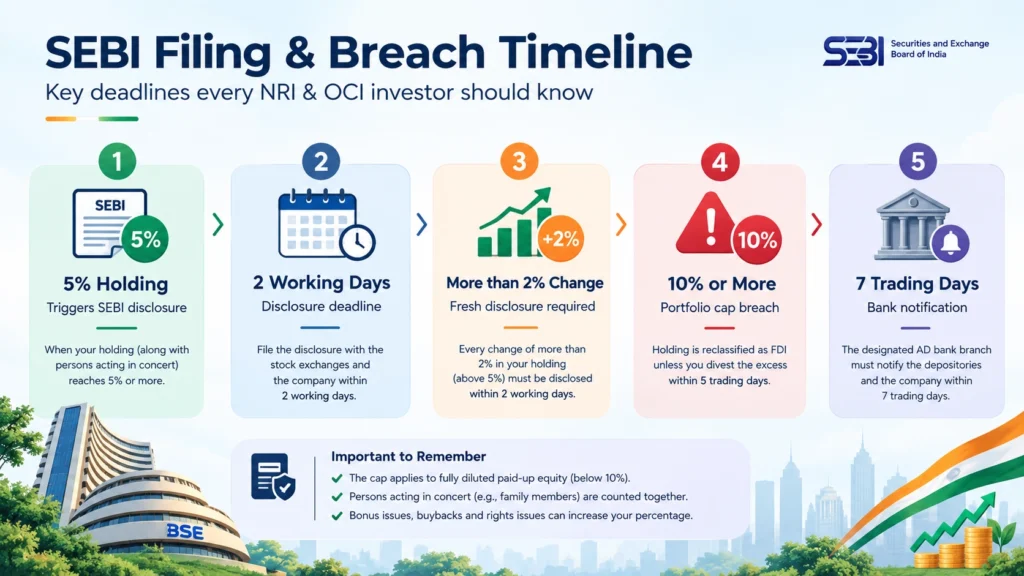
The SEBI (Substantial Acquisition of Shares and Takeovers) Regulations, 2011 apply to every acquirer, resident or not.
- Regulation 29(1): when your holding, together with persons acting in concert, reaches 5 percent or more, you must disclose it
- Regulation 29(2): once you hold 5 percent or more, every change of more than 2 percent must be disclosed
- Regulation 29(3): disclosures go to the stock exchanges and the company within two working days
The words persons acting in concert matter for families. If you, your spouse, and your parent all buy the same stock, regulators may treat the holdings together. A family that crosses 5 percent collectively has a disclosure duty even if no single member does.
Two more points help NRIs plan:
- Staying below 10 percent also keeps you under the significant beneficial owner threshold in the Companies Act rules
- If you join the board or receive unpublished price-sensitive information, SEBI insider trading rules apply to your trades
Breach Rules: What If You Cross the Ceiling?
The 2026 amendment has a strict breach mechanism:
- Excess holdings must be sold within five trading days of the settlement date
- If not sold, the entire holding in that company is treated as FDI
- The investor is then barred from further portfolio investment in that company
- The designated AD bank branch must notify the depositories and the company within seven trading days
Bonus issues, buybacks, and rights issues can push your percentage up without a single purchase, since the cap is measured on fully diluted capital. Track these corporate actions.
Who Should Use the Extra Headroom
The higher cap is most useful for a narrow group:
- High-net-worth NRIs with strong conviction in a mid-cap or small-cap company
- Founders' families abroad building a position in a company they understand
- Former employees who already hold meaningful stakes through ESOPs
- Long-term investors in stocks where the old 10 percent aggregate cap was full
For most NRIs, the change matters less directly. A portfolio worth a few crore rupees rarely approaches 5 percent of a listed company. The real benefit is indirect: more room in stocks that were previously on the RBI caution list because NRI and OCI holdings had hit the aggregate cap.
Portfolio Rebalancing: Headroom Is Not a Strategy
A higher legal ceiling does not mean higher concentration is wise. Before you build a large single-stock position, run through these checks.
- Concentration risk: a single-company position above 10 to 15 percent of your total net worth adds risk that diversification cannot offset
- Liquidity: a large stake in a thinly traded stock is hard to exit within the five-day breach window
- Currency: your returns depend on the rupee as well as the share price
- Sector caps: FDI sectoral limits for banking, insurance, and defence still apply
- Aggregate headroom: popular stocks may already be close to the 24 percent mark
A balanced approach for most NRIs looks like this:
- Keep direct stock holdings for high-conviction ideas, sized sensibly
- Use mutual funds for NRIs for core diversified exposure
- Consider a PMS for NRIs if you want a managed concentrated portfolio
- Look at GIFT City funds for USD-denominated access to Indian markets
Tax Implications for NRIs on Larger Positions
The cap change does not alter tax rates. For listed shares held by NRIs:
- Short-term capital gains (held 12 months or less): 20 percent plus surcharge and cess
- Long-term capital gains (held more than 12 months): 12.5 percent above the Rs 1.25 lakh annual exemption
- TDS is deducted at source by your broker under Section 393(2) of the Income Tax Act 2025
- Dividends attract TDS at 20 percent plus surcharge and cess, or the lower DTAA rate if you file Form 41 with a valid Tax Residency Certificate
Larger positions mean larger gains and larger TDS. Plan exits across financial years where possible. Our Capital Gain Tax team models the tax on a staggered exit, and the NRI TDS Refund Calculator estimates any excess TDS you can recover.
Banking and Account Set-Up
Portfolio investment on a repatriation basis runs through a designated Authorised Dealer bank branch. You need:
- An NRE account linked to a PIS-enabled trading and demat account for repatriable investment
- An NRO account for non-repatriable investment
- KYC that matches your passport, OCI, and PAN details
Our NRI Bank Account Type Advisor helps you set up the right NRE, NRO, and PIS structure before you increase your position.
Common Mistakes to Avoid
- Assuming the new cap is exactly 10 percent rather than below 10 percent
- Ignoring family holdings when checking the 5 percent SEBI disclosure line
- Missing the two-working-day disclosure deadline
- Forgetting that bonus and buyback events change your percentage
- Buying a stock where the 24 percent aggregate cap is nearly full
- Mixing repatriable and non-repatriable holdings in the same account
- Concentrating too much net worth in one stock
How MostlyNRI Helps
At MostlyNRI, we help NRIs and OCIs across the USA, UAE, UK, Canada, Singapore, and Australia with:
- Portfolio reviews under the new limits
- Mutual fund, PMS, and GIFT City allocation
- NRE, NRO, and PIS account structuring
- Capital gains and TDS planning on large positions
- ITR filing under the Income Tax Act 2025 through our Income Tax Returns Filing service
- DTAA claims with Form 41
Our team serves clients in 13 Indian cities across 33+ countries.
Planning to build a bigger position in an Indian listed company? Book a consultation with our specialists at MostlyNRI.com to check headroom, SEBI disclosure triggers, and the tax impact before you buy.
Frequently Asked Questions (FAQs)
What is the new shareholding cap for NRIs and OCIs in Indian listed companies?
Individuals resident outside India, including NRIs and OCIs, can now hold below 10 percent of a listed company's fully diluted paid-up equity on a repatriation basis, up from 5 percent. The aggregate limit for the category rose from 10 percent to 24 percent.
When did the new NRI and OCI shareholding limits take effect?
The change was announced in Budget 2026 on 1 February 2026 and notified through the FEMA (Non-debt Instruments) (Third Amendment) Rules, 2026, reported as S.O. 3030(E) dated 12 June 2026, effective on publication in the Official Gazette.
Do foreign individuals who are not NRIs or OCIs also benefit?
Yes. The amendment widened the category to all individuals resident outside India. NRIs and OCIs are now part of this broader group, which means they share the 24 percent aggregate room with other foreign individual investors.
What SEBI filing is required when an NRI crosses 5 percent?
Under Regulation 29 of SEBI's Takeover Regulations, you must disclose a holding of 5 percent or more, and every later change above 2 percent, to the stock exchanges and the company within two working days.
What happens if an NRI's holding crosses the 10 percent ceiling?
The excess must be sold within five trading days of settlement. If not, the entire holding is reclassified as FDI and further portfolio investment in that company is barred. The designated bank informs the depositories and the company.
Do non-repatriable NRI investments count toward the new caps?
No. Investments on a non-repatriation basis under Schedule IV of the NDI Rules are treated like domestic investment and do not count toward the individual or aggregate portfolio limits. They are made through an NRO account.
Has the tax on NRI share gains changed with the new cap?
No. Short-term gains on listed shares are taxed at 20 percent and long-term gains at 12.5 percent above Rs 1.25 lakh, plus surcharge and cess. Brokers deduct TDS under Section 393(2) of the Income Tax Act 2025.
Do family members' holdings count together for SEBI disclosure?
They can. SEBI rules look at holdings of an acquirer together with persons acting in concert. If spouses or parents buy the same stock with a common objective, their combined holding may trigger the 5 percent disclosure duty.
Should NRIs increase single-stock positions because the cap is higher?
Not automatically. The higher cap gives legal room, not investment logic. Concentration, liquidity, currency risk, and sector caps still apply. Most NRIs are better served by diversified mutual funds or PMS, with direct stocks sized carefully.
How can MostlyNRI help with the new shareholding limits?
MostlyNRI reviews your portfolio under the new limits, sets up NRE, NRO, and PIS accounts, plans capital gains and TDS on large positions, allocates across mutual funds, PMS, and GIFT City funds, and files your ITR with DTAA claims.


0 Comments