Category: NRI Investments & Financial Planning

  • 10 Tips for NRIs to Protect Their Indian Investments from Scams and Fraud

    10 Tips for NRIs to Protect Their Indian Investments from Scams and Fraud

    Investing in India from abroad feels like walking a tightrope. On one side, there’s the promise of growth, property appreciation, and staying connected to your roots. On the other? The very real risk of falling victim to scams that can wipe out years of savings. NRIs continue to pour money into Indian real estate, mutual funds, startups, and fixed deposits. But here’s the problem: scammers know NRIs are vulnerable. You’re thousands of miles away. You rely on agents and relatives. You can’t monitor things daily. And that distance creates the perfect breeding ground for fraud.

    Real estate scams, Ponzi schemes, fake investment advisors, and phishing attacks are climbing every year. I’ve seen friends lose lakhs because they trusted the wrong person or skipped basic verification steps. This guide gives you 10 practical, actionable strategies to protect your hard-earned money. Let’s dive in.

    Why NRIs Are Prime Targets for Investment Scams in India

    Scammers don’t pick victims randomly. They target people with specific vulnerabilities.

    You can’t be there in person. Most NRIs can’t fly to India every time they need to verify a property or meet an advisor. Fraudsters know this. They exploit your absence.

    You depend on intermediaries. Relatives, friends, local agents. You have to trust someone on the ground. But what if that trust is misplaced? What if the agent is in on the scam?

    Real-time monitoring is impossible. You’re busy with your job abroad. Time zones don’t match. By the time you notice something’s wrong, the damage is done.

    Cross-border rules are confusing. FEMA regulations, tax laws, RERA guidelines. It’s a maze. Scammers use this complexity to their advantage, knowing you might not catch their lies.

    Legal action from abroad is tough. Filing an FIR from Singapore or the US? Getting a court date? It’s exhausting. Fraudsters bank on you giving up.

    According to recent data, complaints about NRI investment fraud have grown significantly over the past few years. The National Cybercrime Portal receives thousands of reports annually from NRIs who’ve lost money to fake schemes and property frauds.

    10 Tips to Protect NRI Investments in India

    1. Always Verify the Source Before Investing

    This sounds basic. But it’s where most people slip up. Someone messages you on WhatsApp about a “guaranteed return” property deal. A distant relative recommends a mutual fund. An ad on Facebook promises 20% annual returns.

    Stop. Breathe. Verify. Before you invest a single rupee, check these things:

    Is the broker or advisor registered? SEBI maintains a public database of registered investment advisors and brokers. If the person pushing an investment isn’t on that list, walk away. Same goes for real estate. Check if the agent has a valid RERA registration.

    Does the company actually exist? Google the company name. Look for an official website. Check their office address on Google Maps. Call their landline number. Real companies have a real presence.

    What are others saying? Search for reviews. Check forums where NRIs discuss investments. If people are complaining about delayed payments or shady practices, that’s your red flag. Here’s a story: My cousin almost invested in a “luxury villa project” near Bangalore. The brochure looked professional. The sales pitch was smooth. But when he searched the developer’s name, he found multiple complaints about unfinished projects and missing NOCs. He avoided a disaster just by spending 30 minutes on Google.

    Never trust social media investment pitches. Seriously. Instagram and Facebook are full of scam artists promising easy money. They use fake testimonials and rented luxury cars to look successful. Don’t fall for it.

    2. Use SEBI-Registered Advisors Only

    This tip deserves its own spotlight because it’s that important. SEBI, the Securities and Exchange Board of India, regulates financial advisors and brokers. If someone is giving you investment advice for stocks, mutual funds, or securities, they must be SEBI-registered.

    How do you check? Visit the SEBI website and search their registered advisor database. It takes two minutes. Look for their registration number. Legitimate advisors will proudly display this on their website and business cards.

    Watch out for “guaranteed returns” promises. No legitimate advisor will guarantee specific returns. Markets fluctuate. Risks exist. Anyone promising you a fixed 15% or 20% return annually is either lying or running a Ponzi scheme.

    I recently spoke to an NRI friend who’d invested with an unregistered advisor. The guy promised “risk-free” equity returns. Six months later, the advisor vanished. My friend lost over 10 lakhs. The worst part? He had no legal recourse because the advisor wasn’t officially recognized.

    Don’t let this happen to you. If they’re not SEBI-registered, they’re not worth your time.

    3. For Real Estate, Verify Title and Approvals

    Real estate fraud is the number one scam targeting NRIs in India.

    You’re buying property from abroad. You can’t inspect the land yourself. You’re relying on photos and videos. Scammers know this and they exploit it ruthlessly.

    Before you sign anything or transfer money, do this:

    Check RERA registration. Every real estate project must be registered with RERA (Real Estate Regulatory Authority). Visit your state’s RERA website and search for the project. You should find details about the builder, approvals, and completion timeline. No RERA registration? Don’t even think about it.

    Verify land ownership. Get a qualified property lawyer to conduct a title search. They’ll check if the seller actually owns the land and if there are any disputes, liens, or legal issues attached to it. This step is non-negotiable.

    Confirm all NOCs and approvals. Building permits, environmental clearances, occupancy certificates. Every document must be in order. Ask your lawyer to verify these with the relevant municipal authorities.

    Visit the site if possible. I know you’re abroad. But if you can take a trip to India or send a trusted family member, do it. Physical verification catches problems that paperwork can’t.

    Think of it like this: buying property is like getting married. You wouldn’t marry someone without meeting them first, right? Same principle applies here.

    4. Use a Secure and Specific Power of Attorney

    Power of Attorney can be a lifesaver for NRIs. It lets someone act on your behalf in India.But it can also be your biggest nightmare if misused.

    Here’s what you need to know:

    Grant only limited Power of Attorney. Don’t give someone a general PoA that lets them do anything with your assets. Create a specific PoA for defined transactions only. For example, “This PoA allows XYZ to complete the sale of property at ABC address only.”

    Choose your PoA holder carefully. This should be someone you trust completely. A close family member, a longtime friend, or a professional you’ve thoroughly vetted. Not a distant relative you barely know.

    Set clear boundaries and time limits. Specify exactly what the PoA holder can and cannot do. Add an expiry date. Once the transaction is complete, revoke the PoA immediately.

    Monitor their actions. Just because you’ve given someone PoA doesn’t mean you stop watching. Stay in regular contact. Ask for updates. Request copies of documents they sign on your behalf.

    I’ve heard horror stories of PoA holders selling properties without the owner’s knowledge, taking out loans against assets, or diverting rental income. It’s more common than you think. Protect yourself by keeping the PoA as limited and specific as possible.

    5. Avoid Cash Deals in Property Transactions

    Here’s a hard truth about Indian real estate: cash deals are still common. And they’re a massive red flag. If anyone asks you to pay part of the property price in cash, refuse. Period.

    All payments should go through banking channels. Bank transfers, checks, demand drafts. Everything must be documented and traceable.

    Why is this so important?

    First, it protects you legally. If there’s a dispute later, you have clear proof of payment. Cash transactions? Good luck proving anything in court.

    Second, it prevents tax complications. Cash deals often involve underreporting the property value to avoid stamp duty and taxes. This might seem like a good deal initially, but it creates problems when you try to sell. The capital gains calculation gets messy. Tax authorities might question the transaction.

    Third, it keeps you away from black money issues. If the seller is asking for cash, they’re probably trying to hide income. You don’t want to be part of that.

    Banking channels create a paper trail. They protect you. They make the transaction legitimate.

    Think of it like buying a car. Would you hand someone a briefcase full of cash and hope they give you the keys? No. You’d use a proper payment method. Same principle.

    6. Cross-Check Investment Platforms and Fund Houses

    Fake investment platforms are everywhere now. Scammers create websites that look exactly like legitimate mutual fund companies or stock brokers. They use similar logos, professional designs, and convincing language. You transfer money thinking you’re investing in a real fund. But the money goes straight into the scammer’s pocket.

    Here’s how to protect yourself:

    Verify mutual funds with AMFI. The Association of Mutual Funds in India maintains a complete list of registered mutual funds. Before investing, cross-check the fund name and AMC (Asset Management Company) on the AMFI website.

    Look for the correct website URL. Scammers often use URLs that are slightly different from the real ones. For example, they might use “hdfcmutualfund.com” instead of the official HDFC mutual fund domain. Always double-check the URL matches exactly.

    Check for HTTPS and security certificates. Legitimate financial websites have proper security. If you see warnings about unsecured connections, leave immediately.

    Download apps only from official stores. Use Google Play or Apple App Store. Don’t click on links in emails or messages that ask you to download investment apps.

    Call the fund house directly. If you’re unsure about anything, pick up the phone and call the company’s customer service using the number on their official website. Verify that the platform or scheme is genuine.

    A friend of mine once received an email about a “special NRI mutual fund offer” with fantastic returns. The website looked real. But when he called the AMC’s official number, they had no idea about this scheme. He avoided losing 5 lakhs by making one phone call.

    7. Avoid High-Risk Private Schemes and Ponzi Offers

    If something sounds too good to be true, it probably is. Ponzi schemes and high-risk private schemes specifically target NRIs. Why? Because you’re far away. You might not hear about the scam until it’s too late. And by then, the fraudsters have disappeared with your money.

    Common red flags to watch for:

    Unrealistic returns. Anyone promising 30%, 40%, or 50% annual returns is lying. Even the best investors in the world don’t consistently achieve those numbers. If Warren Buffett can’t guarantee 40%, neither can some random guy on the internet.

    Pressure tactics. “This offer expires tomorrow.” “Only 5 spots left.” “You’ll regret missing this.” Scammers use urgency to push you into making quick decisions without proper research. Legitimate investments don’t work this way.

    Vague business models. Ask them exactly how they make money. If they can’t explain it clearly, or if it sounds overly complicated, it’s probably a scam. Real businesses have straightforward revenue models.

    Referral bonuses. If they pay you for bringing in more investors, it’s a pyramid or MLM scheme. These always collapse eventually.

    Examples NRIs often face:

    Cryptocurrency schemes promising guaranteed daily returns. Chit fund scams dressed up as “investment clubs.” Real estate pre-launch projects that never get built. Agricultural investment schemes where you “own” farmland that doesn’t exist.

    Here’s the thing: building wealth takes time. Compound interest works slowly. Anyone selling you a shortcut is selling you a scam.

    Be patient. Stick to regulated, transparent investments. Boring is better than broke.

    8. Protect Against Online Phishing and Account Hacks

    Cybercriminals are getting smarter every day. They send emails that look like they’re from your bank. They create fake websites that steal your login credentials. They use social engineering to trick you into revealing sensitive information. As an NRI managing investments online, you’re a prime target.

    Practical precautions:

    Enable two-factor authentication everywhere. Your bank accounts, trading accounts, mutual fund platforms. Everything should have 2FA turned on. This adds an extra layer of security even if someone gets your password.

    Never click on investment links in emails or messages. Even if it looks like it’s from your bank. Instead, manually type the website address into your browser or use your saved bookmarks.

    Be suspicious of urgent requests. “Your account will be frozen unless you verify immediately.” “Suspicious activity detected, click here now.” These are classic phishing tactics. Your real bank will never ask you to click links or provide passwords via email.

    Check sender email addresses carefully. Scammers use addresses that look similar to real ones. “[email protected]” might actually be “[email protected]” or “[email protected]“. One tiny difference can mean it’s a scam.

    Don’t share OTPs with anyone. Not over the phone. Not via email. Not even with someone claiming to be from your bank. OTPs are meant for you only.

    Use strong, unique passwords. Don’t use the same password across multiple sites. Use a password manager if you need to.

    Block suspicious numbers and emails. If you receive unsolicited investment offers, don’t engage. Block and report.

    I recently got an email that looked exactly like it was from my mutual fund company. The logo was right. The formatting was perfect. But the email address was slightly off. They wanted me to “verify my account” by entering my login credentials on a linked page. I almost fell for it. Always verify before clicking anything.

    9. Keep Investment Documents Digitally Secured

    Physical documents get lost. Files get damaged. Papers disappear.

    When you’re managing investments from abroad, you need a solid digital documentation system.

    Here’s what to do:

    Scan everything. Bank statements, property agreements, RERA documents, Power of Attorney papers, mutual fund statements, tax receipts. Every single document related to your investments should be scanned and saved digitally.

    Use encrypted cloud storage. Google Drive, Dropbox, OneDrive. These services encrypt your data and let you access it from anywhere. Enable two-factor authentication on your cloud accounts too.

    Organize files systematically. Create folders for different investment types. Label files clearly with dates and descriptions. When you need something urgently, you should be able to find it in seconds.

    Keep multiple backups. Don’t rely on just one cloud service. Use at least two different platforms. Also keep copies on an external hard drive.

    Store originals safely. If possible, keep original documents in a bank locker in India. Have a trusted family member who knows where everything is.

    Think of this like insurance. You hope you never need these documents urgently. But if a legal dispute arises or if you need to prove ownership, having organized digital records can save you months of hassle.

    I learned this the hard way when my uncle passed away. His property documents were scattered across different relatives’ homes. Some were lost. Some were damaged. It took us two years to sort everything out. Don’t let this happen to your investments.

    10. Monitor Your Investments Regularly

    Set it and forget it? Terrible strategy. You need to actively monitor your investments, even from thousands of miles away.

    How to do this:

    Track mutual funds via CAMS or NSDL. These platforms consolidate information from multiple fund houses. You can see all your investments in one place. Check your portfolio at least once a month.

    Monitor property status through RERA portals. If you’ve invested in an under-construction project, regularly check the RERA website for updates on construction progress, delays, or any complaints filed against the builder.

    Review bank and brokerage statements monthly. Look for unauthorized transactions. Verify that all interest and dividend payments are being credited correctly.

    Set up alerts. Most banks and brokers let you set up SMS or email alerts for transactions. Enable these. You should know immediately if money moves in or out of your accounts.

    Annual reconciliation is a must. Once a year, sit down and review everything. Match your records with official statements. Calculate returns. Assess whether your investments are performing as expected.

    Stay updated on regulatory changes. Tax laws change. FEMA regulations get updated. RERA rules evolve. Subscribe to newsletters from SEBI, RBI, or reliable financial news sources to stay informed.

    Regular monitoring helps you catch problems early. Maybe your mutual fund advisor is churning your portfolio unnecessarily. Maybe rental income from your property isn’t being deposited. Maybe there’s a construction delay the builder hasn’t told you about. If you’re checking regularly, you’ll spot these issues before they become disasters.

    It’s like checking your car’s oil level. Takes a few minutes. Prevents major breakdowns.

    Red Flags Every NRI Investor Should Watch Out For

    Sometimes the warning signs are obvious. Sometimes they’re subtle.

    Here’s a quick reference table to help you identify scams before you lose money:

    Red FlagWhat It MeansWhat You Should Do
    Unrealistic guaranteed returns (20%+ annually)Likely a Ponzi scheme or fraudStop all communication immediately. Report if possible.
    High pressure to decide quicklyScammer wants you to act without thinkingTake your time. Seek independent advice.
    Request for cash paymentsTax evasion or black money involvedRefuse completely. Insist on banking channels only.
    No written documentation providedLegally unenforceable, designed to cheat youNever proceed without proper contracts and receipts.
    Agent refuses to share RERA/SEBI registrationThey’re likely operating illegallyWalk away. Report them to authorities.
    Investment opportunity shared via WhatsApp/social mediaAlmost always a scam targeting uninformed investorsIgnore and block. Don’t engage.
    Referral bonuses for bringing new investorsPyramid or MLM scheme that will collapseAvoid entirely. These are unsustainable.
    Vague explanations about how returns are generatedThey don’t have a real business modelDemand clear answers. If you don’t get them, leave.
    Company has no physical office or landline numberFly-by-night operation ready to disappearVerify physical presence before investing anything.
    Past investors unable to withdraw moneyThe scheme is already failingDon’t become another victim. Stay away.

    Trust your instincts. If something feels wrong, it probably is.

    What to Do If You Face Investment Fraud as an NRI
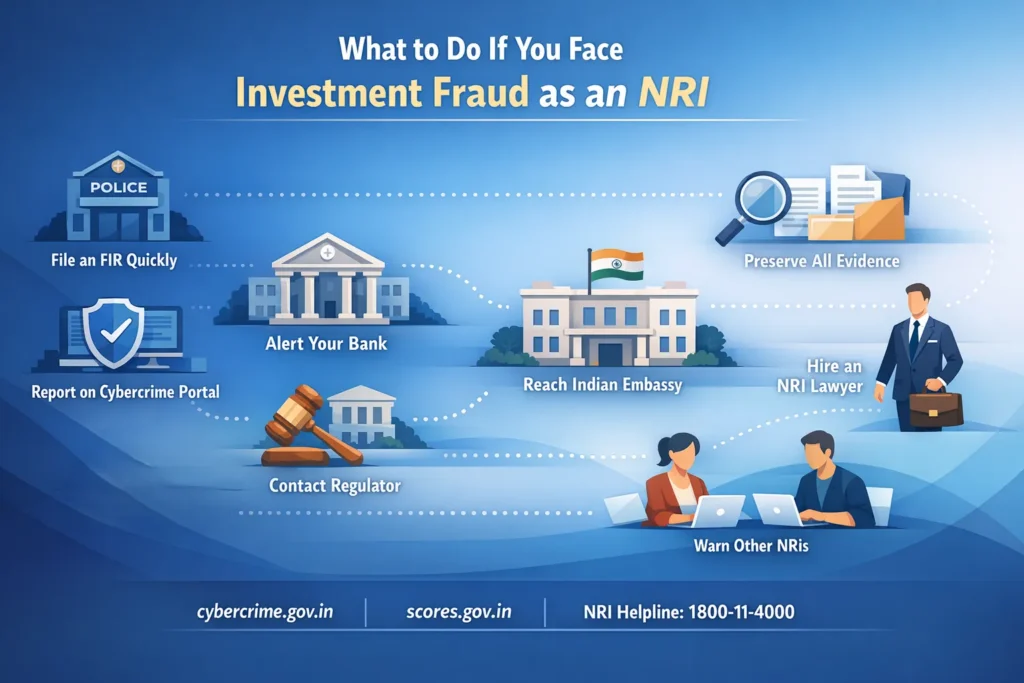
    Despite your best efforts, sometimes fraud still happens. Maybe someone forged documents. Maybe a trusted person betrayed you. Maybe a scammer was just that good. If you’ve been defrauded, don’t panic. And definitely don’t give up.

    Here’s your action plan:

    File an FIR immediately. Contact the local police station where the fraud occurred. You can do this online through the Indian embassy or consulate in your country. Time is critical. The faster you report, the better your chances of recovery.

    Report to cybercrime authorities. Visit the National Cybercrime Portal (cybercrime.gov.in) and file a complaint. This is especially important for online fraud, phishing, or fake investment platforms.

    Contact the relevant regulator. If it’s a real estate fraud, file a complaint with RERA. If it involves securities or mutual funds, use SEBI’s SCORES portal (scores.gov.in). These regulators can take action against licensed entities.

    Notify your banks. If the fraud involved unauthorized transactions or account access, immediately inform your bank. Request them to freeze accounts or reverse transfers if possible.

    Reach out to the Indian embassy. Most embassies have NRI grievance cells. They can guide you through the legal process and connect you with local authorities.

    Hire a specialized lawyer. Find a lawyer who has experience with NRI cases and fraud recovery. They’ll know the best legal strategies and can represent you in Indian courts even while you’re abroad.

    Preserve all evidence. Save every email, message, receipt, contract, and communication related to the fraud. Document everything chronologically. This evidence will be crucial for legal proceedings.

    Warn others. Share your experience (without compromising your legal case) on NRI forums and communities. Your story might prevent someone else from falling for the same scam.

    Important resources:

    • National Cybercrime Portal: cybercrime.gov.in
    • SEBI Complaints: scores.gov.in
    • Consumer helpline: 1800-11-4000
    • Your country’s Indian embassy website will have NRI-specific helpline numbers

    Recovery isn’t guaranteed. Legal processes can be slow. But taking action gives you a fighting chance. And it helps authorities track down fraudsters and prevent future scams.

    Safe Investment Options for NRIs

    After reading about all these scams, you might be thinking: “Is there any safe way to invest in India?”

    Yes. Absolutely yes.

    The key is sticking to regulated, transparent options.

    RERA-approved real estate projects. If you want to invest in property, only consider projects registered with RERA. Check the builder’s track record. Visit the site if possible. Use a lawyer for due diligence. Stick to established developers with completed projects, not fly-by-night operators promising luxury at unrealistic prices.

    Government bonds and securities. These are backed by the Indian government. Risk is minimal. Returns might not be spectacular, but your capital is safe. Consider options like RBI bonds or government treasury bills.

    NRE and NRO bank deposits. These are specifically designed for NRIs. NRE (Non-Resident External) accounts offer tax-free interest and full repatriation. NRO (Non-Resident Ordinary) accounts are good for managing India-sourced income. Stick to established banks. Compare interest rates but don’t chase unrealistic offers.

    SEBI-regulated mutual funds. Mutual funds managed by registered AMCs are transparent and regulated. You can track performance, read fund documents, and exit when needed. Choose funds based on your risk appetite and investment horizon. Avoid obscure fund houses you’ve never heard of.

    Blue-chip equity investments. If you understand the stock market, investing directly in well-established, large-cap companies can work. These are companies with strong fundamentals, good governance, and transparent reporting. Avoid penny stocks and tips from “experts” on social media.

    Public Provident Fund (PPF) and National Pension System (NPS). Long-term, government-backed savings schemes. Great for retirement planning. Completely safe.

    The common thread in all these options? Regulation and transparency. You know where your money is going. You can track it. You can exit if needed. And there are authorities you can complain to if something goes wrong.

    Safe investing might seem boring compared to “double your money in 6 months” schemes. But boring means you sleep well at night. Boring means your money is actually there when you need it.

    Frequently Asked Questions

    What scams are most common among NRIs investing in India?

    Real estate fraud tops the list. This includes selling properties with unclear titles, unregistered projects, or land that doesn’t exist. Ponzi schemes promising guaranteed returns are also extremely common, especially those targeting NRIs through social media and WhatsApp. Power of Attorney misuse, where trusted individuals sell or mortgage properties without permission, is another major issue. Fake mutual fund platforms and phishing attacks targeting NRI bank accounts are growing rapidly too.

    Can NRIs take legal action against fraud from abroad?

    Yes, you can. File an FIR through the Indian embassy or consulate in your country. Use online portals like the National Cybercrime Portal for digital fraud. Contact regulatory bodies like SEBI or RERA depending on the fraud type. Hire a lawyer in India who specializes in NRI cases. They can represent you in court even while you’re abroad. The process might be slower and more complex than if you were in India, but legal recourse is definitely available.

    How do I verify a real estate project is genuine?

    Start by checking RERA registration on your state’s RERA website. Every legitimate project must be registered there. Verify the builder’s track record by looking at their past completed projects. Get a lawyer to conduct title verification to ensure the land ownership is clear and dispute-free. Confirm all NOCs and approvals with municipal authorities. If possible, visit the site in person or send a trusted representative. Check online reviews and complaints from other buyers. Never invest based solely on brochures or website claims.

    What should I do if someone misuses my Power of Attorney?

    Act immediately. File an FIR for cheating and forgery. Revoke the Power of Attorney officially through a registered deed and publish a notice in local newspapers. Inform all relevant banks, property registrars, and authorities about the revocation. Hire a lawyer to start legal proceedings for recovery of assets or damages. If properties were sold, you may be able to challenge the sale in court if you can prove unauthorized use. Document all evidence of the misuse. Contact the Indian embassy for support with the legal process.

    Conclusion

    You’ve worked hard for your money. You’ve sent remittances home. You’ve saved for years. Don’t let scammers steal it. Protecting your Indian investments from abroad isn’t complicated. It just requires vigilance, verification, and common sense. Always verify before you invest. Use registered advisors and platforms only.

    Keep detailed documentation. Monitor your investments regularly. And trust your instincts when something feels wrong. Yes, there are risks. Yes, fraud exists. But thousands of NRIs successfully invest in India every year without falling victim to scams. You can too. Stay informed. Stay skeptical. Stay safe. Your financial security depends on it.

    Also Read: Latest NRI Tax Filing & Compliance Statistics

  • How NRIs Can Open a Demat Account in India

    How NRIs Can Open a Demat Account in India

    You want to invest in the Indian stock market. Maybe it is the company you grew up with, now a giant. Or a new tech startup that everyone is talking about.

    But you live in Dubai. Or New York. Or Singapore.

    The question hits you. How do I, as an NRI, even start? The rules seem confusing. The paperwork feels overwhelming.

    I have been there. I remember staring at forms, wondering about PIS, NRE, and NRO. It felt like learning a new language.

    This guide is for you. We will walk through the process together, one simple step at a time. We will break down the jargon, list the exact documents you need, and compare the top providers. Let us get your NRI Demat account opened.

    What is an NRI Demat Account — Benefits & PIS vs Non-PIS

    A Demat account is like a bank account for your shares. Instead of holding physical share certificates, your securities are held electronically. For NRIs, there are two main types of Demat accounts: NRE (Non-Resident External) and NRO (Non-Resident Ordinary).

    NRE Demat Account: This account is for NRIs who want to invest in Indian markets using foreign earnings. The funds in this account are fully repatriable, meaning you can transfer the money back to your foreign account.

    NRO Demat Account: This account is for managing income earned in India, such as rent, dividends, or pension. The repatriability of funds is limited and subject to certain conditions.

    PIS vs Non-PIS: PIS (Portfolio Investment Scheme) allows NRIs to invest in Indian stocks under the RBI’s portfolio investment scheme. Non-PIS accounts are for those who do not wish to trade on a repatriable basis.

    Eligibility & RBI Rules for NRI Demat Accounts

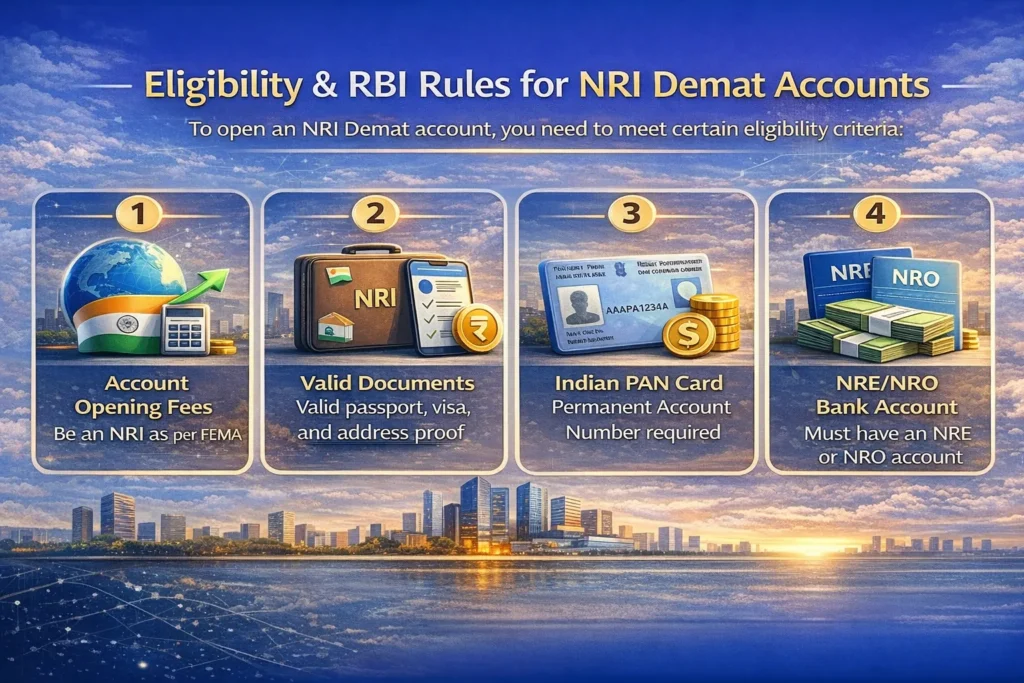
    To open an NRI Demat account, you need to meet certain eligibility criteria:

    1. Residential Status: You must be an NRI as per the Foreign Exchange Management Act (FEMA).
    2. Valid Documents: You need a valid passport, visa, and overseas address proof.
    3. Indian PAN Card: A Permanent Account Number (PAN) card is mandatory.
    4. NRE/NRO Bank Account: You must have an NRE or NRO bank account in India.

    Step-by-Step: How to Open an NRI Demat Account

    Choose between NRE vs NRO & PIS vs Non-PIS

    First, decide whether you need an NRE or NRO account based on your income source and repatriation needs. Then, choose between PIS and Non-PIS based on your trading preferences.

    Select a Broker / Depository Participant

    Choosing the right broker is crucial. Look for brokers who offer NRI Demat accounts and compare their fees, services, and customer support. Some popular brokers include Zerodha, SBI, ICICI Direct, and IDFC FIRST.

    Complete Application & KYC (Online & Offline)

    Fill out the application form provided by your chosen broker. You will need to complete the Know Your Customer (KYC) process, which involves submitting your personal details and documents.

    In-Person Verification (IPV) & Document Attestation

    Some brokers require in-person verification. This can be done at the broker’s office or through a video call. You may also need to get your documents attested by an authorized entity.

    Link to NRE/NRO Bank & Receive PIS Letter from Designated Bank

    Link your Demat account to your NRE or NRO bank account. If you have opted for a PIS account, you will receive a PIS letter from your designated bank, which allows you to trade on a repatriable basis.

    Required Documents for NRI Demat / Trading Account

    Here are the documents you typically need:

    1. Passport: A copy of your valid passport.
    2. Visa: A copy of your valid visa.
    3. Overseas Address Proof: Utility bills, bank statements, or any other document that proves your overseas address.
    4. Indian PAN Card: A copy of your PAN card.
    5. Passport-Sized Photographs: Recent photographs.
    6. NRE/NRO Bank Statement: A copy of your bank statement.
    7. PIS Permission Letter: If you are opening a PIS account.

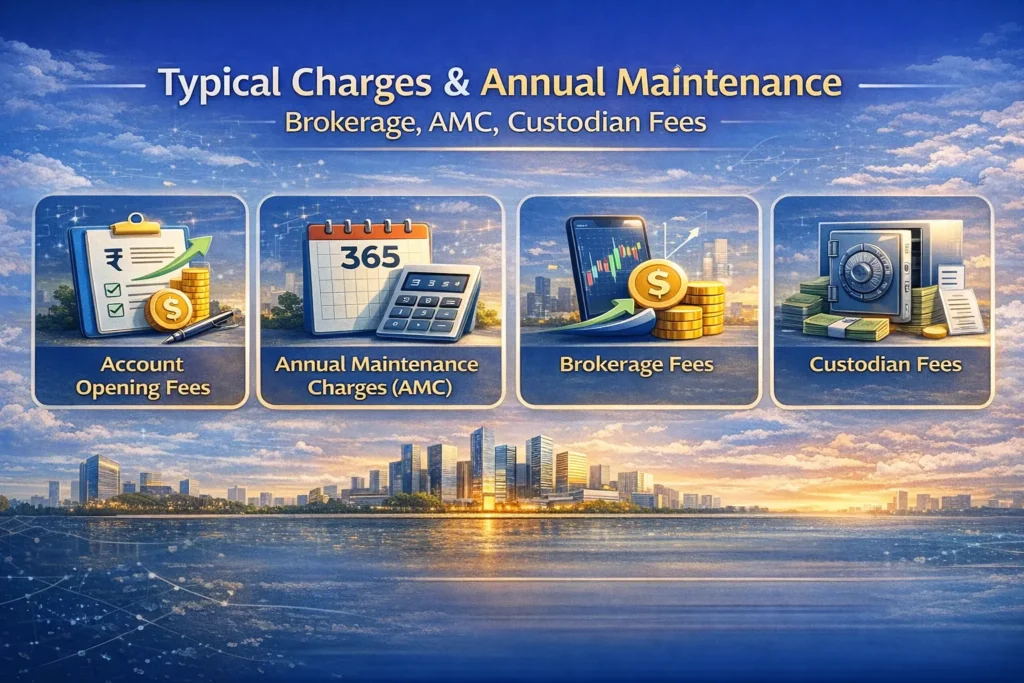
    Typical Charges & Annual Maintenance (Brokerage, AMC, Custodian Fees)

    Opening and maintaining a Demat account involves certain charges:

    1. Account Opening Fees: Some brokers charge a one-time fee for opening the account.
    2. Annual Maintenance Charges (AMC): This is a yearly fee for maintaining your Demat account.
    3. Brokerage Fees: These are charges for buying and selling securities.
    4. Custodian Fees: Some brokers charge a fee for holding your securities.

    Top Providers & Best Demat Account Options for NRIs

    Zerodha

    Zerodha is a popular choice among NRIs for its low fees and user-friendly platform. They offer both NRE and NRO Demat accounts and have a straightforward onboarding process.

    SBI

    State Bank of India (SBI) is a trusted name in banking and offers comprehensive NRI Demat account services. They provide both online and offline account opening options.

    ICICI Direct

    ICICI Direct is known for its robust trading platform and excellent customer support. They offer a range of investment options and have a dedicated NRI desk.

    IDFC FIRST

    IDFC FIRST offers a seamless account opening process and competitive fees. They provide both PIS and Non-PIS accounts and have a user-friendly mobile app.

    Differences: NRI Demat vs Resident Demat Account

    Let us make it crystal clear.

    FeatureNRI Demat AccountResident Demat Account
    Bank LinkMust be linked to an NRE/NRO accountLinked to a regular savings account
    RegulationGoverned by RBI’s FEMA rulesGoverned by standard SEBI rules
    PISRequired for direct equity tradingNot applicable
    RepatriationPossible through NRE routeNot applicable (funds are domestic)
    DocumentationRequires passport, visa, attestationRequires Aadhaar, PAN, Voter ID etc.
    ChargesHas additional PIS and custodian feesGenerally lower maintenance fees

    FAQs

    Can I open an NRI Demat account online from abroad?

    Yes, many brokers offer online account opening facilities for NRIs. You can complete the process from abroad, but you may need to get your documents attested and verified.

    What are the restrictions under the PIS scheme?

    Under the PIS scheme, NRIs can invest in a limited number of stocks and are subject to certain trading restrictions. You need to route your investments through a designated bank.

    How often do I need to update my KYC?

    KYC updates are typically required every few years. Your broker will notify you when it’s time to update your KYC details.

    Conclusion

    Opening an NRI Demat account is a straightforward process if you follow the steps outlined in this guide. Choose the right type of account, select a reliable broker, and ensure you have all the necessary documents. With the right preparation, you can start investing in the Indian stock market and grow your wealth.

    Also Read: International Schools in India

  • Top 7 Online Tools for NRIs to Manage Finances Remotely

    Top 7 Online Tools for NRIs to Manage Finances Remotely

    Managing money is tricky enough. But when your income is in dollars, pounds, or dirhams, and your investments and expenses are back in India, it can feel like a full-time job. You are constantly juggling exchange rates, NRE and NRO accounts, tax rules in two countries, and the simple frustration of not being able to use UPI like everyone else.

    I remember trying to pay a relative in India for a family function. It involved an international wire transfer, several emails, and a two-day delay. There had to be a better way.

    The good news is, that the digital world has finally caught up with the unique needs of Non-Resident Indians. A new wave of online tools is designed to make remote financial management not just possible, but simple.

    This guide walks you through the top 7 online tools that act as your remote financial command center. We will cover everything from daily budgeting and powerful investment platforms to the latest apps that finally let you use UPI with a foreign number.

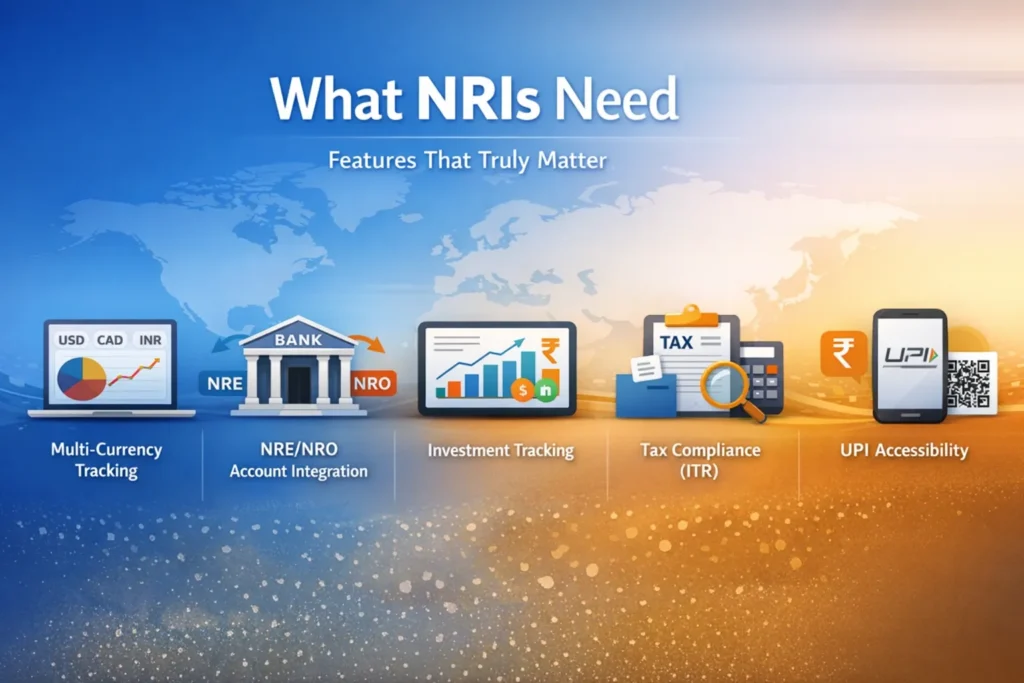
    What NRIs Need: Features That Truly Matter

    Before we dive into the tools, let us talk about what makes an app truly useful for an NRI. It is not just about fancy features. It is about solving specific problems.

    A great NRI finance tool should help you with:

    • Multi-Currency Tracking: Seeing your net worth in one currency, whether it is USD, CAD, or INR.
    • NRE/NRO Account Integration: Easily linking and monitoring your primary Indian bank accounts.
    • Investment Tracking: Keeping an eye on your Indian stocks, mutual funds, and ETFs from a single dashboard.
    • Tax Compliance: Helping you navigate the complexities of Indian tax filing (ITR) as an NRI.
    • UPI Accessibility: Allowing you to make quick payments in India without an active Indian SIM card.

    The following seven tools excel in one or more of these areas. Using a combination of them can completely transform how you handle your finances.

    Mint: Your Budget and Expense Tracker

    The Problem: Your spending happens in two countries. You buy groceries locally, but you also send money to India for family expenses or loan repayments. It is hard to get a clear picture of where your money goes each month.

    The Solution: Mint is a free, popular budgeting app that acts as your financial dashboard. You can link your international bank accounts and your Indian NRE/NRO accounts. It automatically categorizes your transactions, so you can see how much you spend on dining out in the US versus how much you are sending home.

    Why it works for NRIs: It gives you a unified view. Instead of logging into five different bank apps, you see your cash flow in one place. You can set budgets for different categories and get alerts when you are close to your limit. This is incredibly helpful for understanding your true cost of living across borders.

    A small caveat: While Mint is excellent for tracking, its investment features for Indian assets might be limited. It is best for budgeting and expense management.

    ET Money: Investing and SIP Management Made Simple

    The Problem: You want to invest in Indian mutual funds, but the process feels clunky from overseas. Managing multiple Systematic Investment Plans (SIPs) and tracking their performance is a headache.

    The Solution: ET Money is a powerful, all-in-one investment platform tailored for the Indian market. It allows you to invest directly in thousands of mutual funds, track your entire portfolio, and even analyze your investments with smart insights.

    Why it works for NRIs: The platform is built with Indian investments in mind. It supports NRI applications seamlessly. You can start and stop SIPs, switch between funds, and see a clear breakdown of your portfolio’s performance over time. The interface is clean and easy to understand, which is great if you are not a full-time finance expert.

    I found it much easier to consolidate my scattered mutual fund investments onto ET Money. It saved me from the nightmare of tracking them with individual fund house statements.

    Niyo Global / SBNRI: NRI-Focused Banking Cards

    The Problem: Every time you travel to India or make an international purchase, you get hit with high foreign transaction fees and unfair exchange rates from your local bank.

    The Solution: Niyo Global and SBM Bank’s SBNRI are fintech solutions designed specifically for Indians traveling or living abroad. They offer prepaid forex cards and accounts with zero forex markup fees. This means you get the real exchange rate without hidden charges.

    Why it works for NRIs: While living abroad, you can use their cards for daily spending and save on forex fees. When you travel to India, you can load the card and spend in rupees without worrying about currency conversion costs. They also offer dedicated support for NRI-related banking queries, which is a big plus over traditional banks.

    Wealthy / Zerodha: Powerful NRI Investment Platforms

    The Problem: You are ready to move beyond mutual funds and want to trade Indian stocks directly. You need a robust platform that supports NRI trading accounts with ease.

    The Solution: For direct stock and ETF investing, platforms like Wealthy and Zerodha are industry leaders. They offer powerful trading interfaces, in-depth research tools, and straightforward processes for opening an NRI trading account linked to your NRE/NRO account.

    Why it works for NRIs: These platforms demystify the process of investing in the Indian equity market from abroad. They provide clear guidance on the required documentation (like PIS permission). Their apps and websites are fast and reliable, giving you the confidence to manage a self-directed portfolio remotely.

    IDFC FIRST Bank UPI via International SIMs

    The Problem: UPI has become the lifeblood of payments in India. But for years, it was locked behind an Indian mobile number. Asking family to make payments for you felt like a step back in time.

    The Solution: This is a game-changer. IDFC FIRST Bank has launched a feature that allows its NRI customers to use UPI with their international mobile numbers. This means you can now directly pay bills, send money to friends, or shop online on Indian websites using UPI, all from your US, UK, or UAE number.

    Why it works for NRIs: It brings back your financial independence. You are no longer dependent on others for small payments. The setup is simple through the IDFC FIRST Bank mobile app. While it is currently available for numbers from about 12 countries, it signals a major shift towards including NRIs in India’s digital payment revolution.

    ClearTax India: Your NRI Tax and Compliance Assistant

    The Problem: Filing taxes in India as an NRI is complex. The rules are different. You have to declare foreign income, claim deductions correctly, and ensure you are not double-taxed.

    The Solution: ClearTax is a leading platform that simplifies tax filing. It has a dedicated section for NRI income tax returns (ITR). The software guides you through each step, asking simple questions to fill out the complex forms for you.

    Why it works for NRIs: It takes the fear out of tax season. ClearTax helps you identify which ITR form you need to use and ensures you claim all the deductions you are eligible for. It also provides resources and articles that explain NRI-specific tax situations, making you more informed about your obligations.

    GNUKhata: Open-Source Accounting for Serious Investors

    The Problem: You have multiple income streams, rental property in India, and a diverse investment portfolio. You need more than a budgeting app. You need a proper accounting system to manage your assets and generate reports.

    The Solution: GNUKhata is a free, open-source accounting software. Think of it as a simplified version of Tally for individual use. It helps you manage invoices, track expenses across different projects or properties, and generate profit and loss statements.

    Why it works for NRIs: If you have a financial life that is more like running a small business, GNUKhata offers powerful organization. You can use it to meticulously track rental income from a property in India, manage expenses for it, and have clear records for tax purposes. It is for the NRI who wants complete control and transparency over their financial data.

    Quick Feature Comparison Table

    Tool NamePrimary UseBest For NRI Because…Cost
    MintBudgeting & Expense TrackingUnified view of global and Indian accountsFree
    ET MoneyMutual Fund InvestingSimplified SIP management & portfolio trackingFree
    Niyo Global/SBNRIBanking & Forex CardsZero forex markup on international spendingFreemium
    Wealthy/ZerodhaStock & ETF TradingPowerful NRI trading account supportBrokerage Fees
    IDFC FIRST BankUPI PaymentsWorks with international mobile numbersFree
    ClearTaxTax FilingDedicated NRI ITR guidance and supportFreemium
    GNUKhataAccounting & Asset ManagementDetailed bookkeeping for complex financesFree & Open Source

    FAQs

    Can NRIs use UPI with foreign numbers?

    Yes, this is now possible. Banks like IDFC FIRST Bank have enabled UPI for NRI customers using international numbers from specific countries. This is a recent and very welcome development.

    Are investments tracked across platforms?

    Some platforms, like ET Money, can consolidate your mutual fund holdings from different fund houses. However, there is no single platform that automatically tracks everything, including your foreign investments. You may need to use a combination of tools or manual tracking for a complete net worth picture.

    How secure are these apps for global users?

    Reputable apps use bank-level security, including encryption and two-factor authentication. Always download apps from official stores (Google Play Store or Apple App Store) and check the reviews and permissions they request.

    Conclusion

    Managing your finances as an NRI does not have to be a source of stress. The right digital tools can put you back in the driver’s seat, no matter where you live in the world.

    The best tool for you depends on your specific goals. Are you trying to get your spending under control? Start with Mint. Ready to boost your investments in India? Explore ET Money or Zerodha. Tired of missing out on UPI? Check out IDFC FIRST Bank’s offering.

    The key is to start. Pick one tool that addresses your most immediate frustration. You might be surprised at how much time and mental energy you save. And that peace of mind is perhaps the best investment you can make.

  • NRI Financial Planning for Retirement and Children’s Education

    NRI Financial Planning for Retirement and Children’s Education

    Planning your finances as an NRI can feel like walking a tightrope. On one side is your retirement. On the other side is your child’s education. Both are non-negotiable. Both need money. And if you don’t balance them well, you risk falling.

    This guide shows you how to plan for both goals, without losing sleep or breaking your bank.

    Why Dual-Goal Planning Matters for NRIs

    Most people think of retirement and education as separate plans. For NRIs, they are two parts of the same puzzle.

    Imagine this: You’re 45. Your child is 12. In six years, college fees kick in. Around the same time, you’re thinking of slowing down at work. Two massive expenses. Both demanding your attention.

    Here’s the problem. If you put all your money into education, retirement suffers. If you only focus on retirement, your child’s future could be at risk. The solution? Plan for both.

    Dual-goal planning is about balance. It’s about using different instruments for different timelines. Education needs money sooner. Retirement needs money for longer.

    Retirement Planning as an NRI

    Retirement is your safety net. If you ignore it, you’re essentially hoping someone else will take care of you later. That’s a gamble you shouldn’t take.

    Currency Risk, Inflation and Return Objectives

    Your retirement money may sit in India. Or it may stay abroad. Either way, currency movements matter.

    Here’s an example. Suppose you’re in the US and earn in dollars. You invest in India. If the rupee weakens, your returns shrink when converted back to dollars. The reverse can also happen. But over decades, depreciation is more common.

    Inflation is another silent killer. Healthcare in India is rising faster than general inflation. A hospital bill can wipe out years of savings if you don’t plan.

    So your returns must not only beat inflation, but also absorb currency shocks.

    Retirement in India vs Staying Abroad – Key Differences

    If you plan to retire in India, you’ll need to think about:

    • Local medical insurance.
    • Cost of living in the city you choose.
    • Rental income if you own property.

    If you’ll stay abroad, you must:

    • Keep track of tax treaties.
    • Plan for social security in your host country.
    • Factor in exchange rates for money transfers.

    Estate Planning, Wills and Power of Attorney

    A topic most people avoid. But as an NRI, it’s crucial. If you have assets in both India and abroad, things get messy after you’re gone. A will makes life simpler for your family.

    And if you’re ever unable to take decisions, a power of attorney ensures someone you trust handles your finances.

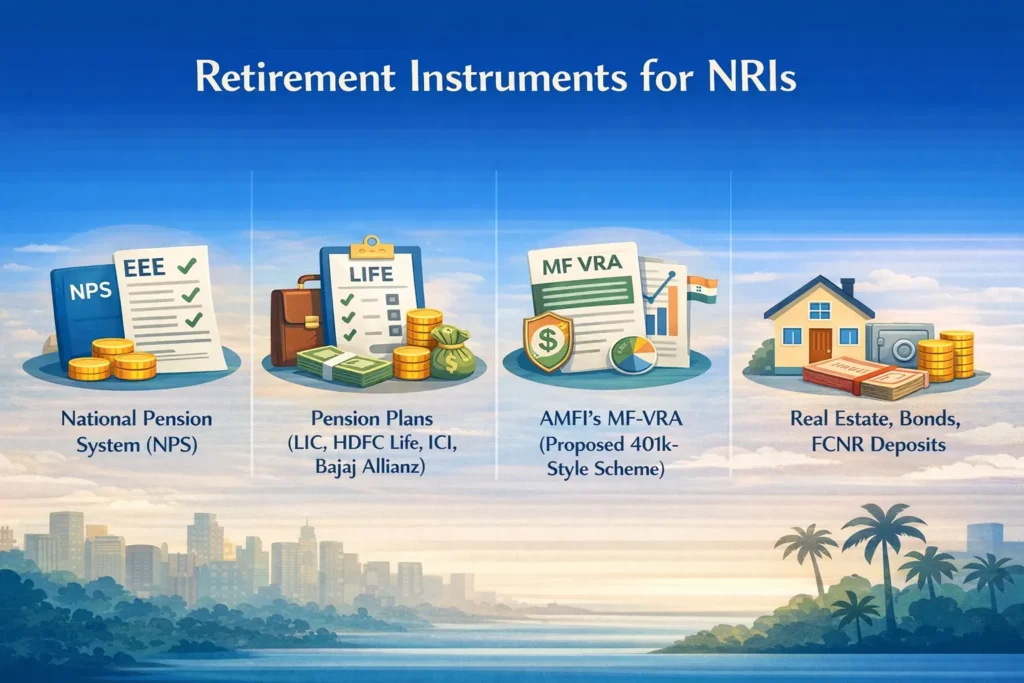
    Retirement Instruments for NRIs

    Here are the main retirement options. Each has its pros and cons.

    National Pension System (NPS)

    • Who can invest: NRIs aged 18–70.
    • Why it matters: Triple tax benefits (EEE), long-term discipline, partial withdrawals allowed.
    • Catch: Withdrawals are partly taxable. And liquidity is limited until retirement.

    Pension Plans (LIC, HDFC Life, ICICI, Bajaj Allianz)

    • Provide annuity or lump sum options.
    • Tax benefits under Section 80C.
    • Safe but often lower returns than mutual funds.

    AMFI’s MF-VRA (Proposed 401k-Style Scheme)

    • Still under discussion, but could give NRIs a structured way to invest like US retirement accounts.
    • Worth keeping an eye on.

    Real Estate, Bonds, FCNR Deposits

    • Real Estate: Popular among NRIs returning to India. But comes with tenant hassles and liquidity issues.
    • Bonds: Safer than stocks, taxable in India.
    • FCNR Deposits: Park foreign currency, earn interest without exchange rate risk.

    Planning Your Child’s Education Corpus

    Your child’s education is a fixed event. Tuition bills won’t wait. Which means you need money ready at the right time.

    SIPs and Mutual Funds – Why NRIs Prefer Them

    Starting a SIP is like planting a tree. Small steps, month after month. Over 10 years, the corpus grows strong.

    For example, investing ₹25,000 monthly for 10 years at 12% return creates ~₹55 lakh. That’s enough to cover most undergrad programs in India or contribute to overseas tuition.

    Sukanya Samriddhi, PPF and FKRA – Restrictions for NRIs

    • Sukanya Samriddhi: Great scheme for girl child education. But once you become an NRI, contributions are not allowed.
    • PPF: Same story. NRIs can’t open new accounts. Existing ones can be maintained till maturity but not extended.
    • FKRA: Few foreign schemes exist, but rules vary country to country.

    Wealth Management Firms Specializing in Education Funds

    Some firms now offer curated “education portfolios” for NRIs. They mix equity, debt, and deposits aligned with timelines. Useful if you don’t want to manage things yourself.

    Cross-Border Financial Planning Essentials

    Here’s where most NRIs get stuck. Your money is spread across two systems.

    Handling Foreign Accounts like 401k or IRA as an NRI

    If you’ve worked in the US, your 401k or IRA still holds value. But once you move back, taxation and withdrawals change. Some people leave them untouched. Others roll them into new accounts. Always take professional advice here.

    DTAA, Tax Residency and Avoiding Double Taxation

    The Double Tax Avoidance Agreement (DTAA) is your shield. It ensures the same income isn’t taxed twice. But you must prove tax residency in your host country with Form 10F and a certificate.

    Example: You earn rent in India. Pay tax here. Then you claim credit in the US under DTAA. Simple if documented right. Painful if ignored.

    Repatriation Rules for Education and Retirement Savings

    Sending money abroad? RBI rules apply. NRE accounts are fully repatriable. NRO accounts have limits. FCNR deposits are flexible.

    For education, outward remittance schemes let you send fees abroad legally. But paperwork is strict.

    Common Mistakes NRIs Must Avoid

    From analyzing HDFC, Dhan, and advisory blogs, here are the big pitfalls:

    1. Over-relying on real estate. Property feels safe, but liquidity is slow.
    2. Ignoring tax in both countries. Leads to penalties later.
    3. Not planning for currency depreciation. Returns look good in rupees, not so in dollars.
    4. Skipping estate planning. Families suffer later.
    5. Last-minute planning. Education funds need time. Retirement needs decades.

    FAQs

    Can NRIs claim tax benefits on Indian pension schemes?

    Yes, but only under certain sections like 80C. Always check your country’s tax laws too.

    How can I fund my child’s education abroad through Indian investments?

    Build an INR corpus, then remit under RBI’s Liberalized Remittance Scheme. Keep forex risk in mind.

    What happens to my NPS or PPF if I return to India permanently?

    NPS continues as usual. PPF can be extended like any resident.

    How much should I save monthly for education?

    Work backwards. If fees are ₹40 lakh in 10 years, you need ₹20,000–25,000 SIP per month at 12% return.

    Can NRIs invest in Sukanya Samriddhi?

    Not after they become NRIs. Existing accounts stay but no fresh deposits.

    Summary Table

    GoalInstrumentsProsConsTax Rules
    RetirementNPS, Pension Plans, FCNR, Real EstateLong-term, stableLock-in, inflation risk80C, DTAA
    EducationSIPs, FDs, Bonds, Education FundsLiquidity, compoundingMarket riskLimited tax benefits
    Cross-Border401k/IRA, NRE/NRO, FCNRCurrency hedge, global optionsComplex rulesDTAA, FATCA

    Conclusion

    Financial planning for NRIs isn’t about choosing between retirement and education. It’s about balancing both with smart allocation.

    Start early. Diversify. Respect tax rules. Avoid the common traps.

    That’s how you give your child the education they deserve, and yourself the retirement you’ve earned.

  • 10 Common NRI Investment Myths Debunked

    10 Common NRI Investment Myths Debunked

    Investing in India as a Non-Resident Indian (NRI) can be a daunting task, often complicated by a web of myths and misconceptions. Many NRIs hesitate or make misinformed decisions due to these persistent myths. This article aims to debunk 10 common NRI investment myths, providing clarity and helping NRIs invest confidently and legally in India. By understanding the truth behind these myths, you can make smarter financial decisions and ensure compliance with Indian regulations.

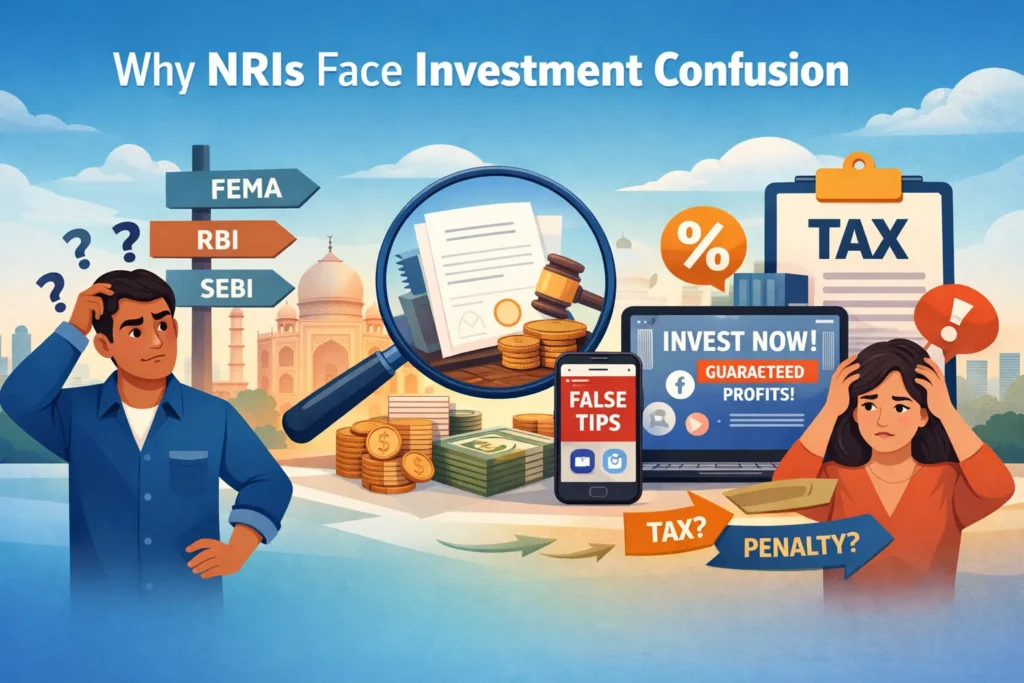
    Why NRIs Face Investment Confusion

    Investing in India as an NRI comes with its own set of challenges. The regulatory landscape is complex, with guidelines from the Foreign Exchange Management Act (FEMA), the Reserve Bank of India (RBI), and the Securities and Exchange Board of India (SEBI) to navigate. Misleading advice on forums and social media adds to the confusion, as does the fear of tax complications. Many NRIs are unsure about the legalities and tax implications of their investments, leading to hesitation and missed opportunities.

    10 Common NRI Investment Myths – And the Truth

    Myth 1: NRIs Cannot Invest in Indian Mutual Funds

    Truth: NRIs are allowed to invest in Indian mutual funds under specific Know Your Customer (KYC) guidelines, including the Foreign Account Tax Compliance Act (FATCA) and the Common Reporting Standard (CRS). This means that as long as you comply with these regulations, you can diversify your investment portfolio with mutual funds in India.

    Myth 2: NRIs Cannot Buy Real Estate in India

    Truth: NRIs are permitted to buy real estate in India, except for agricultural land, plantations, and farmhouses. This opens up a wide range of opportunities for NRIs looking to invest in residential or commercial properties. However, it’s essential to understand the specific regulations and restrictions to make informed decisions.

    Myth 3: NRE Accounts Offer Tax-Free Returns Forever

    Truth: While NRE accounts offer tax-free returns in India, it’s crucial to check the taxation laws in your country of residence, as some countries tax global income. This means that while you might not pay taxes on NRE account returns in India, you could still be liable for taxes in your country of residence.

    Myth 4: All Indian Investment Options Are Open to NRIs

    Truth: There are some restrictions on certain investment options for NRIs, such as the Public Provident Fund (PPF) and small savings schemes. It’s important to be aware of these restrictions to avoid any legal complications. Always check the eligibility criteria before investing in any financial instrument.

    Myth 5: NRIs Cannot Invest in Stocks Directly

    Truth: NRIs can invest in the Indian stock market directly through the Portfolio Investment Scheme (PIS) using NRE/NRO demat accounts with SEBI-registered brokers. This allows NRIs to participate in the Indian stock market and benefit from its growth potential.

    Myth 6: Double Taxation Means You Pay Twice

    Truth: The Double Taxation Avoidance Agreement (DTAA) provides relief to NRIs, ensuring they do not pay tax twice on the same income. This means that if you pay taxes on your income in India, you can claim relief in your country of residence, and vice versa. Understanding DTAA can help you optimize your tax planning and avoid double taxation.

    Myth 7: Real Estate Is Always the Best NRI Investment

    Truth: While real estate can be a lucrative investment, it’s essential to evaluate the return on investment (ROI), liquidity, tax compliance, and maintenance costs. Real estate investments require careful consideration and should be part of a diversified investment portfolio. It’s not always the best option for everyone, and it’s crucial to assess your financial goals and risk tolerance.

    Myth 8: NRI Tax Filing in India Is Optional

    Truth: Filing taxes in India is mandatory for NRIs if their income exceeds the threshold limit, even if Tax Deducted at Source (TDS) has been deducted. It’s important to stay compliant with Indian tax laws to avoid any penalties or legal issues. Always consult a tax advisor to understand your tax obligations and ensure timely filing.

    Myth 9: NRIs Can’t Invest in Indian FDs

    Truth: Special fixed deposit schemes like NRE, NRO, and FCNR deposits are available for NRIs. These deposits offer competitive interest rates and are a safe investment option for NRIs looking to park their funds in India. It’s essential to understand the features and benefits of these deposit schemes to make informed investment decisions.

    Myth 10: Once NRI, Always NRI for Tax

    Truth: Your residential status for tax purposes is evaluated yearly under Indian tax law. This means that even if you are an NRI, your residential status can change based on your stay in India and other factors. It’s crucial to stay updated with the latest tax laws and regulations to ensure compliance and optimize your tax planning.

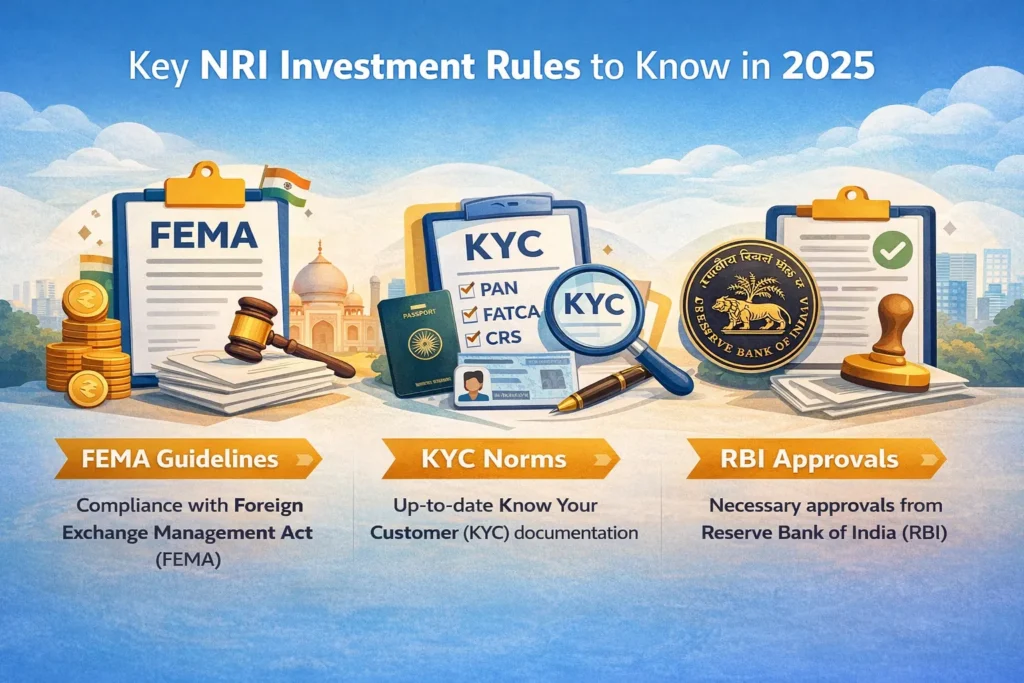
    Key NRI Investment Rules to Know in 2026

    Understanding the key investment rules for NRIs is essential for making informed and compliant investment decisions. Here are some crucial guidelines to keep in mind:

    • FEMA Guidelines: The Foreign Exchange Management Act (FEMA) regulates foreign exchange and investments in India. NRIs must comply with FEMA guidelines when investing in India.
    • KYC Norms: Know Your Customer (KYC) norms, including PAN, FATCA, and CRS, are essential for NRI investments. Ensure that your KYC documentation is up to date to avoid any legal complications.
    • RBI Approvals: Certain investment instruments require approval from the Reserve Bank of India (RBI). It’s important to be aware of these requirements and obtain the necessary approvals before investing.

    How to Avoid Common NRI Investment Mistakes

    Avoiding common investment mistakes is crucial for NRIs looking to invest in India. Here are some tips to help you make smarter investment decisions:

    • Check Eligibility and Documentation: Always verify your eligibility and ensure that your documentation is in order before investing in any financial instrument.
    • Understand Tax Implications: Be aware of the tax implications of your investments in both India and your country of residence. Consult a tax advisor to optimize your tax planning and ensure compliance.
    • Use Regulated Advisors and Brokers: Work with regulated advisors and brokers to ensure that your investments are compliant with Indian regulations. This can help you avoid legal complications and make informed investment decisions.

    Best NRI Investment Options in India 2026

    India offers a wide range of investment options for NRIs. Here are some of the best investment options to consider in 2026:

    • Mutual Funds: Mutual funds offer diversification and professional management, making them an excellent investment option for NRIs. Consider investing in equity and debt mutual funds based on your risk tolerance and financial goals.
    • NRE/NRO/FCNR Deposits: These fixed deposit schemes offer competitive interest rates and are a safe investment option for NRIs. Understand the features and benefits of these deposits to make informed decisions.
    • Direct Equity: Investing in the Indian stock market through the Portfolio Investment Scheme (PIS) allows NRIs to participate in the growth potential of Indian companies. Work with SEBI-registered brokers to ensure compliance and make informed investment decisions.
    • Real Estate: While real estate can be a lucrative investment, it’s essential to evaluate the ROI, liquidity, tax compliance, and maintenance costs. Consider real estate as part of a diversified investment portfolio.

    FAQs on NRI Investments

    Can NRI invest in mutual funds?

    Yes, NRIs can invest in Indian mutual funds under specific KYC guidelines, including FATCA and CRS.

    What are NRI real estate rules?

    NRIs are permitted to buy real estate in India, except for agricultural land, plantations, and farmhouses. It’s essential to understand the specific regulations and restrictions before investing.

    How is NRI income taxed in India?

    NRI income is taxed in India based on the residential status and the type of income. It’s crucial to stay updated with the latest tax laws and regulations to ensure compliance and optimize your tax planning.

    Is NRO FD interest taxable?

    Yes, the interest earned on NRO fixed deposits is taxable in India. It’s important to be aware of the tax implications and ensure timely filing of taxes.

  • Can NRIs can obtain education loans from Indian banks for pursuing education in India?

    Can NRIs can obtain education loans from Indian banks for pursuing education in India?

    Yes, NRIs can generally get education loans from Indian banks to study in India, but the rules differ by bank. Lenders usually look at the student’s admission, the course, and the repayment ability of the parent or guardian, and many ask for a co-borrower and collateral for larger loans.

    Who is eligible?

    The loan is usually taken in the student’s name, with a parent or close relative as co-applicant. Lemonn describes the typical setup: the student is the borrower and the NRI parent or guardian is the co-applicant. Banks that commonly offer these loans include SBI, Bank of Baroda, ICICI Bank and HDFC Credila.

    Common conditions across lenders:

    • The student has confirmed admission to a recognised institution in India for higher, technical or professional study, per ImmiHelp.
    • An NRI co-applicant holds a valid Indian passport and an active NRE or NRO account, per Lemonn.
    • The co-applicant is a close relative such as a parent, sibling or spouse.
    • Lenders usually want an earning co-applicant based in India. HDFC Credila makes this mandatory.

    OCI holders face a stricter rule at some lenders. Credila’s FAQ says a co-applicant must be an Indian citizen, and that an OCI holder is acceptable only alongside an additional Indian-citizen applicant. An NRI can also be a co-applicant by giving power of attorney to someone in India, according to ImmiHelp.

    Loan amount, interest and collateral

    The loan covers admission, tuition and related fees, according to ImmiHelp. NRI students often pay higher fees than resident students at Indian institutes, which is a common reason parents borrow. Money is usually released in stages as the institution requires it, not in one payment.

    Limits and rates vary by lender and by the student’s course and profile. Lemonn lists these indicative interest ranges:

    LenderIndicative interest rate (per year)
    SBI9.15% to 11.00%
    HDFC Credila10.00% to 13.50%

    Rates change often and depend on the borrower’s profile, so confirm them with the bank. HDFC Credila says it has no upper loan limit and prices loans at its benchmark rate plus a spread. Its spread depends on factors such as the student’s academics, the course and college, the co-applicant’s finances and whether collateral is offered.

    Collateral is a negotiating point. Larger loans often need security. Credila lists a fixed deposit assigned to the lender as one option.

    Documents NRIs usually need

    You will need papers for both the student and the NRI co-applicant. Lemonn lists these:

    • KYC documents for the student and the co-applicant.
    • The co-applicant’s valid passport and visa.
    • The co-applicant’s last six months of salary slips and bank statements.
    • The co-applicant’s income tax returns for the last two years, in India and abroad.

    On the student side, expect to provide the admission letter and a statement of course expenses. Banks differ, so ask your lender for its exact checklist.

    Repayment and tax benefit

    Repayment. Lemonn says repayment can come from the student’s income, or from the NRI co-applicant’s account. Lenders such as Credila ask the co-applicant to hold an Indian bank account with a standing instruction for monthly repayment. Loan tenure is usually the study period, plus a grace period after studies, plus the repayment period.

    Tax deduction. Under Section 80E, interest on an education loan can be deducted from taxable income. SBNRI says NRIs can claim it if the loan is from an approved Indian lender, provided they file returns in India and have taxable Indian income. Key points:

    • Only the interest counts, not the principal, and there is no cap on the amount, per Outlook Business.
    • The deduction runs for eight successive years from the year you start paying interest, per the same source.
    • It covers loans for your own, your spouse’s or your child’s higher education.
    • Motilal Oswal says it applies only under the old tax regime for FY 2025-26. Rules and section numbers may change from FY 2026-27, so confirm with a chartered accountant.

    If you have no taxable income in India, the deduction has little value.

    Tips for NRI applicants

    1. Check the co-applicant’s citizenship first. Indian passport holders have the most options; OCI holders may need an extra Indian-citizen co-applicant.
    2. Open or keep an active NRE or NRO account, and an Indian account with standing instructions for repayments.
    3. Compare at least three lenders on rate, spread, fees and collateral, not just the headline rate.
    4. Keep admission and fee documents ready, since disbursal follows the institution’s payment schedule.
    5. Ask the lender for an interest certificate every year if you plan to claim Section 80E.

    This article is general information, not financial or tax advice. Bank terms change, so confirm them with the lender.

  • Converting Physical Shares Into Dematerialized – Updated 2026

    Converting Physical Shares Into Dematerialized – Updated 2026

    Converting physical shares into dematerialised

    #nriinvestments, #dematform, #digitalfinance

    Converting physical shares into dematerialized (demat) form is a crucial step for Non-Resident Indians (NRIs) looking to manage their investments more efficiently in India. Here’s a detailed guide on how NRIs can go about this process:

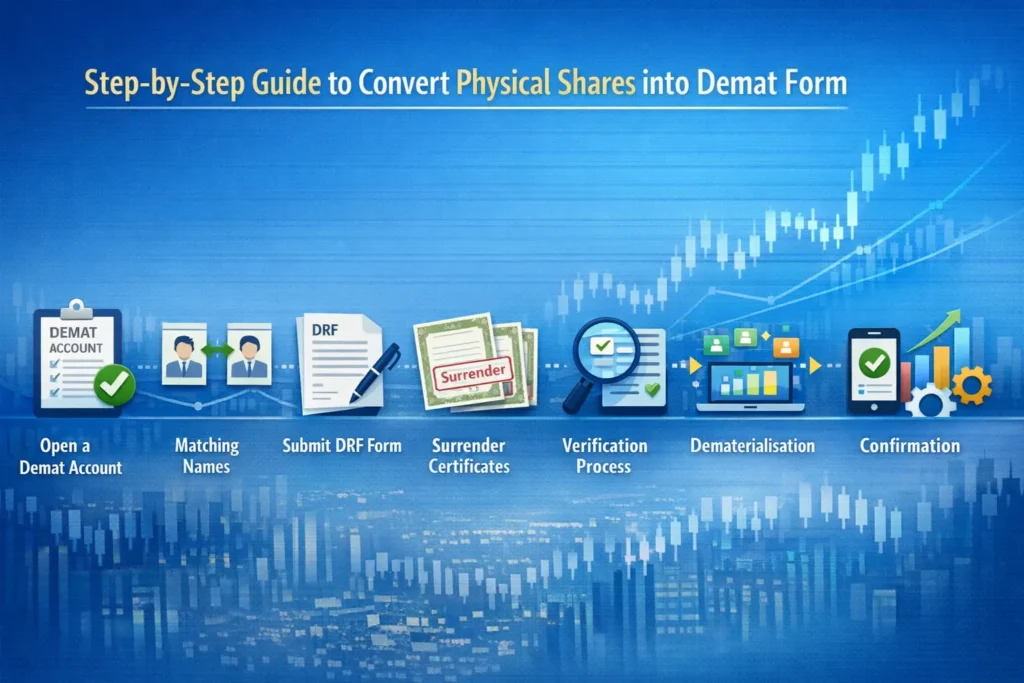
    Step-by-Step Guide to Convert Physical Shares into Demat Form:

    #dematsteps, #nriinvestments, #guide

    1. Open a Demat Account: First, an NRI needs to open a demat account with a registered Depository Participant (DP). This could be a bank, a financial institution, or a brokerage firm. For NRIs, specific documents such as a passport copy, overseas and Indian address proofs, PAN card, and photographs are required.
    2. Matching Names: Ensure that the name on the demat account matches the name on the share certificates. If there is a discrepancy, such as a change due to marriage or other reasons, you may need to submit additional supporting documents like a gazette notification or a marriage certificate to rectify this.
    3. Submit Dematerialisation Request Form (DRF): Fill out a DRF, providing details such as the company name, certificate numbers, and the quantity of shares you want to dematerialize. Each company’s shares will require separate DRFs if they are from different companies.
    4. Surrender Physical Share Certificates: Along with the DRF, submit your physical share certificates to the DP. These will need to be endorsed with a signature that matches the one registered with your demat account.
    5. Verification Process: The DP will verify the submitted documents and share certificates. It’s essential to ensure all documents are complete and correctly filled to avoid delays.
    6. Dematerialisation: Upon successful verification, the DP will process the dematerialisation with the respective depository (NSDL or CDSL). The physical shares will be canceled, and an equivalent number of shares will be credited to your demat account.
    7. Confirmation: You will receive confirmation from your DP once the shares are dematerialized and reflect in your demat account statement. This typically takes around 15 to 30 days, depending on the efficiency of the DP and the completeness of your documentation.
    8. Ongoing Management: Once the shares are in demat form, you can manage them electronically, making it easier to buy, sell, or hold the shares. This process reduces the risks associated with physical certificates such as loss, theft, or damage.

    Important Considerations:

    #sebideadline, #dematform, #stockmarketindia

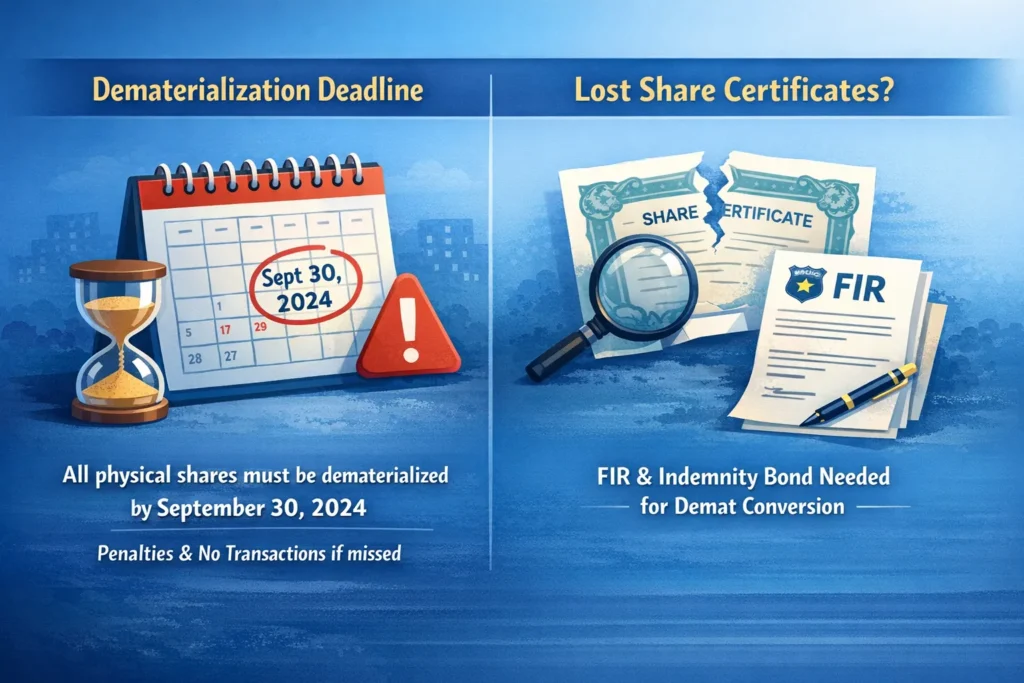
    • Deadline for Dematerialization: It’s important to note that the Securities and Exchange Board of India (SEBI) has mandated the dematerialization of all physical shares by September 30, 2024. Failing to meet this deadline could result in penalties and inability to transact in the securities market.
    • Documents for Loss of Physical Certificates: If physical share certificates are lost, NRIs can still convert their shares into demat form by providing a copy of the FIR and an indemnity bond to their DP.

    This process, while straightforward, requires careful attention to documentation and adherence to regulatory requirements. Starting early and ensuring all details are correctly provided can make the conversion process smooth and hassle-free.

    Also read What is Embassy Attestation in India? A Comprehensive Guide

    Must read Demat Account for NRIs: Common Questions and Answers

  • Demat Account for NRIs: Common Questions and Answers

    Demat Account for NRIs: Common Questions and Answers

    Demat Account for NRIs: Common Questions and Answers

    Investing in India can be a lucrative opportunity for Non-Resident Indians (NRIs), but understanding the nuances of opening and operating a Demat account is crucial for seamless transactions. A Demat account allows NRIs to hold shares and securities in an electronic format, making the process of investing in Indian stock markets more straightforward. Here, we address some of the most common questions NRIs have regarding Demat accounts:

    1. What is a Demat Account, and Why Do NRIs Need It?

    demataccount, #NRIs, #indianstockmarket

    A Demat account, short for “Dematerialized account,” is used to hold shares and securities in an electronic format. NRIs need a Demat account to invest in the Indian stock market. This account simplifies the process of buying, selling, and holding securities such as shares, mutual funds, bonds, and exchange-traded funds (ETFs).

    2. Can NRIs Open a Demat Account in India?

    Yes, NRIs are permitted to open a Demat account in India. The account can be opened with any SEBI-registered Depository Participant (DP), which could be a bank, broker, or financial institution. However, NRIs need to comply with specific regulations under the Foreign Exchange Management Act (FEMA).

    3. What Types of Demat Accounts Can NRIs Open?

    #NREaccount, #NROaccount, #NRIdemat

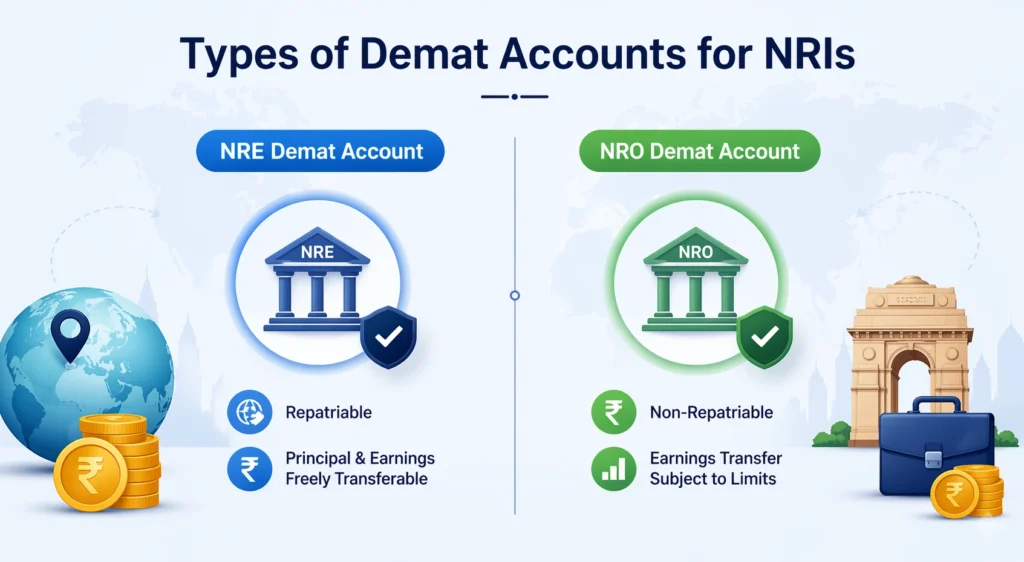
    NRIs can open two types of Demat accounts, each serving a different purpose:

    • NRE Demat Account: This account is linked to an NRE (Non-Resident External) bank account. It allows repatriation of funds, meaning both the principal and earnings can be transferred abroad without any restrictions. This account is suitable for NRIs who wish to invest in repatriable securities.
    • NRO Demat Account: Linked to an NRO (Non-Resident Ordinary) bank account, this account is used for investments where repatriation is not required. Earnings can be transferred abroad, but there are limits on the amount. This is ideal for managing income like rent, dividends, or other earnings in India.

    4. What Documents Are Required to Open a Demat Account for NRIs?

    NRIs need to submit the following documents to open a Demat account:

    • A copy of the passport (proof of identity).
    • Proof of overseas address (utility bills, bank statements).
    • Recent passport-sized photographs.
    •  PAN card (Permanent Account Number).
    •  A copy of the visa or work permit.
    • A filled and signed account opening form provided by the Depository Participant.

    These documents must be self-attested and may require attestation by the Indian embassy or consulate in the NRI’s country of residence.

    #demataccountdocuments, #NRIs, #PANcard

    5. How Do NRIs Invest in the Indian Stock Market Through a Demat Account?

    Once a Demat account is set up, NRIs can start investing in Indian stock markets through a Portfolio Investment Scheme (PIS). This scheme, governed by the Reserve Bank of India (RBI), allows NRIs to buy and sell shares of Indian companies on a repatriation or non-repatriation basis. To trade, NRIs must have:

    • An NRI Demat account (linked to either NRE or NRO account).
    • A trading account with a registered broker.
    • A PIS account with an authorized dealer bank for routing all transactions.

    6. Are There Any Restrictions on NRI Investments Through a Demat Account?

    Yes, there are certain restrictions that NRIs must keep in mind:

    • NRIs cannot trade intraday or speculate in the stock market. They are only allowed to trade on a delivery basis.
    • Investments in certain sectors, like defense and real estate, may be subject to caps and specific conditions.
    • NRIs can only own up to a certain percentage of paid-up capital in listed Indian companies. This percentage varies across sectors and is set by the RBI.

    7. What Are the Tax Implications for NRIs With a Demat Account?

    #NRItax, #capitalgains, #indiantaxation

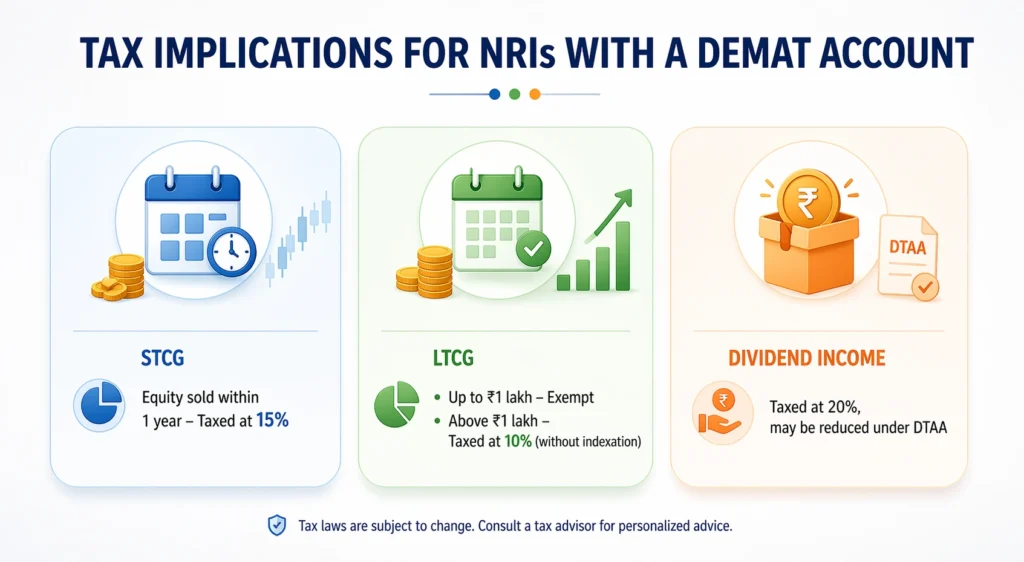
    NRIs are liable to pay taxes on income generated from their investments in India, including capital gains tax. Here’s a brief overview:

    • Short-Term Capital Gains (STCG): Gains from equity shares sold within one year of purchase are taxed at 15%.
    • Long-Term Capital Gains (LTCG): Gains from equity shares sold after one year are exempt up to ₹1 lakh per year. Gains beyond ₹1 lakh are taxed at 10% without indexation.
    • Dividend Income: Dividends from Indian companies are taxable for NRIs at 20% but can be reduced under a Double Taxation Avoidance Agreement (DTAA) between India and the NRI’s country of residence.

    8. Can NRIs Convert Their Resident Demat Account to an NRI Demat Account?

    Yes, NRIs who already have a resident Demat account must convert it to an NRI Demat account when their residential status changes. The process involves closing the existing resident Demat account and opening a new NRI Demat account with updated documentation reflecting their non-resident status.

    9. How Are Repatriation and Non-Repatriation Transactions Managed in a Demat Account?

    #repatriation, #NROaccount, #NREAccount

    NRIs can invest on a repatriable basis through an NRE Demat account, where the investment’s principal and returns can be transferred outside India. Non-repatriable investments, managed through an NRO Demat account, mean that the principal remains in India, but NRIs can remit up to $1 million per financial year outside India under the RBI’s guidelines.

    10. Is it Possible for NRIs to Appoint a Nominee for Their Demat Account?

    Yes, NRIs can appoint a nominee for their Demat account, just like resident investors. The nominee could be a resident Indian or another NRI. This provision helps ensure that the securities are transferred seamlessly in the event of the account holder’s demise.

    Conclusion:

    A Demat account is an essential tool for NRIs looking to invest in Indian markets. Understanding the various aspects—from account types to tax implications—can help NRIs make informed decisions and maximize their investment potential. By staying compliant with the rules and regulations laid out by RBI and FEMA, NRIs can enjoy a smooth investing experience in India’s dynamic stock markets.

    If you’re an NRI considering investing in India, ensure you choose a reliable Depository Participant and seek guidance from financial advisors familiar with NRI investments. This will help you navigate the complexities and optimize your returns. Happy investing!