Category: US & Cross-Border Tax

  • Understand the Difference Between W-2 and 1099 Income

    Understand the Difference Between W-2 and 1099 Income

    Tax season rolls around. You open your mailbox. There’s a form from your employer. But wait. Is it a W-2 or a 1099?

    If you’re scratching your head right now, you’re not alone. Thousands of workers get confused about these two forms every year. And that confusion can cost you real money.

    Here’s the truth: Whether you receive a W-2 or 1099 determines how much you pay in taxes, what benefits you get, and how you file your return. Miss this distinction and you might owe the IRS more than you expected.

    This guide breaks down everything you need to know about W-2 vs 1099 income. No confusing tax jargon. Just clear answers to help you understand your work status and plan for tax time.

    What Is W-2 Income? (Employee Status)

    Let’s start with the most common type: W-2 income.

    You’re a W-2 employee if you work for someone else who controls your schedule, tells you how to do your job, and provides the tools you need. Think of a traditional job at a company.

    Your employer takes taxes out of every paycheck automatically. Social Security. Medicare. Federal income tax. Sometimes state tax too.

    By the end of January each year, you’ll receive Form W-2 in the mail. This form shows exactly how much you earned and how much tax was already paid on your behalf.

    Typical W-2 jobs include:

    Corporate office workers, retail store employees, teachers and school staff, hospital nurses on payroll, restaurant workers, bank tellers, factory workers, and government employees.

    The biggest advantage of W-2 status? Your employer handles the heavy lifting on taxes. They also typically offer benefits that independent contractors don’t get.

    Common employee benefits:

    Health insurance (often with employer paying part of the premium), paid vacation days and sick leave, retirement plans like 401(k) with company matching, unemployment insurance if you lose your job, workers’ compensation for job injuries, and sometimes dental, vision, and life insurance.

    I recently talked to a friend who switched from freelancing to a full-time job. She told me the health insurance alone saved her over $400 per month. That’s real money back in her pocket.

    But W-2 status isn’t perfect. You have less control over your schedule. Fewer tax deductions. And your employer decides when and how you work.

    What Is 1099 Income? (Independent Contractor Status)

    Now let’s talk about the other side: 1099 income.

    You’re a 1099 contractor if you work for yourself. You control when you work, how you complete projects, and what tools you use. You’re running your own show.

    The catch? Nobody takes taxes out of your payments.

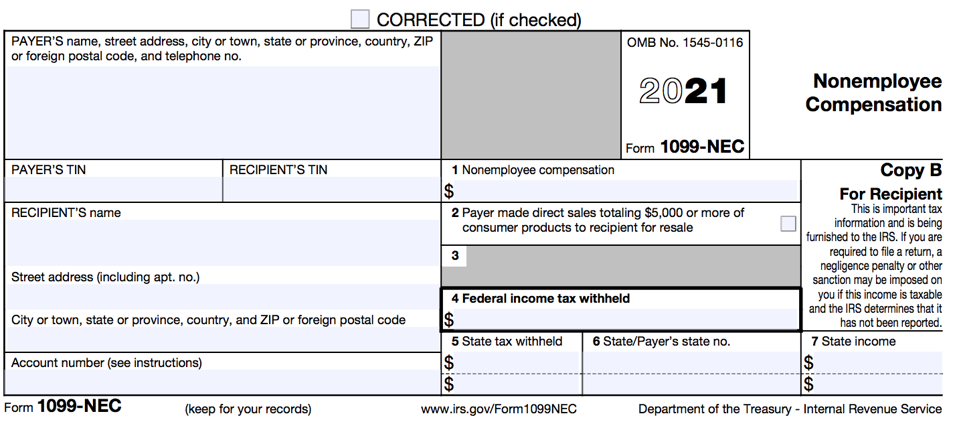
    When you earn $600 or more from a client during the year, they’ll send you Form 1099-NEC. That stands for “nonemployee compensation.” Basically, it’s proof you got paid.

    Common 1099 workers include:

    Freelance writers and designers, Uber and Lyft drivers, DoorDash delivery people, independent consultants, real estate agents, construction subcontractors, virtual assistants, photographers, and web developers.

    Here’s where it gets tricky. As a 1099 contractor, you pay both sides of Social Security and Medicare taxes. Employees split this cost with their employer. You pay the whole thing yourself.

    This is called self-employment tax, and it’s 15.3% of your net income. That’s on top of regular income tax.

    Let me put this in perspective. Say you earn $50,000 as a 1099 contractor. You’ll owe around $7,650 in self-employment tax alone. Then add your regular income tax on top of that.

    Ouch.

    But there’s a silver lining. 1099 contractors can deduct business expenses that W-2 employees can’t. Home office space. Computer and phone costs. Internet bills. Mileage when you drive for work. Professional software subscriptions.

    These deductions lower your taxable income, which means you pay less tax overall.

    Quick Comparison Table of W-2 vs 1099

    Let’s break this down in a simple chart:

    FactorW-2 Employee1099 Contractor
    Work StatusEmployee of a companySelf-employed business owner
    Tax WithholdingEmployer automatically deductsYou pay everything yourself
    Social Security & MedicareEmployer pays 7.65%, you pay 7.65%You pay the full 15.3%
    Benefits ProvidedUsually yes (health, PTO, retirement)Almost never included
    Work ControlEmployer sets schedule and methodsYou decide how and when to work
    Expense DeductionsVery limited optionsMany business expenses deductible
    Income StabilitySteady paycheck every periodCan vary month to month
    Job SecuritySome protection and unemploymentNo safety net if work dries up

    This chart shows the core tradeoff. W-2 employees get stability and benefits but less freedom. 1099 contractors get flexibility and tax deductions but more responsibility.

    Tax Differences: W-2 vs 1099 Income
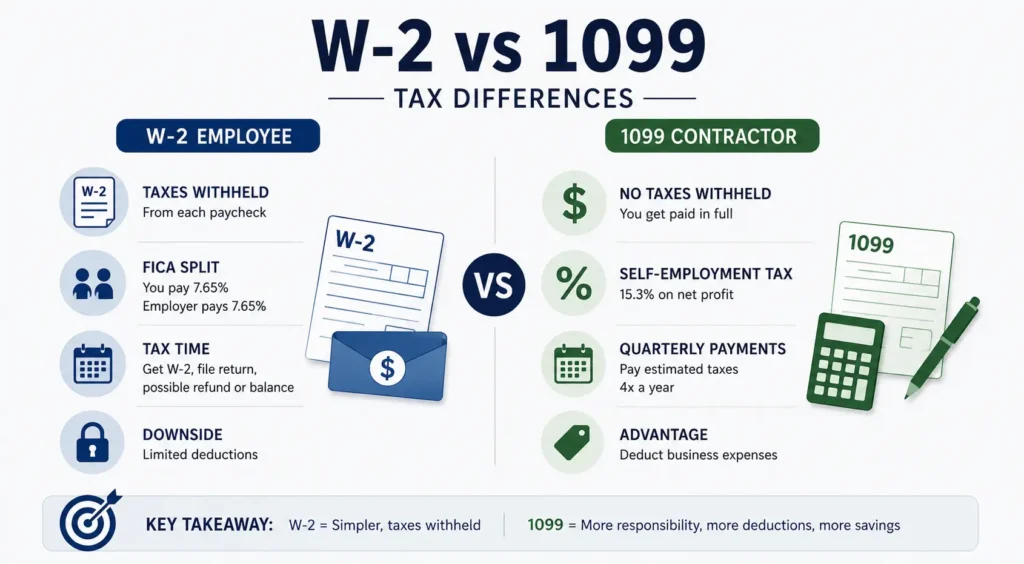
    Let’s get specific about taxes. This is where the rubber meets the road.

    W-2 Taxes Explained

    When you’re a W-2 employee, life is simpler at tax time.

    Your employer withholds money from each paycheck for federal income tax, Social Security tax (6.2% of your wages), and Medicare tax (1.45% of your wages). Some states also require state income tax withholding.

    You split the Social Security and Medicare burden with your employer. They pay 7.65%. You pay 7.65%. Total of 15.3% gets covered.

    Come tax season, you receive your W-2 form. You enter the numbers on your tax return. If your employer withheld the right amount, you might get a small refund or owe a little. Usually, it’s not a huge surprise.

    The downside? Limited deductions. You can’t write off your home office or your laptop. Those expenses come out of your after-tax dollars.

    1099 Taxes Explained

    Now here’s where 1099 work gets complicated.

    Nobody withholds taxes from your payments. When a client pays you $2,000, you get the full $2,000. But don’t spend it all.

    You owe self-employment tax of 15.3% on your net profit. That’s your income minus your business expenses.

    You also owe regular income tax based on your tax bracket. Could be 10%, 12%, 22%, or higher depending on how much you earn.

    And here’s the kicker: The IRS wants you to pay quarterly estimated taxes. That means four times a year (April, June, September, and January), you need to calculate what you owe and send money to the IRS.

    Miss these quarterly payments? You’ll get hit with penalties and interest. I learned this the hard way during my first year freelancing. I owed $800 in penalties just because I didn’t know about quarterly payments.

    But here’s the good news: 1099 contractors can deduct legitimate business expenses.

    Common deductions include:

    A portion of your rent or mortgage if you have a dedicated home office, computer, printer, and office equipment, business-related phone and internet costs, vehicle mileage for business trips, tools, software subscriptions, and professional development courses, business meals (50% deductible), health insurance premiums if you’re self-employed, and accounting or legal fees for your business.

    These deductions add up fast. Let’s say you earned $60,000 as a freelancer and had $15,000 in legitimate business expenses. You’d only pay taxes on $45,000 instead of the full $60,000.

    That’s a real tax savings.

    IRS Worker Classification Rules (Who Decides?)

    So who gets to decide if you’re W-2 or 1099? Great question.

    The IRS doesn’t leave this up to personal preference. They have specific rules about worker classification. And companies that get it wrong face serious penalties.

    The IRS uses three main tests to determine your status:

    1. Behavioral Control

    Does the company control how you do your work? Do they tell you when to show up, what methods to use, and who to report to?

    If yes, you’re probably an employee (W-2).

    Can you do the work however you want, on your own schedule, using your own methods?

    If yes, you’re likely an independent contractor (1099).

    2. Financial Control

    Do you have the opportunity to make a profit or loss based on your business decisions? Do you invest in your own equipment? Can you work for multiple clients?

    If yes to these, you’re probably a contractor.

    Does the company provide all your tools, pay you a salary or hourly wage, and limit your ability to work elsewhere?

    That sounds like an employee.

    3. Relationship Type

    Is this a permanent, ongoing relationship with benefits like insurance and vacation time?

    Employee territory.

    Is this a short-term project with a clear end date and no benefits?

    Contractor status.

    The IRS looks at all three factors together. No single factor determines your status. It’s the total picture that matters.

    Why this matters: Companies sometimes misclassify workers to avoid paying payroll taxes and benefits. If you think you’ve been misclassified, you can file Form SS-8 with the IRS to request an official determination.

    I know someone who worked as a “contractor” for a company for three years. Same schedule every week. Used company equipment. Had one single client. The IRS investigated and ruled she should have been an employee the whole time. The company had to pay back taxes and penalties.

    W-2 vs 1099 Pros and Cons

    Let’s lay out the advantages and disadvantages of each status clearly.

    W-2 Employee Pros:

    Predictable income. You know exactly when paychecks arrive and how much they’ll be. This makes budgeting easier.

    Employer-sponsored benefits. Health insurance, retirement matching, paid time off. These benefits have real dollar value, often worth thousands per year.

    Lower tax burden. Your employer pays half of Social Security and Medicare taxes. That’s about 7.65% of your wages you don’t have to pay.

    Simpler taxes. No quarterly payments. No tracking business expenses. Just enter your W-2 info and file.

    Unemployment protection. Lose your job through no fault of your own? You can collect unemployment benefits.

    Workers’ compensation. Get injured on the job? Workers’ comp covers medical bills and lost wages.

    W-2 Employee Cons:

    Less flexibility. You work when and where your employer says. Want to work from the beach on Tuesday afternoon? Probably not happening.

    Fewer tax deductions. You can’t write off your laptop, phone, or home office like contractors can.

    Limited income ceiling. Your pay is set by your employer. Want to earn more? You need a raise or promotion, which you don’t fully control.

    Less autonomy. Your boss decides how you do your work. Less room for creativity and personal approach.

    1099 Contractor Pros:

    Total flexibility. Work when you want, where you want, how you want. Early bird or night owl, it doesn’t matter.

    Higher earning potential. You can take on multiple clients and raise your rates. Your income isn’t capped by an employer.

    Tax deductions. Deduct legitimate business expenses to lower your taxable income significantly.

    Be your own boss. You make the decisions. No one micromanages your methods or schedule.

    Choose your clients. Don’t like working with someone? You can fire them and find better clients.

    1099 Contractor Cons:

    Higher tax burden. You pay the full 15.3% self-employment tax. That adds up fast.

    No benefits. Health insurance, retirement, paid time off. You pay for all of this yourself.

    Income instability. Busy months are great. Slow months are stressful. You never know exactly what next month looks like.

    More administrative work. You handle invoicing, bookkeeping, quarterly taxes, and business management.

    No unemployment insurance. Lose all your clients? There’s no safety net to fall back on.

    Quarterly tax payments. Miss these and face penalties. It requires discipline and planning.

    Filing Taxes With Both W-2 and 1099 Income
    Here’s a scenario that trips people up all the time.

    You work a full-time W-2 job during the day. At night and on weekends, you do freelance work that earns you 1099 income.

    How do you file taxes?

    Actually, it’s not that complicated once you understand the process.

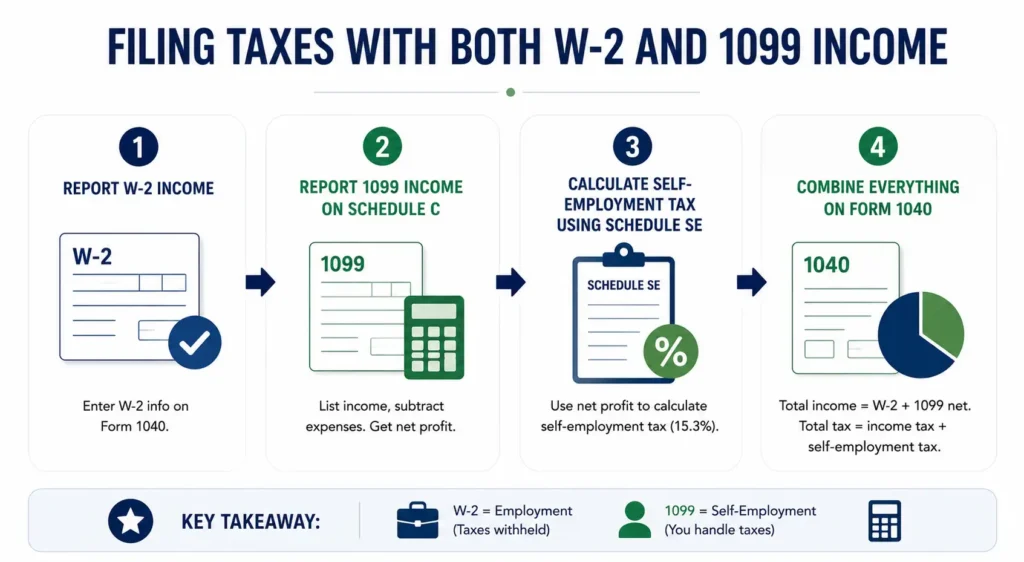
    Step 1: Report your W-2 income

    Enter your W-2 information on Form 1040 just like you normally would. This part is straightforward.

    Step 2: Report your 1099 income on Schedule C

    Schedule C is where you report business income and expenses. List all your 1099 income at the top. Then deduct your business expenses. The result is your net profit.

    Step 3: Calculate self-employment tax using Schedule SE

    Take your net profit from Schedule C and use it to calculate self-employment tax on Schedule SE. This is the 15.3% we talked about earlier.

    Step 4: Combine everything on Form 1040

    Your total income includes both W-2 wages and 1099 net profit. Your total tax includes income tax on all of it, plus self-employment tax on the 1099 portion.

    Here’s a real example:

    You earned $50,000 at your W-2 job. You earned $20,000 from freelancing but had $5,000 in business expenses. Your net freelance profit is $15,000.

    Your total taxable income is $65,000. You’ll pay income tax on all $65,000 and self-employment tax on the $15,000 freelance profit.

    Many people do this. Having a steady W-2 job provides stability and benefits. The 1099 side income lets you pursue passion projects and earn extra money.

    Just remember to save money from your 1099 income to pay taxes. A good rule of thumb: Set aside 25-30% of your 1099 earnings for taxes.

    Which Is Better: W-2 or 1099?

    This is the million-dollar question. Unfortunately, there’s no universal answer.

    It depends on what you value most.

    Choose W-2 employee status if you want:

    Steady, predictable income without worrying about finding clients. Health insurance and other benefits without paying full price. Simpler taxes with automatic withholding. Job security and unemployment protection. Someone else to handle business operations.

    Choose 1099 contractor status if you want:

    Freedom to set your own schedule and work from anywhere. Ability to choose which projects and clients you work with. Higher earning potential through multiple clients and rate increases. Tax deductions for business expenses. Complete control over your business decisions.

    I’ll be honest with you. I spent five years as a W-2 employee before switching to 1099 work. The transition was scary at first. No more automatic health insurance. No more paid vacation. I had to learn about quarterly taxes the hard way.

    But the freedom was worth it. I can work from coffee shops, travel when I want, and choose projects I find interesting. My income varies month to month, but my earning potential increased significantly.

    Your personality matters too. Are you comfortable with uncertainty? Can you handle feast-or-famine income? Do you have discipline to pay quarterly taxes?

    If you need structure and stability, W-2 might be better. If you crave independence and control, 1099 could be your path.

    Some people do both. Keep a part-time W-2 job for benefits and stability. Add 1099 work for extra income and flexibility. This hybrid approach gives you the best of both worlds.

    Common Reporting Mistakes to Avoid

    Let’s talk about mistakes that cost people money every year.

    Mistake 1: Not reporting all 1099 income

    Some people think if they don’t receive a 1099 form, they don’t have to report that income. Wrong.

    The IRS requires you to report all income, whether you get a form or not. Your client might forget to send you a 1099. You still owe taxes on that money.

    Plus, the IRS gets a copy of every 1099 sent out. They have systems that match forms to tax returns. If your return is missing income that the IRS knows about, you’ll get a letter asking why.

    Mistake 2: Missing quarterly tax payments

    This is huge. The IRS expects 1099 contractors to pay taxes throughout the year, not all at once in April.

    Miss these quarterly deadlines and you’ll owe penalties. Even if you pay your full tax bill when you file, you’ll still get charged penalties for late quarterly payments.

    Set reminders for April 15, June 15, September 15, and January 15. Calculate roughly what you owe and send it in.

    Mistake 3: Poor recordkeeping of expenses

    You can’t deduct expenses if you can’t prove them. Keep receipts. Save invoices. Track mileage.

    I use a simple spreadsheet and take photos of receipts with my phone. It takes five minutes after each purchase but saves hours at tax time.

    Mistake 4: Mixing personal and business expenses

    Went out to dinner with friends? That’s not a business meal. Bought a laptop you use for Netflix and work? You can only deduct the business-use percentage.

    The IRS audits people who try to write off personal expenses as business costs. Keep them separate.

    Mistake 5: Not understanding worker classification

    Some employers call you a contractor when you’re really an employee. This lets them avoid paying payroll taxes and benefits.

    Know the IRS rules. If you believe you’re misclassified, you have options to challenge it.

    Frequently Asked Questions

    Do 1099 workers pay more taxes than W-2 employees?

    Usually yes, but not always. The 15.3% self-employment tax hits 1099 contractors hard. But if you have significant business expenses to deduct, you might end up paying less overall. It depends on your specific situation.

    Can you switch from W-2 to 1099 in the same company?

    Technically yes, but the job duties must genuinely change. The IRS will look closely at this. If you’re doing the same work in the same way, you should stay W-2. Just changing the paperwork isn’t enough.

    What happens if a company incorrectly classifies me?

    You can file Form SS-8 with the IRS requesting an official determination. If the IRS agrees you were misclassified, the company may owe back taxes and penalties. You might also be entitled to benefits you should have received.

    Can I be both W-2 and 1099 in the same year?

    Absolutely. Many people have a regular W-2 job plus side gigs that generate 1099 income. You’ll report both types of income on your tax return. Just remember to pay quarterly taxes on the 1099 portion.

    Conclusion

    Your work status affects your paycheck, your benefits, your tax bill, and what expenses you can deduct. W-2 employees get stability and benefits but less flexibility. 1099 contractors get freedom and earning potential but more responsibility. Neither is inherently better. They serve different needs and lifestyles. Before you accept a new job or gig, understand which category you fall into. Ask questions. Read your contract. Know what you’re signing up for.

    And when tax season arrives, you’ll be prepared instead of surprised. Review your employment agreements carefully. Track your income and expenses throughout the year. If you’re a 1099 worker, set aside money for quarterly taxes. Your work status makes a huge difference when April rolls around. Don’t wait until then to figure it out.

    Also Read: What is OCI Card: Details, Advantages & Guide

    Also Read: Key Changes in FY 2024-25
  • IRS Form 1040 Filing Guide: How to Fill Out Your U.S. Individual Income Tax Return

    IRS Form 1040 Filing Guide: How to Fill Out Your U.S. Individual Income Tax Return

    Filing your taxes can feel like a giant puzzle. You have pieces from your job, your bank, and maybe a side business. And right in the middle of it all is Form 1040. It is the main board where all those pieces finally snap into place.

    This guide will walk you through it. We will explain what the 1040 is, who needs to file it, and how to fill it out, line by line. We will use simple language and clear examples. By the end, you will feel confident tackling your tax return.

    What is IRS Form 1040?

    Think of IRS Form 1040 as your annual financial report card to the government. It is the standard form for individuals to report their income, calculate how much tax they owe, and see if they have already paid enough through withholdings or if they are due a refund.

    In official terms, it is the U.S. Individual Income Tax Return. Every year, you use this form to tell the Internal Revenue Service (IRS) about the money you earned, the deductions you qualify for, and the tax credits you can claim. It all boils down to one simple equation: Tax Owed – Tax Already Paid = Your Refund or Your Bill.

    You can always find the official Form 1040 and its instructions on the IRS website.

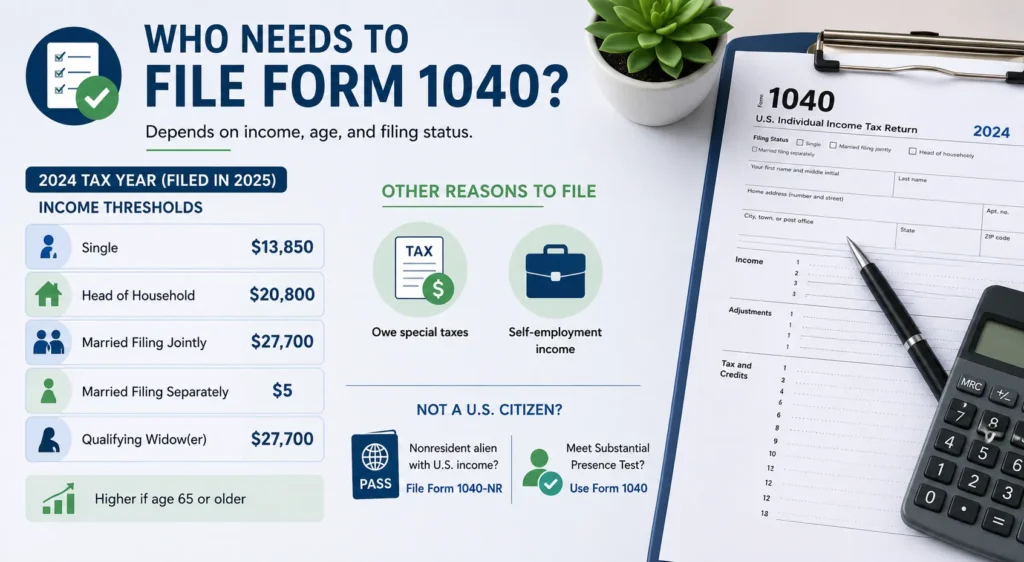
    Who Needs to File Form 1040?

    Not everyone has to file a tax return. The rules depend on your income, your age, and your filing status. It is not just about how much you made. Sometimes, you should file even if you are not required to, just to get a refund.

    You generally must file a Form 1040 if your gross income exceeds a certain threshold. For the 2024 tax year (filed in 2025), the basic thresholds are:

    • Single: $13,850
    • Head of Household: $20,800
    • Married Filing Jointly: $27,700
    • Married Filing Separately: $5
    • Qualifying Widow(er): $27,700

    These numbers go up if you are 65 or older. But income is not the only factor. You must also file if you owe special taxes, like for self-employment income or an early withdrawal from a retirement plan.

    For people who are not U.S. citizens, the rules are different. If you are a nonresident alien with U.S. income, you likely need to file a Form 1040-NR. However, if you meet the Substantial Presence Test, you are considered a resident for tax purposes and must use the standard Form 1040. I once worked with a client who was an international student. He assumed he did not need to file, but because he had a part-time on-campus job, he was required to file a 1040-NR to report that income.

    Types of Form 1040: Which One Should You Use?

    The IRS has a few versions of the 1040. Using the right one is your first step.

    Form TypeDescriptionWho Uses It
    1040Standard individual tax returnMost U.S. citizens and residents. This is the one we are focusing on.
    1040-SRSenior versionTaxpayers aged 65 and older. It has a larger font and a standard deduction chart tailored for seniors.
    1040-NRFor nonresident aliensNonresident aliens who have U.S. income.

    A quick but important note: the 1040A and 1040EZ forms were discontinued after the 2018 tax year. Everyone now uses one of the 1040 forms listed above.

    Key Sections of Form 1040 Explained

    The Form 1040 is two pages long. It is designed to walk you through your finances in a logical order. Let us break it down section by section.

    Filing Status and Personal Information

    This is the warm-up. You will provide your name, address, and Social Security Number. You will also select your filing status: Single, Married Filing Jointly, Married Filing Separately, Head of Household, or Qualifying Widow(er). Your status is crucial. It determines your standard deduction and tax brackets. Choosing the wrong one is a common mistake that can cost you money.

    Income Section

    This is where you report all your taxable income. The most common entry is wages from a W-2 form. But it also includes interest, dividends, retirement distributions, and income from freelancing or a business. This is the “what you earned” part of the story.

    Adjustments to Income

    Think of this as the “but wait, there’s more” section. But in a good way. These adjustments, also called “above-the-line deductions,” reduce your total income before you calculate your tax. They include contributions to a traditional IRA, student loan interest you paid, and alimony payments. Lowering your gross income here is a good thing. It means you pay tax on less money.

    Deductions: Standard or Itemized?

    Now you get to subtract even more from your income. You have a choice: take the standard deduction or itemize your deductions.

    The standard deduction is a flat amount based on your filing status. It is simple and most people take it. For 2024, it is $14,600 for Single filers and $29,200 for Married Filing Jointly.

    Itemizing means you list out specific deductible expenses you paid during the year. These include state and local taxes, mortgage interest, and charitable contributions. You would only do this if the total of your itemized deductions is greater than your standard deduction.

    Tax and Credits

    First, you figure out your tax. Then, you apply credits. This is a critical difference. Deductions reduce the amount of your income that is subject to tax. Credits directly reduce the amount of tax you owe, dollar for dollar. A credit is much more powerful.

    This section is where you claim valuable credits like the Child Tax Credit or the Earned Income Tax Credit. These can significantly lower your bill or boost your refund.

    Payments

    This is the “what you have already paid” section. You will enter the federal income tax withheld from your paychecks (from your W-2 forms) and any estimated tax payments you made during the year.

    The Final Tally: Refund or Amount You Owe This is the grand finale. The form walks you through a simple calculation: Total Tax – Total Payments = Refund or Amount You Owe.

    If the number is positive, the IRS owes you a refund. You can choose to have it directly deposited into your bank account. If the number is negative, you owe that amount to the IRS. You must pay it by the filing deadline to avoid penalties and interest.

    Signature

    Do not forget this. An unsigned tax return is like an unsigned check. It is invalid. You must sign and date your return. If you are filing jointly, your spouse must sign, too.

    Common Schedules Used with Form 1040

    The main Form 1040 is just the summary. For many people, the details go on supplemental forms called schedules. You only need to file the schedules that apply to your situation.

    SchedulePurposeWhen You Need It
    Schedule 1Additional Income and AdjustmentsFor reporting income like business income, rental income, or unemployment compensation, or for claiming adjustments like student loan interest.
    Schedule AItemized DeductionsIf your itemized deductions (like state taxes, mortgage interest, charity) are greater than your standard deduction.
    Schedule BInterest and Ordinary DividendsIf you earned more than $1,500 in taxable interest or dividends.
    Schedule C / SESelf-Employment Income & TaxesIf you own a business or work as a freelancer. Schedule SE calculates the self-employment tax you owe on that income.
    Schedule 2 & 3Additional Taxes and CreditsFor reporting things like the Alternative Minimum Tax (AMT) or claiming less common credits.

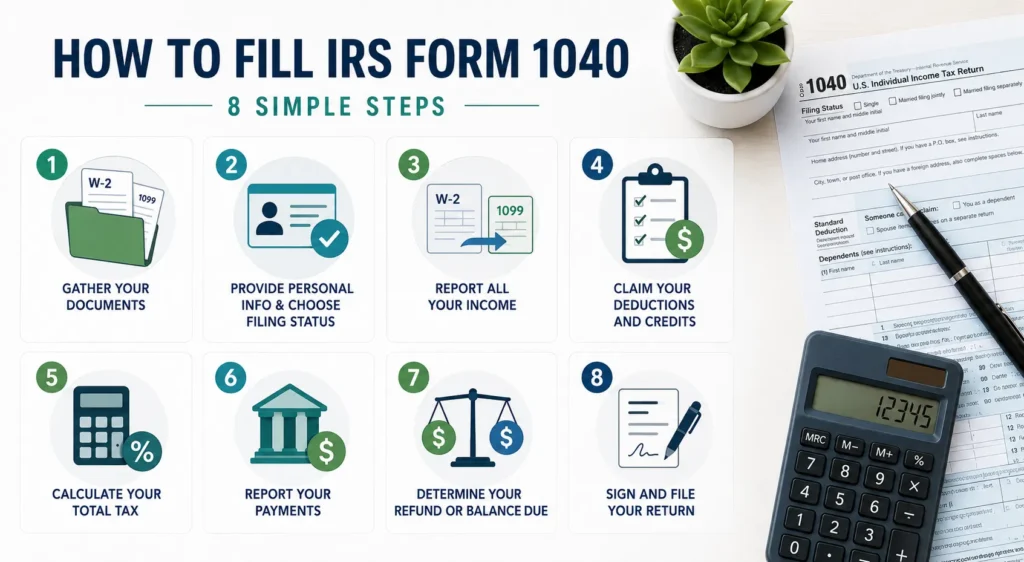
    How to Fill IRS Form 1040: Step-by-Step

    Let us walk through the process from start to finish.

    Step 1: Gather Your Documents

    This is the most important step. Before you touch the form, collect all your paperwork. This includes your W-2 from your employer, 1099s from freelance work or investments, receipts for deductible expenses, and last year’s tax return for reference. Trying to do your taxes without all your documents is like trying to bake a cake without a recipe. You will miss something.

    Step 2: Provide Personal Info and Choose Filing Status

    Start filling in the top of the form. Enter your name, address, and Social Security Number. Then, carefully select your correct filing status.

    Step 3: Report All Your Income

    Transfer the numbers from your W-2 and 1099 forms to the correct lines on the 1040. If you have income that requires a schedule, like business income on a Schedule C, complete that schedule first and then bring the final number over to the main 1040.

    Step 4: Claim Your Deductions and Credits

    Decide whether to take the standard deduction or itemize on Schedule A. Then, move to the credits section. Look carefully at the credits you might qualify for, like the Child Tax Credit. These can make a huge difference.

    Step 5: Calculate Your Total Tax

    The form will guide you here. You will use the IRS tax tables to find the tax on your taxable income. Then, add any other taxes from Schedule 2.

    Step 6: Report Your Payments

    Enter the total federal tax withheld from all your W-2s and any estimated tax payments you made. This is the money you have already paid toward your tax bill.

    Step 7: Determine Your Refund or Balance Due

    Now for the moment of truth. Subtract your total payments from your total tax. If payments are higher, you get a refund. If tax is higher, you owe the difference.

    Step 8: Sign and File Your Return

    Sign and date your return. Then, file it. E-filing is the fastest, safest, and most accurate method. The IRS acknowledges receipt within 24 hours. If you mail a paper return, consider using certified mail for proof of mailing.

    Filing Deadlines for Form 1040 (2025)

    Mark your calendar. The key dates for the 2024 tax year are:

    CategoryDeadline
    Standard filingApril 15, 2025
    Extension (Form 4868)October 15, 2025

    Filing an extension gives you more time to prepare your return, but it does not give you more time to pay any tax you owe. You must still estimate and pay your tax by April 15 to avoid penalties.

    Where to File Form 1040

    The vast majority of people should e-file. It is the modern way. The IRS’s Free File program allows many taxpayers to file for free using brand-name software. If you are mailing a paper return, the address depends on where you live and whether you are including a payment. The IRS provides a clear “Where to File” tool on its website to find the correct address.

    Common Mistakes to Avoid

    A small error can delay your refund or trigger a letter from the IRS. Watch out for these common pitfalls:

    • Wrong or Missing Social Security Numbers. Your SSN is your taxpayer ID. It must be correct.
    • Incorrect Filing Status. This can change your tax bill significantly.
    • Math Errors. E-filing software automatically calculates this for you, eliminating this risk.
    • Forgetting to Sign and Date. It is a simple step, but it is often overlooked on paper returns.
    • Overlooking Income. Remember to report income from all sources, including side jobs and investment accounts.

    FAQs About IRS Form 1040

    What is IRS Form 1040 used for?

    It is used by individuals to report their annual income to the IRS, calculate their income tax liability, and claim refunds for overpayments.

    Who should file Form 1040?

    U.S. citizens and residents whose gross income exceeds the standard deduction for their filing status, anyone who owes special taxes, or those who want to claim a refundable tax credit.

    How do I fill Form 1040?

    You start by gathering your income documents. Then, you complete the form step-by-step, reporting your income, claiming deductions and credits, and calculating whether you owe tax or are due a refund.

    What are the types of 1040 forms?

    The main ones are the standard Form 1040, Form 1040-SR for seniors, and Form 1040-NR for nonresident aliens.

    What is the difference between 1040 and 1040-NR?

    Form 1040 is for U.S. citizens and residents. Form 1040-NR is for nonresident aliens. The rules for deductions and tax rates are different for the 1040-NR.

    Do I need to file if I have no income?

    Usually, no. But you might need to file if you owe certain taxes or want to claim a refundable credit like the Premium Tax Credit.

    Where can I get IRS Form 1040?

    The best place is the IRS website. You can download the PDF and instructions for free. You can also get them at many public libraries and post offices.

  • Complete Guide to IRS Form 1040-NR for Non-Resident Aliens

    Complete Guide to IRS Form 1040-NR for Non-Resident Aliens

    Filing taxes in the U.S. is confusing enough. Now imagine doing it from another country. The forms are different. The rules are different. And a simple mistake can lead to letters from the IRS.

    If you are a non-resident alien with income from the United States, you have probably heard of Form 1040-NR. This is not the regular 1040 form that U.S. citizens use. This is your form.

    This guide will walk you through everything you need to know. We will explain what the form is, who must file it, and how to fill it out step by step. We will break down its complicated schedules and deadlines. Let us demystify the 1040-NR together.

    What is IRS Form 1040-NR?

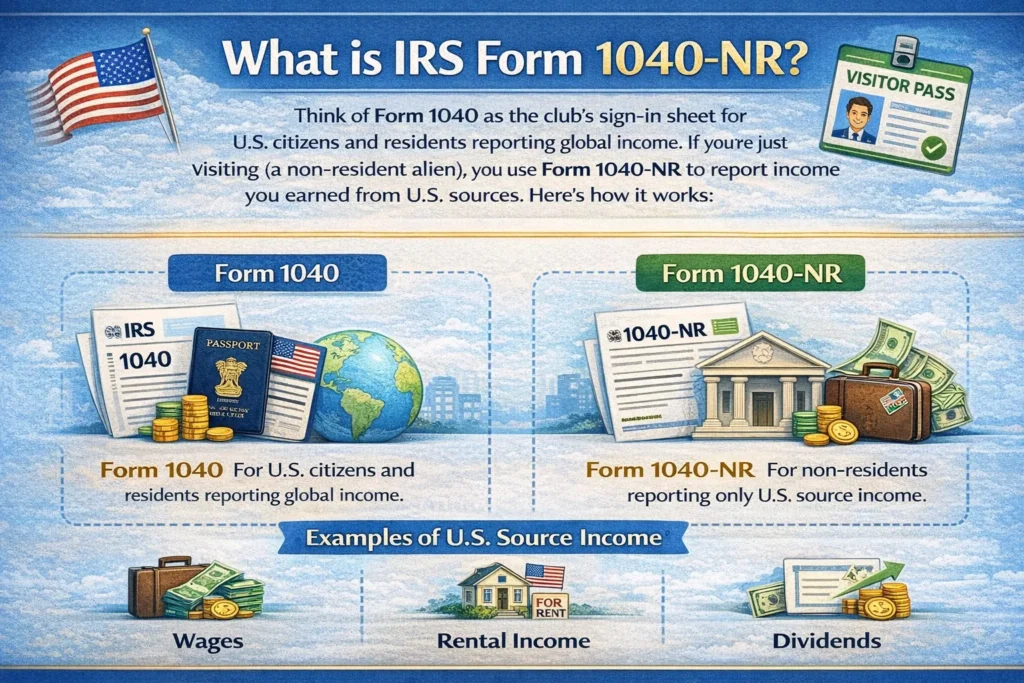
    Think of the United States tax system as an exclusive club. If you are a member (a U.S. citizen or resident), you use Form 1040 to tell the club about all the money you made, no matter where in the world you earned it.

    But if you are just a visitor to the club (a non-resident alien), you use a different form. You use IRS Form 1040-NR. This form has one main job: to report the income you earned from within the United States.

    The IRS does not tax non-resident aliens on their worldwide income. It only cares about the money connected to the U.S. This includes things like wages from a U.S. company, rental income from a U.S. property, or dividends from U.S. stocks.

    In simple terms:

    • Form 1040: For U.S. citizens and residents reporting global income.
    • Form 1040-NR: For non-residents reporting only U.S.-source income.

    This form is crucial for many people. International students on F-1 or J-1 visas use it. Non-Resident Indians (NRIs) with U.S. investments use it. Even professionals on H-1B or L-1 visas who have left the U.S. but still have American income need to file it.

    You can always find the official Form 1040-NR PDF directly on the IRS website.

    Who Must File Form 1040-NR?

    This is the most important question. Filing this form when you do not have to is a waste of time. But not filing it when you are required to can lead to penalties and interest.

    You generally must file a Form 1040-NR if you are a non-resident alien and any of the following are true:

    • You engaged in a trade or business in the United States during the tax year.
    • You have U.S. source income that is subject to income tax, even if no tax was withheld.
    • You have to file a return for a special reason, like to claim a refund of overwithheld tax.

    Let us put this into real world scenarios. You probably need to file a 1040-NR if you are:

    • An international student who worked an on-campus job or received a taxable scholarship. Your university likely gave you a W-2 form.
    • A non-resident alien who earned rental income from a property you own in Florida or New York.
    • An NRI investor who sold U.S. stocks and had capital gains.
    • A researcher or professional who earned honoraria for a speech or consultation in the U.S.
    • Anyone who did not pass the Substantial Presence Test and has any of the income types mentioned above.

    The Substantial Presence Test is the IRS’s method for determining your residency for tax purposes. If you do not meet this test, you are considered a non-resident alien and likely need the 1040-NR.

    1040 vs 1040-NR: Key Differences

    It is easy to get these two forms mixed up. Using the wrong one is a very common mistake. Here is a clear breakdown of the main differences.

    Feature Form 1040 (For Residents) Form 1040-NR (For Non-Residents)
    Income Reporting Reports worldwide income. Reports only U.S.-source income.
    Filing Status Can file as “Married Filing Jointly.” Cannot typically file jointly with a non-resident spouse.
    Standard Deduction Eligible for a standard deduction. Generally not eligible for the standard deduction.
    Tax Treaties Treaty claims are less common. Heavily relies on tax treaties to lower tax rates.
    Key Schedules Uses Schedules A, B, C, D, etc. Uses Schedule OI and Schedule NEC.

    The biggest takeaway? Your global income is safe. You only need to report and pay U.S. tax on what you earned from American sources. And you cannot use the same filing statuses or deductions as your U.S. resident friends.

    Important Schedules: OI and NEC

    The main 1040-NR form is just the beginning. It comes with two special sidekicks that confuse many people: Schedule OI and Schedule NEC. Think of them as mandatory questionnaires that give the IRS the specific details it needs to process your return correctly.

    Schedule OI (Other Information)

    Schedule OI is the IRS’s background check. Its purpose is to collect information about your personal situation that affects your tax liability.

    This schedule asks questions like:

    • What type of visa do you hold? (F-1, J-1, H-1B, etc.)
    • Did you enter the U.S. under a tax treaty?
    • What country are you a resident of for tax purposes?
    • Are you claiming a tax treaty benefit that exempts your income?

    Filling this out is not optional. It is required for almost everyone filing a 1040-NR. It is how you formally tell the IRS, “I am a student from India under the U.S.-India tax treaty, and I am claiming an exemption for my scholarship.” Without Schedule OI, the IRS has no context for your return.

    Schedule NEC (Tax on Income Not Effectively Connected With a U.S. Trade or Business)

    Schedule NEC has a very specific job. It reports a category of income called Fixed, Determinable, Annual, Periodical (FDAP) income. That is a mouthful, so let us simplify.

    FDAP income is typically passive income. Think dividends from U.S. companies, interest from U.S. bank accounts, or royalties from a patent.

    Here is the key part: this type of income is usually taxed at a flat 30% rate. No questions asked.

    But there is a way to lower that rate. This is where tax treaties come in. For example, the U.S.-India tax treaty might reduce the tax on dividend income from 30% to 15% or even 10%. You use Schedule NEC to report the income and to claim that lower treaty rate.

    So, if you are an NRI earning dividends from Google stock, you would report that on Schedule NEC and use the treaty to pay less tax.

    How to Fill IRS Form 1040-NR: Step by Step

    The official instructions can feel like reading a legal textbook. Let us break it down into a clear, actionable process.

    Step 1: Gather Your Documents

    Before you touch the form, get all your papers in one place. You will need:

    • Your W-2 forms from U.S. employers.
    • Your 1042-S forms for scholarship or fellowship income.
    • Any 1099 forms for interest or dividends.
    • Your passport and visa information.
    • Your U.S. Social Security Number (SSN) or Individual Taxpayer Identification Number (ITIN).

    Step 2: Determine Your Residency Status

    Be 100% sure you are a non-resident alien. Use the IRS Substantial Presence Test. If you are filing a 1040-NR, you must have failed this test. If you are unsure, double check. This is the most critical step.

    Step 3: Fill Out Personal Information

    This is the easy part. Carefully enter your name, address, SSN/ITIN, and filing status. For non-residents, your status will almost always be “Single,” even if you are married, unless your spouse is a U.S. resident.

    Step 4: Report Your U.S. Source Income

    Go through your documents and transfer the numbers to the correct lines on the 1040-NR. W-2 wages go on line 1. Taxable scholarship income from a 1042-S goes on line 1h. Be meticulous.

    Step 5: Claim Your Treaty Benefits

    This is where you save money. If your home country has a tax treaty with the U.S., use it. For instance, an Indian student can often claim an exemption for their scholarship under Article 21 of the U.S.-India treaty. You will note this on Schedule OI and often attach a written statement.

    Step 6: Complete Schedule OI and NEC

    Now, fill out the two key schedules we discussed. Schedule OI for your personal and treaty information. Schedule NEC for any passive income like dividends or interest.

    Step 7: Calculate Your Tax Liability

    Use the IRS tax tables for non-residents to calculate how much tax you owe. Remember to apply any reduced treaty rates from Schedule NEC. The form will walk you through adding everything up and comparing it to what was already withheld.

    Step 8: Sign and File Your Return

    A tax return without a signature is invalid. Sign and date it. Then, you can e-file it using approved software or mail it to the IRS address for non-resident filers, which is typically in Austin, Texas.

    Filing Deadlines for 1040-NR (2025)

    Mark your calendar. The deadlines are strict, but they are different depending on your situation.

    Category Deadline
    Non-residents with W-2 income April 15, 2025
    Non-residents without W-2 income June 15, 2025
    Extension Request (Form 4868) October 15, 2025

    A key point: if you are a non-resident and do not have wages subject to U.S. tax withholding (like a W-2), you get an automatic two-month extension to June 15. But if you owe tax, interest will still accrue from the original April 15 date.

    If you need more time, you can file Form 4868 to get an extension until October 15, 2025. This is an extension to file, not an extension to pay. You must estimate and pay any tax you owe by the original deadline to avoid penalties.

    Where and How to File Form 1040-NR

    You have two main options for sending your return to the IRS.

    E-Filing is the fastest, safest, and most recommended method. It reduces errors and gives you confirmation that the IRS received your return. However, not all tax software supports 1040-NR e-filing for everyone. You may need to use a platform specifically designed for non-residents.

    Paper Filing is the traditional method. You print the forms, attach all your documents like your W-2 and 1042-S, sign them, and mail them to the IRS. The mailing address for most non-resident alien tax returns is: Department of the Treasury Internal Revenue Service Austin, TX 73301-0215 USA

    Always double-check the IRS website for the most current mailing address before you send anything.

    Common Mistakes to Avoid

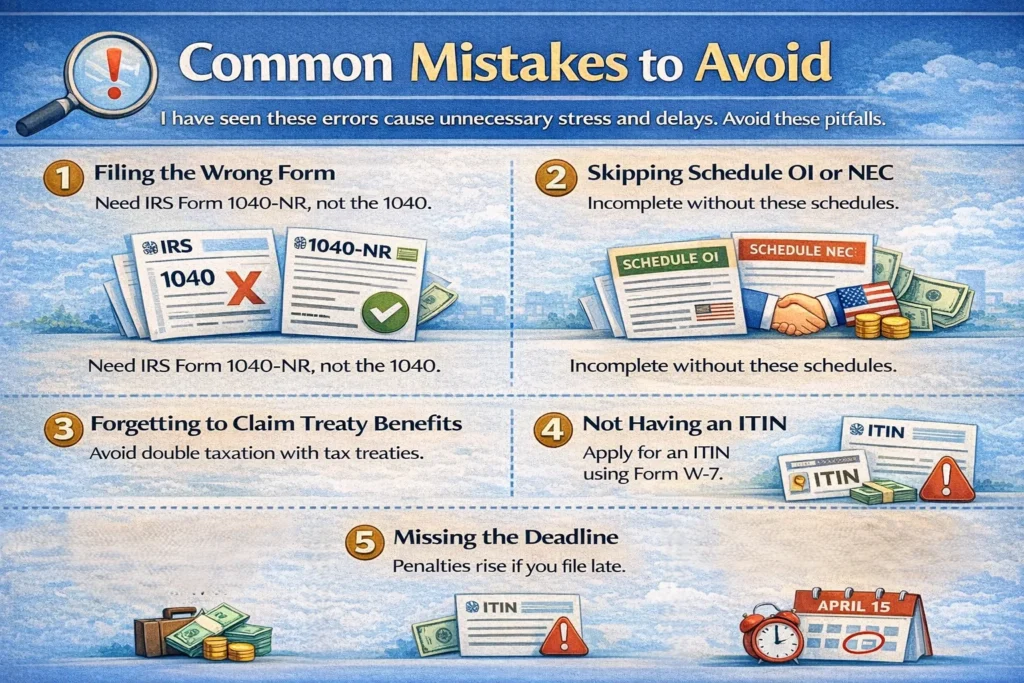
    I have seen these errors cause unnecessary stress and delays. Avoid these pitfalls.

    • Filing the Wrong Form: Do not accidentally file the standard 1040. It is for residents. You need the 1040-NR.
    • Skipping Schedule OI or NEC: These are not optional. Your return will be considered incomplete without them.
    • Forgetting to Claim Treaty Benefits: This is like leaving money on the table. The treaties exist to prevent double taxation. Use them.
    • Not Having an ITIN: If you do not have an SSN and need to file a tax return, you must apply for an ITIN using Form W-7. Do this well before the tax deadline.
    • Missing the Deadline: Even if you cannot pay all the tax you owe, file the return. The penalty for late filing is much higher than the penalty for late payment.

    FAQs About IRS Form 1040-NR

    What is Form 1040-NR used for?

    Form 1040-NR is used by non-resident aliens to report their U.S. source income to the Internal Revenue Service. It is the non-resident version of the standard Form 1040.

    Who needs to file a 1040-NR?

    Any non-resident alien who engaged in a U.S. trade or business or has U.S. source income that is subject to tax must file this form. This includes international students, NRIs with U.S. income, and foreign investors.

    Can NRIs claim the standard deduction?

    Generally, no. Non-resident aliens are not eligible for the standard deduction on Form 1040-NR. However, students from India may be able to claim a standard deduction under the U.S.-India tax treaty, which is a special exception.

    What is the difference between Schedule OI and Schedule NEC?

    Schedule OI collects your personal, visa, and treaty information. Schedule NEC is used to report specific types of passive income like dividends and interest, which are taxed at a flat 30% rate unless a tax treaty lowers it.

    When is the Form 1040-NR deadline for 2025?

    The deadline is April 15, 2025, for those with W-2 income and June 15, 2025, for those without. An extension can push the final deadline to October 15, 2025.

    Can you e-file Form 1040-NR?

    Yes, e-filing is possible and encouraged through certain IRS-approved software providers that support non-resident returns. It is the most efficient way to file.

    What happens if I file my 1040-NR late?

    Filing late can result in a failure-to-file penalty. This penalty is typically 5% of the unpaid taxes for each month your return is late, up to a maximum of 25%. It is always better to file on time, even if you cannot pay the full amount immediately.

  • All about FBAR? A Complete Guide for NRIs

    All about FBAR? A Complete Guide for NRIs

    Living abroad as a Non-Resident Indian comes with a unique set of joys and challenges. You are building a life across two worlds. But with that comes a complex web of financial responsibilities, especially when it comes to US taxes. One form that consistently causes confusion is the FBAR.

    It sounds official. It sounds intimidating. But what is it, really? And more importantly, does it apply to you?

    This guide is designed to cut through the legal jargon. We will walk you through everything you need to know about FBAR in plain English. We will cover what it is, who needs to file it, and how to do it correctly, all with a specific focus on the accounts you likely hold in India.

    What Is FBAR?

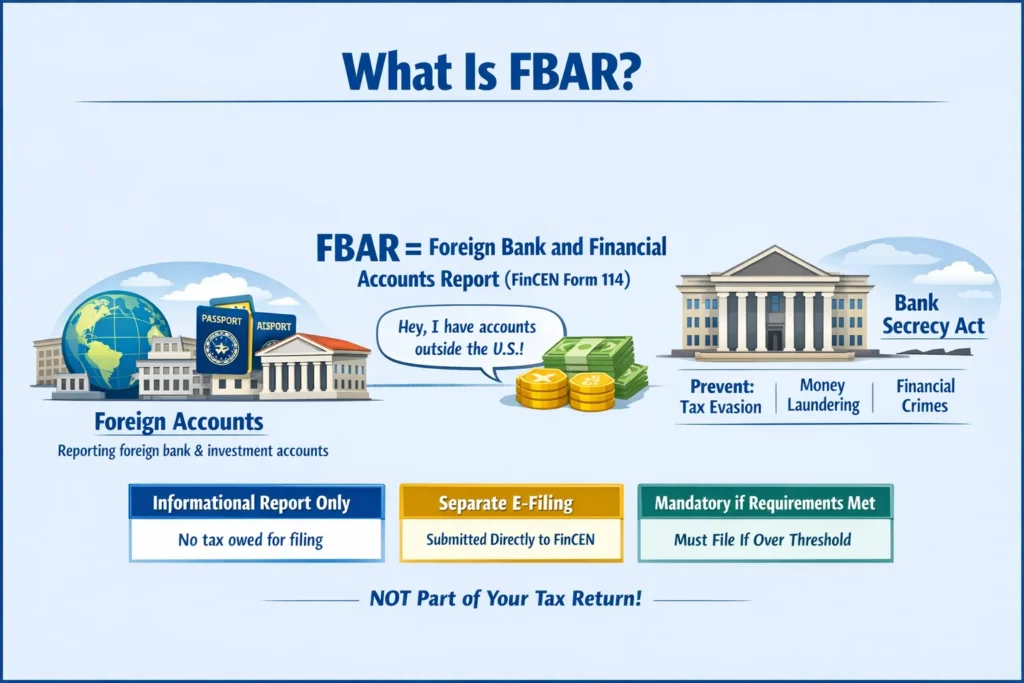
    Let us start with the basics. FBAR stands for Foreign Bank and Financial Accounts Report.

    Think of it as a simple financial headcount you give to the US government. It is you telling the US Treasury Department, “Hey, I have these savings and investment accounts outside the United States.”

    The official name for this report is FinCEN Form 114. FinCEN is the Financial Crimes Enforcement Network, a bureau of the US Treasury Department. This is a key point to remember. The FBAR is not filed with the IRS with your tax return. It is a separate, electronic-only filing sent directly to FinCEN.

    This requirement exists under the Bank Secrecy Act. The goal is not to tax these accounts, but to prevent tax evasion, money laundering, and other hidden financial crimes. It is about transparency.

    You do not owe any money by simply filing an FBAR. It is an informational return. The important thing to know is that filing is mandatory if you meet the requirements. It does not matter if you already paid taxes on the interest in India or if the accounts are tax-free. The filing requirement is separate.

    Who Needs to File FBAR?

    This is the most critical question for every NRI. The rules are specific, and it is easy to get them wrong.

    You must file an FBAR if you are a US person and the total value of all your foreign financial accounts exceeded $10,000 at any point during the calendar year.

    Let us break that down.

    First, who is a “US person”?

    • A US citizen, even if you live full-time in India.
    • A US Green Card holder (Permanent Resident).
    • Someone who meets the “US Resident” test for tax purposes.

    Second, what does “$10,000 at any point” mean? This is the part that trips up many people. We are not talking about the year-end balance. We are talking about the maximum value each account held at any single moment in the year. And we are talking about the combined total of all your foreign accounts.

    Imagine this scenario. You have two accounts in India:

    • Your NRE savings account had a maximum balance of $6,000 in July.
    • A joint fixed deposit with your father, where you have signing authority, had a maximum value of $5,000 in November.

    Even though neither account alone crossed $10,000, their aggregate highest balance is $11,000. This means you have an FBAR filing requirement.

    This rule applies to a wide range of accounts you might hold:

    • NRE and NRO savings accounts
    • Indian fixed deposits (FDs)
    • Indian mutual fund accounts
    • Indian stock trading accounts
    • Life insurance policies with a cash surrender value
    • Any joint accounts where you have financial interest or signature authority

    FBAR Filing Thresholds Explained

    The $10,000 threshold is the cornerstone of FBAR. It is crucial to understand it fully to know when you need to take action.

    CriteriaRequirement
    Threshold Amount$10,000 aggregate balance
    Who Must FileUS citizens, residents, and certain entities
    Filing FrequencyAnnually (by April 15, automatic extension to Oct 15)
    FormFinCEN Form 114
    Filing ModeElectronic via BSA E-Filing website

    The key phrase is “at any time during the year.” If the combined value of your foreign accounts touched $10,001 for even one day, you must file.

    A common question is about currency conversion. You must convert your foreign account balances into US dollars. The rules state you should use the US Treasury’s Financial Management Service rate for the last day of the year. Alternatively, you can use a reasonable, consistent exchange rate that applies on the day of the highest balance.

    What does not count? Generally, accounts where you cannot access the funds, like the Indian Public Provident Fund (PPF) before maturity, do not need to be reported. Funds held in a foreign retirement plan or a foreign social security scheme also typically do not need to be reported. However, always double-check with a professional if you are unsure.

    Types of Accounts to Report on FBAR

    As an NRI, your financial life in India is diverse. It is important to know which of your Indian assets need to be declared on the FBAR. The rule is broad: if it is a financial account held with a foreign financial institution, it likely needs to be reported.

    Here is a list of common accounts for NRIs:

    • NRE (Non-Resident External) Savings Accounts: These are the most common. The foreign currency nature does not exempt them.
    • NRO (Non-Resident Ordinary) Savings Accounts: These are also fully reportable.
    • Fixed Deposits (FDs): Both NRE and NRO fixed deposits must be reported. Their maximum value during the year is what counts.
    • Recurring Deposits (RDs): Same as FDs.
    • Mutual Fund Accounts: Any holdings with an Indian asset management company (like HDFC MF, SBI MF, etc.) are reportable.
    • Stock Trading Accounts: Your Demat and trading accounts with Indian brokers are considered financial accounts.
    • PPF Accounts? This is a gray area. Since access is restricted, many experts do not recommend reporting it. However, if it has a withdrawal facility and you have used it, you may need to include it. Consult a tax advisor.
    • Life Insurance Policies: Only if the policy has a cash value that you can access (like a ULIP). Term insurance with no cash value is not reportable.
    • Joint Accounts and Accounts with Signature Authority: This is critical. If you have the authority to control the assets in an account, even if it is not yours (like a parent’s account where you are a signatory), you must report it.

    The underlying principle is financial interest or signature authority. If you have either over a foreign account, it belongs on your FBAR.

    Step-by-Step: How to File FBAR Online

    Filing an FBAR can feel daunting, but the process is actually quite straightforward once you have your information ready. It is an entirely electronic process.

    Step 1: Collect Your Account Information

    Before you log in, gather details for every foreign account you held during the year. You will need:

    • The name and address of the bank or financial institution (e.g., State Bank of India, Mumbai branch).
    • The account number.
    • The type of account (e.g., savings, checking, mutual fund).
    • The maximum value in the account during the year, converted to US dollars.

    Step 2: Visit the BSA E-Filing Website

    Go to the official FinCEN BSA E-Filing system website. Do not search for “file FBAR with IRS.” It has its own dedicated portal.

    Step 3: Register or Log In

    You have two main options. You can file as an individual, which requires creating an account and password. Alternatively, a tax professional can file it on your behalf.

    Step 4: Fill Out FinCEN Form 114

    The form itself is a series of screens. You will enter your personal information first. Then, you will add each financial account one by one. You will input the bank details, the maximum value, and specify your ownership type (e.g., sole ownership, joint ownership).

    Step 5: Submit Electronically and Get Confirmation

    Once you have entered all accounts and reviewed the information, you submit the form. The system will generate a confirmation number immediately. Save this number. It is your proof that you filed on time.

    I recently helped a client file his FBAR. He was worried it would take hours. Once he had his bank statements ready, we logged in and completed the entire process in about 20 minutes. The relief on his face was palpable. Having your data organized is 90 percent of the work.

    FBAR Filing Deadlines & Extensions

    Staying on top of deadlines is crucial to avoid any potential penalties.

    The annual FBAR deadline is April 15, which aligns with the US tax filing deadline. However, you get a generous automatic extension until October 15.

    This is a key benefit. You do not need to file any forms to request this extension. It is granted to everyone automatically. If you miss the April 15 date, you have until October 15 to file without being considered “late” by the system.

    This gives you extra time to gather information from your Indian banks, especially for accounts you may not check frequently.

    FBAR Penalties: What Happens If You Don’t File

    This is the section that causes the most anxiety. The penalties for not filing an FBAR when required can be severe. The government distinguishes between two types of failure: non-willful and willful.

    Type of ViolationPotential Penalty
    Non-willfulUp to $10,000 per violation
    WillfulGreater of $100,000 or 50% of the account balance
    CriminalFines up to $500,000 and/or up to 10 years in prison

    Non-willful means you didn’t know about the requirement or made a mistake. Even here, the penalties can add up quickly if you have multiple accounts over multiple years.

    Willful means you knowingly and intentionally hid the accounts. The penalties here are designed to be punitive.

    The good news is that the system understands people make mistakes. If you have unfiled FBARs from previous years, you should strongly consider using the IRS’s Delinquent FBAR Submission Procedures. This is a voluntary disclosure program that often allows you to file the past-due forms without any penalties, as long as you were not willfully avoiding the law and you have already paid any taxes due on the income.

    Do not let the fear of penalties paralyze you into inaction. The worst thing you can do is to continue not filing once you know about the requirement.

    FBAR vs FATCA: What’s the Difference?

    Many NRIs get confused between FBAR and FATCA. They are related, but they are two completely different reporting requirements. You may have to file both, one, or neither.

    FeatureFBARFATCA (Form 8938)
    FormFinCEN Form 114IRS Form 8938
    Threshold$10,000 aggregateMuch higher ($50,000 – $600,000+)
    Filed WithFinCEN (Treasury)IRS (with your tax return)
    PurposeAnti-money launderingTax compliance

    Think of it this way. FBAR is for the US Treasury to track where your money is. FATCA is for the IRS to ensure you are paying the correct tax on the income it generates.

    The biggest practical difference for you is the threshold. The FATCA filing thresholds are significantly higher and depend on your filing status and whether you live in the US. For example, a single NRI living in India only needs to file Form 8938 if their specified foreign financial assets exceed $200,000 on the last day of the year, or $300,000 at any time during the year.

    It is very common for an NRI to have an FBAR filing requirement but no FATCA requirement. However, you must check both every year.

    Common FBAR Mistakes NRIs Make

    After years of working with the NRI community, I have seen the same simple mistakes happen again and again. Avoiding these can save you a lot of trouble.

    1. Ignoring NRE/NRO Accounts: “But it’s an Indian account, and I live in India!” This is the most common misconception. The rules are based on your status as a US person, not your location.
    2. Reporting the Year-End Balance: Remember, you must report the maximum value during the year, not the balance on December 31.
    3. Forgetting Fixed Deposits and Mutual Funds: People often remember their savings accounts but forget their FDs and mutual fund investments. These are absolutely reportable.
    4. Overlooking Joint or Authority Accounts: You must report an account you co-own with your spouse or parents. You must also report an account you manage for an elderly parent, even if the money is not yours.
    5. Confusing FBAR with FATCA: As we just discussed, they are different. You must check your requirements for each, every year.

    Here is a quick checklist to run through each year:

    • Did I add up the highest balance from all my Indian bank accounts?
    • Did I include my fixed deposits and mutual funds?
    • Did I check any joint accounts or accounts where I am a signatory?
    • Did the total cross $10,000 at any time?
    • If yes, I need to file an FBAR.

    FAQs on FBAR for NRIs

    What does FBAR stand for?

    It stands for Foreign Bank and Financial Accounts Report. Its official name is FinCEN Form 114.

    Do I need to file FBAR if I have less than $10,000?

    No, you do not. But remember, it is the aggregate total of all your foreign accounts. If the combined highest balance of all your accounts is $10,000 or less, you do not need to file.

    What is the FBAR filing deadline?

    The deadline is April 15, with an automatic extension to October 15. You do not need to request this extension.

    Can I file FBAR for previous years?

    Yes, you can and should. Use the BSA E-Filing system and select the correct year for which you are filing. If you have multiple missed years, you should look into the Delinquent FBAR Submission Procedures to potentially avoid penalties.

    Is FBAR mandatory for NRE/NRO accounts?

    Yes, absolutely. NRE and NRO accounts are foreign financial accounts and must be included in your FBAR calculation.

    How is the maximum balance calculated?

    Look at your monthly or quarterly account statements for the entire year. Find the highest value the account held in the local currency. Then, convert that amount to US dollars using the appropriate exchange rate for that specific date.

    What happens if I miss the FBAR deadline?

    If you miss the October 15 extension deadline, you should file as soon as possible. The sooner you file, the less likely you are to face penalties, especially if your failure was non-willful. The key is to act now.

  • How to Avoid Double Taxation: 6 Key DTAA Tips for NRIs

    How to Avoid Double Taxation: 6 Key DTAA Tips for NRIs

    Non-Resident Indians (NRIs) often face the daunting challenge of double taxation, where the same income is taxed both in India and abroad. This issue can significantly impact your financial health and complicate your tax filings. Fortunately, the Double Taxation Avoidance Agreement (DTAA) provides a solution. This article breaks down six actionable DTAA tips for 2026 to help NRIs avoid paying extra taxes. By understanding and utilizing DTAA, you can ensure that you are not taxed twice on the same income, thereby optimizing your financial planning.

    What is DTAA? Understanding Double Taxation Avoidance Agreement

    Double Taxation Avoidance Agreement (DTAA) is a treaty signed between two or more countries to help taxpayers avoid paying taxes twice on the same income. For NRIs, this means that if you earn income in India and are also liable to pay taxes in your country of residence, DTAA ensures that you do not end up paying taxes on the same income in both countries.

    Double taxation occurs because different countries have different tax laws. For instance, if you are an NRI working in the USA, you might have to pay taxes on your global income in the USA and also in India if you have income sources in India. DTAA helps mitigate this by providing a framework for tax relief.

    Example Scenario: Imagine you are an NRI living in the UK and earning rental income from a property in India. Without DTAA, you would have to pay taxes on this rental income in both the UK and India. However, with DTAA, you can claim relief and avoid being taxed twice.

    Benefits of DTAA for NRIs

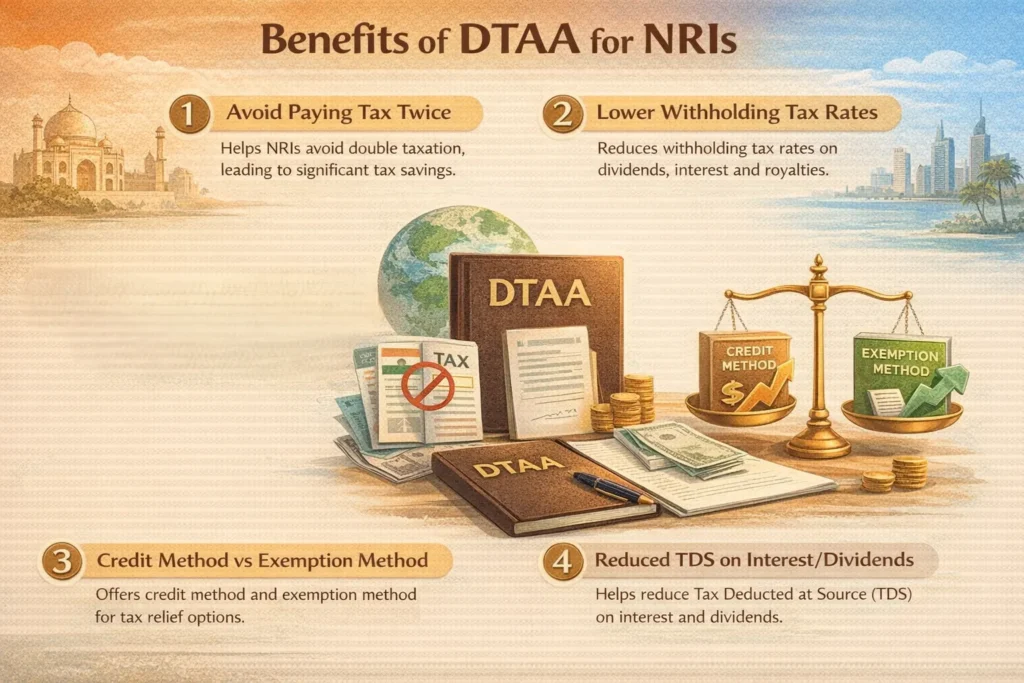
    1. Avoid Paying Tax Twice: The primary benefit of DTAA is that it helps NRIs avoid paying taxes on the same income in two different countries. This can result in significant tax savings.
    2. Lower Withholding Tax Rates: DTAA often provides for lower withholding tax rates on various types of income such as dividends, interest, and royalties. This means that less tax is deducted at source, increasing your net income.
    3. Credit Method vs Exemption Method: DTAA provides two methods for tax relief: the credit method and the exemption method. Under the credit method, you can claim a credit for the taxes paid in one country against the taxes payable in another country. Under the exemption method, certain types of income are exempt from tax in one of the countries.
    4. Reduced TDS on Interest/Dividends: DTAA can also help reduce the Tax Deducted at Source (TDS) on interest and dividends earned in India. This can be particularly beneficial for NRIs who have investments in India.

    6 Key DTAA Tips to Avoid Double Taxation

    Tip 1: Know Your Residential Status

    Determining your residential status is crucial for understanding your tax liability in India. As per Indian tax laws, an individual is considered a resident if they stay in India for 182 days or more in a financial year. NRIs, on the other hand, are those who do not meet this criterion.

    Your residential status determines the taxability of your global income. For instance, if you are a resident, your global income is taxable in India. However, if you are an NRI, only the income earned or accrued in India is taxable.

    Tip 2: Identify Relevant DTAA Country Agreement

    India has a vast network of DTAA agreements with over 90 countries. It is essential to identify the specific DTAA agreement between India and your country of residence. You can find the text of these agreements on the websites of the Central Board of Direct Taxes (CBDT) or the Reserve Bank of India (RBI).

    Tip 3: Understand the Tax Relief Method Used

    DTAA provides two primary methods for tax relief: the credit method and the exemption method. Under the credit method, you can claim a credit for the taxes paid in one country against the taxes payable in another country. This method ensures that you do not pay more taxes than the higher of the two tax rates.

    Under the exemption method, certain types of income are exempt from tax in one of the countries. This method is beneficial if the tax rate in one country is significantly lower than the other.

    Tip 4: Obtain Tax Residency Certificate (TRC)

    To claim DTAA benefits, it is mandatory to obtain a Tax Residency Certificate (TRC) from the country where you are a tax resident. The TRC serves as proof of your tax residency and is required to avail of the benefits under DTAA.

    You can obtain a TRC from the tax authorities in your country of residence. The certificate should include your name, status as a resident, tax identification number, and the period for which the certificate is valid.

    Tip 5: Report Foreign Income Correctly in India

    Even if your foreign income is exempt from tax in India under DTAA, it is essential to disclose it in your Income Tax Return (ITR). Failure to report foreign income can result in penalties and legal complications.

    Tip 6: Consult a Tax Advisor for Complex Cases

    Taxation can be complex, especially for NRIs with income sources in multiple countries. Consulting a tax advisor can help you navigate the intricacies of DTAA and ensure that you are compliant with the tax laws in both countries.

    A tax advisor can provide personalized advice based on your specific situation and help you optimize your tax planning. This is particularly important for high-value investments and complex financial portfolios.

    Example: How DTAA Works for an NRI in USA/UAE/UK

    Let’s consider an example to illustrate how DTAA works for an NRI living in the USA. Suppose you are an NRI earning rental income from a property in India. Without DTAA, you would have to pay taxes on this rental income in both the USA and India.

    However, with DTAA, you can claim a credit for the taxes paid in India against the taxes payable in the USA. This ensures that you do not pay more taxes than the higher of the two tax rates.

    Common DTAA Provisions for Major Countries:

    1. USA: The DTAA between India and the USA provides for lower withholding tax rates on dividends, interest, and royalties. It also includes provisions for the credit method of tax relief.
    2. UAE: The DTAA between India and the UAE provides for the exemption method of tax relief for certain types of income. It also includes provisions for lower withholding tax rates.
    3. UK: The DTAA between India and the UK provides for both the credit and exemption methods of tax relief. It also includes provisions for lower withholding tax rates on dividends, interest, and royalties.

    How to Claim DTAA Benefits While Filing Taxes

    To claim DTAA benefits while filing your taxes, you need to include your Tax Residency Certificate (TRC) and Form 10F. Form 10F is a declaration form that includes details such as your name, address, tax identification number, and the period for which you are claiming DTAA benefits.

    It is also essential to coordinate with your Chartered Accountant (CA) and bank to ensure that the correct amount of tax is deducted at source. This can help you avoid TDS on interest and dividends earned in India.

    DTAA Countries with India

    India has DTAA agreements with over 90 countries. Some of the major partner countries include the USA, UK, UAE, Singapore, Canada, and Australia. You can find the official list of DTAA countries on the websites of the CBDT or RBI.

    FAQs on DTAA for NRIs

    What is DTAA in simple words?

    DTAA, or Double Taxation Avoidance Agreement, is a treaty signed between two or more countries to help taxpayers avoid paying taxes twice on the same income.

    Is TRC mandatory?

    Yes, obtaining a Tax Residency Certificate (TRC) is mandatory to claim DTAA benefits. The TRC serves as proof of your tax residency and is required to avail of the benefits under DTAA.

    Can NRIs avoid all taxes in India?

    No, NRIs cannot avoid all taxes in India. However, DTAA can help NRIs avoid paying taxes twice on the same income and reduce their overall tax liability.

    How to avoid TDS on NRO account?

    To avoid TDS on an NRO account, you need to submit your Tax Residency Certificate (TRC) and Form 10F to your bank. This will help you claim DTAA benefits and reduce the TDS on interest earned in your NRO account.

  • What Is a Form 1099? Understanding Form 1099 & Its Types

    What Is a Form 1099? Understanding Form 1099 & Its Types

    If you work outside a traditional job, chances are you’ve come across the term Form 1099. Maybe you’ve heard it mentioned but never really knew what it meant or why it matters. Or maybe you received one and wondered what to do next. Either way, this guide will break it down simply. You’ll learn what a 1099 form is, who should get one, the common types, and how it affects your taxes.

    Think of a 1099 form as a way the IRS keeps tabs on income that isn’t part of a regular paycheck. It helps make sure everyone reports the money they earn, no matter how or where they earn it.

    Let’s unpack it all, step by step.

    What Is a 1099 Form?

    Imagine you do some freelance work, sell investments, or rent out a room. The money you get doesn’t come from an employer who withholds taxes each paycheck. Instead, it’s income from other sources. A Form 1099 reports this kind of income to the IRS.

    It’s different from a W-2, which tracks wages and salaries. The W-2 comes from your employer and already includes taxes taken out. But a 1099 shows money paid to you without taxes withheld upfront. This means you’re responsible for reporting it and paying taxes later.

    The IRS uses the 1099 to ensure people pay taxes on all income — not just paychecks. So if you get a 1099, it means the IRS knows someone paid you money, and they expect you to report it when you file your tax return.

    Why Does the IRS Use Form 1099?

    Think of the IRS as a watchdog making sure no income slips through the cracks. When you work a job, taxes get taken out automatically. But when you earn money as a freelancer, investor, or from other sources, that money might fly under the IRS’s radar.

    Form 1099 creates a paper trail. It tells the IRS, “Hey, this person got paid this amount.” Businesses and financial institutions file 1099s when they pay people or entities above certain amounts.

    This system helps keep everything fair. Everyone pays their share. The IRS matches the income you report on your tax return against the 1099s they receive. If there’s a mismatch, it raises a flag.

    In short, 1099s keep the tax system honest.

    Who Receives a 1099?

    If you’re wondering, “Am I going to get a 1099?” the answer depends on the money you made and who paid you.

    Most often, 1099s go to:

    • Freelancers and contractors: If you did work for a business and got paid $600 or more, you’ll probably get a 1099-NEC.
    • Investors: Dividends and interest you earned might be reported on 1099-DIV or 1099-INT.
    • Landlords: Rental income over $600 can trigger a 1099-MISC.
    • Winners of prizes or awards: If you won something with cash value, a 1099 might be coming your way.
    • Businesses paying for services outside traditional employment: They have to report certain payments to keep things transparent.

    If you earned money but didn’t get a 1099, you still have to report the income. The form is a tool for the IRS, but it doesn’t replace your responsibility to file accurately.

    Common Types of 1099 Forms

    Form 1099 isn’t just one form. The IRS has many versions, each tracking different income. Here’s a quick look at the most common ones you’ll see:

    1099-NEC: Nonemployee Compensation

    This one’s all about freelancers, contractors, and gig workers. If a business pays you $600 or more for services, they send you this form. It shows how much you earned as a non-employee.

    1099-MISC: Miscellaneous Income

    This is a catch-all form. It reports income like rent, royalties, prizes, awards, and some other payments not covered by 1099-NEC. For example, if you rented a property and earned over $600, you might get a 1099-MISC.

    1099-INT: Interest Income

    Earned interest from your bank account, bonds, or other investments gets reported here. It helps you track income from your savings or investments.

    1099-DIV: Dividends & Distributions

    If you own stocks or mutual funds, dividends paid to you come on this form. It also reports capital gains distributions.

    1099-K: Payment Card & Third-Party Network Transactions

    Have you sold things online or taken payments via platforms like PayPal? If you process more than a threshold amount (usually $600 or $5,000, depending on rules), you’ll get a 1099-K. This form tracks transactions made through cards or third-party networks.

    Other Important 1099s

    There are plenty more 1099 variations, such as:

    Each covers specific income types and has its own reporting rules.

    How Does a 1099 Work?

    Here’s a simple way to think about it: If someone pays you and the IRS needs to know about it, they fill out a 1099 form. They send a copy to you and the IRS.

    When you file your tax return, you use the information from the 1099 to report your income. The IRS uses their copy to cross-check your return.

    If you earned $10,000 freelancing, but only report $5,000, the IRS will notice the difference. This can trigger questions or audits.

    That’s why keeping good records is important. It also helps if you think a 1099 form is wrong or missing.

    When Is Form 1099 Issued & What’s the Deadline?

    Timing matters. Payers must send 1099 forms to recipients and the IRS by January 31 after the tax year ends. This gives you plenty of time to prepare your taxes.

    Some forms, like 1099-S for real estate sales, have a later deadline, usually February 15.

    If you don’t get your form by early February, check in with the payer. It might be lost in the mail or sent electronically. Keeping your address updated helps prevent delays.

    Filing & Reporting 1099 Income on Your Tax Return

    Receiving a 1099 means you have income to report. But how you report it depends on the form and your situation.

    • 1099-NEC income: Usually reported on Schedule C as business income. You may owe self-employment tax on this.
    • 1099-INT and 1099-DIV income: Go on Schedule B or directly on Form 1040 for interest and dividends.
    • Other 1099 income: Can go on different forms depending on what it is — rental income, retirement distributions, and so forth.

    Pay close attention to the numbers on your 1099. They should match what you put on your tax return.

    If they don’t, you risk penalties or audits.

    Common FAQs About Form 1099

    What if I don’t receive a 1099 but earned income?

    Not getting a 1099 doesn’t mean you don’t owe taxes. The IRS expects you to report all income, regardless of whether you receive a form. Use your bank records, invoices, or payment histories to track what you earned.

    If a 1099 is missing, contact the payer early in the year. Keep notes on your communication in case you need to explain later.

    Do I need to pay taxes on 1099 income?

    Most 1099 income is taxable. Since taxes aren’t withheld upfront, you’ll need to set aside money and possibly pay quarterly estimated taxes. Self-employment income also includes Social Security and Medicare taxes, which add to your bill.

    What’s the difference between a W-2 and a 1099?

    A W-2 is for employees. Taxes get taken out before you see the money. Your employer sends it.

    A 1099 is for income earned outside employment. Taxes usually aren’t withheld. You’re responsible for reporting and paying taxes yourself.

    Tips for Businesses Issuing 1099s

    If you run a business, here’s what you should keep in mind when issuing 1099s:

    • Get Form W-9 from contractors to collect correct tax info.
    • Track payments throughout the year to know who crosses the $600 threshold.
    • File 1099s on time — late forms can mean fines.
    • Consider filing electronically if you have many forms to submit.
    • Keep clear communication with payees so they know what to expect.

    Conclusion

    Form 1099 is a key part of tax reporting for anyone earning income outside a regular job. It keeps the tax system fair and transparent. If you get one, it means you need to report that income on your tax return.

    Mistakes happen, but you can avoid penalties by staying organized and proactive. Keep good records, ask for missing forms, and reach out to tax professionals if you’re unsure.

    Here’s what you can do now:

    • Keep all payment records and invoices.
    • Watch out for your 1099 forms after January 31.
    • Report all income on your tax return, even if you don’t get a form.
    • Download our free “1099 Types & Deadlines” cheat sheet to stay on track.
    • Use a tax calculator to estimate what you owe.
    • Need guidance? Talk to a tax expert who can help you navigate the process.