



The Digital e-OCI Card is now the default identity document for Overseas Citizens of India. Under the Citizenship (Amendment) Rules, 2026, notified by the Ministry of Home Affairs on 30 April 2026 and brought into force on 1 May 2026, the paper booklet OCI has been replaced by a QR-coded digital credential that can be downloaded, stored in a mobile wallet, or printed on plain paper. On 30 June 2026, India's Home Minister formally launched the digital e-OCI card, completing a transition the OCI diaspora has been waiting for over a decade.
The reform is more than cosmetic. Processing time has dropped from months to around 15 days. The old 20/50 reissue rule has been largely replaced by an online passport re-link. A new three-month passport update window applies to every passport renewal, with a USD 25 penalty for missing it. For NRIs in the USA, UAE, UK, Canada, Singapore, and Australia, this is the biggest OCI procedural change since the card was first introduced in 2005.
What Changed on 30 April 2026: The Citizenship Amendment Rules
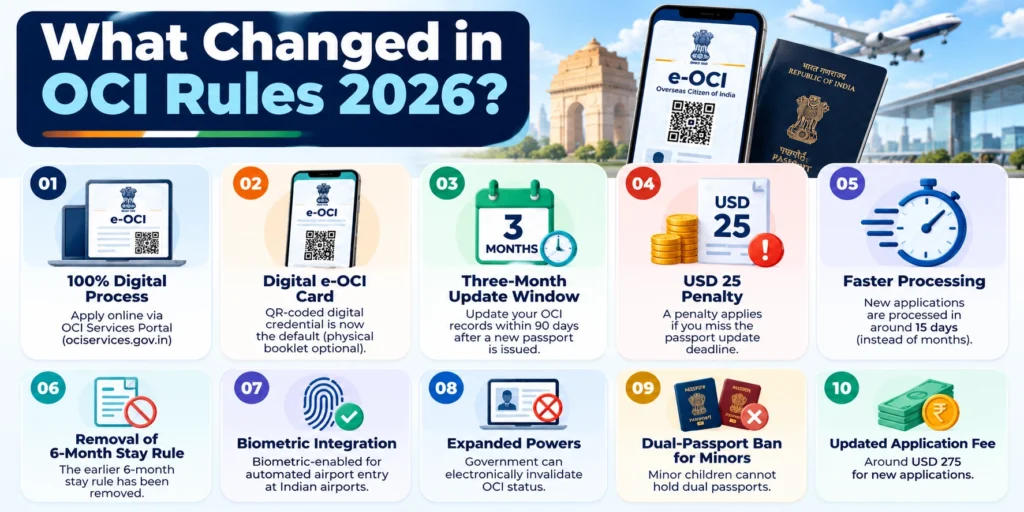
The Citizenship (Amendment) Rules, 2026 delivered a complete digital overhaul of the OCI system. Key reforms include:
- 100 percent digital OCI application process via the OCI Services Portal at ociservices.gov.in
- Digital e-OCI card as the default credential (physical booklet now optional)
- Three-month deadline to update OCI records after a new passport is issued
- USD 25 penalty for missing the passport update window
- Processing time reduced to approximately 15 days for new applications
- Removal of the 6-month stay rule that previously affected OCI eligibility
- Biometric integration for automated airport entry
- Expanded government powers to electronically invalidate OCI status
- Dual-passport prohibition for minor children
- Updated application fee of around USD 275 for new applications
- Age-linked reissue requirements (previously at ages 20 and 50) largely replaced by online re-linking
The effect is that your OCI is less a piece of plastic and more a digital record bound to your current passport. If the passport changes, the record must change. If the record does not reflect your current passport, the e-OCI loses operational validity even if the certificate is otherwise valid.
For NRIs managing broader India-side compliance alongside e-OCI, the NRI Taxation and Compliance framework at MostlyNRI aligns identity updates with your PAN, bank, and ITR records.
What is the Digital e-OCI Card Exactly?
An e-OCI card is the electronic, QR-coded version of the physical OCI booklet. It carries the same legal status as the physical card and can be stored or presented in multiple formats.
Key features:
- Electronic credential issued under the Citizenship Amendment Rules 2026
- QR code containing cardholder identity and passport link
- Can be printed on plain paper or stored in a mobile wallet
- Legally equivalent to the physical booklet for all purposes
- Automatically linked to your current passport on record
- Updatable online when the passport changes
- Readable by Indian immigration and e-Gates at airports
The physical booklet has not been abolished entirely. Existing cardholders retain their booklets, and some may opt for a physical card in parallel. But all new applications default to e-OCI, and most routine updates (passport renewals, address changes) happen fully online.
How to Download Your e-OCI Card
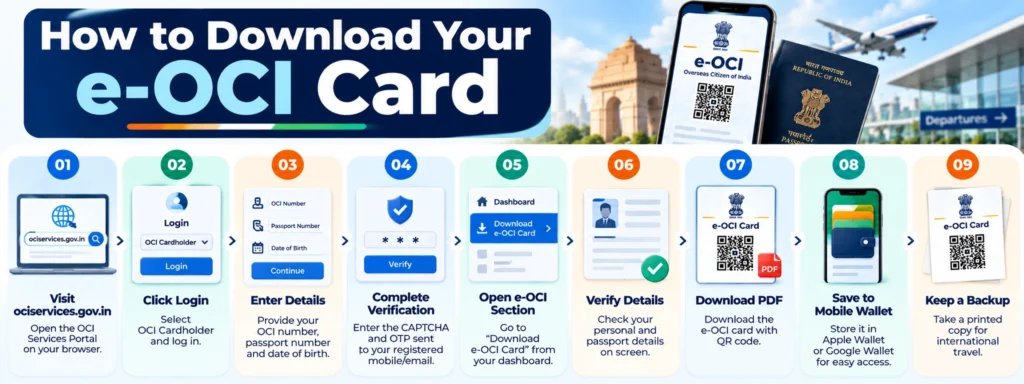
NRIs who already hold an OCI card can download the digital version through the OCI Services Portal.
Step-by-step process:
- Visit ociservices.gov.in on a desktop or mobile browser
- Click Login and select OCI Cardholder
- Enter your OCI number, passport number, and date of birth
- Complete the CAPTCHA and OTP verification
- Navigate to Download e-OCI Card from your dashboard
- Verify your personal and passport details on screen
- Download the PDF with QR code
- Save a copy to your mobile wallet (Apple Wallet, Google Wallet)
- Keep a printed backup for international travel
If your OCI number is on an older physical card, you may need to upgrade your record before downloading. The portal walks you through the one-time upgrade if required.
The Three-Month Passport Update Window: The Critical Deadline
This is the single most important compliance point under the 2026 rules. Every time your passport is renewed or reissued, you must update your OCI record within 90 days (three months) on the portal.
Why this matters:
- Airlines may deny boarding if your OCI is linked to an expired passport
- Indian immigration can treat an un-updated e-OCI as operationally invalid
- Missing the deadline triggers a USD 25 penalty (or equivalent in local currency)
- Repeat non-compliance can complicate future OCI reissue applications
- The passport update is not automatic on renewal; you must initiate it
The rule applies to both your foreign passport and any Indian passport situations (though OCI holders cannot hold a current Indian passport, Indian-origin PIO transitions still see edge cases).
How to Update Your Passport Details on the OCI Portal
The passport update process typically takes under 15 minutes online.
- Log in to ociservices.gov.in with your OCI credentials
- Select Miscellaneous Services from the menu
- Click Update Passport Details or a similarly labelled option
- Upload the bio-data page of your new passport (clear PDF scan)
- Upload a recent passport-size photograph matching standard specifications
- Enter the new passport number, issue date, expiry date, and place of issue
- Review the auto-populated existing details
- Pay any applicable fee (nil if within the three-month window; USD 25 if delayed)
- Submit and note the acknowledgement number
- Download the updated e-OCI once the backend processes the link (usually within a few days)
If you are updating multiple family members' passports after a joint renewal (common for NRI families), each OCI record must be updated individually. The portal does not permit bulk updates.
For NRIs who also need to reconcile PAN and OCI records, our PAN Card service resolves parallel documentation gaps.
e-OCI vs Physical OCI Booklet: The Comparison
| Feature | Physical OCI Booklet | Digital e-OCI Card (2026) |
|---|---|---|
| Format | Printed booklet | QR-coded PDF or mobile wallet entry |
| Validity | Lifetime, tied to physical document | Lifetime, tied to current passport record |
| Processing time | 2 to 6 months typically | Approximately 15 days |
| Reissue at ages 20 and 50 | Mandatory | Largely replaced by online re-link |
| Carrying requirement at airports | Mandatory | Reportedly optional (QR verification sufficient) |
| Update on passport renewal | Physical reissue needed | Online re-link within 3 months |
| Loss or theft | Physical reissue needed | Re-download from portal |
| Government ability to invalidate | Required physical return | Can be invalidated electronically |
| Default for new applications | No longer the default | Yes, default from 1 May 2026 |
Age-Linked Rules: What Changed on the 20/50 Reissue Front
Under the old framework, OCI cards had to be physically reissued when the holder turned 20 years old (to update appearance records) and again at 50 years old. This often meant international mail, consular visits, and 3 to 6 months of waiting.
Under the 2026 rules:
- Age-linked physical reissue has been largely replaced by online re-linking
- New photographs can be uploaded at relevant ages through the portal
- No fresh physical card is required in most cases
- The three-month passport update deadline continues to apply at any age
For NRIs who have been postponing a 20 or 50 reissue, the 2026 framework makes the process substantially simpler, with most steps completable from your laptop.
Special Rules for Minor Children
The 2026 rules tightened OCI compliance for minor cardholders.
- Dual passport holding by minors (holding both Indian and foreign passports) is prohibited
- Parents must choose the foreign passport route to maintain OCI eligibility for the child
- Passport renewals for minors also attract the three-month update deadline
- Children who acquire foreign citizenship after birth must have their OCI applications aligned with the renunciation of any Indian passport
If you are an NRI parent whose child is approaching the Indian citizenship age cut-off, careful planning around passport choice and OCI applications is now essential.
How e-OCI Status Affects NRI Banking, Tax, and Property Matters
An operational, up-to-date e-OCI is not just a travel document. It is the identity anchor for several NRI financial matters.
- NRE and NRO account opening typically requires OCI card verification; banks will reject applications with mismatched passport details
- Mutual fund and PMS onboarding uses OCI as a KYC foundation
- Property purchase by OCI holders requires OCI number proof on the sale deed
- Section 197 lower TDS certificate applications require current identity documents
- ITR filing on ITR-2 or ITR-3 benefits from matched OCI, PAN, and passport entries
- Repatriation paperwork under Forms 145 and 146 (which replaced 15CA and 15CB) uses OCI identity
Our NRI Bank Account Type Advisor ensures your account structure matches the latest OCI and passport details, avoiding bank-side rejections.
Common Mistakes NRIs Make Under the 2026 Rules
The most avoidable errors:
- Assuming the passport update is automatic when the new passport is issued
- Confusing the E-Arrival Card with OCI update (they are separate)
- Missing the three-month window and paying the USD 25 penalty
- Travelling with a mismatched passport and OCI and facing boarding denial
- Not updating the OCI after a child's foreign passport renewal
- Keeping only the physical booklet and not downloading the e-OCI
- Updating one spouse's OCI but forgetting the other after joint passport renewals
- Carrying the old passport instead of the current one at Indian immigration (both are recommended)
- Not reconciling the OCI update with bank and investment KYC records
- Missing the PAN-OCI name match that some financial institutions check
Where identity mismatches have triggered tax notices or refund delays, our NRI Income Tax Notice Solutions team closes the file efficiently.
How MostlyNRI Helps You Align e-OCI, PAN, and Tax Records
The Digital e-OCI card lives alongside your PAN, bank KYC, investment records, and ITR history. One mismatch anywhere can slow down a property sale, delay a refund, or stall a bank account opening. At MostlyNRI, we help NRIs across the USA, UAE, UK, Canada, Singapore, and Australia with:
- PAN and OCI reconciliation across financial institutions
- NRE, NRO, FCNR, and RFC account structuring with updated identity
- ITR filing under the Income Tax Act 2025 with correct OCI and passport details
- Property transaction KYC for OCI buyers and sellers
- TRC and Form 41 filings aligned with the current passport
- Mutual fund and PMS KYC updates after passport renewals
- Response to tax notices arising from identity mismatches
Our team serves NRIs from over 33 countries across 13 Indian cities.
Just renewed your passport and need to update your OCI? Book a consultation with our specialists at MostlyNRI.com to align your e-OCI update with your PAN, bank, and ITR records before the three-month window closes.
Frequently Asked Questions (FAQs)
What is the Digital e-OCI Card under the Citizenship Amendment Rules 2026?
The Digital e-OCI Card is a QR-coded electronic version of the OCI booklet, introduced by the Citizenship (Amendment) Rules 2026, effective 1 May 2026. It can be stored on a mobile device or printed on plain paper and carries the same legal status as the physical card.
How do I download my e-OCI card online?
Log in to ociservices.gov.in with your OCI number, passport number, and date of birth. Navigate to Download e-OCI Card, verify your details, and download the PDF with a QR code. Save it to your mobile wallet and keep a printed backup for travel.
What is the three-month passport update rule for OCI holders?
OCI holders must update their new passport details on the OCI portal within three months (90 days) of a new passport being issued. Missing this window triggers a USD 25 penalty and risks airline boarding denial due to mismatched records.
What is the penalty for missing the OCI passport update deadline?
Non-compliance with the three-month deadline attracts a penalty of approximately USD 25 (or local currency equivalent) plus applicable consular fees. Prolonged delays can also lead to boarding denial by airlines and immigration friction at Indian airports.
Has the 20/50 OCI reissue rule been removed in 2026?
The age-linked 20 and 50 physical reissue requirements have largely been replaced by online re-linking under the 2026 rules. New photographs can be uploaded through the portal, and no fresh physical card is typically required at these age milestones.
Do I still need my physical OCI booklet after e-OCI launch?
The physical booklet remains legally valid, but the Digital e-OCI is now the default. For travel, the QR-coded e-OCI is typically sufficient at Indian immigration. However, many NRIs continue to carry the physical booklet as backup until airport infrastructure fully adapts.
How are minor children treated under the new OCI rules?
The 2026 rules prohibit dual-passport holding by minors. Parents must choose between Indian and foreign passports for the child. OCI eligibility continues on the foreign passport route, and the three-month passport update rule also applies to minor OCI cardholders.
Is the e-Arrival Card the same as the OCI passport update?
No. The e-Arrival Card is a separate digital form completed before each trip to India, replacing physical disembarkation cards. It does not update your OCI record. The three-month passport update on the OCI portal is a distinct and mandatory compliance step.
How does e-OCI status affect NRI banking and property transactions?
An up-to-date e-OCI is required for NRE and NRO account opening, mutual fund and PMS KYC, property purchase registration, Section 197 TDS certificate applications, and ITR filing. Mismatched passport details can cause rejections or refund delays at banks and the tax department.
How can MostlyNRI help me manage my e-OCI, PAN, and tax records together?
MostlyNRI reconciles OCI, PAN, bank KYC, and ITR records under the Income Tax Act 2025, handles Form 41 TRC filings, updates mutual fund and PMS KYC after passport renewals, and resolves tax notices arising from identity mismatches for NRIs across 30+ countries.


0 Comments